Slavery; Puerto RicoBiblio.com
1 554 résultats
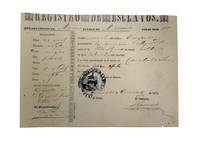
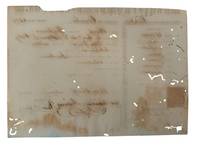
1871réf. 237971871. Puerto Rican slave registration document from 1871 recording the legal identity ownership agricultural occupation and physical classification of Eleuterio a twenty six year old enslaved man in Arecibo during the final years of slavery under Spanish colonial rule. Issued after Spain's 1870 Moret Law had initiated a limited process of emancipation but nearly two years before abolition in Puerto Rico the cédula placed Eleuterio within a registration system designed to record enslaved people by name family relations occupation owner residence and identifying physical characteristics. His classification as "mulato" his occupation as "labrador" and his ownership by the succession of D. Manuel Ortiz place racial designation agricultural labor and property status together within the administrative machinery of colonial slavery. Registro de Esclavos Isla de Puerto Rico. Arecibo Puerto Rico May 15 1871. Single printed and manuscript cédula folio no. 1740. The document identifies "Eleuterio" as an enslaved man "propiedad de la Sucn. de D. Manuel Ortiz" twenty six years old a native of Puerto Rico single and "de oficio labrador." He is recorded as "no está coartado" and as residing in the barrio of Santana with his mother identified as "Valentina." The printed "Filiacion" column subjects his body to a standardized identifying description: tall stature "Color mulato" sparse hair sparse beard black eyes a regular nose and a further description of the mouth partially affected by loss. The lower portion carries the signatures or attestations of the "Registrador" "El dueño" and "El Comisario" with the owner's portion apparently signed on behalf of the succession by Francisco Aguirre. A one peseta fiscal stamp appears at lower left beneath the physical description. The verso bears manuscript docketing and staining associated with subsequent administrative handling. Eleuterio's cédula was produced within a rapidly changing legal regime. The Moret Law of 1870 granted freedom to specified categories of enslaved people including those aged sixty and older those belonging to the state and children born after September 17 1868 while leaving many others including a twenty five six old agricultural laborer such as Eleuterio legally enslaved. His notation as "no está coartado" further records that he had not entered the system of coartación through which an enslaved person could make payments toward self purchase. On March 22 1873 the Spanish National Assembly abolished slavery in Puerto Rico compensating former enslavers while requiring the emancipated population to enter labor contracts for an additional three years. Moderate toning and staining scattered wormholes with small losses affecting several manuscript entries loss along the upper edge affecting part of the printed heading and additional minor edge losses; principal manuscript information and signatures remain legible. Overall good condition. An individually named record of the administrative system that converted Eleuterio's race body family relationship agricultural labor residence and legal ownership into the identifying data of slavery less than two years before abolition in Puerto Rico. unknown
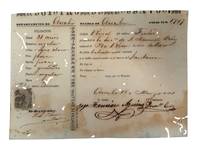
1872réf. 237961872. Puerto Rican slave registration document from January 1872 recording the legal status ownership labor residence parentage and physical identification of Eugenio a twenty year old enslaved Black man in Arecibo during the final fourteen months of slavery on the island. The cédula was issued within the registration system expanded following the Moret Law of 1870 which freed specified categories of enslaved people while leaving young adults such as Eugenio in bondage and led to the preparation of Puerto Rico's central slave register. Surviving 1872 schedules record the same categories present here including name origin residence parents marital status occupation age physical description and enslaver. Registro de Esclavos Isla de Puerto Rico. Arecibo Puerto Rico January 20 1872. Single printed and manuscript slave registration cédula folio no. 119. The document identifies "Eugenio" as twenty years old "Color negro" single and employed "de oficio labrador" placing agricultural labor directly within his official identification. He is recorded as a native of Puerto Rico and registered in the barrio of Cambalache. His ownership entry appears to read "propiedad de la sucesión ." indicating ownership by an estate or succession although the following name is difficult to establish confidently from the manuscript hand. The "Filiacion" column records his stature as "regular" black hair sparse beard brown eyes a regular nose and additional identifying information; under "Señas particulares" a manuscript notation appears to record a defect involving the right foot though the exact wording is partially unclear. The document carries the signatures or attestations of the "Registrador" and "El Comisario" together with a fiscal stamp heavily cancelled by an official circular handstamp. The verso bears additional official stamps and manuscript markings associated with the document's administrative use. Eugenio was registered at a moment when Spanish policy had begun dismantling slavery selectively while continuing to document and regulate those excluded from immediate freedom. The Moret Law granted freedom to people over sixty enslaved people belonging to the state and children born after September 17 1868; at twenty Eugenio fell outside its principal age based provisions. Puerto Rico's surviving 1872 Registro Central de Esclavos is preserved in eight rolls of National Archives microfilm and comparable original Arecibo cédulas survive institutionally including a January 1872 folio at the University of Florida that likewise records an enslaved man's age physical description ownership and official signatures. On March 22 1873 slavery was abolished in Puerto Rico terminating the legal status under which Eugenio had been entered on this form. Light toning and spotting several small wormholes and minor edge losses; stamps printed text and principal manuscript entries remain legible. Overall good condition. An individually named record of how Spanish colonial authorities reduced Eugenio's legal status agricultural occupation ancestry residence and bodily characteristics to standardized identifying data during Puerto Rico's final full year of slavery. unknown
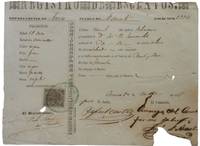
1871réf. 237101871. Slavery Black Labor Puerto Rico This official Puerto Rican slave registry document issued in Manatí in 1871 under Spanish colonial administration represents the bureaucratic infrastructure of slavery in the Caribbean at the precise moment preceding abolition. Titled within the printed form as part of the "Registro de Esclavos - Isla de Puerto Rico" the document records the forced legal identity of an identified enslaved man. Single sheet slave registry document "Empadronamiento General de esclavos" from Manatí Puerto Rico dated 20 de Mayo de 1871. Measuring 6.25" x 8.5". This document was registered by "Don Manuel María Monserrate" for the enslaved person "Feliciano." Document bears official signatures from the local authorities. The enslaved person is listed by their age stature "color" hair color beard eyes nose and mouth. The person is listed as 18 years old and the "color" of this individual is listed as "negro". The physical list of classifications functioned as mechanisms of surveillance control and verification within the colonial slave system. Inclusion of official signatures from both the "dueño" and "comisario" along with a stamped fiscal seal en verso. Produced just under two years prior to the 1873 abolition of slavery in Puerto Rico the document reflects the transitional legal environment in which enslaved individuals were increasingly catalogued in anticipation of emancipation policies that would in practice impose systems of forced apprenticeship and indemnification to former enslavers. Tape was previously applied to the bottom right of the document; some minor wormholes and occasional spotting. Overall good condition. The document stands as evidence of how emancipation in Spanish territories was mediated through administrative control prolonging coercive labor conditions even as slavery was formally dismantled. unknown books
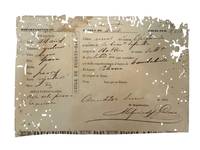
1873réf. 238001873. Puerto Rican slave registration document from January 1873 recording the legal identity ownership agricultural occupation parentage and physical classification of Epifanio a forty four year old enslaved Black man in Arecibo less than three months before slavery was abolished in Puerto Rico. Issued after Spain's 1870 Moret Law had initiated a limited process of emancipation but before the abolition law of March 22 1873 the cédula placed Epifanio within a registration system designed to record enslaved people by name family relations occupation owner residence civil status and identifying physical characteristics. The January 20 date makes the document especially closely situated to abolition recording Epifanio as legally enslaved only weeks before the Spanish National Assembly dismantled the legal institution under which the certificate had been issued. Registro de Esclavos Isla de Puerto Rico. Arecibo Puerto Rico January 20 1873. Single printed and manuscript cédula folio no. 7215. The document identifies "Epifanio" as an enslaved man "propiedad de la Sucn. Tafarella" forty four years old a native of Puerto Rico single and "de oficio labrador." He is recorded as "no está coartado" and as registered in the barrio of Cambalache with his mother identified as "Petrona." The printed "Filiacion" column subjects his body to a standardized identifying description: regular stature "Color negro" sparse hair sparse beard brown eyes and a regular nose. Under "Señas particulares" the manuscript records "Cojo de la pierna izquierda" identifying him as lame in the left leg and incorporating a physical disability into the identifying data maintained by the slave registry. The lower portion differs from the earlier 1871 forms in carrying a prominent signature beneath "El Registrador" while extensive insect damage has removed portions of the printed heading and margins. The verso bears manuscript offsetting and additional evidence of administrative handling. Epifanio's cédula was produced at the endpoint of Puerto Rico's rapidly changing legal regime. The Moret Law of 1870 had granted freedom to specified categories of enslaved people including those aged sixty and older those belonging to the state and children born after September 17 1868 while leaving a forty four year old man such as Epifanio legally enslaved. His notation as "no está coartado" further records that he had not entered coartación the mechanism through which an enslaved person could make payments toward self purchase. His recorded occupation as "labrador" placed him within Puerto Rico's agricultural labor economy while "Cojo de la pierna izquierda" shows how the registry extended beyond racial and occupational classification to bodily characteristics capable of distinguishing one enslaved person from another. On March 22 1873 only about two months after this cédula was dated the Spanish National Assembly abolished slavery in Puerto Rico compensating former enslavers while requiring the emancipated population to enter labor contracts for an additional three years. Extensive insect damage with numerous wormholes and substantial losses along the upper and side margins affecting portions of the printed heading and several fields; moderate toning and staining with principal manuscript entries and the registrar's signature remaining legible. Overall fair condition. An individually named record of the administrative system that converted Epifanio's race body physical disability agricultural labor parentage residence and legal ownership into the identifying data of slavery during the final months before abolition in Puerto Rico. unknown books
1871réf. 237981871. Puerto Rican slave registration document from 1871 recording the legal identity ownership agricultural occupation and physical classification of a named thirty one year old enslaved man in Arecibo during the final years of slavery under Spanish colonial rule. Issued after Spain's 1870 Moret Law had initiated a limited process of emancipation but nearly two years before abolition in Puerto Rico the cédula placed Fruto within a registration system designed to record enslaved people by name occupation owner residence civil status and identifying physical characteristics. His classification as "negro claro" his occupation as "labrador" and his ownership by the succession of D. Manuel Ortiz place racial designation agricultural labor and property status together within the administrative machinery of colonial slavery. Registro de Esclavos Isla de Puerto Rico. Arecibo Puerto Rico March 15 1871. Single printed and manuscript cédula folio no. 1747. The document identifies this enslaved man "propiedad de la Sucn. de D. Manuel Ortiz" thirty one years old a native of Puerto Rico single and "de oficio labrador." He is recorded as "no está coartado" and as residing in the barrio of Santana. The fields for parents spouse and children are left blank. The printed "Filiacion" column subjects his body to a standardized identifying description: regular stature "Color negro claro" sparse hair sparse beard large eyes a regular nose and a further description of the mouth partially obscured by worming. A one peseta fiscal stamp at lower left is cancelled by an official marking. The lower portion carries the signatures or attestations of the "Registrador" "El dueño" and "El Comisario" with the owner's portion apparently signed on behalf of the succession by Francisco Aguirre. The verso bears ink offsetting and staining associated with subsequent administrative handling. This man's cédula was produced within a rapidly changing legal regime. The Moret Law of 1870 granted freedom to specified categories of enslaved people including those aged sixty and older those belonging to the state and children born after September 17 1868 while leaving many others including a thirty one year old agricultural laborer such as this individual legally enslaved. His notation as "no está coartado" further records that he had not entered coartación the mechanism through which an enslaved person could purchase freedom incrementally. The document's ownership by the "Sucn. de D. Manuel Ortiz" also records the treatment of an enslaved person as property within an estate with his legal ownership continuing through the succession rather than ending with the death of the named enslaver. On March 22 1873 the Spanish National Assembly abolished slavery in Puerto Rico compensating former enslavers while requiring the emancipated population to enter labor contracts for an additional three years. Moderate toning and staining scattered wormholes with small losses affecting several manuscript entries minor edge losses and a larger loss at the lower right edge; principal manuscript information and signatures remain legible. Overall good condition. An individually named record of the administrative system that converted this individuals race body agricultural labor residence civil status and legal ownership into the identifying data of slavery less than two years before abolition in Puerto Rico. unknown books
1871réf. 237971871. Puerto Rican slave registration document from 1871 recording the legal identity ownership agricultural occupation and physical classification of Eleuterio a twenty six year old enslaved man in Arecibo during the final years of slavery under Spanish colonial rule. Issued after Spain's 1870 Moret Law had initiated a limited process of emancipation but nearly two years before abolition in Puerto Rico the cédula placed Eleuterio within a registration system designed to record enslaved people by name family relations occupation owner residence and identifying physical characteristics. His classification as "mulato" his occupation as "labrador" and his ownership by the succession of D. Manuel Ortiz place racial designation agricultural labor and property status together within the administrative machinery of colonial slavery. Registro de Esclavos Isla de Puerto Rico. Arecibo Puerto Rico May 15 1871. Single printed and manuscript cédula folio no. 1740. The document identifies "Eleuterio" as an enslaved man "propiedad de la Sucn. de D. Manuel Ortiz" twenty six years old a native of Puerto Rico single and "de oficio labrador." He is recorded as "no está coartado" and as residing in the barrio of Santana with his mother identified as "Valentina." The printed "Filiacion" column subjects his body to a standardized identifying description: tall stature "Color mulato" sparse hair sparse beard black eyes a regular nose and a further description of the mouth partially affected by loss. The lower portion carries the signatures or attestations of the "Registrador" "El dueño" and "El Comisario" with the owner's portion apparently signed on behalf of the succession by Francisco Aguirre. A one peseta fiscal stamp appears at lower left beneath the physical description. The verso bears manuscript docketing and staining associated with subsequent administrative handling. Eleuterio's cédula was produced within a rapidly changing legal regime. The Moret Law of 1870 granted freedom to specified categories of enslaved people including those aged sixty and older those belonging to the state and children born after September 17 1868 while leaving many others including a twenty five six old agricultural laborer such as Eleuterio legally enslaved. His notation as "no está coartado" further records that he had not entered the system of coartación through which an enslaved person could make payments toward self purchase. On March 22 1873 the Spanish National Assembly abolished slavery in Puerto Rico compensating former enslavers while requiring the emancipated population to enter labor contracts for an additional three years. Moderate toning and staining scattered wormholes with small losses affecting several manuscript entries loss along the upper edge affecting part of the printed heading and additional minor edge losses; principal manuscript information and signatures remain legible. Overall good condition. An individually named record of the administrative system that converted Eleuterio's race body family relationship agricultural labor residence and legal ownership into the identifying data of slavery less than two years before abolition in Puerto Rico. unknown books
1872réf. 237961872. Puerto Rican slave registration document from January 1872 recording the legal status ownership labor residence parentage and physical identification of Eugenio a twenty year old enslaved Black man in Arecibo during the final fourteen months of slavery on the island. The cédula was issued within the registration system expanded following the Moret Law of 1870 which freed specified categories of enslaved people while leaving young adults such as Eugenio in bondage and led to the preparation of Puerto Rico's central slave register. Surviving 1872 schedules record the same categories present here including name origin residence parents marital status occupation age physical description and enslaver. Registro de Esclavos Isla de Puerto Rico. Arecibo Puerto Rico January 20 1872. Single printed and manuscript slave registration cédula folio no. 119. The document identifies "Eugenio" as twenty years old "Color negro" single and employed "de oficio labrador" placing agricultural labor directly within his official identification. He is recorded as a native of Puerto Rico and registered in the barrio of Cambalache. His ownership entry appears to read "propiedad de la sucesión ." indicating ownership by an estate or succession although the following name is difficult to establish confidently from the manuscript hand. The "Filiacion" column records his stature as "regular" black hair sparse beard brown eyes a regular nose and additional identifying information; under "Señas particulares" a manuscript notation appears to record a defect involving the right foot though the exact wording is partially unclear. The document carries the signatures or attestations of the "Registrador" and "El Comisario" together with a fiscal stamp heavily cancelled by an official circular handstamp. The verso bears additional official stamps and manuscript markings associated with the document's administrative use. Eugenio was registered at a moment when Spanish policy had begun dismantling slavery selectively while continuing to document and regulate those excluded from immediate freedom. The Moret Law granted freedom to people over sixty enslaved people belonging to the state and children born after September 17 1868; at twenty Eugenio fell outside its principal age based provisions. Puerto Rico's surviving 1872 Registro Central de Esclavos is preserved in eight rolls of National Archives microfilm and comparable original Arecibo cédulas survive institutionally including a January 1872 folio at the University of Florida that likewise records an enslaved man's age physical description ownership and official signatures. On March 22 1873 slavery was abolished in Puerto Rico terminating the legal status under which Eugenio had been entered on this form. Light toning and spotting several small wormholes and minor edge losses; stamps printed text and principal manuscript entries remain legible. Overall good condition. An individually named record of how Spanish colonial authorities reduced Eugenio's legal status agricultural occupation ancestry residence and bodily characteristics to standardized identifying data during Puerto Rico's final full year of slavery. unknown books
1778réf. 36094Colmar Jean-Henri Decker, Imprimeur du Roi & de Nosseigneurs du Conseil Souverain d'Alsace [1778] in-4 dérelié
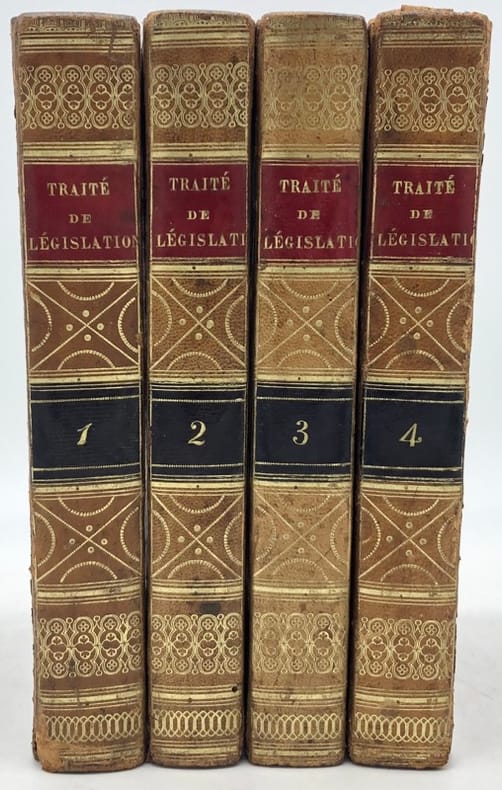
réf. 170358Paris, A. Sautelet, 1826-1827 4 vol. in-8, XIV-527, [4]-478, [4]-492 et [4]-538 pp., basane fauve marbrée, dos lisses ornés alternativement de motifs à la cathédrale et de croisillons de pointillés dorés, pièces de titre et de tomaison cerise et noires, encadrement de simple filet à froid sur les plats, simple filet doré sur les coupes, tranches marbrées (reliure de l'époque). Accroc à un mors inférieur, rousseurs parfois abondantes, mais bel exemplaire.
1790réf. 10775A Paris, chez Demonville, 1790. 2 parties en 1 vol. In-8 de (4)-166 pp. 1 f. blanc 141 pp., demi-toile bleue, couverture imprimée conservée, non rogné (reliure du XIXe siècle).
1730réf. PHO-1965Paris, Saugrain, 1730.4 vol. in-12 de I. xxiv-[2]-381 pp., 14 pl. ; II. [4]-364 pp. 11 pl. ; III. [4]-350 pp., 4 pl.; IV. [4] pp., pp. 345-682, [36] pp., 1 pl., veau brun époque, dos usés avec manque, 1 carte volante, 1 carte avec déchirure sans manque. De la bibliothèque de Sir William Geary, 2nd baronnet (1756 –1825) homme politique conservateur anglais avec son ex-libris
1780A Genêve, Chez Jean Leonard Pellet 1780, imprimeur de la Ville et de l'Académie. 10 volumes In-8 plein veau brun. Dos lisses très ornés à motifs dorés,pièces de titres vertes et de tomaison rouges, tranches marbrées, gardes de papier marbré, triples filets dorés en encadrement sur les plats, filet doré sur les coupes. Bien complet des gravures en frontispice à chaque volume dont le portrait de Raynal dessiné par Cochin, gravé par De Launay. Table des matières en-tête de chaque volume et table alphabétique en fin de chaque. XVI + 532,VIII + 582, VII + 580, VIII + 472, VII + 405, VII + 484, XVI + 558, VIII + 547, VIII + 412, VI + 538 pages. Complet des tableaux dépliants. Coiffe du tome 10 très légérement arasée sans aucune gravité et léger manque de papier en marge de la dernière page (table alphabétique) du tome 8 avec petite perte de texte. Intérieur des volumes en très bel état. Titres des gravures : Portrait de Raynal (Cochin) - Les Anglais demandent pardon à Aurengzeb qu'ils ont offensé (Moreau le Jeune) - Les Espagnols se rendent maîtres de Montezuma dans Mexico même (Moreau le Jeune) - François Pizarre assassiné par une troupe de Conjurés (Moreau le Jeune) - Voilà les tributs que paye le Roi de Portugal (Moreau le Jeune) - Ouragan aux Antilles (Moreau le Jeune) - Un Anglais de la Barbade vend sa maitresse (Moreau le Jeune) - Bienfaisance d'une famille sauvage du Canada envers des Français (Moreau le Jeune) - Penn achète des sauvages le pays qu'il veut occuper (Moreau le Jeune) - Esclaves conduits par des marchands (Moreau le Jeune). Bel exemplaire.
réf. 242994Paris, Pagnerre, 1845 in-8, 256 pp., dérelié.
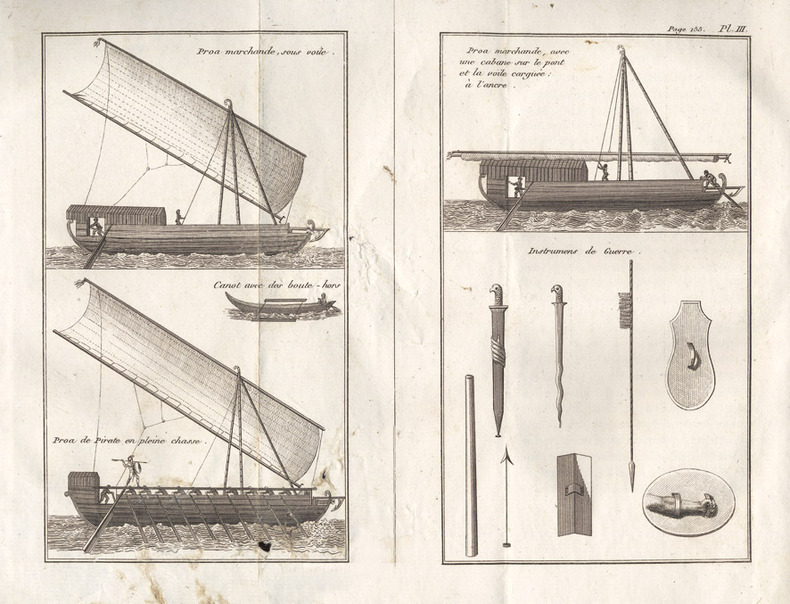
1805réf. 17636Paris, Buisson (imprimerie Jeunehomme), an XIV-1805 ; in-8, broché ; (4), 322 pp. , portrait en frontispice, planche dépliante représentant 3 proas, bateau indigène et des armes et 2 cartes dépliantes, couverture souple bleu uni.
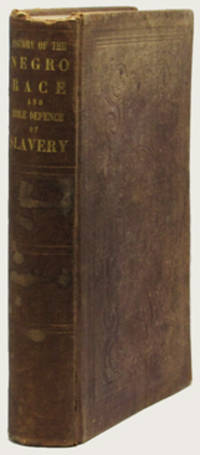
1852réf. 34901Glasgow Kentucky: W.S. Brown 1852. Early edition being a reprint of the 1851 Louisville edition. Each page printed within a decorative chain-line frame the stereotyped title-page makes reference to engravings but none are called for in this edition. Tall 8vo in the publisher's original brown cloth the covers with decorative embossing retaining the emblem of the Louisville publishers in blind the spine lettered in gilt and with flat bands ruled in blind powder-blue endpapers. xiii 569 8 8 ads pp. A sound copy the text-block well preserved and complete a bit of expected age toning to the paper and light foxing here and there as usual the binding with some age-wear but still very sturdy strong and tight. ONE OF THE MOST NOTORIOUS PRO-SLAVERY BOOKS PUBLISHED IN THE UNITED STATES BEFORE THE CIVIL WAR. The author stylized himself as "the Rev. Josiah Priest" but was not ordained in any denomination. The present Louisville text evolved from an earlier version titled "Slavery As It Relates to the Negro or African Race" published in 1843. It went through numerous editions and title changes during the 1840s and 1850s reflecting the growing sectional controversy over slavery. The popularity of the work exploded in 1852 as it was viewed as a counter-argument to Stowe's pro-abolitionist epic UNCLE TOM'S CABIN. The work's central claim is that slavery is fully sanctioned and approved of by the Bible. Among his arguments are: people of African descent were descendants of Ham and therefore subject to a divine curse; the racial differences were ordained by God; that slavery was beneficial or natural for Black people; and that abolitionism was a dangerous fanaticism threatening the social order and status quo. Although repugnant to many modern readers the book is historically significant because it demonstrates how slavery's defenders tried to answer the growing abolitionist movement. The title also accurately states that the issue of slavery was going to divide the Republic thus predicting the Civil War. W.S. Brown hardcover
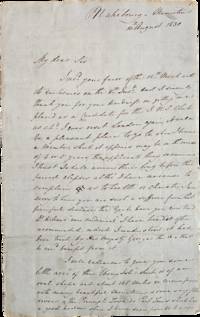
1830réf. List2931Mahébourg Mauritius 1830. Single unsigned fourteen-page letter measuring 8 x 12 ¾ inches. Folded with some stains and pencil marks. Overall near fine. In 1830 Mauritius was a British colony captured from the French in 1810 during the Napoleonic Wars. It was originally a Dutch colony and the Dutch had introduced enslaved labor to the islands. Enslaved people were imported from Madagascar India and Southeast Asia to harvest the valuable ebony trees and later to farm sugarcane. It became a French colony in 1715 and among other provisions the French government awarded upper-class colonists large land grants each with twenty enslaved people to work them. Slavery was abolished in 1835 under British rule after which the planters still farming sugarcane turned to indentured servant labor from India and China alongside illegal slavery.1 Offered here is a lengthy single letter written by an unknown author to an unknown recipient from Mahébourg in 1830 shortly before this radical change. The letter describes the lives and economic circumstances of the planters and merchants and of the non-white population particularly Malabar people and free and enslaved Black people. Noting that “every inch of ground that will produce sugar cane is planted with it” including “the former fine gardens to some of the Habitations” the author reports on the situation for sugar planters: “The price of sugar here is not more than 20/per Cwt. for the best quality which does not now remunerate the Planter as his expenses are becoming every day more heavy in consequence of their slaves diminishing . The want of Slaves induced many of the Planters to send for Chinese Labourers and several hundreds were imported at a great expense but unfortunately they did not answer and were obliged to be reshipped for their native Country again at the charge of those who sent for them.” The author later notes that “nearly everyone of the Planters have heavy mortgages on their Estates and are obliged to pay this immense Interest which keeps them poor and will I fear ultimately ruin them”. In fact the planters in British Mauritius had extra duties on their sugar exports compared with their Caribbean counterparts. The shopkeepers on the other hand “calculate on retiring with a fortune in five years– therefore you will fancy what must be their prices also their profits.” Though writing from Mahébourg the author describes the capital city of Port Louis at length especially its Malabar Indian and free Black residents—the lives of the latter particularly the free Black women seem especially grim. They write: “The Centre of Port Louis is inhabited by all the respectable people and many most excellent houses buildings– the Catholic Chapel the English Church amongst the number. The Suburbs to the West is the part occupied by about 3000 Malabars called ‘Malabar Town.’ – They are dressed mostly in white with Turbans ear rings c c and the females with ornaments in their noses and on their Toes as they generally go bare foot. – Once a year they have what is called a ‘Yamsee’ or a festival in honor of Mehomet which lasts for about a fortnight during which time they seem to get no sleep a continual beating of tom toms – jingling of bells – carrying pagodas which are made of various coloured paper and most richly ornamented followed by all the population of their Caste with their faces daubed with red white c and which has a most ludicrous appearance. The Suburbs to the South is called ‘black Camp’ – the Houses being very small and poor and inhabited by all the free blacks as well as many Mulattoes. – Also a certain class of females of the population of colour – who are visited immediately on the Arrival of a Ship the Crews soon enquiring the way to the ‘Camp.’” As regards relations between the races the author recounts an incident that followed the 1828 abolition of the color bar which would ostensibly give the free non-white population the same rights as the whites: “The Theatre is a very good one but has been closed for several months past the Actors Actresses gone to Bourbon in consequence of the promulgation of the act ‘causing all free people of the population of Colour’ to have the same laws – the same privileges as the Whites’ fearing they ought come to the Theatre which they had hitherto been forbidden thereby cause disturbances as the French Whites detest them wd. not sit in the same box it was considered best to shut the Theatre which is a great loss to the Place it being the chief public amusement and indeed the only one we have here.” Overall a detailed letter giving insight into life in a slave colony at a time when significant changes were on the horizon. Of interest to scholars of the colonial history of Mauritius and the second wave of British colonialism. 1 Truth and Justice Commission Report of the Truth and Justice Commission Vol. 1 Mauritius: Government Printing 2011. unknown
1830réf. List2931Mahébourg Mauritius 1830. Single unsigned fourteen-page letter measuring 8 x 12 ¾ inches. Folded with some stains and pencil marks. Overall near fine. In 1830 Mauritius was a British colony captured from the French in 1810 during the Napoleonic Wars. It was originally a Dutch colony and the Dutch had introduced enslaved labor to the islands. Enslaved people were imported from Madagascar India and Southeast Asia to harvest the valuable ebony trees and later to farm sugarcane. It became a French colony in 1715 and among other provisions the French government awarded upper-class colonists large land grants each with twenty enslaved people to work them. Slavery was abolished in 1835 under British rule after which the planters still farming sugarcane turned to indentured servant labor from India and China alongside illegal slavery.1 Offered here is a lengthy single letter written by an unknown author to an unknown recipient from Mahébourg in 1830 shortly before this radical change. The letter describes the lives and economic circumstances of the planters and merchants and of the non-white population particularly Malabar people and free and enslaved Black people. Noting that “every inch of ground that will produce sugar cane is planted with it” including “the former fine gardens to some of the Habitations” the author reports on the situation for sugar planters: “The price of sugar here is not more than 20/per Cwt. for the best quality which does not now remunerate the Planter as his expenses are becoming every day more heavy in consequence of their slaves diminishing . The want of Slaves induced many of the Planters to send for Chinese Labourers and several hundreds were imported at a great expense but unfortunately they did not answer and were obliged to be reshipped for their native Country again at the charge of those who sent for them.” The author later notes that “nearly everyone of the Planters have heavy mortgages on their Estates and are obliged to pay this immense Interest which keeps them poor and will I fear ultimately ruin them”. In fact the planters in British Mauritius had extra duties on their sugar exports compared with their Caribbean counterparts. The shopkeepers on the other hand “calculate on retiring with a fortune in five years– therefore you will fancy what must be their prices also their profits.” Though writing from Mahébourg the author describes the capital city of Port Louis at length especially its Malabar Indian and free Black residents—the lives of the latter particularly the free Black women seem especially grim. They write: “The Centre of Port Louis is inhabited by all the respectable people and many most excellent houses buildings– the Catholic Chapel the English Church amongst the number. The Suburbs to the West is the part occupied by about 3000 Malabars called ‘Malabar Town.’ – They are dressed mostly in white with Turbans ear rings c c and the females with ornaments in their noses and on their Toes as they generally go bare foot. – Once a year they have what is called a ‘Yamsee’ or a festival in honor of Mehomet which lasts for about a fortnight during which time they seem to get no sleep a continual beating of tom toms – jingling of bells – carrying pagodas which are made of various coloured paper and most richly ornamented followed by all the population of their Caste with their faces daubed with red white c and which has a most ludicrous appearance. The Suburbs to the South is called ‘black Camp’ – the Houses being very small and poor and inhabited by all the free blacks as well as many Mulattoes. – Also a certain class of females of the population of colour – who are visited immediately on the Arrival of a Ship the Crews soon enquiring the way to the ‘Camp.’” As regards relations between the races the author recounts an incident that followed the 1828 abolition of the color bar which would ostensibly give the free non-white population the same rights as the whites: “The Theatre is a very good one but has been closed for several months past the Actors Actresses gone to Bourbon in consequence of the promulgation of the act ‘causing all free people of the population of Colour’ to have the same laws – the same privileges as the Whites’ fearing they ought come to the Theatre which they had hitherto been forbidden thereby cause disturbances as the French Whites detest them wd. not sit in the same box it was considered best to shut the Theatre which is a great loss to the Place it being the chief public amusement and indeed the only one we have here.” Overall a detailed letter giving insight into life in a slave colony at a time when significant changes were on the horizon. Of interest to scholars of the colonial history of Mauritius and the second wave of British colonialism. 1 Truth and Justice Commission Report of the Truth and Justice Commission Vol. 1 Mauritius: Government Printing 2011. unknown books
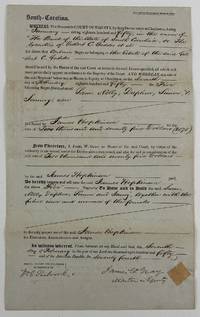
1850réf. 12963Charleston SC: Printed by Walker & Burke February 7 1850. Partially-printed document completed in manuscript 13 x 8 inches. Old folds minor toning and offsetting. Very good. A very rare pre-printed form from antebellum South Carolina designed specifically for documenting the sale of slaves in Charleston in the mid-19th century. The document emanates from the Court of Equity and directs the estate of Gilbert C. Geddes to sell five named slaves to James Hopkinson for $2075. The names of the slaves are Sam Nelly Daphne Simon and Jenny. The document is signed by James W. Gray Master in Equity in the case of "Bank of the State of South Carolina vs. the Executrix of Gilbert C. Geddes et al" and by William E. Seabrook as witness. Gray adds a particularly insidious note near the bottom of the document when he writes that Hopkinson is entitled to "have and hold" the aforementioned five slaves "together with the future issue and increase of the females." Geddes 1806-1848 a wealthy Charleston resident owned more than a hundred enslaved people when he died; his father John Geddes served as governor of South Carolina 1818-1820. This is the first example of this document we have seen and a unique record of the transference of five slaves and particularly interesting for granting the new slaveowner the rights to future slave children. Printed by Walker & Burke, February 7 unknown
1850réf. 12963Charleston SC: Printed by Walker & Burke February 7 1850. Partially-printed document completed in manuscript 13 x 8 inches. Old folds minor toning and offsetting. Very good. A very rare pre-printed form from antebellum South Carolina designed specifically for documenting the sale of slaves in Charleston in the mid-19th century. The document emanates from the Court of Equity and directs the estate of Gilbert C. Geddes to sell five named slaves to James Hopkinson for $2075. The names of the slaves are Sam Nelly Daphne Simon and Jenny. The document is signed by James W. Gray Master in Equity in the case of "Bank of the State of South Carolina vs. the Executrix of Gilbert C. Geddes et al" and by William E. Seabrook as witness. Gray adds a particularly insidious note near the bottom of the document when he writes that Hopkinson is entitled to "have and hold" the aforementioned five slaves "together with the future issue and increase of the females." Geddes 1806-1848 a wealthy Charleston resident owned more than a hundred enslaved people when he died; his father John Geddes served as governor of South Carolina 1818-1820. This is the first example of this document we have seen and a unique record of the transference of five slaves and particularly interesting for granting the new slaveowner the rights to future slave children. Printed by Walker & Burke, February 7 unknown books
1852réf. 100540Letterpress braodsheet 10 3/4 x 6 1/4 text on both sides. Margins trimmed on both sides a little uneven on the left side close to words on reverse but not affecting text a few small stains in text. Indiana was for many years a site of refuge for escaping slaves. With this joint resolution the document declares that the only real way to do away with the injustice of slavery was to advocate emigration and colonialization of Africa.
1852réf. 100540Letterpress braodsheet 10 3/4 x 6 1/4 text on both sides. Margins trimmed on both sides a little uneven on the left side close to words on reverse but not affecting text a few small stains in text. Indiana was for many years a site of refuge for escaping slaves. With this joint resolution the document declares that the only real way to do away with the injustice of slavery was to advocate emigration and colonialization of Africa. books
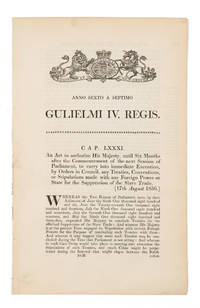
1836réf. 750641836. London: George Eyre and Andrew Spottiswoode 1836. London: George Eyre and Andrew Spottiswoode 1836. Payouts for Former British Enslavers Slavery. Great Britain. William IV 1765-1837 King of Great Britain. An Act for Carrying into Further Execution Two Acts of His Present Majesty Relating to the Compensation for Slaves Upon the Abolition of Slavery And for Facilitating the Distribution and Payment of Such Compensation. London: Printed by George Eyre and Andrew Spottiswoode 1836. 17-24 pp. Folio 11-3/4" x 7-1/2". With William IV King of Great Britain. An Act to Authorize His Majesty Until Six Months After the Commencement of the Next Session of Parliament To Carry into Immediate Execution By Orders in Council Any Treaties Conventions Or Stipulations Made with Any Foreign Power or State for the Suppression of the Slave Trade. London: Printed by George Eyre and Andrew Spottiswoode 1836. 873-876 pp. Folio 11-3/4" x 7-1/2". Disbound stab-stitched pamphlets. Light toning light foxing and soiling to a few leaves small holes to gutter of first two leaves of first act which are detached no loss to text. $950. Two acts dealing with the aftermath of the abolition of slavery in the United Kingdom. After the passage of the Slavery Abolition Act in 1833 all enslaved people in British colonies below the age of six were freed and others were redesignated as apprentices and gradually manumitted. One of the act's central provisions was a 20 million payout for "the persons hitherto entitled to the Services of such Slaves." The present act elaborates further on the logistics of the payout including the process by which former enslavers could claim "compensation" for their "great Inconvenience and Loss." The other act authorizes the king to negotiate treaties related to the end of the slave trade without Parliament when Parliament is not in session. unknown
1836réf. 750641836. London: George Eyre and Andrew Spottiswoode 1836. London: George Eyre and Andrew Spottiswoode 1836. Payouts for Former British Enslavers Slavery. Great Britain. William IV 1765-1837 King of Great Britain. An Act for Carrying into Further Execution Two Acts of His Present Majesty Relating to the Compensation for Slaves Upon the Abolition of Slavery And for Facilitating the Distribution and Payment of Such Compensation. London: Printed by George Eyre and Andrew Spottiswoode 1836. 17-24 pp. Folio 11-3/4" x 7-1/2". With William IV King of Great Britain. An Act to Authorize His Majesty Until Six Months After the Commencement of the Next Session of Parliament To Carry into Immediate Execution By Orders in Council Any Treaties Conventions Or Stipulations Made with Any Foreign Power or State for the Suppression of the Slave Trade. London: Printed by George Eyre and Andrew Spottiswoode 1836. 873-876 pp. Folio 11-3/4" x 7-1/2". Disbound stab-stitched pamphlets. Light toning light foxing and soiling to a few leaves small holes to gutter of first two leaves of first act which are detached no loss to text. $950. Two acts dealing with the aftermath of the abolition of slavery in the United Kingdom. After the passage of the Slavery Abolition Act in 1833 all enslaved people in British colonies below the age of six were freed and others were redesignated as apprentices and gradually manumitted. One of the act's central provisions was a 20 million payout for "the persons hitherto entitled to the Services of such Slaves." The present act elaborates further on the logistics of the payout including the process by which former enslavers could claim "compensation" for their "great Inconvenience and Loss." The other act authorizes the king to negotiate treaties related to the end of the slave trade without Parliament when Parliament is not in session. unknown books
1789réf. 31479S.l. s.d. [1789] in-8 dérelié
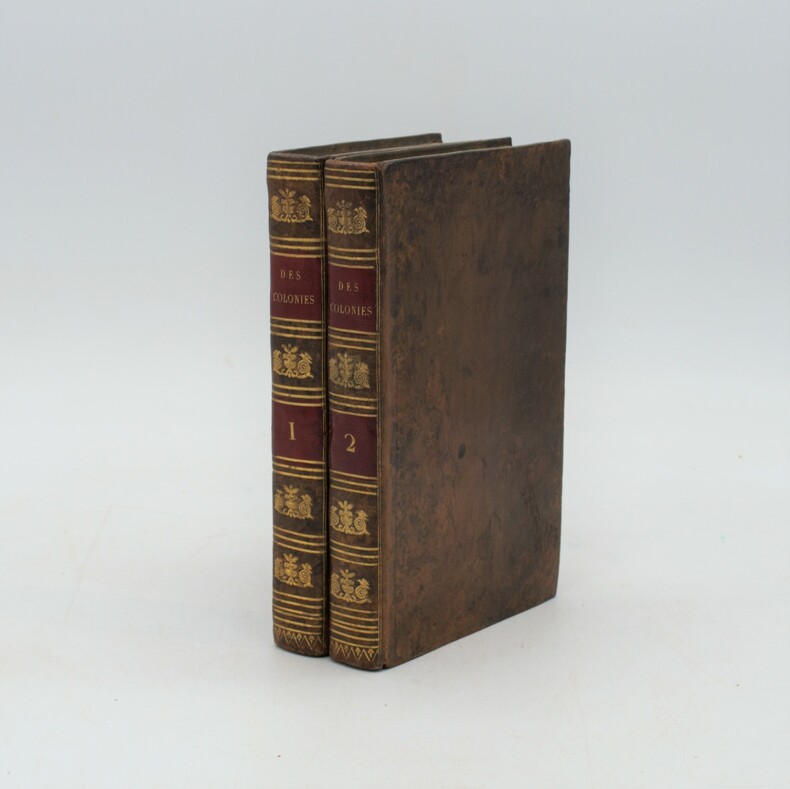
1817réf. PHO-1170Paris, F. Bechet ; A. Égron, février 1817; 2 volumes in-8 ,xxxii,403,[2]; [4],394,[2]pp., relié plein veau raciné époque , dos lisse orné avec pièces de titre et tomaisons rouges, dos lisses. Édition originale.