1838 risultati
rif. M4327P, Emery, 1822 , 2 vols in8br , couverture muette éditeur, cx-409-503pp , 1 portrait frontispice. Langue: Français
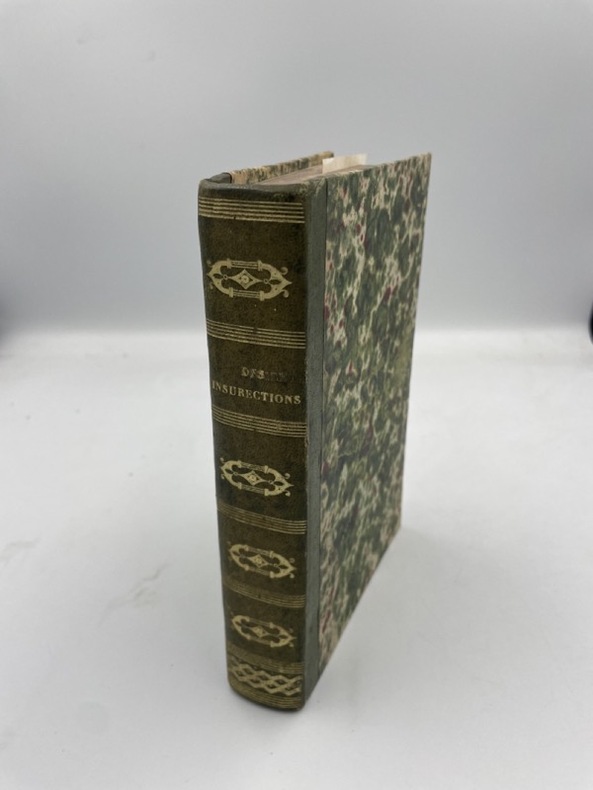
rif. 238672Paris, chez les directeurs de l'Imprimerie du Cercle social, 1793 fort volin-8, 614 pp., 3 pp. [Déclaration de l'auteur de l'ouvrage intitulé, Des Insurrections], demi-veau vert, dos lisse orné de filets, guirlande losangée et larges fleurons dorés, tranches marbrées (reliure de la Restauration). Dos uniformément insolé et passé, petite galerie de vers pp. 59-82, 209-226, 257-274, avec perte de quelques lettres.
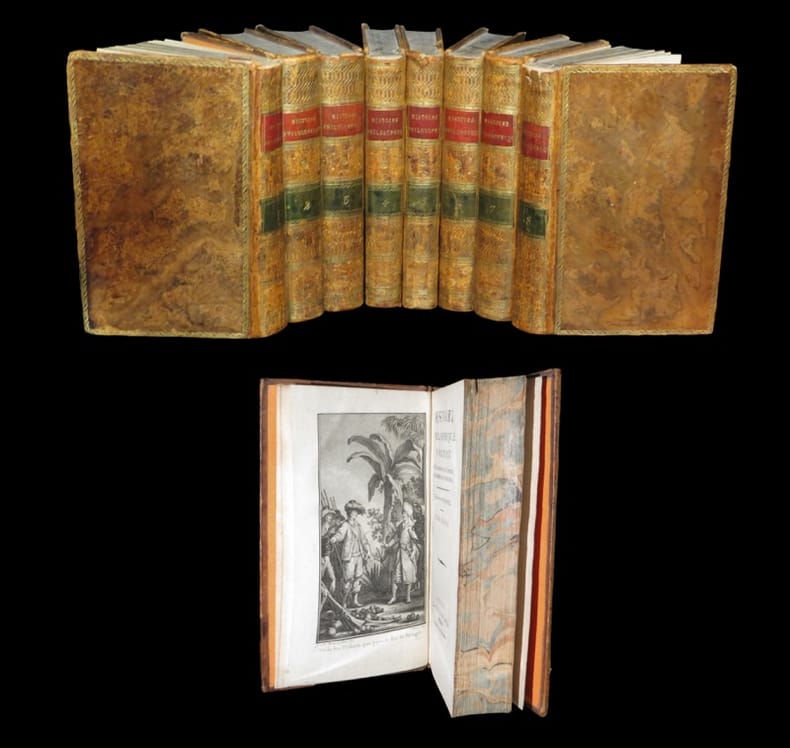
1808rif. 99912953Maradan A Paris, chez Maradan, 1808 - 1809. 8 volumes In-8 relié pleine basane marbrée, dos lisses très ornés. cviii + 400 + 451 + 458 + 568 + 427 + 507 + 487 + 514 pages. Reliures frottées, coins émoussés. Intérieurs en très bon état. Edition originale. Ouvrage contenant d'innombrables articles, entre autres : Sur l'Afrique et l'esclavage, le Mexique, la Turquie, la Syrie, le commerce dans le Levant, la Perse, l'Empire Birman, la Chine, le Tonkin ainsi qu'un très grand nombre de renseignements sur les moeurs et coutumes, les métiers etc. Malgré les défauts signalés bon exemplaire.
rif. 226959Douai, Pierre Bogart, 1635 in-16, titre-frontispice gravé, 264 pp., typographie en petit corps, manquent les pièces liminaires, dont la dédicace ([6] ff. n. ch.), veau brun granité, dos à nerfs cloisonné et fleuronné, tranches rouges (reliure de l'époque). Coins un peu abîmés.
1775rif. 31351A Paris, chez Berry, 3ème année de l'ère Républicaine [1795]. 8 vol. au format in-8 (203 x 130 mm) de 2 ff. n.fol., 1 frontispice gravé n.fol., iv, iv - 500 pp. ; 1 frontispice gravé n.fol. et 548 pp. ; 2 ff. n.fol., 1 frontispice gravé n.fol. et 536 pp. ; 2 ff. n.fol., 1 frontispice gravé n.fol. et 447 pp. ; 2 ff. n.fol., 1 frontispice gravé n.fol. et 383 pp. ; 1 frontispice gravé n.fol. et 456 pp. ; 1 frontispice gravé n.fol. et 531 pp. ; 2 ff. n.fol., 1 frontispice gravé n.fol. et 516 pp. Reliures uniformes de l'époque de plein veau flammé blond, double filet doré et frise dorés encadrant chacun des plats, dos lisses ornés d'un double filet d'encadrement doré, filets gras dorés, doubles filets maigres dorés, entrelacs de filets gras et maigres dorés formant croisillons, fleurons dorés, semis de petits fleurons trapézoïdaux dorés, entrelacs de filets maigres dorés formant chaînettes, pièces de titre de maroquin vieux-rouge, pièces de tomaison de maroquin émeraude, titre doré, tomaison dorée, palette dorée en queue, filet doré sur les coupes, tranches jaspées.
1751rif. PHO-1113A Paris, chez Durand et Pissot, 1751. 2 volumes in-12, X -258 pages ; (2 ff), 313 p. Plein veau raciné époque (Coiffes endommagées, coins, coupes et mors épidermés. Infime galerie de ver n'affectant pas le texte aux pages 57 à 64 du tome I)
rif. 67143aafAmstelodami (Amsterdam), sumptibus Andreae Frisii, 1674, sm. in-8vo, 18 leaves incl. engraved frontispiece title, printed title with printer's mark + 582 pp., illustr. with 28 engraved figures of which 18 full page engravings + 15 folding engraved plates + 19 leaves (Index), light browning in places, marbled endpaper, full calf, red title label on spine, richly gold tooled spine, goldtooled inner dentelle, slight rubbing, red edges. Very Fine copy.
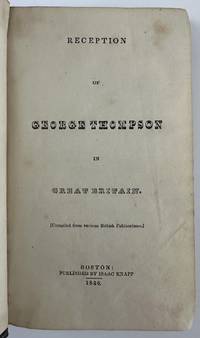
1836rif. 1691Boston: Isaac Knapp 1836. About very good. xvi13-238pp. 12mo. Original publisher's blue boards with black sheep spine gilt. Boards rubbed corners and spine moderately worn. Text lightly foxed. Scarce work addressing the anti-slavery work of George Thompson following his visit to America. Thompson 1804-1878 was British lecturer and reformer who worked as a commercial clerk. "Thompson first came to prominence in 1831 when he was recruited by the London Anti-Slavery Society's Agency Committee as an itinerant lecturer. In the run up to the Emancipation Act of 1833 he became the most effective British anti-slavery lecturer since Thomas Clarkson. With the struggle against British slavery apparently won Thompson was instrumental in reorienting anti-slavery effort towards the Americas and particularly the United States. . In 1834 he encountered the charismatic American abolitionist William Lloyd Garrison. Recognizing Thompson's talent Garrison invited him to travel to the United States with his growing family to labour there on behalf of the enslaved people of America" - DNB. Thompson employed sarcasm and vitriol in his orations attacking anti-abolitionist sentiment across the northern states. In the process he failed to make very many friends or converts and alienated those with more moderate views. "Opponents attacked him as a foreign interloper and an anti-American agitator. They also discovered a scandal in Thompson's past alleging that in 1829 he had absconded with £80 embezzled from his employer. His supporters angrily rejected this charge though Thompson later privately admitted it was true he eventually repaid the sum in full. Hostility increasingly turned violent and in fear of his life he was smuggled out of the country in October 1835 returning to a hero's welcome in Britain" - DNB. This work is a rebuttal made by Thompson's American supporters aggregating information from British sources to defend his good name and abolitionist efforts after fleeing America for his homeland. It includes some of Thompson's speeches on slavery in America given before audiences in Scotland and England and discusses his work with the American Anti-Slavery Society. Though there are a handful of institutional copies the work is scarce on the market and does not appear in auction records over the pasty forty years. Sabin 9324. American Imprints 36449. Isaac Knapp unknown
1836rif. 1691Boston: Isaac Knapp 1836. About very good. xvi13-238pp. 12mo. Original publisher's blue boards with black sheep spine gilt. Boards rubbed corners and spine moderately worn. Text lightly foxed. Scarce work addressing the anti-slavery work of George Thompson following his visit to America. Thompson 1804-1878 was British lecturer and reformer who worked as a commercial clerk. "Thompson first came to prominence in 1831 when he was recruited by the London Anti-Slavery Society's Agency Committee as an itinerant lecturer. In the run up to the Emancipation Act of 1833 he became the most effective British anti-slavery lecturer since Thomas Clarkson. With the struggle against British slavery apparently won Thompson was instrumental in reorienting anti-slavery effort towards the Americas and particularly the United States. . In 1834 he encountered the charismatic American abolitionist William Lloyd Garrison. Recognizing Thompson's talent Garrison invited him to travel to the United States with his growing family to labour there on behalf of the enslaved people of America" - DNB. Thompson employed sarcasm and vitriol in his orations attacking anti-abolitionist sentiment across the northern states. In the process he failed to make very many friends or converts and alienated those with more moderate views. "Opponents attacked him as a foreign interloper and an anti-American agitator. They also discovered a scandal in Thompson's past alleging that in 1829 he had absconded with £80 embezzled from his employer. His supporters angrily rejected this charge though Thompson later privately admitted it was true he eventually repaid the sum in full. Hostility increasingly turned violent and in fear of his life he was smuggled out of the country in October 1835 returning to a hero's welcome in Britain" - DNB. This work is a rebuttal made by Thompson's American supporters aggregating information from British sources to defend his good name and abolitionist efforts after fleeing America for his homeland. It includes some of Thompson's speeches on slavery in America given before audiences in Scotland and England and discusses his work with the American Anti-Slavery Society. Though there are a handful of institutional copies the work is scarce on the market and does not appear in auction records over the pasty forty years. Sabin 9324. American Imprints 36449. Isaac Knapp unknown books
1850rif. 106404Folio manuscript legal sheets 11 pp. plus docketing on final back sheet. Traces of wax in some margins. Paper is browned and aged some minor creasing at folds margin hole on a couple of pages not affecting text; otherwise very good. This is a very complex legal case about the ownership of two slaves. These manuscript documents are signed by the three Constables deposed as witnesses. The testimony is taken at the law offices of Lysander G. Gordon. It seems that an individual who owed people money was forced to give the slaves to a sheriff and were then sold to William Knox in Southern Tennessee. However it appears that the slaves actually belonged to someone else. These documents try to sort though this mess.
1850rif. 106404Folio manuscript legal sheets 11 pp. plus docketing on final back sheet. Traces of wax in some margins. Paper is browned and aged some minor creasing at folds margin hole on a couple of pages not affecting text; otherwise very good. This is a very complex legal case about the ownership of two slaves. These manuscript documents are signed by the three Constables deposed as witnesses. The testimony is taken at the law offices of Lysander G. Gordon. It seems that an individual who owed people money was forced to give the slaves to a sheriff and were then sold to William Knox in Southern Tennessee. However it appears that the slaves actually belonged to someone else. These documents try to sort though this mess. books
1807rif. 190225London: W. Flint 1807. First edition published soon after the abolition of the slave trade in the British Empire appealing for Britain to make the international end of the trade a core part of its aims in the ongoing Napoleonic Wars. Quarto 248 x 194 mm 4 pp. Recent white and grey boards printed paper label to front cover. Light stain at bottom fore corner and light spotting: a good copy. hardcover
1846rif. 18128London; Chapman Brothers. 1846. The True 1st Edition. Hardback. Very good copy in the original blind-blocked fine-ribbed cloth. Minor nick to the spine crown with the usual dust-dulling to the bands and panel edges. Remains an uncommonly well-preserved example of a scarce and seminal title; 296 pages; Physical desc. : 296 p. ; 22 cm. Intended by the publisher as the first in a 'Library' of political and literary importance for discerning readers. Subject: Slaves - United States - Social conditions. The Clarke Family Narrative - Witness accounts - Jonathan Walker's Trial - etc. London; Chapman Brothers. hardcover
rif. 101301 P., Veuve Tilliard et Fils, An VII, petit in-8° de 230 pp.-f.bl., relié demi-basane noire d'époque, dos lisse orné, titre or sur pièce peau rouge ; mouillure angulaire en tête jusqu'à la page 19, à peine perceptible jusquà la page 160 puis descendant vers le deuxième tiers des pages et finissant plus marquée de la p. 209 au feuillet de garde.
rif. 13974453Paris: Chez Louis Anne Sevestre et Pierre François Giffaré, 1721 in-16, titre, [7]-169-lx ("Liste des Esclaves rachetez")-306 ("La tradition de l'Eglise pour le rachat des captifs")-(6), 2 gravures, l'une en double page ("Audience du Deï d'Alger donné à Mr. Dusault ...."). Reliure veau d'ép., usures, coiffes manquantes, coins de toile postérieurs, pièce de titre et n° de classement sur étiquettes de papier, qq rousseurs, déchirure transversale sans manque de papier page 103. Edition originale. (Barbier IV,1095).
rif. 733216Imprimerie Royale Paris 1841 In-8 ( 230 X 155 mm ) de XVI-546 pages, demi-chagrin vert sapin, dos à nerfs orné de chaînettes dorées. EDITION ORIGINALE très rare. Usures minimes aux coupes, bel exemplaire, très pur imprimé sur beau papier vergé.
1842rif. PHO-2339Paris, Dauvin et Fontaine Libraires, 1842, Au Comptoir Des Imprimeurs-Unis, 1844, 2 volumes in-8 (21,5x13,5cm), VIII-356 pp., 481 pp., demi chagrin époque, dos à nerfs avec auteur et titre, armoiries dorées en pied, ex-libris en page de garde (Bruneau, officier de vaisseau).
rif. his2518Mchez lezs libraires associés., A La Haye 1776 - 7 volumes IN8. Reliure d'époque en demi-veau blond. Dos lisses avec pièces de titres et de tomaison en maroquin. Tranches mouchetées.(Trois coiffes usées). Bonne édition complète du portrait gravé de l'auteur et des sept cartes
1860rif. 9565Charleston: Steam-Power Presses of Evans & Cogswell 1860. Disbound. Very Good binding. Octavo. 30 2 blank pp. First edition. Removed from binding. Vertical crease from old fold; a few instances of pencil bracketing; De Bow's name is penciled in on the title page by a later hand. Generally a well preserved copy. One of a series of pamphlet issued by Charleston's "1860 Association" a group of wealthy slave-holders who moved to promote immediate secession. In this tract De Bow a Charlestonian by birth who was living and publishing pro-Southern essays in his New Orleans Commercial Review of the South and Southwest offers and economic argument about the "benefits" of slavery on the Southern worker's wages and working condition. De Bow's essay is followed by extracts from an article on the rights of secession as well as lengthy extracts from a sermon by Rev. Henry J. Van Dyke "The Character and Influence of Abolitionism" in which this Northern pastor argues that abolitionism has no Biblical foundation and that its principles are misrepresented for men's gain. Uncommon in commerce. Parrish & Willingham 5330; Confederate Hundred 28; Work p. 399; Afro-Americana 5157; Turnbull III p. 298. Steam-Power Presses of Evans & Cogswell unknown
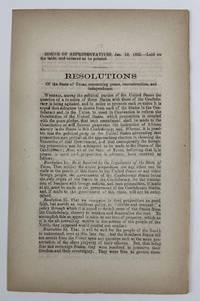
1865rif. 4902Richmond Va.: January 19 1865. Very good. 3pp. printed on a single folded sheet. Minor toning and wear. A defiant screed issued by the Confederate House of Representative in January 1865 printing eight resolutions by the Texas Legislature passed in November 1864 to be presented to the President of the Confederate States should a "re-union" between the Confederacy and the Union occur at the end of the Civil War. Paramount among the Texas House's concerns is their insistence that an amendment be made to the U.S. Constitution that "will forever guarantee the institution of African slavery in the States in this Confederacy." The third resolution prints a familiar refrain in which the Texas House argues that their secession from the Union was not motivated "upon any questions such as the mere preservation of the slave property of their citizens" but rather in order to "preserve their freedom and their sovereignty" i.e. state's rights. Further in this same resolution the Texas legislature warns that they "are still unwavering in their resolution to preserve their freedom and their sovereignty without which all else is valueless." Other resolutions cover trade with foreign powers the South's unfavorable opinion of Abraham Lincoln "a Chief Magistrate with the purpose that he should destroy our liberties in disregard to the Constitution" the South's inability to accept reconciliation with the North and proposes that any end to the Civil War must begin with the U.S. government "making their proposition to the Government of the Confederate States which alone can entertain it." Resolution five contains fiery language cataloguing the "inhumanities of this war" which concludes with an unsurprising but nonetheless eye-opening accusation: "Lying to themselves and pretending to the rest of the world that they are fighting the battle of freedom for four millions of happy and contented negroes they are attempting the enslavement of eight millions of freedmen. With devilish mockery of philanthropy. they have deluded and dragged these negroes from their comfortable homes to use them as screens from our weapons in the day of battle and they have sent them by thousands to painful death by neglect exposure and starvation. January 19 unknown
1865rif. 4902Richmond Va.: January 19 1865. Very good. 3pp. printed on a single folded sheet. Minor toning and wear. A defiant screed issued by the Confederate House of Representative in January 1865 printing eight resolutions by the Texas Legislature passed in November 1864 to be presented to the President of the Confederate States should a "re-union" between the Confederacy and the Union occur at the end of the Civil War. Paramount among the Texas House's concerns is their insistence that an amendment be made to the U.S. Constitution that "will forever guarantee the institution of African slavery in the States in this Confederacy." The third resolution prints a familiar refrain in which the Texas House argues that their secession from the Union was not motivated "upon any questions such as the mere preservation of the slave property of their citizens" but rather in order to "preserve their freedom and their sovereignty" i.e. state's rights. Further in this same resolution the Texas legislature warns that they "are still unwavering in their resolution to preserve their freedom and their sovereignty without which all else is valueless." Other resolutions cover trade with foreign powers the South's unfavorable opinion of Abraham Lincoln "a Chief Magistrate with the purpose that he should destroy our liberties in disregard to the Constitution" the South's inability to accept reconciliation with the North and proposes that any end to the Civil War must begin with the U.S. government "making their proposition to the Government of the Confederate States which alone can entertain it." Resolution five contains fiery language cataloguing the "inhumanities of this war" which concludes with an unsurprising but nonetheless eye-opening accusation: "Lying to themselves and pretending to the rest of the world that they are fighting the battle of freedom for four millions of happy and contented negroes they are attempting the enslavement of eight millions of freedmen. With devilish mockery of philanthropy. they have deluded and dragged these negroes from their comfortable homes to use them as screens from our weapons in the day of battle and they have sent them by thousands to painful death by neglect exposure and starvation. January 19 unknown books
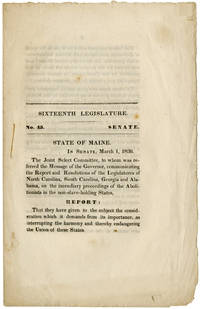
1836rif. 52765N.p. likely Augusta. 1836. Mainers Propose to Not Meddle in the Slave States A rare Maine slip-bill document resolving that the citizens from Maine and other states should not interfere with the issue of slavery in slave-holding states. The legislature writes: "Any interference therefore of a State or the inhabitants of a State with the domestic concerns of another State is dangerous as having a direct tendency to create jealousies between the States and thereby weakening the attachment to the Union which is our only security against domestic dissensions and foreign aggressions." This is a somewhat surprising position for the state of Maine to have taken at the time. Maine came into the Union in 1820 as a free state to balance the admission of the slave-owning state of Missouri. Also Maine opposed the admission of the Republic of Texas in 1836 the same year the present document was printed on the basis of Texas' position on slavery. It is curious that they would take two seemingly opposite positions in the same year. Still the legislature printed the resolution and authorized copies to be sent to the four southern slave-owning states mentioned in the title. Folded sheets stitched. Minor foxing and toning. Very good. Untrimmed. unknown
1836rif. 52765N.p. likely Augusta. 1836. Mainers Propose to Not Meddle in the Slave States A rare Maine slip-bill document resolving that the citizens from Maine and other states should not interfere with the issue of slavery in slave-holding states. The legislature writes: "Any interference therefore of a State or the inhabitants of a State with the domestic concerns of another State is dangerous as having a direct tendency to create jealousies between the States and thereby weakening the attachment to the Union which is our only security against domestic dissensions and foreign aggressions." This is a somewhat surprising position for the state of Maine to have taken at the time. Maine came into the Union in 1820 as a free state to balance the admission of the slave-owning state of Missouri. Also Maine opposed the admission of the Republic of Texas in 1836 the same year the present document was printed on the basis of Texas' position on slavery. It is curious that they would take two seemingly opposite positions in the same year. Still the legislature printed the resolution and authorized copies to be sent to the four southern slave-owning states mentioned in the title. Folded sheets stitched. Minor foxing and toning. Very good. Untrimmed. unknown books
1842rif. 106407Folded letter sheet four pages and remnant of wax seal. Creases at folds normal aging; otherwise very good or better. The letter is to Henry J. Carter Stockbridge Mass. from his brother. An unemployed 20 year-old Massachusetts teacher who had left home the year before in "exceeding hard times" Edward had gone to Baltimore – where some 50 teachers were out of work – and taken a job working for a wealthy man who had 4 acres of farm land worked by slaves. "…he has given me the office of overseer to look after the blacks in their work. O but you ought to see me walk over the lot with my cane in my hand to see how my work is going on. Then you ought to see the darky when he wants anything of me come up and take off his hat before he speaks…" Praising the "fine folks live in this beautiful part of the world" Carter proves that even a Massachusetts Yankee could quickly adapt to Southern culture and make peace with slavery. The letter is unsigned.
1842rif. 106407Folded letter sheet four pages and remnant of wax seal. Creases at folds normal aging; otherwise very good or better. The letter is to Henry J. Carter Stockbridge Mass. from his brother. An unemployed 20 year-old Massachusetts teacher who had left home the year before in "exceeding hard times" Edward had gone to Baltimore – where some 50 teachers were out of work – and taken a job working for a wealthy man who had 4 acres of farm land worked by slaves. "…he has given me the office of overseer to look after the blacks in their work. O but you ought to see me walk over the lot with my cane in my hand to see how my work is going on. Then you ought to see the darky when he wants anything of me come up and take off his hat before he speaks…" Praising the "fine folks live in this beautiful part of the world" Carter proves that even a Massachusetts Yankee could quickly adapt to Southern culture and make peace with slavery. The letter is unsigned. books