1.828 Ergebnisse
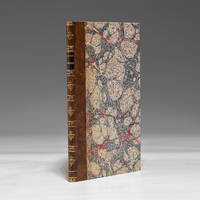
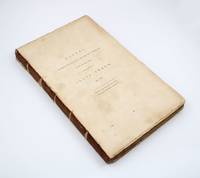
1805Best.-Nr. 369285London 1805. 309; 4 46pp. Uncut. 2 vols. Folio. Disbound. 309; 4 46pp. Uncut. 2 vols. Folio. Two British Parliamentary papers on the slave trade issued in the midst of the debates for its abolition. The first paper organized by West Indian island includes the correspondence between the British government and their West India colonies regarding slavery from the period 1797 to 1800 and includes the text of the Leeward Island Amelioration Act of 1798. The paper includes a wealth of statistical information on the enslaved populations of each island as well as the names of plantation owners and their holdings. The second paper continues the correspondence from 1804-1805 with updated statistics. unknown
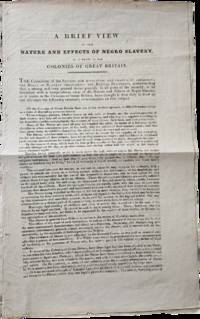
1823Best.-Nr. List3302London England: Ellerton and Henderson 1823. Three page document measuring 8 ½ x 13 ¼ inches. Folded with some small wrinkles at edges else Near Fine. A document produced by the Society for Mitigating and Gradually Abolishing the State of Slavery throughout the British Dominions better known as the Anti-Slavery Society. The group was founded in London in 1823 by a group of politicians philanthropists and businessmen including William Wilberforce Joseph Sturge and Zachary Macaulay. The document discusses the horrors of enslavement—even unfavorably comparing the British colonies’ conditions with those in the US—and decries the fact that after the 1807 Slave Trade Act essentially nothing more had been done to put “an end to a condition of society which so grievously outrages every feeling of humanity”. We find a single copy of the Ellerton and Henderson edition in physical format listed in OCLC as accession number 83930673. Ellerton and Henderson unknown
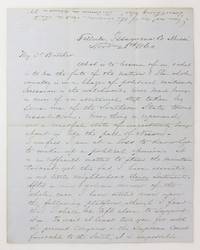
1860Best.-Nr. 6445Tallula Ms: November 28 1860. Very good. 4pp. on a bifolium. Minor soiling and wear along old folds. Otherwise clean. Written in the immediate aftermath of the Election of 1860 this letter presents a ground-level account of Southern uncertainty at the onset of the secession crisis with a very notable section on the Texas slave insurrection panic of 1860. The writer Isaac E. Nicholson lived in a region of the Mississippi Delta with a large population of enslaved people and he attempts to balance a lingering attachment to the Union with mounting fears of insurrection political collapse and economic instability. The letter moves between national politics local anxieties reports of violence in Texas and personal family concerns. He begins by describing the intensity of the moment: "The whole country is in a blaze of political excitement. Secession is the watchword." Despite this Nicholson positions himself at least provisionally against immediate disunion advocating delay and negotiation: "To wait at least two yrs.and in the mean time make certain demands upon the Northern States. This will make it a test question.whether there is any spirit of compromise left." He adds that "With the present Congress & the Supreme Court favorable to the South it is impossible for her to suffer materially" though he concedes that he may be "Left alone to support it." That moderation is undercut by a stark expression of racialized fear: "We who live in a country with about 30 blacks to one white man slumbering over a volcano.cannot long remain silent." He continues "It is no trivial matter.to retire at night with a probability of being murdered before morning. This thing has a reality here." He concludes that "The fine alternative of Revolution.will become necessary unless their aggressions.cease." The most dramatic section concerns events in Texas where Nicholson reports that his brother suffered heavy losses during unrest in Dallas: "His office & furniture & his whole library were destroyed by fire" and "His dwelling house was set on fire at three different times." He attributes the destruction to "Abolition Preachers.forced to leave for tampering with slaves" who "Endeavored to avenge themselves" adding that "The whole town of Dallas West was laid in ruins. They were both hung by a mob." Financial losses are detailed as well: "About $2000" destroyed followed by news that a New Orleans firm holding "$4000 deposited. had failed." This account corresponds to the unrest surrounding the Texas slave insurrection panic of 1860 during which fires in Dallas were widely blamed on enslaved people and Northern abolitionists and suspected agitators including Methodist ministers were expelled or killed by vigilante groups. Three men -- Patrick Jennings Sam Smith and Cato -- were killed in a public execution near Dealey Plaza now renamed Martyrs' Park in their honor. Although Nicholson presents the destruction as organized retaliation historians have generally concluded that the fires were likely accidental with the conspiracy narrative emerging from rumor and fear. His description reflects how these events circulated in Southern correspondence at the time combining real violence with exaggerated or misinterpreted causes and the passages are notable for the blending of what was presumably fact -- his brother's house catching on fire -- with the fiction of abolitionists arsonists. We find no records of correspondence or any material relating to these events in auction records or on the market at the time of writing. Overall a scarce account overall of a tragic episode in Texas history and the rumor mill that fueled it. November 28 unknown
1845Best.-Nr. 1216681845. First Edition. PHILLIPS Wendell. Can Abolitionists Vote or Take Office under the United States Constitution New York: American Anti-Slavery Society 1845. Octavo half calf-gilt marbled boards; pp. 1-3 4-39 1. $1500.First edition of the provocative abolitionist's fierce attack on the ConstitutionÑproclaiming it ""an irredeemably proslavery document""Ñdeclaring its legacy implicates ""all Americans in the crimes of slaveholding"" and caused the American flag to be weighed ""heavy with blood.""An eloquent writer and orator abolitionist Wendell Phillips was the ""most important ally"" of William Lloyd Garrison who famously contended the Constitution was a ""covenant with death"" and ""an agreement with Hell."" As Garrison's ""deepest source of inspiration"" Phillips saw the ""abolitionist as the catalyst for revolution."" In this seminal work he contends ""that the U.S. Constitution was an irredeemably proslavery documentÉ and abolitionists must withdraw support from the political system because it implicated all Americans in the crimes of slaveholding"" ANB. He notes herein that since the ratification of the Constitution Americans witnessed ""slaves trebling in numbersÑslaveholders monopolizing the offices and dictating the policy of the GovernmentÉ making the courts of the country their tools.""A citizen's vote Phillips declares is ""an oath to support the ConstitutionÑthe whole of itÉ a contract with the whole nation"" emphasis in original. He cites key clauses quotes statements made by James Madison and others during its ratification and counters a series of 16 objections to the Garrisonian/Phillips position. In answering ""the question of slavery"" he states: ""we are not dealing with extreme casesÉ every sixth man is a slaveÉ the national banner clings to the flag-staff heavy with bloodÉ If the Constitution is not what history unbroken practice and the courts prove that our fathers intended to make it and what too their descendantsÉ say they did make it and agree to upholdÑwho shall decide what the Constitution is"" Scholar Paul Finkelman points out that while there now seems certain failure in the Garrisonian/Phillips position that the Constitution ""logically led to the conclusion that the free states should secede from the unionÉ in the 1830s and 40s the idea of a northern secession as a way of destroying slavery made some senseÉ what would happen if the Garrisonians accomplished their goal and the North left the Union to form a nation based on freedom instead of slavery It would be like moving the Canadian border to the Mason-Dixon line. Suddenly slavery would be threatened in Kentucky and Virginia because slaves could now escape to a free country just by crossing the Ohio River"" Making a Covenant. Phillips is widely esteemed as ""a commanding presence in the history of the nation's struggles to overcome racial and economic injustice"" ANB. First edition first printing: No. 13 The Anti-Slavery Examiner. '""Introduction"" signed in print ""Wendell Phillips. Boston Jan. 15 1845."" With ""Extracts from J.Q. Adams"" at rear. Sabin 81919. Text very fresh tiny gutter-edge-pinholes from original stitching handsomely bound. hardcover
1883Best.-Nr. 1255001883. First Edition. Signed. PILLSBURY Parker. Acts of the Anti-Slavery Apostles. Concord N.H.: Clague Wegman Schlicht 1883. Octavo original gilt-lettered brown cloth floral endpapers; pp. 503. $1500.First edition of the fearless abolitionist's memoir a distinctive presentation copy inscribed by Pillsbury to ""To Mr. & Mrs. F. M. CÑ With sincere regards and best wishes of their friend Parker Pillsbury. Concord New Hampshire 1894."" Hailed as a ""fighting book"" it documents the bold tactics of this notorious radical who early warned America was ""hastening toÉ a baptism of blood"" and was praised by Emerson as a ""tough oak stock of a man not to be silenced or insulted or intimidated"" a splendid copy in original cloth.Born in Massachusetts in 1809 the son of a blacksmith Pillsbury became a Congregational minister but was soon famed as one of the era's most radical abolitionists. Having once witnessed a slave auction he recorded its advertisement of: ""'two mules a horse andÉ 27 Negroes'É Does any mortal man or woman"" he asked ""comprehend all the tremendous meaning of those words"" Infamous for his apocalyptic style and confrontational tactics Pillsbury early declared the nation was ""hastening to its baptism. It is a baptism of blood."" He was resolute in denying any possible ""union with slave-holders""and also insisted ""women must be given their due rights."" Emerson admired him as a ""tough oak stock of a man not to be silenced or insulted or intimidated by a mob because he is more mob than they. He mobs the mob."" He was ""in Susan B. Anthony's eyes the Jeremiah of the anti-slavery movement"" Filler Parker Pillsbury 315 328-37.Fiercely anticlerical in his writings and in action Pillsbury would dramatically interrupt ""religious servicesÉ calling on audiences to 'come out' from their proslavery churches."" He linked most clergy to timid politicians and cautious abolitionists proclaiming them a ""brotherhood of thieves"" Robertson Hard Cold Stern Life 189. Pillsbury's 1883 memoir Acts of the Anti-Slavery Apostles was above all ""a fighting book."" In it he writes of his esteem for his fellow white radical Stephen S. Foster and leading Black abolitionists such as David Ruggles as well as his disdain for Lincoln; Pillsbury ""never forgot that the idolized Lincoln meant to save the Union and not necessarily to free the slaves"" Filler 336. First edition first printing: issued in brown cloth this copy and in green cloth no priority determined. Blockson 9099. See Work 304 1884 edition. This copy is inscribed to ""To Mr. & Mrs. F. M. Crosby."" It is notable that while there was a Crosby family of abolitionists in New Hampshire the identity of this copy's recipients could not be confirmed.Text pristine; tiniest bit of soiling to cloth. An especially handsome copy in fine condition. hardcover
1850Best.-Nr. 1210761850. First Edition. SLAVERY SMITH Gerrit. Substance of the Speech Made by Gerrit Smith in the Capitol of the State of New York March 11th and 12th 1850. Albany: Jacob T. Hazen 1850. Octavo period-style half calf gilt marbled boards; pp. 1-3 4-25 26-27 28-30. $1500.First edition of the bold abolitionist's Speech proclaiming the Constitution ""does not allow the three million of our colored countrymen to be held in slavery"" a close friend of Frederick Douglass who ""openly embraced Smith's version of an antislavery interpretation of the Constitution"" delivered the same decade as John Brown's Harpers Ferry raid substantially financed by Smith.Smith a wealthy philanthropist was ""among the most outspoken"" of white abolitionists Jackson Force and Freedom 65. Once linked to William Lloyd Garrison's view of the Constitution as a ""covenant with death"" Smith split from Garrison and became a founder of both the Liberty Party and its successor the Radical Abolitionist Party. He was as well key in forging a close interracial alliance between Frederick Douglass Black abolitionist and physician James McCune Smith and John Brown. The four men shared the goal of achieving ""a 'radical change' in government."" By the early 1850s Douglass ""openly embraced Smith's version of an antislavery interpretation of the Constitution"" Blight 213. To Smith Douglass and figures as Alvan Stewart and Lysander Spooner ""the Constitution empoweredÑeven requiredÑCongress to abolish slavery in the southern states by direct legislationÉ As an editor Douglass had always engaged with national politics. Now the federal authority at the base of slavery's stranglehold on America became his intensive focus"" Blight 214; emphasis in original.This very scarce first edition captures the force of Smith's groundbreaking 1850 Speech and clearly demonstrates the breadth of his constitutional argument. Declaring ""law is for the protection of rightsÑnot for the destruction of rights"" emphasis in original he cites passages in the Declaration and Bill of Rights and addresses the pivotal ""three-fifths"" clause. Smith proclaims the Founding Fathers did not intend ""to make this whole land the slaveholder's hunting ground"" and asserts the Constitution ""does not allow the three million of our colored countrymen to be held in slavery."" He would use his wealth to help establish a Black settlement at North Elba N.Y. which was ""John Brown's permanent residence from 1854 until his death"" Stauffer Black Hearts 3. After Harpers Ferry and Brown's execution Smith faced demands that he be tried as an ""accessory after the fact."" While he ""publicly denied it Smith gave warm encouragement and financial assistance"" to Brown and the Harpers Ferry insurrection. Yet ""guilt over the failure of Brown's raid and fear of possible arrest as a co-conspirator caused Smith to commit himself to the Utica State Lunatic Asylum"" ANB. In time he publicly retreated from his Radical Abolitionist stance and died in 1874. Sabin 82670. A fine copy. hardcover
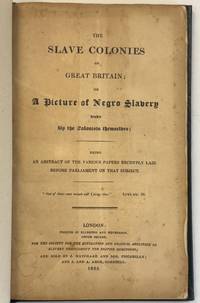
1825Best.-Nr. 41192London: Printed by Ellerton and Henderson Gough Square for the Society for the Mitigation and Gradual Abolition of Slavery Throughout the British Dominions; and Sold by J. Hatchard and Son Piccadilly; and J. and A. Arch Cornhill 1825. iv 164 pp. Some foxing to first and last few leaves; title and last page toned. Bound in modern dark boards with gilt-lettered title stamped on front cover. Good plus. A second edition issued in 1826. The book reviews developments concerning slavery in each of the British West India colonies: laws for free people of color and for slaves manumissions proposed reforms and objections to reforms trials of alleged rebels and insurgents including the destruction of the Methodist chapel in Barbados and revolts and trials in Jamaica changes in the law punishments inflicted manumissions the slave trade slave unrest. "The reports were called for in order to learn what had been done in the way of effecting amelioration in the colonies. This work brought out by the Society for the Mitigation and Gradual Abolition of Slavery Throughout the British Dominions. . . showing that nothing substantial has been done" Ragatz. It "presents cases of extreme cruelty" id. to slaves in Berbice. Authorship and editorship are attributed to Zachary Macaulay founder and organizer of several antislavery societies and a major force in accomplishing the British Emancipation. He focused on providing a picture of Negro Slavery based on reports of "the colonists themselves." FIRST EDITION. Ragatz 458. Sabin 82063. Not in LCP. Printed by Ellerton and Henderson, Gough Square, for the Society for the Mitigation and Gradual Abolition of Slavery Throughout unknown
1710Best.-Nr. 1200341710. First Edition. SLAVERY ANONYMOUS. A True State of the Present Difference Between the Royal African Company and the Separate Traders. London: No publisher 1710. Slim octavo period-style full tan sheep gilt red morocco spine label raised bands; pp. 40. $1650.First edition of this argument against providing a monopoly over the British slave trade to the Royal African Company with tipped-in diagram of one of the Royal African Company's forts.This work attempts to highlight the irregularities of the business practices of the Royal African Company and to argue for the superiority of open trade in Africa particularly as a means of supplying slaves to the American plantations. Founded in 1660 by the royal Stuart family and the City of London the Royal African Company was founded to exploit natural resources like gold along the west coast of Africa. While the Royal African Company did participate heavily in the gold trade the majority of their income came from slave-trading. The Royal African Company was part of a concerted effortÑfully elaboration in the Navigation ActsÑto establish dominance in the slave trade since the Dutch had been the leading slave-traders prior to the Restoration. To that end the Royal African Company established a brutal and highly efficient slave-trading system eventually providing more slaves to the West Indies than any other company or state. The slaves were branded with the initials of the company or its longtime governor the Duke of York. Children were included in the transports. Between 1662 and 1731 the Company transported approximately 212000 slaves a fifth of whom died enroute. While the Company formally gave up slave-trading in 1731 they remained involved in the trade of ivory and gold dust industries dependent on labor exploitation and slavery. Goldsmiths 4605. Kress 2677. Early ink underlining and marginal notations.Small paper repair to diagram text and diagram trimmed close affecting portion of imprint and scattered catchwords not affecting readability. A very good copy. hardcover books
1710Best.-Nr. 1200341710. First Edition. SLAVERY ANONYMOUS. A True State of the Present Difference Between the Royal African Company and the Separate Traders. London: No publisher 1710. Slim octavo period-style full tan sheep gilt red morocco spine label raised bands; pp. 40. $1650.First edition of this argument against providing a monopoly over the British slave trade to the Royal African Company with tipped-in diagram of one of the Royal African Company's forts.This work attempts to highlight the irregularities of the business practices of the Royal African Company and to argue for the superiority of open trade in Africa particularly as a means of supplying slaves to the American plantations. Founded in 1660 by the royal Stuart family and the City of London the Royal African Company was founded to exploit natural resources like gold along the west coast of Africa. While the Royal African Company did participate heavily in the gold trade the majority of their income came from slave-trading. The Royal African Company was part of a concerted effortÑfully elaboration in the Navigation ActsÑto establish dominance in the slave trade since the Dutch had been the leading slave-traders prior to the Restoration. To that end the Royal African Company established a brutal and highly efficient slave-trading system eventually providing more slaves to the West Indies than any other company or state. The slaves were branded with the initials of the company or its longtime governor the Duke of York. Children were included in the transports. Between 1662 and 1731 the Company transported approximately 212000 slaves a fifth of whom died enroute. While the Company formally gave up slave-trading in 1731 they remained involved in the trade of ivory and gold dust industries dependent on labor exploitation and slavery. Goldsmiths 4605. Kress 2677. Early ink underlining and marginal notations.Small paper repair to diagram text and diagram trimmed close affecting portion of imprint and scattered catchwords not affecting readability. A very good copy. hardcover
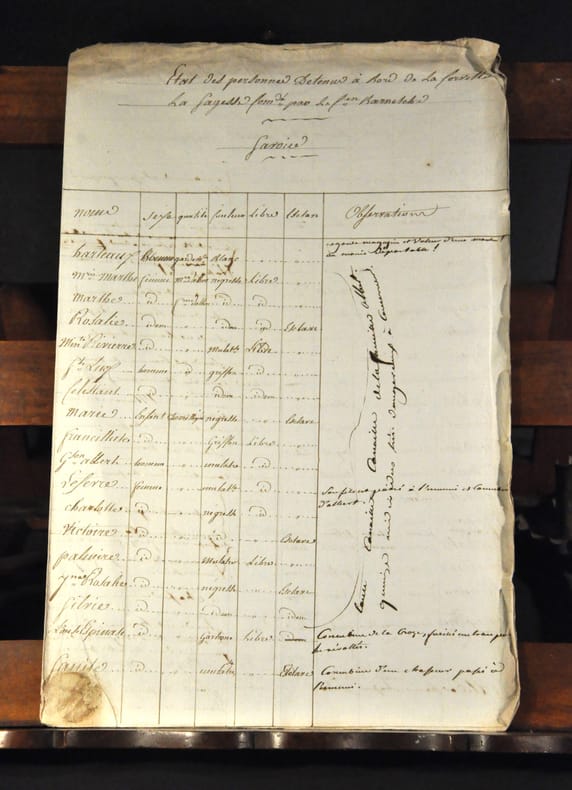
1803Best.-Nr. 301729 germinal An 11 (19 avril 1803) 1803 Trois pages in-folio sur papier filigrané « Texier Ponbreton » aux armes du bonnet frégien (An 2). Manuscrit à l’encre brune, se composant d’un tableau détaillant la condition des personnes détenues à bord de la corvette. Les catégories sont : nom / sexe / qualité / couleur / libre / esclave / observations. Il s’agit de l’état dressé des prisonniers, libres et esclaves, détenus à bord de la corvette « La Sagesse » le 29 germinal an 11 (19 avril 1803) en rade du Fort « Dhauphin » (Fort liberté). Le document est signé par le capitaine commandant Barnetche et l’agent comptable Peychaud. La liste contient quarante-quatre noms dans lesquels on ne relève que quatre blancs, les catégories font frémir : blanc, négresse libre, négresse esclave, mulâtre libre, griffon (enfant issu d’un.e mulâtre et d’un.e noir.e), gartron , nergilion … Les observations portées en marge sont explicites. En voici quelques exemples. "Harteaux", homme, blanc , « vagabond magasin et voleur d’une montre ! Au moins déportation ! »Tous les membres proches de la famille d’Albert qu’ils soient libres ou esclaves sont affublés du commentaire suivant « Canaille Canaille de la famille Albert. Quinze individus très dangereux à conserver (gouverner ?) »Leferve, femme mulâtre, libre : « Son fils est passé à l’ennemi et carabinier d’Albert »On note le nom de Marie, domestique, caractéristique : « enfant, négresse et esclave. » Plus loin Louis d’Espinase, une femme quarteronne, libre : « Concubine de La Croze, fusillé (…) » La majorité des détenus sont des femmes comme cette Cassile, mulâtresse esclave qualifiée de « Concubine d’un chasseur passé à l’ennemi ». Un autre blanc se glisse au milieu de cette sinistre liste, il s’appelle Bassidaux, c’est « un lâche et un traitre », il écrit « fusillable » souligné deux fois, puis encore « Ce Bassidaux est fusillable ! » Sur d’autres « Je ne veux point de ces hommes chasseurs » « Concubine de chasseur » Fanchonelle, femme, négresse, esclave « Concubine d’un chasseur passé à l’ennemi ».Sophie, blanche, taxée de « Concubine de l’Univers et d’un chasseur ennemi » Quasiment tous les prisonniers ont le droit à ces commentaires cinglants « coquinissime », « déportable », « ce français italien de nation » , « parente des deux babys fusillées hier » « à chasser ». Sur des négrillons, esclaves : « enfants : très petits enfants »
Best.-Nr. ORD-12743Paris. Imprimerie Royale. Juin 1844. In-4 (220 x 270mm) cartonnage vert de l'éditeur, 2ff., 668 pages. Cachet de bibliothèque au fx-titre, qq. pages brunies, couverture un peu tachée mais exemplaire solide en plutôt bon état. Ouvrage rare et d'une grande importance sur la condition des esclaves dans les colonies françaises, paru avant l'acte d'émancipation en Avril 1848. Sabin, 14712.
1773Best.-Nr. 0034671773 Amsterdam, et se trouve à Paris, Chez Merlin, 1773. Deux volumes in-8 (134 X 205 mm) veau fauve marbré, encadrement de filet à froid sur les plats, dos cinq nerfs, caissons dorés avec fleuron central, large dentelle en queue et tête, coupes et coiffes ornées, pièces de titre et de tomaison maroquin rouge, tranches rouges (reliure de l'époque). Tome I : (1) f. blanc, faux-titre, frontispice, titre, 328 pages, 3 planches et 4 tableaux dépliants, (1) f. blanc ; Tome II : faux-titre, titre, 278 pages, 2 planches, (1) f. blanc. Notice ancienne collée sur le premier contreplat du tome I. Les planches de Moreau sont brunies.
1907243 pages. Tissue-protected frontis photo portrait of author. Attractively decorated maroon cloth-covered front board. All seventeen black and white plates present. "An autobiographical account of the author's first twelve years (from 1862 to September 1873) as a Methodist missionary among the Cowichan and Nanaimo Indians." - Lowther. Average wear. Prior owner's name in light pencil upon front free endpaper. Faint moisture marks to fore-edge of first twenty-five pages. Hinges starting. Issued without dust jacket. LOWTHER 1556, RICKS p.75, AMTMANN 3499, SMITH 2134, WALLACE p.52, MATTHEWS 295, TOD & CORDINGLEY p.85. Book
1797Best.-Nr. 12434Paris, Du Pont, 1797. In-8 de XXIV-237 pp., 1 planche dépliante, veau raciné, dos lisse orné, pièce de titre en mariquin rouge, tranches mouchetées (reliure de l'époque).
Best.-Nr. 3042Vers la fin du XVIIIe siècle Cahier In 4 en couverture souple, « J.J Proa _ Mes mémoires » écrit à l’encre brune sur le plat supérieur. Manuscrit rédigé au net, certainement par un membre de la famille de J.J. Proa vers la fin du XVIIIe siècle. Manuscrit rédigé à l’encre violette très joliment calligraphiée. 1bl, 113ff, 2bl
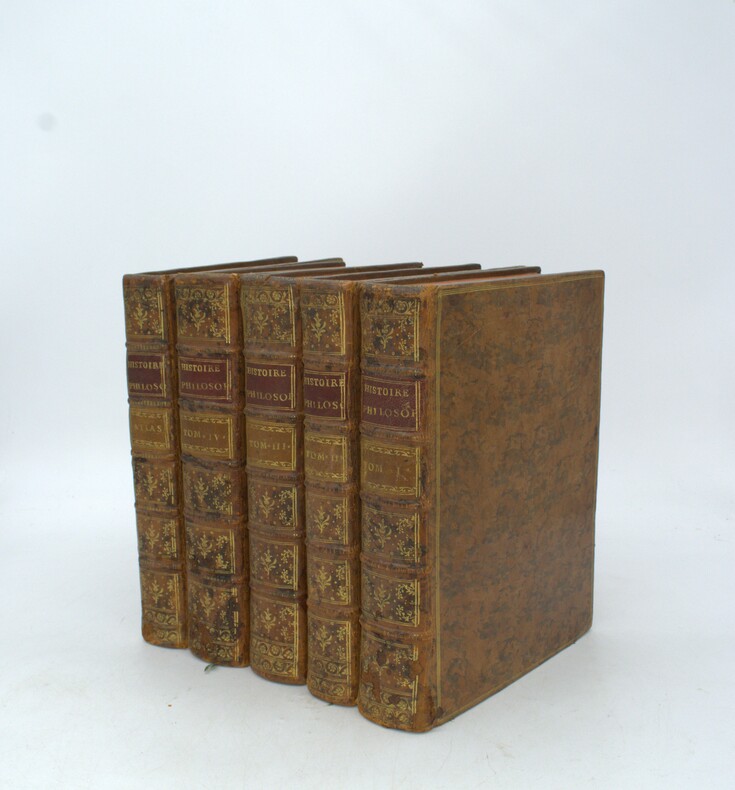
1780Best.-Nr. PHO-2003Genève, Jean-Léonard Pellet, 1780. 5 volumes in-4, 4 volumes de texte (25,5x20cm) et 1 Atlas (25,5x22cm), portrait, XVI, front.,741 pp., front., (2 ff.), VIII, 485 pp.; front., XV, 629 pp.; front., (2 ff.), VIII, 770 pp., (1 f.); 22 pp., (1 f. bl.), 50 cartes (49+17bis) et 23 tableaux. Relié plein veau marbré époque, dos à nerfs orné avec tomaison et pièce de titre grenat, filets aux plats, tranches rouges, frottements aux charnières, petites épidermures au dos, qlqs feuillets légèrement brunis. Bel exemplaire en reliure uniforme
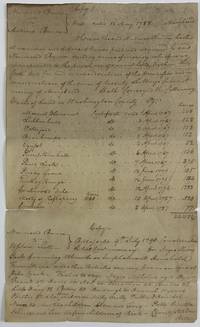
1790Best.-Nr. 13400Washington County MD 1790. 2pp. on a single folio sheet. Moderate toning and dust-soiling old folds one fold separation repaired on verso with archival tape. Overall good plus condition. A striking document from early national Maryland detailing the sale of numerous types of property by Norman Bruce a Maryland militia man and land speculator. Norman Bruce was a Scottish immigrant who came to the American colonies as a young man served in the Maryland militia and acquired large tracts of land mostly in modern-day Carroll County. He also served as the Sheriff of Frederick County and as a judge and was known to own numerous slaves. Interestingly his wife Susanna Gardiner Key Bruce was great aunt to Francis Scott Key. The present documents first memorializes Bruce's sale of a dozen parcels of land to his son Andrew Bruce. The document notes the location date of sale and the number of acres for each parcel. Most impactfully though the document records Bruce's sale of his slaves. In a bill of sale in the present document Bruce sells two dozen named enslaved persons to his great-nephew Upton Scott along with various other property such as "Stock Farming Utensils or Implements Household Furniture and other articles." The transaction for the enslaved men women and children lists them by name and mostly age and reads in part: "Bill of sale 9th July 1790.For Negro Slaves.That is to say Negro Nicholas Aged 48 years. Frank 47. Harvey 46. Ned 44. Jonathan 44. Brutus 37. Little Harry 32. Betsey 50. Her daughter Hannah 11 years. Phillis 37 & her four children Milly Molly Phillis & Hannibal. Nance 24. Her two children Clem and Terry - Patty Pricilla Jeanie and Sam the four children of Beck. Charity and Stephen & Cassey the children of Nell." These enslaved persons apparently worked Bruce's "Farm on Great Pipe Creek." An unusual 18th-century Maryland slave document providing critical named connections within multiple slave families known to be living and working at a specific Maryland farm in 1790. unknown books
1790Best.-Nr. 13400Washington County MD 1790. 2pp. on a single folio sheet. Moderate toning and dust-soiling old folds one fold separation repaired on verso with archival tape. Overall good plus condition. A striking document from early national Maryland detailing the sale of numerous types of property by Norman Bruce a Maryland militia man and land speculator. Norman Bruce was a Scottish immigrant who came to the American colonies as a young man served in the Maryland militia and acquired large tracts of land mostly in modern-day Carroll County. He also served as the Sheriff of Frederick County and as a judge and was known to own numerous slaves. Interestingly his wife Susanna Gardiner Key Bruce was great aunt to Francis Scott Key. The present documents first memorializes Bruce's sale of a dozen parcels of land to his son Andrew Bruce. The document notes the location date of sale and the number of acres for each parcel. Most impactfully though the document records Bruce's sale of his slaves. In a bill of sale in the present document Bruce sells two dozen named enslaved persons to his great-nephew Upton Scott along with various other property such as "Stock Farming Utensils or Implements Household Furniture and other articles." The transaction for the enslaved men women and children lists them by name and mostly age and reads in part: "Bill of sale 9th July 1790.For Negro Slaves.That is to say Negro Nicholas Aged 48 years. Frank 47. Harvey 46. Ned 44. Jonathan 44. Brutus 37. Little Harry 32. Betsey 50. Her daughter Hannah 11 years. Phillis 37 & her four children Milly Molly Phillis & Hannibal. Nance 24. Her two children Clem and Terry - Patty Pricilla Jeanie and Sam the four children of Beck. Charity and Stephen & Cassey the children of Nell." These enslaved persons apparently worked Bruce's "Farm on Great Pipe Creek." An unusual 18th-century Maryland slave document providing critical named connections within multiple slave families known to be living and working at a specific Maryland farm in 1790. unknown
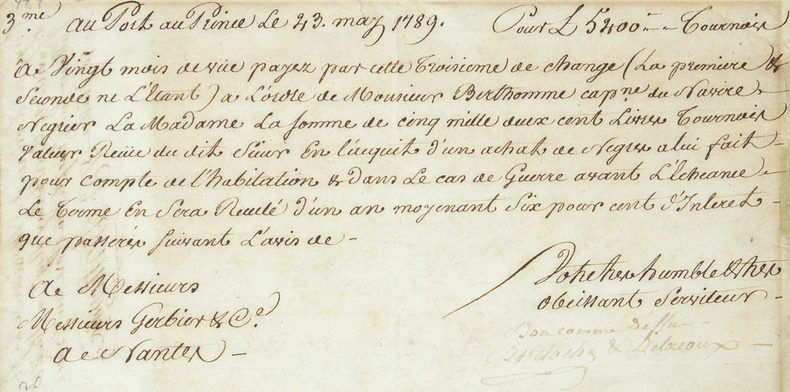
1789Best.-Nr. YQV-13Port-au-Prince, 23 mars 1789 Un billet in-8 oblong (128 × 243 mm), manuscrit à la plume au recto (11 lignes) et au verso (4 lignes), encre noire.
1816Best.-Nr. 1138361816. First Edition. SLAVERY. The Interference of the British Legislature in the Internal Concerns of the West India Islands Respecting Their Slaves Deprecated. London: J. Mawman 1816. Slim octavo modern blue-gray paper wrappers; pp. 58. $1800.First edition of this defense of the West Indian slave trade arguing against emancipation.Cloaked in pro-abolition language and anonymously written by a person claiming to be an abolitionist this work is actually a zealous condemnation of British interference in the slave trade of the West Indies. After briefly discussing the abolition movement the 1807 act abolishing slavery in britain and prominent anti-slavery organization the author sets out to make his main argument: that a bill requiring registry of slaves in the West Indies would infringe on the rights of those colonies. The author swiftly aligns himself with the interests of the West Indian Planters arguing that abolishing slavery is a different cause from emancipating people of African descent. He points out that this bill is merely the first in a projected series of measures meant to emancipate the Black population of the West Indies. Set in the awkward period between 1807 and 1833 when slavery in Britain was illegal but the slave trade still thrived abroad this work makes sense of obvious hypocrisy by arguing that slavery was permitted by God and that Blacks of African descent were better off as slaves than in Africa. The will of those against slavery proved stronger and complete abolition eventually became the law of the land. Sabin 34904. Kress 21649. This work last appeared at auction over 25 years ago; prior to that it had not been seen since the 1940s.Interior quite clean with only slight pressure offsetting toning to spine of modern wrappers. A beautiful copy in fine condition. unknown books
1792Best.-Nr. 1262151792. HAITI SLAVERY. A Particular Account of the Insurrection of the Negroes of St. Domingo Begun in August 1791: Translated from the French caption title as issued. London: 1792. Slim octavo modern green cloth; pp. 32. $1800.Fourth edition published one year after the very rare first of this sensationalistic account of the early months of the Slave Rebellion in Haiti the beginnings of the Haitian Revolution which ultimately led to the establishment of the first independent black state in the New World. The publishers of this polemic hoped to frighten the British public and turn them away from the abolitionists Wilberforce and Clarkson who were trying to put and end to slavery in the British colonies in the West Indies.Translated into English this is a speech to France's National Assembly ""by the Deputies from the General Assembly of the French part of St. Domingo."" The tract provides a frightening and grisly account of the August 1791 Slave Rebellion the result of ""a plot to set fire to the plantations and to murder all the whites."" The start of the insurrection by its ""perfidious"" leaders resulted in a catalogue of horrors and atrocities as the rebels ""spread over the plain with dreadful shouts set fires to houses and canes and massacred the inhabitants."" The ""fury of the cannibals"" is recounted in gory detail. The Speech is signed at the bottom of page 19 by six Deputies who call the insurrection ""the greatest calamity that has visited the human race in the course of the eighteenth century."" An Appendix records Letters and Speeches concerning the Rebellion. ESTC T110428. Goldsmiths' 15167. See Sabin 58932 1791 first edition; LCP 7460 2nd edition 1792; Work 349 1832 printing. First and last leaf slightly darkened text quite clean. Trimmed irregularly along upper margin affecting page numbers on two leaves but not any text. A very good copy of this scarce item. hardcover books
1816Best.-Nr. 1138361816. First Edition. SLAVERY. The Interference of the British Legislature in the Internal Concerns of the West India Islands Respecting Their Slaves Deprecated. London: J. Mawman 1816. Slim octavo modern blue-gray paper wrappers; pp. 58. $1800.First edition of this defense of the West Indian slave trade arguing against emancipation.Cloaked in pro-abolition language and anonymously written by a person claiming to be an abolitionist this work is actually a zealous condemnation of British interference in the slave trade of the West Indies. After briefly discussing the abolition movement the 1807 act abolishing slavery in britain and prominent anti-slavery organization the author sets out to make his main argument: that a bill requiring registry of slaves in the West Indies would infringe on the rights of those colonies. The author swiftly aligns himself with the interests of the West Indian Planters arguing that abolishing slavery is a different cause from emancipating people of African descent. He points out that this bill is merely the first in a projected series of measures meant to emancipate the Black population of the West Indies. Set in the awkward period between 1807 and 1833 when slavery in Britain was illegal but the slave trade still thrived abroad this work makes sense of obvious hypocrisy by arguing that slavery was permitted by God and that Blacks of African descent were better off as slaves than in Africa. The will of those against slavery proved stronger and complete abolition eventually became the law of the land. Sabin 34904. Kress 21649. This work last appeared at auction over 25 years ago; prior to that it had not been seen since the 1940s.Interior quite clean with only slight pressure offsetting toning to spine of modern wrappers. A beautiful copy in fine condition. unknown
1792Best.-Nr. 1262151792. HAITI SLAVERY. A Particular Account of the Insurrection of the Negroes of St. Domingo Begun in August 1791: Translated from the French caption title as issued. London: 1792. Slim octavo modern green cloth; pp. 32. $1800.Fourth edition published one year after the very rare first of this sensationalistic account of the early months of the Slave Rebellion in Haiti the beginnings of the Haitian Revolution which ultimately led to the establishment of the first independent black state in the New World. The publishers of this polemic hoped to frighten the British public and turn them away from the abolitionists Wilberforce and Clarkson who were trying to put and end to slavery in the British colonies in the West Indies.Translated into English this is a speech to France's National Assembly ""by the Deputies from the General Assembly of the French part of St. Domingo."" The tract provides a frightening and grisly account of the August 1791 Slave Rebellion the result of ""a plot to set fire to the plantations and to murder all the whites."" The start of the insurrection by its ""perfidious"" leaders resulted in a catalogue of horrors and atrocities as the rebels ""spread over the plain with dreadful shouts set fires to houses and canes and massacred the inhabitants."" The ""fury of the cannibals"" is recounted in gory detail. The Speech is signed at the bottom of page 19 by six Deputies who call the insurrection ""the greatest calamity that has visited the human race in the course of the eighteenth century."" An Appendix records Letters and Speeches concerning the Rebellion. ESTC T110428. Goldsmiths' 15167. See Sabin 58932 1791 first edition; LCP 7460 2nd edition 1792; Work 349 1832 printing. First and last leaf slightly darkened text quite clean. Trimmed irregularly along upper margin affecting page numbers on two leaves but not any text. A very good copy of this scarce item. hardcover
1863Best.-Nr. 101890Letterpress broadside 18 7/8" x 11 3/4" bold black type for highlighted words. Paper evenly toned some wrinkling considerable archival conservation and restoration with archival paper repair; despite the imperfections it is still a decent copy with a nice impression. This appears to fall into the political dirty tricks department in an election between John Brodhead and Henry Bumm for city treasurer in Philadelphia. The broadside is supposed to highlight a letter from John Brodhead to Jefferson Davis in 1860. It has strong racist overtones as Brodhead supposedly requests a position in Nicaragua so he can "help open it up to civilization and Niggers." He goes on to state he is "tired of being a white slave at the North and long for a home in the sunny South." These kinds of political tricks were not uncommon during the Civil War period perhaps that's still true today and the racist overtones would certainly not help one's chances in a Northern election. books
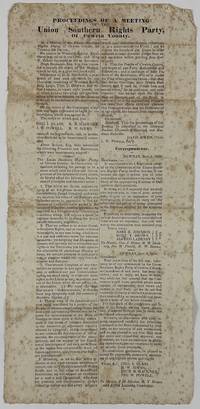
1850Best.-Nr. 13416Newnan GA 1850. Broadside 15.5 x 7.25 inches. Minor edge wear old folds substantial foxing. Overall good plus. A very rare broadside memorializing a meeting of the Union Southern Rights Party in late-1850. The text records the proceedings of a November 5 1850 meeting in Newnan the seat of Coweta County Georgia to nominate Congressional candidates and propagate the organization's Preamble and Resolutions. The Preamble asserts that the Union Southern Rights Party of Coweta County has assembled to meet a "crisis which calls for a free and full expression of the opinions of every citizen" and therefore issues their "Declaration of principles and intended action." The six resolutions can be summed up as follows: they oppose the recent admission of California; "Disunion at present" is not the answer.yet; they reserve the right to secede if Congress continues to "war upon our property" and they are "left no other alternative;" they "express the determination of the state of Georgia" at an upcoming convention and wish to "promote true Southern Independence" if necessary; any candidate should "oppose any and every measure which may lead either directly or indirectly to a dissolution of the Union;" and that the people of Georgia should "forget all past Party distinctions and differences" and work together to ensure that the government is "rescued from impending dangers." Here the Union Southern Rights Party stands opposed to secession but reserves the right to exercise it in the future a fairly common viewpoint in the mid-19th century South. They answer some critics further along the path to secession in one passage here stating that "We repel the idea that we are 'Submissionists' or that we have any sympathy with the enemies of Southern Rights." In this way they are emblematic of a large portion of Southern politicians at the time who believed that slavery was an inherent right baked into the Constitution and was further a states rights issue. That viewpoint continued up to during and clear through the other side of the Civil War. Only one holding noted in OCLC and Hummel at Duke University. Hummel 402. unknown books