1 545 résultats
2015réf. Gyan-9789333667104Facsimile Publisher 2015. Hardcover. New. 22.59 x 14.34 x 3.27 cm. English Facsimile Publisher hardcover
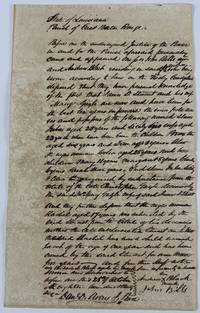
1836réf. 13107East Baton Rouge Parish LA: October 25 1836. 1p. on a single folded sheet integral blank docketed on verso. Old folds moderate toning and foxing short closed tear along one fold line a few small instances of ink burn. Overall good condition. An interesting document of legal testimony involving numerous named slaves in Louisiana in 1836 ranging in age from one year to almost thirty years of age and including seven children. According to the docketing the document is effectively a "Title to Slaves." The deponents were two local citizens John Bills and Andrew Black who had "personal knowledge of the fact that James D. Stuart and his wife Mary Gayle are now and have been for the last ten years & upwards the bona fide owners and possessors of the following named slaves: Juba Aged 25 and Sicily his wife aged 22 to whom have been born the children Braxton aged six years and Dan aged 3 years. Also the negro woman Celia aged 28 years and her children Mary 11 years Margaret 8 years Charley 6 years Sarah three years which slaves Juba Sicily & Celia were acquired by inheritance from the estate of Christopher Gayle. And they further depose that the negro woman Rachel aged 17 years was inherited by the said Stuart from the estate of his deceased mother.and that the said Rachel has now a child named Jacob of the age of one year." The document is signed by Black Bills and the Justice of the Peace Daniel D. Avery. Documents involving slave inheritance of and subsequent ownership by not one but both members of a marriage are exceedingly rare. October 25 unknown
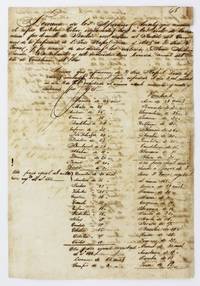
1866réf. 4747Havana: July 10 1866. Good. 3pp. on a bifolium. Separated at fold. Some wear to edge of first leaf cause some minor loss to text. A few scattered tape repairs and reattachments. Some offsetting. A colonial Spanish manuscript slave manifest for the steamship Cristobal Colon carrying dozens of enslaved Africans from Bailen to Partido del Cano both in Cuba. The text at the head reads as follows: "Nomina de los Africano bozales que conducten el vapor Cristobol Colon embarcado hoy a las siete de la mañana por el muelle de Bailen con destino al Partido del Cano unos de la propridad de D. José Rafael Diaz y otros de D. José Garcia y por encargo de sus dueños los custodia D. Juan Antonio Sanchez Bustamante y este individuo tiene biencia annal del Partido de Consolacion del Sur." Bailen is on the southern coast of Cuba north of the Isle of Pines; "El Cano" seems to have been a plantation outside of Havana while Consolacion del Sur is coastal town in the Pinar del Rio region of Cuba. The manifest lists 133 "Africanos bozales" that is slaves who could not speak Spanish in two or three columns separated between men "varones" and women "hembras" - their assigned names are given generally of Christian origin but with some range e.g "Ciforiana" "Liborio" and "Dionisia." Their ages are given one as young as nine several in their late thirties but most in their teens to early thirties. An additional leaf signed from Manila and dated July 10 1866 notes that although 133 people were sent only 115 survived the journey and lists the names of those who perished. July 10
2001réf. __0252026322Univ of Illinois Pr 2001. Hardcover. New. 328 pages. 9.25x6.25x1.00 inches. Univ of Illinois Pr hardcover
réf. 15313Birmingham 3/13 1852. 1-page 8vo tipped on to part of an album page. He regrets that he is unable "to lodge at your home at the Quarterly Meeting" as "My dear Hannah is expecting to be confined almost daily and I cannot.leave home at all.". Birmingham 3/13 1852. unknown
1862réf. 13270Moulton AL: June 7 1862. 4pp. on a single folded sheet. Old folds moderate staining rubbing and toning edges worn and a bit chipped a few small holes in the body of the text. A well-worn newspaper in good condition. A notable issue of a very rare newspaper from Confederate Alabama with many interesting historical aspects. Most noteworthy is the runaway slave advertisement printed on the last page relating the story of "a black boy who calls himself John" currently held at the jail in Lawrence County Alabama. John claims that his owner Jack Mason of Limestone County "was killed at Corinth on the day of the battle there and that he was endeavoring to return home when arrested." A physical description of John follows and concludes with a notice that "The owner will please come forward pay charges and take him away or he will be disposed of according to law." Other advertisements document various sheriff sales and the dissolution of a local law partnership. The paper also includes informative content on the Civil War including a substantial proclamation by Alabama Governor John Gill Shorter encouraging Alabama men to take the war seriously gather arms to the front and participate as part of the "State Guard." The paper also prints part of a notice from the Charleston Courier arguing that if Confederate currency is not worth real value "then the whole cotton crop of the South will be seized by the invader then Lincoln's recommendation to his Congress will be adopted and enforced and all the lands of the Southern people will be parcelled out among Northern soldiers." There is also a dispatch from Corinth encouraging southerners to identify and send back soldiers absent from duty and other wartime content. The only physical issue we could locate dated April 17 1863 is held at Samford; the remainder of the OCLC records we consulted reported microfilm or digital forms. June 7 unknown
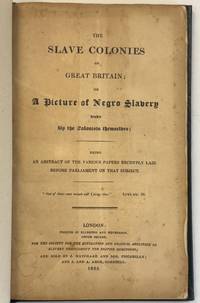
1825réf. 41192London: Printed by Ellerton and Henderson Gough Square for the Society for the Mitigation and Gradual Abolition of Slavery Throughout the British Dominions; and Sold by J. Hatchard and Son Piccadilly; and J. and A. Arch Cornhill 1825. iv 164 pp. Some foxing to first and last few leaves; title and last page toned. Bound in modern dark boards with gilt-lettered title stamped on front cover. Good plus. A second edition issued in 1826. The book reviews developments concerning slavery in each of the British West India colonies: laws for free people of color and for slaves manumissions proposed reforms and objections to reforms trials of alleged rebels and insurgents including the destruction of the Methodist chapel in Barbados and revolts and trials in Jamaica changes in the law punishments inflicted manumissions the slave trade slave unrest. "The reports were called for in order to learn what had been done in the way of effecting amelioration in the colonies. This work brought out by the Society for the Mitigation and Gradual Abolition of Slavery Throughout the British Dominions. . . showing that nothing substantial has been done" Ragatz. It "presents cases of extreme cruelty" id. to slaves in Berbice. Authorship and editorship are attributed to Zachary Macaulay founder and organizer of several antislavery societies and a major force in accomplishing the British Emancipation. He focused on providing a picture of Negro Slavery based on reports of "the colonists themselves." FIRST EDITION. Ragatz 458. Sabin 82063. Not in LCP. Printed by Ellerton and Henderson, Gough Square, for the Society for the Mitigation and Gradual Abolition of Slavery Throughout unknown
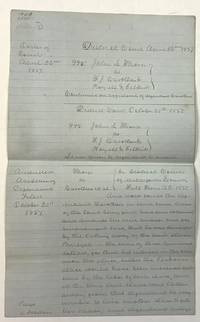
1857réf. 40346Matagorda County Texas 1857. Six pages in neat ink manuscript on lined pale blue legal paper. Fine. The document is probably the record for Carothers' appeal of the Court's judgment in favor of Thorn. The parties having waived a jury trial the Court found in favor of Thorn the Plaintiff. In addition to the failure to pay Thorn for the hire of Taswell Thorn claimed that Carothers had failed to pay $100 rent to Thorn for farming on Thorn's property. Carothers said that the slave Bridget upon whom Carothers had relied for performing work on the property had been "taken away" apparently by Thorn during the term of the agreement. Bridget's absence Carothers said caused his nonperformance and thus excused his failure to pay. The Court disagreed and ordered Carothers to pay the amount of the notes plus costs and interest. unknown
1789réf. 40544Hempfield Westmoreland County Pennsylvania 1789. Folio leaves folded to oblong 7.5" x 9." Plain wraps with manuscript title detached but present. 44 pp including: 1-title 35 hand-paginated with entries 1-tally page and 1-assessors' certification 6 blank. Toned some splitting along spine folds light chipping at edges. Good. In March 1780 Pennsylvania enacted "An Act for the Gradual Abolition of Slavery" requiring "That all persons as well Negroes and Mulattoes as others who shall be born within this state from and after the passing of this act shall not be deemed and considered as servants for life or slaves; and that all servitude for life or slavery of children in consequence of the slavery of their mothers in the case of all children born within this state from and after the passing of this act as aforesaid shall be and hereby is utterly taken away extinguished and for ever abolished." Persons born in Slavery before the date of the Act would remain as slaves. This inventory of taxable property is a Who's Who of Hempfield Township in western Pennsylvania consisting of an alphabetical list of the heads of households for the township. Each entry includes the number of servants under columns headed "Negro & Mulatto Slaves" or "Negroes"; land by deed warrant or location; improvements; number of horses horned cattle mills stills houses/lots and outlots; and value of the property in pounds shillings and pence. Several entries have "Single Man" written across the first few columns. The total taxable property in this return is £12850.3.9. Five entries have a "1" under the "Negroes" column including: William Perry Esq.; James Guthry who notes F 30; Alexander McDowall; David D.P. Marchant; Christian Rhodabough who notes 1-30. Other entries have an "X" in the "Negroes" column. The assessor is listed on the last page as Robert Flemman; Robert McKee 1771-1850 and Robert Taylor are his assistants. "Hempfield's early settlers were Germans from southeastern Pennsylvania. The name Hempfield was taken from Hempfield Township in Lancaster County which was formed in 1729 as an English place name. Hempfield Township in Lancaster County derived their name from the production of hemp. In 1818 Lancaster County divided Hempfield Township into East and West Hempfield. The settlers from Lancaster County that came to this area gave the same name to our Township where some of the early settlers had resided. Agriculture was the base for the settlers in the early days. The Township was known for the stills and distilleries where farmers refined the substantial grain output." "Naming & Establishing Hempfield Township" accessed at official website of Hempfield Township 25 February 2025. Two notable individuals listed are Henry Aleshouse 1757-1837 and Michael Huffnagle 1753-1819. Aleshouse was Captain of the Continental Army from 1776-1780 and prisoner of war during his service; Major in the Pennsylvania Militia in 1783; member of the Pennsylvania State House of Representatives from 1802-1805 1812-15 1817-1818; and Pennsylvania State Senate from 1819-1826. Huffnagle was prothonotary for Westmoreland County Captain in the 8th Pennsylvania Regiment during the Revolutionary War one of the first lawyers admitted to the Westmoreland County bar Judge of the Court of Common Pleas Clerk of the Court of Quarter Sessions and Clerk of the Orphan's Court and Agent for Forfeited Estates. Of the slave owners Dr. David Marchant Marchand 1746-1809 was a Captain in the American Revolution local doctor and founder of the first hospital west of the Allegheny Mountains; William Perry Esq. 1745-1793 was a sheriff of Westmoreland County from about 1777-1789 Treasurer of Westmoreland County from 1783-1788 County Sheriff in 1779 and Captain of a company of rangers with the Westmoreland Militia. Some of the surnames listed are: Alesworth Aultman Berger Brisby Beer Barnheart Bell Campbell Condon Cough Crookshank Clingahsmith Davison Errit Fullerton Jenkins Kimble McCurdey Russell Robison Shotts Shull Taylor Turner Wagley Waterson Yokey and others. unknown
1856réf. 33708Philadelphia 1856. 24pp disbound three small binding holes in blank left margin. Two early signatures of Wm. Thompson Shafer on title page. Light spotting throughout. About Good. This scarce pamphlet says the "great issue" is whether "Slavery shall be allowed to overspread a territory of greater extent than that of the whole United States" and "whether the policy of our government is to continue to be that of Slavery Extension or Slavery Restriction." All the power of the presidency is "being used to force the withering and blighting scourge of Slavery upon the National domain." Pursuing this tyrannical course our government "shall lend its aid in striking a deathblow to the freedom of speech the liberty of the press and the security for life personal liberty possession and peace." LCP 4300. OCLC 22829199 4- LCP No. IL U Haverford Detroit Pub. Lib. as of April 2017. unknown
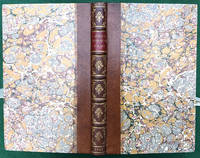
1801réf. 58147ELOQUENT ARGUMENT FOR ABOLITION OF THE SLAVE TRADE BY A WEST INDIES SLAVE OWNER - WITH A DESCRIPTION OF SUGAR PLANTATIONS Full title: 'Letters on the Cultivation of the Otaheite Cane; the Manufacture of Sugar and Rum; the Saving of Molasses; the Care and Preservation of Stock; with the Attention and Anxiety which is due to Negroes. To these Topics are added a few other Particulars analogous to the Subject of the Letters; and also Speech on the Slave Trade the most important Feature in West Indian Cultivation.' first edition 8vo. xvi 248 248 1 blank 249-290 291-301 prospectus with detailed contents for book on Leeward Islands 1 blankpp large folding table at p.247 modern quarter rich tan calf spine panelled by raised bands with the panels richly gilt tooled red morocco title label marbled sides scattered foxing some light old water staining to lower and fore margins most noticeable in gatherings B and L and never obtrusive else a nice copy in a very handsome binding. SABIN 9850 Goldsmiths'-Kress no. 18156.4 Rare Books Hub records none at auction. Clement Caines d. 1817-1822 trained as a barrister in London inherited his family's sugar plantations in St. Kitts around 1778 and became the largest slave owner in the island. In the General Assembly of the Leeward Islands in 1798 he advocated the abolition of the slave trade better treatment for enslaved workers and an end to the slave trade. He wrote extensively on the desirability of humane treatment for plantation slaves and the abolition of the slave trade as well as political topics including his support for the Embargo. The first part of this book effectively a detailed description the workings of a West Indian sugar cane plantation benefits from Caines's first hand experience of the topic. The second part p.249-288 contains his 'Speech on the Slave Trade' delivered to the General Assembly of the Leeward Islands in March 1798 which was discussing a resolution that the abolition of slave trade 'would be oppressive to the British planter destructive to the sugar colonies and consequently to the British Revenue and of no benefit to the Africans themselves'. Caines unambiguously stated "the slave-trade ought to be abolished. It ought to be abolished immediately. It ought immediately to be abolished for the sake and benefit of the planter". Caines argued that the slave trade was injurious not only to the slaves but to their owners. Having observed the death rates from exposure overwork and disease involved in forest clearing he bluntly stated that slave labour "cements with blood the walls of every sugar-work that is raised where forests grew". He stated that his business had "never been delegated to others. The slaves who were committed to my care performed their work under my own eyes. My time was passed with them and my attention devoted to them and their condition. I could not fail then to become acquainted with their wants and sufferings - to remark their sickness disability and premature decay: - the diseases among their men the sterility of their women and the death among their children". He directly challenged his hearers for their calculation "that a hardy African can be purchased for less than a Creole infant can be reared" and their consequent failure to provide adequate housing for mothers and children. He reports that about a quarter of newly arrived slaves on discovering their situation "pine and droop linger rather than live and shortly sink into the grave". Only an end to the importation of new slaves could disrupt the planters' callous calculation that they could "run our Negroes for two or three years" in the certainty that they could be then be replaced. Caines's familiarity with the actuality of slave life and his eloquent and direct illustration of it give this work an especial power. Interestingly in 1811 Caines wrote to both Thomas Jefferson and James Madison sending copies of his publications vide https://founders.archives.gov/documents/Jefferson/03-03-02-0394 . Printed for Messrs Robinson hardcover
1846réf. 18128London; Chapman Brothers. 1846. The True 1st Edition. Hardback. Very good copy in the original blind-blocked fine-ribbed cloth. Minor nick to the spine crown with the usual dust-dulling to the bands and panel edges. Remains an uncommonly well-preserved example of a scarce and seminal title; 296 pages; Physical desc. : 296 p. ; 22 cm. Intended by the publisher as the first in a 'Library' of political and literary importance for discerning readers. Subject: Slaves - United States - Social conditions. The Clarke Family Narrative - Witness accounts - Jonathan Walker's Trial - etc. London; Chapman Brothers. hardcover
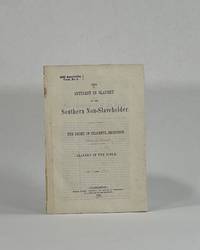
1860réf. 9565Charleston: Steam-Power Presses of Evans & Cogswell 1860. Disbound. Very Good binding. Octavo. 30 2 blank pp. First edition. Removed from binding. Vertical crease from old fold; a few instances of pencil bracketing; De Bow's name is penciled in on the title page by a later hand. Generally a well preserved copy. One of a series of pamphlet issued by Charleston's "1860 Association" a group of wealthy slave-holders who moved to promote immediate secession. In this tract De Bow a Charlestonian by birth who was living and publishing pro-Southern essays in his New Orleans Commercial Review of the South and Southwest offers and economic argument about the "benefits" of slavery on the Southern worker's wages and working condition. De Bow's essay is followed by extracts from an article on the rights of secession as well as lengthy extracts from a sermon by Rev. Henry J. Van Dyke "The Character and Influence of Abolitionism" in which this Northern pastor argues that abolitionism has no Biblical foundation and that its principles are misrepresented for men's gain. Uncommon in commerce. Parrish & Willingham 5330; Confederate Hundred 28; Work p. 399; Afro-Americana 5157; Turnbull III p. 298. Steam-Power Presses of Evans & Cogswell unknown
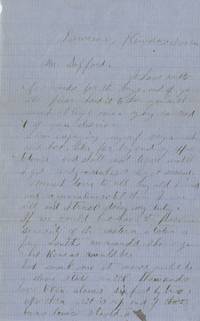
1850réf. List38115Lawrence Kansas Territory 1850. Autograph letter signed "O. S. Hemps" addressed to Mr. Harvey Safford. Two pages measuring 5x 8 inches. With envelope postmarked "LAWRENCE K.T." Letter folded with some discoloration along folds with small chip at top left margin. Near Fine. An excellent Free-State Kansas letter written from Lawrence in which the author reports that he is well and "doing my duty" praises the possibilities of Kansas if only it had "the peace or security of the eastern states" and issues a striking warning regarding the territory's future: "But mark me it never will be a slave state until thousands have taken claims six feet by two. Northern grit is up ." The writer further predicts "amazing times" should officers attempt to enforce the "bogus laws" in Kansas especially if they came "for the prisoners." His language places the letter firmly in the heated political atmosphere of Bleeding Kansas when Free-State settlers and proslavery forces struggled for control of the territory's legal and political future. Full transcription follows: "Lawrence Kansas Nov. 24 Mr. Safford "I have written a few words for the boys and if you will please hand it to them you will much oblige me. You can read it if you desire. I am enjoying myself very much . like far beyond my expectations and shall not leave until I get ready & unless I get scared. Much love to all my old friends and acquaintances. Tell them I am well and I trust doing my duty. If we could but have the peace or security of the eastern states a few months we would show you what Kansas could be. But mark me it never will be a slave state until thousands have taken claims six feet by two. Northern grit is up and if officers should attempt to execute those bogus laws here we should have amazing times of it especially if they should come for the prisoners. "How is Armida these days. I hope she is much better than when I was there. Tell Edwin if I can possibly find time I shall send him a long letter soon. "With much respect I remain your obedient servant O. S. Hemps to Mr. Harvey Safford ." A vivid territorial Kansas letter with unusually direct antislavery language and a memorable declaration that Kansas would not become a slave state without mass bloodshed. . unknown
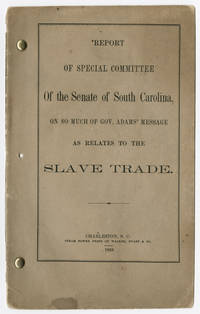
1858réf. 53597Charleston. 1858. Report submitted to the South Carolina Senate which concludes that slavery is essential to the agricultural production of the South. Additionally the committee felt that the slave trade helped relieve Africa from "the pressure of a redundant population as might be afforded by emigration in the only form in which its benefits can be extended to them." Original printed wrappers. Spine perished held together with brass tacks; light chipping and soiling. Paper lightly and evenly toned. Good. unknown
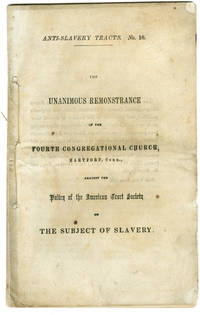
1855réf. 55824New York: American Anti-Slavery Society 1855. Criticizing the American Tract Society for Suppressing Anti-Slavery Works The scarce second printing of what is technically the first edition of this anti-slavery pamphlet printed in New York by the American Anti-Slavery Society from the same "stereotype plates.without alteration" as the edition printed in Hartford earlier the same year. The text focuses on an appeal to the American Tract Society to take a more vocal and concerted stand against slavery. The authors of the text accuse the American Tract Society of "suppression" of anti-slavery sentiment by censorship of certain works it publishes that speak against the institution and an overall sin of "studied and persistent omission" by not itself issuing "a direct condemnation of the most giant iniquity of our land." The text is signed in print at the conclusion by "The Members of the Fourth Congregational Church Hartford Conn." The work was issued as the sixteenth entry in the American Anti-Slavery Society's "Anti-Slavery Tracts." Gathered signatures stitched as issued. Minor edge wear spotting and soiling. Very good. SABIN 30676. unknown
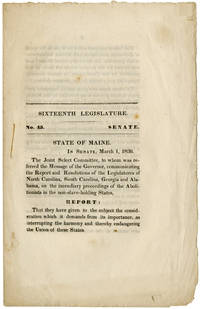
1836réf. 52765N.p. likely Augusta. 1836. Mainers Propose to Not Meddle in the Slave States A rare Maine slip-bill document resolving that the citizens from Maine and other states should not interfere with the issue of slavery in slave-holding states. The legislature writes: "Any interference therefore of a State or the inhabitants of a State with the domestic concerns of another State is dangerous as having a direct tendency to create jealousies between the States and thereby weakening the attachment to the Union which is our only security against domestic dissensions and foreign aggressions." This is a somewhat surprising position for the state of Maine to have taken at the time. Maine came into the Union in 1820 as a free state to balance the admission of the slave-owning state of Missouri. Also Maine opposed the admission of the Republic of Texas in 1836 the same year the present document was printed on the basis of Texas' position on slavery. It is curious that they would take two seemingly opposite positions in the same year. Still the legislature printed the resolution and authorized copies to be sent to the four southern slave-owning states mentioned in the title. Folded sheets stitched. Minor foxing and toning. Very good. Untrimmed. unknown
1831réf. 40189Washington. 1831. The Society attempted to alleviate the problem of slavery and degradation of free Blacks by establishing a colony for them outside the United States preferably in Africa thereby "separating them WITH THEIR OWN CONSENT from the white race." The Society established the colony of Liberia in 1822 assisting African Americans to resettle there. The colony continued to grow for the next twenty years and Liberia declared itself an independent state in 1847. Not in AMERICAN IMPRINTS. Original cream printed wrappers. Wrappers detached. Contemporary ownership inscription on front cover. Some light foxing and tanning to a few leaves else clean and bright. About good. Untrimmed. unknown
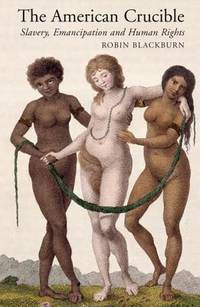
réf. Blackburn-CrucibleNew. unknown
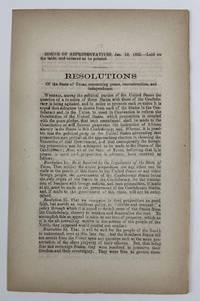
1865réf. 4902Richmond Va.: January 19 1865. Very good. 3pp. printed on a single folded sheet. Minor toning and wear. A defiant screed issued by the Confederate House of Representative in January 1865 printing eight resolutions by the Texas Legislature passed in November 1864 to be presented to the President of the Confederate States should a "re-union" between the Confederacy and the Union occur at the end of the Civil War. Paramount among the Texas House's concerns is their insistence that an amendment be made to the U.S. Constitution that "will forever guarantee the institution of African slavery in the States in this Confederacy." The third resolution prints a familiar refrain in which the Texas House argues that their secession from the Union was not motivated "upon any questions such as the mere preservation of the slave property of their citizens" but rather in order to "preserve their freedom and their sovereignty" i.e. state's rights. Further in this same resolution the Texas legislature warns that they "are still unwavering in their resolution to preserve their freedom and their sovereignty without which all else is valueless." Other resolutions cover trade with foreign powers the South's unfavorable opinion of Abraham Lincoln "a Chief Magistrate with the purpose that he should destroy our liberties in disregard to the Constitution" the South's inability to accept reconciliation with the North and proposes that any end to the Civil War must begin with the U.S. government "making their proposition to the Government of the Confederate States which alone can entertain it." Resolution five contains fiery language cataloguing the "inhumanities of this war" which concludes with an unsurprising but nonetheless eye-opening accusation: "Lying to themselves and pretending to the rest of the world that they are fighting the battle of freedom for four millions of happy and contented negroes they are attempting the enslavement of eight millions of freedmen. With devilish mockery of philanthropy. they have deluded and dragged these negroes from their comfortable homes to use them as screens from our weapons in the day of battle and they have sent them by thousands to painful death by neglect exposure and starvation. January 19 unknown
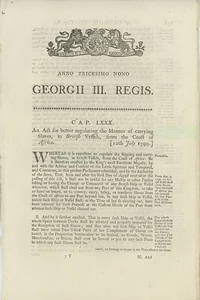
1799réf. 28145London: Printed by George Eyre and Andrew Strahan Printers to the King's most Excellent Majesty 1799 1799. ESTC N60288 Lincoln's Inn Library and Wellcome Institute. Fine. 4to disbound paginated 637-652 untrimmed. An act passed by Parliament in the summer of 1799 delineated in 39 paragraphs that regulated the slave trade beginning in August 1800 - an act no doubt intended to placate the growing voices of opposition to the English slave trade. The act stipulates how many slaves could be stowed in a ship by mathematical formula according to the size of the ship but never more than 400; that slaves must be separated from other cargo; and that the space for the slaves "be full and complete perpendicular height of five feet." Nothing is said about their treatment other than that the ship's surgeon was required keep a log of illnesses and deaths of both slaves and crew. Much of the act is taken up with its enforcement and the penalties and fines for violations; it also regulates the conditions and treatment of the crew. The acts of Parliament were usually published separately and later issued in collections of the Public General Statutes; this one was issued as part of the collection of statues Passed in the Thirty-Ninth Year of the Reign of His Majesty King George the Third: Being the Third Session of the Eighteenth Parliament of Great Britain. This copy is disbound from such a volume. (London: Printed by George Eyre and Andrew Strahan, Printers to the King's most Excellent Majesty, 1799) unknown
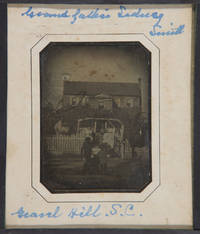
1845réf. 42820850A unique survival. This important collection of largely identified photographs documents the home and family of Dr. Sidney Smith and those he enslaved at Gravel Hill his South Carolina plantation. The collection includes an extraordinary daguerreotype depicting Dr. Smith his two daughters and his brother posed together with two enslaved African American men. This is one of the earliest known images—if not the very earliest photograph—of an identified plantation owner posing with enslaved African Americans. The photographs : 1. Quarter plate daguerreotype 4 x 3 1/8 in. of Gravel Hill Plantation near Robertville St. Peter's Parish Beaufort District South Carolina. Ca. mid-to-late 1840s. Manuscript notation on passe-partout mat "Grandfather Sidney Smith Gravel Hill S.C." The image shows the plantation house with various figures engaged in an unidentified activity with a horse tied to a picket fence. The two girls in white may be Sidney Smith's daughters Arabella b. 1832 and Julia b. 1837 and the others may be enslaved African American children. An enslaved African American subject stands on the steps in the background. In the foreground are two figures with an unknown object perhaps a dog cart or a bone-shaker bicycle. In front of the house is a heavily-vined grape arbor presumably connected with Smith's efforts in viniculture. 2. A quarter plate tintype copy of the above daguerreotype. 3. Sixth plate daguerreotype of Sidney Smith his daughters Arabella and Julia his brother James Laurens Smith and two unidentified African American men almost certainly enslaved men. Ca. mid-1840s-1850. One of the girls is blurred because she is hold a struggling dog. Accompanied by the envelope in which the daguerreotype was discovered with penciled notation about the subjects as well as a tentative date of "1850 or thereabout." 4. Sixth plate daguerreotype of Smith's daughters Arabella and Julia pointing to a book and an unidentified object. Ca. mid-1840s-1850. 5. Sixth plate daguerreotype of Sidney Smith. Ca. 1845. Smith appears to be wearing a mourning band on his coat suggesting that the image was made following the death of his first wife Eliza in March 1845. 6. Sixth plate tintype copy of the above portrait. 7. Sixth plate tintype portrait of Maria King Smith second wife of Sidney Smith with an infant possibly William King Smith. A period copy image. 8. Sixth plate ambrotype of William King Smith son of Sidney and Maria Smith possibly as a cadet. Ca 1850s. 9. Quarter plate ambrotype of Sarah Smith sister of Sidney and James Laurens Smith aunt to Arabella and Julia. Ca 1850s-1860s. 10. Sixth plate ambrotype of Rosa Nicholes sister of Maria Smith with "Eddie" Postell possibly the Edward Postell who was killed in action in 1863 at Fort Wagner. Ca 1850s. Dr. Sidney Smith Sidney Smith was born in 1805 in or near Beaufort SC the son of William Smith a man of moderate wealth and Elizabeth Wilson Smith of Philadelphia reportedly a Quaker. Sidney was sent to Yale College and subsequently studied medicine in Ohio. His younger brother James Laurens Smith b. 1809 studied law but he apparently never practiced devoting himself instead to agriculture. Sidney Smith married Eliza Lawton in 1829. The two had several children including daughters Arabella and Julia. Smith was apparently practicing medicine in the vicinity of Robertville South Carolina as well as trying his hand at being a planter. In 1831 he appears in the Lawton Family Papers as having been paid two dollars for "expirating a Fungus Tumor from the head of Little Negro Shiloh" Inabinett 1963. His name appears in several land transactions in the upper St. Peter's Parish in Beaufort District where he experimented with various crops. Smith's experiments with wine received wide-ranging coverage in the press. A notice in the Boston Daily Atlas of 28 December 1844 printed a report from a Savannah newspaper: "This editor of the Savannah Republican has samples of eight kinds of wine made by Dr. Sidney Smith of Robertville Beaufort District S.C. They are pure juice of the grape without the addition of any spirits whatever. One of the specimens is from the vintage of 1833 another from that of '38 and the other six from that of the present year. They differ in flavor according to the species of grape from which they were expressed … Dr. S. has on hand some 800 gallons of those wines which he finds useful for all medicinal and culinary purposes." Smith's first wife Eliza died in 1845 at the age of 37 possibly explaining her absence from the group portrait. In 1846 Smith married Maria Ann King with whom he would have two children who survived into adulthood William King Smith b. 1846 and Walter Watson Smith b. 1849. By 1850 Smith and most of his family had left Gravel Hill and relocated to Marietta Georgia where he acquired another plantation Rockford near Marietta. By this time Smith had acquired 74 slaves according to the 1850 Slave Schedules of the United States Census. He continued to run Gravel Hill as an absentee owner from Georgia. In 1853 Smith sold Gravel Hill then comprising 700 acres and his other plantation properties in the Robertville area to John Goldwire Lawton in 1853 according to genealogical records at the Heritage Library Foundation. Smith's Gravel Hill home appears to have been on the site of present-day Gravel Hill Plantation the ca. 1910 hunting preserve near Robertville on the National Register of Historic Places. The elaborately decorated center-hall plan home as well as the town of Robertville was burned by W.T. Sherman's troops in 1865. After the war the land was sold to Northern buyers. Newer structures were apparently built on the foundations of the original Gravel Hill around 1910 when it was refashioned as a gentleman's hunting plantation. Dr. Smith and his wife Maria died in 1856. Their sons Walter and William became wards of Smith's brother James who himself apparently died in 1865. Walter Smith was a student at the Georgia Military Institute when it closed at the time of W. T. Sherman's approach in 1864. At the age of 14 he and the other cadets were sent to guard the river crossings in the approaches to Atlanta. With his brother William Walter served in Confederate units until the end of the Civil War. Sidney Smith's sister Sarah known as "Aunt Sarah" to Walter and William Smith wrote vivid letters describing the evacuation of Marietta and her flight to Atlanta. While no documentary evidence of the Smith family's views on slavery has been found Susan E. Geoffrey claims in her academic paper "A Southern Family in Transition 1830-1865" that Sidney and his siblings were "reasonably humane to their slaves according to the standards of their society." Geoffrey adds that Sidney's sisters Sarah and Hannah developed an interest in educating their brothers' enslaved children. Dexter's biographical sketch of Smith notes that Smith "opposed strenuously the act of nullification in South Carolina and by his personal efforts retarded the action of that State." Smith's brother James provided in his 1853 will that every tenth! child born into slavery in the estate should at age eighteen be granted freedom to be facilitated by the Colonization Society. The photographers The photographers of these images are unidentified but it appears that Smith himself may have made two of the daguerreotypes. Biographical Sketches of the Graduates of Yale College with Annals of the College History vol. 7 1913 notes of Smith: "He was a man of unusual mental gifts an earnest student and devoted to the community and mankind. When the art of the daguerreotype was first introduced he was a pioneer in cultivating it in the South." Based on his interest in the "art of the daguerreotype" it is possible that Smith created the daguerreotypes himself perhaps with the aid of an assistant so he could be included in certain images most notably the group portrait. The informal group portrait shows a relaxed family posing together. Smith appears to have moved into the frame at the last moment after setting up the shot. Likewise the subjects in the Gravel Hill daguerreotype are in casual poses as if they are in a Daguerreian snapshot of the family rather than formally arranged portraits. Dating The approximate dating of the featured images has been determined based on the estimated ages of Smith's daughters Arabella and Julia who are pictured in two or perhaps three of the daguerreotypes. Arabella b. 1832 and Julia b. 1837 appear to be around the ages of twelve/thirteen and eight/nine respectively. The girls appear together in a sixth plate daguerreotype portrait and in the sixth plate group portrait of Dr. Sidney Smith his brother and two unidentified African American men almost certainly enslaved subjects. The sisters may also be the two girls in white dresses on the steps of the house in the quarter plate daguerreotype. This dates those daguerreotypes to the mid-1840s and no later than 1850 thus making them among the very earliest photographs of a slave-holding antebellum plantation. A rare opportunity It is evident that Dr. Sidney Smith wanted to use the new art of photography to create a visual record of his plantation home at Gravel Hill and of his family and the enslaved individuals who worked for him. The daguerreotypes offered here most notably the group portrait of Smith with his brother daughters and two Black men are unique in depicting enslaved subjects posed together with their owner especially in a relatively informal setting. We are not aware of comparable images dating from the mid-to-late 1840s. This exceptional collection of photographs from an identified family in the antebellum South is worthy of further research. References Dexter Franklin Bowditch. Biographical Notices of Graduates of Yale College 1913 Geoffrey Susan E. "A Southern Family in Transition 1830-1865" 1982 Accessed online through the Heritage Library History and Research Center in Hilton Head SC September-October 2024. Background on the Smith family is derived from this academic paper although the research center's copy is incomplete lacking numerous footnotes and bibliography. Some but not all of Geoffrey's sources have been located in the William King Smith Papers Wilson Special Collections Library UNC Chapel Hill. 1845-1850 four daguerreotypes and ca. 1855-1860 three ambrotypes plus three early tintype copy images. 10 items.
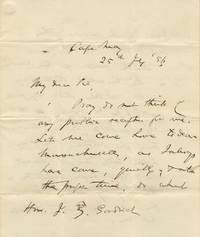
1856réf. List3745Cape May New Jersey 1856. Folded sheet with letter on three of four pages measuring 8 ½ x 7 ¼ inches. Fine condition. In May 1856 Senator Charles Sumner of Massachusetts delivered his incendiary "Crime Against Kansas" speech condemning slavery's expansion into the territories and attacking the architects of the Kansas-Nebraska Act. Three days later Representative Preston Brooks of South Carolina entered the Senate chamber and brutally assaulted him with a cane inflicting injuries severe enough to remove Sumner from public life for years. The attack became one of the defining symbolic episodes of the sectional crisis before the Civil War. Northern newspapers followed his condition closely and his empty Senate seat itself became a political emblem. Written from Cape May only two months after the attack while Sumner remained under physician supervision and uncertain whether full recovery would come quickly-or at all-Sumner writes here to a political ally in Massachusetts describing his physical and mental state: "My dear Sir "Pray do not think of any public reception for me. Let me come home to dear Massachusetts as I always have come quietly & at the proper time do what I can for the cause. This is best. Another reason for this course is the uncertain state of my health. I am still very feeble with such recurring ups & downs that my complete restoration seems sometimes far distant. My physician tells me I cannot be strong before September & then only by entire absence from all excitement. Perhaps not then. "Think of these things; & let us all join to stir Massachusetts in the good work forgetting men & remembering only the cause. "Ever sincerely yours Charles Sumner "P.S. From here I go to the mountains; but my address will be with Rev. Wm. H. Furness Phila. to Hon. J. Z. Goodrich" The letter gives a personal insight into the fallout of one of the most dramatic and violent political events of the antebellum sectional crisis. Sumner would return to politics three years later and the event would galvanize both Southern sympathizers to Brooks who sent him canes as tokens of gratitude and the Northern anti-slavery cause which considered Sumner a martyr. We find two other examples of letters by Sumner discussing the aftermath of the attack in all historical auction records.
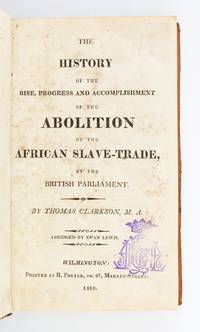
1816réf. ST19567-131Wilmington: Printed by R. Porter 1816. Abridged Edition. 180 x 115 mm. 7 x 4 1/2". 348 pp.Abridged by Evan Lewis. Contemporary tree calf smooth spine with double gilt rules tan leather label with gilt lettering. With one small illustration of a seal in text. Title with crowned monogram stamp in purple ink. Sabin 13486. Calf with significant wear front hinge exposed but the binding very tight; text as expected with varying sometimes noticeable degrees of foxing and browning because of quality of paper. First published in two volumes in 1808 this important work on the history of the slave trade is an "invaluable" resource and "contains much essential autobiographical and other information." DNB The present edition was condensed into one volume in order to "be more generally diffused among the people of the United States" where slavery would not be abolished for another half a century. Thomas Clarkson 1760-1846 was a leading English abolitionist who advocated for an end to slavery world-wide and was an original founder of the Committee for the Abolition of the Slave Trade as well as the pacifist Society for the Promotion of Permanent and Universal Peace. Printed by R. Porter