CONSTITUTION SLAVERYBiblio.com
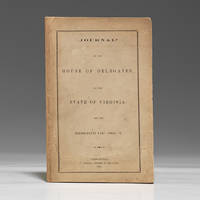
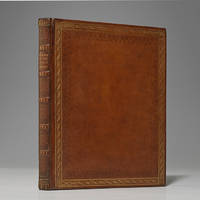
1865Best.-Nr. 1260191865. First Edition. CONSTITUTION. Journal of the House of Delegates of the State of Virginia. for the Session of 1864Ñ5. Alexandria: D. Turner 1865. Octavo original front printed wrapper respined renewed rear wrapper original string stitching; pp. 1-3 4-83 1. Housed in a custom chemise and clamshell box. $4500.First edition one of 500 copies of the momentous Journal featuring its February 9 1865 entry on the Alexandria Virginia government's passage of the 13th Amendment mere days after the U.S. Congress the first of the four Unionist southern states to pass the Amendment also featuring the governor's Message noting: ""though we have in inherited from our fathers of the revolution the blessings of a great nation yet they also left to us an inheritance of African slavery which has proved a bitter dreg in our cup of freedom"" a vital record of forces for constitutional change near the end of the Civil War.Soon after the 1860 election amidst southern secession ""the great questions of union or disunion war or peace hung in the balance. Probably the crucial weight on the scale was VirginiaÉ as long as the federal government did not seek to coerce the states Virginia secessionists were unable to achieve a majority. When Lincoln responded with force to the attack on Fort Sumter however the vote in Virginia went in favor of secession."" Subsequently a Virginia convention ""met in Wheeling on May 13 1861É it elected as Governor Francis Pierpont a western Virginian and ardent Unionist and arranged for the creation of a legislature to replace the body sitting in RichmondÉ in July 1861 the new legislature met at the 'Restored Virginia' capital of Wheeling in a special session called by Pierpont."" Against its ""claim to represent a majority of Virginians"" a new state of West Virginia was created in 1863 and Pierpont's government moved to Alexandria to govern areas of Virginia under Union occupation Harrison Lawfulness of the Reconstruction Amendments 380-83.Scholars observe that the 13th Amendment its fellow amendments and Reconstruction as ""both a political process made possible by military successes and constitutional thought grew from wartime as well as post-Appomattox developments"" Hyman and Wiecek Equal Justice 247. This rare first edition of Journal of the House of Delegates substantiates that in documenting passage of the 13th Amendment by Pierpont's Virginia government mere days after the U.S. Congress passed the Amendment on January 31 1865. With that Virginia became the first of the four Unionist southern states that ratified the 13th Amendment. Of those Louisiana followed on February 17 with Arkansas and Tennessee that April. The 13th Amendment is the focus of the Journal's entry for February 9 1865 which states: ""Mr. Brownley called up Senate bill No. 12 entitled 'An Act to ratify the joint resolution of Congress passed January 31 1865 proposing an amendment to the Constitution of the United States.' The bill was read the first and second timeÉ and the rules were suspended and the bill read the third timeÉ and the bill passed."" Also notable herein is the complete printing of Governor Pierpont's opening Message where he notes: ""though we inherited from our fathers of the revolution the blessings of a great nation yet they also left to us an inheritance of African slavery which has proved a bitter dreg in our cup of freedom."" He speaks at length of the rights due people of color and the abolition of laws such as those that prohibit ""negro testimony"" or proscribe a ""different punishmentÉ for persons of African dissent"" from that of ""white persons.""""The legislature met for its second session on December 5 1864É The governor's message was a long and important document and indicated the changes of opinion that the war was bringing about. Pierpont gave his views upon the all-important negro question. He congratulated the constitutional convention which had met in the spring on the abolition of slavery in Virginia and advocated sweeping changes in the laws concerning negroes. The act prescribing different punishments for blacks should he said be altered in accordance with the amended constitution as well as the law for apprenticing them. The law prohibiting the education of negroes should be abolishedÉ His language was on the whole very moderate. He advised the legalizing of the marital relations of negroes and most important the establishment of public schoolsÉ Notwithstanding the governor's advice no acts of great importance passed the legislatureÉ On February 9 1865 the assembly ratified the 13th Amendment to the Constitution of the United States. It adjourned on March 7"" Eckenrode Political History of Virginia During the Reconstruction. Faint ""U.N.C. Duplicate"" stamp to front wrapper.Text fine; just a bit of faint soiling and a tide line to fragile front wrapper. An excellent copy of this elusive item. unknown
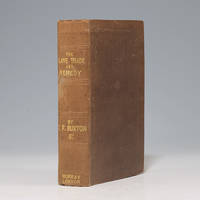
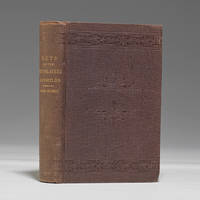
1840Best.-Nr. 1132391840. First Edition. SLAVERY BUXTON Thomas Fowell. The African Slave Trade and its Remedy. London: John Murray 1840. Octavooriginal brown clothuncut and partially unopened; pp.14 viii 3 6-273 274-276 i ii-vi 277 278-582. $2800.First expanded and revised edition of British abolitionist Buxton's powerful call for an end to the slave trade the first to include his extensive and influential Remedy two major works that followed the lead of Wilberforce in calling for treaties and commerce to end the slave trade and outlined a way to ""secure the regeneration of Africa through agricultural development"" with large folding map a handsome copy in original cloth.Quaker Thomas Buxton was in Parliament when in 1824 Wilberforce asked him to become his successor. ""In 1789 Wilberforce had begged Parliament to 'make reparation to AfricaÉ by establishing a trade upon true commercial principlesÉ Fifty years later Buxton redeveloped this appeal in The African Slave TradeÉ To support his vision Buxton formed the African Civilization Society July 1839."" In this first expanded edition of African Slave Trade 1839Ñthe first to include his RemedyÑBuxton argues for the ""agricultural colonization of West Africa and the development of a broad-based commerce that could undercut the economic dominance of the illicit slave trade"" Hopkins Peter Thonning 615. He documents the horrors of the Middle Passage to show that despite all efforts to end the slave trade ""twice as many human beings are now its victims as when Wilberforce and Clarkson entered upon their noble task."" And in Remedy he further develops his argument: showing how ""legitimate commerce would put down the Slave Trade by demonstrating the superior value of man as a laborer on the soil to man as an object of merchandise.""With African Slave Trade and its Remedy Buxton powerfully ""synthesized contemporary currents of thought developed the arguments about the relationship between abolition and African improvement more systematically than before and then catapulted them to national prominenceÉ His views prevailed. The belief that the only way to suppress the African slave trade was to promote 'legitimate commerce' and that this new trade would launch Africa on the road to moral and material progress became the conventional wisdom in mid-19th-century Britain."" Among those he convinced was David Livingstone who as ""an unknown medical student attended the 1840 meeting of the African Civilization Society where Buxton first announced his remedy for the slave trade. What Livingstone heard on that occasion helped inspire a lifetime of work and travel on the continent"" Mann Slavery and the Birth of an African City 88-90. First expanded and revised edition: first to include Buxton's Remedy which was issued separately in 1839. Precedes the first American edition. With folding map of ""Central Africa."" Paginated as issued without loss of text. With 14-page ""Prospectus of the Society for the Extinction of the Slave Trade and for the Civilization of Africa"" preceding title page. Sabin 9685. Goldsmith's 31743. Kress C5121 See Goldsmith's 31181; Kress C4818; Blockson 9121. Interior fresh with light foxing to folding map as often front inner paper hinge starting but very sound mild rubbing and toning to bright original cloth. A desirable near-fine copy. hardcover
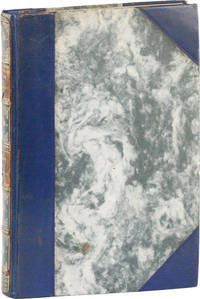
1884Best.-Nr. 52888Boston: Printed by the Order of the City Council 1884. First Edition. Small quarto 26.5cm; marbled paper over navy blue calf spine in seven compartments with six raised bands leather labels titling and decorative elements stamped in gilt on spine; marbled endpapers; engraved portrait frontispiece1011-70 with an additional 31 leaves bound in. Armorial bookplate of Walter Merriam Pratt on front pastedown. Re-backed with the original spine laid down; light wear to upper and lower board edges with some touch-up to leather at crown and heel; Very Good. A grangerized copy containing 22 ANS and ALS ca.1-4pp one autograph sentiment a 4.25" x 6.5" cabinet card signed by Phillips and several clipped portraits of various sizes depicting Phillips his wife and his son in uniform. Most prominent among the letters are those written to G.W. Putnam 6 H.G. Denny 2 R.L. Winthrop 2 John Boyle O'Reilly 1 and an October 8 1853 ALS to abolitionist and social reformer Gerrit Smith in which he claims to have mislaid his letter but is available to come to Brooklyn either on 15 December or 5 January 1854 and that his fee would be fifty dollars. Handsome volume memorializing American abolitionist and orator Wendell Phillips 1811-1884 commissioned by the City of Boston in an edition of 5000 copies. Nearly half the text is comprised of the eulogy by George William Curtis and includes extensive remarks by city council members and aldermen a prayer by Rev. Minot J. Savage an address by the Mayor and a poem by Mrs. Mary E. Blake. A proud son of Boston Phillips abandoned a career in law after being converted to the cause of abolitionism by William Lloyd Garrison in 1836. He was a frequent speaker at meetings of the American Anti-Slavery Society active in the free-produce movement a member of the Boston Vigilance Committee and an early advocate of women's rights. Later in life he turned considerable effort towards gaining equal rights for Native Americans and together with Helen Hunt Jackson and Massachusetts Governor William Claflin helped found the Massachusetts Indian Commission. cf.BAL 4347. Printed by the Order of the City Council unknown
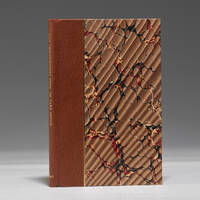
1850Best.-Nr. 1210761850. First Edition. SLAVERY SMITH Gerrit. Substance of the Speech Made by Gerrit Smith in the Capitol of the State of New York March 11th and 12th 1850. Albany: Jacob T. Hazen 1850. Octavo period-style half calf gilt marbled boards; pp. 1-3 4-25 26-27 28-30. $1500.First edition of the bold abolitionist's Speech proclaiming the Constitution ""does not allow the three million of our colored countrymen to be held in slavery"" a close friend of Frederick Douglass who ""openly embraced Smith's version of an antislavery interpretation of the Constitution"" delivered the same decade as John Brown's Harpers Ferry raid substantially financed by Smith.Smith a wealthy philanthropist was ""among the most outspoken"" of white abolitionists Jackson Force and Freedom 65. Once linked to William Lloyd Garrison's view of the Constitution as a ""covenant with death"" Smith split from Garrison and became a founder of both the Liberty Party and its successor the Radical Abolitionist Party. He was as well key in forging a close interracial alliance between Frederick Douglass Black abolitionist and physician James McCune Smith and John Brown. The four men shared the goal of achieving ""a 'radical change' in government."" By the early 1850s Douglass ""openly embraced Smith's version of an antislavery interpretation of the Constitution"" Blight 213. To Smith Douglass and figures as Alvan Stewart and Lysander Spooner ""the Constitution empoweredÑeven requiredÑCongress to abolish slavery in the southern states by direct legislationÉ As an editor Douglass had always engaged with national politics. Now the federal authority at the base of slavery's stranglehold on America became his intensive focus"" Blight 214; emphasis in original.This very scarce first edition captures the force of Smith's groundbreaking 1850 Speech and clearly demonstrates the breadth of his constitutional argument. Declaring ""law is for the protection of rightsÑnot for the destruction of rights"" emphasis in original he cites passages in the Declaration and Bill of Rights and addresses the pivotal ""three-fifths"" clause. Smith proclaims the Founding Fathers did not intend ""to make this whole land the slaveholder's hunting ground"" and asserts the Constitution ""does not allow the three million of our colored countrymen to be held in slavery."" He would use his wealth to help establish a Black settlement at North Elba N.Y. which was ""John Brown's permanent residence from 1854 until his death"" Stauffer Black Hearts 3. After Harpers Ferry and Brown's execution Smith faced demands that he be tried as an ""accessory after the fact."" While he ""publicly denied it Smith gave warm encouragement and financial assistance"" to Brown and the Harpers Ferry insurrection. Yet ""guilt over the failure of Brown's raid and fear of possible arrest as a co-conspirator caused Smith to commit himself to the Utica State Lunatic Asylum"" ANB. In time he publicly retreated from his Radical Abolitionist stance and died in 1874. Sabin 82670. A fine copy. hardcover
1845Best.-Nr. 1216681845. First Edition. PHILLIPS Wendell. Can Abolitionists Vote or Take Office under the United States Constitution New York: American Anti-Slavery Society 1845. Octavo half calf-gilt marbled boards; pp. 1-3 4-39 1. $1500.First edition of the provocative abolitionist's fierce attack on the ConstitutionÑproclaiming it ""an irredeemably proslavery document""Ñdeclaring its legacy implicates ""all Americans in the crimes of slaveholding"" and caused the American flag to be weighed ""heavy with blood.""An eloquent writer and orator abolitionist Wendell Phillips was the ""most important ally"" of William Lloyd Garrison who famously contended the Constitution was a ""covenant with death"" and ""an agreement with Hell."" As Garrison's ""deepest source of inspiration"" Phillips saw the ""abolitionist as the catalyst for revolution."" In this seminal work he contends ""that the U.S. Constitution was an irredeemably proslavery documentÉ and abolitionists must withdraw support from the political system because it implicated all Americans in the crimes of slaveholding"" ANB. He notes herein that since the ratification of the Constitution Americans witnessed ""slaves trebling in numbersÑslaveholders monopolizing the offices and dictating the policy of the GovernmentÉ making the courts of the country their tools.""A citizen's vote Phillips declares is ""an oath to support the ConstitutionÑthe whole of itÉ a contract with the whole nation"" emphasis in original. He cites key clauses quotes statements made by James Madison and others during its ratification and counters a series of 16 objections to the Garrisonian/Phillips position. In answering ""the question of slavery"" he states: ""we are not dealing with extreme casesÉ every sixth man is a slaveÉ the national banner clings to the flag-staff heavy with bloodÉ If the Constitution is not what history unbroken practice and the courts prove that our fathers intended to make it and what too their descendantsÉ say they did make it and agree to upholdÑwho shall decide what the Constitution is"" Scholar Paul Finkelman points out that while there now seems certain failure in the Garrisonian/Phillips position that the Constitution ""logically led to the conclusion that the free states should secede from the unionÉ in the 1830s and 40s the idea of a northern secession as a way of destroying slavery made some senseÉ what would happen if the Garrisonians accomplished their goal and the North left the Union to form a nation based on freedom instead of slavery It would be like moving the Canadian border to the Mason-Dixon line. Suddenly slavery would be threatened in Kentucky and Virginia because slaves could now escape to a free country just by crossing the Ohio River"" Making a Covenant. Phillips is widely esteemed as ""a commanding presence in the history of the nation's struggles to overcome racial and economic injustice"" ANB. First edition first printing: No. 13 The Anti-Slavery Examiner. '""Introduction"" signed in print ""Wendell Phillips. Boston Jan. 15 1845."" With ""Extracts from J.Q. Adams"" at rear. Sabin 81919. Text very fresh tiny gutter-edge-pinholes from original stitching handsomely bound. hardcover
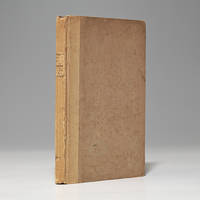
1827Best.-Nr. 1184001827. First Edition. SLAVERY STROUD George M. A Sketch of the Laws Relating to Slavery in the Several States of the United States of America. Philadelphia: Kimber and Sharpless 1827. Octavo original half tan and light brown paper boards uncut. $1350.First edition of Judge Stroud's groundbreaking 1827 work documenting state slave laws and relevant Constitutional provisions held as a key resource for Harriet Beecher Stowe's Uncle Tom's Cabin a cornerstone volume Òconsidered by many the best of the ante-bellum studies"" on slavery uncut in original boards.""The ink was hardly dry on the Constitution when the powers of Congress relative to slavery were called into question"" Dumond 153. The Fugitive Slave Act was passed in 1793 and in 1819 Congress began a bitter debate over slavery in the territories that culminated in the 1820 Missouri Act. At this time Philadelphia Judge George Stroud began work on Sketch of the Laws. ""This work the first substantial legal treatise on American slavery is considered by many the best of the ante-bellum studies"" Cohen 9877. His coverage of state slave codes and Constitutional provisions is a cornerstone of the legal literature. Published well before ""the Dred Scott decision Stroud's book had extensive influence upon national legal thinking on the issue of slavery. For example it is believed by some scholars that Harriet Beecher Stowe gained her knowledge of slave laws from Stroud's work"" Johnson Stroud's Slave Laws vi. In legal literature of antislavery one key group is on ""slave codes and their administration. The purpose of these works was to use slave law as data credible data as to the realities of slavery. The first and in many ways the best of these works was George Stroud A Sketch of the Laws"" Cover Justice Accused 149n. Blockson 9965. Sabin 93097. Work 343. Harvard Law Catalogue II:680. Text generally fresh with scattered foxing mild embrowning mild edge-wear rubbing to spine label. A very good copy of a major early work on slavery. hardcover
1809Best.-Nr. 1187761809. First Edition. SLAVERYÑABOLITION MONTGOMERY James GRAHAME James and BENGER Elizabeth. Poems on the Abolition of the Slave Trade. London: Printed for R. Bowyer 1809 i.e. 1810. Tall quarto contemporary brown calf gilt rebacked with original spine laid down raised bands marbled endpapers and edges. $2000.First edition of famed publisher and artist BowyerÕs richly illustrated volume featuring eloquent anti-slavery poems by Montgomery Grahame and Benger a major antislavery work issued shortly after BritainÕs abolition of the slave trade with engraved portraits of abolitionists Sharpe Clarkson and Wilberforce engraved allegorical title page and nine full-page engravings after paintings by artist Sir Robert Smirke a handsome wide-margined copy in contemporary boards.This handsomely illustrated volume features three epic poemsÑMontgomery's The West Indies Grahame's Africa Delivered and Elizabeth Benger's A Poem Occasioned by the Abolition of the Slave Trade in 1806. All were ""commissioned by the London publisher Robert Bowyer for inclusion in a lavish volume of antislavery poetryÉ timed to celebrate the abolition of the slave trade"" Basker Amazing Grace 612. With biographies and engraved full-page medallion portraits of leading British abolitionists Sharpe Clarkson and Wilberforce Poems on the Abolition of the Slave Trade is especially noted for its nine full-page engravings and the allegorical title page vignette engraved by Scriven and Worthington after paintings by renowned artist Sir Robert Smirke whose works were considered ""gems in the art of history painting"" American Daily Advertiser. On presenting a copy to George III Bowyer described this as a ""most beautifully embellished volume of Poems which have been written expressly for the occasion on the Abolition of the Slave Trade"" Baptist Quarterly 35. Poems won early critical praise as an ""elegant publication on the Abolition of this traffic and we congratulate the poets the artist and the editor"" Monthly Review. First edition: plates dated ""Dec. 1 1809""; portraits dated ""Jan 1 1810."" With engraved and letterpress title pages. With directions to the binder leaf bound in at rear. Lowndes 1591. Goldsmiths 19923. Kress B5549. Sabin 50145. Benezit IX:656. Occasional faint foxing chiefly marginal. A near-fine copy scarce and desirable in contemporary binding. hardcover
1710Best.-Nr. 1200341710. First Edition. SLAVERY ANONYMOUS. A True State of the Present Difference Between the Royal African Company and the Separate Traders. London: No publisher 1710. Slim octavo period-style full tan sheep gilt red morocco spine label raised bands; pp. 40. $1650.First edition of this argument against providing a monopoly over the British slave trade to the Royal African Company with tipped-in diagram of one of the Royal African Company's forts.This work attempts to highlight the irregularities of the business practices of the Royal African Company and to argue for the superiority of open trade in Africa particularly as a means of supplying slaves to the American plantations. Founded in 1660 by the royal Stuart family and the City of London the Royal African Company was founded to exploit natural resources like gold along the west coast of Africa. While the Royal African Company did participate heavily in the gold trade the majority of their income came from slave-trading. The Royal African Company was part of a concerted effortÑfully elaboration in the Navigation ActsÑto establish dominance in the slave trade since the Dutch had been the leading slave-traders prior to the Restoration. To that end the Royal African Company established a brutal and highly efficient slave-trading system eventually providing more slaves to the West Indies than any other company or state. The slaves were branded with the initials of the company or its longtime governor the Duke of York. Children were included in the transports. Between 1662 and 1731 the Company transported approximately 212000 slaves a fifth of whom died enroute. While the Company formally gave up slave-trading in 1731 they remained involved in the trade of ivory and gold dust industries dependent on labor exploitation and slavery. Goldsmiths 4605. Kress 2677. Early ink underlining and marginal notations.Small paper repair to diagram text and diagram trimmed close affecting portion of imprint and scattered catchwords not affecting readability. A very good copy. hardcover
1816Best.-Nr. 1138361816. First Edition. SLAVERY. The Interference of the British Legislature in the Internal Concerns of the West India Islands Respecting Their Slaves Deprecated. London: J. Mawman 1816. Slim octavo modern blue-gray paper wrappers; pp. 58. $1800.First edition of this defense of the West Indian slave trade arguing against emancipation.Cloaked in pro-abolition language and anonymously written by a person claiming to be an abolitionist this work is actually a zealous condemnation of British interference in the slave trade of the West Indies. After briefly discussing the abolition movement the 1807 act abolishing slavery in britain and prominent anti-slavery organization the author sets out to make his main argument: that a bill requiring registry of slaves in the West Indies would infringe on the rights of those colonies. The author swiftly aligns himself with the interests of the West Indian Planters arguing that abolishing slavery is a different cause from emancipating people of African descent. He points out that this bill is merely the first in a projected series of measures meant to emancipate the Black population of the West Indies. Set in the awkward period between 1807 and 1833 when slavery in Britain was illegal but the slave trade still thrived abroad this work makes sense of obvious hypocrisy by arguing that slavery was permitted by God and that Blacks of African descent were better off as slaves than in Africa. The will of those against slavery proved stronger and complete abolition eventually became the law of the land. Sabin 34904. Kress 21649. This work last appeared at auction over 25 years ago; prior to that it had not been seen since the 1940s.Interior quite clean with only slight pressure offsetting toning to spine of modern wrappers. A beautiful copy in fine condition. unknown
1792Best.-Nr. 1262151792. HAITI SLAVERY. A Particular Account of the Insurrection of the Negroes of St. Domingo Begun in August 1791: Translated from the French caption title as issued. London: 1792. Slim octavo modern green cloth; pp. 32. $1800.Fourth edition published one year after the very rare first of this sensationalistic account of the early months of the Slave Rebellion in Haiti the beginnings of the Haitian Revolution which ultimately led to the establishment of the first independent black state in the New World. The publishers of this polemic hoped to frighten the British public and turn them away from the abolitionists Wilberforce and Clarkson who were trying to put and end to slavery in the British colonies in the West Indies.Translated into English this is a speech to France's National Assembly ""by the Deputies from the General Assembly of the French part of St. Domingo."" The tract provides a frightening and grisly account of the August 1791 Slave Rebellion the result of ""a plot to set fire to the plantations and to murder all the whites."" The start of the insurrection by its ""perfidious"" leaders resulted in a catalogue of horrors and atrocities as the rebels ""spread over the plain with dreadful shouts set fires to houses and canes and massacred the inhabitants."" The ""fury of the cannibals"" is recounted in gory detail. The Speech is signed at the bottom of page 19 by six Deputies who call the insurrection ""the greatest calamity that has visited the human race in the course of the eighteenth century."" An Appendix records Letters and Speeches concerning the Rebellion. ESTC T110428. Goldsmiths' 15167. See Sabin 58932 1791 first edition; LCP 7460 2nd edition 1792; Work 349 1832 printing. First and last leaf slightly darkened text quite clean. Trimmed irregularly along upper margin affecting page numbers on two leaves but not any text. A very good copy of this scarce item. hardcover
1883Best.-Nr. 1255001883. First Edition. Signed. PILLSBURY Parker. Acts of the Anti-Slavery Apostles. Concord N.H.: Clague Wegman Schlicht 1883. Octavo original gilt-lettered brown cloth floral endpapers; pp. 503. $1500.First edition of the fearless abolitionist's memoir a distinctive presentation copy inscribed by Pillsbury to ""To Mr. & Mrs. F. M. CÑ With sincere regards and best wishes of their friend Parker Pillsbury. Concord New Hampshire 1894."" Hailed as a ""fighting book"" it documents the bold tactics of this notorious radical who early warned America was ""hastening toÉ a baptism of blood"" and was praised by Emerson as a ""tough oak stock of a man not to be silenced or insulted or intimidated"" a splendid copy in original cloth.Born in Massachusetts in 1809 the son of a blacksmith Pillsbury became a Congregational minister but was soon famed as one of the era's most radical abolitionists. Having once witnessed a slave auction he recorded its advertisement of: ""'two mules a horse andÉ 27 Negroes'É Does any mortal man or woman"" he asked ""comprehend all the tremendous meaning of those words"" Infamous for his apocalyptic style and confrontational tactics Pillsbury early declared the nation was ""hastening to its baptism. It is a baptism of blood."" He was resolute in denying any possible ""union with slave-holders""and also insisted ""women must be given their due rights."" Emerson admired him as a ""tough oak stock of a man not to be silenced or insulted or intimidated by a mob because he is more mob than they. He mobs the mob."" He was ""in Susan B. Anthony's eyes the Jeremiah of the anti-slavery movement"" Filler Parker Pillsbury 315 328-37.Fiercely anticlerical in his writings and in action Pillsbury would dramatically interrupt ""religious servicesÉ calling on audiences to 'come out' from their proslavery churches."" He linked most clergy to timid politicians and cautious abolitionists proclaiming them a ""brotherhood of thieves"" Robertson Hard Cold Stern Life 189. Pillsbury's 1883 memoir Acts of the Anti-Slavery Apostles was above all ""a fighting book."" In it he writes of his esteem for his fellow white radical Stephen S. Foster and leading Black abolitionists such as David Ruggles as well as his disdain for Lincoln; Pillsbury ""never forgot that the idolized Lincoln meant to save the Union and not necessarily to free the slaves"" Filler 336. First edition first printing: issued in brown cloth this copy and in green cloth no priority determined. Blockson 9099. See Work 304 1884 edition. This copy is inscribed to ""To Mr. & Mrs. F. M. Crosby."" It is notable that while there was a Crosby family of abolitionists in New Hampshire the identity of this copy's recipients could not be confirmed.Text pristine; tiniest bit of soiling to cloth. An especially handsome copy in fine condition. hardcover
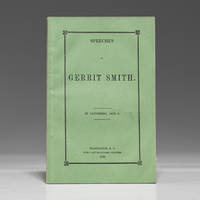
1854Best.-Nr. 1266881854. First Edition. SMITH Gerrit. Speeches of Gerrit Smith. In Congress 1853-'4. Washington D.C.: Buell and Blanchard 1854. Octavo original printed green self-wrappers original stitching. $1850.First edition of nine major 1854 speeches by radical abolitionist Smith together in print for the first time featuring elemental works such as ""No Slavery in Nebraska"" defying Stephen Douglas' Kansas-Nebraska bill and denouncing ""the federal government as a 'bastard democracy'"" very elusive in fragile original wrappers.In the early 1850s Gerrit Smith ""a man of enormous emotional complexity religious fervor antislavery commitment and wealthÉ embraced political abolitionism."" By then Frederick Douglass had become ""an outspoken supporterÉ and rejoiced in Smith's election to Congress as a radical abolitionist in 1852"" Blight Frederick Douglass 207 252. Once linked to Garrison's view of the Constitution as a ""covenant with death"" Smith split from him to become a founder of both the Liberty Party and the Radical Abolitionist Party. As documented in this collection of nine key speeches Smith in his ""congressional career of 1853 and 1854É evolved into one of America's renowned militant antislavery activists"" Gordon-Omelka Militant Abolitionist 2. Key works here such as his June 14 1854 speech ""Abolition of the Postal System"" reflected his conviction that ""the right to free discussion"" was fundamental and that ""Southerners were threatening the very openness and integrity of American democracyÉ Smith would not stand for itÉ he presaged a new generation of American abolitionists: those whose membership was inspired not by evangelical Christianity like the earlier Garrisons and Tappans but by secular liberal political ideals."" His attention to issues such asÑ""freedom of speech civil liberties social order the proper role of federal and state governments with respect to slaveryÑmotivated a new kind of political abolitionism which attracted new groups into the movement and gave them new tools for action"" Lonky Revolutionizing the Public Sentiment 56.Also notably featured here is Smith's ""No Slavery in Nebraska."" It stands as his defining response to Senator Stephen Douglas' December 1853 version of the Kansas-Nebraska bill which ""ultimately repealed the Missouri Compromise of 1820 and allowed the territories' citizens to decide the slavery questionÉ Smith signed Chase's abolitionist appeal against the bill"" and in his April 6 1854 ""No Slavery"" speech ""asserted a fresh reason to oppose the bill based on the Constitution's limits on state sovereignty.'"" Denouncing ""the federal government as a 'bastard democracy'"" he predicted ""a violent end to slaveryÉ a reckoning for deep and damning wrongs"" Gordon-Omelka 12. Soon afterward following his resignation from Congress Smith helped establish a Black settlement at North Elba N.Y. which was ""John Brown's permanent residence from 1854 until his death"" Stauffer Black Hearts 3. In June 1855 Smith Frederick Douglass and John Brown were together at the first convention in Syracuse of the Radical Abolition party. Four years later Brown was executed following the Harpers Ferry Raid that Smith helped fund causing Smith to suffer a mental breakdown. The decade after the Civil War he died in 1874. First edition:containing nine separately paginated speeches: Speech of Gerrit Smith On War. In Congress January 18 1854. Washington D.C.: Buell & Blanchard 1854; Homes for All. Speech of Gerrit Smith On the Homestead Bill. In Congress February 21 1854. Washington D.C.: Buell & Blanchard 1854; No Slavery in Nebraska: No Slavery in the Nation: Slavery an Outlaw. Speech of Gerrit Smith on the Nebraska Bill. In Congress April 6 1854. Washington D.C.: Buell & Blanchard 1854; Keep Government within its Limits. Speech of Gerrit Smith on the Pacific Railroad In the House of Representatives May 30 1854. Washington D.C.: Buell and Blanchard 1854; Abolition of the Postal System. Speech of Gerrit Smith In the House of Representatives June 14 1854. Washington D.C.: Buell & Blanchard 1854; Speech of Gerrit Smith On Mexican Treaty and ""Monroe Doctrine."" In Congress June 27 1854. Buell and Blanchard: Washington D.C. 1854; Letter of Gerrit Smith On the Reciprocity Treaty. No place: no publisher: 1854; Government Bound to Protect from the Dramshop. Speech of Gerrit Smith On Sale of Intoxicating Drinks in the City of Washington. In Congress July 22 1854. Washington D.C.: Buell & Blanchard 1843; Gerrit Smith to his Constituents. Washington D.C.: Buell & Blanchard 1854. With Nebraska Bill partially unopened. Sabin 92595; 82634; 82635; 82639; 82642; 82649; 82658; 82659; 82660. See LCP. Afro-Americana 9513 1855 ed. Fine condition. unknown
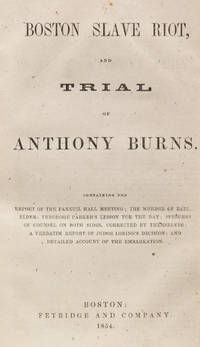
1854Best.-Nr. 1266841854. First Edition. SLAVERY BURNS Anthony. Boston Slave Riot and Trial of Anthony Burns. Boston: Fetridge 1854. Slim octavo modern half calf and marbled boards. $3000.First edition of a seminal pre-Civil War pamphlet on the 1854 arrest and Boston trial of fugitive slave Anthony Burns whose return to his Virginia slave owner at the order of the Boston court sparked public fury and ""set Boston on its ear in the spring of 1854"" inspiring Whitman to write his Boston Ballad and Thoreau to deliver his speech Slavery in Massachusetts to a July 4 1854 antislavery rally.The trial of fugitive slave Anthony Burns which ""set Boston on its ear in the spring of 1854É.was nothing less than a pocket revolution"" Von Frank Trials of Anthony Burns xii. The arrest and trial in Boston of Burns whose Virginia slave-owner Suttle followed him there was ""one of the most dramatic and famous incidents in the enforcement of the Fugitive Slave Act."" When Boston Commissioner Loring signed Burns' arrest warrant Richard Henry Dana Jr. and Charles Ellis immediately volunteered to defend Burns. On ""May 26 there was a mass meeting in Faneuil Hall to protest Burns' arrest. This meeting was followed by a poorly planned and disastrously executedÉ attempt to rescue BurnsÉ Despite conflicting testimony and imperfect evidence provided by Suttle Loring declared Burns was indeed Suttle's slave."" With that Burns was taken from the courtroom and through streets crowded with his supporters then placed aboard a ship ""for return to Virginia. The trial and removal of Burns from Boston created one of the great spectacles of the late antebellum period"" Finkelman 107-112.""The Burns case made slavery appear to Northerners as an immediate threatÉ Walt Whitman was impelled to write an ironic piece A Boston Ballad soon to be incorporated into his revolutionary volume Leaves of GrassÉ At an antislavery rally in Framingham Massachusetts on July 4É William Lloyd Garrison burned copies of the Fugitive Slave Law and the Constitution as the large crowd chanted 'Amen!' Thoreau delivered his speech Slavery in Massachusetts declaring that the American system had lost its integrity and purityÉ The antislavery sentiment bred by the case helped give birth to the Republican Party which in turn fostered Lincoln's Presidency the South's secession and the Civil War"" New York Times. Containing ""valuable primary source material about the trial and the events surrounding it"" including testimony legal documents"" as well as the full texts of the speeches of the counsel and the opinion of Commissioner Loring."" Bound without rear advertisements: ""some have advertisements at the back of the pamphlet while others do not"" no priority established Finkelman 113. Sabin 6505. Harvard Law Catalogue II:1030. Text fine. hardcover
Best.-Nr. RGW15681Stipple and line engraving unknown
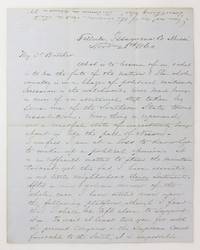
1860Best.-Nr. 6445Tallula Ms: November 28 1860. Very good. 4pp. on a bifolium. Minor soiling and wear along old folds. Otherwise clean. Written in the immediate aftermath of the Election of 1860 this letter presents a ground-level account of Southern uncertainty at the onset of the secession crisis with a very notable section on the Texas slave insurrection panic of 1860. The writer Isaac E. Nicholson lived in a region of the Mississippi Delta with a large population of enslaved people and he attempts to balance a lingering attachment to the Union with mounting fears of insurrection political collapse and economic instability. The letter moves between national politics local anxieties reports of violence in Texas and personal family concerns. He begins by describing the intensity of the moment: "The whole country is in a blaze of political excitement. Secession is the watchword." Despite this Nicholson positions himself at least provisionally against immediate disunion advocating delay and negotiation: "To wait at least two yrs.and in the mean time make certain demands upon the Northern States. This will make it a test question.whether there is any spirit of compromise left." He adds that "With the present Congress & the Supreme Court favorable to the South it is impossible for her to suffer materially" though he concedes that he may be "Left alone to support it." That moderation is undercut by a stark expression of racialized fear: "We who live in a country with about 30 blacks to one white man slumbering over a volcano.cannot long remain silent." He continues "It is no trivial matter.to retire at night with a probability of being murdered before morning. This thing has a reality here." He concludes that "The fine alternative of Revolution.will become necessary unless their aggressions.cease." The most dramatic section concerns events in Texas where Nicholson reports that his brother suffered heavy losses during unrest in Dallas: "His office & furniture & his whole library were destroyed by fire" and "His dwelling house was set on fire at three different times." He attributes the destruction to "Abolition Preachers.forced to leave for tampering with slaves" who "Endeavored to avenge themselves" adding that "The whole town of Dallas West was laid in ruins. They were both hung by a mob." Financial losses are detailed as well: "About $2000" destroyed followed by news that a New Orleans firm holding "$4000 deposited. had failed." This account corresponds to the unrest surrounding the Texas slave insurrection panic of 1860 during which fires in Dallas were widely blamed on enslaved people and Northern abolitionists and suspected agitators including Methodist ministers were expelled or killed by vigilante groups. Three men -- Patrick Jennings Sam Smith and Cato -- were killed in a public execution near Dealey Plaza now renamed Martyrs' Park in their honor. Although Nicholson presents the destruction as organized retaliation historians have generally concluded that the fires were likely accidental with the conspiracy narrative emerging from rumor and fear. His description reflects how these events circulated in Southern correspondence at the time combining real violence with exaggerated or misinterpreted causes and the passages are notable for the blending of what was presumably fact -- his brother's house catching on fire -- with the fiction of abolitionists arsonists. We find no records of correspondence or any material relating to these events in auction records or on the market at the time of writing. Overall a scarce account overall of a tragic episode in Texas history and the rumor mill that fueled it. November 28 unknown
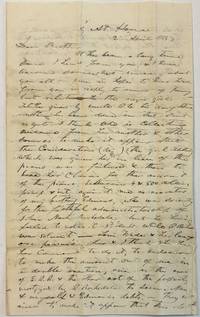
1847Best.-Nr. 40201Stewartsboro TN 1847. Folio 15" x 12-3/4" sheet folded to 7-1/2" x 12-3/4". 4 pp. Completely in ink manuscript integral address leave bearing Stewartsboro Tennessee April 3 1847 manuscript postal marking. mailing address on last page. The initials of the writer's name are difficult to decipher; this is our best guess. Old folds two short fold splits and a few tiny holes at fold corners. Wax seal remnant with tear at edge loss of a few letters some toning. Good to Very Good. The writer is concerned that Thomas had not responded to his letter "relating to the negro girl Tabitha given by Uncle R. to his daughter- nothing has been done in that suit as yet. I think she is collecting evidence from her mother & other sources to make it appear that the consideration viz the girl Tabitha which was given her in lieu of the piano was a failure & then to base her claim for the amount of the piano between 4 and 500 dollars princp. & int. against me as executor of my brother Edmond who was security for the faithful administrationship of John Nash Barksdale but he having failed to collect sd. debt while R. Barksdale was solvent. Levi Wade & her lawyer are persuading her. . . " He gives Thomas permission to "calculate on receiving a portion of the money for which Paulina sold. . . Negroes have advanced within 3 or 4 months but I fear one diseased as your boy Phil will command but a small price." Dr. Thomas Hill Read 1798-1874 of Tennessee settled in Macon County Illinois in 1831. He was the brother-in-law of Capt. David L. Allen one of the most prominent early citizens having married his sister. Dr. Read became known for his success in the treatment of children's ailments and was considered an expert in cholera infantum. He had a reputation for honesty and was said to have acted as administrator of more estates than anyone else in Macon County. Dr. Read was a member of the Decatur Board of Trustees in 1839 1841 1846 and 1847; County Treasurer from 1845-1846 and County Probate Judge from 1846-1849. John Nash Barksdale 1818-1844 Thomas Read's maternal cousin was born in Tennessee graduated from the University of North Carolina and became a lawyer. He practiced law in Tennessee for a few years and then moved to Columbus Mississippi and entered the law firm of his cousin Gen. William Barksdale. The Columbus bar announced that its members would wear the badge of mourning for thirty days following his death. "Death of John N. Barksdale" Republican Banner Nashville TN Dec. 6 1844 Page 2. Uncle R was likely Randolph Barksdale 1795-1844 Thomas H. Read's maternal uncle and John Nash Barksdale's father. Randolph settled in Tennessee with his father in 1808 and later established his own plantation. He was married three times and became the owner of a large estate and several slaves in Rutherford County Tennessee thanks to the wealth of his first wife. He also owned an estate near Chulahoma in Marshall County Mississippi. unknown
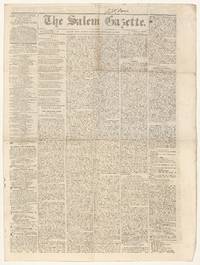
1850Best.-Nr. 515519Salem Mass: Published by C. Foote 1850. Unbound. Very Good. First edition. Folio. 4pp. Printed self-wrappers. Owner's contemporary ink name on front cover in upper margin. Text is folded lightly creased few spots of faint soiling very good. Text includes: "The Beloved Tune" by Lydia Maria Child three full columns and a thirty-six line announcement about the pending publication of Nathaniel Hawthorne's The Scarlet Letter. Also includes a brief article entitled "Mr. Clay on Slavery" printing extracts from a debate between Senator Clay and General Cass; also prints a three-line announcement about the liberation of fourteen slaves: "Fourteen slaves belonging to Dr. John Casson of Mississippi have been taken to Cincinnati and liberated by their owner. Published by C. Foote unknown
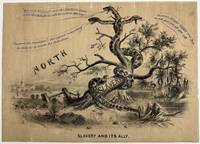
1864Best.-Nr. 12816N.p. 1864. Lithograph 14.5 x 20.5 inches. Noticeable toning small areas of light discoloration along top margin short closed tear to left edge minor dust-soiling numerous creases and wrinkles. About very good. A dramatic political cartoon issued during the Civil War and satirizing the dangerous influence of those who argue a compromise on slavery or an easy solution to the war. The work was likely issued in the midst of the 1860 but more likely the 1864 presidential election campaign. The central image of the lithograph involves a three-headed snake -- labeled "The People's Party" and emerging from the American "South" personified by a moss-covered swamp -- which is wrapped around the length of a large tree labeled "Slavery." Each snake vocalizes a different misleading message about the issue of slavery and compromise seemingly aligned with political entities such as the Peace Party and the Copperheads. The messages from each snake head read respectively "Extend Slavery over the Northern States and the Rebellion will be over in 60 days;" "Persevere till after election and then we will give you all you ask;" and "'Support the President' - but oppose everything he may do to crush the Rebellion." This latter message indicates the author of the work supported President Lincoln. The North is personified in the background at left by a depiction of the U.S. Capitol Building. The central image of the lithograph carries echoes of the story of the Book of Genesis with the involvement of a deceptive serpent amid the tree of life. The lithograph is signed in the stone at bottom right reading simply "Brooks." Though the work came to us proposing the identify of the artist as Reuben Brooks 1794-1870 we were ultimately unable to confirm this authorship. The lack of an imprint in the lithograph also precludes easy research and identification. In fact the rarity of the lithograph makes it difficult to expound much more about it at all. OCLC reports just a single copy at the Peabody Essex Museum and it is not listed in Weitenkampf or Reilly. Given its rarity and content the present lithograph offers an outstanding opportunity for further research and contextualization. unknown
Best.-Nr. DADAX1538102692Rowman & Littlefield Publishers 2017-10-06. Second. paperback. New. 5.86x0.79x9.07. Buy with confidence. Excellent Customer Service & Return policy. Rowman & Littlefield Publishers paperback
Best.-Nr. DADAX1538102684Rowman & Littlefield Publishers 2017-10-06. Second. hardcover. New. 6.21x0.95x9.34. Buy with confidence. Excellent Customer Service & Return policy. Rowman & Littlefield Publishers hardcover
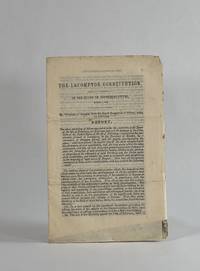
1858Best.-Nr. 9866Washington 1858. Unbound. near Very Good binding. Octavo. 16 pp. First edition. Unbound folded sheet forming 8 leaves. Old folds with some closed tears/silverfishing along a couple the creases; staining to the bottom margin of a a few leaves not touching text; otherwise generally a very good copy. Circumstances surrounding Kansas's Lecompton Constitution brought the tension surrounding the confluence of statehood and slavery to a new level. A pro-slavery document the Lecompton Constitution and subsequent votes on it were a fraught and dishonest affair complete with subterfuge false choices boycotted votes and more all in service of establishing a pro-slavery constitution in a state that's populace had a clear and before the end demonstrable antislavery majority. This report before the House by Georgia's Alexander Stephens soon to be Vice President of the Confederate State of America defends a December election that was widely boycotted by antislavery voters because the options presented to the electorate both allowed for slavery to persist in Kansas despite the misleading language of the referendum. By August of this same year 1858 a new vote would be held to keep or toss out the Lecompton Constitution. In a vote that demonstrated the antislavery sentiment of Kansas residents the Constitution would be thrown out by a 7 to 1 margin. Leaving space for a constitution to be drafted and ratified prohibiting slavery in Kansas. Krdlicka James F. Colonists Citizens Constitutions: Creating the American Republic. Sabin 91261. unknown
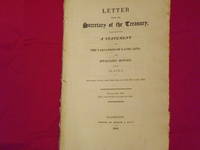
1816Best.-Nr. 100537Pamphlet formate folio disbound first pamphlet 3 leaves printed on recto only second 7pp. third 6 pages and folding chart. Pamphlet extracted from larger volumne chipping along spine and edges not affecting text second papmple completely disbound paper browned and somewhat dry These pamphlets are rare and represent an important source of information on the numbers and values of slaves in early 19th century America. The first title presents the value assigned to slaves in 11 states including New York. The second lists the number and values of slaves in the various counties in the state of Maryland. The final pamphlet presents real estate values and values on dwellings including slaves in the counties of Pennsylvania. The information in these reports was compiled by Alexander James Dallas 1759-1817 who was the Secretary of the Treasury. Dallas born in Kingston Jamaica settled in Pennsylvania and practiced law there. Eventually he would become Secretary of the Treasury in 1814 when the nation was almost bankrupt. He managed to reorganize the department get the country out of debt created a surplus and even helped promote what would become the Second Bank of the United States. ANB. William A. Davis,
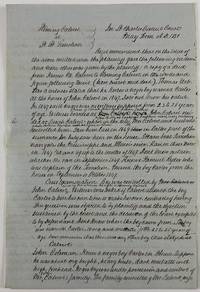
1851Best.-Nr. 13321St. Charles LA 1851. 31pp. docketed on last page. Original folds minor wear. Very good plus. An intriguing legal document from antebellum Louisiana involving the status of Carter "a dark mulatto from 23 to 26 years of age" whose ownership and/or freedom is being contested. The deposition opens with testimony regarding the last time Carter was seen by the plaintiff's family the Calverts as well as another man named John Coleman both in 1849. The testimony also discusses Carter's ability to hire himself out for work and further testimony from Joseph M. Heddy a "negro trader" who valued Carter at $750 to $800. At this point the plaintiffs rested the case. Further testimony from the defense lays out a detailed argument that Carter was actually the son of a slave named Lucinda who was owned by a man named Isham Harrison who took Lucinda to Illinois 1812. In a one-page addendum the defense asks the Court to instruct the jury that by taking Lucinda to Illinois where Lucinda gave birth to Carter that "the mother by such residence became free and any children born of the mother after the time said Isham took up his residence in Illinois are free.and the defendant is entitled to the verdict." The strategy did not work. The plaintiff won the case and was awarded $800 for Carter. unknown
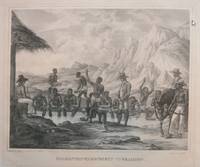
Best.-Nr. #[36399]München ca. 1830 Original lithographed plate by Meier E. Meyer and printed by J. Selb depicting the Brazilian diamond mines of Curralinho. Ca. 39 x 46 cm. From: Johann Baptist von Spix & Karl Friedrich Philipp von Martius Atlas zur Reise in Brasilien. - The atlas appeared in instalments and is rarely found complete. From 1817 to 1820 the botanist and traveller Martius 1794-1868 travelled in Brazil together with the zoologist Spix 1781-1826. Their journey was a scientific expedition financed by king Maximillian Joseph I of Bavaria. - Famous slavery print of the Brazilian diamond mines. - Unobtrusive dampstain in margin left lower corner mainly to be seen on verso few spots in margin otherwise a very fine copy. Borba de Moraes II p.p. 829; Bosch Brasilien-Bibliothek 346. unknown
2015Best.-Nr. Gyan-9789333667104Facsimile Publisher 2015. Hardcover. New. 22.59 x 14.34 x 3.27 cm. English Facsimile Publisher hardcover