1561 risultati
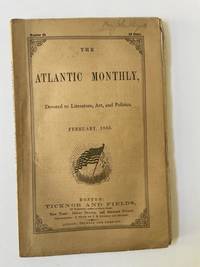
1863rif. 158141863. Emerson Ralph Waldo. "Boston Hymn" 1863 printed in the February 1863 issue of The Atlantic Monthly constitutes one of the earliest periodical appearances of his poetic response to President Lincoln's Emancipation Proclamation and stands as a direct literary intervention in the political crisis of slavery and civil war. Written at the request of Boston organizers for the January 1 1863 celebration marking the Proclamation's issuance the poem was first read by Emerson at Boston Music Hall the same day Lincoln's order took effect. In "Boston Hymn" Emerson situates emancipation within a providential and constitutional lineage explicitly aligning the Proclamation with the Declaration of Independence while declaring the abolition of slavery a fulfillment rather than a departure from American founding principles. His verse rejects compensation to enslavers and instead demands justice for the formerly enslaved: "Who is the owner The slave is the owner / And ever was. Pay him." The poem thus places emancipation within a moral economy grounded in restitution and national accountability. Emerson Ralph Waldo. "Boston Hymn." In The Atlantic Monthly; A Magazine of Literature Science Art and Politics. Boston: Ticknor and Fields February 1863. Issue No. 64. The poem appears within the continuously paginated issue pp. 146-272 plus advertisements. Original tan printed wrappers with vignette of the American flag; original advertisements present including pink advertising slip with affixed newspaper clipping; early ownership inscription "Hon. John Boyd" in pencil to front cover. This issue followed closely upon the poem's January 24 1863 appearance in Dwight's Journal of Music placing it among the earliest print disseminations of Emerson's Emancipation commentary in a major national literary periodical. The February 1863 issue appeared at a decisive stage of the Civil War as emancipation shifted Union war aims toward abolition and Black freedom. Emerson already among the nation's most visible intellectuals used the poem to frame Lincoln's executive act as a moral correction to constitutional compromise and as a theological affirmation of human equality. His public reading before approximately 3000 attendees delivered without advance notice of his participation amplified the poem's symbolic force in Boston's abolitionist culture. As printed in The Atlantic Monthly a leading forum for literary and political discourse the text entered national circulation at the moment emancipation became federal policy. Light wear to wrappers; minor age toning; contents complete with advertisements; pink advertising slip present; small penciled ownership inscription to cover. Overall very good condition. A significant Civil War-era periodical issue preserving an early printing of Emerson's poetic defense of emancipation and moral governance. unknown
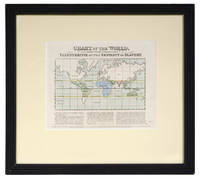
rif. 94420London Joseph Cross n.d. but c. 1825. . Hand coloured engraved map. The map shows the extent 30° north and south of the Equator in which sugar is grown. Australia is still shown as New Holland. 29.8 cm x 23.7 cm 11¾" x 9¼". Framed and glazed. Scarce colour-coded map concerning the sugar trade and its link to slavery. The section shaded yellow is the appropriate climate for the growing of sugar. The section shaded red is the area from which Britain may obtain sugar cheaply parts of South America and the West Indies under British rule. The blue section shows where Britain is unable to obtain sugar due to the devastating effects of the slave trade. The pink and green areas are those from which the sugar trade is limited by high duties and restrictions. The argument is that the duties and restrictions are there to protect the slave trade and ultimately damage the British economy. James Cropper was a successful and wealthy Quaker merchant philanthropist and disciple of Adam Smith. A major force in the anti-slavery movement he believed that eliminating tariff protections would lead to the end of slave labour in the West Indies. Cropper himself had interests in East Indian sugar and therefore stood to benefit from the reduction of tariffs which colored his role in the abolition movement. Nevertheless 'in Cropper's mind the intensity of Quaker Quietism had fused with the economic optimism of Adam Smith. Anti-slavery confirmed this union endowing laissez-faire with an immediate moral and spiritual purpose and enriching his faith in the inevitability of human progress' Davis James Cropper and the British Anti-Slavery Movement 1961. London, Joseph Cross, n.d. [but c. 1825]. unknown
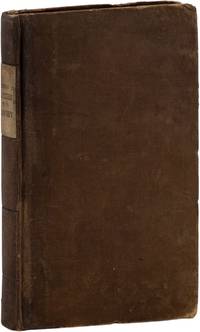
1833rif. 84791Lexington KY: Abraham Skillman 1833. First Edition. First printing. 12mo 18.5cm; original brown cloth-covered boards; viii207pp. Respined to style with facsimile printed spine label; Bookplate of the Young Men's Christian Institute New Haven to front pastedown; bookseller's ticket Williams' Bookstore Under the Old South Meeting House Boston at base of front flyleaf; pencil signature faded and illegible to front endpaper. Complete sound and Good. One of a tiny number of pre-Civil War abolitionist texts to have been written by a Virginia author. Paxton 1784-1868 was a Presbyterian minister born in Rockbridge County Virginia and educated at Princeton Theological Seminary; it is likely his mentorship there under Charles Hodge helped develop Paxton's antislavery sentiments. In 1826 after publishing an essay asserting the institution of slavery to be incompatible with the teachings of the Bible Paxton was expelled from his pastorship of Cumberland Presbyterian Church near Farmville in south-central Virginia. The present text addressed to his former congregation recounts the events of his expulsion reprints the essay in question and adds a series of epistolary essays supporting his theological position in oppostion to slavery. The existence of any abolitionist sentiment during this period in Virginia's history is remarkable in itself. For a native-born minister to willfully preach the gospel of antislavery even the relatively conservative version of abolitionism professed by Paxton before a congregation whose sentiments on the subject would have been diametrically opposed - and which doubtless included a number of slaveholding families - must have amounted to apostasy in some congregants' eyes. By publishing the present work Paxton essentially doubled down on his unpopular beliefs making him in this cataloguer's eyes a rather remarkable figure. We find it surprising that so little biographical information exists regarding Paxton. His name barely appears in the scholarly literature on the period; perhaps because no mention of abolition is made in either the title nor the sub-title of his book the work is rarely discussed in articles on the antebellum southern antislavery movement. Though reasonably available institutionally Letters on Slavery is perenially scarce in commerce having appeared at auction only three times in the current century. This a quite decent copy in a discreetly restored binding. SABIN 59264. DUMOND Antislavery Bibliography p.89. LCP AFRO-AMERICANA 7501. Abraham Skillman unknown
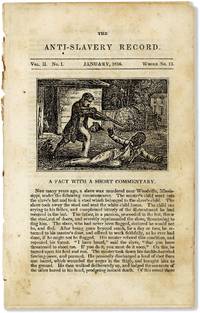
1836rif. 82919New York: American Anti-Slavery Society 1836. 12mo 19cm. Stitched self-wrappers; pp.1-12. Removed; first and final leaves detached but present; light soil scattered faint foxing; tear to bottom inch of bound edge away from text; complete and Good. Woodcut decoration at head of text a strikingly violent image depicting the murder of a Black man by his enslaver in Woolville Mississippi. Single issue of this monthly abolitionist periodical that ran from 1835 to 1837 published by the American Anti-Slavery Society under the direction of Elizur Wright. It was "a small magazine with excellent woodcuts containing principally extracts from other publications" that was "distributed freely without charge" and "found its way into the schools and colleges everywhere" Dumond p.267. Wright stated that in September 1835 the Society published 25000 copies of the Record p.267. BLOCKSON 9174. LCP AFRO-AMERICANA 622. American Anti-Slavery Society unknown
1860rif. 63532New York: Published and for sale at 5 Beekman Street 1860. First Edition. 12mo. 20th-c. binding of tan calf over paper-covered boards; marbled page edges; 951pp. About fine and complete; the pamphlet appears to have been offered without cover wrappers in any case not noted by Blanck. Uncommon first edition of this late tract by the important abolitionist and feminist Lydia Maria Child 1802-1880. Child's intention with this work was to make a direct case to southern slaveholders based not on any moral grounds but purely on business hoping that the Caribbean example would convince southerners that abolition could be achieved without wrecking their economy. "Child suggested to Samuel B. May the publisher .that the title page omit any mention of the American Anti-slavery Society giving only an address but no publisher. She even considered issuing the tract anyonymously but decided that her notoriety would probably help rather than hinder its circulation" see Karcher The First Woman in the Republic: a Cultural Biography of Lydia Maria Child. Durham 1994; p.428ff. Blanck notes two editions in 1860 as well as a reissue in 1862; this with verso of the final leaf unprinted is the first. Rarely encountered in commerce. BAL 3189. Published and for sale at 5 Beekman Street unknown
rif. SKU0602368Rowman & Littlefield Publishers 2017-10-06. paperback. Good. 5x0x9. Textbook May Have Highlights Notes and/or Underlining BOOK ONLY-NO ACCESS CODE NO CD Ships with Tracking Rowman & Littlefield Publishers paperback
rif. SKU0649875Rowman & Littlefield Publishers 2017-10-06. paperback. New. 5x0x9. New Textbook Ships with Tracking Rowman & Littlefield Publishers paperback
1852rif. 198241852. Law Howard Benjamin C. Reports of Cases Argued and Adjudged in The Supreme Court of the United States December Term 1852. Boston: Little Brown and Company 1853. First Edition Hardcover rebound. 650 pages. Measures 5.75" x 8.75". Includes various Supreme Court decisions from the year 1852 during the December session. Cases cover a wide range of topics including issues over ownership and patents land disputes with Native Americans railroad injuries and slavery among other issues. Cases include THOMAS MOORE EXECUTOR OF RICHARD EELS PLAINTIFF IN ERROR v. THE PEOPLE OF THE STATE OF ILLINOIS WHICH FOUND that the power of legislating upon the subject of fugitive slaves ought to be vested in Congress. also INCLUDED IS tHE Philadelphia AND rEADING rAILROAD cOMPANY V. eLIAS h. dERBY. Title page has stamp stating "Library of Congress Serial Record Jan. 3 1980." New boards and pastedown but all original pages are together with textblock tight and only minor foxing on title page. oFFERS A UNIQUE GLIMPSE INTO THE sUPREME cOURT DECISIONS OF 1851 during December session. Overall in very good condition. unknown
1865rif. 81012New York: American News Company 1865. First Edition. First printing. Octavo. Sewn printed wrappers; 76pp. Brief closed tear to title page margin; bit of wear at upper fore-corner of text block well away from text else a clean fresh copy in the original printed wraps; Very Good or better. Includes text of letters written to various colleagues in the antislavery ranks including Elizabeth Cady Stanton Charles Sumner and others. The first volume taking in the year 1863 was printed a year earlier. SABIN 82664. American News Company unknown
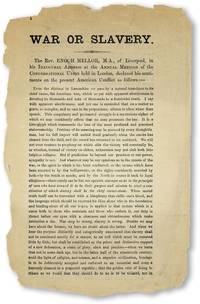
1863rif. 46597Manchester: Union and Emancipation Society n.d. ca. 1863. First Edition. Original broadsheet handbill 22x13.5cm.; extremities chipped with shallow losses not approaching text the whole rather dust-soiled and unevenly toned else Good or better overall. Text reproduces an address delivered by the Rev. Enoch Mellor of Liverpool "in his INAUGURAL ADDRESS at the ANNUAL MEETING of the CONGREGATIONAL UNION held in London" in which he "declared his sentiments on the present American Conflict." Mellor 1823-1881 was the life-long minister of the non-conformist Square Congregational Church in Halifax West Yorkshire with the exception of a five-year period coinciding with this address when he succeeded the abolitionist Congregational minister Thomas Raffles 1788-1863. Mellor's argument begins with reference to the Lancashire Cotton Panic an economic depression caused by a dearth of baled cotton imports following the start of the American Civil War. Mellr goes on to say that "War /may/ be wrong slavery /is/ wrong" comparing its presence on the American continent with that of the propagation of polygamy "carefully and resolutely laid as a foundation-stone in the territory of Utah. Union and Emancipation Society unknown
1836rif. 750641836. London: George Eyre and Andrew Spottiswoode 1836. London: George Eyre and Andrew Spottiswoode 1836. Payouts for Former British Enslavers Slavery. Great Britain. William IV 1765-1837 King of Great Britain. An Act for Carrying into Further Execution Two Acts of His Present Majesty Relating to the Compensation for Slaves Upon the Abolition of Slavery And for Facilitating the Distribution and Payment of Such Compensation. London: Printed by George Eyre and Andrew Spottiswoode 1836. 17-24 pp. Folio 11-3/4" x 7-1/2". With William IV King of Great Britain. An Act to Authorize His Majesty Until Six Months After the Commencement of the Next Session of Parliament To Carry into Immediate Execution By Orders in Council Any Treaties Conventions Or Stipulations Made with Any Foreign Power or State for the Suppression of the Slave Trade. London: Printed by George Eyre and Andrew Spottiswoode 1836. 873-876 pp. Folio 11-3/4" x 7-1/2". Disbound stab-stitched pamphlets. Light toning light foxing and soiling to a few leaves small holes to gutter of first two leaves of first act which are detached no loss to text. $950. Two acts dealing with the aftermath of the abolition of slavery in the United Kingdom. After the passage of the Slavery Abolition Act in 1833 all enslaved people in British colonies below the age of six were freed and others were redesignated as apprentices and gradually manumitted. One of the act's central provisions was a 20 million payout for "the persons hitherto entitled to the Services of such Slaves." The present act elaborates further on the logistics of the payout including the process by which former enslavers could claim "compensation" for their "great Inconvenience and Loss." The other act authorizes the king to negotiate treaties related to the end of the slave trade without Parliament when Parliament is not in session. unknown
1875rif. 61084New York: Harper and Brothers 1875. First American Edition. Octavo 24cm. Green cloth stamped in gilt; brown coated endpapers; 542pp; steel-engraved frontispiece 2 wood-enraved frontispieces 2 color maps 1 folding and 48 wood-engraved plates all with tissue guards. Inscribed "Charles V. Payne from his friend M. R. E. Christmas 1874" on front free endpaper; the same inscription is repeated with the date 1875 on a front flyleaf. A sound copy externally rubbed with superficial silverfishing to both boards internally clean with two central gatherings pulled but not fully detached short tear to folding map at gutter: just Very Good. Samuel Baker 1821-1893 was a noted British explorer of Africa. In 1860 he was appointed "governor-general of the equatorial Nile basin" by the Khedive Ismail of Egypt with duties including "annexing the equatorial Nile basin establishing Egyptian authority over the region south of Gondokoro suppressing the slave trade" and more ODNB. His success was mixed: he successfully annexed Gondokoro and did suppress the slave trade but failed to establish secure control of the region ODNB. This account published after his return to England details how he "raised and trained a fighting force.to crush" the slave trade Czech. CZECH p.11. Harper and Brothers unknown
1862rif. 61272New York: D. Appleton & Co 1862. Second Edition. Octavo 20.5cm. Green cloth titled in gilt on spine; yellow coated endpapers; 39018pp; 8 tinted lithographs. A firm copy rubbed at spine ends and bumped at corners mildly foxed: Very Good. Commander Andrew Hull Foote 1806-1963 served on the USS Perry from 1849 to 1851 suppressing the slave trade off the coast of Africa. In 1854 he published an abolitionist history of Africa describing African cultures American colonies and the slave trade. He was a noted commander for the Union Navy until his unexpected death of kidney disease in 1863. D. Appleton & Co unknown
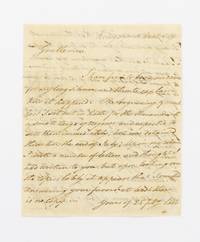
rif. 130002Very Good. Quarto 4 pages a bifolium comprising 3 pages of text with the last page used for address purposes. Creased where folded for posting; slight loss to the leading edge of the second leaf where torn open removing one word of text; overall in excellent condition. The letter dated 10 December 1791 and carried privately by ship from Kingston is addressed to 'Messrs Newton Gordon & Murdoch Merchants Madeira'. A number of lesser matters are touched upon but the letter deals primarily with the importation of wine: 'I cannot at present ascertain what quantity of wine I shall be able to dispose of next year as I have 20 pipes on hand and sales are slow from the great quantity at market; however you will please ship me twenty pipes of York market wine Barbadoes Gauge & 12 Iron hoops at first convenient opportunity'. As often with letters of any age the first paragraph contains an apology for the tardy response: 'I have first to beg your excuse for my silence and then to explain how it happen'd. The beginning of March last I set out in haste for the Havana with a small cargo of negroes and expected to sell them immediately but was detain'd there till the end of July'. unknown
rif. SONG1538102684Rowman & Littlefield Publishers 2017-10-06. Second. hardcover. Used: Good. 6.21x0.95x9.34. Buy with confidence. Excellent Customer Service & Return policy. Rowman & Littlefield Publishers hardcover
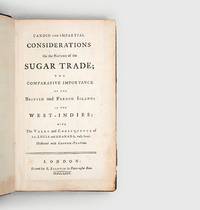
1763rif. 132583London: R. Baldwin 1763. A classic of in the field of colonial and Caribbean literature First edition of the first-named fourth of the second which was first published in Antigua 1750 under the pseudonym of "An Old Planter". John Campbell 1708-1775 was a highly successful historian and miscellaneous author Johnson thought well of him and praised the usefulness of his knowledge also describing him as "the richest author that ever grazed the common of literature" ODNB. The present work was commissioned by Lord Bute to rebut criticism of the Treaty of Paris by demonstrating "the value of colonial holdings in general and of sugar islands in particular" Ragatz. That is was felt to have done its job is perhaps confirmed by Campbell's appointment in 1765 as king's agent to Georgia. Considered by Ragatz to be a "classic of in the field of colonial and Caribbean literature embodying as it does one of the clearest statements of eighteenth-century philosophy regarding the relations that should exist between the metropole and its outlying possessions". This copy has additional material bound in: Bew's map of St Christopher's a 2-page manuscript index and bound at the rear a copy of Martin's practical essay on plantation management. Samuel Martin 1694/5-1776 had been born on Antigua but spent some considerable time thereafter in Britain on his full-time return to the island he found the family estates much run down and "embarked on a rigourous policy of reconstruction. Although he helped to pioneer improvements at most of the key stages in sugar-making and rum distillation his interests focused mainly on the non-manufacturing side of production. He was a firm advocate of crop rotation followed by marling in order to improve soil fertility. He was also instrumental in developing more effective systems of drainage and utilising windmills rather than animals for crushing the cane. By the standards of his contemporaries Martin was an enlightened slave owner. He advocated the provision of adequate supplies of food clothing shelter and medical facilities for slaves and ground for the cultivation of their own food" ODNB. His methods made him Antigua's leading and most progressive planter and during his own lifetime he certainly "succeeded in making sugar production a moderately profitable enterprise on his own estates". Both titles are moderately well-represented institutionally but neither appear with any great frequency at auction just a handful of copies of Campbell in the last fifty years and no copy of the Essay upon Plantership in any edition has passed through the rooms since 1951. Two works bound in a single vol. octavo 196 x 120 mm. Both bound without half-titles. 4 folding maps to the first-named 3 as called for; Caribbee Islands and Guyanna coloured in outline; The Harbour of Calivenie. Island of Grenada. Drawn by John Powell Topographer; and Plan of Fort Royal in the Island of Grenada and additionally a map of St. Christophers by J. Bew dated 1782 coloured. Contemporary streaked calf flat spine ruled gilt red morocco label single gilt rule to board edges Dahlia marbled endpapers. A little rubbed particularly on the joints label chipped no loss of lettering corners through small patch of insect damage to the lower board pastedowns lifting at the lower corners front free endpaper torn without loss slight erosion at the lower corner of the text-block for the first thirty pages or so mild worming to the fore-margin pp. 39-176 some small splits and closed tears to the maps no losses; overall very good. Campbell: ESTC T65879; Ragatz p. 284; Kress 6081; Sabin 10232. Martin: ESTC T81835; Sabin 44920 hardcover
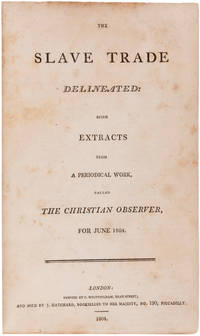
1805rif. 21055261805. London: Whittingham for Hatchard. 1805. 8vo. Recent marbled wrappers; pp. 20 printed in two columns; one corner of title-page clipped light browning; a good copy of a great rarity.This combined offprint opens with a first-hand report by 'Leo Africanus' of a journey recently made on a slave ship from West Africa to the West Indies. On board the ship the Captian told the visitors and traveller 'that a slave ship was a very different thing from what it had been represented. We should find the slaves rejoicing in their happy state' p. 3. The truth however showed the sheer horror of this crime against humanity at high sea. This is followed on page ten by a discussion of a Hatchard-published pamphlet on the abolition of the slave trade. The present pamphlet is concluded by the refutation of the printed Letter to the Right Honorable W.Pitt containing some new Arguments against the Abolition of the Slave Trade in which the author Britannicus had argued 'if we give freedom to the negroes we shall ourselves indubitable become slaves of Bonaparte' p. 13. Post-truth over two hundred years ago. unknown
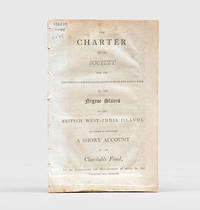
1794rif. 126550London no printer 1794 or later. First edition variously dated by ESTC and WorldCat between 1794 the date given at the end of the preliminary "Short Account of the origin and present state of the charitable fund" and 1823. The short account dated March 1794 is followed by a tipped in leaf reporting on the first meeting of the society which took place on Thursday April 3 1794 electing the Lord Bishop of London as president. The Charter of the Society 18 pages in length is dated at Westminster "this thirtieth Day of October in the thirty-fourth Year of our Reign" which again falls in 1794. Octavo 190 x 123 mm pp. ix 18. Sometime in a pamphlet vol. now disbound. Spine shows evidence of earlier binding sometime folded vertically; title lightly dust soiled page ix trimmed down and tipped onto p. viii; a good copy. Sabin 85881. unknown
1858rif. 660371858. Dividing Prize Money After the Capture of a Slave Ship Slavery. United States. In the Senate of the United States. February 21 1858-Ordered to Be Printed. Mr. Polk Made the Following Adverse Report To Accompany Bill S. C. of C. 108.: The Committee of Claims To Whom was Referred the Opinion of the Court of Claims in the Case of O.H. Berryman and Others Report: The Claimants in this Case are the Officers and Crew of the United States Schooner "On-Ka-Hy-E" drop-head title. Washington DC: S.n. 1858. 13 pp. Octavo 9" x 5-1/2". Disbound light rubbing to extremities some toning and light foxing. $100. 35th Congress 1st Session Senate Rep. Com. No. 33. This speech disputes the distribution of prize money between the Federal government and the crew that captured the slave ship Laurens. unknown
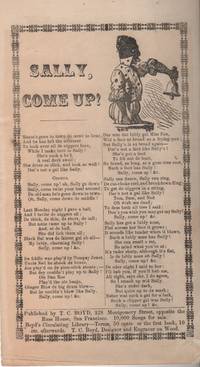
1860rif. 43380San Francisco: T.C. Boyd 1860. Near fine. Racist slavery-era broadside printed and designed by one T.C. . Boyd featuring a drawing and lyrics to a ballad which begins: "Massa's gone to town de news to hear / And he has left the overseer / To look over all de nrs here / While I make love to Sally!" Boyd notes he had 10000 such sheets for sale at his shop. Broadside 8.5" by 4.5". Printed from type and wood engraving. Very near fine with trivial crease to edges. T.C. Boyd unknown
1817rif. 378683Philadelphia: Printed for the Convention 1817. 38 2pp. Errata in the rear. 8vo. Disbound. Foxing. Library blindstamp. 38 2pp. Errata in the rear. 8vo. With much on the kidnapping of free persons of color to enslave them in the south. Also of note is a report on the printing of an edition of Clarkson's History for distribution in the south. Printed for the Convention unknown
1860rif. 64534Augusta GA: Pritchard Abbott & Loomis 1860. Tall thick 8vo. xv 1 17-908 pp. plus 4 pp. publisher’s ads. Steel-engraved frontisp. 4 steel-engraved frontisp. plates for individual work interspersed. Contemporary full sheep red black & gilt spine labels rebacked w/ original labels laid-back down scuffing edgewear foxing to endpapers some foxing & occasional toning on some leaves tidemark at gutter margin through first few leaves still a VG- copy w/ ownership markings dated April 30 1860 for W.J. Freeman and Frank B. Freeman w/ price indicated as $ 6.00 about $ 250.00 today. First edition of this massive work considered the must-read for all good pro-Southern planters on the eve of the Civil War with the editor in the introduction declaiming the “anarchy and bloodshed in Kansas. . . the existence of the ‘Underground Railroad’ . . . a party in the North organized for the express purpose of robbing the citizens of the Southern States of their property; the almost daily occurrence of fugitive slave mobs. . . attempt to circulate incendiary documents among the slaves in the Southern States. . . and finally the recent attempt to excite at Harper’s Ferry and throughout the South an insurrection and a civil and servile war.” By 1860 slavery was becoming more concentrated in the southern United States fading somewhat from Brazil Cuba Puerto Rico and the Dutch Colonies and even in the U.S. abolitionist efforts had led to the proportions of lsaves dropping in Missouri from 18 to 10 percent of the populace Kentucky to 19 percent and even Maryland down to 13%. This anthology of racist polemics buttressed with the Dred Scott Decision included as one section blindly attempted to argue slavery was a humane and Christian institution justified by scripture and an economic underpinning of the South. Pritchard, Abbott & Loomis, unknown
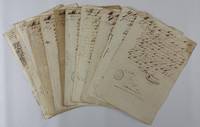
1873rif. 12720Cuba 1873. Twelve manuscript documents on folio sheets approximately 8.5 x 12.5 inches all with official rubber-stamped seal. Small pinholes along left margin light wear occasional chipping to edges some ink bleed and light damp staining. Overall very good. A collection of documents recording the liberation or attempted liberation of numerous men women teenagers and a child from enslavement. The child is but seven years old while the remaining slaves range from fifteen to fifty-seven years old. The slave trade ended in Cuba around 1867 but the practice of owning slaves remained legal until 1880 and then was abolished completely by Spanish decree in 1886. Cuba was the penultimate country to outlaw slavery in the western hemisphere beating Brazil to formal abolishment by two years. Even before the official abolition of slavery in Cuba African or criollo slaves were manumitted by a variety of owners and at various costs as evidenced here especially after the practice of importing Chinese indentured servants began. Each of the present documents names the slaveholder and the slave granted "libertad" along with the cost in escudos or pesetas of that liberty. The slaves liberated here are as follows: 1 Luis criollo 7 years old for the sum of 28 pesos 2 Maria Antonia part criolla 20 years old for the sum of 2500 pesetas 3 Catalina morena de Africa 41 years old for c.200 pesetas 4 Lorenzo moreno criollo 21 years old for 2500 pesetas 5 Lucia morena criolla 15 years old for 320 pesos or 1600 pesetas 6 Frigidae "negro.de Africae" 56 years old 7 Augusto criollo 19 years old for 1750 pesetas 8 Marta criolla 16 years old for 1621 pesetas 9 Gil moreno de Africa 57 years old for 1500 pesos 10 Carmita morena criolla 20 years old for 1750 pesetas 11 Augustina Prieto morena criolla 30 years old for 1750 pesetas 12 Edwigio 39 criolla; Lazara 36 criolla; and Maria Leoncia 15 criolla for 2000 pesetas. These Cuban slave manumissions are offered with one 1844 manumission document liberating a slave in Spain totaling two pages and measuring about 8.5 x 13.5 inches. The document also has three rubber-stamped official seals at the head noting Isabella II. This document appears to free slave Nicolas 25 years old for the sum of 400 pesos and is signed November 5 1844. unknown
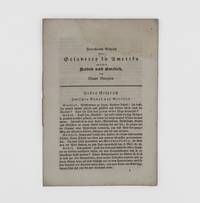
1845rif. 332998United States 1845. 16pp. 8vo. Self-wrappers dampstaining. 16pp. 8vo. An anti-slavery work in German written in the form of a dialogue between Gottlieb who argues that the slave trade is a sin and Nabob who begins by arguing in defense of slavery but is swayed by Gottlieb's arguments. unknown
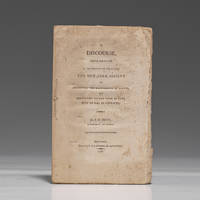
1798rif. 1244831798. First Edition. SMITH Elihu.Hubbard. A Discourse Delivered April 11 1798 At the Request of and Before the New-York Society for Promoting the Manumission of Slaves and Protecting Such of Them as Have Been or May Be Liberated. New-York: T. & J. Swords 1798. Slim octavo original tan self-wrappers string tied uncut; pp. 1-5 6-30 2. $3500.First edition of Smith's scathing attack on American slavery declaring it a betrayal as ""thousands of your fellow-beings children of the same father and inheritors of the same destinyÉ writhe under the lash of cruelty"" an exceptional 18th-century abolitionist work published barely ten years after ratification of the Constitution exceedingly rare uncut in original wrappers.Trained as a physician under Benjamin Rush ""Smith was an early abolitionist a member and Recording Secretary of the New York Manumission Society and trustee of the city's African Free School"" Stevenson Litchfield Native. ""Passionately committed to the improvement of the fledgling nation through the acquisition and circulation of information"" Smith's analysis of slavery in this very rare work published the same year as his early death at 27 expresses his and the Society's commitment ""to ideals of human perfectibility which they combined with the practical labor of achieving change"" Kelly on Kaplan Men of Letters. Here he takes aim at leaders and nations where the ""spirit of despotismÉ multiplied and extended the evil"" of slavery and ""wrought it into a system."" Noting the influence of renowned abolitionists John Woolman and Anthony Benezet he asserts that it is those in slave trade who particularly ""opened a new field forÉ every baneful enterprise"" when they became ""the first to violate the noble principles by which they had been guided."" Smith especially speaks to American leaders and slaveholders who concede ""slavery is unjust"" but claim ""it is entailed upon us by our fathers; it is interwoven with every part of our social organization."" In reply he declares that it is ""strange reasoning"" to endorse slavery simply because it exists. Arguing ""the laws of our country authorized the possession in human flesh"" he asks: ""Shall the legislators of a great nation be denied the powerÉ of acknowledging their errors and laboring to correct themÉ Encumbered as we are with this mighty evil"" Smith proclaims: ""You yes you the Legislators of America you are the real upholders of slaveryÉ you foster and protect itÉ you immortalize injusticeÉ while thousands of your fellow-beings children of the same father and inheritors of the same destinyÉ writhe under the lash of cruelty."" Evans 34554. Sabin 82502. Dumond 103. ESTC W37980. Not in Blockson. Text quite fresh with only faintest foxing to original wrappers. An excellent about-fine uncut copy in original wrappers. unknown