SLAVERY STROUD George MBiblio.com
1561 risultati
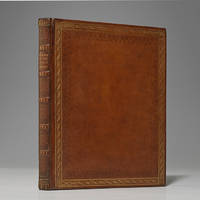
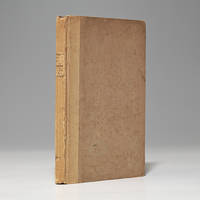
1827rif. 1184001827. First Edition. SLAVERY STROUD George M. A Sketch of the Laws Relating to Slavery in the Several States of the United States of America. Philadelphia: Kimber and Sharpless 1827. Octavo original half tan and light brown paper boards uncut. $1350.First edition of Judge Stroud's groundbreaking 1827 work documenting state slave laws and relevant Constitutional provisions held as a key resource for Harriet Beecher Stowe's Uncle Tom's Cabin a cornerstone volume Òconsidered by many the best of the ante-bellum studies"" on slavery uncut in original boards.""The ink was hardly dry on the Constitution when the powers of Congress relative to slavery were called into question"" Dumond 153. The Fugitive Slave Act was passed in 1793 and in 1819 Congress began a bitter debate over slavery in the territories that culminated in the 1820 Missouri Act. At this time Philadelphia Judge George Stroud began work on Sketch of the Laws. ""This work the first substantial legal treatise on American slavery is considered by many the best of the ante-bellum studies"" Cohen 9877. His coverage of state slave codes and Constitutional provisions is a cornerstone of the legal literature. Published well before ""the Dred Scott decision Stroud's book had extensive influence upon national legal thinking on the issue of slavery. For example it is believed by some scholars that Harriet Beecher Stowe gained her knowledge of slave laws from Stroud's work"" Johnson Stroud's Slave Laws vi. In legal literature of antislavery one key group is on ""slave codes and their administration. The purpose of these works was to use slave law as data credible data as to the realities of slavery. The first and in many ways the best of these works was George Stroud A Sketch of the Laws"" Cover Justice Accused 149n. Blockson 9965. Sabin 93097. Work 343. Harvard Law Catalogue II:680. Text generally fresh with scattered foxing mild embrowning mild edge-wear rubbing to spine label. A very good copy of a major early work on slavery. hardcover
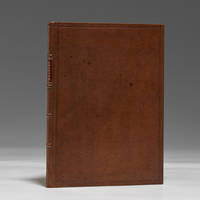
1809rif. 1187761809. First Edition. SLAVERYÑABOLITION MONTGOMERY James GRAHAME James and BENGER Elizabeth. Poems on the Abolition of the Slave Trade. London: Printed for R. Bowyer 1809 i.e. 1810. Tall quarto contemporary brown calf gilt rebacked with original spine laid down raised bands marbled endpapers and edges. $2000.First edition of famed publisher and artist BowyerÕs richly illustrated volume featuring eloquent anti-slavery poems by Montgomery Grahame and Benger a major antislavery work issued shortly after BritainÕs abolition of the slave trade with engraved portraits of abolitionists Sharpe Clarkson and Wilberforce engraved allegorical title page and nine full-page engravings after paintings by artist Sir Robert Smirke a handsome wide-margined copy in contemporary boards.This handsomely illustrated volume features three epic poemsÑMontgomery's The West Indies Grahame's Africa Delivered and Elizabeth Benger's A Poem Occasioned by the Abolition of the Slave Trade in 1806. All were ""commissioned by the London publisher Robert Bowyer for inclusion in a lavish volume of antislavery poetryÉ timed to celebrate the abolition of the slave trade"" Basker Amazing Grace 612. With biographies and engraved full-page medallion portraits of leading British abolitionists Sharpe Clarkson and Wilberforce Poems on the Abolition of the Slave Trade is especially noted for its nine full-page engravings and the allegorical title page vignette engraved by Scriven and Worthington after paintings by renowned artist Sir Robert Smirke whose works were considered ""gems in the art of history painting"" American Daily Advertiser. On presenting a copy to George III Bowyer described this as a ""most beautifully embellished volume of Poems which have been written expressly for the occasion on the Abolition of the Slave Trade"" Baptist Quarterly 35. Poems won early critical praise as an ""elegant publication on the Abolition of this traffic and we congratulate the poets the artist and the editor"" Monthly Review. First edition: plates dated ""Dec. 1 1809""; portraits dated ""Jan 1 1810."" With engraved and letterpress title pages. With directions to the binder leaf bound in at rear. Lowndes 1591. Goldsmiths 19923. Kress B5549. Sabin 50145. Benezit IX:656. Occasional faint foxing chiefly marginal. A near-fine copy scarce and desirable in contemporary binding. hardcover
1710rif. 1200341710. First Edition. SLAVERY ANONYMOUS. A True State of the Present Difference Between the Royal African Company and the Separate Traders. London: No publisher 1710. Slim octavo period-style full tan sheep gilt red morocco spine label raised bands; pp. 40. $1650.First edition of this argument against providing a monopoly over the British slave trade to the Royal African Company with tipped-in diagram of one of the Royal African Company's forts.This work attempts to highlight the irregularities of the business practices of the Royal African Company and to argue for the superiority of open trade in Africa particularly as a means of supplying slaves to the American plantations. Founded in 1660 by the royal Stuart family and the City of London the Royal African Company was founded to exploit natural resources like gold along the west coast of Africa. While the Royal African Company did participate heavily in the gold trade the majority of their income came from slave-trading. The Royal African Company was part of a concerted effortÑfully elaboration in the Navigation ActsÑto establish dominance in the slave trade since the Dutch had been the leading slave-traders prior to the Restoration. To that end the Royal African Company established a brutal and highly efficient slave-trading system eventually providing more slaves to the West Indies than any other company or state. The slaves were branded with the initials of the company or its longtime governor the Duke of York. Children were included in the transports. Between 1662 and 1731 the Company transported approximately 212000 slaves a fifth of whom died enroute. While the Company formally gave up slave-trading in 1731 they remained involved in the trade of ivory and gold dust industries dependent on labor exploitation and slavery. Goldsmiths 4605. Kress 2677. Early ink underlining and marginal notations.Small paper repair to diagram text and diagram trimmed close affecting portion of imprint and scattered catchwords not affecting readability. A very good copy. hardcover
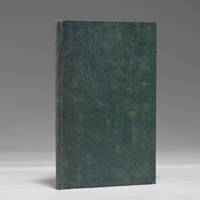
1816rif. 1138361816. First Edition. SLAVERY. The Interference of the British Legislature in the Internal Concerns of the West India Islands Respecting Their Slaves Deprecated. London: J. Mawman 1816. Slim octavo modern blue-gray paper wrappers; pp. 58. $1800.First edition of this defense of the West Indian slave trade arguing against emancipation.Cloaked in pro-abolition language and anonymously written by a person claiming to be an abolitionist this work is actually a zealous condemnation of British interference in the slave trade of the West Indies. After briefly discussing the abolition movement the 1807 act abolishing slavery in britain and prominent anti-slavery organization the author sets out to make his main argument: that a bill requiring registry of slaves in the West Indies would infringe on the rights of those colonies. The author swiftly aligns himself with the interests of the West Indian Planters arguing that abolishing slavery is a different cause from emancipating people of African descent. He points out that this bill is merely the first in a projected series of measures meant to emancipate the Black population of the West Indies. Set in the awkward period between 1807 and 1833 when slavery in Britain was illegal but the slave trade still thrived abroad this work makes sense of obvious hypocrisy by arguing that slavery was permitted by God and that Blacks of African descent were better off as slaves than in Africa. The will of those against slavery proved stronger and complete abolition eventually became the law of the land. Sabin 34904. Kress 21649. This work last appeared at auction over 25 years ago; prior to that it had not been seen since the 1940s.Interior quite clean with only slight pressure offsetting toning to spine of modern wrappers. A beautiful copy in fine condition. unknown
1792rif. 1262151792. HAITI SLAVERY. A Particular Account of the Insurrection of the Negroes of St. Domingo Begun in August 1791: Translated from the French caption title as issued. London: 1792. Slim octavo modern green cloth; pp. 32. $1800.Fourth edition published one year after the very rare first of this sensationalistic account of the early months of the Slave Rebellion in Haiti the beginnings of the Haitian Revolution which ultimately led to the establishment of the first independent black state in the New World. The publishers of this polemic hoped to frighten the British public and turn them away from the abolitionists Wilberforce and Clarkson who were trying to put and end to slavery in the British colonies in the West Indies.Translated into English this is a speech to France's National Assembly ""by the Deputies from the General Assembly of the French part of St. Domingo."" The tract provides a frightening and grisly account of the August 1791 Slave Rebellion the result of ""a plot to set fire to the plantations and to murder all the whites."" The start of the insurrection by its ""perfidious"" leaders resulted in a catalogue of horrors and atrocities as the rebels ""spread over the plain with dreadful shouts set fires to houses and canes and massacred the inhabitants."" The ""fury of the cannibals"" is recounted in gory detail. The Speech is signed at the bottom of page 19 by six Deputies who call the insurrection ""the greatest calamity that has visited the human race in the course of the eighteenth century."" An Appendix records Letters and Speeches concerning the Rebellion. ESTC T110428. Goldsmiths' 15167. See Sabin 58932 1791 first edition; LCP 7460 2nd edition 1792; Work 349 1832 printing. First and last leaf slightly darkened text quite clean. Trimmed irregularly along upper margin affecting page numbers on two leaves but not any text. A very good copy of this scarce item. hardcover
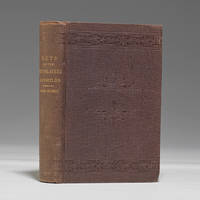
1883rif. 1255001883. First Edition. Signed. PILLSBURY Parker. Acts of the Anti-Slavery Apostles. Concord N.H.: Clague Wegman Schlicht 1883. Octavo original gilt-lettered brown cloth floral endpapers; pp. 503. $1500.First edition of the fearless abolitionist's memoir a distinctive presentation copy inscribed by Pillsbury to ""To Mr. & Mrs. F. M. CÑ With sincere regards and best wishes of their friend Parker Pillsbury. Concord New Hampshire 1894."" Hailed as a ""fighting book"" it documents the bold tactics of this notorious radical who early warned America was ""hastening toÉ a baptism of blood"" and was praised by Emerson as a ""tough oak stock of a man not to be silenced or insulted or intimidated"" a splendid copy in original cloth.Born in Massachusetts in 1809 the son of a blacksmith Pillsbury became a Congregational minister but was soon famed as one of the era's most radical abolitionists. Having once witnessed a slave auction he recorded its advertisement of: ""'two mules a horse andÉ 27 Negroes'É Does any mortal man or woman"" he asked ""comprehend all the tremendous meaning of those words"" Infamous for his apocalyptic style and confrontational tactics Pillsbury early declared the nation was ""hastening to its baptism. It is a baptism of blood."" He was resolute in denying any possible ""union with slave-holders""and also insisted ""women must be given their due rights."" Emerson admired him as a ""tough oak stock of a man not to be silenced or insulted or intimidated by a mob because he is more mob than they. He mobs the mob."" He was ""in Susan B. Anthony's eyes the Jeremiah of the anti-slavery movement"" Filler Parker Pillsbury 315 328-37.Fiercely anticlerical in his writings and in action Pillsbury would dramatically interrupt ""religious servicesÉ calling on audiences to 'come out' from their proslavery churches."" He linked most clergy to timid politicians and cautious abolitionists proclaiming them a ""brotherhood of thieves"" Robertson Hard Cold Stern Life 189. Pillsbury's 1883 memoir Acts of the Anti-Slavery Apostles was above all ""a fighting book."" In it he writes of his esteem for his fellow white radical Stephen S. Foster and leading Black abolitionists such as David Ruggles as well as his disdain for Lincoln; Pillsbury ""never forgot that the idolized Lincoln meant to save the Union and not necessarily to free the slaves"" Filler 336. First edition first printing: issued in brown cloth this copy and in green cloth no priority determined. Blockson 9099. See Work 304 1884 edition. This copy is inscribed to ""To Mr. & Mrs. F. M. Crosby."" It is notable that while there was a Crosby family of abolitionists in New Hampshire the identity of this copy's recipients could not be confirmed.Text pristine; tiniest bit of soiling to cloth. An especially handsome copy in fine condition. hardcover
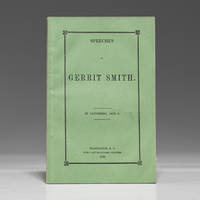
1854rif. 1266881854. First Edition. SMITH Gerrit. Speeches of Gerrit Smith. In Congress 1853-'4. Washington D.C.: Buell and Blanchard 1854. Octavo original printed green self-wrappers original stitching. $1850.First edition of nine major 1854 speeches by radical abolitionist Smith together in print for the first time featuring elemental works such as ""No Slavery in Nebraska"" defying Stephen Douglas' Kansas-Nebraska bill and denouncing ""the federal government as a 'bastard democracy'"" very elusive in fragile original wrappers.In the early 1850s Gerrit Smith ""a man of enormous emotional complexity religious fervor antislavery commitment and wealthÉ embraced political abolitionism."" By then Frederick Douglass had become ""an outspoken supporterÉ and rejoiced in Smith's election to Congress as a radical abolitionist in 1852"" Blight Frederick Douglass 207 252. Once linked to Garrison's view of the Constitution as a ""covenant with death"" Smith split from him to become a founder of both the Liberty Party and the Radical Abolitionist Party. As documented in this collection of nine key speeches Smith in his ""congressional career of 1853 and 1854É evolved into one of America's renowned militant antislavery activists"" Gordon-Omelka Militant Abolitionist 2. Key works here such as his June 14 1854 speech ""Abolition of the Postal System"" reflected his conviction that ""the right to free discussion"" was fundamental and that ""Southerners were threatening the very openness and integrity of American democracyÉ Smith would not stand for itÉ he presaged a new generation of American abolitionists: those whose membership was inspired not by evangelical Christianity like the earlier Garrisons and Tappans but by secular liberal political ideals."" His attention to issues such asÑ""freedom of speech civil liberties social order the proper role of federal and state governments with respect to slaveryÑmotivated a new kind of political abolitionism which attracted new groups into the movement and gave them new tools for action"" Lonky Revolutionizing the Public Sentiment 56.Also notably featured here is Smith's ""No Slavery in Nebraska."" It stands as his defining response to Senator Stephen Douglas' December 1853 version of the Kansas-Nebraska bill which ""ultimately repealed the Missouri Compromise of 1820 and allowed the territories' citizens to decide the slavery questionÉ Smith signed Chase's abolitionist appeal against the bill"" and in his April 6 1854 ""No Slavery"" speech ""asserted a fresh reason to oppose the bill based on the Constitution's limits on state sovereignty.'"" Denouncing ""the federal government as a 'bastard democracy'"" he predicted ""a violent end to slaveryÉ a reckoning for deep and damning wrongs"" Gordon-Omelka 12. Soon afterward following his resignation from Congress Smith helped establish a Black settlement at North Elba N.Y. which was ""John Brown's permanent residence from 1854 until his death"" Stauffer Black Hearts 3. In June 1855 Smith Frederick Douglass and John Brown were together at the first convention in Syracuse of the Radical Abolition party. Four years later Brown was executed following the Harpers Ferry Raid that Smith helped fund causing Smith to suffer a mental breakdown. The decade after the Civil War he died in 1874. First edition:containing nine separately paginated speeches: Speech of Gerrit Smith On War. In Congress January 18 1854. Washington D.C.: Buell & Blanchard 1854; Homes for All. Speech of Gerrit Smith On the Homestead Bill. In Congress February 21 1854. Washington D.C.: Buell & Blanchard 1854; No Slavery in Nebraska: No Slavery in the Nation: Slavery an Outlaw. Speech of Gerrit Smith on the Nebraska Bill. In Congress April 6 1854. Washington D.C.: Buell & Blanchard 1854; Keep Government within its Limits. Speech of Gerrit Smith on the Pacific Railroad In the House of Representatives May 30 1854. Washington D.C.: Buell and Blanchard 1854; Abolition of the Postal System. Speech of Gerrit Smith In the House of Representatives June 14 1854. Washington D.C.: Buell & Blanchard 1854; Speech of Gerrit Smith On Mexican Treaty and ""Monroe Doctrine."" In Congress June 27 1854. Buell and Blanchard: Washington D.C. 1854; Letter of Gerrit Smith On the Reciprocity Treaty. No place: no publisher: 1854; Government Bound to Protect from the Dramshop. Speech of Gerrit Smith On Sale of Intoxicating Drinks in the City of Washington. In Congress July 22 1854. Washington D.C.: Buell & Blanchard 1843; Gerrit Smith to his Constituents. Washington D.C.: Buell & Blanchard 1854. With Nebraska Bill partially unopened. Sabin 92595; 82634; 82635; 82639; 82642; 82649; 82658; 82659; 82660. See LCP. Afro-Americana 9513 1855 ed. Fine condition. unknown
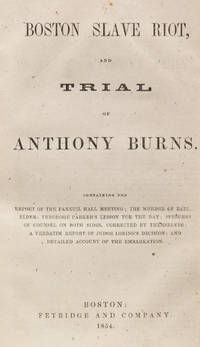
1854rif. 1266841854. First Edition. SLAVERY BURNS Anthony. Boston Slave Riot and Trial of Anthony Burns. Boston: Fetridge 1854. Slim octavo modern half calf and marbled boards. $3000.First edition of a seminal pre-Civil War pamphlet on the 1854 arrest and Boston trial of fugitive slave Anthony Burns whose return to his Virginia slave owner at the order of the Boston court sparked public fury and ""set Boston on its ear in the spring of 1854"" inspiring Whitman to write his Boston Ballad and Thoreau to deliver his speech Slavery in Massachusetts to a July 4 1854 antislavery rally.The trial of fugitive slave Anthony Burns which ""set Boston on its ear in the spring of 1854É.was nothing less than a pocket revolution"" Von Frank Trials of Anthony Burns xii. The arrest and trial in Boston of Burns whose Virginia slave-owner Suttle followed him there was ""one of the most dramatic and famous incidents in the enforcement of the Fugitive Slave Act."" When Boston Commissioner Loring signed Burns' arrest warrant Richard Henry Dana Jr. and Charles Ellis immediately volunteered to defend Burns. On ""May 26 there was a mass meeting in Faneuil Hall to protest Burns' arrest. This meeting was followed by a poorly planned and disastrously executedÉ attempt to rescue BurnsÉ Despite conflicting testimony and imperfect evidence provided by Suttle Loring declared Burns was indeed Suttle's slave."" With that Burns was taken from the courtroom and through streets crowded with his supporters then placed aboard a ship ""for return to Virginia. The trial and removal of Burns from Boston created one of the great spectacles of the late antebellum period"" Finkelman 107-112.""The Burns case made slavery appear to Northerners as an immediate threatÉ Walt Whitman was impelled to write an ironic piece A Boston Ballad soon to be incorporated into his revolutionary volume Leaves of GrassÉ At an antislavery rally in Framingham Massachusetts on July 4É William Lloyd Garrison burned copies of the Fugitive Slave Law and the Constitution as the large crowd chanted 'Amen!' Thoreau delivered his speech Slavery in Massachusetts declaring that the American system had lost its integrity and purityÉ The antislavery sentiment bred by the case helped give birth to the Republican Party which in turn fostered Lincoln's Presidency the South's secession and the Civil War"" New York Times. Containing ""valuable primary source material about the trial and the events surrounding it"" including testimony legal documents"" as well as the full texts of the speeches of the counsel and the opinion of Commissioner Loring."" Bound without rear advertisements: ""some have advertisements at the back of the pamphlet while others do not"" no priority established Finkelman 113. Sabin 6505. Harvard Law Catalogue II:1030. Text fine. hardcover
rif. RGW15681Stipple and line engraving unknown
1817rif. SLAVERY005957W. Alexander York. 1817. First U.K. edition with additions to the Philadelphia printing. 12mo. 156 pages including 4 pages of adverts. Frontispiece. Original boards with paper backstrip and title label. Anthony Benezet 1713-1784 was a leading abolitionist.Early nameplates Thomas Marsh and Robert Langdon on front pastedown. Some foxing to prelims. Cup ring to front cover. Backstrip defective label rubbed. Very good. Scarce in original state. W. Alexander, York. hardcover
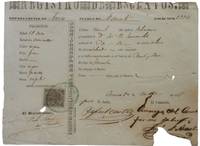
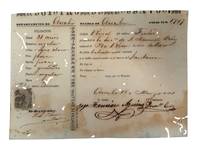
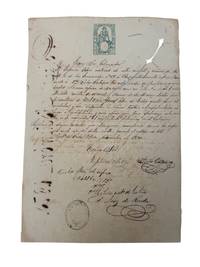
1871rif. 237101871. Slavery Black Labor Puerto Rico This official Puerto Rican slave registry document issued in Manatí in 1871 under Spanish colonial administration represents the bureaucratic infrastructure of slavery in the Caribbean at the precise moment preceding abolition. Titled within the printed form as part of the "Registro de Esclavos - Isla de Puerto Rico" the document records the forced legal identity of an identified enslaved man. Single sheet slave registry document "Empadronamiento General de esclavos" from Manatí Puerto Rico dated 20 de Mayo de 1871. Measuring 6.25" x 8.5". This document was registered by "Don Manuel María Monserrate" for the enslaved person "Feliciano." Document bears official signatures from the local authorities. The enslaved person is listed by their age stature "color" hair color beard eyes nose and mouth. The person is listed as 18 years old and the "color" of this individual is listed as "negro". The physical list of classifications functioned as mechanisms of surveillance control and verification within the colonial slave system. Inclusion of official signatures from both the "dueño" and "comisario" along with a stamped fiscal seal en verso. Produced just under two years prior to the 1873 abolition of slavery in Puerto Rico the document reflects the transitional legal environment in which enslaved individuals were increasingly catalogued in anticipation of emancipation policies that would in practice impose systems of forced apprenticeship and indemnification to former enslavers. Tape was previously applied to the bottom right of the document; some minor wormholes and occasional spotting. Overall good condition. The document stands as evidence of how emancipation in Spanish territories was mediated through administrative control prolonging coercive labor conditions even as slavery was formally dismantled. unknown
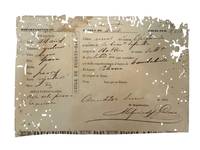
1873rif. 238001873. Puerto Rican slave registration document from January 1873 recording the legal identity ownership agricultural occupation parentage and physical classification of Epifanio a forty four year old enslaved Black man in Arecibo less than three months before slavery was abolished in Puerto Rico. Issued after Spain's 1870 Moret Law had initiated a limited process of emancipation but before the abolition law of March 22 1873 the cédula placed Epifanio within a registration system designed to record enslaved people by name family relations occupation owner residence civil status and identifying physical characteristics. The January 20 date makes the document especially closely situated to abolition recording Epifanio as legally enslaved only weeks before the Spanish National Assembly dismantled the legal institution under which the certificate had been issued. Registro de Esclavos Isla de Puerto Rico. Arecibo Puerto Rico January 20 1873. Single printed and manuscript cédula folio no. 7215. The document identifies "Epifanio" as an enslaved man "propiedad de la Sucn. Tafarella" forty four years old a native of Puerto Rico single and "de oficio labrador." He is recorded as "no está coartado" and as registered in the barrio of Cambalache with his mother identified as "Petrona." The printed "Filiacion" column subjects his body to a standardized identifying description: regular stature "Color negro" sparse hair sparse beard brown eyes and a regular nose. Under "Señas particulares" the manuscript records "Cojo de la pierna izquierda" identifying him as lame in the left leg and incorporating a physical disability into the identifying data maintained by the slave registry. The lower portion differs from the earlier 1871 forms in carrying a prominent signature beneath "El Registrador" while extensive insect damage has removed portions of the printed heading and margins. The verso bears manuscript offsetting and additional evidence of administrative handling. Epifanio's cédula was produced at the endpoint of Puerto Rico's rapidly changing legal regime. The Moret Law of 1870 had granted freedom to specified categories of enslaved people including those aged sixty and older those belonging to the state and children born after September 17 1868 while leaving a forty four year old man such as Epifanio legally enslaved. His notation as "no está coartado" further records that he had not entered coartación the mechanism through which an enslaved person could make payments toward self purchase. His recorded occupation as "labrador" placed him within Puerto Rico's agricultural labor economy while "Cojo de la pierna izquierda" shows how the registry extended beyond racial and occupational classification to bodily characteristics capable of distinguishing one enslaved person from another. On March 22 1873 only about two months after this cédula was dated the Spanish National Assembly abolished slavery in Puerto Rico compensating former enslavers while requiring the emancipated population to enter labor contracts for an additional three years. Extensive insect damage with numerous wormholes and substantial losses along the upper and side margins affecting portions of the printed heading and several fields; moderate toning and staining with principal manuscript entries and the registrar's signature remaining legible. Overall fair condition. An individually named record of the administrative system that converted Epifanio's race body physical disability agricultural labor parentage residence and legal ownership into the identifying data of slavery during the final months before abolition in Puerto Rico. unknown
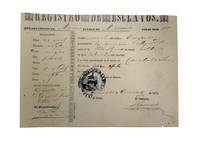
1871rif. 237981871. Puerto Rican slave registration document from 1871 recording the legal identity ownership agricultural occupation and physical classification of a named thirty one year old enslaved man in Arecibo during the final years of slavery under Spanish colonial rule. Issued after Spain's 1870 Moret Law had initiated a limited process of emancipation but nearly two years before abolition in Puerto Rico the cédula placed Fruto within a registration system designed to record enslaved people by name occupation owner residence civil status and identifying physical characteristics. His classification as "negro claro" his occupation as "labrador" and his ownership by the succession of D. Manuel Ortiz place racial designation agricultural labor and property status together within the administrative machinery of colonial slavery. Registro de Esclavos Isla de Puerto Rico. Arecibo Puerto Rico March 15 1871. Single printed and manuscript cédula folio no. 1747. The document identifies this enslaved man "propiedad de la Sucn. de D. Manuel Ortiz" thirty one years old a native of Puerto Rico single and "de oficio labrador." He is recorded as "no está coartado" and as residing in the barrio of Santana. The fields for parents spouse and children are left blank. The printed "Filiacion" column subjects his body to a standardized identifying description: regular stature "Color negro claro" sparse hair sparse beard large eyes a regular nose and a further description of the mouth partially obscured by worming. A one peseta fiscal stamp at lower left is cancelled by an official marking. The lower portion carries the signatures or attestations of the "Registrador" "El dueño" and "El Comisario" with the owner's portion apparently signed on behalf of the succession by Francisco Aguirre. The verso bears ink offsetting and staining associated with subsequent administrative handling. This man's cédula was produced within a rapidly changing legal regime. The Moret Law of 1870 granted freedom to specified categories of enslaved people including those aged sixty and older those belonging to the state and children born after September 17 1868 while leaving many others including a thirty one year old agricultural laborer such as this individual legally enslaved. His notation as "no está coartado" further records that he had not entered coartación the mechanism through which an enslaved person could purchase freedom incrementally. The document's ownership by the "Sucn. de D. Manuel Ortiz" also records the treatment of an enslaved person as property within an estate with his legal ownership continuing through the succession rather than ending with the death of the named enslaver. On March 22 1873 the Spanish National Assembly abolished slavery in Puerto Rico compensating former enslavers while requiring the emancipated population to enter labor contracts for an additional three years. Moderate toning and staining scattered wormholes with small losses affecting several manuscript entries minor edge losses and a larger loss at the lower right edge; principal manuscript information and signatures remain legible. Overall good condition. An individually named record of the administrative system that converted this individuals race body agricultural labor residence civil status and legal ownership into the identifying data of slavery less than two years before abolition in Puerto Rico. unknown
1871rif. 237971871. Puerto Rican slave registration document from 1871 recording the legal identity ownership agricultural occupation and physical classification of Eleuterio a twenty six year old enslaved man in Arecibo during the final years of slavery under Spanish colonial rule. Issued after Spain's 1870 Moret Law had initiated a limited process of emancipation but nearly two years before abolition in Puerto Rico the cédula placed Eleuterio within a registration system designed to record enslaved people by name family relations occupation owner residence and identifying physical characteristics. His classification as "mulato" his occupation as "labrador" and his ownership by the succession of D. Manuel Ortiz place racial designation agricultural labor and property status together within the administrative machinery of colonial slavery. Registro de Esclavos Isla de Puerto Rico. Arecibo Puerto Rico May 15 1871. Single printed and manuscript cédula folio no. 1740. The document identifies "Eleuterio" as an enslaved man "propiedad de la Sucn. de D. Manuel Ortiz" twenty six years old a native of Puerto Rico single and "de oficio labrador." He is recorded as "no está coartado" and as residing in the barrio of Santana with his mother identified as "Valentina." The printed "Filiacion" column subjects his body to a standardized identifying description: tall stature "Color mulato" sparse hair sparse beard black eyes a regular nose and a further description of the mouth partially affected by loss. The lower portion carries the signatures or attestations of the "Registrador" "El dueño" and "El Comisario" with the owner's portion apparently signed on behalf of the succession by Francisco Aguirre. A one peseta fiscal stamp appears at lower left beneath the physical description. The verso bears manuscript docketing and staining associated with subsequent administrative handling. Eleuterio's cédula was produced within a rapidly changing legal regime. The Moret Law of 1870 granted freedom to specified categories of enslaved people including those aged sixty and older those belonging to the state and children born after September 17 1868 while leaving many others including a twenty five six old agricultural laborer such as Eleuterio legally enslaved. His notation as "no está coartado" further records that he had not entered the system of coartación through which an enslaved person could make payments toward self purchase. On March 22 1873 the Spanish National Assembly abolished slavery in Puerto Rico compensating former enslavers while requiring the emancipated population to enter labor contracts for an additional three years. Moderate toning and staining scattered wormholes with small losses affecting several manuscript entries loss along the upper edge affecting part of the printed heading and additional minor edge losses; principal manuscript information and signatures remain legible. Overall good condition. An individually named record of the administrative system that converted Eleuterio's race body family relationship agricultural labor residence and legal ownership into the identifying data of slavery less than two years before abolition in Puerto Rico. unknown
1872rif. 237961872. Puerto Rican slave registration document from January 1872 recording the legal status ownership labor residence parentage and physical identification of Eugenio a twenty year old enslaved Black man in Arecibo during the final fourteen months of slavery on the island. The cédula was issued within the registration system expanded following the Moret Law of 1870 which freed specified categories of enslaved people while leaving young adults such as Eugenio in bondage and led to the preparation of Puerto Rico's central slave register. Surviving 1872 schedules record the same categories present here including name origin residence parents marital status occupation age physical description and enslaver. Registro de Esclavos Isla de Puerto Rico. Arecibo Puerto Rico January 20 1872. Single printed and manuscript slave registration cédula folio no. 119. The document identifies "Eugenio" as twenty years old "Color negro" single and employed "de oficio labrador" placing agricultural labor directly within his official identification. He is recorded as a native of Puerto Rico and registered in the barrio of Cambalache. His ownership entry appears to read "propiedad de la sucesión ." indicating ownership by an estate or succession although the following name is difficult to establish confidently from the manuscript hand. The "Filiacion" column records his stature as "regular" black hair sparse beard brown eyes a regular nose and additional identifying information; under "Señas particulares" a manuscript notation appears to record a defect involving the right foot though the exact wording is partially unclear. The document carries the signatures or attestations of the "Registrador" and "El Comisario" together with a fiscal stamp heavily cancelled by an official circular handstamp. The verso bears additional official stamps and manuscript markings associated with the document's administrative use. Eugenio was registered at a moment when Spanish policy had begun dismantling slavery selectively while continuing to document and regulate those excluded from immediate freedom. The Moret Law granted freedom to people over sixty enslaved people belonging to the state and children born after September 17 1868; at twenty Eugenio fell outside its principal age based provisions. Puerto Rico's surviving 1872 Registro Central de Esclavos is preserved in eight rolls of National Archives microfilm and comparable original Arecibo cédulas survive institutionally including a January 1872 folio at the University of Florida that likewise records an enslaved man's age physical description ownership and official signatures. On March 22 1873 slavery was abolished in Puerto Rico terminating the legal status under which Eugenio had been entered on this form. Light toning and spotting several small wormholes and minor edge losses; stamps printed text and principal manuscript entries remain legible. Overall good condition. An individually named record of how Spanish colonial authorities reduced Eugenio's legal status agricultural occupation ancestry residence and bodily characteristics to standardized identifying data during Puerto Rico's final full year of slavery. unknown
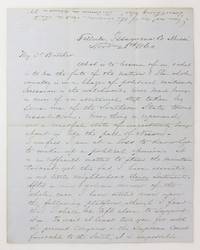
1860rif. 6445Tallula Ms: November 28 1860. Very good. 4pp. on a bifolium. Minor soiling and wear along old folds. Otherwise clean. Written in the immediate aftermath of the Election of 1860 this letter presents a ground-level account of Southern uncertainty at the onset of the secession crisis with a very notable section on the Texas slave insurrection panic of 1860. The writer Isaac E. Nicholson lived in a region of the Mississippi Delta with a large population of enslaved people and he attempts to balance a lingering attachment to the Union with mounting fears of insurrection political collapse and economic instability. The letter moves between national politics local anxieties reports of violence in Texas and personal family concerns. He begins by describing the intensity of the moment: "The whole country is in a blaze of political excitement. Secession is the watchword." Despite this Nicholson positions himself at least provisionally against immediate disunion advocating delay and negotiation: "To wait at least two yrs.and in the mean time make certain demands upon the Northern States. This will make it a test question.whether there is any spirit of compromise left." He adds that "With the present Congress & the Supreme Court favorable to the South it is impossible for her to suffer materially" though he concedes that he may be "Left alone to support it." That moderation is undercut by a stark expression of racialized fear: "We who live in a country with about 30 blacks to one white man slumbering over a volcano.cannot long remain silent." He continues "It is no trivial matter.to retire at night with a probability of being murdered before morning. This thing has a reality here." He concludes that "The fine alternative of Revolution.will become necessary unless their aggressions.cease." The most dramatic section concerns events in Texas where Nicholson reports that his brother suffered heavy losses during unrest in Dallas: "His office & furniture & his whole library were destroyed by fire" and "His dwelling house was set on fire at three different times." He attributes the destruction to "Abolition Preachers.forced to leave for tampering with slaves" who "Endeavored to avenge themselves" adding that "The whole town of Dallas West was laid in ruins. They were both hung by a mob." Financial losses are detailed as well: "About $2000" destroyed followed by news that a New Orleans firm holding "$4000 deposited. had failed." This account corresponds to the unrest surrounding the Texas slave insurrection panic of 1860 during which fires in Dallas were widely blamed on enslaved people and Northern abolitionists and suspected agitators including Methodist ministers were expelled or killed by vigilante groups. Three men -- Patrick Jennings Sam Smith and Cato -- were killed in a public execution near Dealey Plaza now renamed Martyrs' Park in their honor. Although Nicholson presents the destruction as organized retaliation historians have generally concluded that the fires were likely accidental with the conspiracy narrative emerging from rumor and fear. His description reflects how these events circulated in Southern correspondence at the time combining real violence with exaggerated or misinterpreted causes and the passages are notable for the blending of what was presumably fact -- his brother's house catching on fire -- with the fiction of abolitionists arsonists. We find no records of correspondence or any material relating to these events in auction records or on the market at the time of writing. Overall a scarce account overall of a tragic episode in Texas history and the rumor mill that fueled it. November 28 unknown
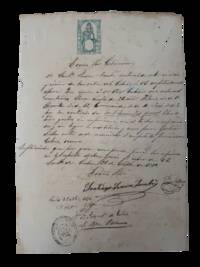
1870rif. 231221870. Slavery Cuba Spanish colonial slave sale manuscript recording the transfer of four enslaved individuals in Cuba in 1870. Produced within the official bureaucratic framework of Spanish colonial governance the document reflects the legal normalization of slavery in Cuba even as abolitionist pressures mounted across the Atlantic world. The document records the sale of four enslaved people described as "criollos" and African-born individuals situating the transaction within a labor system that combined locally born and imported enslaved populations. Created at a time when Spain had formally restricted the transatlantic slave trade but continued to permit slavery itself the manuscript demonstrates the persistence of legalized human commodification and the integration of enslaved labor into the island's economic structure sixteen years prior to abolition in 1886. Official Cuban slave contract documenting the sale of four enslaved individuals to Don Pedro Catasús by Don Enfemia Ochoa for the sum of 1100 pesos on November 29 1870. Single manuscript leaf written in Spanish cursive in black ink measuring 8.25" x 12". A green "50 cs de escudo" revenue stamp is affixed at the top center with a blind embossed Spanish crest at the upper left and a circular black ink government seal impressed at the lower left. Large vertical docketing appears on the verso. A stylized watermark is visible within the paper. The text organizes the enslaved individuals within a standardized transactional structure while the signatures of Enfemia Ochoa Pedro Catasús and A. Díaz de Rada authenticate the exchange and identify participants within the slaveholding economy. By 1870 Cuba remained a central node in the late Atlantic slave system with plantation agriculture especially sugar dependent on enslaved labor despite mounting abolitionist pressure. Although Spain had curtailed official slave imports earlier in the century illegal trafficking persisted into the 1860s and other coerced labor systems including the importation of Chinese indentured workers overlapped with slavery into the 1870s. The presence of both Creole and African individuals in this document reflects the layered composition of the enslaved population during this period. Light toning scattered foxing and edge wear visible. A closed wormhole extends from the upper right margin approximately five inches into the sheet resulting in partial loss of text. Evidence of prior tape reinforcement visible on the verso along with offsetting from previously adjacent material. Overall in very good condition. This document provides named transactional evidence of late-period slavery in Cuba offering concrete material for examining race labor and legal practice within Spanish colonial society. unknown
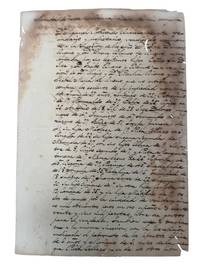
1875rif. 231241875. Slavery Cuba Spanish colonial slave sale manuscript recording the transfer of thirty-eight enslaved individuals in Cuba in 1875 materializing the sheer scale and organization of enslaved labor within the island's plantation economy during the final decade before abolition. The document enumerates a large group of enslaved people including multiple family units with young children demonstrating how slavery functioned as both an economic system and a hereditary condition sustained through the sale and reproduction of enslaved populations. Created eleven years prior to the abolition of slavery in Cuba in 1886 the manuscript documents the continued legality and normalization of large-scale slave transactions despite decades of international pressure and earlier prohibitions on the transatlantic trade offering concrete evidence of how internal markets sustained the institution in its final phase. Official Cuban slave contract documenting the sale of thirty-eight enslaved individuals for the sum of 126000 pesetas formalized before a public notary or legal authority. Single manuscript leaf written in Spanish cursive in black ink on both recto and verso densely filled with names ages and relational identifiers. Measures 8.5" x 12.25". The text lists individuals sequentially including men women and children with repeated references to kinship structures such as mothers with multiple children indicating the sale of family groupings rather than isolated individuals. The script reflects extended passages detailing ownership exclusions and conditions of transfer. A partial watermark of the official coat of arms of Cuba is visible. By 1875 Cuba remained one of the last major slave societies in the Atlantic world with sugar production driving demand for large controlled labor forces. Even after Spain curtailed the official slave trade earlier in the century illegal importation persisted into the 1860s and alternative systems of coerced labor including Chinese indenture supplemented plantation workforces. The scale of this transaction demonstrates the consolidation and redistribution of enslaved labor within domestic markets while the inclusion of children underscores the long-term economic logic of slavery as a self-reproducing system. Moderate toning and foxing concentrated along the edges with numerous small closed wormholes a few affecting portions of the text. Light edge wear present. Overall in good condition. This document provides unusually extensive nominal data on a large enslaved population encompassing the roles of kinship valuation and labor organization in late Spanish colonial Cuba. unknown
1870rif. 231191870. Slavery Cuba Spanish colonial manuscript documenting the late persistence of slavery in Cuba recording the sale of five enslaved Creole individuals including women and children 1870. Produced within the official bureaucratic framework of Spanish colonial governance the document reflects the legal normalization of slavery in Cuba even as abolitionist pressures mounted across the Atlantic world. The presence of multiple children within the transaction underscores the hereditary nature of enslavement and the commodification of family units offering direct material evidence of how slavery functioned socially and economically in its final decades on the island. Although Spain had formally ended the transatlantic slave trade earlier in the century illegal trafficking and internal slave markets persisted and slavery itself would not be abolished in Cuba until 1886 placing this document within a crucial transitional period marked by reform debates gradual emancipation laws and continued exploitation. Official Cuban slave contract recording the sale of five enslaved individuals identified as "criollos" including one adult woman and four children from Santiago Simón Fambi to Don Pedro Catasús for the sum of 1200 pesos on November 21 1870. Single page manuscript leaf measuring 8.25" x 12". The manuscript is written in Spanish cursive hand in black ink. The upper left bears a blind embossed crest of Spain while a circular black ink government seal is impressed at the lower left partially overlapping the text. The text enumerates the enslaved individuals with ages and names embedding human lives within the formulaic language of sale and valuation while the bold signatures of both seller Santiago Simón Fambi and buyer Pedro Catasús anchor the transaction in identifiable actors within the colonial economy. By 1870 slavery in Spanish Cuba remained central to the island's plantation economy particularly in sugar production which had expanded rapidly in the mid-19th century with industrialized mills and global demand. Enslaved people were primarily forced into agricultural labor under highly regimented and brutal conditions though others were used in urban domestic service skilled trades or as hired laborers generating income for their owners. This document exhibits light toning edge wear and scattered foxing throughout. A closed wormhole extends approximately two inches from the upper right margin inward not affecting legibility of the text. Minor losses and small tears along the edges. Overall in very good condition. Given that this document records a woman and four children the family was likely intended for a combination of field labor and domestic or auxiliary work with the children gradually incorporated into plantation labor as they aged reflecting the system's reliance on both immediate exploitation and the reproduction of enslaved labor over time. unknown
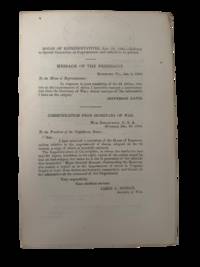
1865rif. 231171865. Civil War Black Military Slavery Virginia Confederate government pamphlet on the impressment of enslaved men for military labor January 1865 one of the clearest bureaucratic efforts to formalize the use of enslaved labor in support of the Confederate war effort. The document responds to a congressional inquiry into the impressment of enslaved people explicitly acknowledging state-directed seizure of enslaved men for military labor. Within the text the Confederate state attempts to regulate this extraction noting limits such as "no more than one out of five male slaves between the ages specified. from any one owner" while simultaneously confirming large-scale requisitions including "5000 slaves from the State of Virginia for service with the army of Northern Virginia." The language reveals both the administrative reach of the Confederate state and its dependence on enslaved labor as a logistical backbone in the war's final phase. Octavo pamphlet measuring 9.5" x 6" 5 pages printed in Richmond Virginia January 1865. Printed for the Confederate House of Representatives and comprising the titled sections "Message of the President" "Communication from Secretary of War" "Resolution of House of Representatives" and "Response of Superintendent of Conscription" with official correspondence dated from December 1864 through January 1865. The exchange includes communications from Brig. Gen. Jno. S. Preston and Major Gen. J. L. Kemper concerning the mechanics of requisition the proportional distribution of impressed labor among slaveholders and errors in previous impressments including the improper inclusion of enslaved people outside the categories prescribed by Confederate authority. While the Confederacy had long resisted arming or formally incorporating enslaved people fearing empowering Black men with weapons and military responsibility would destabilize slavery this document demonstrates a late-war shift toward coercive mobilization framed as "employment" to "increase the efficiency of the army." Additional correspondence from Brig. Gen. Jno. S. Preston and Major Gen. J. L. Kemper details the mechanics of requisition emphasizing proportional seizure across slaveholders and acknowledging prior errors in impressment including the improper inclusion of enslaved people outside prescribed categories. Condition shows light toning minor spotting and edge wear consistent with age; paper remains stable with clear legible text throughout; faint institutional stamp present on front. Overall very good condition. This document underscores how the Confederate war effort relied on systems of exploitation applied to enslaved African American men. unknown
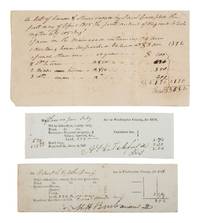
1815rif. 201561815. Manuscript fiscal records from antebellum Virginia documenting the taxation and valuation of enslaved African Americans as property within the legal and economic system of slavery. Dating from 1815 to 1854 the records span nearly four decades and demonstrate the routine bureaucratic mechanisms through which enslaved people were enumerated assigned monetary value and incorporated into county and state taxation alongside land horses clocks and other forms of personal property. The documents provide direct evidence of the administrative infrastructure underlying slavery in Virginia during the decades preceding the Civil War. The earliest record dated April 1 1815 concerns the property of Jacob Campbell and is headed "A list of land & slaves owned by Jacob Campbell the first day of April 1815." An associated receipt provides a particularly stark example of the economic treatment of enslaved people enumerating eight individuals according to gender and age categories and assigning them monetary values totaling $2170. Rather than identifying the individuals as members of families or communities the fiscal record reduces them to demographic classifications and assessed financial values for purposes of property accounting. A later tax receipt for Robert L. Berry and John Berry of Washington County Virginia dated 1848 similarly includes "Slaves" among taxable "Revenue" categories alongside horses clocks and land. The juxtaposition illustrates the legal status imposed upon enslaved African Americans: human beings were entered into the same fiscal accounting system used for other forms of privately held property. The final record a Washington County tax receipt issued to Miss Francis Jane Irby in 1854 includes "Black" titheables among taxable categories together with personal property salary land and a road levy. Virginia's system of tithables had long provided a mechanism for counting certain members of the population for taxation including enslaved African Americans. The terminology and structure of the receipt demonstrate how racial classification was embedded directly within ordinary local fiscal administration. Taken together the records trace the persistence of this system from the aftermath of the War of 1812 through the decade immediately preceding the Civil War. They document slavery not through political argument or retrospective testimony but through the ordinary paperwork of government and property ownership: lists valuations assessments and receipts. Particularly significant is the 1815 valuation of eight enslaved people at a combined $2170 providing direct evidence of the conversion of individual human lives into quantified financial assets. Virginia was central to the development and expansion of slavery in British North America and the early United States. The arrival of Africans at Point Comfort in Virginia in 1619 marked an early and consequential moment in the history of Africans in English North America while slavery subsequently became deeply embedded in the colony and state's economic and legal institutions. By the 1860 federal census more than one-third of Virginia's population was enslaved. Records such as these reveal the administrative dimension of that system: local authorities and property owners routinely recorded enslaved African Americans as taxable economic assets making racial slavery part of the ordinary machinery of government. Group of manuscript fiscal records from Washington County Virginia 1815-1854 ranging in size from approximately 6.75 x 2 inches to standard letter size. Includes the 1815 Jacob Campbell list and associated valuation receipt the 1848 Robert L. and John Berry tax receipt and the 1854 Francis Jane Irby tax receipt. Original folds and creasing minor foxing and a small chip to the lower left corner of one document; docketing on versos. Text remains clear and legible. Overall very good condition. unknown
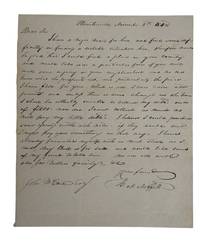
1842rif. 209651842. Slavery North Carolina Letter signed offering a "negro man" to settle debts. Letter signed by "H.M. Moffett" of Huntersville Virginia now West Virginia. Dated November 8th 1842. Measures 9.5" by 7.75". The letter reads in full: "Dear Sir I have a negro man for hire and find some difficulty in finding a suitable situation here therefore would be glad that I could find a place in your country and would take in as a particular favor if you will make some inquiring in your neighborhood and let me know what the prospects are and particularly the price- I have $200 for you which is all I can raise at present and unless their is some change in the times I shall be utterly unable to collect my debts of $1600 now due. I can't collect as much as will pay my little debts. I believe I could purchase some young cattle with notes if they would . I might pay you something in that negro sic. I have already furnished myself with as much stock as I need my Bull is for sale and would like some of my friends to take him. We are all well also Jan sic Millers family - . -- your friend H.M. Moffett." The letter was likely penned by Henry Hiller Moffett second Clerk of Pocahontas county Virginia present day West Virginia. Moffett is listed in the 1850 census with eight enslaved persons. Original folds some minor foxing. Overall very good condition. unknown
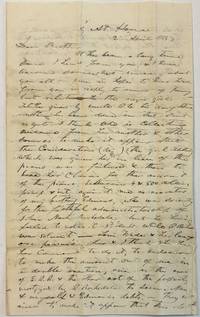
1847rif. 40201Stewartsboro TN 1847. Folio 15" x 12-3/4" sheet folded to 7-1/2" x 12-3/4". 4 pp. Completely in ink manuscript integral address leave bearing Stewartsboro Tennessee April 3 1847 manuscript postal marking. mailing address on last page. The initials of the writer's name are difficult to decipher; this is our best guess. Old folds two short fold splits and a few tiny holes at fold corners. Wax seal remnant with tear at edge loss of a few letters some toning. Good to Very Good. The writer is concerned that Thomas had not responded to his letter "relating to the negro girl Tabitha given by Uncle R. to his daughter- nothing has been done in that suit as yet. I think she is collecting evidence from her mother & other sources to make it appear that the consideration viz the girl Tabitha which was given her in lieu of the piano was a failure & then to base her claim for the amount of the piano between 4 and 500 dollars princp. & int. against me as executor of my brother Edmond who was security for the faithful administrationship of John Nash Barksdale but he having failed to collect sd. debt while R. Barksdale was solvent. Levi Wade & her lawyer are persuading her. . . " He gives Thomas permission to "calculate on receiving a portion of the money for which Paulina sold. . . Negroes have advanced within 3 or 4 months but I fear one diseased as your boy Phil will command but a small price." Dr. Thomas Hill Read 1798-1874 of Tennessee settled in Macon County Illinois in 1831. He was the brother-in-law of Capt. David L. Allen one of the most prominent early citizens having married his sister. Dr. Read became known for his success in the treatment of children's ailments and was considered an expert in cholera infantum. He had a reputation for honesty and was said to have acted as administrator of more estates than anyone else in Macon County. Dr. Read was a member of the Decatur Board of Trustees in 1839 1841 1846 and 1847; County Treasurer from 1845-1846 and County Probate Judge from 1846-1849. John Nash Barksdale 1818-1844 Thomas Read's maternal cousin was born in Tennessee graduated from the University of North Carolina and became a lawyer. He practiced law in Tennessee for a few years and then moved to Columbus Mississippi and entered the law firm of his cousin Gen. William Barksdale. The Columbus bar announced that its members would wear the badge of mourning for thirty days following his death. "Death of John N. Barksdale" Republican Banner Nashville TN Dec. 6 1844 Page 2. Uncle R was likely Randolph Barksdale 1795-1844 Thomas H. Read's maternal uncle and John Nash Barksdale's father. Randolph settled in Tennessee with his father in 1808 and later established his own plantation. He was married three times and became the owner of a large estate and several slaves in Rutherford County Tennessee thanks to the wealth of his first wife. He also owned an estate near Chulahoma in Marshall County Mississippi. unknown
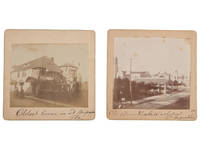
1897rif. 185871897. Albumen photographs of slavery-related sites circa 1890s document physical locations tied to the sale and habitation of enslaved people in the United States and the persistence of those sites in post-Emancipation visual culture. The images include a pavilion in St. Augustine Florida identified in contemporary sources as a site where enslaved Africans were bought and sold a photographic negative depicting outbuildings identified as Mississippi slave quarters and a mounted view of the González Alvarez House a colonial structure associated with early settlement in St. Augustine. Together the photographs provide material evidence of how spaces connected to slavery were recorded labeled and circulated in the late nineteenth century linking architectural survival to the historical memory of enslavement in both the Southeast and the Gulf South. Collection of three albumen photographs. United States circa 1890s. One mounted photograph approximately 3 3/16 x 3 inches bears the ink inscription "Old Slave Market Cathedral St. Augustine Fla." and depicts the waterfront pavilion constructed in the early nineteenth century originally used as a commercial market and identified in local records as a site of slave trading. One photographic negative approximately 3 1/2 x 3 3/4 inches shows three small structures identified as Mississippi slave quarters. One mounted photograph approximately 3 1/8 x 2 5/8 inches is inscribed "Oldest house in St. Augustine Fla. Built in the early 1700s" depicting the González Alvarez House. Mounts and inscriptions indicate a documentary intent linking the images to historically significant sites. By the late nineteenth century sites associated with slavery were being reframed within local historical narratives often presented as landmarks while still retaining traces of their earlier function within systems of forced labor and sale. The identification of the St. Augustine pavilion as a slave market in inscription and record aligns the image with documented urban sites of sale in Spanish and later American Florida while the Mississippi quarters image extends the archive into the plantation landscape of the postbellum South. The grouping provides a concise visual record of how structures tied to enslavement were preserved interpreted and circulated in photographic form decades after abolition. Minor adhesive residue to one mount small tear to negative and light toning and staining to mounts; overall good condition. unknown
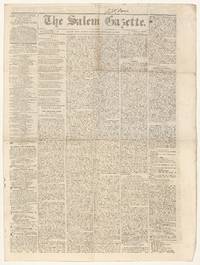
1850rif. 515519Salem Mass: Published by C. Foote 1850. Unbound. Very Good. First edition. Folio. 4pp. Printed self-wrappers. Owner's contemporary ink name on front cover in upper margin. Text is folded lightly creased few spots of faint soiling very good. Text includes: "The Beloved Tune" by Lydia Maria Child three full columns and a thirty-six line announcement about the pending publication of Nathaniel Hawthorne's The Scarlet Letter. Also includes a brief article entitled "Mr. Clay on Slavery" printing extracts from a debate between Senator Clay and General Cass; also prints a three-line announcement about the liberation of fourteen slaves: "Fourteen slaves belonging to Dr. John Casson of Mississippi have been taken to Cincinnati and liberated by their owner. Published by C. Foote unknown