Best.-Nr. 13978604Allerthorpe, York: K Book Editions, 1973 in-12, 56 pages. Cartonné, jaquette, bon état. Réédition fac-simile de l'édition de 1788 (London, J. Phillips).
1791Best.-Nr. 140945477Printed at the Joint Expence of the Glasgow and Edinburgh Societies instituted for the Abolition of the Slave Trade: Edinburgh 1791. First Edinburgh Edition. Very Good. Rare first Edinburgh edition published same year as the London edition of eye-witness testimony on the horrors of the British slave trade containing a very early engraving of the famous large folding plate of slaves packed into the hold of the slave-ship Brookes. The famous engraving is one of the most powerful and influential images in the history of social justice and the fight to abolish slavery. It served as a gruesome test of the Britain's "humane" Slave Trade Act of 1788 also known as Dolben's Act which limited the number of enslaved people that British slave ships could transport based on the ships' tons burthen. Very Good. Small 8vo bound in somewhat recent quarter calf and marbled boards with light fading to the spine. Folding frontispiece map of the west coast of Africa in with 2 x 0.5" loss along one edge neatly restored. Large folding woodcut 16.25 x 15.5" of a slave ship based on the engraving W. Elford published in a pamphlet in London in 1789 is excellent and bright with several repairs made to the verso mending tears. The print now an iconic symbol of the Middle Passage was so visually arresting that William Wilbeforce created a scale model of the Brookes making it a central part of his presentation before the House of Commons. His abolition bill did not garner enough support to pass and it was not until 1807 that England succeeded in abolishing slavery. Edinburgh unknown
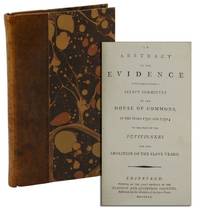
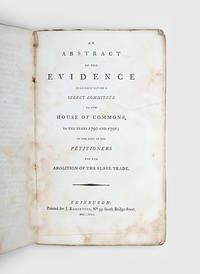
1791Best.-Nr. 180598Edinburgh: Printed for J. Robertson 1791. Stepping up the campaign against slavery Second Edinburgh edition of this best-selling report on the colonial slave trade including a version of among the most famous abolitionist images the cross-section depicting the enslaved individuals transported aboard the Brookes. The Abstract is the first abolitionist work to ground its arguments not on biblical appeals or forceful rhetoric but on documented eyewitness accounts. Until 1790 the abolitionist campaign had been channelled through pamphlet and pulpit. After 1790 abolitionists turned to the new technique of mass petition campaigns against Parliament. The Abstract publishes the testimonies of the witnesses called by the petitioners arranging them thematically by chapter. Among others the select committee called planters traders naval officers and doctors. "The abolitionist petition campaign reached an apex during 1791-1792 where an unprecedented 519 abolitionist petitions coming from all over Britain were delivered to Parliament. Some 400000 persons signed these petitions 1 out of every 11 adults with Manchester alone contributing 20000 names from an adult population of about 30000" Fogel p. 212. Octavo pp. iv 128. Large folding plan of a slave ship folding map of the western coast of Africa tables in the text. Original paper wrappers spine lettered in manuscript ink edges uncut. Housed in custom orange cloth box. Contemporary presentation inscription from "Mr. Campbell" to "John White" on the front cover. Rubbing and chipping minor loss to spine and extremities browning and foxing to contents slight offsetting to plates folding plan loose: just about a very good fragile copy. ESTC N29168. William Fogel Without Consent or Contract 1989. hardcover
1791Best.-Nr. 140945477Printed at the Joint Expence of the Glasgow and Edinburgh Societies instituted for the Abolition of the Slave Trade: Edinburgh 1791. First Edinburgh Edition. Very Good. Rare first Edinburgh edition published same year as the London edition of eye-witness testimony on the horrors of the British slave trade containing a very early engraving of the famous large folding plate of slaves packed into the hold of the slave-ship Brookes. The famous engraving is one of the most powerful and influential images in the history of social justice and the fight to abolish slavery. It served as a gruesome test of the Britain's "humane" Slave Trade Act of 1788 also known as Dolben's Act which limited the number of enslaved people that British slave ships could transport based on the ships' tons burthen. Very Good. Small 8vo bound in somewhat recent quarter calf and marbled boards with light fading to the spine. Folding frontispiece map of the west coast of Africa in with 2 x 0.5" loss along one edge neatly restored. Large folding woodcut 16.25 x 15.5" of a slave ship based on the engraving W. Elford published in a pamphlet in London in 1789 is excellent and bright with several repairs made to the verso mending tears. The print now an iconic symbol of the Middle Passage was so visually arresting that William Wilbeforce created a scale model of the Brookes making it a central part of his presentation before the House of Commons. His abolition bill did not garner enough support to pass and it was not until 1807 that England succeeded in abolishing slavery. Edinburgh unknown books
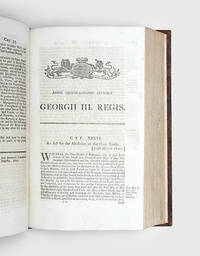
1807Best.-Nr. 182125London: printed by George Eyre and Andrew Strahan 1807. The African Slave Trade. is hereby utterly abolished prohibited and declared to be unlawful First edition of one of the most consequential acts of legislation in world history abolishing the slave trade within the British Empire. The Act the culmination of many years of campaigning by British abolitionists ended two centuries in which Britain took the pre-eminent role in the transatlantic slave traffic. The act paved the way for other European empires to abolish the trade and for Britain to use its navy to intercept slave ships which effectively ended the transatlantic slave trade by the latter half of the century. However the act did not end slavery in the British Empire which did not follow until 1833. Parliamentary acts were issued individually and in collected format printed from the same type. This copy includes the full acts for 1807 comprising the only session of the Third Parliament with the first session of the Fourth the second session was held in 1808 together with the separately published report on vaccination. It was bound for use by the civic authorities of the town of Elgin in Scotland. 3 parts in 1 vol. folio 289 x 181 mm pp. 16 466 1; 14 578 2 blank; 16. Contemporary sprinkled calf twin red and green morocco labels "Town of Elgin Acts of Parliament / 1807" edges speckled blue. Pencilled notation at head of title page. Neatly restored at extremities very minor foxing and finger-soiling to contents. A very good copy. unknown
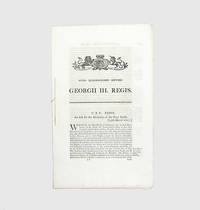
1807Best.-Nr. 184142London: Printed by George Eyre and Andrew Strahan 1807. The African Slave Trade. is hereby utterly abolished prohibited and declared to be unlawful First edition of one of the most consequential acts of legislation in world history abolishing the slave trade within the British Empire. This copy is a well-preserved example of the separate folio printing. From 1807 enslaved persons could no longer be bought or sold within the British Empire while the Royal Navy was empowered to target vessels engaged in slave transportation a task it took up with vigour. Parliamentary acts were issued in collected annual volumes and as individual pamphlets all printed from the same type. As King's Printers Eyre & Strahan held the exclusive rights to publish and sell parliamentary statutes and this pamphlet would have been among those sold at their offices near Fleet Street. Folio 319 x 197 mm pp. 317-326 2. Woodcut headpiece. Stab-sewn as issued edges uncut. Minor offsetting else a near-fine copy. unknown
1996A clean, unmarked book with a tight binding. 208 pages. Previous owner's name label inside.
1786Best.-Nr. 40654Philadelphia: London printed: Philadelphia: re-printed by Joseph Crukshank 1786. 8vo. 8 1/2 x 5 inches. xix 2 22-155 pp. Publisher's advertisement at rear. Original blue paper wrappers Exceedingly rare first American edition of Clarkson's first work. A landmark work by the writer who helped abolish slavery in the British Empire. First American edition of Clarkson's rare first published work preceded by the same years first English edition his famous prize essay on the abolition of slavery igniting the campaign for one of the fundamental rights of man PMM 232. In 1770s England as "rebellious Americans were severing ties with their former British motherland a strenuous battle occurred that spawned the noble civil- and human-rights fight that eventually ended Britain's participation in the African slave trade." With this Essay on the Slavery and Commerce of the Human Species Thomas Clarkson "became the official whistle-blower of the horrors of transatlantic slavery the driving force behind the abolition of African slavery and the slave trade" Smith Thomas Clarkson 17. Clarkson's "famous prize essay was the prelude to parliamentary action" on the abolition of slavery. Clarkson together with William Wilberforce led the "campaign carried on by word of mouth and by means of the printing press for one of the fundamental rights of man" PMM 232. Clarkson had been completing his studies at Cambridge when he entered an essay competition and came across an "advertisement for Benezet's Historical Account of Guinea. He was profoundly struck by the title and 'hastened to London to buy it'. Overwhelmed by the horror and brutality of transatlantic slavery his goal of merely winning the prize for its own sake" shifted to creating a work of wider impact. On winning the 1785 Cambridge prize Clarkson translated the essay his Latin dissertation into English for publication. He documents the long history of slavery the devastating Middle Passage and the inhumanity of slavery in the colonies. Clarkson is renowned as "the man who spawned the British Abolitionist Movement and the first Briton to devote his entire adult life to ending African slavery… the moral conscience of American slavery proponents well into the 19th century" Smith 9-30 43. "He never ceased to work for anti-slavery lending his pen and his prestige particularly to the cause of abolition in the United States" DNB. Evans 19561; Library Company of Philadelphia. Afro-Americana 1553-1906 2nd ed. 2384; Kress B1028; ESTC W32021; PMM 232a; Sabin 13484. London, printed: Philadelphia: re-printed by Joseph Crukshank unknown
1786Best.-Nr. 40654Philadelphia: London printed: Philadelphia: re-printed by Joseph Crukshank 1786. 8vo. 8 1/2 x 5 inches. xix 2 22-155 pp. Publisher's advertisement at rear. Original blue paper wrappers Exceedingly rare first American edition of Clarkson's first work. A landmark work by the writer who helped abolish slavery in the British Empire. First American edition of Clarkson's rare first published work preceded by the same years first English edition his famous prize essay on the abolition of slavery igniting the campaign for one of the fundamental rights of man PMM 232. In 1770s England as "rebellious Americans were severing ties with their former British motherland a strenuous battle occurred that spawned the noble civil- and human-rights fight that eventually ended Britain's participation in the African slave trade." With this Essay on the Slavery and Commerce of the Human Species Thomas Clarkson "became the official whistle-blower of the horrors of transatlantic slavery the driving force behind the abolition of African slavery and the slave trade" Smith Thomas Clarkson 17. Clarkson's "famous prize essay was the prelude to parliamentary action" on the abolition of slavery. Clarkson together with William Wilberforce led the "campaign carried on by word of mouth and by means of the printing press for one of the fundamental rights of man" PMM 232. Clarkson had been completing his studies at Cambridge when he entered an essay competition and came across an "advertisement for Benezet's Historical Account of Guinea. He was profoundly struck by the title and 'hastened to London to buy it'. Overwhelmed by the horror and brutality of transatlantic slavery his goal of merely winning the prize for its own sake" shifted to creating a work of wider impact. On winning the 1785 Cambridge prize Clarkson translated the essay his Latin dissertation into English for publication. He documents the long history of slavery the devastating Middle Passage and the inhumanity of slavery in the colonies. Clarkson is renowned as "the man who spawned the British Abolitionist Movement and the first Briton to devote his entire adult life to ending African slavery… the moral conscience of American slavery proponents well into the 19th century" Smith 9-30 43. "He never ceased to work for anti-slavery lending his pen and his prestige particularly to the cause of abolition in the United States" DNB. Evans 19561; Library Company of Philadelphia. Afro-Americana 1553-1906 2nd ed. 2384; Kress B1028; ESTC W32021; PMM 232a; Sabin 13484. London, printed: Philadelphia: re-printed by Joseph Crukshank unknown books
1786Best.-Nr. 43537Bergerac, J. B. Puynesge, 1786. 2 vol. in-4 de XXV-(1)-553-(1) pp. et XVIII-401-(1)-40 pp., demi-basane brune, dos lisse orné (relié vers 1820).
Best.-Nr. 13977243Abidjan: Université d'Abidjan, 1986 in-8, 171 pages. Broché, très bon état. Sommaire: KOUAME (N.), La dynamique de l'habitat baoulé. - TOURE (M.), Croissance urbaine et développement économique et social en Afrique au sud du Sahara. - OUATTARA (S.), Une problématique sociologique du phénomène migratoire. - TOURE (I.), Le syndicalisme de participation à l'épreuve. - MEMEL FOTE (H.), Conficius et l'esclavage: une philosophie problématique. - TRAORE (A.), Des conséquences de la sous-représentation statistique des femmes sur le développement national.
Best.-Nr. 13974535Abidjan: Université d'Abidjan, 1977 in-8, 110 pages. Broché. Sommaire: A. NEGRE: A propos de Mogadiscio au Moyen Age. - S. DAGET: Encore Théodore Canot: quelques années de la vie d'un négrier et quelques questions. - R. ANOUMA: Les sociétés indigènes de prévoyance, la caisse centrale de Crédit Agricole Mutuelle: organisation, fonctionnement et rôle en Côte d'Ivoire jusqu'à la veille de la 2è guerre mondiale. - J.-N: LOUCOU. Aux origines du Parti Démocratique de la Côte d'Ivoire.
Best.-Nr. ORD-695Publiées avec l'approbation du Ministre de la Marine et des Colonies et sous les auspices de S. A. R. Mgr le Prince de Joinville. 32e Année. 3°série. Partie non officielle. Tome III. 2°section. Revue Coloniale. Tome 102 de la Collection. Paris. Imprimerie Royale. 1847. In-8 (133 x 198mm) dos lisse basane brune, filets et titres or, 680 pages, 3 planches dépliantes hors texte. Bon exemplaire.
2004Best.-Nr. 13346Paris, Editions de l'Ecole des Hautes Etudes en Sciences Sociales, 2004 1 volume 17 x 24cm, Broché 2 feuillets, puis paginé de 489 à 690, XIIIp., 6 feuillets. Bon état.
1955Best.-Nr. 133601955. Fort-de-France (Martinique) Annales des Antilles n°1 1955 - Agrafé 16 cm x 24 5 cm 87 pages+ publicités locales - Présentation de René Cottrell textes de Maurice Thamar J. Petitjean-Roget Guy Desportes Maurice Nicolas ; relation de la Martinique par un R. P. Jésuite en 1701 titres de noblesse de la famille Tascher de la Pagerie - Bien complet de la brochure de présentation de l'association dos restauré sinon bon état
2004N°3, de mai-juin 2004, 59è année, de la revue bimestrielle fondée par Marc Bloch et Lucien Febvre. Au sommaire, articles sur 3 thèmes: "Légitimité dynastique et formes de l'Etat" ("L'Etat dans la Chine des Song"), "Après l'esclavage - Terre, citoyenneté, mémoire" (Cuba, Martinique, Jamaïque, Colombie), "La valeur des femmes" (relecture des sources ethnographiques antiques à propos des Thraces); comptes rendus d'ouvrages sur la guerre. Français
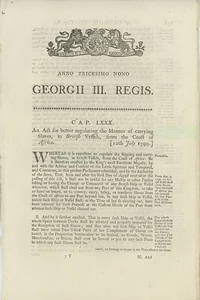
1799Best.-Nr. 28145London: Printed by George Eyre and Andrew Strahan Printers to the King's most Excellent Majesty 1799 1799. ESTC N60288 Lincoln's Inn Library and Wellcome Institute. Fine. 4to disbound paginated 637-652 untrimmed. An act passed by Parliament in the summer of 1799 delineated in 39 paragraphs that regulated the slave trade beginning in August 1800 - an act no doubt intended to placate the growing voices of opposition to the English slave trade. The act stipulates how many slaves could be stowed in a ship by mathematical formula according to the size of the ship but never more than 400; that slaves must be separated from other cargo; and that the space for the slaves "be full and complete perpendicular height of five feet." Nothing is said about their treatment other than that the ship's surgeon was required keep a log of illnesses and deaths of both slaves and crew. Much of the act is taken up with its enforcement and the penalties and fines for violations; it also regulates the conditions and treatment of the crew. The acts of Parliament were usually published separately and later issued in collections of the Public General Statutes; this one was issued as part of the collection of statues Passed in the Thirty-Ninth Year of the Reign of His Majesty King George the Third: Being the Third Session of the Eighteenth Parliament of Great Britain. This copy is disbound from such a volume. (London: Printed by George Eyre and Andrew Strahan, Printers to the King's most Excellent Majesty, 1799) unknown
Best.-Nr. 23092Without date or place. 3pp. 12mo. Bifolium on ruled laid paper. Fair: aged with a 12.5 x 5 cm section cut away from the top of the first leaf before the writing out of the poem. 63 lines divided into six nine-line stanzas. The stanzas are numbered and the poem is complete. The stanzas are numbered and the poem is complete. Written from the slave's point of view with the first stanza reading: 'I'm weary yet I cannot sleep Dark thoughts of morning make me weep For at the rising Sun I'm told I'll be converted into gold There's no escape I must be sold Because my master wants the gold And I'm his Slave yes I'm his Slave Because my master wants the gold And I'm his slave'. Last stanza describing the slave's flight to Canada: 'At last my dreadful journeys o'er I'm safe upon the farther shore St Georges cross floats over me I've found the land of Liberty. My youths renewed no more I'm old That fear is gone of being sold For now I'm Free Yes now I'm Free The fear is gone of being sold For now I'm Free.' No indication has been found that the poem was ever published. Without date or place. unknown
1873Best.-Nr. 189241873. Saint-Quentin Imprimerie Ch. Poette 1873 - Broché 15 cm x 23 cm 44 pages - Texte de Camille Demoulin - Sans couv. sinon bon état ; extrait du tome XI troisième série de la Société Académique de Saint-Quentin
1986Best.-Nr. 104542PUF, coll. « Pratiques Théoriques » 1986 In-8 broché 21,6 cm sur 15. 375 pages. Très bon état d’occasion.
1998Best.-Nr. 192787Puf Paris, Puf, 1998. In-8 broché de 375 pages. Collection Quadrige. Bon état
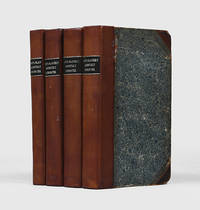
1827Best.-Nr. 163198London: Printed for the London Society for the Mitigation and Abolition of Slavery in the British Dominions 1827-32. A new age of abolitionist agitation First collected editions being the full run under its original title of Zachary Macaulay's abolitionist magazine the leading organ of British abolitionist thought and campaigning. It was afterwards renamed the Anti-Slavery Reporter and has lasted under changing titles to this day. The journal "systematically collected information on the abuses of slavery" ODNB. "Highlighting the rise of abolitionist petition drives antislavery discussions in church and government venues and debates over unfree labor throughout the empire the paper celebrated a new age of abolitionist agitation" Newman pp. 44-45. The volumes collect the monthly issues from June 1825 to December 1831 with collective title pages and contents tables. 4 vols. octavo 216 x 129 mm. Contemporary half calf rebacked black morocco labels marbled sides edges speckled brown. Wear at extremities inner hinges reinforced a little browned and spotted: still very good copies. Richard S. Newman Abolitionism: A Very Short Introduction 2018. unknown
2019Best.-Nr. LFA-126747177N° 574 (Mars 2019) : revue de 82 pages, format 215 x 285 mm, illustrée, brochée couverture couleurs, bon état
1987S. l. (Paris), S. é., 1987; in-8, 32 pp., couverture et feuilles agrafées. Extrait d'Enquêtes et Documents (Centre de Recherches sur l'Histoire du Monde Atlantique). - Tome XIII — 1987. G. I. R. I.