1 532 résultats
1975réf. R240136173FRANCOIS MASPERO. 1975. In-8. Broché. Bon état, Couv. convenable, Agraffes rouillées, Intérieur frais. Tiré à part paginé de 77 à 90 - pages agrafées - hommage de l'auteur sur la page 77 - 2 photos disponibles.. . . . Classification Dewey : 326-Esclavage
réf. 7928Paris, Firmin-Didot, s.d. (1902), 1 percaline rouge, encadrements et ornements floraux dorés, tranches dorées. in-8 de 158 pp., illustré de 19 gravures dont 1 en frontispice ;
réf. LFA-126730525Un ouvrage de 158 pages, format 150 x 230 mm, illustré de 19 gravures, relié cartonnage, s.d. (début du XXe siècle), Librairie de Paris
In-12, demi-chagrin bordeaux de l'époque, dos à 5 nerfs orné de filets à froid et dorés, titre doré, (2) f., 330 p., (1) f. d'errata. Edition originale. Historien et théologien, dans la mouvance du protestantisme libéral, Albert Reville fut nommé professeur au Collège de France en 1880 à la première chaire d'histoire des religions. Il fut lors de sa création en 1886, le premier Président de la section des sciences religieuses de l'Ecole Pratique des Hautes Etudes et le fondateur de la "Revue de l'Histoire des Religions". Très bon exemplaire, bien relié à l'époque.
1970réf. vh3705Fascicule 1970 In-8 (16 x 24 cm), fascicule agrafé, paginé de 214 à 224 ; petites taches autour des agrafes rouillées, par ailleurs assez bon état. Livraison a domicile (La Poste) ou en Mondial Relay sur simple demande.
réf. 19739In-12, demi-chagrin bordeaux de l'époque, dos à 5 nerfs orné de filets à froid et dorés, titre doré, (2) f., 330 p., (1) f. d'errata. Paris, C. Reinwald et J. Cherbuliez, 1865.
réf. 211230Paris, C. Reinwald, J. Cherbuliez, 1865 in-12, [2] ff. n. ch., 330 pp., un f. n. ch. d'errata, demi-chagrin cerise, dos à nerfs orné de filets à froid, tranches mouchetées de bleu (reliure de l'époque). Infimes accrocs au dos.
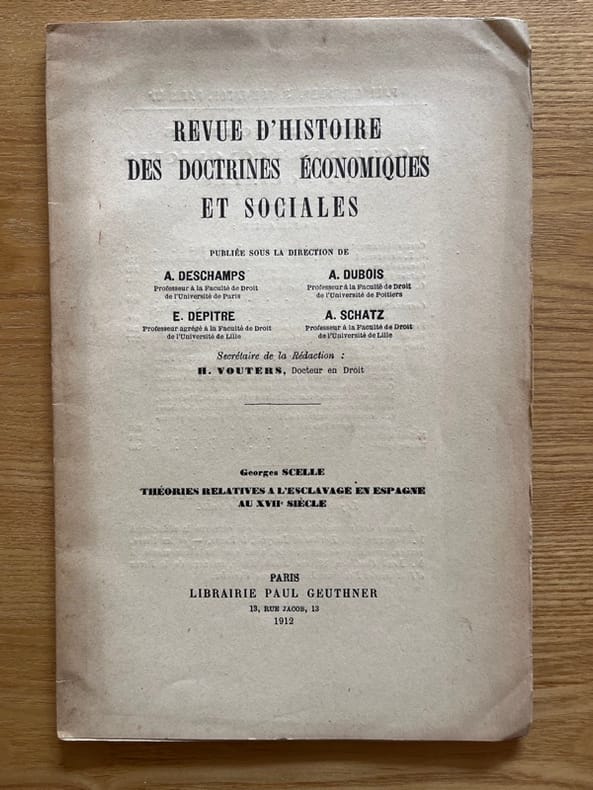
réf. 235165Paris, Geuthner, 1912 in-8, 28 pp., broché.
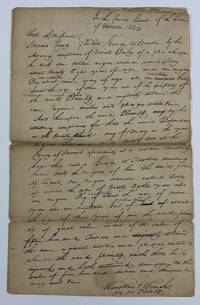
1822réf. 4276Howard County Mo 1822. Good. Three documents totaling 3pp. folio the two earliest documents written on each side of the same leaf with an integral blank and attached to the third document with sealing wax each document docketed on verso. Some short separations along folds minor spotting two short tape repairs. A series of three documents recording a case of slave theft in Missouri. The plaintiff in the case George W. Hardin sues a man named Urial Bailey for stealing three slaves from the Hardin estate in Howard County Missouri. The first document is a sworn oath dated May 23 1822 by George Hardin stating that "He was lawfully possessed of the negroes.and that the same were unlawfully taken by Urial Bailey.from his properties and with out his consent within one year last past and that he is now lawfully entitled to the possession of the said negroes." The document is attested by the clerk and signed by Hardin. The second document is executed by Hardin's lawyers on the verso of his oath dated the same day and constitutes an order from the court to the Sheriff of Howard County informing him that "George W. Hardin hath come into the Circuit Court held in the town of Franklin and found sufficient sureties as well as his clamour to prosecute for a certain woman called Dolly about the age of twenty eight years also one negro boy of about the age of nine years named Nathan also one negro girl called Eliza about the age of three years all the property of the said Plaintiff.which a certain Uriel Bailey.hath taken and unjustly detains. You are hereby commanded that the said goods.be delivered to the said George W. Hardin and that.Uriel Bailey appear before the said Circuit Court to be held at the town of Franklin." The third document is executed by Hardin's lawyers on the verso of his oath dated September 1822 and lays out the facts of the case. It reads in part: "George W. Hardin by his Attorney Tompkins & French complains of Urial Bailey that he took the previously named slaves of great value. To wit of the value of fifteen hundred dollars.where fore the said Plaintiff saith that he is injured and hath sustained damages to the value of five hundred dollars and therefore he brings suit." Interestingly in this document Hardin's lawyers refer to the youngest slave Eliza as a "mulatto girl." Docketing on the integral blank attached to the oath and lawyer's document dated May 23 1822 indicate that Hardin was seeking "Replevin Damages" of $500 which the court seems to grant. The motive behind Urial or Uriel Bailey's thefts are not recorded here but the issue of slave stealing was not uncommon and had been going on in the American colonies and the fledgling United States for a long time. According to Timothy F. Reilly in "Slave Stealing in the Early Domestic Trade as Revealed by a Loyal Manservant" published in Louisiana History: The Journal of the Louisiana Historical Association Vol. 55 No. 1 Winter 2004 pp.5-39: "Slave stealing plagued domestic slaveholders as far back as the colonial period when those who would unlawfully deprive a property owner of human chattel were detested as 'Negro jockeys.' Whether operating in the northern or southern colonies a 'man-stealer' lurking about either as a piratical thief or as a high-minded abolitionist was guilty of one of the worst crimes against the sanctity of property. By the 1830s man stealing reached epidemic levels in parts of the South." Despite the seeming prevalence of slave theft for a long period of time in the United States primary source records of court cases are very scarce. unknown books
1822réf. 4276Howard County Mo 1822. Good. Three documents totaling 3pp. folio the two earliest documents written on each side of the same leaf with an integral blank and attached to the third document with sealing wax each document docketed on verso. Some short separations along folds minor spotting two short tape repairs. A series of three documents recording a case of slave theft in Missouri. The plaintiff in the case George W. Hardin sues a man named Urial Bailey for stealing three slaves from the Hardin estate in Howard County Missouri. The first document is a sworn oath dated May 23 1822 by George Hardin stating that "He was lawfully possessed of the negroes.and that the same were unlawfully taken by Urial Bailey.from his properties and with out his consent within one year last past and that he is now lawfully entitled to the possession of the said negroes." The document is attested by the clerk and signed by Hardin. The second document is executed by Hardin's lawyers on the verso of his oath dated the same day and constitutes an order from the court to the Sheriff of Howard County informing him that "George W. Hardin hath come into the Circuit Court held in the town of Franklin and found sufficient sureties as well as his clamour to prosecute for a certain woman called Dolly about the age of twenty eight years also one negro boy of about the age of nine years named Nathan also one negro girl called Eliza about the age of three years all the property of the said Plaintiff.which a certain Uriel Bailey.hath taken and unjustly detains. You are hereby commanded that the said goods.be delivered to the said George W. Hardin and that.Uriel Bailey appear before the said Circuit Court to be held at the town of Franklin." The third document is executed by Hardin's lawyers on the verso of his oath dated September 1822 and lays out the facts of the case. It reads in part: "George W. Hardin by his Attorney Tompkins & French complains of Urial Bailey that he took the previously named slaves of great value. To wit of the value of fifteen hundred dollars.where fore the said Plaintiff saith that he is injured and hath sustained damages to the value of five hundred dollars and therefore he brings suit." Interestingly in this document Hardin's lawyers refer to the youngest slave Eliza as a "mulatto girl." Docketing on the integral blank attached to the oath and lawyer's document dated May 23 1822 indicate that Hardin was seeking "Replevin Damages" of $500 which the court seems to grant. The motive behind Urial or Uriel Bailey's thefts are not recorded here but the issue of slave stealing was not uncommon and had been going on in the American colonies and the fledgling United States for a long time. According to Timothy F. Reilly in "Slave Stealing in the Early Domestic Trade as Revealed by a Loyal Manservant" published in Louisiana History: The Journal of the Louisiana Historical Association Vol. 55 No. 1 Winter 2004 pp.5-39: "Slave stealing plagued domestic slaveholders as far back as the colonial period when those who would unlawfully deprive a property owner of human chattel were detested as 'Negro jockeys.' Whether operating in the northern or southern colonies a 'man-stealer' lurking about either as a piratical thief or as a high-minded abolitionist was guilty of one of the worst crimes against the sanctity of property. By the 1830s man stealing reached epidemic levels in parts of the South." Despite the seeming prevalence of slave theft for a long period of time in the United States primary source records of court cases are very scarce. unknown
197266 pages. Features: John Chisum - Empire Builder; Little Sister of Courage; Moman Pruiett - Genius of Hate; The Day Wyatt Earp Died; Tragedy on the Sweetwater; Guarding the Rio Grande (cover story); The Northfield Raid; Revival Meeting Cutups; Lake of the Pawnee Blood; "I Met Butch Cassidy"; Poker Alice - the West's First Female Gambler; Early Day Fire Departments; Slavery in the West. Magazine
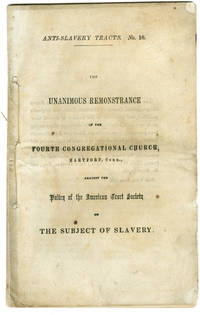
1855réf. 55824New York: American Anti-Slavery Society 1855. Criticizing the American Tract Society for Suppressing Anti-Slavery Works The scarce second printing of what is technically the first edition of this anti-slavery pamphlet printed in New York by the American Anti-Slavery Society from the same "stereotype plates.without alteration" as the edition printed in Hartford earlier the same year. The text focuses on an appeal to the American Tract Society to take a more vocal and concerted stand against slavery. The authors of the text accuse the American Tract Society of "suppression" of anti-slavery sentiment by censorship of certain works it publishes that speak against the institution and an overall sin of "studied and persistent omission" by not itself issuing "a direct condemnation of the most giant iniquity of our land." The text is signed in print at the conclusion by "The Members of the Fourth Congregational Church Hartford Conn." The work was issued as the sixteenth entry in the American Anti-Slavery Society's "Anti-Slavery Tracts." Gathered signatures stitched as issued. Minor edge wear spotting and soiling. Very good. SABIN 30676. unknown books
1855réf. 55824New York: American Anti-Slavery Society 1855. Criticizing the American Tract Society for Suppressing Anti-Slavery Works The scarce second printing of what is technically the first edition of this anti-slavery pamphlet printed in New York by the American Anti-Slavery Society from the same "stereotype plates.without alteration" as the edition printed in Hartford earlier the same year. The text focuses on an appeal to the American Tract Society to take a more vocal and concerted stand against slavery. The authors of the text accuse the American Tract Society of "suppression" of anti-slavery sentiment by censorship of certain works it publishes that speak against the institution and an overall sin of "studied and persistent omission" by not itself issuing "a direct condemnation of the most giant iniquity of our land." The text is signed in print at the conclusion by "The Members of the Fourth Congregational Church Hartford Conn." The work was issued as the sixteenth entry in the American Anti-Slavery Society's "Anti-Slavery Tracts." Gathered signatures stitched as issued. Minor edge wear spotting and soiling. Very good. SABIN 30676. unknown
1836réf. 1005398vo pamphlet marbeled wrappers with printed label on front cover 32 pp.some minor spine snd edge wear slight aging; very good or better.The work begins with the original source of funds for its "Charitable Fund" which began with estate of Robert Boyle in 1691. Since the 500000 Negro Slaves in the West Indies were mostly "infidels and heathens" converting them to Christianity would be doing them a favor and help the empire.Converting the slaves to Christianity would make them more virtuous more comfortable offer them a prospect of eternall happines and even make them better servants. Richard Clay, books
1836réf. 1005398vo pamphlet marbeled wrappers with printed label on front cover 32 pp.some minor spine snd edge wear slight aging; very good or better.The work begins with the original source of funds for its "Charitable Fund" which began with estate of Robert Boyle in 1691. Since the 500000 Negro Slaves in the West Indies were mostly "infidels and heathens" converting them to Christianity would be doing them a favor and help the empire.Converting the slaves to Christianity would make them more virtuous more comfortable offer them a prospect of eternall happines and even make them better servants. Richard Clay,
1852réf. 100540Letterpress braodsheet 10 3/4 x 6 1/4 text on both sides. Margins trimmed on both sides a little uneven on the left side close to words on reverse but not affecting text a few small stains in text. Indiana was for many years a site of refuge for escaping slaves. With this joint resolution the document declares that the only real way to do away with the injustice of slavery was to advocate emigration and colonialization of Africa. books
1852réf. 100540Letterpress braodsheet 10 3/4 x 6 1/4 text on both sides. Margins trimmed on both sides a little uneven on the left side close to words on reverse but not affecting text a few small stains in text. Indiana was for many years a site of refuge for escaping slaves. With this joint resolution the document declares that the only real way to do away with the injustice of slavery was to advocate emigration and colonialization of Africa.
réf. 1332593208.Gpaperback. Good. Access codes and supplements are not guaranteed with used items. May be an ex-library book. paperback
2001réf. __0252026322Univ of Illinois Pr 2001. Hardcover. New. 328 pages. 9.25x6.25x1.00 inches. Univ of Illinois Pr hardcover
réf. 0656338911.Ghardcover. Good. Access codes and supplements are not guaranteed with used items. May be an ex-library book. hardcover
1990A clean, unmarked book with a tight binding. Previous owner's name and label inside. 342 pages.
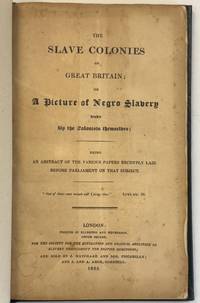
1825réf. 41192London: Printed by Ellerton and Henderson Gough Square for the Society for the Mitigation and Gradual Abolition of Slavery Throughout the British Dominions; and Sold by J. Hatchard and Son Piccadilly; and J. and A. Arch Cornhill 1825. iv 164 pp. Some foxing to first and last few leaves; title and last page toned. Bound in modern dark boards with gilt-lettered title stamped on front cover. Good plus. A second edition issued in 1826. The book reviews developments concerning slavery in each of the British West India colonies: laws for free people of color and for slaves manumissions proposed reforms and objections to reforms trials of alleged rebels and insurgents including the destruction of the Methodist chapel in Barbados and revolts and trials in Jamaica changes in the law punishments inflicted manumissions the slave trade slave unrest. "The reports were called for in order to learn what had been done in the way of effecting amelioration in the colonies. This work brought out by the Society for the Mitigation and Gradual Abolition of Slavery Throughout the British Dominions. . . showing that nothing substantial has been done" Ragatz. It "presents cases of extreme cruelty" id. to slaves in Berbice. Authorship and editorship are attributed to Zachary Macaulay founder and organizer of several antislavery societies and a major force in accomplishing the British Emancipation. He focused on providing a picture of Negro Slavery based on reports of "the colonists themselves." FIRST EDITION. Ragatz 458. Sabin 82063. Not in LCP. Printed by Ellerton and Henderson, Gough Square, for the Society for the Mitigation and Gradual Abolition of Slavery Throughout unknown books
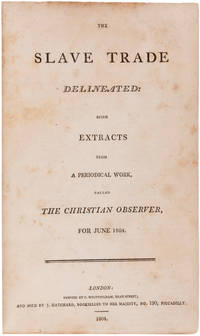
1805réf. 21055261805. London: Whittingham for Hatchard. 1805. 8vo. Recent marbled wrappers; pp. 20 printed in two columns; one corner of title-page clipped light browning; a good copy of a great rarity.This combined offprint opens with a first-hand report by 'Leo Africanus' of a journey recently made on a slave ship from West Africa to the West Indies. On board the ship the Captian told the visitors and traveller 'that a slave ship was a very different thing from what it had been represented. We should find the slaves rejoicing in their happy state' p. 3. The truth however showed the sheer horror of this crime against humanity at high sea. This is followed on page ten by a discussion of a Hatchard-published pamphlet on the abolition of the slave trade. The present pamphlet is concluded by the refutation of the printed Letter to the Right Honorable W.Pitt containing some new Arguments against the Abolition of the Slave Trade in which the author Britannicus had argued 'if we give freedom to the negroes we shall ourselves indubitable become slaves of Bonaparte' p. 13. Post-truth over two hundred years ago. unknown
1825réf. 41192London: Printed by Ellerton and Henderson Gough Square for the Society for the Mitigation and Gradual Abolition of Slavery Throughout the British Dominions; and Sold by J. Hatchard and Son Piccadilly; and J. and A. Arch Cornhill 1825. iv 164 pp. Some foxing to first and last few leaves; title and last page toned. Bound in modern dark boards with gilt-lettered title stamped on front cover. Good plus. A second edition issued in 1826. The book reviews developments concerning slavery in each of the British West India colonies: laws for free people of color and for slaves manumissions proposed reforms and objections to reforms trials of alleged rebels and insurgents including the destruction of the Methodist chapel in Barbados and revolts and trials in Jamaica changes in the law punishments inflicted manumissions the slave trade slave unrest. "The reports were called for in order to learn what had been done in the way of effecting amelioration in the colonies. This work brought out by the Society for the Mitigation and Gradual Abolition of Slavery Throughout the British Dominions. . . showing that nothing substantial has been done" Ragatz. It "presents cases of extreme cruelty" id. to slaves in Berbice. Authorship and editorship are attributed to Zachary Macaulay founder and organizer of several antislavery societies and a major force in accomplishing the British Emancipation. He focused on providing a picture of Negro Slavery based on reports of "the colonists themselves." FIRST EDITION. Ragatz 458. Sabin 82063. Not in LCP. Printed by Ellerton and Henderson, Gough Square, for the Society for the Mitigation and Gradual Abolition of Slavery Throughout unknown
1860réf. 63532New York: Published and for sale at 5 Beekman Street 1860. First Edition. 12mo. 20th-c. binding of tan calf over paper-covered boards; marbled page edges; 951pp. About fine and complete; the pamphlet appears to have been offered without cover wrappers in any case not noted by Blanck. Uncommon first edition of this late tract by the important abolitionist and feminist Lydia Maria Child 1802-1880. Child's intention with this work was to make a direct case to southern slaveholders based not on any moral grounds but purely on business hoping that the Caribbean example would convince southerners that abolition could be achieved without wrecking their economy. "Child suggested to Samuel B. May the publisher .that the title page omit any mention of the American Anti-slavery Society giving only an address but no publisher. She even considered issuing the tract anyonymously but decided that her notoriety would probably help rather than hinder its circulation" see Karcher The First Woman in the Republic: a Cultural Biography of Lydia Maria Child. Durham 1994; p.428ff. Blanck notes two editions in 1860 as well as a reissue in 1862; this with verso of the final leaf unprinted is the first. Rarely encountered in commerce. BAL 3189. Published and for sale at 5 Beekman Street unknown books