1 828 résultats
1982réf. R150205957ENCRE. 1982. In-8. Broché. Bon état, Couv. convenable, Dos satisfaisant, Intérieur frais. 291 pages- quelques pages de photos en noir et blanc hors texte. . . . Classification Dewey : 326-Esclavage
1850réf. 1210761850. First Edition. SLAVERY SMITH Gerrit. Substance of the Speech Made by Gerrit Smith in the Capitol of the State of New York March 11th and 12th 1850. Albany: Jacob T. Hazen 1850. Octavo period-style half calf gilt marbled boards; pp. 1-3 4-25 26-27 28-30. $1500.First edition of the bold abolitionist's Speech proclaiming the Constitution ""does not allow the three million of our colored countrymen to be held in slavery"" a close friend of Frederick Douglass who ""openly embraced Smith's version of an antislavery interpretation of the Constitution"" delivered the same decade as John Brown's Harpers Ferry raid substantially financed by Smith.Smith a wealthy philanthropist was ""among the most outspoken"" of white abolitionists Jackson Force and Freedom 65. Once linked to William Lloyd Garrison's view of the Constitution as a ""covenant with death"" Smith split from Garrison and became a founder of both the Liberty Party and its successor the Radical Abolitionist Party. He was as well key in forging a close interracial alliance between Frederick Douglass Black abolitionist and physician James McCune Smith and John Brown. The four men shared the goal of achieving ""a 'radical change' in government."" By the early 1850s Douglass ""openly embraced Smith's version of an antislavery interpretation of the Constitution"" Blight 213. To Smith Douglass and figures as Alvan Stewart and Lysander Spooner ""the Constitution empoweredÑeven requiredÑCongress to abolish slavery in the southern states by direct legislationÉ As an editor Douglass had always engaged with national politics. Now the federal authority at the base of slavery's stranglehold on America became his intensive focus"" Blight 214; emphasis in original.This very scarce first edition captures the force of Smith's groundbreaking 1850 Speech and clearly demonstrates the breadth of his constitutional argument. Declaring ""law is for the protection of rightsÑnot for the destruction of rights"" emphasis in original he cites passages in the Declaration and Bill of Rights and addresses the pivotal ""three-fifths"" clause. Smith proclaims the Founding Fathers did not intend ""to make this whole land the slaveholder's hunting ground"" and asserts the Constitution ""does not allow the three million of our colored countrymen to be held in slavery."" He would use his wealth to help establish a Black settlement at North Elba N.Y. which was ""John Brown's permanent residence from 1854 until his death"" Stauffer Black Hearts 3. After Harpers Ferry and Brown's execution Smith faced demands that he be tried as an ""accessory after the fact."" While he ""publicly denied it Smith gave warm encouragement and financial assistance"" to Brown and the Harpers Ferry insurrection. Yet ""guilt over the failure of Brown's raid and fear of possible arrest as a co-conspirator caused Smith to commit himself to the Utica State Lunatic Asylum"" ANB. In time he publicly retreated from his Radical Abolitionist stance and died in 1874. Sabin 82670. A fine copy. hardcover books
1850réf. 1210761850. First Edition. SLAVERY SMITH Gerrit. Substance of the Speech Made by Gerrit Smith in the Capitol of the State of New York March 11th and 12th 1850. Albany: Jacob T. Hazen 1850. Octavo period-style half calf gilt marbled boards; pp. 1-3 4-25 26-27 28-30. $1500.First edition of the bold abolitionist's Speech proclaiming the Constitution ""does not allow the three million of our colored countrymen to be held in slavery"" a close friend of Frederick Douglass who ""openly embraced Smith's version of an antislavery interpretation of the Constitution"" delivered the same decade as John Brown's Harpers Ferry raid substantially financed by Smith.Smith a wealthy philanthropist was ""among the most outspoken"" of white abolitionists Jackson Force and Freedom 65. Once linked to William Lloyd Garrison's view of the Constitution as a ""covenant with death"" Smith split from Garrison and became a founder of both the Liberty Party and its successor the Radical Abolitionist Party. He was as well key in forging a close interracial alliance between Frederick Douglass Black abolitionist and physician James McCune Smith and John Brown. The four men shared the goal of achieving ""a 'radical change' in government."" By the early 1850s Douglass ""openly embraced Smith's version of an antislavery interpretation of the Constitution"" Blight 213. To Smith Douglass and figures as Alvan Stewart and Lysander Spooner ""the Constitution empoweredÑeven requiredÑCongress to abolish slavery in the southern states by direct legislationÉ As an editor Douglass had always engaged with national politics. Now the federal authority at the base of slavery's stranglehold on America became his intensive focus"" Blight 214; emphasis in original.This very scarce first edition captures the force of Smith's groundbreaking 1850 Speech and clearly demonstrates the breadth of his constitutional argument. Declaring ""law is for the protection of rightsÑnot for the destruction of rights"" emphasis in original he cites passages in the Declaration and Bill of Rights and addresses the pivotal ""three-fifths"" clause. Smith proclaims the Founding Fathers did not intend ""to make this whole land the slaveholder's hunting ground"" and asserts the Constitution ""does not allow the three million of our colored countrymen to be held in slavery."" He would use his wealth to help establish a Black settlement at North Elba N.Y. which was ""John Brown's permanent residence from 1854 until his death"" Stauffer Black Hearts 3. After Harpers Ferry and Brown's execution Smith faced demands that he be tried as an ""accessory after the fact."" While he ""publicly denied it Smith gave warm encouragement and financial assistance"" to Brown and the Harpers Ferry insurrection. Yet ""guilt over the failure of Brown's raid and fear of possible arrest as a co-conspirator caused Smith to commit himself to the Utica State Lunatic Asylum"" ANB. In time he publicly retreated from his Radical Abolitionist stance and died in 1874. Sabin 82670. A fine copy. hardcover
1856réf. 257105Washington D.C.: Globe Office 1856. Signed by Kelsey ordering 2500 and by James Livingston for 100 and another. Old folds. Blind embossed " Platner & Porter Cobngress" staionary. Signed by Kelsey ordering 2500 and by James Livingston for 100 and another. Globe Office unknown books
1856réf. 257105Washington D.C.: Globe Office 1856. Signed by Kelsey ordering 2500 and by James Livingston for 100 and another. Old folds. Blind embossed " Platner & Porter Cobngress" staionary. Signed by Kelsey ordering 2500 and by James Livingston for 100 and another. Globe Office unknown
1998With the ownership name to titlepage, ink notes, and underlining, of Julius Moravcsik (one of the contributors). Else minor shelfwear. ; Xxii, 351pp. This volume addresses a wide variety of moral concerns regarding slavery as an institutionalized social practice. By considering the slave's critical appropriation of the natural rights doctrine, the ambiguous implications of various notions of consent and liberty are examined. The authors assume that, although slavery is undoubtedly an evil social practice, its moral assessment stands in need of a more nuanced treatment. They address the question of what is wrong with slavery by critically examining, and in some cases endorsing, certain principles derived from communitarianism, paternalism, utilitarianism, and jurisprudence. ; 351 pages; Signed by Contributor
1998Small tiny stain to back inner cover and endpaper. Light edgewear. 1 small corner crease to front wrap. ; 424 pages; This is a collection of P. A. Brunt's writings on Greek history and thought--some previously published in journals and others unpublished until now. Subjects covered include Greek political history of the fifth century B. C. And ancient historiography--including an introduction to Thucydides designed for the more general reader, to which the author has now annexed a new study of Thucydides' funeral speech. Four essays concern the relationship between Greek philosophical thinking and social and political conditions, and of these, three, which constitute about a third of the volume, are new. Two examine the extent to which Plato and his pupils sought, or were able, to make any impact on the contemporary world, and the practicality of the model city in Plato's Laws; the third discusses Aristotle's theory of slavery in relation to the actual Greek institution and to other attempts to justify slavery as well as in the context of Aristotle's own ethical doctrines.
réf. 8877Nice, imp. Malvano-Mignon, s.d. (fin XIXème), 1 1 cahier. in-4 de 2 feuillets ;
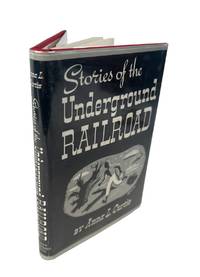
1941réf. 200441941. African American Curtis Anna L. Stories of the Underground Railroad. New York: The Island Workshop Press Co-Op. Inc. 1941. First Edition First Printing Hardcover with Dust Jacket. 115 pages. Measures 5.25" x 7.75". Contains black and white illustrations by William Brooks. Anna Curtis a Quaker author examines her own background by compiling ten stories from the underground railroad. Stories follow historical figures like Isaac T. Hopper Levi Coffin Thomas Garrett and Harriet Tubman as well as lesser known love stories from the period. From the introduction: "In pre-Civil War times thousands of Negro slaves were helped to freedom by the Quakers. The escape system set up by them was called 'The Underground Railroad' and amazing as it now seems to us children often played an active part in this hazardous undertaking." Dust jacket is very clean with vibrant black and white illustration of a Black man and a steam ship. No marks copy is in very good to near-excellent condition. unknown books
1941réf. 200441941. African American Curtis Anna L. Stories of the Underground Railroad. New York: The Island Workshop Press Co-Op. Inc. 1941. First Edition First Printing Hardcover with Dust Jacket. 115 pages. Measures 5.25" x 7.75". Contains black and white illustrations by William Brooks. Anna Curtis a Quaker author examines her own background by compiling ten stories from the underground railroad. Stories follow historical figures like Isaac T. Hopper Levi Coffin Thomas Garrett and Harriet Tubman as well as lesser known love stories from the period. From the introduction: "In pre-Civil War times thousands of Negro slaves were helped to freedom by the Quakers. The escape system set up by them was called 'The Underground Railroad' and amazing as it now seems to us children often played an active part in this hazardous undertaking." Dust jacket is very clean with vibrant black and white illustration of a Black man and a steam ship. No marks copy is in very good to near-excellent condition. unknown
1906This is a very good softcover copy in the original publisher's tan printed wrappers with almost no wear. Just a little scrape on the right edge of the front cover. Spine has a small stain. Very clean inside and out. No marks. This is one pamphlet from a 6 volume series published by the University of Pennsylvania. This is Number VI: Slavery and the Union, 1845-1861. A collection of documents from various states referring to slavery, the Fugitive Slave Law, the Wilmot Proviso, etc. 8" high X 5" wide, 80 pages. This book will be securely packed and shipped with tracking.
1863562p. Hardcover Good condition, light dampstain bottom corner
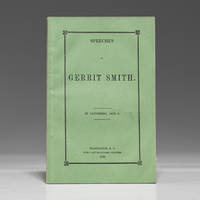
1854réf. 1266881854. First Edition. SMITH Gerrit. Speeches of Gerrit Smith. In Congress 1853-'4. Washington D.C.: Buell and Blanchard 1854. Octavo original printed green self-wrappers original stitching. $1850.First edition of nine major 1854 speeches by radical abolitionist Smith together in print for the first time featuring elemental works such as ""No Slavery in Nebraska"" defying Stephen Douglas' Kansas-Nebraska bill and denouncing ""the federal government as a 'bastard democracy'"" very elusive in fragile original wrappers.In the early 1850s Gerrit Smith ""a man of enormous emotional complexity religious fervor antislavery commitment and wealthÉ embraced political abolitionism."" By then Frederick Douglass had become ""an outspoken supporterÉ and rejoiced in Smith's election to Congress as a radical abolitionist in 1852"" Blight Frederick Douglass 207 252. Once linked to Garrison's view of the Constitution as a ""covenant with death"" Smith split from him to become a founder of both the Liberty Party and the Radical Abolitionist Party. As documented in this collection of nine key speeches Smith in his ""congressional career of 1853 and 1854É evolved into one of America's renowned militant antislavery activists"" Gordon-Omelka Militant Abolitionist 2. Key works here such as his June 14 1854 speech ""Abolition of the Postal System"" reflected his conviction that ""the right to free discussion"" was fundamental and that ""Southerners were threatening the very openness and integrity of American democracyÉ Smith would not stand for itÉ he presaged a new generation of American abolitionists: those whose membership was inspired not by evangelical Christianity like the earlier Garrisons and Tappans but by secular liberal political ideals."" His attention to issues such asÑ""freedom of speech civil liberties social order the proper role of federal and state governments with respect to slaveryÑmotivated a new kind of political abolitionism which attracted new groups into the movement and gave them new tools for action"" Lonky Revolutionizing the Public Sentiment 56.Also notably featured here is Smith's ""No Slavery in Nebraska."" It stands as his defining response to Senator Stephen Douglas' December 1853 version of the Kansas-Nebraska bill which ""ultimately repealed the Missouri Compromise of 1820 and allowed the territories' citizens to decide the slavery questionÉ Smith signed Chase's abolitionist appeal against the bill"" and in his April 6 1854 ""No Slavery"" speech ""asserted a fresh reason to oppose the bill based on the Constitution's limits on state sovereignty.'"" Denouncing ""the federal government as a 'bastard democracy'"" he predicted ""a violent end to slaveryÉ a reckoning for deep and damning wrongs"" Gordon-Omelka 12. Soon afterward following his resignation from Congress Smith helped establish a Black settlement at North Elba N.Y. which was ""John Brown's permanent residence from 1854 until his death"" Stauffer Black Hearts 3. In June 1855 Smith Frederick Douglass and John Brown were together at the first convention in Syracuse of the Radical Abolition party. Four years later Brown was executed following the Harpers Ferry Raid that Smith helped fund causing Smith to suffer a mental breakdown. The decade after the Civil War he died in 1874. First edition:containing nine separately paginated speeches: Speech of Gerrit Smith On War. In Congress January 18 1854. Washington D.C.: Buell & Blanchard 1854; Homes for All. Speech of Gerrit Smith On the Homestead Bill. In Congress February 21 1854. Washington D.C.: Buell & Blanchard 1854; No Slavery in Nebraska: No Slavery in the Nation: Slavery an Outlaw. Speech of Gerrit Smith on the Nebraska Bill. In Congress April 6 1854. Washington D.C.: Buell & Blanchard 1854; Keep Government within its Limits. Speech of Gerrit Smith on the Pacific Railroad In the House of Representatives May 30 1854. Washington D.C.: Buell and Blanchard 1854; Abolition of the Postal System. Speech of Gerrit Smith In the House of Representatives June 14 1854. Washington D.C.: Buell & Blanchard 1854; Speech of Gerrit Smith On Mexican Treaty and ""Monroe Doctrine."" In Congress June 27 1854. Buell and Blanchard: Washington D.C. 1854; Letter of Gerrit Smith On the Reciprocity Treaty. No place: no publisher: 1854; Government Bound to Protect from the Dramshop. Speech of Gerrit Smith On Sale of Intoxicating Drinks in the City of Washington. In Congress July 22 1854. Washington D.C.: Buell & Blanchard 1843; Gerrit Smith to his Constituents. Washington D.C.: Buell & Blanchard 1854. With Nebraska Bill partially unopened. Sabin 92595; 82634; 82635; 82639; 82642; 82649; 82658; 82659; 82660. See LCP. Afro-Americana 9513 1855 ed. Fine condition. unknown books
1854réf. 1266881854. First Edition. SMITH Gerrit. Speeches of Gerrit Smith. In Congress 1853-'4. Washington D.C.: Buell and Blanchard 1854. Octavo original printed green self-wrappers original stitching. $1850.First edition of nine major 1854 speeches by radical abolitionist Smith together in print for the first time featuring elemental works such as ""No Slavery in Nebraska"" defying Stephen Douglas' Kansas-Nebraska bill and denouncing ""the federal government as a 'bastard democracy'"" very elusive in fragile original wrappers.In the early 1850s Gerrit Smith ""a man of enormous emotional complexity religious fervor antislavery commitment and wealthÉ embraced political abolitionism."" By then Frederick Douglass had become ""an outspoken supporterÉ and rejoiced in Smith's election to Congress as a radical abolitionist in 1852"" Blight Frederick Douglass 207 252. Once linked to Garrison's view of the Constitution as a ""covenant with death"" Smith split from him to become a founder of both the Liberty Party and the Radical Abolitionist Party. As documented in this collection of nine key speeches Smith in his ""congressional career of 1853 and 1854É evolved into one of America's renowned militant antislavery activists"" Gordon-Omelka Militant Abolitionist 2. Key works here such as his June 14 1854 speech ""Abolition of the Postal System"" reflected his conviction that ""the right to free discussion"" was fundamental and that ""Southerners were threatening the very openness and integrity of American democracyÉ Smith would not stand for itÉ he presaged a new generation of American abolitionists: those whose membership was inspired not by evangelical Christianity like the earlier Garrisons and Tappans but by secular liberal political ideals."" His attention to issues such asÑ""freedom of speech civil liberties social order the proper role of federal and state governments with respect to slaveryÑmotivated a new kind of political abolitionism which attracted new groups into the movement and gave them new tools for action"" Lonky Revolutionizing the Public Sentiment 56.Also notably featured here is Smith's ""No Slavery in Nebraska."" It stands as his defining response to Senator Stephen Douglas' December 1853 version of the Kansas-Nebraska bill which ""ultimately repealed the Missouri Compromise of 1820 and allowed the territories' citizens to decide the slavery questionÉ Smith signed Chase's abolitionist appeal against the bill"" and in his April 6 1854 ""No Slavery"" speech ""asserted a fresh reason to oppose the bill based on the Constitution's limits on state sovereignty.'"" Denouncing ""the federal government as a 'bastard democracy'"" he predicted ""a violent end to slaveryÉ a reckoning for deep and damning wrongs"" Gordon-Omelka 12. Soon afterward following his resignation from Congress Smith helped establish a Black settlement at North Elba N.Y. which was ""John Brown's permanent residence from 1854 until his death"" Stauffer Black Hearts 3. In June 1855 Smith Frederick Douglass and John Brown were together at the first convention in Syracuse of the Radical Abolition party. Four years later Brown was executed following the Harpers Ferry Raid that Smith helped fund causing Smith to suffer a mental breakdown. The decade after the Civil War he died in 1874. First edition:containing nine separately paginated speeches: Speech of Gerrit Smith On War. In Congress January 18 1854. Washington D.C.: Buell & Blanchard 1854; Homes for All. Speech of Gerrit Smith On the Homestead Bill. In Congress February 21 1854. Washington D.C.: Buell & Blanchard 1854; No Slavery in Nebraska: No Slavery in the Nation: Slavery an Outlaw. Speech of Gerrit Smith on the Nebraska Bill. In Congress April 6 1854. Washington D.C.: Buell & Blanchard 1854; Keep Government within its Limits. Speech of Gerrit Smith on the Pacific Railroad In the House of Representatives May 30 1854. Washington D.C.: Buell and Blanchard 1854; Abolition of the Postal System. Speech of Gerrit Smith In the House of Representatives June 14 1854. Washington D.C.: Buell & Blanchard 1854; Speech of Gerrit Smith On Mexican Treaty and ""Monroe Doctrine."" In Congress June 27 1854. Buell and Blanchard: Washington D.C. 1854; Letter of Gerrit Smith On the Reciprocity Treaty. No place: no publisher: 1854; Government Bound to Protect from the Dramshop. Speech of Gerrit Smith On Sale of Intoxicating Drinks in the City of Washington. In Congress July 22 1854. Washington D.C.: Buell & Blanchard 1843; Gerrit Smith to his Constituents. Washington D.C.: Buell & Blanchard 1854. With Nebraska Bill partially unopened. Sabin 92595; 82634; 82635; 82639; 82642; 82649; 82658; 82659; 82660. See LCP. Afro-Americana 9513 1855 ed. Fine condition. unknown
1865réf. 81012New York: American News Company 1865. First Edition. First printing. Octavo. Sewn printed wrappers; 76pp. Brief closed tear to title page margin; bit of wear at upper fore-corner of text block well away from text else a clean fresh copy in the original printed wraps; Very Good or better. Includes text of letters written to various colleagues in the antislavery ranks including Elizabeth Cady Stanton Charles Sumner and others. The first volume taking in the year 1863 was printed a year earlier. SABIN 82664. American News Company unknown books
1865réf. 81012New York: American News Company 1865. First Edition. First printing. Octavo. Sewn printed wrappers; 76pp. Brief closed tear to title page margin; bit of wear at upper fore-corner of text block well away from text else a clean fresh copy in the original printed wraps; Very Good or better. Includes text of letters written to various colleagues in the antislavery ranks including Elizabeth Cady Stanton Charles Sumner and others. The first volume taking in the year 1863 was printed a year earlier. SABIN 82664. American News Company unknown
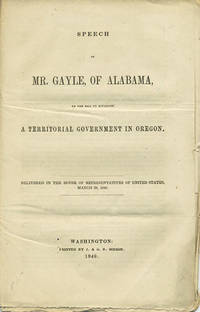
1848réf. 37646Washington D.C.: J. & G.S. Gideon printers 1848. First edition. Removed. A very good unopened uncut and intrimmed copy with a mail fold. 14 pp. 8vo. Against Oregon admittance over the slavery issue: "The position I shall assume and attempt to maintain is that Congress has no power to organize what is called a territorial government by ordinance or otherwise; nor has Congress the power to pass laws for the people of the territories of the United States.The speech of the honorable member from Ohio Mr. Root delivered on the 15th of the present month. That speech breathes nothing but hostility to Southern institutions. It was uttered in a tone of defiance and in such language of menace as left the impression that the honorable speaker thought that empty threats were quite sufficient to intimidate what he was pleased to call “Southern chivalry.What does the gentleman from Ohio mean by this haughty and vainglorious boasting Does he think that the South are to be frightened from their duty to their country and themselves by these empty menaces The proposition to exclude slave labor from the territories of the United States is a proposition to degrade the slave States—to render them inferior to the free States." John Gayle 1792-1859 "was Alabama's seventh governor and also served as a U.S. congressman state legislator and jurist. Gayle was a fervent champion of states' rights and his advocacy laid the foundation for that movement in Alabama in the 1850s and for the realignment of state political parties." Sarah Woolfolk Wiggins: John Gayle Encyl. of Alabama. Sabin 26798. J. & G.S. Gideon, printers unknown books
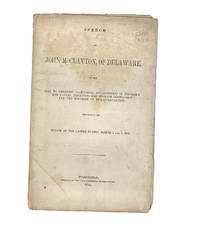
1854réf. 26154Washington: Printed at the Congressional Glove Office 1854. First edition. pp. 22. 1 vols. 8vo. Self wrappers unsewn as issued. Some browning and spotting wear along spine and edges but a very good copy. First edition. pp. 22. 1 vols. 8vo. Primarily concerning the issue of slavery in the territories this speech was part of the debates for the Kansas-Nebraska Act. The act initiated by Douglas ultimately repealed the Missouri Compromise allowed the local residents to determine whether the area was free or slave territory allowed for "the doctrine of popular sovereignty of the two territories" and laid the way for a transcontental railroad. The Kansas-Nebraska Act was passed in the Senate on the 3rd of March. Clayton was a lawyer noted agriculturist and long-time member of Congress who was Secretary of State under President Taylor. As Secretary of State he is best remembered for having negotiated the Clayton-Bulwer treaty with Great Britain which provided for a neutral international canal across Central America and "contained pledges which ultimately forced Great Britain to withdraw from large tracts of territory which.it had been occupying on the Isthmus." DAB. Sabin 13576n Printed at the Congressional Glove Office unknown books
1854réf. 26154Washington: Printed at the Congressional Glove Office 1854. First edition. pp. 22. 1 vols. 8vo. Self wrappers unsewn as issued. Some browning and spotting wear along spine and edges but a very good copy. First edition. pp. 22. 1 vols. 8vo. Primarily concerning the issue of slavery in the territories this speech was part of the debates for the Kansas-Nebraska Act. The act initiated by Douglas ultimately repealed the Missouri Compromise allowed the local residents to determine whether the area was free or slave territory allowed for "the doctrine of popular sovereignty of the two territories" and laid the way for a transcontental railroad. The Kansas-Nebraska Act was passed in the Senate on the 3rd of March. Clayton was a lawyer noted agriculturist and long-time member of Congress who was Secretary of State under President Taylor. As Secretary of State he is best remembered for having negotiated the Clayton-Bulwer treaty with Great Britain which provided for a neutral international canal across Central America and "contained pledges which ultimately forced Great Britain to withdraw from large tracts of territory which.it had been occupying on the Isthmus." DAB. Sabin 13576n Printed at the Congressional Glove Office unknown
1848réf. 37646Washington D.C.: J. & G.S. Gideon printers 1848. First edition. Removed. A very good unopened uncut and intrimmed copy with a mail fold. 14 pp. 8vo. Against Oregon admittance over the slavery issue: "The position I shall assume and attempt to maintain is that Congress has no power to organize what is called a territorial government by ordinance or otherwise; nor has Congress the power to pass laws for the people of the territories of the United States.The speech of the honorable member from Ohio Mr. Root delivered on the 15th of the present month. That speech breathes nothing but hostility to Southern institutions. It was uttered in a tone of defiance and in such language of menace as left the impression that the honorable speaker thought that empty threats were quite sufficient to intimidate what he was pleased to call “Southern chivalry.What does the gentleman from Ohio mean by this haughty and vainglorious boasting Does he think that the South are to be frightened from their duty to their country and themselves by these empty menaces The proposition to exclude slave labor from the territories of the United States is a proposition to degrade the slave States—to render them inferior to the free States." John Gayle 1792-1859 "was Alabama's seventh governor and also served as a U.S. congressman state legislator and jurist. Gayle was a fervent champion of states' rights and his advocacy laid the foundation for that movement in Alabama in the 1850s and for the realignment of state political parties." Sarah Woolfolk Wiggins: John Gayle Encyl. of Alabama. Sabin 26798. J. & G.S. Gideon, printers unknown
1961Broch?. 439 pages. Format de poche.
1959Reliure toile club. 279 pages.
1945réf. A1-086Paris 30.10.1947 (DL 1945), Aimery Somogy éditeur in-8° 384 pp. rel. demi-bas. Dos 5 nerfs. Roman historique. Traduit de l’anglais par Albert Lehman. Introduction de l'éditeur pages 7 à 13.
1974réf. qq1937La Guilde du livre Toile d'éditeur 1974 In-8 (15.3 x 22 cm), toile d'éditeur rouge, 278 pages, exemplaire n°1672 ; des taches d'usage aux plats, intérieur frais, bon état général. Livraison a domicile (La Poste) ou en Mondial Relay sur simple demande.
1728réf. 100536Pamphlet 8vo modern full calf in the style of an 18th century Cambridge binding 32 pp.Very slight aging; in excellent condition. This is a rare first edition of a work that presents a complaint by British planters in the West Indies concerning the Assiento or agreement with Spain that gave Britain a virtual monopoly on the African slave trade. This agreement came out of the Treaty of Utrecht which ended the War of the Spanish Succession. This pamphlet indicates that the planters feared as a result of this agreement British slavers might be required to provide African slaves to the Spanish colonies which could result in insufficient numbers available for the West India plantations. The Assiento with Spain would mark the beginning of the Atlantic slave trade as a very powerful economic growth engine. Unfortunately this would translate into millions of Africans being taken from their homes. H. Whitridge books