1 720 résultats
1910réf. 55667The Hague Netherlands: Martinus Nijhoff 1910. Thick 8vo. xx 474 pp. Title in red & black 1 large folding colour map at rear. Quarter-black cloth over printed boards textblock reinforced w/ gray linen foxing & spotting to endpapers & first few leaves minor worming to gutter margin of first leaves edgewear rubbing still G reference copy from the library of Andrew W. Lind. Second edition substantially revised & expanded of this seminal work on the history of slavery in primitive societies from ethnological and economic viewpoints. Nieboer 1873-1920 argues that slavery in primitive societies such as among Pacific Northwest Coast Indians other North American Indian tribes Eskimos Australian aborigines Polynesian cultures Melanesia and others not only established that slaves were not just the physical property of their owners but that they also could be commanded to perform labors and that their status was recognized by the society of the slave holder. Martinus Nijhoff, hardcover
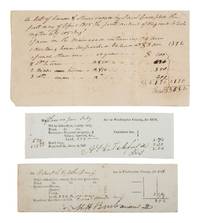
1815réf. 201561815. Manuscript fiscal records from antebellum Virginia documenting the taxation and valuation of enslaved African Americans as property within the legal and economic system of slavery. Dating from 1815 to 1854 the records span nearly four decades and demonstrate the routine bureaucratic mechanisms through which enslaved people were enumerated assigned monetary value and incorporated into county and state taxation alongside land horses clocks and other forms of personal property. The documents provide direct evidence of the administrative infrastructure underlying slavery in Virginia during the decades preceding the Civil War. The earliest record dated April 1 1815 concerns the property of Jacob Campbell and is headed "A list of land & slaves owned by Jacob Campbell the first day of April 1815." An associated receipt provides a particularly stark example of the economic treatment of enslaved people enumerating eight individuals according to gender and age categories and assigning them monetary values totaling $2170. Rather than identifying the individuals as members of families or communities the fiscal record reduces them to demographic classifications and assessed financial values for purposes of property accounting. A later tax receipt for Robert L. Berry and John Berry of Washington County Virginia dated 1848 similarly includes "Slaves" among taxable "Revenue" categories alongside horses clocks and land. The juxtaposition illustrates the legal status imposed upon enslaved African Americans: human beings were entered into the same fiscal accounting system used for other forms of privately held property. The final record a Washington County tax receipt issued to Miss Francis Jane Irby in 1854 includes "Black" titheables among taxable categories together with personal property salary land and a road levy. Virginia's system of tithables had long provided a mechanism for counting certain members of the population for taxation including enslaved African Americans. The terminology and structure of the receipt demonstrate how racial classification was embedded directly within ordinary local fiscal administration. Taken together the records trace the persistence of this system from the aftermath of the War of 1812 through the decade immediately preceding the Civil War. They document slavery not through political argument or retrospective testimony but through the ordinary paperwork of government and property ownership: lists valuations assessments and receipts. Particularly significant is the 1815 valuation of eight enslaved people at a combined $2170 providing direct evidence of the conversion of individual human lives into quantified financial assets. Virginia was central to the development and expansion of slavery in British North America and the early United States. The arrival of Africans at Point Comfort in Virginia in 1619 marked an early and consequential moment in the history of Africans in English North America while slavery subsequently became deeply embedded in the colony and state's economic and legal institutions. By the 1860 federal census more than one-third of Virginia's population was enslaved. Records such as these reveal the administrative dimension of that system: local authorities and property owners routinely recorded enslaved African Americans as taxable economic assets making racial slavery part of the ordinary machinery of government. Group of manuscript fiscal records from Washington County Virginia 1815-1854 ranging in size from approximately 6.75 x 2 inches to standard letter size. Includes the 1815 Jacob Campbell list and associated valuation receipt the 1848 Robert L. and John Berry tax receipt and the 1854 Francis Jane Irby tax receipt. Original folds and creasing minor foxing and a small chip to the lower left corner of one document; docketing on versos. Text remains clear and legible. Overall very good condition. unknown
1957163 pages. Index. "The first book to take seriously the ethical and religious aspects of slavery in the formative period of the United States." - from dust jacket. Moderate wear to unmarked book. Dust jacket now preserved in glossy new archival-grade Brodart cover. Sound copy. Book
1853196p. Issued by the publisher without the Conclusion, p. 197-200. Hardcover Good condition, lacking leaf preceding t.p., endpapers chipped
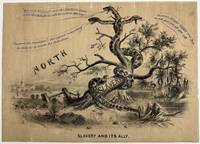
1864réf. 12816N.p. 1864. Lithograph 14.5 x 20.5 inches. Noticeable toning small areas of light discoloration along top margin short closed tear to left edge minor dust-soiling numerous creases and wrinkles. About very good. A dramatic political cartoon issued during the Civil War and satirizing the dangerous influence of those who argue a compromise on slavery or an easy solution to the war. The work was likely issued in the midst of the 1860 but more likely the 1864 presidential election campaign. The central image of the lithograph involves a three-headed snake -- labeled "The People's Party" and emerging from the American "South" personified by a moss-covered swamp -- which is wrapped around the length of a large tree labeled "Slavery." Each snake vocalizes a different misleading message about the issue of slavery and compromise seemingly aligned with political entities such as the Peace Party and the Copperheads. The messages from each snake head read respectively "Extend Slavery over the Northern States and the Rebellion will be over in 60 days;" "Persevere till after election and then we will give you all you ask;" and "'Support the President' - but oppose everything he may do to crush the Rebellion." This latter message indicates the author of the work supported President Lincoln. The North is personified in the background at left by a depiction of the U.S. Capitol Building. The central image of the lithograph carries echoes of the story of the Book of Genesis with the involvement of a deceptive serpent amid the tree of life. The lithograph is signed in the stone at bottom right reading simply "Brooks." Though the work came to us proposing the identify of the artist as Reuben Brooks 1794-1870 we were ultimately unable to confirm this authorship. The lack of an imprint in the lithograph also precludes easy research and identification. In fact the rarity of the lithograph makes it difficult to expound much more about it at all. OCLC reports just a single copy at the Peabody Essex Museum and it is not listed in Weitenkampf or Reilly. Given its rarity and content the present lithograph offers an outstanding opportunity for further research and contextualization. unknown books
2004Paperback Like New. Ships directly from publishers being a new release book . Pls. allow a minimum of 25 business days delivery time.
1990Cloth. First Edition. Hardback. 8vo - over 7¾" - 9¾" tall. 246pp with index and reference notes. The dust jacket and book are in fine condition and the book contents are clean and tight
1864réf. 12816N.p. 1864. Lithograph 14.5 x 20.5 inches. Noticeable toning small areas of light discoloration along top margin short closed tear to left edge minor dust-soiling numerous creases and wrinkles. About very good. A dramatic political cartoon issued during the Civil War and satirizing the dangerous influence of those who argue a compromise on slavery or an easy solution to the war. The work was likely issued in the midst of the 1860 but more likely the 1864 presidential election campaign. The central image of the lithograph involves a three-headed snake -- labeled "The People's Party" and emerging from the American "South" personified by a moss-covered swamp -- which is wrapped around the length of a large tree labeled "Slavery." Each snake vocalizes a different misleading message about the issue of slavery and compromise seemingly aligned with political entities such as the Peace Party and the Copperheads. The messages from each snake head read respectively "Extend Slavery over the Northern States and the Rebellion will be over in 60 days;" "Persevere till after election and then we will give you all you ask;" and "'Support the President' - but oppose everything he may do to crush the Rebellion." This latter message indicates the author of the work supported President Lincoln. The North is personified in the background at left by a depiction of the U.S. Capitol Building. The central image of the lithograph carries echoes of the story of the Book of Genesis with the involvement of a deceptive serpent amid the tree of life. The lithograph is signed in the stone at bottom right reading simply "Brooks." Though the work came to us proposing the identify of the artist as Reuben Brooks 1794-1870 we were ultimately unable to confirm this authorship. The lack of an imprint in the lithograph also precludes easy research and identification. In fact the rarity of the lithograph makes it difficult to expound much more about it at all. OCLC reports just a single copy at the Peabody Essex Museum and it is not listed in Weitenkampf or Reilly. Given its rarity and content the present lithograph offers an outstanding opportunity for further research and contextualization. unknown
réf. 1168936209.Ghardcover. Good. Access codes and supplements are not guaranteed with used items. May be an ex-library book. hardcover
réf. 133494363X.Gpaperback. Good. Access codes and supplements are not guaranteed with used items. May be an ex-library book. paperback
réf. 0243034016.Gpaperback. Good. Access codes and supplements are not guaranteed with used items. May be an ex-library book. paperback
1947348pp., 25cm., originele omslag (voorkant licht beschadigd: scheurtje en 3 kleine stukjes papier afgescheurd aan randen), tekst en interieur in goede staat, F78046
1987Book's cover is faded at top edge, page ends are lightly stained, otherwise book is very clean. Binding is solid and square, covers have sharp corners, exterior shows no other blemishes, text/interior is clean and free of marking of any kind. Dust jacket shows the slightest signs of shelf wear only, no tears, now wrapped in protective clear cover. Previous owner's name or sticker in front section of the book. 425 pages, contents include: Slavery and the circle of culture, David Walker: in defense of African rights and liberty, Henry Highland Garnet: nationalism, class analysis and revolution, W.E.B. Du Bois: black cultural reality and the meaning of freedom, On being African: Paul Robeson and the ends of nationalist theory and practice.
1989réf. 119496Moka, Mauritius, Mahatma Gandhi Institute Press 1989 In-8 22,5 x 17 cm. Broché, couverture caramel, auteurs & titre en blanc sur le dos et le premier plat, 406 pp. sommaire, bibliographies. Exemplaire en très bon état.
réf. 13977986Berg en Dal: Afrika Museum, 2003 in-8 oblong, 372 pages, nombreuses illustrations. Bibliographie. Broché. Textes de Jan-Lodewijk Grootaers, Jok Madut Jok, Leo van Kessel, Bob Papelard, Ulrike Weinhold. Texte en néerlandais et en allemand.
réf. 17415, Berg en Dal, Afrika Museum, 2003**, Paperback , oblong formaat : 235 x 230mm., 372pp., zeer uitgebreide illustratie in ( voornamelijk ) z/w en kleur.
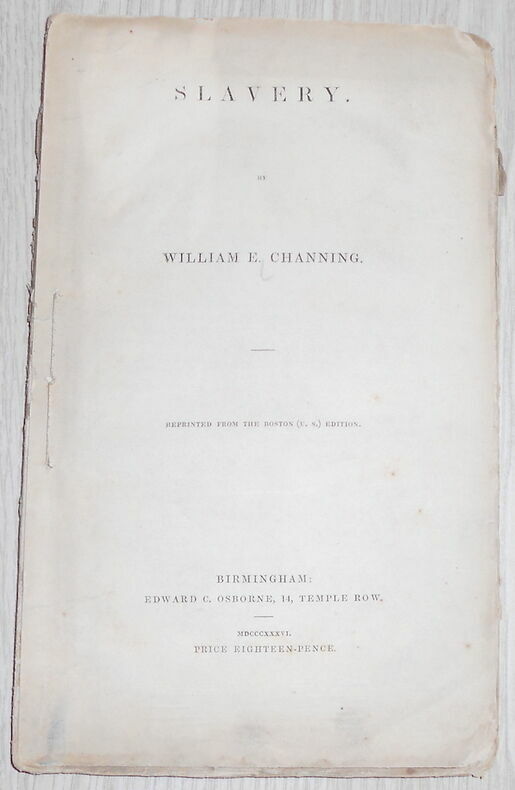
1836réf. 188651836. Birmingham Edward C. Osborne 1836 (e.o. anglaise réimprimée de l'ed. de Boston) - Broché 14 cm x 23 cm 99 pages - Texte en anglais de William E. Channing - Sans couv. sinon bon état
1997Light scuffing to front board; Beiträge Zur Altertumskunde 93; 329 pages
1997Former owner's name neatly stamped on ffep (P. Stork). Very light browning to spine else Fine. ; Beiträge Zur Altertumskunde 93; 329 pages
1852420p. Damp stained. Age stained. Bookplate of Mechanics' Library, Lancaster, Pa. With their stamp on title page, and related stamps embossed in blind. Tall 8vo. Original full black publisher's cloth binding, rubbed and worn. Hardbound. Lewis Cass (1782-1866) was an American military officer and politician. During the War of 1812, he served as Brigadier General. As a reward for his service he was appointed Governor of the Michigan Territory by President James Madison. In 1831 he resigned as Governor of the Michigan Territory to take the post of Secretary of War under President Andrew Jackson, serving until 1836. Cass was a central figure in formulating and implementing the Indian Removal policy of the Jackson administration. From 1836 to 1842, he was U.S. Ambassador to France. Cass represented the State of Michigan in the United States Senate from 1845 to 1848. In 1848 he resigned from the Senate to run for President. Cass was a leading supporter of the Doctrine of Popular Sovereignty, which held that the people who lived in a territory should decide whether or not to permit slavery there. His nomination caused a split in the Democratic party, leading many antislavery Democrats to join the Free Soil Party. After losing the election to Zachary Taylor, he returned to the Senate, serving from 1849 to 1857. Cass then served as Secretary of State under President James Buchanan (1857-1860). This book was apparently issued in hopes that Cass would again run for the Presidency in 1852. **PRICE JUST REDUCED! AMERICANA BOX 1
1827réf. 1184001827. First Edition. SLAVERY STROUD George M. A Sketch of the Laws Relating to Slavery in the Several States of the United States of America. Philadelphia: Kimber and Sharpless 1827. Octavo original half tan and light brown paper boards uncut. $1350.First edition of Judge Stroud's groundbreaking 1827 work documenting state slave laws and relevant Constitutional provisions held as a key resource for Harriet Beecher Stowe's Uncle Tom's Cabin a cornerstone volume Òconsidered by many the best of the ante-bellum studies"" on slavery uncut in original boards.""The ink was hardly dry on the Constitution when the powers of Congress relative to slavery were called into question"" Dumond 153. The Fugitive Slave Act was passed in 1793 and in 1819 Congress began a bitter debate over slavery in the territories that culminated in the 1820 Missouri Act. At this time Philadelphia Judge George Stroud began work on Sketch of the Laws. ""This work the first substantial legal treatise on American slavery is considered by many the best of the ante-bellum studies"" Cohen 9877. His coverage of state slave codes and Constitutional provisions is a cornerstone of the legal literature. Published well before ""the Dred Scott decision Stroud's book had extensive influence upon national legal thinking on the issue of slavery. For example it is believed by some scholars that Harriet Beecher Stowe gained her knowledge of slave laws from Stroud's work"" Johnson Stroud's Slave Laws vi. In legal literature of antislavery one key group is on ""slave codes and their administration. The purpose of these works was to use slave law as data credible data as to the realities of slavery. The first and in many ways the best of these works was George Stroud A Sketch of the Laws"" Cover Justice Accused 149n. Blockson 9965. Sabin 93097. Work 343. Harvard Law Catalogue II:680. Text generally fresh with scattered foxing mild embrowning mild edge-wear rubbing to spine label. A very good copy of a major early work on slavery. hardcover books
1827réf. 1184001827. First Edition. SLAVERY STROUD George M. A Sketch of the Laws Relating to Slavery in the Several States of the United States of America. Philadelphia: Kimber and Sharpless 1827. Octavo original half tan and light brown paper boards uncut. $1350.First edition of Judge Stroud's groundbreaking 1827 work documenting state slave laws and relevant Constitutional provisions held as a key resource for Harriet Beecher Stowe's Uncle Tom's Cabin a cornerstone volume Òconsidered by many the best of the ante-bellum studies"" on slavery uncut in original boards.""The ink was hardly dry on the Constitution when the powers of Congress relative to slavery were called into question"" Dumond 153. The Fugitive Slave Act was passed in 1793 and in 1819 Congress began a bitter debate over slavery in the territories that culminated in the 1820 Missouri Act. At this time Philadelphia Judge George Stroud began work on Sketch of the Laws. ""This work the first substantial legal treatise on American slavery is considered by many the best of the ante-bellum studies"" Cohen 9877. His coverage of state slave codes and Constitutional provisions is a cornerstone of the legal literature. Published well before ""the Dred Scott decision Stroud's book had extensive influence upon national legal thinking on the issue of slavery. For example it is believed by some scholars that Harriet Beecher Stowe gained her knowledge of slave laws from Stroud's work"" Johnson Stroud's Slave Laws vi. In legal literature of antislavery one key group is on ""slave codes and their administration. The purpose of these works was to use slave law as data credible data as to the realities of slavery. The first and in many ways the best of these works was George Stroud A Sketch of the Laws"" Cover Justice Accused 149n. Blockson 9965. Sabin 93097. Work 343. Harvard Law Catalogue II:680. Text generally fresh with scattered foxing mild embrowning mild edge-wear rubbing to spine label. A very good copy of a major early work on slavery. hardcover
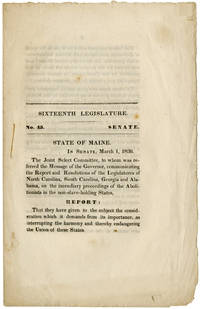
1836réf. 52765N.p. likely Augusta. 1836. Mainers Propose to Not Meddle in the Slave States A rare Maine slip-bill document resolving that the citizens from Maine and other states should not interfere with the issue of slavery in slave-holding states. The legislature writes: "Any interference therefore of a State or the inhabitants of a State with the domestic concerns of another State is dangerous as having a direct tendency to create jealousies between the States and thereby weakening the attachment to the Union which is our only security against domestic dissensions and foreign aggressions." This is a somewhat surprising position for the state of Maine to have taken at the time. Maine came into the Union in 1820 as a free state to balance the admission of the slave-owning state of Missouri. Also Maine opposed the admission of the Republic of Texas in 1836 the same year the present document was printed on the basis of Texas' position on slavery. It is curious that they would take two seemingly opposite positions in the same year. Still the legislature printed the resolution and authorized copies to be sent to the four southern slave-owning states mentioned in the title. Folded sheets stitched. Minor foxing and toning. Very good. Untrimmed. unknown books
1836réf. 52765N.p. likely Augusta. 1836. Mainers Propose to Not Meddle in the Slave States A rare Maine slip-bill document resolving that the citizens from Maine and other states should not interfere with the issue of slavery in slave-holding states. The legislature writes: "Any interference therefore of a State or the inhabitants of a State with the domestic concerns of another State is dangerous as having a direct tendency to create jealousies between the States and thereby weakening the attachment to the Union which is our only security against domestic dissensions and foreign aggressions." This is a somewhat surprising position for the state of Maine to have taken at the time. Maine came into the Union in 1820 as a free state to balance the admission of the slave-owning state of Missouri. Also Maine opposed the admission of the Republic of Texas in 1836 the same year the present document was printed on the basis of Texas' position on slavery. It is curious that they would take two seemingly opposite positions in the same year. Still the legislature printed the resolution and authorized copies to be sent to the four southern slave-owning states mentioned in the title. Folded sheets stitched. Minor foxing and toning. Very good. Untrimmed. unknown
réf. 242994Paris, Pagnerre, 1845 in-8, 256 pp., dérelié.