1 926 résultats
1849réf. 24577Paris Imprimerie et lithographie de Maulde et Renou 1849 in-8 demi-basane brune, dos lisse, couverture imprimée conservée [Rel. moderne], fortes traces d'humidité, plats gondolés
1983réf. RO90140217Presses Universitaires de France Edition originale Première édition Août 1983. 1983. In-12. Broché. Bon état, Couv. convenable, Dos satisfaisant, Intérieur frais. 128 pages illustrées de quelques dessins en noir et blanc. . . . Classification Dewey : 326-Esclavage
1962réf. RO90133336Presses Universitaires de France 2ème édition. 1962. In-12. Broché. Bon état, Couv. convenable, Dos satisfaisant, Intérieur frais. 128 pages illustrées de quelques dessins en noir et blanc. . . . Classification Dewey : 326-Esclavage
1981réf. 46368Fayard, 1981, in-8°, 294 pp, 2 cartes, chronologie comparée, biblio, broché, couv. illustrée, bon état
2017réf. 32218Le Club 2017
VG/VG Some minor creasing to the DJ edges, and a small cut to lower edge at spine, with associated edge wear. not unsightly. Dj unclipped. no inscriptions. 1st edition. rare title. 3 autobiographies of slaves.
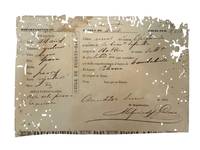
1873réf. 238001873. Puerto Rican slave registration document from January 1873 recording the legal identity ownership agricultural occupation parentage and physical classification of Epifanio a forty four year old enslaved Black man in Arecibo less than three months before slavery was abolished in Puerto Rico. Issued after Spain's 1870 Moret Law had initiated a limited process of emancipation but before the abolition law of March 22 1873 the cédula placed Epifanio within a registration system designed to record enslaved people by name family relations occupation owner residence civil status and identifying physical characteristics. The January 20 date makes the document especially closely situated to abolition recording Epifanio as legally enslaved only weeks before the Spanish National Assembly dismantled the legal institution under which the certificate had been issued. Registro de Esclavos Isla de Puerto Rico. Arecibo Puerto Rico January 20 1873. Single printed and manuscript cédula folio no. 7215. The document identifies "Epifanio" as an enslaved man "propiedad de la Sucn. Tafarella" forty four years old a native of Puerto Rico single and "de oficio labrador." He is recorded as "no está coartado" and as registered in the barrio of Cambalache with his mother identified as "Petrona." The printed "Filiacion" column subjects his body to a standardized identifying description: regular stature "Color negro" sparse hair sparse beard brown eyes and a regular nose. Under "Señas particulares" the manuscript records "Cojo de la pierna izquierda" identifying him as lame in the left leg and incorporating a physical disability into the identifying data maintained by the slave registry. The lower portion differs from the earlier 1871 forms in carrying a prominent signature beneath "El Registrador" while extensive insect damage has removed portions of the printed heading and margins. The verso bears manuscript offsetting and additional evidence of administrative handling. Epifanio's cédula was produced at the endpoint of Puerto Rico's rapidly changing legal regime. The Moret Law of 1870 had granted freedom to specified categories of enslaved people including those aged sixty and older those belonging to the state and children born after September 17 1868 while leaving a forty four year old man such as Epifanio legally enslaved. His notation as "no está coartado" further records that he had not entered coartación the mechanism through which an enslaved person could make payments toward self purchase. His recorded occupation as "labrador" placed him within Puerto Rico's agricultural labor economy while "Cojo de la pierna izquierda" shows how the registry extended beyond racial and occupational classification to bodily characteristics capable of distinguishing one enslaved person from another. On March 22 1873 only about two months after this cédula was dated the Spanish National Assembly abolished slavery in Puerto Rico compensating former enslavers while requiring the emancipated population to enter labor contracts for an additional three years. Extensive insect damage with numerous wormholes and substantial losses along the upper and side margins affecting portions of the printed heading and several fields; moderate toning and staining with principal manuscript entries and the registrar's signature remaining legible. Overall fair condition. An individually named record of the administrative system that converted Epifanio's race body physical disability agricultural labor parentage residence and legal ownership into the identifying data of slavery during the final months before abolition in Puerto Rico. unknown books
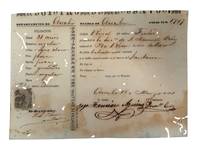
1871réf. 237981871. Puerto Rican slave registration document from 1871 recording the legal identity ownership agricultural occupation and physical classification of a named thirty one year old enslaved man in Arecibo during the final years of slavery under Spanish colonial rule. Issued after Spain's 1870 Moret Law had initiated a limited process of emancipation but nearly two years before abolition in Puerto Rico the cédula placed Fruto within a registration system designed to record enslaved people by name occupation owner residence civil status and identifying physical characteristics. His classification as "negro claro" his occupation as "labrador" and his ownership by the succession of D. Manuel Ortiz place racial designation agricultural labor and property status together within the administrative machinery of colonial slavery. Registro de Esclavos Isla de Puerto Rico. Arecibo Puerto Rico March 15 1871. Single printed and manuscript cédula folio no. 1747. The document identifies this enslaved man "propiedad de la Sucn. de D. Manuel Ortiz" thirty one years old a native of Puerto Rico single and "de oficio labrador." He is recorded as "no está coartado" and as residing in the barrio of Santana. The fields for parents spouse and children are left blank. The printed "Filiacion" column subjects his body to a standardized identifying description: regular stature "Color negro claro" sparse hair sparse beard large eyes a regular nose and a further description of the mouth partially obscured by worming. A one peseta fiscal stamp at lower left is cancelled by an official marking. The lower portion carries the signatures or attestations of the "Registrador" "El dueño" and "El Comisario" with the owner's portion apparently signed on behalf of the succession by Francisco Aguirre. The verso bears ink offsetting and staining associated with subsequent administrative handling. This man's cédula was produced within a rapidly changing legal regime. The Moret Law of 1870 granted freedom to specified categories of enslaved people including those aged sixty and older those belonging to the state and children born after September 17 1868 while leaving many others including a thirty one year old agricultural laborer such as this individual legally enslaved. His notation as "no está coartado" further records that he had not entered coartación the mechanism through which an enslaved person could purchase freedom incrementally. The document's ownership by the "Sucn. de D. Manuel Ortiz" also records the treatment of an enslaved person as property within an estate with his legal ownership continuing through the succession rather than ending with the death of the named enslaver. On March 22 1873 the Spanish National Assembly abolished slavery in Puerto Rico compensating former enslavers while requiring the emancipated population to enter labor contracts for an additional three years. Moderate toning and staining scattered wormholes with small losses affecting several manuscript entries minor edge losses and a larger loss at the lower right edge; principal manuscript information and signatures remain legible. Overall good condition. An individually named record of the administrative system that converted this individuals race body agricultural labor residence civil status and legal ownership into the identifying data of slavery less than two years before abolition in Puerto Rico. unknown books
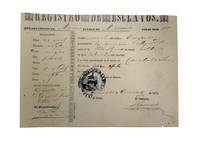
1871réf. 237971871. Puerto Rican slave registration document from 1871 recording the legal identity ownership agricultural occupation and physical classification of Eleuterio a twenty six year old enslaved man in Arecibo during the final years of slavery under Spanish colonial rule. Issued after Spain's 1870 Moret Law had initiated a limited process of emancipation but nearly two years before abolition in Puerto Rico the cédula placed Eleuterio within a registration system designed to record enslaved people by name family relations occupation owner residence and identifying physical characteristics. His classification as "mulato" his occupation as "labrador" and his ownership by the succession of D. Manuel Ortiz place racial designation agricultural labor and property status together within the administrative machinery of colonial slavery. Registro de Esclavos Isla de Puerto Rico. Arecibo Puerto Rico May 15 1871. Single printed and manuscript cédula folio no. 1740. The document identifies "Eleuterio" as an enslaved man "propiedad de la Sucn. de D. Manuel Ortiz" twenty six years old a native of Puerto Rico single and "de oficio labrador." He is recorded as "no está coartado" and as residing in the barrio of Santana with his mother identified as "Valentina." The printed "Filiacion" column subjects his body to a standardized identifying description: tall stature "Color mulato" sparse hair sparse beard black eyes a regular nose and a further description of the mouth partially affected by loss. The lower portion carries the signatures or attestations of the "Registrador" "El dueño" and "El Comisario" with the owner's portion apparently signed on behalf of the succession by Francisco Aguirre. A one peseta fiscal stamp appears at lower left beneath the physical description. The verso bears manuscript docketing and staining associated with subsequent administrative handling. Eleuterio's cédula was produced within a rapidly changing legal regime. The Moret Law of 1870 granted freedom to specified categories of enslaved people including those aged sixty and older those belonging to the state and children born after September 17 1868 while leaving many others including a twenty five six old agricultural laborer such as Eleuterio legally enslaved. His notation as "no está coartado" further records that he had not entered the system of coartación through which an enslaved person could make payments toward self purchase. On March 22 1873 the Spanish National Assembly abolished slavery in Puerto Rico compensating former enslavers while requiring the emancipated population to enter labor contracts for an additional three years. Moderate toning and staining scattered wormholes with small losses affecting several manuscript entries loss along the upper edge affecting part of the printed heading and additional minor edge losses; principal manuscript information and signatures remain legible. Overall good condition. An individually named record of the administrative system that converted Eleuterio's race body family relationship agricultural labor residence and legal ownership into the identifying data of slavery less than two years before abolition in Puerto Rico. unknown books
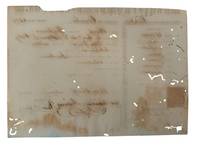
1872réf. 237961872. Puerto Rican slave registration document from January 1872 recording the legal status ownership labor residence parentage and physical identification of Eugenio a twenty year old enslaved Black man in Arecibo during the final fourteen months of slavery on the island. The cédula was issued within the registration system expanded following the Moret Law of 1870 which freed specified categories of enslaved people while leaving young adults such as Eugenio in bondage and led to the preparation of Puerto Rico's central slave register. Surviving 1872 schedules record the same categories present here including name origin residence parents marital status occupation age physical description and enslaver. Registro de Esclavos Isla de Puerto Rico. Arecibo Puerto Rico January 20 1872. Single printed and manuscript slave registration cédula folio no. 119. The document identifies "Eugenio" as twenty years old "Color negro" single and employed "de oficio labrador" placing agricultural labor directly within his official identification. He is recorded as a native of Puerto Rico and registered in the barrio of Cambalache. His ownership entry appears to read "propiedad de la sucesión ." indicating ownership by an estate or succession although the following name is difficult to establish confidently from the manuscript hand. The "Filiacion" column records his stature as "regular" black hair sparse beard brown eyes a regular nose and additional identifying information; under "Señas particulares" a manuscript notation appears to record a defect involving the right foot though the exact wording is partially unclear. The document carries the signatures or attestations of the "Registrador" and "El Comisario" together with a fiscal stamp heavily cancelled by an official circular handstamp. The verso bears additional official stamps and manuscript markings associated with the document's administrative use. Eugenio was registered at a moment when Spanish policy had begun dismantling slavery selectively while continuing to document and regulate those excluded from immediate freedom. The Moret Law granted freedom to people over sixty enslaved people belonging to the state and children born after September 17 1868; at twenty Eugenio fell outside its principal age based provisions. Puerto Rico's surviving 1872 Registro Central de Esclavos is preserved in eight rolls of National Archives microfilm and comparable original Arecibo cédulas survive institutionally including a January 1872 folio at the University of Florida that likewise records an enslaved man's age physical description ownership and official signatures. On March 22 1873 slavery was abolished in Puerto Rico terminating the legal status under which Eugenio had been entered on this form. Light toning and spotting several small wormholes and minor edge losses; stamps printed text and principal manuscript entries remain legible. Overall good condition. An individually named record of how Spanish colonial authorities reduced Eugenio's legal status agricultural occupation ancestry residence and bodily characteristics to standardized identifying data during Puerto Rico's final full year of slavery. unknown books
1873réf. 238001873. Puerto Rican slave registration document from January 1873 recording the legal identity ownership agricultural occupation parentage and physical classification of Epifanio a forty four year old enslaved Black man in Arecibo less than three months before slavery was abolished in Puerto Rico. Issued after Spain's 1870 Moret Law had initiated a limited process of emancipation but before the abolition law of March 22 1873 the cédula placed Epifanio within a registration system designed to record enslaved people by name family relations occupation owner residence civil status and identifying physical characteristics. The January 20 date makes the document especially closely situated to abolition recording Epifanio as legally enslaved only weeks before the Spanish National Assembly dismantled the legal institution under which the certificate had been issued. Registro de Esclavos Isla de Puerto Rico. Arecibo Puerto Rico January 20 1873. Single printed and manuscript cédula folio no. 7215. The document identifies "Epifanio" as an enslaved man "propiedad de la Sucn. Tafarella" forty four years old a native of Puerto Rico single and "de oficio labrador." He is recorded as "no está coartado" and as registered in the barrio of Cambalache with his mother identified as "Petrona." The printed "Filiacion" column subjects his body to a standardized identifying description: regular stature "Color negro" sparse hair sparse beard brown eyes and a regular nose. Under "Señas particulares" the manuscript records "Cojo de la pierna izquierda" identifying him as lame in the left leg and incorporating a physical disability into the identifying data maintained by the slave registry. The lower portion differs from the earlier 1871 forms in carrying a prominent signature beneath "El Registrador" while extensive insect damage has removed portions of the printed heading and margins. The verso bears manuscript offsetting and additional evidence of administrative handling. Epifanio's cédula was produced at the endpoint of Puerto Rico's rapidly changing legal regime. The Moret Law of 1870 had granted freedom to specified categories of enslaved people including those aged sixty and older those belonging to the state and children born after September 17 1868 while leaving a forty four year old man such as Epifanio legally enslaved. His notation as "no está coartado" further records that he had not entered coartación the mechanism through which an enslaved person could make payments toward self purchase. His recorded occupation as "labrador" placed him within Puerto Rico's agricultural labor economy while "Cojo de la pierna izquierda" shows how the registry extended beyond racial and occupational classification to bodily characteristics capable of distinguishing one enslaved person from another. On March 22 1873 only about two months after this cédula was dated the Spanish National Assembly abolished slavery in Puerto Rico compensating former enslavers while requiring the emancipated population to enter labor contracts for an additional three years. Extensive insect damage with numerous wormholes and substantial losses along the upper and side margins affecting portions of the printed heading and several fields; moderate toning and staining with principal manuscript entries and the registrar's signature remaining legible. Overall fair condition. An individually named record of the administrative system that converted Epifanio's race body physical disability agricultural labor parentage residence and legal ownership into the identifying data of slavery during the final months before abolition in Puerto Rico. unknown
1871réf. 237981871. Puerto Rican slave registration document from 1871 recording the legal identity ownership agricultural occupation and physical classification of a named thirty one year old enslaved man in Arecibo during the final years of slavery under Spanish colonial rule. Issued after Spain's 1870 Moret Law had initiated a limited process of emancipation but nearly two years before abolition in Puerto Rico the cédula placed Fruto within a registration system designed to record enslaved people by name occupation owner residence civil status and identifying physical characteristics. His classification as "negro claro" his occupation as "labrador" and his ownership by the succession of D. Manuel Ortiz place racial designation agricultural labor and property status together within the administrative machinery of colonial slavery. Registro de Esclavos Isla de Puerto Rico. Arecibo Puerto Rico March 15 1871. Single printed and manuscript cédula folio no. 1747. The document identifies this enslaved man "propiedad de la Sucn. de D. Manuel Ortiz" thirty one years old a native of Puerto Rico single and "de oficio labrador." He is recorded as "no está coartado" and as residing in the barrio of Santana. The fields for parents spouse and children are left blank. The printed "Filiacion" column subjects his body to a standardized identifying description: regular stature "Color negro claro" sparse hair sparse beard large eyes a regular nose and a further description of the mouth partially obscured by worming. A one peseta fiscal stamp at lower left is cancelled by an official marking. The lower portion carries the signatures or attestations of the "Registrador" "El dueño" and "El Comisario" with the owner's portion apparently signed on behalf of the succession by Francisco Aguirre. The verso bears ink offsetting and staining associated with subsequent administrative handling. This man's cédula was produced within a rapidly changing legal regime. The Moret Law of 1870 granted freedom to specified categories of enslaved people including those aged sixty and older those belonging to the state and children born after September 17 1868 while leaving many others including a thirty one year old agricultural laborer such as this individual legally enslaved. His notation as "no está coartado" further records that he had not entered coartación the mechanism through which an enslaved person could purchase freedom incrementally. The document's ownership by the "Sucn. de D. Manuel Ortiz" also records the treatment of an enslaved person as property within an estate with his legal ownership continuing through the succession rather than ending with the death of the named enslaver. On March 22 1873 the Spanish National Assembly abolished slavery in Puerto Rico compensating former enslavers while requiring the emancipated population to enter labor contracts for an additional three years. Moderate toning and staining scattered wormholes with small losses affecting several manuscript entries minor edge losses and a larger loss at the lower right edge; principal manuscript information and signatures remain legible. Overall good condition. An individually named record of the administrative system that converted this individuals race body agricultural labor residence civil status and legal ownership into the identifying data of slavery less than two years before abolition in Puerto Rico. unknown
1871réf. 237971871. Puerto Rican slave registration document from 1871 recording the legal identity ownership agricultural occupation and physical classification of Eleuterio a twenty six year old enslaved man in Arecibo during the final years of slavery under Spanish colonial rule. Issued after Spain's 1870 Moret Law had initiated a limited process of emancipation but nearly two years before abolition in Puerto Rico the cédula placed Eleuterio within a registration system designed to record enslaved people by name family relations occupation owner residence and identifying physical characteristics. His classification as "mulato" his occupation as "labrador" and his ownership by the succession of D. Manuel Ortiz place racial designation agricultural labor and property status together within the administrative machinery of colonial slavery. Registro de Esclavos Isla de Puerto Rico. Arecibo Puerto Rico May 15 1871. Single printed and manuscript cédula folio no. 1740. The document identifies "Eleuterio" as an enslaved man "propiedad de la Sucn. de D. Manuel Ortiz" twenty six years old a native of Puerto Rico single and "de oficio labrador." He is recorded as "no está coartado" and as residing in the barrio of Santana with his mother identified as "Valentina." The printed "Filiacion" column subjects his body to a standardized identifying description: tall stature "Color mulato" sparse hair sparse beard black eyes a regular nose and a further description of the mouth partially affected by loss. The lower portion carries the signatures or attestations of the "Registrador" "El dueño" and "El Comisario" with the owner's portion apparently signed on behalf of the succession by Francisco Aguirre. A one peseta fiscal stamp appears at lower left beneath the physical description. The verso bears manuscript docketing and staining associated with subsequent administrative handling. Eleuterio's cédula was produced within a rapidly changing legal regime. The Moret Law of 1870 granted freedom to specified categories of enslaved people including those aged sixty and older those belonging to the state and children born after September 17 1868 while leaving many others including a twenty five six old agricultural laborer such as Eleuterio legally enslaved. His notation as "no está coartado" further records that he had not entered the system of coartación through which an enslaved person could make payments toward self purchase. On March 22 1873 the Spanish National Assembly abolished slavery in Puerto Rico compensating former enslavers while requiring the emancipated population to enter labor contracts for an additional three years. Moderate toning and staining scattered wormholes with small losses affecting several manuscript entries loss along the upper edge affecting part of the printed heading and additional minor edge losses; principal manuscript information and signatures remain legible. Overall good condition. An individually named record of the administrative system that converted Eleuterio's race body family relationship agricultural labor residence and legal ownership into the identifying data of slavery less than two years before abolition in Puerto Rico. unknown
1872réf. 237961872. Puerto Rican slave registration document from January 1872 recording the legal status ownership labor residence parentage and physical identification of Eugenio a twenty year old enslaved Black man in Arecibo during the final fourteen months of slavery on the island. The cédula was issued within the registration system expanded following the Moret Law of 1870 which freed specified categories of enslaved people while leaving young adults such as Eugenio in bondage and led to the preparation of Puerto Rico's central slave register. Surviving 1872 schedules record the same categories present here including name origin residence parents marital status occupation age physical description and enslaver. Registro de Esclavos Isla de Puerto Rico. Arecibo Puerto Rico January 20 1872. Single printed and manuscript slave registration cédula folio no. 119. The document identifies "Eugenio" as twenty years old "Color negro" single and employed "de oficio labrador" placing agricultural labor directly within his official identification. He is recorded as a native of Puerto Rico and registered in the barrio of Cambalache. His ownership entry appears to read "propiedad de la sucesión ." indicating ownership by an estate or succession although the following name is difficult to establish confidently from the manuscript hand. The "Filiacion" column records his stature as "regular" black hair sparse beard brown eyes a regular nose and additional identifying information; under "Señas particulares" a manuscript notation appears to record a defect involving the right foot though the exact wording is partially unclear. The document carries the signatures or attestations of the "Registrador" and "El Comisario" together with a fiscal stamp heavily cancelled by an official circular handstamp. The verso bears additional official stamps and manuscript markings associated with the document's administrative use. Eugenio was registered at a moment when Spanish policy had begun dismantling slavery selectively while continuing to document and regulate those excluded from immediate freedom. The Moret Law granted freedom to people over sixty enslaved people belonging to the state and children born after September 17 1868; at twenty Eugenio fell outside its principal age based provisions. Puerto Rico's surviving 1872 Registro Central de Esclavos is preserved in eight rolls of National Archives microfilm and comparable original Arecibo cédulas survive institutionally including a January 1872 folio at the University of Florida that likewise records an enslaved man's age physical description ownership and official signatures. On March 22 1873 slavery was abolished in Puerto Rico terminating the legal status under which Eugenio had been entered on this form. Light toning and spotting several small wormholes and minor edge losses; stamps printed text and principal manuscript entries remain legible. Overall good condition. An individually named record of how Spanish colonial authorities reduced Eugenio's legal status agricultural occupation ancestry residence and bodily characteristics to standardized identifying data during Puerto Rico's final full year of slavery. unknown
1840réf. 7120Paris, Imprimerie Royale, 1840-1841. 4 volumes in-8 (225 x 114 mm), (10)-XXXII-343 pp. + (4)-V-(3)-430 pp. + (4)-XVI-546 pp. + (4)-504 pp., reliure d'époque demi-veau, coiffes frottées, un mors fendu en tête sur 5 cm ( tome II), frottements aux mors du tome IV, coins frottés, sur tous les volumes un cachet de la bibliothèque de la Société des études coloniales et maritimes sur le feuillet de garde et sur la première page de texte.
1833réf. PHO-614Paris, Firmin Didot frères, 1833. In-8, VII-365pp. Relié plein veau marron époque,liseré fleuri sur les plats, dos orné avec pièce de titre et auteur en maroquin dos orné , plat détaché, cachet de bibliothèque.
2015réf. 1742015 - cartonné - Les Editions du Corsaire - 2015 - In-8 format à l'italienne (20,5 x 29 cm) cartonné - 196 pages - Nombreuses illustrations et photographies en noir et blanc - ISBN : 9789994938193 - Avec la collaboration de Denis et Gérard MAUJEAN - Pour l'amicale Ile Maurice - France - Contient le feuillet libre de l'allocution de Yvan MARTIAL :"Trois cents ans de présence française à Maurice... Trois cents ans de conquête des coeurs et des esprits"
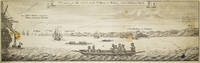
1745réf. 316296London: Thomas Astley 1745. Engraving. 4 x 13-1/4 inches. Creased from prior folding a few wormholes soiling and foxing. Engraving. 4 x 13-1/4 inches. Engraving showing "Negro Canoas carying Slaves aboard at Mansrow" extracted from A New Collection of Voyages and Travels 4 vols London: Thomas Astley 1745-7. Thomas Astley unknown
190028p. Illustrated with a full page portrait. Mildly XLib. Small 4to. Original printed wraps. Spine crudely taped. PA PAMPH 20_31 BX7
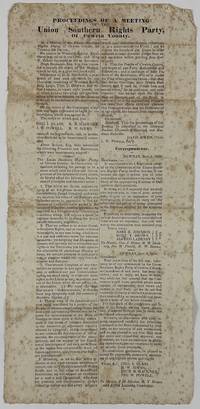
1850réf. 13416Newnan GA 1850. Broadside 15.5 x 7.25 inches. Minor edge wear old folds substantial foxing. Overall good plus. A very rare broadside memorializing a meeting of the Union Southern Rights Party in late-1850. The text records the proceedings of a November 5 1850 meeting in Newnan the seat of Coweta County Georgia to nominate Congressional candidates and propagate the organization's Preamble and Resolutions. The Preamble asserts that the Union Southern Rights Party of Coweta County has assembled to meet a "crisis which calls for a free and full expression of the opinions of every citizen" and therefore issues their "Declaration of principles and intended action." The six resolutions can be summed up as follows: they oppose the recent admission of California; "Disunion at present" is not the answer.yet; they reserve the right to secede if Congress continues to "war upon our property" and they are "left no other alternative;" they "express the determination of the state of Georgia" at an upcoming convention and wish to "promote true Southern Independence" if necessary; any candidate should "oppose any and every measure which may lead either directly or indirectly to a dissolution of the Union;" and that the people of Georgia should "forget all past Party distinctions and differences" and work together to ensure that the government is "rescued from impending dangers." Here the Union Southern Rights Party stands opposed to secession but reserves the right to exercise it in the future a fairly common viewpoint in the mid-19th century South. They answer some critics further along the path to secession in one passage here stating that "We repel the idea that we are 'Submissionists' or that we have any sympathy with the enemies of Southern Rights." In this way they are emblematic of a large portion of Southern politicians at the time who believed that slavery was an inherent right baked into the Constitution and was further a states rights issue. That viewpoint continued up to during and clear through the other side of the Civil War. Only one holding noted in OCLC and Hummel at Duke University. Hummel 402. unknown books
1850réf. 13416Newnan GA 1850. Broadside 15.5 x 7.25 inches. Minor edge wear old folds substantial foxing. Overall good plus. A very rare broadside memorializing a meeting of the Union Southern Rights Party in late-1850. The text records the proceedings of a November 5 1850 meeting in Newnan the seat of Coweta County Georgia to nominate Congressional candidates and propagate the organization's Preamble and Resolutions. The Preamble asserts that the Union Southern Rights Party of Coweta County has assembled to meet a "crisis which calls for a free and full expression of the opinions of every citizen" and therefore issues their "Declaration of principles and intended action." The six resolutions can be summed up as follows: they oppose the recent admission of California; "Disunion at present" is not the answer.yet; they reserve the right to secede if Congress continues to "war upon our property" and they are "left no other alternative;" they "express the determination of the state of Georgia" at an upcoming convention and wish to "promote true Southern Independence" if necessary; any candidate should "oppose any and every measure which may lead either directly or indirectly to a dissolution of the Union;" and that the people of Georgia should "forget all past Party distinctions and differences" and work together to ensure that the government is "rescued from impending dangers." Here the Union Southern Rights Party stands opposed to secession but reserves the right to exercise it in the future a fairly common viewpoint in the mid-19th century South. They answer some critics further along the path to secession in one passage here stating that "We repel the idea that we are 'Submissionists' or that we have any sympathy with the enemies of Southern Rights." In this way they are emblematic of a large portion of Southern politicians at the time who believed that slavery was an inherent right baked into the Constitution and was further a states rights issue. That viewpoint continued up to during and clear through the other side of the Civil War. Only one holding noted in OCLC and Hummel at Duke University. Hummel 402. unknown
réf. 1333734212.Gpaperback. Good. Access codes and supplements are not guaranteed with used items. May be an ex-library book. paperback
réf. ORD-2301Extrait de la Revue Maritime et Coloniale. 1865. In-8 (148 x 210mm) couverture en carton souple bleu, imprimée (couverture factice), pages 431 à 446 de la revue, à la fin pages 447 à 452: Bulletin bibliographique de la Marine et des Colonies. Bon état.
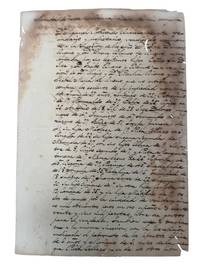
1875réf. 231241875. Slavery Cuba Spanish colonial slave sale manuscript recording the transfer of thirty-eight enslaved individuals in Cuba in 1875 materializing the sheer scale and organization of enslaved labor within the island's plantation economy during the final decade before abolition. The document enumerates a large group of enslaved people including multiple family units with young children demonstrating how slavery functioned as both an economic system and a hereditary condition sustained through the sale and reproduction of enslaved populations. Created eleven years prior to the abolition of slavery in Cuba in 1886 the manuscript documents the continued legality and normalization of large-scale slave transactions despite decades of international pressure and earlier prohibitions on the transatlantic trade offering concrete evidence of how internal markets sustained the institution in its final phase. Official Cuban slave contract documenting the sale of thirty-eight enslaved individuals for the sum of 126000 pesetas formalized before a public notary or legal authority. Single manuscript leaf written in Spanish cursive in black ink on both recto and verso densely filled with names ages and relational identifiers. Measures 8.5" x 12.25". The text lists individuals sequentially including men women and children with repeated references to kinship structures such as mothers with multiple children indicating the sale of family groupings rather than isolated individuals. The script reflects extended passages detailing ownership exclusions and conditions of transfer. A partial watermark of the official coat of arms of Cuba is visible. By 1875 Cuba remained one of the last major slave societies in the Atlantic world with sugar production driving demand for large controlled labor forces. Even after Spain curtailed the official slave trade earlier in the century illegal importation persisted into the 1860s and alternative systems of coerced labor including Chinese indenture supplemented plantation workforces. The scale of this transaction demonstrates the consolidation and redistribution of enslaved labor within domestic markets while the inclusion of children underscores the long-term economic logic of slavery as a self-reproducing system. Moderate toning and foxing concentrated along the edges with numerous small closed wormholes a few affecting portions of the text. Light edge wear present. Overall in good condition. This document provides unusually extensive nominal data on a large enslaved population encompassing the roles of kinship valuation and labor organization in late Spanish colonial Cuba. unknown books
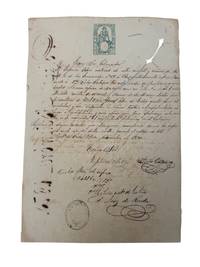
1870réf. 231221870. Slavery Cuba Spanish colonial slave sale manuscript recording the transfer of four enslaved individuals in Cuba in 1870. Produced within the official bureaucratic framework of Spanish colonial governance the document reflects the legal normalization of slavery in Cuba even as abolitionist pressures mounted across the Atlantic world. The document records the sale of four enslaved people described as "criollos" and African-born individuals situating the transaction within a labor system that combined locally born and imported enslaved populations. Created at a time when Spain had formally restricted the transatlantic slave trade but continued to permit slavery itself the manuscript demonstrates the persistence of legalized human commodification and the integration of enslaved labor into the island's economic structure sixteen years prior to abolition in 1886. Official Cuban slave contract documenting the sale of four enslaved individuals to Don Pedro Catasús by Don Enfemia Ochoa for the sum of 1100 pesos on November 29 1870. Single manuscript leaf written in Spanish cursive in black ink measuring 8.25" x 12". A green "50 cs de escudo" revenue stamp is affixed at the top center with a blind embossed Spanish crest at the upper left and a circular black ink government seal impressed at the lower left. Large vertical docketing appears on the verso. A stylized watermark is visible within the paper. The text organizes the enslaved individuals within a standardized transactional structure while the signatures of Enfemia Ochoa Pedro Catasús and A. Díaz de Rada authenticate the exchange and identify participants within the slaveholding economy. By 1870 Cuba remained a central node in the late Atlantic slave system with plantation agriculture especially sugar dependent on enslaved labor despite mounting abolitionist pressure. Although Spain had curtailed official slave imports earlier in the century illegal trafficking persisted into the 1860s and other coerced labor systems including the importation of Chinese indentured workers overlapped with slavery into the 1870s. The presence of both Creole and African individuals in this document reflects the layered composition of the enslaved population during this period. Light toning scattered foxing and edge wear visible. A closed wormhole extends from the upper right margin approximately five inches into the sheet resulting in partial loss of text. Evidence of prior tape reinforcement visible on the verso along with offsetting from previously adjacent material. Overall in very good condition. This document provides named transactional evidence of late-period slavery in Cuba offering concrete material for examining race labor and legal practice within Spanish colonial society. unknown books