1 720 résultats
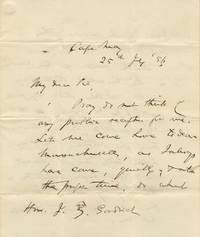
1856réf. List3745Cape May New Jersey 1856. Folded sheet with letter on three of four pages measuring 8 ½ x 7 ¼ inches. Fine condition. In May 1856 Senator Charles Sumner of Massachusetts delivered his incendiary "Crime Against Kansas" speech condemning slavery's expansion into the territories and attacking the architects of the Kansas-Nebraska Act. Three days later Representative Preston Brooks of South Carolina entered the Senate chamber and brutally assaulted him with a cane inflicting injuries severe enough to remove Sumner from public life for years. The attack became one of the defining symbolic episodes of the sectional crisis before the Civil War. Northern newspapers followed his condition closely and his empty Senate seat itself became a political emblem. Written from Cape May only two months after the attack while Sumner remained under physician supervision and uncertain whether full recovery would come quickly-or at all-Sumner writes here to a political ally in Massachusetts describing his physical and mental state: "My dear Sir "Pray do not think of any public reception for me. Let me come home to dear Massachusetts as I always have come quietly & at the proper time do what I can for the cause. This is best. Another reason for this course is the uncertain state of my health. I am still very feeble with such recurring ups & downs that my complete restoration seems sometimes far distant. My physician tells me I cannot be strong before September & then only by entire absence from all excitement. Perhaps not then. "Think of these things; & let us all join to stir Massachusetts in the good work forgetting men & remembering only the cause. "Ever sincerely yours Charles Sumner "P.S. From here I go to the mountains; but my address will be with Rev. Wm. H. Furness Phila. to Hon. J. Z. Goodrich" The letter gives a personal insight into the fallout of one of the most dramatic and violent political events of the antebellum sectional crisis. Sumner would return to politics three years later and the event would galvanize both Southern sympathizers to Brooks who sent him canes as tokens of gratitude and the Northern anti-slavery cause which considered Sumner a martyr. We find two other examples of letters by Sumner discussing the aftermath of the attack in all historical auction records.
1418réf. 106697Letter Signed 2 pp. folio letter sheet stampless address leaf. Two full pages of text. Folds with a couple of small tears or holes at folds normal aging and browning; otherwise very good.The letter is by Caroline F.R. Morgan to A.J.Walker in Milton North Carolina. Probably written in another hand but apparently her own verbiage with underlinings for emphasis and corrections. A strong legal statement by the widow Morgan of her rights as administrator of the Estate of her "late lamented husband" and his father responding to a Doctor's claim in a property sale in Milton North Carolina. Stating equivocally that "I administered his estate" with "Double powers of attorney if I may so express myself" and refusing to send a copy of her husband's will which "I consider a foolish request" and "would not do…for only the small amount of property in Milton but not for the whole of Milton."Most slave-owning women in the antebellum South were the widows of slave plantation owners who relied on overseers to manage often distant estates. A very few were more actively involved in the business affairs of the estates they had inherited. In Yalobusha County Mississippi two widows owned plantations with hundreds of slaves. One of these was Sarah Childress Polk of Tennessee widow of the 11th President of the United States. But her slave-holdings were exceeded by those of 42 year-old Caroline Fitz Randolph Morford Morgan of Lynchburg Virginia. Born in New Jersey to the grandson of a Quaker founder of Princeton University she had married a Virginia medical student whose father owned much of the city of Lynchburg as well as having real estate and slave holdings throughout the South. When he died in March 1847 she was left with three children and vast property in which she took an active interest not common "for a woman of her time and station." While she had many charitable interests – she was a charter member of a Female Missionary Society – records indicate that she personally bought and sold slaves both for the Morgavin Plantation in Mississippi and for her Virginia properties owning more than 100 African-American men and women including one "Aunt Sally" aged 104. She remained a widow for two years until she re-married to a younger man a Doctor who had come to Lynchburg to treat her family and slaves during an epidemic of yellow fever. That marriage ended contentiously in the 1850s and by the start of the Civil War she resumed her legal status as an independent woman ahead of her time. Apparently impoverished by the War she died in 1883. gavegarden.org books
1418réf. 106697Letter Signed 2 pp. folio letter sheet stampless address leaf. Two full pages of text. Folds with a couple of small tears or holes at folds normal aging and browning; otherwise very good.The letter is by Caroline F.R. Morgan to A.J.Walker in Milton North Carolina. Probably written in another hand but apparently her own verbiage with underlinings for emphasis and corrections. A strong legal statement by the widow Morgan of her rights as administrator of the Estate of her "late lamented husband" and his father responding to a Doctor's claim in a property sale in Milton North Carolina. Stating equivocally that "I administered his estate" with "Double powers of attorney if I may so express myself" and refusing to send a copy of her husband's will which "I consider a foolish request" and "would not do…for only the small amount of property in Milton but not for the whole of Milton."Most slave-owning women in the antebellum South were the widows of slave plantation owners who relied on overseers to manage often distant estates. A very few were more actively involved in the business affairs of the estates they had inherited. In Yalobusha County Mississippi two widows owned plantations with hundreds of slaves. One of these was Sarah Childress Polk of Tennessee widow of the 11th President of the United States. But her slave-holdings were exceeded by those of 42 year-old Caroline Fitz Randolph Morford Morgan of Lynchburg Virginia. Born in New Jersey to the grandson of a Quaker founder of Princeton University she had married a Virginia medical student whose father owned much of the city of Lynchburg as well as having real estate and slave holdings throughout the South. When he died in March 1847 she was left with three children and vast property in which she took an active interest not common "for a woman of her time and station." While she had many charitable interests – she was a charter member of a Female Missionary Society – records indicate that she personally bought and sold slaves both for the Morgavin Plantation in Mississippi and for her Virginia properties owning more than 100 African-American men and women including one "Aunt Sally" aged 104. She remained a widow for two years until she re-married to a younger man a Doctor who had come to Lynchburg to treat her family and slaves during an epidemic of yellow fever. That marriage ended contentiously in the 1850s and by the start of the Civil War she resumed her legal status as an independent woman ahead of her time. Apparently impoverished by the War she died in 1883. gavegarden.org
réf. 26786Paris de l'imprimerie du Patriote Français 1790 in 8 (20x13) 1 fascicule broché, 3 pages, non rogné. Avec la liste des noms de Colons Américains signataires qui attestent de leur soumission à l'Assemblée Nationale. Cette lettre datée du premier Août 1790 est leur réponse à un arrêté de l'île de Saint-Domingue, par lequel cette colonie déclare n'entendre soumettre les loix relatives au régime intérieur de la colonie, qu'à la seule sanction du Roi. Elle précéde aussi les importants débats de la Constituante sur les droits politiques des hommes de couleur dans les colonies du mois de mai 1791. Bel exemplaire ( Photographies sur demande / We can send pictures of this book on simple request )
réf. ORD-3633Au clergé de son diocèse sur l'Esclavage. Orléans. Georges Jacob.1862. In-8 br.pp.387 à 399.
réf. 210609[Paris], Imprimerie du Patriote François, s.d. (1791) in-4, 3 pp., broché sous couverture d'attente de papier marbré.
réf. RO20256076HACHETTE LIVRE / BNF / GALLICA BIBLIOTHEQUE NUMERIQUE. non daté. In-8. Broché. Bon état, Couv. convenable, Dos satisfaisant, Intérieur frais. 79 PAGES - 3 planches en noir/blanc ( 1 portrait, 2 cartes). . . . Classification Dewey : 326-Esclavage
1778réf. 36094Colmar Jean-Henri Decker, Imprimeur du Roi & de Nosseigneurs du Conseil Souverain d'Alsace [1778] in-4 dérelié
1785réf. 15723Genève, Paris, [], 1785. In-8 de 14-(2)-292 pp., veau fauve, dos lisse orné, pièce de titre en maroquin (reliure de l'époque).
2015réf. 114575L’Harmattan 2015 In-8 broché 21,5 cm sur 13,6. 254 pages. Bon état d’occasion.
1789réf. 31479S.l. s.d. [1789] in-8 dérelié
1776réf. 39628Paris P.G. Simon 1776 in-4 cartonnage de papier marbré rouge, pièce de titre noire [Rel. moderne]
réf. 17270par Monseigneur Dugoujon, Préfet apostolique de la Guadeloupe, et Monseigneur Castelli, Préfet apostolique de la Martinique. P. 1935. In-8 (23/14cm). IX-147 pages. Broché (la 2ème couverture et le dos manquent).
1961Dakar, I. F. A. N., 1961; in-8, 26 pp., couverture, feuilles et cahiers agrafés. Extrait du Bulletin de l'I. F. A. N., T. XXIII, série B, n° 3-4, 1961.
1964Dakar, I. F. A. N., 1964; in-8, 48 pp., couverture, feuilles et cahiers agrafés. Extrait du Bulletin de l'I. F. A. N., T. XXVI, série B, n° 1-2, 1964.
1965Dakar, I. F. A. N., 1965; in-8, 46 pp., couverture, feuilles et cahiers agrafés. Extrait du Bulletin de l'I. F. A. N., T. XXVII, série B, n° 3-4, 1965.
PARIS, Ed. France-Empire - 1970 - In-8 - Broché sous jacquette illustrée en couleurs - 351 pages - Légère déchirure en coiffe de la jaquette - Très bon état.
in-8, broché.- Gravure en frontispice. Couverture et dos défraichis (manques), quelques rousseurs. [NV-30]
Paris PUF, 1972. N°1191. Un volume broché de format petit in 8° de 128 pp. annotations au crayon; sinon bel état.
1897251pp., 22cm., relié en couv.cart., br.orig. conservée, 2 cachets, texte frais et sans rousseurs, bon état, G86918
1998Le Cherche Midi 1998, In-4 broché, 271 pages, nombreuses photos. Très bon état
1853Limoges, Barbou, 1853. In-8 relié demi-basane blonde éditeur, dos à nerfs très orné, plats décorés de guirlandes dorées et estampés à froid. Mention en lettres dorées de "Prix d'honneur donné à Monseigneur l'Evêque de Limoges". Toutes tranches dorées. 336 pages. Gravures. Bon état.
LIMOGES, bardou frères - 1852 - In-8 - Reliure romantique - 1 & 4 plats ornés de motifs arabisants, entourés d'écoinçons en relief - frontispice - Gravures HT PP - légères rousseurs 336 pages - Bon exemplaire - propre
1942Amiot Dumont 1952, In-8 broché, couverture à rabats. 372 pages + carte dépliante et photos . Préface de M. Henri Bureau, armateur. Bon exemplaire
1969Traduction, par Maurice-Edgar COINDREAU, de "The Confessions of Nat Turner", roman publié en 1966 par l'écrivain états-unien William STYRON (1925-2006), dont le narrateur est Nat Turner, meneur à la personnalité complexe de la violente insurrection d'esclaves noirs de Southampton (1831), qui évoque sa vie et sa révolte: adaptation littéraire de "Les Confessions de Nat Turner", récit recueilli par son avocat Thomas R. Gray et publié peu après son exécution, précédée de "Au public", préface de Thomas R. GRAY à ce récit, et d'une note de l'écrivain qui précise ne s'être "écarté que très rarement des faits connus sur Nat Turner et sur la révolte dont il fut le chef", dans un récit où il a essayé de "recréer un homme et sa période". Ouvrage où William STYRON "fait œuvre d'historien, de sociologue, de peintre de mœurs et de psychologue sans jamais oublier qu'il est avant tout romancier. Cela l'amène à prendre certaines libertés avec les faits [...] mais lui permet de brosser un tableau coloré de la vie dans les plantations du sud des Etats-Unis avant la guerre de Sécession et de nous présenter une analyse aiguë d'un dangereux illuminé, mystique sanguinaire et obsédé sexuel." (4è de couverture). 1ère édition sur papier ordinaire (après 46 exemplaires sur pur fil): achevé d'imprimer 9 janvier 1969. Français