[Slavery]: [Maryland]Biblio.com
1 590 résultats
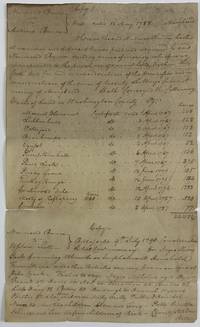
1790réf. 13400Washington County MD 1790. 2pp. on a single folio sheet. Moderate toning and dust-soiling old folds one fold separation repaired on verso with archival tape. Overall good plus condition. A striking document from early national Maryland detailing the sale of numerous types of property by Norman Bruce a Maryland militia man and land speculator. Norman Bruce was a Scottish immigrant who came to the American colonies as a young man served in the Maryland militia and acquired large tracts of land mostly in modern-day Carroll County. He also served as the Sheriff of Frederick County and as a judge and was known to own numerous slaves. Interestingly his wife Susanna Gardiner Key Bruce was great aunt to Francis Scott Key. The present documents first memorializes Bruce's sale of a dozen parcels of land to his son Andrew Bruce. The document notes the location date of sale and the number of acres for each parcel. Most impactfully though the document records Bruce's sale of his slaves. In a bill of sale in the present document Bruce sells two dozen named enslaved persons to his great-nephew Upton Scott along with various other property such as "Stock Farming Utensils or Implements Household Furniture and other articles." The transaction for the enslaved men women and children lists them by name and mostly age and reads in part: "Bill of sale 9th July 1790.For Negro Slaves.That is to say Negro Nicholas Aged 48 years. Frank 47. Harvey 46. Ned 44. Jonathan 44. Brutus 37. Little Harry 32. Betsey 50. Her daughter Hannah 11 years. Phillis 37 & her four children Milly Molly Phillis & Hannibal. Nance 24. Her two children Clem and Terry - Patty Pricilla Jeanie and Sam the four children of Beck. Charity and Stephen & Cassey the children of Nell." These enslaved persons apparently worked Bruce's "Farm on Great Pipe Creek." An unusual 18th-century Maryland slave document providing critical named connections within multiple slave families known to be living and working at a specific Maryland farm in 1790. unknown
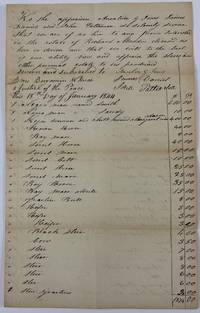
1844réf. 13105St. Genevieve County MO: January 18 1844. 4pp. on a single folded sheet. Original folds minor wear. Very good condition. A sobering manuscript inventory from the estate of Richard Maddin following his death in Missouri in 1843 detailing his "slaves and other personal" property. The inventory begins by listing the enslaved persons by name along with an assignation of value for each of them as such: "1 Negro man named Smith $600. 1 Negro man named Sandy $10. 1 Negro woman and child named Margaret and Jason $400." The inventory then goes on to list the other property beginning with a long list of livestock followed by equipment household goods and so forth. The document is certified and witnessed by a number of local citizens who attest to the "full and perfect inventory of the goods chattles and personal estate" of the deceased Mr. Maddin. The reasoning is unclear why the second listed slave Sandy was worth only $10. January 18 unknown
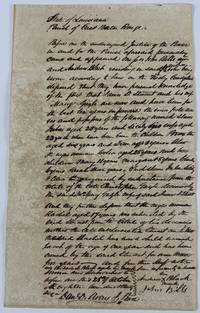
1836réf. 13107East Baton Rouge Parish LA: October 25 1836. 1p. on a single folded sheet integral blank docketed on verso. Old folds moderate toning and foxing short closed tear along one fold line a few small instances of ink burn. Overall good condition. An interesting document of legal testimony involving numerous named slaves in Louisiana in 1836 ranging in age from one year to almost thirty years of age and including seven children. According to the docketing the document is effectively a "Title to Slaves." The deponents were two local citizens John Bills and Andrew Black who had "personal knowledge of the fact that James D. Stuart and his wife Mary Gayle are now and have been for the last ten years & upwards the bona fide owners and possessors of the following named slaves: Juba Aged 25 and Sicily his wife aged 22 to whom have been born the children Braxton aged six years and Dan aged 3 years. Also the negro woman Celia aged 28 years and her children Mary 11 years Margaret 8 years Charley 6 years Sarah three years which slaves Juba Sicily & Celia were acquired by inheritance from the estate of Christopher Gayle. And they further depose that the negro woman Rachel aged 17 years was inherited by the said Stuart from the estate of his deceased mother.and that the said Rachel has now a child named Jacob of the age of one year." The document is signed by Black Bills and the Justice of the Peace Daniel D. Avery. Documents involving slave inheritance of and subsequent ownership by not one but both members of a marriage are exceedingly rare. October 25 unknown
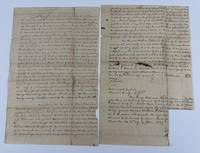
1839réf. 3013Washington D.C. 1839. Fair. 3pp. Large folio. Separated into six pieces with a very small section of the final attestation lacking altogether. Still highly readable. A wounded but important document. A rare and historically-important document relating to slavery in the District of Columbia which was outlawed on April 16 1862 nearly nine months before the issuance of the Emancipation Proclamation. The present document is an indenture made between William G. Howison and Alexander Hunter Esquire both citizens of Washington D.C. associated with property conveyed to Hunter by the deceased Joseph Birch. In 1824 Birch conveyed to Hunter land "and also a negro man slave for life named Lewis - another named George - two horses - 4 cows - 3 calves." The document indicates that Lewis was subsequently sold for four hundred dollars and George was sold to Birch in his lifetime. Documents recording the movement of slaves within the District especially among two citizens of the city are rare in the market. unknown
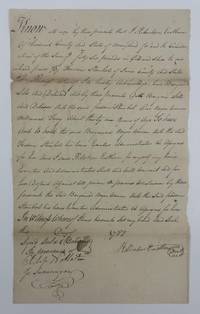
1788réf. 4111Frederick County Md: March 7 1788. About very good. 1p. folio docketed on verso. Old folds short splits along a couple of fold lines minor toning. An impactful manuscript document from the early national period in Maryland formalizing the sale of a slave woman in Frederick County. The sale was made by Robertson Eastburn whose family emigrated from England to Maryland in the early 18th century. The document reads in part: "In consideration of the sum of forty six pounds in Gold and Silver to me in hand and paid by Frederic Strombol.I do hereby Acknowledge have Bargain'd Sold and Delivered and by these presents doth Bargain Sell and Deliver Unto the said Frederic Strombol One Negro Woman named Torry about thirty years of age To Have and to hold the said Bargained Negro woman unto the said Frederic Strombol." Slavery in Maryland lasted over 200 years from its beginnings in 1642 when the first Africans were brought as slaves to St. Mary's City to its end following the Civil War. In 1664 under the governorship of Charles Calvert 3rd Baron Baltimore the Assembly ruled that all enslaved people should be held in slavery for life and that children of enslaved mothers should also be held to the same standard of law. 19th-century American slave sale documents are growing increasingly scarce in the market. March 7 unknown
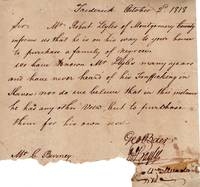
1818réf. 12956Frederick MD: October 2 1818. 1p. docketed on verso. Roughly torn along bottom edge minor foxing and spotting. Good condition. An uncommon document in Maryland slave history in which George Baer the future mayor of Frederick and a few other men attest that another local citizen named Robert Lyles is not a slave trader. The document reads in part: "Lyles is on his way to your house to purchase a family of negroes. We have known Mr. Lyles many years and have never heard of his Trafficking in Slaves nor do we believe that in this instance he has any other view but to purchase them for his own use." Baer served as mayor of Frederick from 1820 to 1823; his correspondent "C. Burney" is perhaps Clotworthy Birney 1765-1845 a farmer and real estate trader living near Taney Town. An unusual Maryland slave document concerning a slave owner who just wants to buy slaves for his own use not traffic in them because that's somehow better. October 2 unknown
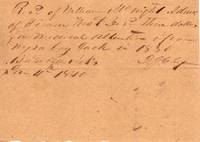
1840réf. 12966Batesville AR: January 11 1840. 1p. 4 x 5.5 inches docketed on verso. Old horizontal fold toning. Very good. An interesting manuscript record of slave care in Arkansas in the 1830s. The short but impactful document reads in full: "Recd of William McNight Admin. Of Hiram West Decd three dollars for medical attention upon negro boy Jack in 1836. Batesville Ark. Jan 11 1840 DJ Chipman." Such documents are increasingly rare in the market and more uncommon than slave sale documents from the same period. Arkansas has just achieved statehood four years before the presetn document was written. January 11 unknown
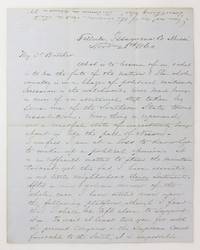
1860réf. 6445Tallula Ms: November 28 1860. Very good. 4pp. on a bifolium. Minor soiling and wear along old folds. Otherwise clean. Written in the immediate aftermath of the Election of 1860 this letter presents a ground-level account of Southern uncertainty at the onset of the secession crisis with a very notable section on the Texas slave insurrection panic of 1860. The writer Isaac E. Nicholson lived in a region of the Mississippi Delta with a large population of enslaved people and he attempts to balance a lingering attachment to the Union with mounting fears of insurrection political collapse and economic instability. The letter moves between national politics local anxieties reports of violence in Texas and personal family concerns. He begins by describing the intensity of the moment: "The whole country is in a blaze of political excitement. Secession is the watchword." Despite this Nicholson positions himself at least provisionally against immediate disunion advocating delay and negotiation: "To wait at least two yrs.and in the mean time make certain demands upon the Northern States. This will make it a test question.whether there is any spirit of compromise left." He adds that "With the present Congress & the Supreme Court favorable to the South it is impossible for her to suffer materially" though he concedes that he may be "Left alone to support it." That moderation is undercut by a stark expression of racialized fear: "We who live in a country with about 30 blacks to one white man slumbering over a volcano.cannot long remain silent." He continues "It is no trivial matter.to retire at night with a probability of being murdered before morning. This thing has a reality here." He concludes that "The fine alternative of Revolution.will become necessary unless their aggressions.cease." The most dramatic section concerns events in Texas where Nicholson reports that his brother suffered heavy losses during unrest in Dallas: "His office & furniture & his whole library were destroyed by fire" and "His dwelling house was set on fire at three different times." He attributes the destruction to "Abolition Preachers.forced to leave for tampering with slaves" who "Endeavored to avenge themselves" adding that "The whole town of Dallas West was laid in ruins. They were both hung by a mob." Financial losses are detailed as well: "About $2000" destroyed followed by news that a New Orleans firm holding "$4000 deposited. had failed." This account corresponds to the unrest surrounding the Texas slave insurrection panic of 1860 during which fires in Dallas were widely blamed on enslaved people and Northern abolitionists and suspected agitators including Methodist ministers were expelled or killed by vigilante groups. Three men -- Patrick Jennings Sam Smith and Cato -- were killed in a public execution near Dealey Plaza now renamed Martyrs' Park in their honor. Although Nicholson presents the destruction as organized retaliation historians have generally concluded that the fires were likely accidental with the conspiracy narrative emerging from rumor and fear. His description reflects how these events circulated in Southern correspondence at the time combining real violence with exaggerated or misinterpreted causes and the passages are notable for the blending of what was presumably fact -- his brother's house catching on fire -- with the fiction of abolitionists arsonists. We find no records of correspondence or any material relating to these events in auction records or on the market at the time of writing. Overall a scarce account overall of a tragic episode in Texas history and the rumor mill that fueled it. November 28 unknown
réf. 11095Bale, chez Jean Schweighauser, 1775, 1 demi basane à coins, tranches rouge, petit manque sur la coiffe supérieure. in-8 de 307-(19) pp. ;
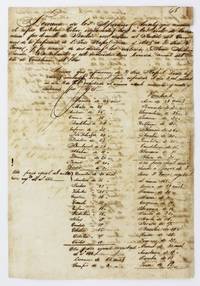
1866réf. 4747Havana: July 10 1866. Good. 3pp. on a bifolium. Separated at fold. Some wear to edge of first leaf cause some minor loss to text. A few scattered tape repairs and reattachments. Some offsetting. A colonial Spanish manuscript slave manifest for the steamship Cristobal Colon carrying dozens of enslaved Africans from Bailen to Partido del Cano both in Cuba. The text at the head reads as follows: "Nomina de los Africano bozales que conducten el vapor Cristobol Colon embarcado hoy a las siete de la mañana por el muelle de Bailen con destino al Partido del Cano unos de la propridad de D. José Rafael Diaz y otros de D. José Garcia y por encargo de sus dueños los custodia D. Juan Antonio Sanchez Bustamante y este individuo tiene biencia annal del Partido de Consolacion del Sur." Bailen is on the southern coast of Cuba north of the Isle of Pines; "El Cano" seems to have been a plantation outside of Havana while Consolacion del Sur is coastal town in the Pinar del Rio region of Cuba. The manifest lists 133 "Africanos bozales" that is slaves who could not speak Spanish in two or three columns separated between men "varones" and women "hembras" - their assigned names are given generally of Christian origin but with some range e.g "Ciforiana" "Liborio" and "Dionisia." Their ages are given one as young as nine several in their late thirties but most in their teens to early thirties. An additional leaf signed from Manila and dated July 10 1866 notes that although 133 people were sent only 115 survived the journey and lists the names of those who perished. July 10 books
1866réf. 4747Havana: July 10 1866. Good. 3pp. on a bifolium. Separated at fold. Some wear to edge of first leaf cause some minor loss to text. A few scattered tape repairs and reattachments. Some offsetting. A colonial Spanish manuscript slave manifest for the steamship Cristobal Colon carrying dozens of enslaved Africans from Bailen to Partido del Cano both in Cuba. The text at the head reads as follows: "Nomina de los Africano bozales que conducten el vapor Cristobol Colon embarcado hoy a las siete de la mañana por el muelle de Bailen con destino al Partido del Cano unos de la propridad de D. José Rafael Diaz y otros de D. José Garcia y por encargo de sus dueños los custodia D. Juan Antonio Sanchez Bustamante y este individuo tiene biencia annal del Partido de Consolacion del Sur." Bailen is on the southern coast of Cuba north of the Isle of Pines; "El Cano" seems to have been a plantation outside of Havana while Consolacion del Sur is coastal town in the Pinar del Rio region of Cuba. The manifest lists 133 "Africanos bozales" that is slaves who could not speak Spanish in two or three columns separated between men "varones" and women "hembras" - their assigned names are given generally of Christian origin but with some range e.g "Ciforiana" "Liborio" and "Dionisia." Their ages are given one as young as nine several in their late thirties but most in their teens to early thirties. An additional leaf signed from Manila and dated July 10 1866 notes that although 133 people were sent only 115 survived the journey and lists the names of those who perished. July 10
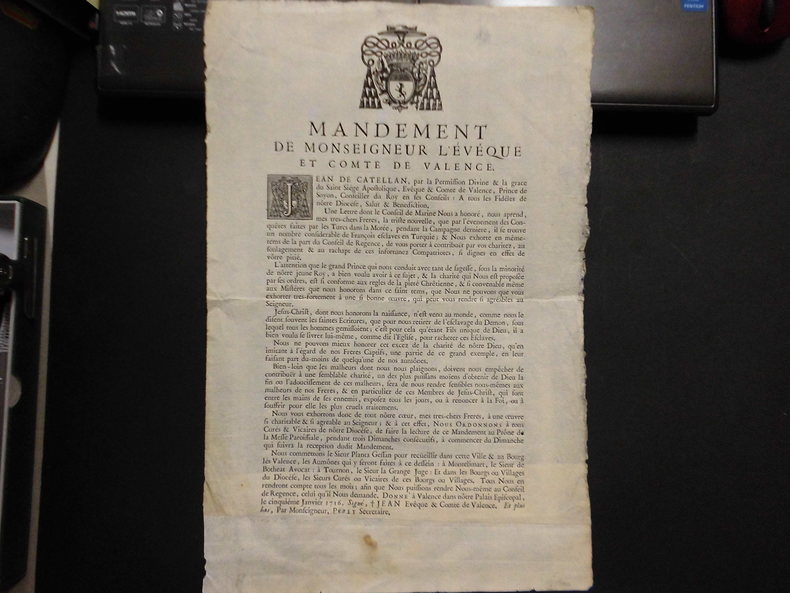
1716réf. 106Petite affichette (23,5 X 35,8 cm) "Une lettre dont le conseil de marine nous a honoré nous apprend la triste nouvelle que par l'évènement des conquêtes faites par les turcs dans la Morée, pendant la campagne dernière, il se trouve un nombre de français considérable esclave en Turquie et nous exhorte en même temps de la part du conseil de régence de vous porter à contribuer par vos charités au soulagement et au rachat de ces infortunés compatriotes si dignes de votre pitié". A noter sur le bas un rajout de papier le document ayant été coupé sans manque de texte. Jean de Catellan, né à Toulouse vers 1659 et mort le 7 janvier 1725, est évêque de Valence.
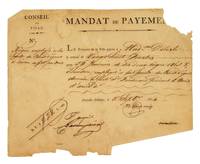
1914réf. 1272741914. New Orleans: September 1 1814. Single sheet 242 x 197 mm printed and manuscript document age-toned with considerable edgewear and the loss of two corners affecting only two characters of the title and with no loss of sense. Good. § Municipal payment order issued by the New Orleans City Council to its treasurer to pay for the hire of two enslaved men Abel and Theodore to work on the drainage canal at Fort St. Ferdinand. The document is dated a few months before the Battle of New Orleans and likely concerns improvement to the city's defensive works. Nicholas Girod was mayor of New Orleans from 1812 to 1815. He was the first regularly elected mayor after Louisiana's admission to the Union and did much to prepare the city against the British invasion force. The text of the document reads: Conseil de Ville. Mandat de Payement Le Trésorier de la Ville payera à Madame Delisle la somme de Vingt huit Piastres pour 56 journées de ses deux nègres Abel & Théodore employés à la fouille du Canal d'égout derrière le Fort Saint Ferdinand pendant le mois d'août dernier. Nouvelle-Orléans le 1er Septembre 1814. signature N. Girod Maire Par le Maire struck through A marginal note adds "Nègres employés à la fouille du Canal d'égout à raison de $15 par mois. unknown books
1914réf. 1272741914. New Orleans: September 1 1814. Single sheet 242 x 197 mm printed and manuscript document age-toned with considerable edgewear and the loss of two corners affecting only two characters of the title and with no loss of sense. Good. § Municipal payment order issued by the New Orleans City Council to its treasurer to pay for the hire of two enslaved men Abel and Theodore to work on the drainage canal at Fort St. Ferdinand. The document is dated a few months before the Battle of New Orleans and likely concerns improvement to the city's defensive works. Nicholas Girod was mayor of New Orleans from 1812 to 1815. He was the first regularly elected mayor after Louisiana's admission to the Union and did much to prepare the city against the British invasion force. The text of the document reads: Conseil de Ville. Mandat de Payement Le Trésorier de la Ville payera à Madame Delisle la somme de Vingt huit Piastres pour 56 journées de ses deux nègres Abel & Théodore employés à la fouille du Canal d'égout derrière le Fort Saint Ferdinand pendant le mois d'août dernier. Nouvelle-Orléans le 1er Septembre 1814. signature N. Girod Maire Par le Maire struck through A marginal note adds "Nègres employés à la fouille du Canal d'égout à raison de $15 par mois. unknown
1930réf. 88051930 Paris, Firmin-Didot, 1930.histoire d'outre-mer, In-8 broché de 230pp.
GALLIMARD. 28-10-1952. In-8 Carré. Broché. Bon état. Couv. convenable. Dos satisfaisant. Intérieur frais. 550 pages TRADUIT PAR R BASTIDE- PREFACE DE L FEBVRE
1952réf. R150223504GALLIMARD. 28-10-1952. In-8. Broché. Bon état, Couv. convenable, Dos satisfaisant, Intérieur frais. 550 pages. . . . Classification Dewey : 326-Esclavage
1952réf. 27241952 NRF GALIMARD "la Crois du Sud ,traduit par R.Bastide, 1952, fort in8 br ,couv ill ,bibliographie ,glossaire
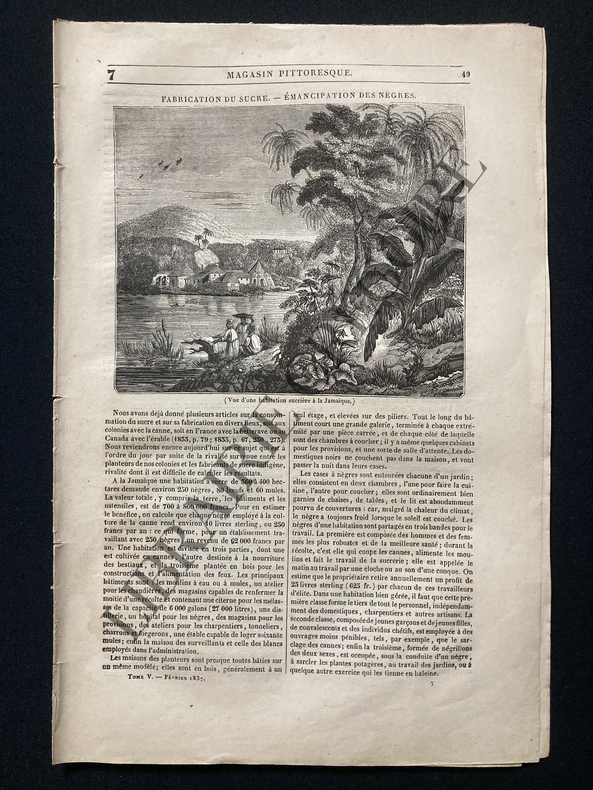
1837réf. ABE-17094261862038 PAGES-20 CM X 30,5 CM-FABRICATION DU SUCRE-EMANCIPATION DES NEGRES, 2 PAGES, GRAVURE DEMI PAGE (VUE D'UNE HABITATION SUCRIERE A LA JAMAIQUE)-REGLES DE L'ART DE PATINER, 1P-HEIDELBERG, 1P, GRAVURE-LUTTES EN BRETAGNE, 1P, GRAVURE
2005réf. 100155569ALBIN MICHEL 2005 226 pages 14 5x22 3x2 2cm. 2005. Broché. 226 pages.
in-8, 205 pp., broché, couv. Bon état. [NV-25]
1904réf. AMA-129Paris, Alcan, 1904. in 8°,toile moderne, couverture usée conservée. XVI-396 pp.-(2)ff.
réf. 50641Paris, Guillaumin - Victor Lecou 1853, 180x110mm, 370pages, reliure demi-basane. Plats papier marbré. Titre doré au dos. Quelques trous de ver. Rousseurs sur tranches et parfois sur les marges. Bon état de l’ensemble.
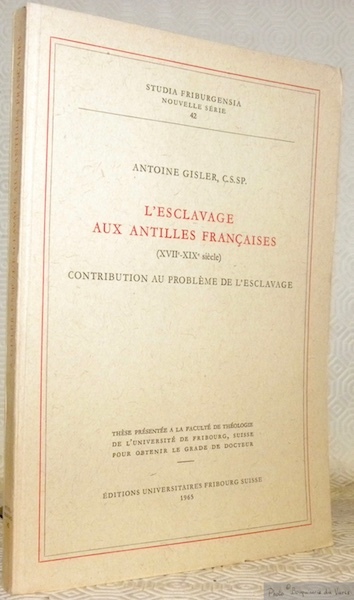
réf. 62774Fribourg, Editions Universitaires Fribourg 1965, 240x165mm, XIV- 213pages, broché. Non coupé. Exemplaire à l'état de neuf.
1836réf. 216961836. Slavery & Abolition CHILD Lydia Marie. An Appeal in Favor of That Class of Americans Called Africans. New York: Published by John S. Taylor 1836. Second edition. Illustrated with 2 plates. Coleridge quote on title page. In original blue cloth boards with embossing and gilt to spine. 8vo 216 pages. Child was a vocal abolitionist women's rights activist anti-American expansionist and proponent of racial equality amongst African and Native Americans. An Appeal in Favor of That Class of Americans Called Africans was the first written by a white woman in support of the immediate emancipation of slaves without compensation to their enslavers. Child begins by writing about the history of the slave trade as well as harrowing stories on it's detrimental and immoral faculties in order to engage readers to action. One illustrated plate showcases shackles and chains used on enslaved individuals. First published in 1833 Child's work was a prominent contribution to the abolitionist movement and her writing influenced many notable figures including Harriet Beecher Stowe and Frederick Douglass. Missing frontispiece some foxing to pages some wear to covers. Small tear affecting a few words in the fist first sentence on page 127. Binding is tight and text is clean and legible. Overall very good condition. unknown books