2 034 résultats
1935réf. GITc022Marseille Editions Publiroc 1935. In-8 broché couverture illustrée 136pp. Illustrations dans le texte et à pleine page. Bel exemplaire.
in-12, 534 pp., cartonnage éditeur avec jaquette i Jaquette lég. insolée sinon bel exemplaire. [JU-4]
réf. 053869Paris Librairie Charles Gosselin 1840 in 8 (19,5x12) 1 volume reliure demi basane havane de l'époque, dos à nerfs soulignés de filets à froid, 392 pages. Quatrième édition. Bel exemplaire ( Photographies sur demande / We can send pictures of this book on simple request )
1836réf. PHO-2331Paris, Gosselin, 1836. 2 volumes in-8 (20x13), VIII-396 pp., 2 ff.-334 pp., basane époque, dos lisse orné avec pièce d’auteur et titre, tomaison. Frottements, coins usés, rousseurs éparses.
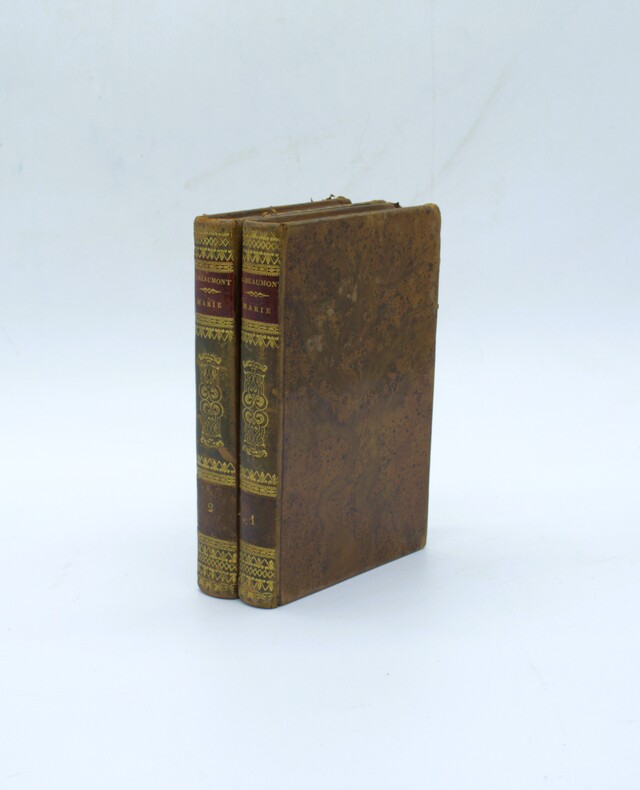
1842réf. 12540Paris Gosselin 1842 Un volume in-8 demi chagrin bordeau, reliure XXe, dos à nerfs, titre doré, couverture conservée, 588 pages. Quelques passages soulignés au crayon, néanmoins bel exemplaire.
1836réf. C014113,4 cm X 21 cm, 410 pp, reliure demi cuir, dos à 4 nerfs, titres et tomaison dorés.
réf. 11074Valence, imp. Chaléat, 1872, 1 br. in-8 de 178 pp. ;
1864réf. 1067529 leaves of blue lined paper written in ink on rectos only. 31.5x20 cm 12¼x8" set in custom-made half cloth folder .Minor aging old folds; near fine. Official court document from Bexar County Texas summarizing the case of "Jim Owen a free person of African descent thirty years of age a resident of said county and state" who "desires to choose an owner and mistress and has selected for his mistress Sephrony Kerr…" Owen states that "he was brought from the State of Illinois to his state in 1850 before he was of lawful age by one John H. Burrus… who has since said time assumed a kind of guardianship over your petitioner without lawful authority…" All seemed on track until John H. Burrus filed suit stating that he was the "owner of said petitioner Owen" and "proof was not made that said petitioner is a free man of African descent" and "the negro Jim Owen… is his slave that he was brought to this State by the respondent in January 1850 as is slave and has been so held and owned up to the present time…" A new trial was granted and Kerr and Owen's petition denied. An appeal was allowed contingent on paying to Burrus a surety bond of $1500. A fascinating glimpse into the legal morass surrounding slavery as the Civil War raged and the "peculiar institution" of slavery was soon to be ended by force of arms. books
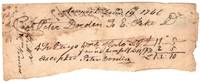
1766réf. 13353Newport RI: December 19 1766. Manuscript document 2.25 x 6 inches. Unevenly trimmed moderate toning and staining. About very good. Rare surviving evidence of a slaveowner hiring out a slave for manual labor in colonial Rhode Island. Here Captain Peter Darden bills E. Teke for "4 Days work of Cato" for eleven shillings five pence. The verso indicates the bill was paid on January 6 1767; the payment may have involved another slave as Teke seems to note that payment was made by an "agt" agent named Cicero. A rare surviving document pertaining to slavery in pre-revolutionary Rhode Island. December 19 unknown books
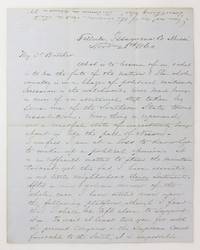
1860réf. 6445Tallula Ms: November 28 1860. Very good. 4pp. on a bifolium. Minor soiling and wear along old folds. Otherwise clean. Written in the immediate aftermath of the Election of 1860 this letter presents a ground-level account of Southern uncertainty at the onset of the secession crisis with a very notable section on the Texas slave insurrection panic of 1860. The writer Isaac E. Nicholson lived in a region of the Mississippi Delta with a large population of enslaved people and he attempts to balance a lingering attachment to the Union with mounting fears of insurrection political collapse and economic instability. The letter moves between national politics local anxieties reports of violence in Texas and personal family concerns. He begins by describing the intensity of the moment: "The whole country is in a blaze of political excitement. Secession is the watchword." Despite this Nicholson positions himself at least provisionally against immediate disunion advocating delay and negotiation: "To wait at least two yrs.and in the mean time make certain demands upon the Northern States. This will make it a test question.whether there is any spirit of compromise left." He adds that "With the present Congress & the Supreme Court favorable to the South it is impossible for her to suffer materially" though he concedes that he may be "Left alone to support it." That moderation is undercut by a stark expression of racialized fear: "We who live in a country with about 30 blacks to one white man slumbering over a volcano.cannot long remain silent." He continues "It is no trivial matter.to retire at night with a probability of being murdered before morning. This thing has a reality here." He concludes that "The fine alternative of Revolution.will become necessary unless their aggressions.cease." The most dramatic section concerns events in Texas where Nicholson reports that his brother suffered heavy losses during unrest in Dallas: "His office & furniture & his whole library were destroyed by fire" and "His dwelling house was set on fire at three different times." He attributes the destruction to "Abolition Preachers.forced to leave for tampering with slaves" who "Endeavored to avenge themselves" adding that "The whole town of Dallas West was laid in ruins. They were both hung by a mob." Financial losses are detailed as well: "About $2000" destroyed followed by news that a New Orleans firm holding "$4000 deposited. had failed." This account corresponds to the unrest surrounding the Texas slave insurrection panic of 1860 during which fires in Dallas were widely blamed on enslaved people and Northern abolitionists and suspected agitators including Methodist ministers were expelled or killed by vigilante groups. Three men -- Patrick Jennings Sam Smith and Cato -- were killed in a public execution near Dealey Plaza now renamed Martyrs' Park in their honor. Although Nicholson presents the destruction as organized retaliation historians have generally concluded that the fires were likely accidental with the conspiracy narrative emerging from rumor and fear. His description reflects how these events circulated in Southern correspondence at the time combining real violence with exaggerated or misinterpreted causes and the passages are notable for the blending of what was presumably fact -- his brother's house catching on fire -- with the fiction of abolitionists arsonists. We find no records of correspondence or any material relating to these events in auction records or on the market at the time of writing. Overall a scarce account overall of a tragic episode in Texas history and the rumor mill that fueled it. November 28 unknown books
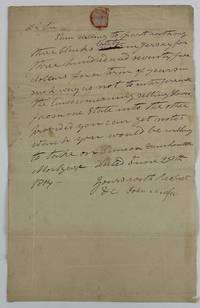
1814réf. 13354N.p.: June 28 1814. 1p. addressed on verso. Old mailing folds remnants of wax seal minor staining and toning. Very good. An interesting letter involving the sale of slaves in early-19th-century New Jersey. The letter comes from a slaveowner named John Neagie writing to Garrabrandt Van Houten Esquire in Patterson New Jersey in 1814. The text of the letter reads in full: "Dear Sir I am willing to part with my three blacks lately in Jersey for three hundred and seventy five dollars for a term of years in such way as not to interfere with the laws concerning selling slaves from one state into the other provided you can get notes which you would be willing to take on. Same on Van Houten's mortgage. Dated June 20th 1814. Yours with respect John Neagie." Neagie's concerns about "selling slaves from one state into the other" seems to indicate that he is based somewhere outside New Jersey where his slaves have been "lately." In fact he has crossed out the word "now" and replaced it with "lately. June 28 unknown books
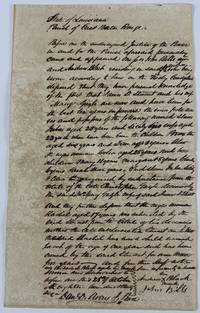
1836réf. 13107East Baton Rouge Parish LA: October 25 1836. 1p. on a single folded sheet integral blank docketed on verso. Old folds moderate toning and foxing short closed tear along one fold line a few small instances of ink burn. Overall good condition. An interesting document of legal testimony involving numerous named slaves in Louisiana in 1836 ranging in age from one year to almost thirty years of age and including seven children. According to the docketing the document is effectively a "Title to Slaves." The deponents were two local citizens John Bills and Andrew Black who had "personal knowledge of the fact that James D. Stuart and his wife Mary Gayle are now and have been for the last ten years & upwards the bona fide owners and possessors of the following named slaves: Juba Aged 25 and Sicily his wife aged 22 to whom have been born the children Braxton aged six years and Dan aged 3 years. Also the negro woman Celia aged 28 years and her children Mary 11 years Margaret 8 years Charley 6 years Sarah three years which slaves Juba Sicily & Celia were acquired by inheritance from the estate of Christopher Gayle. And they further depose that the negro woman Rachel aged 17 years was inherited by the said Stuart from the estate of his deceased mother.and that the said Rachel has now a child named Jacob of the age of one year." The document is signed by Black Bills and the Justice of the Peace Daniel D. Avery. Documents involving slave inheritance of and subsequent ownership by not one but both members of a marriage are exceedingly rare. October 25 unknown books
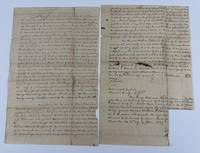
1839réf. 3013Washington D.C. 1839. Fair. 3pp. Large folio. Separated into six pieces with a very small section of the final attestation lacking altogether. Still highly readable. A wounded but important document. A rare and historically-important document relating to slavery in the District of Columbia which was outlawed on April 16 1862 nearly nine months before the issuance of the Emancipation Proclamation. The present document is an indenture made between William G. Howison and Alexander Hunter Esquire both citizens of Washington D.C. associated with property conveyed to Hunter by the deceased Joseph Birch. In 1824 Birch conveyed to Hunter land "and also a negro man slave for life named Lewis - another named George - two horses - 4 cows - 3 calves." The document indicates that Lewis was subsequently sold for four hundred dollars and George was sold to Birch in his lifetime. Documents recording the movement of slaves within the District especially among two citizens of the city are rare in the market. unknown books
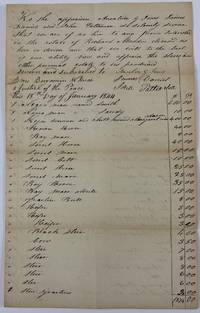
1844réf. 13105St. Genevieve County MO: January 18 1844. 4pp. on a single folded sheet. Original folds minor wear. Very good condition. A sobering manuscript inventory from the estate of Richard Maddin following his death in Missouri in 1843 detailing his "slaves and other personal" property. The inventory begins by listing the enslaved persons by name along with an assignation of value for each of them as such: "1 Negro man named Smith $600. 1 Negro man named Sandy $10. 1 Negro woman and child named Margaret and Jason $400." The inventory then goes on to list the other property beginning with a long list of livestock followed by equipment household goods and so forth. The document is certified and witnessed by a number of local citizens who attest to the "full and perfect inventory of the goods chattles and personal estate" of the deceased Mr. Maddin. The reasoning is unclear why the second listed slave Sandy was worth only $10. January 18 unknown books
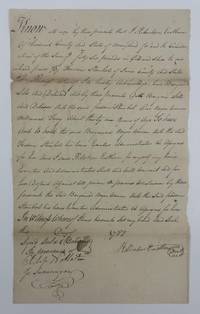
1788réf. 4111Frederick County Md: March 7 1788. About very good. 1p. folio docketed on verso. Old folds short splits along a couple of fold lines minor toning. An impactful manuscript document from the early national period in Maryland formalizing the sale of a slave woman in Frederick County. The sale was made by Robertson Eastburn whose family emigrated from England to Maryland in the early 18th century. The document reads in part: "In consideration of the sum of forty six pounds in Gold and Silver to me in hand and paid by Frederic Strombol.I do hereby Acknowledge have Bargain'd Sold and Delivered and by these presents doth Bargain Sell and Deliver Unto the said Frederic Strombol One Negro Woman named Torry about thirty years of age To Have and to hold the said Bargained Negro woman unto the said Frederic Strombol." Slavery in Maryland lasted over 200 years from its beginnings in 1642 when the first Africans were brought as slaves to St. Mary's City to its end following the Civil War. In 1664 under the governorship of Charles Calvert 3rd Baron Baltimore the Assembly ruled that all enslaved people should be held in slavery for life and that children of enslaved mothers should also be held to the same standard of law. 19th-century American slave sale documents are growing increasingly scarce in the market. March 7 unknown books
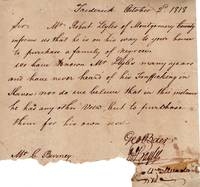
1818réf. 12956Frederick MD: October 2 1818. 1p. docketed on verso. Roughly torn along bottom edge minor foxing and spotting. Good condition. An uncommon document in Maryland slave history in which George Baer the future mayor of Frederick and a few other men attest that another local citizen named Robert Lyles is not a slave trader. The document reads in part: "Lyles is on his way to your house to purchase a family of negroes. We have known Mr. Lyles many years and have never heard of his Trafficking in Slaves nor do we believe that in this instance he has any other view but to purchase them for his own use." Baer served as mayor of Frederick from 1820 to 1823; his correspondent "C. Burney" is perhaps Clotworthy Birney 1765-1845 a farmer and real estate trader living near Taney Town. An unusual Maryland slave document concerning a slave owner who just wants to buy slaves for his own use not traffic in them because that's somehow better. October 2 unknown books
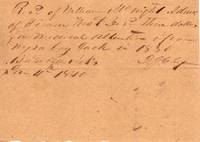
1840réf. 12966Batesville AR: January 11 1840. 1p. 4 x 5.5 inches docketed on verso. Old horizontal fold toning. Very good. An interesting manuscript record of slave care in Arkansas in the 1830s. The short but impactful document reads in full: "Recd of William McNight Admin. Of Hiram West Decd three dollars for medical attention upon negro boy Jack in 1836. Batesville Ark. Jan 11 1840 DJ Chipman." Such documents are increasingly rare in the market and more uncommon than slave sale documents from the same period. Arkansas has just achieved statehood four years before the presetn document was written. January 11 unknown books
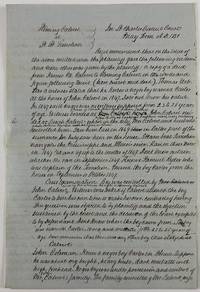
1851réf. 13321St. Charles LA 1851. 31pp. docketed on last page. Original folds minor wear. Very good plus. An intriguing legal document from antebellum Louisiana involving the status of Carter "a dark mulatto from 23 to 26 years of age" whose ownership and/or freedom is being contested. The deposition opens with testimony regarding the last time Carter was seen by the plaintiff's family the Calverts as well as another man named John Coleman both in 1849. The testimony also discusses Carter's ability to hire himself out for work and further testimony from Joseph M. Heddy a "negro trader" who valued Carter at $750 to $800. At this point the plaintiffs rested the case. Further testimony from the defense lays out a detailed argument that Carter was actually the son of a slave named Lucinda who was owned by a man named Isham Harrison who took Lucinda to Illinois 1812. In a one-page addendum the defense asks the Court to instruct the jury that by taking Lucinda to Illinois where Lucinda gave birth to Carter that "the mother by such residence became free and any children born of the mother after the time said Isham took up his residence in Illinois are free.and the defendant is entitled to the verdict." The strategy did not work. The plaintiff won the case and was awarded $800 for Carter. unknown books
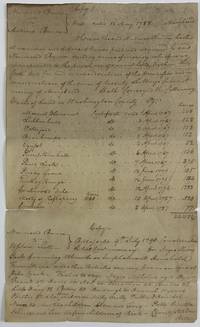
1790réf. 13400Washington County MD 1790. 2pp. on a single folio sheet. Moderate toning and dust-soiling old folds one fold separation repaired on verso with archival tape. Overall good plus condition. A striking document from early national Maryland detailing the sale of numerous types of property by Norman Bruce a Maryland militia man and land speculator. Norman Bruce was a Scottish immigrant who came to the American colonies as a young man served in the Maryland militia and acquired large tracts of land mostly in modern-day Carroll County. He also served as the Sheriff of Frederick County and as a judge and was known to own numerous slaves. Interestingly his wife Susanna Gardiner Key Bruce was great aunt to Francis Scott Key. The present documents first memorializes Bruce's sale of a dozen parcels of land to his son Andrew Bruce. The document notes the location date of sale and the number of acres for each parcel. Most impactfully though the document records Bruce's sale of his slaves. In a bill of sale in the present document Bruce sells two dozen named enslaved persons to his great-nephew Upton Scott along with various other property such as "Stock Farming Utensils or Implements Household Furniture and other articles." The transaction for the enslaved men women and children lists them by name and mostly age and reads in part: "Bill of sale 9th July 1790.For Negro Slaves.That is to say Negro Nicholas Aged 48 years. Frank 47. Harvey 46. Ned 44. Jonathan 44. Brutus 37. Little Harry 32. Betsey 50. Her daughter Hannah 11 years. Phillis 37 & her four children Milly Molly Phillis & Hannibal. Nance 24. Her two children Clem and Terry - Patty Pricilla Jeanie and Sam the four children of Beck. Charity and Stephen & Cassey the children of Nell." These enslaved persons apparently worked Bruce's "Farm on Great Pipe Creek." An unusual 18th-century Maryland slave document providing critical named connections within multiple slave families known to be living and working at a specific Maryland farm in 1790. unknown books
1864réf. 1067529 leaves of blue lined paper written in ink on rectos only. 31.5x20 cm 12¼x8" set in custom-made half cloth folder .Minor aging old folds; near fine. Official court document from Bexar County Texas summarizing the case of "Jim Owen a free person of African descent thirty years of age a resident of said county and state" who "desires to choose an owner and mistress and has selected for his mistress Sephrony Kerr…" Owen states that "he was brought from the State of Illinois to his state in 1850 before he was of lawful age by one John H. Burrus… who has since said time assumed a kind of guardianship over your petitioner without lawful authority…" All seemed on track until John H. Burrus filed suit stating that he was the "owner of said petitioner Owen" and "proof was not made that said petitioner is a free man of African descent" and "the negro Jim Owen… is his slave that he was brought to this State by the respondent in January 1850 as is slave and has been so held and owned up to the present time…" A new trial was granted and Kerr and Owen's petition denied. An appeal was allowed contingent on paying to Burrus a surety bond of $1500. A fascinating glimpse into the legal morass surrounding slavery as the Civil War raged and the "peculiar institution" of slavery was soon to be ended by force of arms.
1851réf. 13321St. Charles LA 1851. 31pp. docketed on last page. Original folds minor wear. Very good plus. An intriguing legal document from antebellum Louisiana involving the status of Carter "a dark mulatto from 23 to 26 years of age" whose ownership and/or freedom is being contested. The deposition opens with testimony regarding the last time Carter was seen by the plaintiff's family the Calverts as well as another man named John Coleman both in 1849. The testimony also discusses Carter's ability to hire himself out for work and further testimony from Joseph M. Heddy a "negro trader" who valued Carter at $750 to $800. At this point the plaintiffs rested the case. Further testimony from the defense lays out a detailed argument that Carter was actually the son of a slave named Lucinda who was owned by a man named Isham Harrison who took Lucinda to Illinois 1812. In a one-page addendum the defense asks the Court to instruct the jury that by taking Lucinda to Illinois where Lucinda gave birth to Carter that "the mother by such residence became free and any children born of the mother after the time said Isham took up his residence in Illinois are free.and the defendant is entitled to the verdict." The strategy did not work. The plaintiff won the case and was awarded $800 for Carter. unknown
1766réf. 13353Newport RI: December 19 1766. Manuscript document 2.25 x 6 inches. Unevenly trimmed moderate toning and staining. About very good. Rare surviving evidence of a slaveowner hiring out a slave for manual labor in colonial Rhode Island. Here Captain Peter Darden bills E. Teke for "4 Days work of Cato" for eleven shillings five pence. The verso indicates the bill was paid on January 6 1767; the payment may have involved another slave as Teke seems to note that payment was made by an "agt" agent named Cicero. A rare surviving document pertaining to slavery in pre-revolutionary Rhode Island. December 19 unknown
1814réf. 13354N.p.: June 28 1814. 1p. addressed on verso. Old mailing folds remnants of wax seal minor staining and toning. Very good. An interesting letter involving the sale of slaves in early-19th-century New Jersey. The letter comes from a slaveowner named John Neagie writing to Garrabrandt Van Houten Esquire in Patterson New Jersey in 1814. The text of the letter reads in full: "Dear Sir I am willing to part with my three blacks lately in Jersey for three hundred and seventy five dollars for a term of years in such way as not to interfere with the laws concerning selling slaves from one state into the other provided you can get notes which you would be willing to take on. Same on Van Houten's mortgage. Dated June 20th 1814. Yours with respect John Neagie." Neagie's concerns about "selling slaves from one state into the other" seems to indicate that he is based somewhere outside New Jersey where his slaves have been "lately." In fact he has crossed out the word "now" and replaced it with "lately. June 28 unknown
1790réf. 13400Washington County MD 1790. 2pp. on a single folio sheet. Moderate toning and dust-soiling old folds one fold separation repaired on verso with archival tape. Overall good plus condition. A striking document from early national Maryland detailing the sale of numerous types of property by Norman Bruce a Maryland militia man and land speculator. Norman Bruce was a Scottish immigrant who came to the American colonies as a young man served in the Maryland militia and acquired large tracts of land mostly in modern-day Carroll County. He also served as the Sheriff of Frederick County and as a judge and was known to own numerous slaves. Interestingly his wife Susanna Gardiner Key Bruce was great aunt to Francis Scott Key. The present documents first memorializes Bruce's sale of a dozen parcels of land to his son Andrew Bruce. The document notes the location date of sale and the number of acres for each parcel. Most impactfully though the document records Bruce's sale of his slaves. In a bill of sale in the present document Bruce sells two dozen named enslaved persons to his great-nephew Upton Scott along with various other property such as "Stock Farming Utensils or Implements Household Furniture and other articles." The transaction for the enslaved men women and children lists them by name and mostly age and reads in part: "Bill of sale 9th July 1790.For Negro Slaves.That is to say Negro Nicholas Aged 48 years. Frank 47. Harvey 46. Ned 44. Jonathan 44. Brutus 37. Little Harry 32. Betsey 50. Her daughter Hannah 11 years. Phillis 37 & her four children Milly Molly Phillis & Hannibal. Nance 24. Her two children Clem and Terry - Patty Pricilla Jeanie and Sam the four children of Beck. Charity and Stephen & Cassey the children of Nell." These enslaved persons apparently worked Bruce's "Farm on Great Pipe Creek." An unusual 18th-century Maryland slave document providing critical named connections within multiple slave families known to be living and working at a specific Maryland farm in 1790. unknown
1844réf. 13105St. Genevieve County MO: January 18 1844. 4pp. on a single folded sheet. Original folds minor wear. Very good condition. A sobering manuscript inventory from the estate of Richard Maddin following his death in Missouri in 1843 detailing his "slaves and other personal" property. The inventory begins by listing the enslaved persons by name along with an assignation of value for each of them as such: "1 Negro man named Smith $600. 1 Negro man named Sandy $10. 1 Negro woman and child named Margaret and Jason $400." The inventory then goes on to list the other property beginning with a long list of livestock followed by equipment household goods and so forth. The document is certified and witnessed by a number of local citizens who attest to the "full and perfect inventory of the goods chattles and personal estate" of the deceased Mr. Maddin. The reasoning is unclear why the second listed slave Sandy was worth only $10. January 18 unknown