CARRION, UlisesABAA

179 résultats
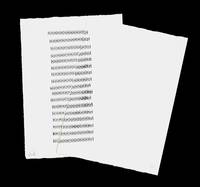
réf. 10308Single paper sheet 350 x 222 mm. mounted on black craft paper letterpress-printed signed in lower left corner. Amsterdam: 1975. A signed Ulises Carrión print adapted from a 1972 typewritten work. Near fine; minuscule tear on the left side inoffensive sunning. Inscribed in the lower left corner: “U. Carrión ‘75.” From the collection of Guy Schraenen 1941-2018. unknown books
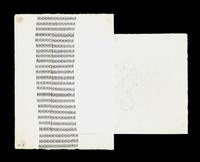
réf. 10307Single paper sheet 348 x 224 mm. mounted on black craft paper letterpress-printed signed. Amsterdam: 1975. A very rare signed language work print by Ulises Carrión. Fine; a trifle sunned. Inscribed in the lower left corner: “U. Carrión ‘75.” From the collection of Guy Schraenen 1941-2018. unknown books
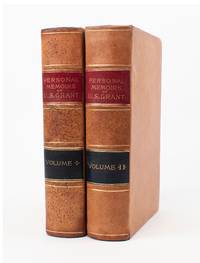
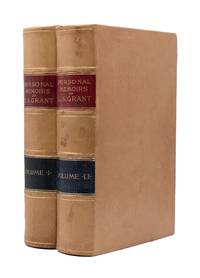
réf. 9562New York: Charles L. Webster & Company 1885. Hardcover. 2 vols. 8vo original full sheep raised bands gilt rules red and blue morocco title and volume number labels at spine. CONDITION: Very good spines and some edges speckled minimal wear darkening to top edge of one spine. First edition of Grant's classic memoir recalling his service in both the Mexican War and the Civil War. Scarce in the publisher's full sheep binding. New York: Charles L. Webster & Company, 1885 unknown books
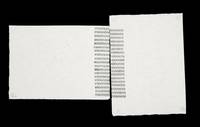
réf. 10311Two torn pieces of watermarked paper typewritten text mounted on black craft paper signed. Amsterdam: n.d. A signed “structure work” by Ulises Carrión. Fine; adhesive bleeding through the corners. Initialed in the bottom left corner of the left sheet. ⧠G. Schraenen Dear reader. Don’t read. 2015 pp. 110 & 116 pictured. unknown books
réf. 10312Two torn pieces of watermarked paper typewritten text mounted on black craft paper signed. Amsterdam: n.d. A signed “structure work” by Ulises Carrión. Fine; adhesive bleeding through the corners. The artist has initialed the bottom left corner of the left sheet. ⧠G. Schraenen Dear reader. Don’t read. 2015 pp. 110 & 117 pictured. unknown books
réf. 10313Two torn pieces of watermarked paper typewritten text mounted on black craft paper signed. Amsterdam: n.d. A signed “structure work” by Ulises Carrión. Fine; adhesive bleeding through the corners. The artist has initialed the bottom left corner of the left sheet. ⧠G. Schraenen Dear reader. Don’t read. 2015 pp. 110 & 117 pictured. unknown books
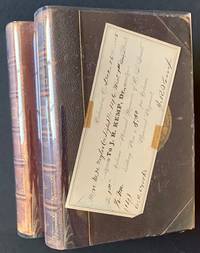
1886réf. 20527New York: Charles L. Webster & Co 1886. 1/2 leather. Very Good. The 1885 1st edition in the publisher's less common 1/2 deluxe brown morocco over chocolate-brown boards. Complete in 2 volumes the first published in 1885 the second and final volume published in 1886. Both volumes solid and very presentable with lightly-rubbed gilt-titling along the spines and bright gilt-medallions at the front panels. A bit of light wear to the outer hinges and mild scuffing at the panels. Internally all plates present and no writing or markings to speak of save for 2 blank preliminary pages in Vol. II with light crayon. Thick uniform octavos matching edges pastedowns and endsheets. THIS COPY ALSO INCLUDES SOME VERY INTERESTING EPHEMERA such as the original 1885 printed receipt for the purchase of the set and a well-executed late 19th century pencil sketch of the set's "erudite" first owner a woman named Matilda Ziegler. Opposite the sketch is an original pasted-on memorial card of Matilda produced by the family. Charles L. Webster & Co unknown books
réf. 60370The letter reads: Washington DC Apl 51864 I have examined the new gun and saber shield invented by Crpl Moffett and would recommend its adoption for such veteran Rang who have been known to make and receive a casualty claim with saber I would not recommend it for any cavalry of less than two years service and constantly in the field US Grant Lt Gen unknown books
1885réf. 2942New York: Charles Webster and Co 1885. First edition. Original deluxe sheep. Very Good. FIRST EDITION IN ORIGINAL PUBLISHER'S DELUXE SHEEP BINDINGS of Grant's important and fascinating memoirs illustrated throughout with numerous steel engravings facsimiles and over forty maps. Written during the final days of Grant's life and seen through publication by Mark Twain the Memoirs provide a personal and poignant record of some of the most significant events in American history. The first edition of the Memoirs was issued in cloth morocco and sheep bindings. The soft sheep leather wears most easily and therefore has become the most difficult to find in good condition. New York: Charles Webster & Co. 1885-86. Octavo original full publisher's sheep with leather spine labels marbled endpapers and edges. Two volumes. Volume 1 with a few scuffs to rear board and joints and with spine lightly toned; volume two binding with only very light wear. Text in each exceptionally clean. A very good copy - much nicer than is usually found. Charles Webster and Co unknown books
réf. 10316Black & white photographic print 169 x 169 mm. matted with beige paper captioned and initialed. Amsterdam: 1979. A rare signed photographic print; the same image depicting the artist’s “address archive” adorns the lower cover of Ulises Carrión’s artist’s book In Alphabetical Order 1979. In fine condition. Captioned on the bottom left and signed and dated to the right. From the collection of Guy Schraenen 1941-2018. unknown books
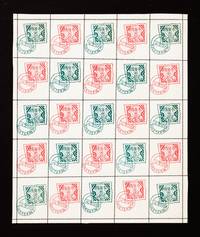
réf. 10317Single sheet mounted on black craft paper printed in red & green perforated. Amsterdam: late 1970s. A compelling specimen of Ulises Carrión’s avid involvement with the Eternal Network: a complete sheet of his “Here & Now” stamps. In excellent condition. unknown books
1886réf. 353811New York: Charles L. Webster 1886. First edition. Illustrated. 584; 647 1 pp. 2 vols. 8vo. Publisher's full tan sheep with contrasting labels marbled edges. Faintest traces of rubbing a near fine set. First edition. Illustrated. 584; 647 1 pp. 2 vols. 8vo. The president and Civil War general's remarkable memoir written in the final years of his life as he was suffering from terminal throat cancer. Suffering both physically and financially as the result of financial misfortune Grant began writing his autobiography in the fall of 1884 and finished in July of 1885 five days before his death. Samuel Clemens Mark Twain encouraged Grant and shepherded the book to publication through the Webster connection. Eagerly anticipated by a public that had been following Grant's illness in the press the book was an immediate success upon its release and has long been considered one of if not the best memoirs written by an American president. Since its publication it has received acclaim from literary figures including Twain and Gertrude Stein and from numerous modern American historians and political commentators from Eric Foner to Ta-Nehisi Coates. Charles L. Webster unknown books
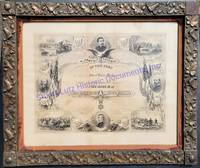
réf. 6831ULYSSES S. GRANT 1822-1885. Ulysses S. Grant was the Eighteenth President and led the Union Army to victory in the Civil War. DS. 1pg. c. 1884. Washington D.C. A document signed U.S. Grant as President of the Society of the Army of the Potomac and Horatio C. King as the organizations secretary. The partly-printed and illustrated document certifies membership of Captain Albert Victor Meeks to the Society of the Army of the Potomac. THE ARMY OF THE POTOMAC OF THIS ARMY ORGANIZED AUGUST 20 1861 DISBANDED JUNE 30TH 1865 Captain Albert Victor Meeks 62nd N.Y. Vols. was a Soldier and is now A MEMBER OF THE SOCIETY OF THE ARMY OF THE POTOMAC U. S. Grant President Horatio C. King Secretary. This certificate includes vignettes of famous Union commanders Major General George B. McClellan Major General Ambrose Burnside Major General George G. Meade and Major General Joseph Hooker. Albert Victor Meeks was a New York City lawyer and real estate businessman who served as a Captain in the Union Army during the Civil War. He served with the 62nd New York Volunteer Infantry. As a member of the Army of the Potomac his regiment fought in the Peninsula Campaign Antietam Fredericksburg Chancellorsville and Gettysburg. His unit was particularly noted for its bravery at the Bloody Angle during the Battle of Spotsylvania Court House. Along with being signed by Ulysses S. Grant this document is also signed by Horatio Collins King a celebrated Civil War hero who rode into the thick of battle at Dinwiddie Courthouse in 1865 and was awarded the Medal of Honor. He was also the Secretary for the Society of the Army of the Potomac for nearly three decades. The Society of the Army of the Potomac was a veteran organization founded in 1869 to preserve the history and fraternal bonds of the Unions eastern fighting force. In this society Grants role was defined by his status. His influence within the Society settled disputes helped the Society transition from a small group of elite officers into a more influential organization and his name was used to attract wealthy donors and political support for the Societys projects such as the establishment of military parks and the commissioning of statues. This document is held in a decorative antique frame and in fine condition. unknown books
réf. 1089086 1 p. 8vo 225 x 155 mm. orig. printed red semi-stiff wrappers title on spine. Cullompton Devon: Beau Geste Press 1973. First edition the deluxe version on vibrant multi-colored Strathmore Grandee paper of this scarce and early Carrión 1941-89 bookwork. Arguments was printed in a total edition of 400 copies 200 on Huntsman white cartridge and unsigned and 200 deluxe copies and signed on the verso of the title-page. Formed in 1970 by Felipe Ehrenberg Martha Hellion David Mayor Chris Welch and Madeleine Gallard the Beau Geste Press was instrumental in Carrión’s growing engagement with artists’ books. The scholar Zanna Gilbert recalls in the Beau Geste Press catalogue p. 405 that in 2017 Ehrenberg “commented that Carrión had never gotten his hands dirty with ink before visiting the Beau Geste Press.” In 1973 the Press published two of his books Arguments Autumn and Looking for Poetry/Tras la Poesía Winter. In the Getty Research Institute exhibition catalogue Artists and Their Books Books and Their Artists 2018 Gilbert describes the present bookwork: “Carrión humorously interrogates the structure and content of books and the literary devices used by authors and playwrights. The titular exchanges in Arguments are indicated only by the names of the participants with no reference to the actual content of their disagreements. The distinctly Anglophone names are arranged in various configurations on each page of the book leaving the reader to wonder about the substance of the disputes. Indeed as the ‘arguments’ play out across the gridded field of the typeset page the book increasingly becomes about the materiality of the text itself with Carrión adding symbols such as the ampersand or violating the names themselves—as when for example ‘Marion’ becomes ‘Mar ion’—resulting in ever more complex exchanges” p. 72. The book was beautifully typeset by Terry Wright a skilled printer who joined the Press in 1972; laid out by Mayor; and offset-printed by Ehrenberg. Each “Argument” is numbered by hand there are 25 in total with several misnumbered and corrected in this copy nos. 5 22 23 24. Carrión’s book concludes with an unnumbered page on translucent paper with the entreaty: “My name is Ulises / What’s yours ” A fine copy; spine a trifle sunned. ⧠Alice Motard ed. Beau Geste Press 2020 No. 48 pp. 186-91 illustrating both versions. J. J. Agius & R. Ocampo eds. Ulises Carrión: Books & More Catalogue Raisonné 2013 7. unknown books
réf. 10310Single purple paper sheet 295 x 210 mm. mounted on beige paper collaged yellow pieces of paper with ms. text in ink & graphite signed. Amsterdam: 1977. A Ulises Carrión language work with manuscript text on the collaged strips of paper. In fine condition; adhesive in corners bleeding through the paper. Inscribed in the lower left corner: “Ulises Carrión ‘77.” From the collection of Guy Schraenen 1941-2018. ⧠G. Schraenen Dear reader. Don’t read. 2015 pp. 110 & 115 pictured. unknown books
réf. 10309Single purple paper sheet 298 x 209 mm. mounted on beige paper collaged yellow pieces of paper with ms. text. signed. Amsterdam: 1977. Manuscript collage language work by Mexican artist Ulises Carrión. He contributed a version of the piece to the magazine Kontexts it appears in issue 5 1974. Near fine; adhesive in corners bleeding through. Signed in the lower left corner: “Ulises Carrión ‘77.” From the collection of Guy Schraenen 1941-2018. With thanks to Rich Dana Sackner Archive Project Coordinator Librarian at the University of Iowa Special Collections who confirmed the appearance of this work in Kontexts issue 5. The Sackner Archive holds the editorial files for Kontexts including original contributions like Edgardo Antonio Vigo JH Kocman Carrión Felipe Ehrenberg Bob Cobbing Clemente Padin Jiri Valoch etc. ⧠G. Schraenen Dear reader. Don’t read. 2015 pp. 110 & 114 pictured. unknown books
réf. 10315Single paper sheet 290 x 160 mm. adhered to beige paper sheet Letraset lettering affixed signed & dated. Amsterdam: 1974. Heretofore undocumented language work by Ulises Carrión employing Letraset lettering with which he has created five vowel-consonant pairs. In fine condition. With the work’s title written in the bottom left in Carrión’s characteristic hand and signed on the right: “U. Carrión / 74.” ⧠Not in Dear reader. Don’t read. 2015. unknown books
réf. 10314Single paper sheet 291 x 158 mm. adhered to beige paper sheet hand-drawn grid & Letraset letters affixed signed & dated. Amsterdam: 1974. A Ulises Carrión language work combining Letraset lettering and a hand-drawn grid. In fine condition; faint bleeding in the corners from the adhesive. Titled in the artist’s characteristic hand in the bottom left and signed on the right: “U. Carrión / 74.” From the collection of Guy Schraenen 1941-2018. ⧠G. Schraenen Dear reader. Don’t read. 2015 pp. 110 & 111 pictured. unknown books
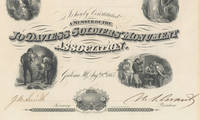
1865réf. 3462628/08/1865. Ulysses S. Grant was living in Galena Illinois when the Civil War broke out. The Civil War won on August 18 1865 Galena celebrated Grant’s heroic return. Following a jubilant procession with much flag waving and speeches a group of Galena citizens presented the General with a handsome furnished house on Bouthillier Street. Today the house is managed by the Illinois Historic Preservation Agency as the U.S. Grant Home State Historic Site. The Soldiers Monument Association was a group of local organizations founded after the American Civil War to fund and erect monuments to fallen soldiers and veterans. In 1865 many such groups formed and one of these was the Jo Daviess Soldiers Monument Association in Galena Illinois established to honor that county's soldiers who served in the Civil War. The Association is known for its handsome membership certificates which pictured vignettes of Lincoln Liberty flags and soldiers and were signed by Grant who was the honorary president. In time a monument to the soldiers of Jo Daviess County was constructed in Grant Park Galena. A membership certificate to the Soldiers Monument Association with compelling vignettes including Lincoln constituting individuals as members of the Jo Daviess Soldiers Monument Association Galena dated August 28 1865 and signed by Grant as President of the Association. Gen. J.C. Smith has also signed as Secretary. This is the first Soldiers Monument Association certificate we have ever carried and it is particularly compelling with its association of Grant and Lincoln. <img class=""alignnone wp-image-25018 size-post-window"" src=""https://cdn.raabcollection.com/wp-content/uploads/20231204144051/Folder-site-11-1600x1327.jpg"" alt="""" width=""1600"" height=""1327"" /> unknown books
1870réf. 3292608/01/1870. John Quincy Adams first enlisted in 1862 with the 38th Ohio Volunteers. On October 15 of that year he was a quartermaster sergeant with the 10th Ohio Cavalry reporting to Cairo Ill. for Instruction on February 23 1863. After a stint as acting lieutenant on July 15 1864 he was appointed by the President Second Lieutenant to date from March 3 1863. Adams was actively involved in the Georgia campaign conducted by Gen. William T. Sherman. He was with left wing of the 16th Army Corps on the march to Chattanooga Tenn. In the Atlanta Campaign he participated in the battles of Resaca Dallas Kennesaw Mountain. and Jonesboro. He manned signal corps stations at Kennesaw Mt. and Allatoona. Adams was on the ""the March to the Sea"" with Sherman’s forces. He was in the engagements at Port McAllister and Rice Mill station in the campaign from Savannah through the Carolinas including battles at Columbia Bentonville and Raleigh; and at the surrender of Confederate Gen. Joseph E. Johnston to Sherman on April 26 1865. Adams was breveted 1st lieutenant for gallant and meritorious service in the Signal Corps at the battle of Allatoona; he was breveted captain for gallant and meritorious services in the Signal Corps at the capture of Fort McAllister and Savannah and throughout the war. Adams was mustered out August 22 1865. After the war he was in the 1st U. S. Cavalry and was in the Indian wars and finished his career as captain and aide to Gen. O.O. Howard in October 1884. He is listed on the roster of the U.S. Signal Corps in the Civil War. This is President Ulysses S. Grant’s appointment of Adams as First Lieutenant in the 1st U. S. Cavalry. Document signed Washington January 8 1870 naming Adams “First Lieutenant in the First Regiment of Cavalry” to rank as such from the fourteenth of September 1869. The document is countersigned by William Belknap as Secretary of War. In 1866 the 1st Cavalry Division was sent west to California and other western states and it served during the Indian Wars in the west. In June 1884 while Adams was still serving with the regiment it was transferred to the Department of Dakota. In their new assignment the troops were assigned to various forts which had been established during the Indian wars to subjugate the Sioux Cheyenne Crow and other Native Americans. <img class=""alignnone wp-image-25018 size-post-window"" src=""https://cdn.raabcollection.com/wp-content/uploads/20231204144051/Folder-site-11-1600x1327.jpg"" alt="""" width=""1600"" height=""1327"" /> unknown books
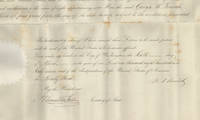
1869réf. 3251406/04/1869. The Dakota Territory was created by an Act of Congress on March 2 1861. Boundaries of the Dakota Territory changed on a number of occasions. Originally the territory comprised an area that included the present states of North Dakota South Dakota and much of Montana and Wyoming. From 1863 to 1864 the area of the territory was limited to the present day Dakotas. The territory included most of the present state of Wyoming and the Dakotas from 1864 to 1868. And from 1868 to 1889 the territory comprised the present states of North Dakota and South Dakota. The territorial capital was established in Yankton in 1861 and later removed to Bismarck in 1883. When the final extent of the reduced territory was split and admitted to the Union as the states of North and South Dakota the Supreme Court of the Dakotas was abolished by operation of law and its function was taken over by the North Dakota Supreme Court and the South Dakota Supreme Court. Document signed Washington April 6 1869 appointing George W. French subject to the advice and consent of the Senate to be the Chief Justice of the Supreme Court of the Territory of Dakota. <img class=""alignnone wp-image-25018 size-post-window"" src=""https://cdn.raabcollection.com/wp-content/uploads/20231204144051/Folder-site-11-1600x1327.jpg"" alt="""" width=""1600"" height=""1327"" /> unknown books
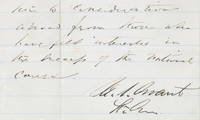
1865réf. 3776421/12/1865. Ulysses S. Grant through his intelligence determination iron will and patriotism was the military man most responsible for leading the United States through the greatest time of crisis and chaos in the nation’s history. As general of the Army during the Civil War he commanded hundreds of thousands of soldiers leading the Union Army to victory over the Confederacy. Moreover all recognized that his strategy had compelled Lee and the Confederacy to fight the kind of war they could not win. Later as president he guided the nation through Reconstruction helping to bind the wounds between North and South while empowering newly freed African Americans. In November 1865 President Andrew Johnson sent Grant on a fact-finding tour of the defeated South to assess conditions and report back on Reconstruction. Grant returned and submitted his report to Johnson on December 18 1865. Grant recommended continuing a reformed Freedmen's Bureau though he advised against using Black troops in garrisons believing it discouraged farm labor. Johnson seized on the generally lenient tone of Grant's report to bolster his own position: Grant's report recommended a lenient Reconstruction policy and that December Johnson declared the reconstruction process complete — a declaration that outraged Radical Republicans in Congress who had just reconvened that same month and were refusing to seat the newly elected Southern representatives including several former Confederate generals and cabinet officers. Samuel Stephen Curtis was born in 1838 in McConnelsville Ohio the son of Samuel Ryan Curtis the future Union major general and congressman from Iowa. Before the war he made his way west to the Colorado gold country where he became a prominent figure in the young territory — laying out the streets of Denver naming one Curtis Street after himself building a business in real estate mercantile trade and mining and serving as the city's postmaster. When the Civil War broke out Colorado's territorial governor sent him east to Fort Laramie to secure arms and munitions for the territory's volunteer companies then on to Washington to lobby for funding — missions he carried out successfully enough to earn a major's commission in the 2nd Colorado Infantry. He was promoted to lieutenant colonel in 1862 and joined the staff of his father then commanding in the Trans-Mississippi theater serving as his aide-de-camp through campaigns in Arkansas and later duty with the Departments of Kansas Missouri and the Northwest. He briefly left his father's staff to command Camp Weld Colorado's training post near Denver at the request of territorial governor John Evans before returning to serve alongside his father for the remainder of the war. Mustered out of the volunteer service at war's end Curtis embarked on a tour of Europe in December 1865 Letter signed Washington December 21 1865 on official “Head-Quarters Armies of the United States” letterhead. “Col. S.S. Curtis late an officer of the Volunteer Service of the United States is about visiting Europe on a trip of information and pleasure. His services and late rank entitle him to consideration abroad from those who have felt interested on the success of the National Cause.” <img class=""alignnone wp-image-25018 size-post-window"" src=""https://cdn.raabcollection.com/wp-content/uploads/20231204144051/Folder-site-11-1600x1327.jpg"" alt=""historical memorabilia dealer"" width=""1600"" height=""1327"" /> unknown books
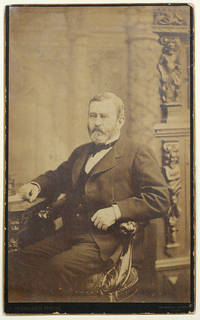
réf. 2081First edition. Framed photograph. Very Good. MAGNIFICENT LARGE ALBUMEN PHOTOGRAPH OF ULYSSES S. GRANT BY ABRAHAM BOGARDUS. An unusually large late c.1880 photograph of Grant post-presidency in formal dress sitting and in partial profile. Mounted on thick card with the photographer's credit and address "A. Bogardus / 872 Broadway NY" on matte below the photo. The photographer Anthony Bogardus was a photographic pioneer described by the New York Times as "the best-known photographer in the United States" in his prime who took "the first photographs of Gen. Grant Gen. Hancock Samuel D. Morse inventor of the telegraph; Horace Greeley Henry Ward Beecher and other equally well-known men." The engravers Currier & Ives produced an engraving based on this photograph calling it "the last and best taken of General Grant". This very large approximately 10x16 inches; 10.5x16.5 with mount photograph also appears to have served as the model for a small carte-de-visit issued at the end of Grant's life. Albumen print. Contemporary or near-contemporary printing 1880-1890. On original thick cardboard mount with gilt edges. Archivally framed to an overall size of 17.25 x 23.5 inches. Light wear around edges of mount. A STUNNING LARGE IMAGE IN OUTSTANDING CONDITION. unknown books
1879réf. 3244413/05/1879. We are aware of no other autographs of Grant from this trip having reached the market Richard Nixon was not the first President to visit China. On February 20 1979 the New York Times reported: ""When President Nixon arrives in China today on an unprecedented state visit he will not be the first American President to have set foot on that nation's shores. Nearly one hundred years ago while the Manchu dynasty still held sway over the crumbling Chinese Empire Gen. Ulysses S. Grant entered the gates of Peking and was borne in an imperial palanquin into the heart of the Forbidden City. Just one month after the expiration of his Presidential term General Grant embarked on a worldwide tour which took him to Europe Asia Minor India and Indochina on his way to the two great realms of the Far East. In all he spent six weeks In China visiting the cities of Canton Swatow Amoy Shanghai Tientsin and Chefoo with a full week in Peking from June 3 to 10 1879. During his stay he was entertained in the royal manner and granted interviews with Prince Kung the ruling regent of the Manchu Court —the real Emperor was only 5 years old at the time—and Li Hung_chang the Western_oriented strongman of North China."" The Chinese had hopes largely unrealized that Grant would help them handle diplomatic and military crises with Japan and Vietnam where the French had influence. He went with a delegation of his own which included his wife and son officers of the US Navy and one of the earliest US ministers to China Chester Holcombe. Document signed Swatow Shantou China May 13 1879 a place card for the dinner held in Grant's honor that evening belonging to a Mrs. Scott. Signed by Ulysses S. Grant his son Frederick Dent Grant his wife Julia Grant Charge d'Affaires Chester Holcombe two representatives from his naval escort. <img class=""alignnone wp-image-25018 size-post-window"" src=""https://cdn.raabcollection.com/wp-content/uploads/20231204144051/Folder-site-11-1600x1327.jpg"" alt="""" width=""1600"" height=""1327"" /> unknown books
1878réf. 2401Rome: Henri Le Lieure 1878. First edition. Framed. Very Good. ALBUMEN PHOTOGRAPH OF GRANT IN MILITARY DRESS SIGNED BY GRANT ON THE PHOTOGRAPHER'S MOUNT. A very handsome bust-length portrait of Grant taken by photographer Henri Le Lieure during Grant's visit to Rome in 1878. Signed "U.S. Grant" in ink on the original mount beneath the photograph. A handwritten note on the paper backing of the frame reads: "This photograph was autographed by U. S. Grant in April 1878 at the home of Dr. Charles McMillan Counsel General Great Uncle of Eunice in Rome Italy. Dr. McMillan had served as Medical Director on Grant's staff throughout the Vicksburg Campaign." The frame with the seal of "The Dayton Company Picture Galleries Minneapolis" on the backing likely dates from early-mid 20th century. The Dayton Company was a celebrated Minneapolis department store in Minneapolis from 1911-1962 ultimately serving as the parent company for Target. Grant visited Rome on his hugely successful post-presidential world tour. "Grant traveled aboard a government vessel. as the representative of his country an emerging power in the world." In Rome he was granted an audience with both Pope Leo XIII and King Umberto I. "Grant wasn't fazed that a king and a pope vied for his company." Chernow Grant pp. 871-73. With printed credit of the photographer "H. Le Lierue Phot. / Rome Place Mignanelli" printed beneath the photo. Henri Le Lieure 1831-1914 was a French-born photographer based in Italy who took photographic portraits of some of the most famous people of his day. Size: Mounted image = 4x5.75 in; with mount = 6.5x8.5 in. Rome: H. Le Lieure 1878. A few stray spots to image beginning of Grant's "U" a little faint probably due to trouble getting the ink to flow. An elegant stately image documenting an important event in Grant's post-presidential career with large three-inches long presentation signature by Grant. Henri Le Lieure unknown books