77 résultats
1800réf. D6751early 1800s. Hardcover. Very Good. Full red morocco arms of George III stamped in gilt on boards lettering "Standing Orders" and ornament stamped in gilt on spine a.e.g. inside gilt dentelles; 8vo 5x7 inches; approx. pp. 200 entries beautifully handwritten in black ink with numbered subject headings in the margins and an index at rear. Scuffing along joints and edges of boards; joints a bit tender. Recorded by one or two scribes addressing parliamentary procedures in the 18th century. A lovely reference. hardcover books
réf. 560232 hand-coloured woodcuts copied from the illustrations in The Universal Magazine for October and November 1761 the first taken as the Archbishop of Canterbury places the Crown on the King's head is lettered with explanations of the crowded scene including at h 'The Dukes of Normandie and Acquitain and other great officers' the second similarly explained shows the King's Champion flanked by the Earl Marshal and Lord High Constable riding up the centre between the long tables watched by the diners and the others present in the galleries printed within a 'Greek Key' border both referring to 22nd September 1761 laid down on two separate album leaves 10" x 7¾" with other items on the versos the two prints no date circa edges worn and border trimmed in places without loss to text or image The original articles of 1761 explain the role at the Dinner of the King's Champion who challenged any one to assert that George III was not their lawful sovereign and the 'Dukes of Normandy and Aquitaine' at the Coronation. The French King had anciently a council of twelve great Peers 6 lay and 6 ecclesiastic. Long after the council ceased to function the ecclesiastics attended at Reims but the lay peerages had became vested in the crown. So the King appointed people to represent his lay peerages. Henry II liked this idea which was last used in 1761 given that in 1801 Great Britain renounced all claims to France and the use of the lilies on her coat of arms. On the versos are 1 a pleasing engraving of Bouverie Hall Chart next Sutton Valence Kent and 2 a number of cuttings including temperance verses and the monument to Captain Charles Colby of the 98th Dragoons killed by a tiger at 'Rawal Pinde' 27th March 1852. unknown
1788réf. 97191CB[London?], 1788. 1 Blatt: 53,5 x 75,2 cm. [2 Warenabbildungen]
réf. 0483275670.Ghardcover. Good. Access codes and supplements are not guaranteed with used items. May be an ex-library book. hardcover
1791réf. WRCLIT70719Dublin: Printed by Brett Smith for Messrs.R. Cross et al 1791. 21731pp. Contemporary calf gilt label. Neat ink name on title modest wear to extremities and old stain on upper board; internally a very good crisp copy. Bookplate. First and sole 18th century Dublin edition of this highly popular anonymous summary history. It reached a self-proclaimed 6th London edition in very short order. ESTC T48424. BRADSHAW 2020. Printed by Brett Smith, for Messrs.R. Cross [et al] unknown books
1790réf. AQ12371London: Printed by Charles Eyre and Andrew Strahan Printers to the King's most Excellent Majesty 1790. 2 1303-1370 2. With a final blank leaf. Issued separately with a general title page as here and also as part of: Anno Regni Georgii III. Regis Magnæ Britanniae Franciae & Hiberniae tricesimo. At the Parliament begun and holden at Westminster the eighteenth day of May Anno Domini 1784.And from thence continued by several prorogations and adjournments to the twenty-first day of January 1790; being the seventh session of the sixteenth Parliament of Great Britain. Later stitching through original stab-holes. A trifle dusty. A rare survival in original state of a Georgian act 'for paving cleansing lighting watching and regulating the streets lanes ways and publick passages and places within the city of Durham'. ESTC records a single copy in the British Isles Lincoln's Inn and one further in North America Kansas. ESTC N58976. Folio. Printed by Charles Eyre and Andrew Strahan, Printers to the King's most Excellent Majesty unknown
1812réf. AQ24031London: s.n. 1812. 27pp 1. Docket title to verso of final leaf. Stitched as issued. A trifle browned and dusty. A Georgian act for the appropriation and privatisation of common land in the parish of Toft Cambridgeshire for agricultural purposes. . First edition. Folio. [s.n.] unknown
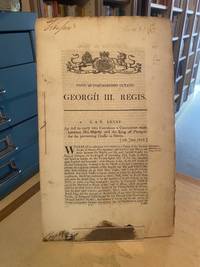
1818réf. 65380Eyre & Strahan London 1818. First Edition. Softcover. Good Condition. Size: Folio - over 12 - 15" tall. 729-744pp. String-bound. Previous owner's signature in ink. Slightly chipped at margins. Creasing to page corners. Covers marked. Original Act of Parliament. Quantity Available: 1. Shipped Weight: Under 250 grams. Category: Law & Criminal Studies; Britain/UK; 19th century; History. Pictures of this item not already displayed here available upon request. Inventory No: 65380. . Eyre & Strahan paperback
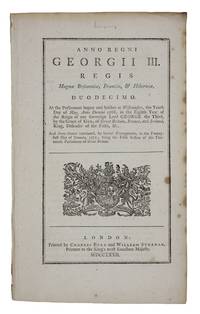
1773réf. 1912270013London : Printed by Charles Eyre and William Strahan Printers to the King's Most Excellent Majesty 1773. First Edition. Hardcover. Acceptable. 2 volumes bound as one. Bound in full contemporary leather. Joints cracked. 131 17; 104 14 pages ; 19 cm. Public General Acts. 1772-1773. 13 Geo. III.c.78. Turnpike Road Act 13 Geo. III Cap. lxxxiv An act to explain amend and reduce into one act of Parliament the general laws now in being for regulating the Turnpike Roads in that part of Great Britain called England and for other purposes. London : Printed by Charles Eyre and William Strahan, Printers to the King's Most Excellent Majesty hardcover
1771réf. ZB517827London: Charles Eyre & William Strahan 1771. tall quarto 46 pp. general title leaf pp. 1271-1314 complete in itself but part of a series two pieces of clear tape on extraction mark at left margin else very good. - If you are reading this this item is actually physically in our stock and ready for shipment once ordered. We are not bookjackers. Buyer is responsible for any additional duties taxes or fees required by recipient's country. London: Charles Eyre & William Strahan unknown
1779réf. 34022London: Printed for the Editor; and sold by J. Bew 1779. First edition. Pp. iii-57. Lacking half-title. 1 vols. 8vo. Red morocco-backed green cloth spine lettered in gilt. Rubbed some light spotting. Bookplate of John Carter Brown ex-library with stamp on title else very good. First edition. Pp. iii-57. Lacking half-title. 1 vols. 8vo. A satire. Often attributed to Richard Tickell as it imitates the tone of Tickell's "Anticipation" published the year before. Purports to contains speeches made in the Houses responding to the King's speech on the war in America and his need for more monies to pay for it. Adams "American Controversy" 79-3a; Sabin 1685 Printed for the Editor; and sold by J. Bew unknown
1779réf. 34022London: Printed for the Editor; and sold by J. Bew 1779. First edition. Pp. iii-57. Lacking half-title. 1 vols. 8vo. Red morocco-backed green cloth spine lettered in gilt. Rubbed some light spotting. Bookplate of John Carter Brown ex-library with stamp on title else very good. First edition. Pp. iii-57. Lacking half-title. 1 vols. 8vo. Financing the Revolution. A satire. Often attributed to Richard Tickell as it imitates the tone of Tickell's "Anticipation" published the year before. Purports to contains speeches made in the Houses responding to the King's speech on the war in America and his need for more monies to pay for it. Adams "American Controversy" 79-3a; Sabin 1685 Printed for the Editor; and sold by J. Bew unknown books
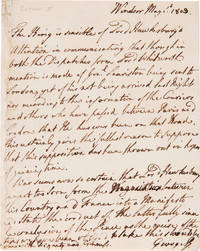
1803réf. 56968Windsor. May 12 1803. King George III Admits War with Napoleon "seems now so certain" A royal letter of profound import written entirely in the hand of King George III and signed "George R." Here the British King writes hastily to Lord Hawkesbury his Secretary of State outlining the lack of recent communications from his emissaries in Paris who were conducting peacetime negotiations with Napoleon after the failure of the Treaty of Amiens the year before. King George III mentions receiving dispatches from Lord Whitworth who was serving as the King's ambassador to France at the time; interestingly it was Whitworth to whom Napoleon threatened war if Great Britain did not evacuate Malta just a few months earlier in February 1803. Whitworth himself evacuated France the day after the present letter was written in full knowledge that peace negotiations were over. The King also relates the failure of French General Jacques Lauriston to arrive in London presumably for last-minute peace talks to prevent conflict. The King states that Lauriston's activities were likely intended to buy time for French negotiators. King George III then writes portentously beginning the second and final paragraph: "War seems now so certain that Lord Hawkesbury cannot too soon form the negotiations between this country and France into a Manifesto and state the conduct of the latter fully since the conclusion of the Peace as the cause of the steps we have been obliged to take." In other words the King is ordering his Secretary of State Lord Hawkesbury to state Great Britain's case for war with France. This is very likely the first admission by the King himself of the reality of impending war with France. Six days after the present letter was written Great Britain declared war on France sparking the long series of armed conflicts known as the Napoleonic Wars which would culminate a dozen years later at the Battle of Waterloo. Important letters signed by King George III are rarely offered in the market. Rarer still are letters composed entirely in his hand and signed by him as in the present example. Cheffin's Auctions in England sold a follow-up to the present letter also to Lord Hawkesbury and dated two days later on May 14 for £11430 in January 2019. That letter was bought for £55 in 1966. By comparison the present earlier letter was bought by H. Richard Dietrich for $92 at Parke Bernet's Fitzgerald sale on November 6 1963. It has remained part of the Dietrich American Foundation collection since then. A momentous political and diplomatic communication from the King of England to his Secretary of State resigned to the fact that war with Napoleon is at hand. 1p. on an 8¾ x 6¾-inch sheet. Left margin reinforced with thicker paper old folds. Mostly minor losses along left margin just touching first letters of several words. Very good. unknown
réf. 19217Queens House 14 January 1781 52 minutes past 5 P.M.. 2 lines on 1 page 9 x 7 inches in very good condition with an integral blank leaf. King George III reigned 1760-1820. Sir Stanier Porter diplomat and courtier. Frederick North 1732-92 known as Lord North was Prime Minister from 1770-1782 and was largely responsible for the measures which led to the loss of America. unknown
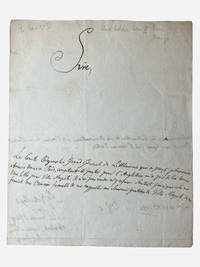
1785réf. 003743original letter. WILLIAM V PRINCE OF ORANGE 1748-1806 Stadtholder of the United Provinces. Autograph letter signed in French to GEORGE III King of Great Britain recommending Count Michal Kazimierz Oginski 1730-1800 Grand Hetman of Lithuania. 18 December 1785. Single bifolium written on the first and second pages with integral address panel endorsed "Prince d'Orange to the King" and contemporary docketing. Signed in the formal court style "De Votre Majesté le très humble et très obéissant serviteur G. Pr. d'Orange." Old folds light browning small repair at one fold; otherwise sound. Very good. English translation of the letter: "Sire Count Oginski Grand General of Lithuania who has spent several years in this country and who intends to depart for England in the month of June has had the honour of presenting himself to Your Majesty and most humbly to beg that Your Majesty will be pleased to grant him the continuation of your goodwill and assistance in the plans which he may have the honour to submit to you. I cannot refrain from expressing the profound respect with which I am Of Your Majesty The very humble and very obedient servant W. Prince of Orange. 18 December 1785." A formal letter of introduction from William V to George III on behalf of Count Michal Kazimierz Oginski Grand Hetman of Lithuania commending him to the King's continued favour and assistance as he prepared to travel to England. Oginski was one of the senior military and political figures of the Polish-Lithuanian Commonwealth. A former leader of the Bar Confederation and a persistent opponent of Russian dominance he had been defeated by Russian forces in the early 1770s forced into exile and thereafter remained a politically sensitive figure in eastern European affairs. . Very Good. Soft cover. 1st Edition. 1st Printing. 1785. original letter paperback
1820réf. 10251820. Mezzotint frontis. port. of George III a little foxed arms on each title & two engraved views of the library serving as head- & tailpieces. Five vols. Large folio cont. red straight-grained morocco minor scuffing panelled & tooled in gilt with centerpiece stamped monogram "GR" surmounted by a crown on covers spines gilt dentelles gilt a.e.g. London: W. Bulmer & W. Nicol 1820-29. The catalogue "sumptuously printed" by Bulmer of the magnificent library of King George III 1738-1820 donated to the nation by his son George IV. This is a royal copy having belonged to Ernest Augustus Duke of Cumberland and the fifth son of George III who became King of Hanover in 1837. It is superbly bound in red straight-grained morocco and printed on paper superior to other sets. "The kings of England had from the end of the fifteenth century always shown a certain taste for fine books especially for the handsomer volumes of their own day.A new library was started in 1765 by King George III when he purchased for 10000 pounds the valuable collection of incunabula with a few manuscripts brought together by Joseph Smith 1682-1770 the British Consul at Venice. "George III continued adding to his library for nearly fifty years buying with considerable discrimination at all the notable sales of the period; he secured the best books at the West Ratcliffe and Askew auctions built up a magnificent collection of English plays and kept on right up to the Roxburghe sale 1812. His usual agents were Messrs Nicol the booksellers but he seems to have obtained from the Continent some extremely valuable incunabula by the assistance of one Horn of Ratisbon a great despoiler of the German convents. "There is a sumptuously printed but hastily compiled catalogue of which copies are seldom met with."-De Ricci pp. 55-56. "As a boy George III had received an excellent education. He learned Latin well enough to be able to read the classics; French and German; history geography and the British political system; mathematics and elementary science; art architecture and music. After he left the schoolroom he continued his education under the Earl of Bute an inspiring if somewhat pedantic tutor.Under his tuition the King developed wide cultural interests a reverence for scholarship and the instinct of a collector. "The King's aim was.to acquire a library which contained every book which an eighteenth-century scholar could desire. It was a library to be used not simply to be admired.It was as far as it could be in the eighteenth century a universal library.It is rich in library catalogues. In addition to the catalogues of British libraries there are catalogues from France Italy Spain Portugal Germany Belgium Switzerland Sweden Poland and Russia. There are over five hundred sale catalogues most British and most with the prices marked. "It was the King's wish that a catalogue should be published but he postponed this as long as possible. When it became clear after 1812 that the King would never recover Queen Charlotte and the Prince Regent urged the preparation of a catalogue. It was compiled by Barnard and published between 1820 and 1829 in five folio volumes.It was never offered for sale but copies were presented to heads of state and the great libraries in the United Kingdom and on the Continent. It is today an extremely rare book."John Brooke "The Library of King George III" in The Yale University Library Gazette Vol. 52 No. 1 July 1977 pp. 33-45. "Frederick Barnard had begun the catalogue of the books and manuscripts of the King's Library while it was at Buckingham House. The catalogue was completed.by Barnard and his staff for the Trustees of the British Museum and printed in five volumes between 1820 and 1829.Very few copies were printed none for sale and they are now very rare."-Paintin The King's Library p. 22. This copy lacks the engraved frontispiece portrait of Bernard. A sixth volume issued separately in 1829 and not present here describes the maps prints and drawings. A magnificent set. From the library of Prince Ernest Augustus Duke of Cumberland and the subsequent Kings of Hanover. Miller That Noble Cabinet p. 125"one of the finest libraries ever created by one man.By the time of the King's death the collection amounted to 65250 volumes besides 19000 unbound tracts. unknown
réf. 1025Mezzotint frontis. port. of George III a little foxed arms on each title & two engraved views of the library serving as head- & tailpieces. Five vols. Large folio cont. red straight-grained morocco minor scuffing panelled & tooled in gilt with centerpiece stamped monogram "GR" surmounted by a crown on covers spines gilt dentelles gilt a.e.g. London: W. Bulmer & W. Nicol 1820-29. The catalogue "sumptuously printed" by Bulmer of the magnificent library of King George III 1738-1820 donated to the nation by his son George IV. This is a royal copy having belonged to Ernest Augustus Duke of Cumberland and the fifth son of George III who became King of Hanover in 1837. It is superbly bound in red straight-grained morocco and printed on paper superior to other sets. "The kings of England had from the end of the fifteenth century always shown a certain taste for fine books especially for the handsomer volumes of their own day.A new library was started in 1765 by King George III when he purchased for 10000 pounds the valuable collection of incunabula with a few manuscripts brought together by Joseph Smith 1682-1770 the British Consul at Venice. "George III continued adding to his library for nearly fifty years buying with considerable discrimination at all the notable sales of the period; he secured the best books at the West Ratcliffe and Askew auctions built up a magnificent collection of English plays and kept on right up to the Roxburghe sale 1812. His usual agents were Messrs Nicol the booksellers but he seems to have obtained from the Continent some extremely valuable incunabula by the assistance of one Horn of Ratisbon a great despoiler of the German convents. "There is a sumptuously printed but hastily compiled catalogue of which copies are seldom met with."-De Ricci pp. 55-56. "As a boy George III had received an excellent education. He learned Latin well enough to be able to read the classics; French and German; history geography and the British political system; mathematics and elementary science; art architecture and music. After he left the schoolroom he continued his education under the Earl of Bute an inspiring if somewhat pedantic tutor.Under his tuition the King developed wide cultural interests a reverence for scholarship and the instinct of a collector. "The King's aim was.to acquire a library which contained every book which an eighteenth-century scholar could desire. It was a library to be used not simply to be admired.It was as far as it could be in the eighteenth century a universal library.It is rich in library catalogues. In addition to the catalogues of British libraries there are catalogues from France Italy Spain Portugal Germany Belgium Switzerland Sweden Poland and Russia. There are over five hundred sale catalogues most British and most with the prices marked. "It was the King's wish that a catalogue should be published but he postponed this as long as possible. When it became clear after 1812 that the King would never recover Queen Charlotte and the Prince Regent urged the preparation of a catalogue. It was compiled by Barnard and published between 1820 and 1829 in five folio volumes.It was never offered for sale but copies were presented to heads of state and the great libraries in the United Kingdom and on the Continent. It is today an extremely rare book."John Brooke "The Library of King George III" in The Yale University Library Gazette Vol. 52 No. 1 July 1977 pp. 33-45. "Frederick Barnard had begun the catalogue of the books and manuscripts of the King's Library while it was at Buckingham House. The catalogue was completed.by Barnard and his staff for the Trustees of the British Museum and printed in five volumes between 1820 and 1829.Very few copies were printed none for sale and they are now very rare."-Paintin The King's Library p. 22. This copy lacks the engraved frontispiece portrait of Bernard. A sixth volume issued separately in 1829 and not present here describes the maps prints and drawings. A magnificent set. From the library of Prince Ernest Augustus Duke of Cumberland and the subsequent Kings of Hanover. Miller That Noble Cabinet p. 125"one of the finest libraries ever created by one man.By the time of the King's death the collection amounted to 65250 volumes besides 19000 unbound tracts." unknown books
réf. 503685May 25 1801. Appointment of "Peter Ogier Gentleman as Clerk in the Office of Our Secretary." Signed by 3 officials and a witness November 24 1801. Printed document completed in a secretarial hand. Full vellum 16" x 15" with 2 blue wax seals and hand-colored portrait of George III folds and slight stains. Rare with seals. 22" x 20". Signed by Authors. F. Soft cover. hardcover
réf. 43632printed with the details filled in by hand appointing Colonel James Pringle "to be Major General in our Army in the East Indies only." countersigned by Robert Banks Jenkinson 2nd Earl LIVERPOOL Baron Hawkesbury 1770-1828 Prime Minister 1 side oblong folio on vellum with papered seal and revenue stamp St James's 25th October hardcover
15 illustrations. 219 pages. Maroon cloth covers. Rubbing to surface of dust jacket. Dust jacket price clipped.
réf. 000162London 1798. Fine. 15x10 1/2 in. A military appointment framed. A lovely signature on an elagant item. London, 1798. unknown
1776réf. 305122London 1776. Partially printed document on vellum accomplished in manuscript paper seals intact remnant of red wax seal. 11 x 16-1/4 in. Creased and lightly soiled small hole at central crease. Partially printed document on vellum accomplished in manuscript paper seals intact remnant of red wax seal. 11 x 16-1/4 in. Appointing James Lee to Captain of the 30th Regiment of Foot. The appointment comes at the start of the American War of Independence though the 30th Regiment of Foot would not join the fight until 1781. unknown books
1772réf. AQ29286London: Printed by Charles Eyre and William Strahan 1772. 2 1127-1131pp 1. Disbound. Scattered spotting. A rare survival of a Georgian act both continuing and amending earlier legislation primarily relating to the importation of goods to Britain from American colonies notably sugar. ESTC records a single copy in the British Isles Lincoln's Inn and a further six copies in North America Brown Huntington Minnesota North Carolina Society of the Cincinnati and Virginia. ESTC N57304. Folio. Printed by Charles Eyre and William Strahan unknown
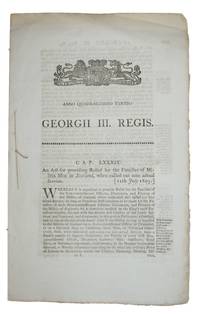
1803réf. AQ18908London: Printed by George Eyre and Andrew Strahan 1803. 1 910-916pp. Stitched as issued. Lightly creased small hole to gutter of first leaf slight chipping to margins. A Georgian act for the provision of a weekly allowance for the families of non- commissioned officers drummers and private militiamen in Scotland; likely issued in response to the emergent conflict with Napoleonic forces on the Continent. . Folio. [Printed by George Eyre and Andrew Strahan] unknown
réf. 19768with Royal Arms below including Hanover vellum approx. 5" x 5" date in pencil on verso 24th March hardcover