123 résultats
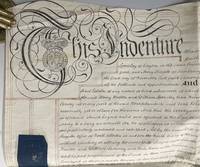
réf. 42584appointing "Our Trusty and Wellbeloved Major Thoam Inglis on half pay of our One Hundred and Twenty Sixth Regiment of Foot. to be Lieutenant Colonel." countersigned by Pelham at the foot 1 side oblong folio on vellum with papered seal and revenue stamp Court at St James's 29th April Pelham was Home Secretary from July 1801 to August 1803 under Addington who made him Chancellor of the Duchy of Lancaster in 1803. Pelham went out of office in 1804 and in the next year succeeded to the earldom. hardcover
réf. 42237printed with manuscript details giving "Our Royal Licence authorizjng them to pay two Bills of Exchange for the respective sums of £290 & £473.19.10 the former drawn on themselves the other on Messrs Boyd Benfield & Co drawn at Leghorn." the printed side states that "by these Presents and by the Powers vested in us by the Act passed in the Thirty-fourth Year of Our Reign intitled 'An Act for preventing Money or Effects in the Hands of His Majesty's Subjects belonging to or disposable by Persons resident in France being applied to the Use of the Persons exercising the Powers of Government in France and for preserving the Property thereof'." countersigned by Portland 1 side folio with papered seal Court at St James's 1st April Thomas RAIKES the Elder 1741-1813 was a British merchant particularly trading from London with Russia a banker and newspaper proprietor. Notably he was Governor of the Bank of England during the 1797 currency crisis when the Bank was prohibited by the British Government from paying out in gold. Walter BOYD 1754-1837 was a financier. In March 1793 the firm of Boyd Benfield & Co. was established in London. Boyd as the principal partner contributed £60000 to the common stock. The Bank Restriction Act of 1797 was an Act of Parliament which removed the requirement for the Bank of England to convert banknotes into gold. The period lasted until 1821 when convertibility was restored. The period between these two dates is known as the Restriction period. unknown
réf. 51577printed with manuscript details appointing Richard Ward to be "Captain of Dragoons in Our Army" countersigned by "Dunk HALIFAX" George Montague-Dunk 1716-1771 2nd Earl of Halifax uncle of Lord North as a Secretary of State and by the Hon. Robert WALPOLE d. 1810 Clerk of the Privy Council Ambassador to Portugal for the War office vellum 1 side oblong folio with papered seal and revenue stamp Court at St James's 17th November Dunk Halifax 'the Father of the Colonies' was 1st Lord of Trade 1748-1761 promoting Nova Scotia whose capital is named after him 1749 as are counties in Virginia and North Carolina. In 1741 he married the heiress of Sir Thomas Dunk. In 1763 he signed the famous 'Dunk Warrant' to search and apprehend the authors printers and publishers of Wilkes 'North Briton' No. 45. After the officers arrested 18 people and seized a vast quantity of papers the warrant was pronounced by the judges to be 'unreasonable search and seizure' and Halifax was mulcted in damages. It has been called 'the most important warrant in Anglo-American law' and the doctine overturning it is closely related to the Fourth Amendment. Robert Walpole's father was Horatio 1st Baron Walpole of Wolterton brother of the Prime Minister. hardcover
réf. 53782appointing James Hay of Seggieden 1771-1838 as Captain Lieutenant in the Perthshire Regiment of Fencible Cavalry commanded by Colonel Charles Moray in the Troop of which Hay is already Captain and further he is to rank as "Captain in the Army during the Establishment of the said Regiment in the Army only" engraved with manuscript additions papered seal of Royal Arms 1 side vellum 5" x 15" no date circa lower portion has been cut away in a rather irregular line three other small portions cut out affecting two words easily supplied James Hay had begun as a Cornet in his local Yeomanry in 1794. In 1804 following the great invasion scare he had been appointed Captain though not so to rank in the Army unless called to active service. Militia regiments were being called upon to volunteer up to half their strength for service in the line and Hay now ranks as a full Captain in the Army. By 1809 he was Lieutenant-Colonel Commandant of the E. Perth Regiment of Militia. Seggieden is 4 miles SE of Perth. hardcover
réf. 43488saying that "Edward Warburton and William Boulton were at a Quarter Session of the Peace holden at Aylesbury. tried and convicted of Grand Larceny and were sentenced to be transported seven years for the same. We in consideration of some favorable circumstances humbly represented unto Us in their behalf are graciously pleased to extend Our Grace and Mercy unto them and grant them our Pardon for their said Crime on Condition of their enlisting and entering to serve Us as Soldiers in Our Army abroad until duly discharged therefrom." 2 sides folio with papered seal Court at St James 21st January unknown
réf. 40960saying that "on receiving the two Boxes yesterday morning I perceived that the one was not intended for my perusal and sent it to the Messenger which gave rise to the mistake of his going to London previous to my dispatching the other Box which I therefore sent by a safe hand at a later hour." 1 side 4to. Windsor 8th February It is unusual to find holograph letters from the monarch. unknown
1823réf. 11828L. G. Michaud 1823 458 pages in8. 1823. reliure editeur plein veau dos orné. 458 pages.
19578vo., First Edition, small neat signature on front free endpaper; green cloth, gilt back, a very good, bright copy in unclipped dustwrapper.
19988vo., First Edition, with plates; black cloth, pictorial endpapers, a fine copy in unclipped dustwrapper.
1935Biography of George IV, with eight illustrations. 301 pages. Index. ex-libris label on front pastedown, two creases on front free endpaper, spine faded and browned, covers faded in parts, particularly on back cover, light foxing to page edges.
réf. #[60986]British Empire d.d. 1 August 1817. Vellum charter good condition. 60x45 cm. Manuscript text and calligraphy with 4 coloured coats of arms three of the King and the officials and one of Hopton. Original 'signatures' written names and attached wax seals of both officials in decorated wooden spane casings. Encased in a made to fit oblong wooden case with metal closing mechanism and clothed with red linen decorated in gold with GR initials and crowns. This comes with an original letter from George W. Marshall Rouge Croix from the College of Arms dated 1900 and the Royal licence signed by Queen Victoria adressed to Lieutenant-Colonel Hopton for a change of name and arms from John Dutton Hunt to Hopton. This charter explains that William Hopton heretofore William Parsons only surviving son of John Parsons MP of Kemerton Court county Gloucester deceased by Deborah his wife who was the daughter of Richard Hopton of Canon Frome in Hereford and the aunt of Richard Cope Hopton also deceased took the name of Hopton by Royal decree of 11 March 1817 in order to inherit the Canon Frome estate. It also relates to the impressive family history dating several centuries back. The Hoptons had lived at Canon Frome for several generations the succession often being through the female line. The Canon Frome estate was one of the largest in the county and he was a typical squarson'. William Parsons Hopton married twice first to Mary Graves and second to Anna Poole and his eldest grandson by the second marriage Edward married his cousin Clare Ellen Trafford. A soldier who served in the Crimea Indian Mutiny and the Kaffir and Zulu Wars Edward became a General and was knighted in 1900. He and his son Edward after him were Trustees of the Michaelchurch Estate and Eliza Rawson bought them a house at Cagebrook in the parish of Eaton Bishop. It seems that Canon Frome Court is now inhabitated by a rural living community of adults and children. Kemerton Court apparently the ancestral home of the Parsons family still exists and in the village of Kemerton there is a two storey tower still known as "Parsons folly". Unusual is the grant of a crest "out of a Ducal Coronet" "under the peculiar circumstances and the antiquity of the family" but "may not be made a precedent." H96 hardcover
réf. 750Light rubbing and soiling. Very good. JJA-750. George III County of York Indenture of Conveyance in the amount of £150 from Dorothy Temple to Henry Haldor and William Spencelay both of York and dated May 21 1776. Measures approx. 11 x 31.5 inches. Manuscript on vellum sealed and stamped. Docketed to verso. . unknown
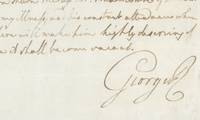
1701réf. 3775117/01/1801. A rare ALS of the King just weeks before yet another episode of his illness King George demonized in the New World for mental incapacity struggled throughout his life. He had experienced a poorly documented illness in 1765 but the episode beginning in 1788 was dramatically more serious. Earlier that year he suffered physical problems including jaundice or gall-duct trouble. After spending time recuperating at Cheltenham his behavior became increasingly abnormal. By October and November after returning to Windsor he was unmistakably suffering from a major psychiatric episode. Contemporary observers described a striking cluster of symptoms: extreme agitation extraordinarily rapid and incessant speech sleeplessness racing thoughts emotional volatility inappropriate familiarity delusions and at times violent or uncontrollable behavior. Treatments were typical of eighteenth-century medicine and could be brutal. The King was subjected to bloodletting blistering purgatives and emetics; some medicines contained substances such as antimony that could themselves produce serious side effects. In the interim he was unable to properly rule. This was a major English constitutional crisis with domestic issues playing out while a potential regency was being mapped out. What would they do with a living but ""mad"" King Parliament spent the winter of 1788–89 wrestling with the extraordinary question of how to create a regency when the monarch was alive but incapable of giving royal assent to the legislation establishing it. And then George recovered. By February 1789 his physicians were increasingly confident. On February 26 the medical bulletin announced the ""entire cessation of His Majesty's illness."" It was this illness that gave credence to the name ""mad King George."" Among the men at his bedside in 1788-9 was apothecary Robert Battiscombe. He had been treating members of the royal household since about 1780 and personally attended George during the King's famous 1788–89 episode of mental illness including cupping him applying and dressing blisters bleeding him and sitting regular watches over him. His surviving memorandum book records those encounters. In early 1801 the King's longtime apothecary John Devaynes died. For a time he wanted another apothecary Everard Augustus Brande to fill the role. He was a first-generation Englishman. But ultimately he wanted to reward Battiscombe. The Marquess of Salisbury is James Cecil 1st Marquess of Salisbury. He was a senior courtier and politician under George III and served as Lord Chamberlain of the Household from 1783 to 1804. Autograph letter signed January 17 1801 Queen's House to Salisbury. ""I am sensible of the Marquess of Salisbury's Attention in having immediately acquainted Me of the death of Mr Desvaines one of my Apothecaries. I as well as every one of my Predecessors have employed constantly Mr. Brande's Shop. I desire therefore that Mr. Brande Junior who is an Englishman may be appointed to succeed Mr. Desvaines. The other Apothecary is now an Old Man his employment less lucrative. The attention shewn me by Mr. Battiscombe of Windsor during my illness and his constant attendance when I am there will make him highly deserving of it when it shall it become vacant."" George suffered a serious recurrence of his mental illness in February 1801 less than a month after this letter was written. Beginning around February 12–13 the King became increasingly agitated talkative sleepless and eventually delirious at one point reportedly praying that God would either let him die or spare his reason. The attack coincided with an intense political crisis over Catholic emancipation: George believed granting political rights to Catholics would violate his Coronation Oath and the dispute contributed to William Pitt's resignation; George himself later blamed Pitt for having caused his illness. By February 22 the King was considered incapable of properly exercising his royal functions and members of the Willis family who had treated him during his famous 1788–89 breakdown were again summoned. Unlike that earlier crisis however the 1801 episode was comparatively brief and George had substantially recovered by early March. Battiscombe would in 1805 become apothecary of Windsor to the royal household. He stayed in that role for decades — he's the apothecary of Windsor recorded as handling the king's post-mortem preparations in 1820. <img class=""alignnone wp-image-25018 size-post-window"" src=""https://cdn.raabcollection.com/wp-content/uploads/20231204144051/Folder-site-11-1600x1327.jpg"" alt=""historical memorabilia dealer"" width=""1600"" height=""1327"" /> unknown
19548vo., Second Impression, some moderate offsetting from fold-ins to free endpapers, neat contemporary signature on front free endpaper; blue cloth, gilt back, a bright, clean copy in unclipped dustwrapper, the latter browned at backstrip and extremities. Published a year after the first edition.
1701réf. 3775117/01/1801. A rare ALS of the King just weeks before yet another episode of his illness King George demonized in the New World for mental incapacity struggled throughout his life. He had experienced a poorly documented illness in 1765 but the episode beginning in 1788 was dramatically more serious. Earlier that year he suffered physical problems including jaundice or gall-duct trouble. After spending time recuperating at Cheltenham his behavior became increasingly abnormal. By October and November after returning to Windsor he was unmistakably suffering from a major psychiatric episode. Contemporary observers described a striking cluster of symptoms: extreme agitation extraordinarily rapid and incessant speech sleeplessness racing thoughts emotional volatility inappropriate familiarity delusions and at times violent or uncontrollable behavior. Treatments were typical of eighteenth-century medicine and could be brutal. The King was subjected to bloodletting blistering purgatives and emetics; some medicines contained substances such as antimony that could themselves produce serious side effects. In the interim he was unable to properly rule. This was a major English constitutional crisis with domestic issues playing out while a potential regency was being mapped out. What would they do with a living but ""mad"" King Parliament spent the winter of 1788–89 wrestling with the extraordinary question of how to create a regency when the monarch was alive but incapable of giving royal assent to the legislation establishing it. And then George recovered. By February 1789 his physicians were increasingly confident. On February 26 the medical bulletin announced the ""entire cessation of His Majesty's illness."" It was this illness that gave credence to the name ""mad King George."" Among the men at his bedside in 1788-9 was apothecary Robert Battiscombe. He had been treating members of the royal household since about 1780 and personally attended George during the King's famous 1788–89 episode of mental illness including cupping him applying and dressing blisters bleeding him and sitting regular watches over him. His surviving memorandum book records those encounters. In early 1801 the King's longtime apothecary John Devaynes died. For a time he wanted another apothecary Everard Augustus Brande to fill the role. He was a first-generation Englishman. But ultimately he wanted to reward Battiscombe. The Marquess of Salisbury is James Cecil 1st Marquess of Salisbury. He was a senior courtier and politician under George III and served as Lord Chamberlain of the Household from 1783 to 1804. Autograph letter signed January 17 1801 Queen's House to Salisbury. ""I am sensible of the Marquess of Salisbury's Attention in having immediately acquainted Me of the death of Mr Desvaines one of my Apothecaries. I as well as every one of my Predecessors have employed constantly Mr. Brande's Shop. I desire therefore that Mr. Brande Junior who is an Englishman may be appointed to succeed Mr. Desvaines. The other Apothecary is now an Old Man his employment less lucrative. The attention shewn me by Mr. Battiscombe of Windsor during my illness and his constant attendance when I am there will make him highly deserving of it when it shall it become vacant."" George suffered a serious recurrence of his mental illness in February 1801 less than a month after this letter was written. Beginning around February 12–13 the King became increasingly agitated talkative sleepless and eventually delirious at one point reportedly praying that God would either let him die or spare his reason. The attack coincided with an intense political crisis over Catholic emancipation: George believed granting political rights to Catholics would violate his Coronation Oath and the dispute contributed to William Pitt's resignation; George himself later blamed Pitt for having caused his illness. By February 22 the King was considered incapable of properly exercising his royal functions and members of the Willis family who had treated him during his famous 1788–89 breakdown were again summoned. Unlike that earlier crisis however the 1801 episode was comparatively brief and George had substantially recovered by early March. Battiscombe would in 1805 become apothecary of Windsor to the royal household. He stayed in that role for decades — he's the apothecary of Windsor recorded as handling the king's post-mortem preparations in 1820. <img class=""alignnone wp-image-25018 size-post-window"" src=""https://cdn.raabcollection.com/wp-content/uploads/20231204144051/Folder-site-11-1600x1327.jpg"" alt=""historical memorabilia dealer"" width=""1600"" height=""1327"" /> unknown books
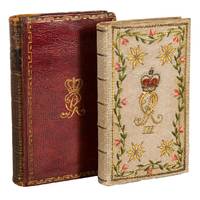
réf. 61172Lauenburg 1801. 8vo. 18 x 11 cm. pp.xxxii2643416. Contemporary needlework binding of white gold silk twill with borders of gold sequins and foliate border of green silks issuing in red flowers upper cover with crowned monogram of George III to the centre monogram in gold sequins the crown worked in coloured silks the lower cover with a central cornucopia worked in gold threads with flowers and leafy sprays in coloured silks corner pieces of flowers worked in sequins and gold threads gilt edges bright green endpapers slightly rubbed the binding preserved in its original red morocco slipcase with crowned gilt monogram of George III to upper cover and star emblem to lower cover gilt border to sides spine richly gilt. Slipcase a little rubbed at extremities the binding remarkable well preserved overall in excellent condition. Lauenburg, 1801. unknown
réf. 360435Contentum Ltd. Loose sheet. New. High-quality art print based on an original work from the Met. Created in the 18th century 1793–1800. Professionally printed on premium fine-art paper Photo Rag Bright White premium quality in size A2. The artwork is printed with a white border museum-style presentation. Contentum Ltd. unknown
réf. 360434Contentum Ltd. Loose sheet. New. High-quality art print based on an original work from the Met. Created in the 18th century 1793–1800. Professionally printed on premium fine-art paper Photo Matt Fibre in size A2. The artwork is printed with a white border museum-style presentation. Contentum Ltd. unknown
réf. 360436Contentum Ltd. Loose sheet. New. High-quality art print based on an original work from the Met. Created in the 18th century 1793–1800. Professionally printed on premium fine-art paper Museum Etching museum quality in size A2. The artwork is printed with a white border museum-style presentation. Contentum Ltd. unknown
réf. 360433Contentum Ltd. Loose sheet. New. High-quality art print based on an original work from the Met. Created in the 18th century 1793–1800. Professionally printed on premium fine-art paper Museum Etching museum quality in size A3. The artwork is printed with a white border museum-style presentation. Contentum Ltd. unknown
réf. 19779St James 30 July 1796. 2 pages 9 x 7 inches plus integral address leaf gilt edges in fine fresh and attractive condition bearing two seals in red wax with ends of red silk ties SIGNED BY A RELUCTANT GEORGE III ON BEHALF OF HIS FORMER MINISTER TO THE UNITED STATES. The bearer of this letter George Hammond had returned to England after serving as the first British Minister to the United States of America in 1795. He was then promoted by George Grenville the Foreign Secretary to act as his senior Under-Secretary with George Canning serving as the second. Meanwhile faced with Napoleon's victories in Italy and the Rhineland Pitt's First Coalition was facing collapse. Grenville keen on an alliance with Prussia proposed that her support could be ensured by giving her a free hand in annexing either of the Belgic provinces or extensive domains in Germany; a plan that was turned down by George III with the cutting observation that 'Italian politics are too complicated for my understanding'. Nevertheless as Ward puts it the British Cabinet was in its desperation 'prepared to act on the degrading principle of gaining the help of a powerful State by conniving at its annexation of a week neighbour' Cambridge History of British Foreign Policy ii p. 267. Hammond as per our letter was therefore despatched to Berlin with George III's reluctant agreement. But he had no luck. For when he got to Berlin he discovered that the King was away and nothing could be done in his absence. So he let the matter drop. unknown
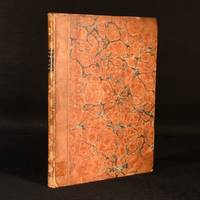
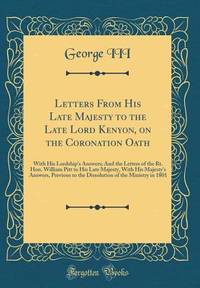
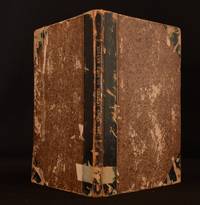
1827réf. 1024Y13London: John Murray 1827. First edition. Leather. Very Good. 11.5" by 8.5". None. The first edition of this fascinating epistolary collection from George III addressed to William Pitt and Lord Kenyon. First edition. In a contemporary half calf binding with marbled paper covered boards bound with the half title and original endpapers. With frontispiece facsimile of George III's handwriting. A selection of letters from George III to two political figures regarding the proposition of Catholic emancipation and his Coronation Oath. Addressed to Lord Kenyon and the then Prime Minister William Pitt George III notes to the first letter that 'The following Queries on the present attempt to abolish all distinctions in Religion in Ireland with the intention of favouring the Roman Catholics in that Kingdom.' Bookplate of F. Ponsonby to the front paste down and verso of title page likely Frederick Edward Grey Ponsonby 1st Baron Sysonby 1867-1935 a British soldier and courtier. A member of a junior branch of the Ponsonby family he was the grandson of General Sir Frederick Ponsonby British Army officer of the Napoleonic Wars and the great-grandson of Frederick Ponsonby 3rd Earl of Bessborough. He wrote the standard history: The Grenadier Guards in the Great War of 19141918 published in 1920. In a contemporary half calf binding with marbled paper covered boards. Externally generally smart with rubbing and fading to the extremities. Front hinge is starting but firm. Bookplate of F. Ponsonby to the front paste down and verso of title page. Internally firmly bound. Pages are bright and generally clean with minor spotting mostly seen to the upper margins. Scattered spots to the endpapers. Very Good John Murray hardcover
réf. 0267212348.Ghardcover. Good. Access codes and supplements are not guaranteed with used items. May be an ex-library book. hardcover
réf. 0313230390.Ghardcover. Good. Access codes and supplements are not guaranteed with used items. May be an ex-library book. hardcover
1827réf. 619L14London: John Murray 1827. First edition. Leather. Good Only. 11" by 9". None. A selection of letters from George III to two political figures regarding the proposition of Catholic emancipation and his Coronation Oath. He writes to British politician and barrister Lord Kenyon and the then Prime Minister William Pitt. The first edition of this uncommon work. These letters are associated with the political process during the late eighteenth and early nineteenth century regarding the 'Catholic emancipation' or 'relief'. Following the Act of Union between Great Britain and Ireland there was a call to remove many of the restrictions on Roman Catholics introduced by the Act of Uniformity Test Acts and penal laws. During the Act of Union William Pitt the Younger the Prime Minister at the time promised emancipation to accompany the act. However no further steps were taken. This was due to King George III believing that any Catholic emancipation would violate his Coronation Oath. To this work there are correspondences between Pitt and George III regarding this matter. Pitt resigned from his position as Prime Minister when the King's opposition became known. To the main body of this work George writes to Kenyon regarding the standing of the Coronation Oath. He notes to the first letter that 'The following Queries on the present attempt to abolish all distinctions in Religion in Ireland with the intention of favouring the Roman Catholics in that Kingdom.' The King is enquiring to Kenyon as to whether emancipation would affect his Coronation Oath. With an introduction by Henry Phillpotts a well known opponent of Catholic emancipation. One of his well known works is 'A Letter to an English Layman on the Coronation Oath which was issued after this work. This copy is from the Bishop Phillpotts Library in Truro with a bookplate for the library to the front pastedown. The Philpotts library is still an important centre for theological studies. It was first opened in 1871 by Henry Phillpotts. Another prior owner's bookplate to front pastedown 'Henricus Exoniensis'. There are six letters between Kenyon and George III to this volume and five letters between Pitt and the King. With a facsimile letter by George III as the frontispiece. The first edition of this interesting contemporaneous account of British history. In a half calf binding with paper covered boards. Externally sound with slight rubbing to the boards spine and extremities. Loss to the calf at the spine due to a previous library removal. Bookplate to the front pastedown for Bishop Philpotts' Library Truro. Philpotts wrote the introduction to this work. Another bookplate to front pastedown Clero Cornubiensi Henricus Exoniensis. Front hinge is strained but firm. Internally firmly bound. Pages are generally bright with patches of scattered spotting mostly to the page edges. Good Only John Murray hardcover