9.052 Ergebnisse
1836Best.-Nr. BOOKS288572--/No Dustjacket. 1836. One page folio with the seal as Chief Justice of New York Supreme Court. . unknown
Best.-Nr. DADAX0415960797New unknown
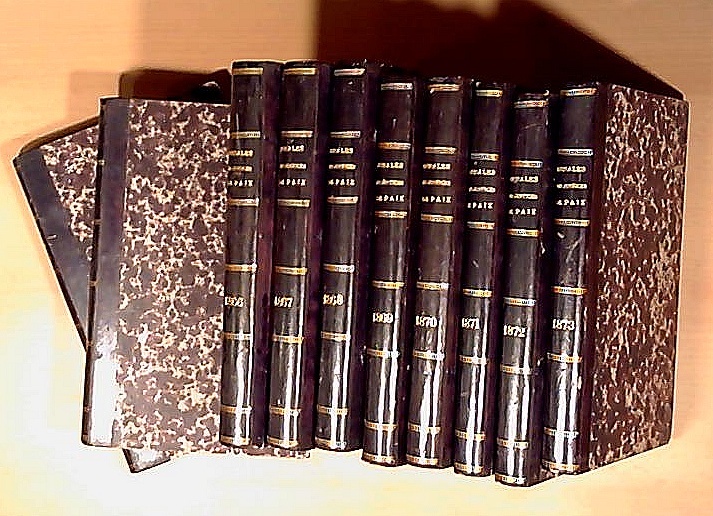
1875Best.-Nr. 103812Couverture rigide. 10 volumes 16 x 24 cm d'environ 400 pages, reliures demi basane en très bon état.
Best.-Nr. DADAX0415171512New unknown
Best.-Nr. DADAX0199399034New unknown
Best.-Nr. 296826Hippolyte Walzer, Libraire-Editeur Paris 1888-1890 3 volumes in-4 ( 280 X 190 mm ) de LI-804-4 829 et 857 pages, demi-chagrin tabac, dos à nerfs jansénistes ( Reliures de l'époque ). Edition originale. Bon exemplaire.
Best.-Nr. CZC-7797auquels sont joints quelques ouvrages de MM. Baptiste du Mesnil, advocat général du Roy, de M. Pierre Pithov, Sieur de Sauoye, advocat en la cour & de plusieurs autres célèbres personnage de leur temps. Le tout receuilly & mis nouvellement en lumière par M. Claude Joly, cy-devant advocat en parlement, & à présent Chanoine en l’Église de Paris, petit fils de M. Antoine Loisel. Complet, volume in4, 260x400, relié pleine basane époque, accrocs, bel état intérieur, bien frais, 754pp Paris, chez Jean Guignard, 1656 ref/be
Best.-Nr. CZC-7127Nouvelle édition augmentée de plusieurs pièces qui ont été trouvées parmis les papiers de l'auteur après sa mort. Seule édition complète. Les plaidoyers et les œuvres diverses de Monsieur Patru, membre de l'Académie Française, sont des textes littéraires et juridiques qui ont marqué la littérature française du XVIIe siècle. Guy-Patin, un contemporain de Patru, les décrit comme étant « écrits avec tant d'esprit, de grâce et de force, que c'est une chose admirable » Patru était un avocat renommé, et ses plaidoyers étaient considérés comme des modèles de rhétorique. Ses discours étaient connus pour leur clarté, leur éloquence et leur capacité à persuader les juges. Ses plaidoyers étaient souvent cités en exemple dans les écoles de droit. Il est important de noter que les écrits de Patru étaient très appréciés de son vivant, mais ils sont moins connus aujourd'hui. Cependant, ils restent des témoignages importants de la littérature et de la rhétorique du XVIIe siècle français. Complet en un fort volume in, 190x130, relié pleine basane époque, dos a nerfs, bien frais, 984pp+ table. Plaidoyers pour le Duc de Noailles, pour Maximilien Fraçois de Béthune, Duc de Sully, pour les Pères Mahurins, pour les Religieux de ND de Nevers, pour l'université de Paris, pour Catherine de Rambouillet, pour le Sr de la Rochelie, pour le Duc de Rohan, Pour la Fontaine Desprez, pour Maitre Gratien Galichon, etc.. Rare exemplaire ! Belle provenance " Bibliothèque de M. de Barray, Conseiller au Parlement ". Ex libris. Paris, chez Sébastien Mabre-Cramoisy, 1681
2026Best.-Nr. x-1041167067Taylor & Francis Ltd 2026. Hardcover. New. 240 pages. 9.18x6.12x9.45 inches. Taylor & Francis Ltd hardcover
2021Best.-Nr. x-0367076810CRC Pr I Llc 2021. Hardcover. New. 328 pages. 9.25x6.00x0.75 inches. CRC Pr I Llc hardcover
2021Best.-Nr. x-0367076047CRC Pr I Llc 2021. Hardcover. New. 344 pages. 9.25x6.00x1.00 inches. CRC Pr I Llc hardcover
2004Best.-Nr. x-0415299551Routledge 2004. Hardcover. New. 1st edition. 224 pages. 9.25x6.25x0.75 inches. Routledge hardcover
Best.-Nr. DADAX0415523591New unknown
1901Very Good Turkish, Ottoman (1500-1928) 1/4 leather bdg. 4to. (28 x 22 cm). In Ottoman script. 2 volumes set: (327 p.; 367 p.). 2 volumes in 1. Kitab-i Mevkufat. Mültekâu'l-ebhur tercümesi. 2 volumes set. Translated by Mevkufati Mehmed. Halebi has written about twenty-four works and many of his treaties were concerned with the issues that were discussed in his own time. Mülteka-i ebhur, which contains more than 17.000 jurisprudential subjects, was taught as a text book in the Ottoman madrasahs and at the same time constituted one of the reference sources of the kadis and muftis. Along with Molla Hüsrev's Dürerü'l-hükkâm, the Ottoman Empire's semi-official collection of legal works has been published many times (eg 1252, 1258, 1264, 1288, Bulaq 1263, Bombay 1278). M. d'Ohsson, Tableau général de l'Empire ottoman (Paris 1787-1820), as he based on this book, explains Ottoman legal order. Rare as set. Özege 13378.
1765Best.-Nr. ST19567-130Dublin: John Exshaw 1765. Fourth Edition First Irish Edition. 250 x 125 mm. 8 x 5". 8 p.l. xxvi 443 1 pp. 6 leaves index. Plain contemporary calf spine with raised bands head and tail of spine and some edges and corners skillfully restored. Four copperplate diagrams inserted into the text three folding; additionally with two attractive woodcut headpieces and one tailpiece all with scrolling foliate motifs. Front pastedown with handwritten bookplate of L. A. Skinner 4 The Ridge Coulsdon Surrey. ESTC T129360. Spine and edges of the boards dried and darkened lower corner of front cover with large discoloration from damp text with very thin dampstain all suggesting the book survived a fire but the binding sturdy and the text surprisingly clean and fresh nevertheless. This is a nicely illustrated work that had a huge impact on British horticulture as the first work to focus in depth on the practicalities of growing plants in a cold climate like that of Scotland. Scottish lawyer and horticulturist Sir James Justice 1698-1763 was well known among his contemporaries for the collection of rare and exotic plants he curated on his Midlothian estate. He is credited with having cultivated the first pineapple in Scotland and was elected to the Royal Society for his botanical efforts. Fellow Royal Society member William Houston named in his honor the genus Justicia which contains more than 900 species of mostly tropical flowering plants. This work his best known was originally published in Edinburgh in 1754 under the title "The Scots Gardiners Director." Because of its obvious relevance for gardeners in Scotland it was an immediate success there as well as in northern England and Ireland. This led to the re-titling of the book to "The British Gardener’s Director" and the publication of two further editions in Edinburgh followed by our 1765 Dublin edition which seems to be quite rare on the market. John Exshaw unknown
1765Best.-Nr. ST19567-130Dublin: John Exshaw 1765. Fourth Edition First Irish Edition. 250 x 125 mm. 8 x 5". 8 p.l. xxvi 443 1 pp. 6 leaves index. Plain contemporary calf spine with raised bands head and tail of spine and some edges and corners skillfully restored. Four copperplate diagrams inserted into the text three folding; additionally with two attractive woodcut headpieces and one tailpiece all with scrolling foliate motifs. Front pastedown with handwritten bookplate of L. A. Skinner 4 The Ridge Coulsdon Surrey. ESTC T129360. Spine and edges of the boards dried and darkened lower corner of front cover with large discoloration from damp text with very thin dampstain all suggesting the book survived a fire but the binding sturdy and the text surprisingly clean and fresh nevertheless. This is a nicely illustrated work that had a huge impact on British horticulture as the first work to focus in depth on the practicalities of growing plants in a cold climate like that of Scotland. Scottish lawyer and horticulturist Sir James Justice 1698-1763 was well known among his contemporaries for the collection of rare and exotic plants he curated on his Midlothian estate. He is credited with having cultivated the first pineapple in Scotland and was elected to the Royal Society for his botanical efforts. Fellow Royal Society member William Houston named in his honor the genus Justicia which contains more than 900 species of mostly tropical flowering plants. This work his best known was originally published in Edinburgh in 1754 under the title "The Scots Gardiners Director." Because of its obvious relevance for gardeners in Scotland it was an immediate success there as well as in northern England and Ireland. This led to the re-titling of the book to "The British Gardener’s Director" and the publication of two further editions in Edinburgh followed by our 1765 Dublin edition which seems to be quite rare on the market. John Exshaw unknown books
Best.-Nr. DADAX0415856337New unknown
Best.-Nr. DADAX0415960835New unknown
Best.-Nr. DADAX0415774845New unknown
Best.-Nr. DADAX1594519005New unknown
Best.-Nr. DADAX0415626501New unknown
Best.-Nr. DADAX0415688698New unknown
Best.-Nr. DADAX0415872871New unknown