9 090 résultats
1943122p. Hardcover Very good condition
réf. DADAX0268019428New unknown
réf. DADAX019953229XNew unknown
réf. DADAX0199289999New unknown
réf. SONG019953229XUsed: Good unknown
réf. DADAX0060391979New unknown
réf. SONG0313312508Used: Good unknown
1964réf. 45882Boston: Houghton Mifflin. Fine. First Edition; First Printing. Full leather. Autograph; 8vo; 4 p.l. 273 pages; This is a specially bound copy of the first edition. Full brown crushed levant morocco five raised bands on the spine title and author stamped in gilt directly in the second and fourth panels -- swirl marbled endpapers top edges gilt. This special volume has an inscription from the author to Abe Fortas soon to be appointed by President Johnson the the United States Supreme Court as an Associate Justice. The inscription is written in ink on the rear free-endpaper upside down -- front the usual point of view. Clearly the volume was flipped over from the normal position and the inscription written after mistakenly opening the rear cover instead of the front. The inscription reads: To carol and abe fortas / -- in deep friendship and regard / signed William S. White". "Carol" was Mrs. Abe Fortas -- the significant and accomplished lawyer Carolyn E. Agger. The handwriting in this unusually-placed inscription gets progressively shakier -- the final word "regard" is nearly illegible. It may have been executed during a social engagement. The author and Abe Fortas had each known Lyndon Johnson well since the 'thirties. William S. White was born in Texas in 1905 attented the Univeristy of Texas in Austin -- and as a working journalist specialising in Washington and the Congress knew the younger Lyndon Johnson since the latter a young Congressional staffer was first elected in as a Congressman from the Tenth district of Texas in 1937 in a special election to fill a seat. Abe Fortas also a contemporary to both journalist White and Lyndon Johnson knew Johnson well as a friend by the time that Fortas represented Johnson before the Supreme Court after Johnson's nomination and election to the U. S. Senate was a matter of dispute in 1948. Lyndon Johnson's rise to power from this initial point in his new Senate career was well understood and covered by William S. White -- writing at that point as a lead Washington journalist for the New York Times. Johnson was selected by his fellow Democrats to be Senate Minority Leader in January of 1953; he became the most junior senator ever elected to this position. White soon wrote a well-regarded study of Johnson's opposite number in the Senate the Republican Majority Leader Robert Taft; White's book 'The Taft Story' was published in 1954 and received the Pulitzer Prize for Biography or Autobiography May 1955. White's next book brought him even further into Johnson's extraordinary career in the Senate. White published Citadel: The Story of the United States Senate to considerable accaim in 1957. Lyndon Johnson was probably the author's principal living source for this volume -- Johnson in turn saw to it that all newly-elected Senators received a copy of the 'Citidel' -- in hopes that knowledge of the history and ways of the great legislative body might prove useful. If one reads this book in the manner that Washingtonians are said to look at a book -- turning immediately to the index one sees only two references to "Abe Fortas." In the Washington world in which turning to the index is a well-known sport -- this means one of two things. Either the party "indexed" is paripheral or was really a more significant source to the author than either might care to acknowledge. This is clearly a case of the latter. Both references to Fortas in the index are substantial; White uses Lyndon Johnson's first night back in his private house in Washinton after having to take the Presidential Oath of Office on the airplane returning to the Capitol city following the disasterous Presidential trip to Dallas -- as a means of organizing the structure of his first section of the book. Johnson spent much of that evening working the phone in conversations with his fellow Cabinet officers from the suddenly-terminated Kennedy administration. Only a couple of Johnson friends were there with him at "The Elms"-- Fortas was one of this small group. His friendship with the new President never stumbled through many twists and turns right through Johnson's death in 1973. Johnson named Abe Fortas to the Supreme Court; through various circumstances the President's subsequent appointment of Fortas to be Chief Justice. was withdrawn -- but the two men remained great friends and Johnson remained a legal client right to the end. In the final days of Johnson's single term in office he awarded White the Presidential Medal of Freedom -- January 1969. Inscribed books are part of the long-standing Washington system of influence. Many are clearly generated with only minimal contact with either the donor or the book's recipient -- other than a quick thumbing of the index-- as discussed above. This volume is an exception in all respects. For one thing this elegantly-bound book looks better than all but a very few specimens of "the Washington inscribed book" and clearly meant a great deal to the author the subject and the recipient. Fortas kept the book for the two decades remaining of his life. We bought it as his estate sale on R Street about thirty years ago. an unsigned binding but of higher quality in terms of material and workmanship to the usual "gift" bindings presented by publishers to their authors; Signed by Author . 1964. Houghton, Mifflin hardcover
1990réf. 40491San Francisco: Harper & Row Publishers. Near Fine in Very Good dust jacket. 1990. First Edition; First Printing. Hardcover. 0060693614 . A first edition/first printing in Near Fine condition minor shelf wear in Very Good lightly scuffed dust-jacket; Racial Reform and the Social Gospel 1877-1925. 'The Rauschenbusch Lectures New Series II. Foreword by James M. McPherson; 8vo; 309 pages . Harper & Row Publishers hardcover books
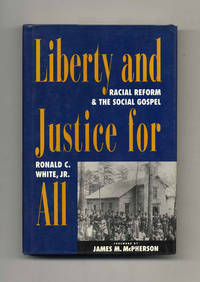
1990réf. 40491San Francisco: Harper & Row Publishers. Near Fine in Very Good dust jacket. 1990. First Edition; First Printing. Hardcover. 0060693614 . A first edition/first printing in Near Fine condition minor shelf wear in Very Good lightly scuffed dust-jacket; Racial Reform and the Social Gospel 1877-1925. 'The Rauschenbusch Lectures New Series II. Foreword by James M. McPherson; 8vo; 309 pages . Harper & Row Publishers hardcover
réf. DADAX1403965846New unknown
réf. DADAX0198258097New unknown
réf. DADAX0275960269New unknown
réf. SONG0700625852Used: Good unknown
réf. DADAX184392059XNew unknown
réf. DADAX0520237455New unknown
réf. DADAX0195128109New unknown
réf. DADAX0199385262New unknown
réf. DADAX0195122186New unknown
1937104pp., dans la série "Etudes morales, sociales et juridiques", br.orig., estampe, 20cm., bon état
1937réf. J42304Louvain, Editions de la Société d'Etudes morales, sociales et juridiques 1937 104pp., dans la série "Etudes morales, sociales et juridiques", br.orig., estampe, 20cm., bon état
1969réf. 202330Golden Press 1969. Hardcover. Good. 1969 edition. A Little Golden Book. Glossy paper cover has rubbing and peeling at corners. Gold foiling on spine is partially worn off. Binding is good. Pages are clean and unmarked with toning. LO/ia26 Golden Press hardcover books
2013réf. 8624bdGainesville: University Press of Florida 2013. First Edition Advance Review Copy with Publisher’s letter laid-in. Octavo blue boards hardcover 142 pp. Fine in a Fine dust jacket. From dust jacket: Hanging chads. Butterfly ballots. Unruly demonstrations across the country. A state capital occupied by the national press corps. For thirty-six excruciating days in late 2000 a nation held its breath while behind closed doors the seven justices of the Florida Supreme Court debated the outcome of the presidential election. The events that transpired within the justices’ chambers -- their arguments exhortations and appeals to one another -- have remained a mystery. until now. Inside Bush v. Gore presents the unique candid and compelling perspective of the Florida Supreme Court Chief Justice who stood at the center of the storm. Charley Wells a strong dissenting voice in the court’s 4-3 decision that mandated a statewide manual recount gives an unprecedented play-by-play of those tumultuous days. Not only is his legal analysis of Bush v. Gore at the state and federal levels invaluable but he also offers an insider’s view of judicial relationships the frustrations of ambiguous election laws the difficulties of separating the legalities from the politics and the unsung yet critical role played by state court professionals. Ultimately Inside Bush v. Gore is a story about the transfer of power in a country that prides itself on the democratic process of electing its leaders and the ability of the court system to justly and fairly resolve disputes. With the advantage of hindsite and the perspective gained by reading countless commentaries and studies about the decisions of both the Florida and the United States Supreme Courts Wells highlights how the rule of law prevailed in the midst of one of the country’s most controversial elections in recent history. University Press of Florida, (2013). First Edition, Advance Review Copy, with Publisher’s letter laid-in. hardcover books
réf. 18840Stock, 1967. In-8, broché, couverture souple ill. , 352 pages. Propre.
réf. DADAX0415720249New unknown