Justice, KatieBiblio.com

6 990 résultats
réf. 16731Gresham High School. 2000. Hardback. Good. Autographs on the front inside covers. 9 x 12 inches with many b&w and color photos a high school yearbook for Gresham High School. Gresham High School hardcover
réf. Bloomsbury-9781526508058Bloomsbury Professional. Paperback. New. 320 pages Bloomsbury Professional paperback
réf. Bloomsbury-9781526508058Bloomsbury Professional. Paperback. New. 320 pages Bloomsbury Professional paperback
réf. Bloomsbury-9781526512826Bloomsbury Professional. Paperback. New. 552 pages Bloomsbury Professional paperback
réf. Bloomsbury-9781526512826Bloomsbury Professional. Paperback. New. 552 pages Bloomsbury Professional paperback
réf. Bloomsbury-9781526530837Bloomsbury Professional. Paperback. New. 344 pages Bloomsbury Professional paperback
réf. Bloomsbury-9781526530837Bloomsbury Professional. Paperback. New. 344 pages Bloomsbury Professional paperback
réf. Bloomsbury-9781526522542Bloomsbury Professional. Paperback. New. 264 pages Bloomsbury Professional paperback
réf. Bloomsbury-9781526522542Bloomsbury Professional. Paperback. New. 264 pages Bloomsbury Professional paperback
réf. 26542in-8 broché - 1979 - 348p
réf. 0366465570.Ghardcover. Good. Access codes and supplements are not guaranteed with used items. May be an ex-library book. hardcover
1978réf. 54465Washington: GPO 1978. Magazine. vii 54p. 8.5x11 inchesintroduction examinations photos and tables very good booklet in stapled brown wraps. GPO unknown books
1975réf. 2091202133101212Teikoku Case Law Publishing Company 1975. Soft Cover. Fine. Volume: 1 Teikoku Case Law Publishing Company paperback
1961réf. 370High Holborn House. The Modernistic Press. 1961. hardcover. Bueno. Kent 1961. High Holborn House. The Modernistic Press. 100 pp. 22 x 14. Tela. Contiene anotaciones del anterior propietario. En inglés. High Holborn House. The Modernistic Press. hardcover
1916réf. 000139Pomeroy Ohio OH. Fair. 1916. Cloth. On offer is the handwritten manuscript diary of Mrs. J.P. Bradbury Pomeroy Ohio 1916 and as found on genealogical sites Mrs. Bradbury 1853-1918 being Emma L. Woods the widow and second wife of Justice Joseph Perry Bradbury 1838-1915 of the Ohio Supreme Court. Research finds Justice Bradbury and his family in the 1880 census it said that he was then married to his first wife Sarah E. Bradbury who was an invalid and that two other people lived in the house Emma Woods as sister so it seems clear to be his first wifes sister. It also lists Elizabeth Blackwell servant living at the home. The diary itself is written just a few months after the death of Joseph. Her grief as she puts it is too much to bear and almost everyday she writes about him and missing him. She calls him Petty for a nickname too. I thought it was Perry because of his middle name but on closer inspection it is Petty. She starts out her entries on January and writes on almost every available space for everyday see scan but then suddenly stops her entries on July 24th. Entries are extremely interesting probing what it is like for a newly widowed woman who seemed to be deeply in love with her husband as one will see in the following excerpts: How am I to get along without my own dear Petty . I am homesick for my dear Petty. I do not see how I am to go on this way. Petty dear if I could only have kept you how happy I would be as it is I am so depressed Mr. Quincy came in to do some hauling of stuff left from the old house. Mrs. Barbara Wehe mother of Mrs. Frank Hudson of Chicago was brought here for burial Friday of last week. Mrs. Wehe used to live here in Pomeroy and was quite well-known. How I do miss my own dear Petty and when I think I could not do one thing to keep him it almost kills me. Dearest Petty The river is very high. Word came this morning that the steamer Kanawha had struck a part of dam no. 19 just below Parkersburg. In three minutes time the boat capsized. She lay upon her side. The number lost is estimated at from 12 to 25. Mrs. E.C. Atkinson of Racine and a lady whom I knew very well was lost. Her husband saved. I did not know any of the other people. It was a terrible calamity . some days I think I will fly to pieces. I am so very nervous and oh how I do miss my dear dear Petty. I just think I must see his dear sweet face oh; my poor old heart aches all the time for him. How I loved him just six months since my dear Petty left me. Some days I think I can not stand it. I just must see him. No one knows how I miss my dear sweet Petty. How I did love him. He was so sweet and good to me Dorothy and Mary Etta went out for walk into see the doctor. The town is full of sick people. Doctors are just rushed to death just one year ago today my dear Petty fell and hurt his arm. This was the beginning of his going down. Oh how I miss him. It was the 14th of February but it was a Sunday. Oh how I miss Petty . This was my dearest husband 78th birthday. Oh I have missed him . one year ago today my Petty was in bed with a sprained arm and now he has gone from me. Oh how I do miss my dear sweet Petty who was so good to me . I am still so blue and miss Perry so much today. I just feel as if I must see him. I do not see how I am to go on without him. Dear dear Petty and I miss Dorothy so much too . I sincerely hope I may be taken to my heavenly home for I know I never could stand it. I hope my life will not be long. I do not want to live to be a real old woman and not a burden to anyone. If I could have gone with my Petty how much better it would have been perhaps. I get dreadfully blue some days .Bert Millen brought the deed for the farm for me to sign today. I wish Petty could have settled all up with Dale Roberts. I feel a little shaky about the settlement of that . River still rising and there will be between 48 and 50 feet of water here. It will be in my cellar tonight. Took the gas heater out this morning from the furnace. The Creek is up around the Bradford House and water and Mrs. Geyers seller. Mr. A.L. Willock deputy sheriff died this afternoon and leaves a wife and daughter. A year ago this evening my own dear Petty and I walked down to Dr. Henlows Office. Coming home Petty wanted to be weighed so we went to Mr. Stockmores seed store and he weighed only 148 pounds. Oh how I did hate to see that. It made Petty feel badly . Dearest husband how I have missed you this day. How I would love to see you. Oh Petty Petty how am I to go on without you. This has been a very gloomy day . Republican convention is still on in Chicago. Hope Roosevelt will not get the nomination. I miss my Petty so much. He would always tell me about how the conventions were conducted. He usually went to them. Petty how I do miss you . I went up to see Dr. Jane but she was out. So I whet down to see Mrs. Plantz. She is not very well. I talked to her about the lump in my breast. After I came home and went for Dr. Gribble. He made an examination and found a growth but advised me to see how it will be in a few weeks from now. It worries me very much. Now to think I have not my Petty to go to and talked it over. Oh dear Petty maybe it won't be very long until we will be together again . Just one year ago this 17th day of July my dear Petty closed his eyes in death. I will never forget how sweet he looked that morning and how blue his eyes were some days I think I can not stand it I must see him and hear his sweet voice. Dear dear Petty perhaps it won't be long until I will be with my loved ones. I pray that my Father in heaven will only keep me from long-suffering with this dreadful thing that has come to me. Better I could go before I get to be a care and hope I won't have to suffer with it. How my dear Petty would worry if he knew this." Many names listed; Blackmore DeWolfe Crow Planty Helen Russell Frank Hudson Atkinson Hollis Johnston Fisher Minister Dr. Jane Gulliford Horvitz Helen Shrewsby Scott Dr. James McCullough Remington Keizer Dave Geyer Helen and Ray Clifton Mary Williams Asa Bradbury John Kasper Bert Miller Dale Roberts Antoinette Osborn Arnold Roy Brown Edith Peters Ruth Jacobs Stanbury Lillian Roush and more. Condition of this diary most of the pages from January 1 of February 25 are torn on the seam. Some of the pages are also loose but the writing can easily be made out. 4" x 5". ; 32mo - over 4" - 5" tall; HANDWRITTEN MANUSCRIPT DOCUMENT LETTER AUTOGRAPH DIARY JOURNAL LOG KEEPSAKE WRITER HAND WRITTEN DOCUMENTS SIGNED LETTERS MANUSCRIPTS HISTORICAL HOLOGRAPH WRITERS DIARIES JOURNALS LOGS AUTOGRAPHS PERSONAL MEMOIR MEMORIAL PERSONAL HISTORY AMERICANA LEGAL LAW ATTORNEY JUSTICE JURISPRUDENCE OHIO OH SUPREME COURT PIONEER MID WEST MIDWEST ; Signed by Autograph . hardcover
1916réf. LRB505Librairie Aristide Quillet Paris 1916 Préface : Paul Deschanel — Volumes : 3 tomes (I - II - III) — Format : Grand in-4 — Reliure : Reliure éditeur pleine percaline grainée estampée à froid, titres dorés au dos et au plat (tome I vert, tomes II et III noirs) — Langue : Français — Illustrations : Très riche iconographie ? nombreuses photographies in'texte, planches hors'texte en héliogravure et plusieurs planches en couleurs (portraits, scènes, uniformes), serpentes conservées, ornementations typographiques en rouge et noir au titre — État : Ensemble solide et complet de ses trois volumes. Usure d'usage aux reliures éditeur, particulièrement au tome I (frottements marqués au dos et aux coiffes) ; tomes II et III mieux conservés avec frottements légers. Intérieur propre avec papier uniformément jauni, rousseurs éparses sans atteinte au texte ni aux planches
réf. 54192, Paris, Armand Le Chevalier 1866, ptt in-8, demi-rel. cartonnée, tit. doré sur pc. de maroquin bordeaux, dos lisse orné de filets dorés, tr. mouchetées, bon état, VII-252p.
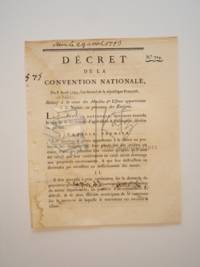
1793réf. 0010123Good with no dust jacket. 1793. Ephemera. On offer is a superb document issued two days following the creation of the notorious Committee of Public Safety which deliberately created the Reign of Terror following the French Revolution. The Decree was published on April 8th 1793 two days following the creation of the infamous Committee of Public Safety. It deals with the seizure of property specifically mills and factories that were owned by emigres those French aristocrats who had fled France following the Revolution. This emigration created several problems for the Revolutionary government. There now existed outside of France and within the borders of her enemies a very motivated group who were dedicated to the overthrow of the Revolution. Also among other assets the mills and factories that they owned were now idle contributing to lost food production and jobs. The National Convention ordered that all emigres return to France. Failure to do so would result in being permanently barred from ever re-entering the country and all of their assets would be forfeited to the government. This Decree addresses this. An excerpt from the decree follows: Relatif à la vente des Moulins et Usines appartement a la Nation ou provenus des Emigres Translation: Relative to the sale of the Mills and Factories owned by the Nation or originating from the Emigrants The Decree follows a report from the Committees of Agriculture and Food. Further excerpts from the document follow: Les moulins et usines appartement a la nation ou provenus des emigres qui sont places sur des rivieres ou cours d'eau ne pourront etre vendus qu'apres qu'il aura ete verifie que leur conservation ne cause aucun dommage aux proprietes environnantes et que leur destruction ne deviendra pas necessaire aux dessechement des marais. Translation: The mills and factories belonging to the nation or originating from the emigrants which are located on rivers or watercourses can only be sold after it has been verified that their preservation does not cause any damage to the surrounding properties and that their destruction will not become necessary for the draining of the marshes. . Apres ce rapport le directoire du department sur l'avis de celui du district ordonnera la vente desdits objets ou il y fera surseoir si le cas l'exige. Translation: . After this report the director of the department on the advice of that of the district will order the sale of the aforementioned objects or will have it postponed if the case requires it. The manuscript is signed by Louis-Jérôme Gohier the President of the Executive Council and Minister of Justice. When Napoleon became dictator Gohiet served in his government as Consul-General in Amsterdam. He was offered a similar position in the United States but was too ill to take up the position. For a historian or a collector of material from the earliest days of the French Revolution this is a superb item documenting the earliest efforts of the French people to establish a republican government separate from the monarchy and the feudal system that had ruled France for a millennium. For a person involved in the financial or economic world it is a wonderful piece of evidence of what can happen to a society where economic realities are cast aside. This double-sided single sheet document measures 8.75 inches by 7.0 inches. It has been separated from a larger bound volume and the thread holes are visible. There is some staining from dampness and from age. Otherwise it is in very good condition. ; 8vo 8" - 9" tall; 1 pages .
réf. CZC-11193Journal du Palais ou recueil des principales décisions de tous les parlements et Cours souveraines de France, sur les questions les plus importantes du Droit Civil, de coutumes, de matières criminelles & bénéficiales & de droit public par feus Maîtres Blondeau & Gabriel Gueret, avocats au parlement. Empruntant son nom au registre où les tribunaux consignaient leurs activités quotidiennes, et s'inscrivant dans une longue tradition de recueils d'arrêts, le Journal du Palais innova à la fois par la publication périodique et la sélection de décisions éditées avec des remarques, ce qui le destinait autant à l'information qu'à l'étude. Ses deux auteurs, les avocats Gabriel Guéret et Claude Blondeau connurent une carrière assez différente: le premier lancé dans les cercles mondains écrivit un petit manuel de la réussite à la Cour, plusieurs œuvres précieuses et assura l'édition d'ouvrages de droit civil, alors que le second, aîné des deux amis, s'intéressait plus spécialement au droit ecclésiastique. Ces deux juristes obtinrent conjointement, le 6 février 1672, un privilège qu'ils ne tardèrent pas à faire enregistrer, le 12 du même mois. Il les autorisait à publier pendant dix ans un «recueil des principales décisions de tous les parlemens et cours souveraines de France», ce qui reprenait une partie du privilège d'août définissant le champ du Journal des savants dont Guéret et Blondeau captèrent aussi un peu du prestige en plagiant son titre. Tome I. contenant les arrêts depuis l'année 1660, jusqu'en 1678 volume in folio, 400x300, relié pleine basane époque, accrocs, solide, bel état intérieur, très frais, 964pp + table. A paris, au Palais, chez Knapen, MDCCLV Poids 10kg. Envoi possible en Mondial Relais pour les pays desservis.
réf. CZC-11193Journal du Palais ou recueil des principales décisions de tous les parlements et Cours souveraines de France, sur les questions les plus importantes du Droit Civil, de coutumes, de matières criminelles & bénéficiales & de droit public par feus Maîtres Blondeau & Gabriel Gueret, avocats au parlement. Empruntant son nom au registre où les tribunaux consignaient leurs activités quotidiennes, et s'inscrivant dans une longue tradition de recueils d'arrêts, le Journal du Palais innova à la fois par la publication périodique et la sélection de décisions éditées avec des remarques, ce qui le destinait autant à l'information qu'à l'étude. Ses deux auteurs, les avocats Gabriel Guéret et Claude Blondeau connurent une carrière assez différente: le premier lancé dans les cercles mondains écrivit un petit manuel de la réussite à la Cour, plusieurs œuvres précieuses et assura l'édition d'ouvrages de droit civil, alors que le second, aîné des deux amis, s'intéressait plus spécialement au droit ecclésiastique. Ces deux juristes obtinrent conjointement, le 6 février 1672, un privilège qu'ils ne tardèrent pas à faire enregistrer, le 12 du même mois. Il les autorisait à publier pendant dix ans un «recueil des principales décisions de tous les parlemens et cours souveraines de France», ce qui reprenait une partie du privilège d'août définissant le champ du Journal des savants dont Guéret et Blondeau captèrent aussi un peu du prestige en plagiant son titre. Tome I. contenant les arrêts depuis l'année 1660, jusqu'en 1678 volume in folio, 400x300, relié pleine basane époque, accrocs, solide, bel état intérieur, très frais, 964pp + table. A paris, au Palais, chez Knapen, MDCCLV Poids 10kg. Envoi possible en Mondial Relais pour les pays desservis.
réf. CZC-11007La Pratiqve de Masver ancien, Ivrisconsvlte et practicien de France, mise en François par Antoine Fontanon Jean Mazuer (ou Masuer), éminent jurisconsulte, serait né en Auvergne vers la fin du XIV° siècle. Les sources divergent quant au lieu et à la date. Toujours est il qu'il rédigea sa Practica forensis Galliæ à Riom, au barreau de la sénéchaussée, au début du XV° siècle. L'intérêt de ce recueil important dépasse le domaine des règles de la Procédure (que l'on appelait alors le Style du Palais), pour aborder aussi le droit et la procédure. Méplain précise que l'ouvrage fut composé au point de vue du droit écrit et des coutumes de la province d'Auvergne, parce que Masuer l'écrivait à Riom où le retenait sa dignité de Chancelier des ducs d'Auvergne. Les usages du Bourbonnais y sont aussi fréquemment rapportés, l'auteur ayant aussi tenu la charge d'avocat à la sénéchaussée de cette province. En constatant aussi les emprunts nombreux que la coutume avait fait au droit romain, le savant élargit la portée de son travail ". qui, bien qu'il semble écrit plus spécialement pour l'utilité de ces deux provinces, il devint bientôt le manuel obligé des jurisconsultes de tout le royaume. C'est un autre auvergnat, Antoine Fontanon, qui traduisit en français la Practica Forensis, en 1581. fort volume relié gd in8, 25x18, relié plein vélin époque, couvertures à lacets, petits manque au dos, bien solide, mouillures sèches en début d'ouvrage, 548pp + 36 pages de tables alphabétiques. Exemplaire de travail avec des mentions manuscrites en marge. Paris, Chez Sébastien Niuelle, rue S Iaques, aux Cicognes. MDLXXXI ( 1581)
réf. CZC-11007La Pratiqve de Masver ancien, Ivrisconsvlte et practicien de France, mise en François par Antoine Fontanon Jean Mazuer (ou Masuer), éminent jurisconsulte, serait né en Auvergne vers la fin du XIV° siècle. Les sources divergent quant au lieu et à la date. Toujours est il qu'il rédigea sa Practica forensis Galliæ à Riom, au barreau de la sénéchaussée, au début du XV° siècle. L'intérêt de ce recueil important dépasse le domaine des règles de la Procédure (que l'on appelait alors le Style du Palais), pour aborder aussi le droit et la procédure. Méplain précise que l'ouvrage fut composé au point de vue du droit écrit et des coutumes de la province d'Auvergne, parce que Masuer l'écrivait à Riom où le retenait sa dignité de Chancelier des ducs d'Auvergne. Les usages du Bourbonnais y sont aussi fréquemment rapportés, l'auteur ayant aussi tenu la charge d'avocat à la sénéchaussée de cette province. En constatant aussi les emprunts nombreux que la coutume avait fait au droit romain, le savant élargit la portée de son travail ". qui, bien qu'il semble écrit plus spécialement pour l'utilité de ces deux provinces, il devint bientôt le manuel obligé des jurisconsultes de tout le royaume. C'est un autre auvergnat, Antoine Fontanon, qui traduisit en français la Practica Forensis, en 1581. fort volume relié gd in8, 25x18, relié plein vélin époque, couvertures à lacets, petits manque au dos, bien solide, mouillures sèches en début d'ouvrage, 548pp + 36 pages de tables alphabétiques. Exemplaire de travail avec des mentions manuscrites en marge. Paris, Chez Sébastien Niuelle, rue S Iaques, aux Cicognes. MDLXXXI ( 1581)
2005La Côte d'Azur abrite nombre de criminels ainsi que ceux qui les protègent . " A travers treize mystérieuses affaires , l'auteur fait de stupéfiantes révélations où l'on voit triompher de la vérité , une justice sous influence , des policiers corrompus , les liaisons dangereuses unissant mafieux , affairistes et politiques " Nous dit l'éditeur . - 296 p. , 650 gr.