4002 resultados
1958ref. 2111902160305419Nagano Prefecture Police Headquarters 1958. Soft Cover. Fine. The book is in fine condition. Nagano Prefecture Police Headquarters paperback
1834ref. 973F4London: A. Varnham 1834 . First edition. Cloth. Near Fine. 13" by 8.5". None. A fascinating and very scarce 1834 review of the Metropolitan Police and its management expenditure and effectiveness. A very scarce first edition report.This report offers a rigorous review of the Metropolitan Police force just five years after its establishment under the 1829 Act. Including minutes of evidence which feature testimonies from Members of Parliament local parish representatives and police officials who debated issues of cost constitutional concerns public trust and the force's structure.Rebound in cloth with endpapers renewed.The committee and report ultimately upheld the Metropolitan Police's and offered the endorsement of it as "one of the most valuable modern institutions" for its role in suppressing crime and safeguarding life and property. Rebound in cloth with endpapers renewed. Externally fine. Internally firmly bound. Pages a touch age toned to perimeters otherwise clean and bright. Near Fine A. Varnham hardcover
1758ref. 18688paris Gissey 1758 in-4 plein-veau un volume, reliure de l'époque plein veau brun moucheté (binding full calfskin in-4) in-quarto (19,5 x 26 cm), dos à nerfs (spine with raised bands) décoré or (gilt decoration) filets or (gilt line) et filets à froid (blind-stamping line decoration), entre-nerfs à compartiments à fleuron au fer plein (floweret with full blocking stamp) dans un encadrement à filet et roulette or à fleurettes "or" aux angles, titre frappé or (gilt title), pice de titre sur fond bordeaux à filet et roulette or, la coiffe de tête manque, roulette or en place des nerfs et filets à froid de part et d'autre des nerfs, roulettes sur les coupes (fillets on the cuts) avec légers manques de dorure (blurred gilding), toutes tranches rouges (all red edges), sans illustrations (no illustration) excepté des fronts de chapitres, lettrines et culs-de-lampes gravés sur bois en noir, XVI-588 pages avec privilège du roy, 1758 Paris, Gissey Editeur,
1887ref. 2110502150400702Okudzuke nashi 1887. Soft Cover. Fine. Volume: 1 Okudzuke nashi paperback
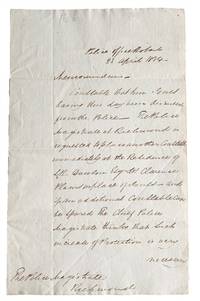
1834ref. 5000932Hobart: Police Office 1834. Two pages folio manuscript in ink on a bifolium the third page blank the fourth page a docket title. The Hobart Police Office ask the Police Magistrate at Richmond to provide a replacement officer and if possible a second for the protection of Samuel Robinson Dawson of Clarence Plains following the dismissal of the previously assigned constable Matthew Jones such protection being "very necessary in the Populous District of Clarence Plains". Dawson was a leading figure in the area which was settled in the 1820s and now forms part of Greater Hobart on the east side of the Derwent. He was a magistrate and justice of the peace and a substantial landowner: three years earlier he had placed a newspaper advertisement cautioning the public against trespassing on his grant of 2560 acres at Brushy Plains the first settlement in the area known today as Runnymede. . Provenance: From the library of the late Dr. Robert Edwards AO. Police Office unknown
1876ref. 008261Hobart Town: James Barnard Government Printer 1876. First Edition . Cloth. No Jacket as Issued. 4to - over 9¾" - 12" tall. Very Good with light wear to the covers. PP 206 weekly police reports for the year 1876 Rare ! James Barnard Government Printer hardcover
1900ref. 008262Hobart: John Vail Government Printer Hobart 1900. First Edition . Cloth. No Jacket as Issued. 4to - over 9¾" - 12" tall. Very Good with light wear to the covers. PP 206 weekly police reports for the year 1899 Rare ! John Vail Government Printer Hobart hardcover
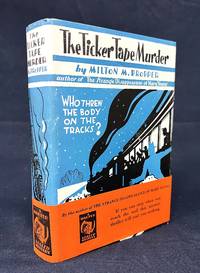
1930ref. 021149N.Y.: Harper & Brothers 1930. First edition so stated. Previous owner's name at inside cover. Some mnor rubbing at spine edges and along bottom edges with corners bumped. Some loss of white lettering at spine otherwise a very good near fine copy in a beautiful dust jacket no tears or creases and with the very rare wrap-around band for the Harper Sealed Mystery. "Philip Nixon is the president of American Motors the biggest auto concern in the world. On the eve of cornering the US automobile market his corpse is found on the train tracks. Sgt. Gilmore had been asked to act as a bodyguard to the financier. Fortunately Gilmore was a passenger on the train that hit Nixons body.Milton M. Propper 1906-62 was an American devotee of Freeman Wills Crofts and Lynn Brock. The book is the American equivalent of Crofts: a methodical policeman Detective Sergeant Gilmore and Tommy Rankin of the Philadelphia police-- not brilliant but capable and thorough-- testing discrepancies and checking alibis; finance; transport three different train and two cars thundering across New Jersey by night; and plenty of railway timetables. Like his British models Propper handles a complex plot admirably unfolding layer by layer each mysterys solution opening new possibilities. The pure puzzle satisfies because there is no fat. But which character doesnt need to be in the book has no motive and hasnt been suspected when all the other characters have been eliminated Theres your murderer! With Audobon stock soaring under his skillful manipulation with the money world aghast at the significance of the colossal corner the death of Philip Nixon was a calamity. Mangled on the steel rails of the East Shore Express his body yielded no clues. Armed with knowledge of blackmail threats Detective Sergeant Gilmore of the Philadelphia Police took the case with full confidence of pushing it to an obvious and rapid conclusion. But numerous motives appeared and soon the list of potential murderers included gangsters thirsting for revenge the brothers of a betrayed girl a desperate bear speculator and the mans own secretary once before convicted of manslaughter. Who threw the body on the tracks By sheer doggedness and an intelligence that missed no single detail Gilmore solved this thrilling mystery in a way that will delight the keenest reader." -- Nicholas Fuller at "The Grandest Game in the World" blog. This copy although not marked as such comes from the auction of the Gary Gorton Crime Fiction collection of detective fiction . First Edition. Hardcover. Very Good-Near Fine/Fine. Book. Harper & Brothers
ref. 124909aafLeipzig, in der Commerschen Buchhandlung, 1810, in-8vo, Titelblatt + 130 S. + gef. Kupfertafeln, Stempel auf Titelblatt ‘Bibliotheca Smecnensis’, schlichter O.-Pappband d. Zeit
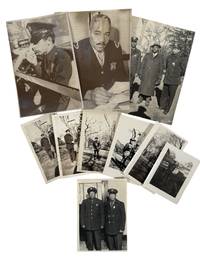
1960ref. 210231960. African American law enforcement photographic archive 1940s-1969 documenting the presence and professional roles of Black police officers during the decades spanning segregation and the Civil Rights Movement in the United States. These images record individual officers peer relationships and public-facing roles within police institutions providing visual evidence of Black participation in law enforcement at a time of limited access to such positions. The archive captures both formal portraiture and informal interaction situating these individuals within evolving social and institutional conditions. Archive comprises 11 vintage silver gelatin photographs ranging in size from approximately 2.75" x 5.5" to 5.5" x 7.25". A sequence of six smaller photographs depicts several African American men in uniform including officers wearing double-breasted dress coats with badges a patrolman in standard duty attire and one image showing a man in a Marine uniform standing beside a police officer. One photograph captures two uniformed officers shaking hands suggesting a moment of professional recognition such as academy completion. Another image shows two officers flanking a third individual in civilian attire possibly a legal official based on positioning and dress. A separate photograph includes two older uniformed officers with a handwritten inscription on the verso reading "This is your Brother A.B. and his buddy Ezell Anderson." The archive also includes a 1969 press photograph identifying Herbert A. Craigwell as a high-ranking officer in the Boston Police Department alongside accompanying text referencing increasing representation of Black officers in major city forces. An additional press image identifies Los Angeles patrolman Ronald Allen described in relation to the gradual inclusion of Black officers within urban policing structures. A signed photo of a policeman wearing small round glasses a hat with the number 7 above "Police" reads "Lovingly Kenny" depicting an African American officer likely from the mid 1940s at a municipal department. Created during a period marked by both institutional exclusion and gradual integration these photographs provide a record of African American participation in law enforcement prior to and during major Civil Rights reforms. The inclusion of press images and personal photographs reflects both public recognition and private documentation of professional identity. Minor edge wear and light fading visible across several photographs; overall very good condition. This archive offers a focused visual record of Black law enforcement presence in mid-twentieth-century America. unknown
1960ref. 210231960. African American law enforcement photographic archive 1940s-1969 documenting the presence and professional roles of Black police officers during the decades spanning segregation and the Civil Rights Movement in the United States. These images record individual officers peer relationships and public-facing roles within police institutions providing visual evidence of Black participation in law enforcement at a time of limited access to such positions. The archive captures both formal portraiture and informal interaction situating these individuals within evolving social and institutional conditions. Archive comprises 11 vintage silver gelatin photographs ranging in size from approximately 2.75" x 5.5" to 5.5" x 7.25". A sequence of six smaller photographs depicts several African American men in uniform including officers wearing double-breasted dress coats with badges a patrolman in standard duty attire and one image showing a man in a Marine uniform standing beside a police officer. One photograph captures two uniformed officers shaking hands suggesting a moment of professional recognition such as academy completion. Another image shows two officers flanking a third individual in civilian attire possibly a legal official based on positioning and dress. A separate photograph includes two older uniformed officers with a handwritten inscription on the verso reading "This is your Brother A.B. and his buddy Ezell Anderson." The archive also includes a 1969 press photograph identifying Herbert A. Craigwell as a high-ranking officer in the Boston Police Department alongside accompanying text referencing increasing representation of Black officers in major city forces. An additional press image identifies Los Angeles patrolman Ronald Allen described in relation to the gradual inclusion of Black officers within urban policing structures. A signed photo of a policeman wearing small round glasses a hat with the number 7 above "Police" reads "Lovingly Kenny" depicting an African American officer likely from the mid 1940s at a municipal department. Created during a period marked by both institutional exclusion and gradual integration these photographs provide a record of African American participation in law enforcement prior to and during major Civil Rights reforms. The inclusion of press images and personal photographs reflects both public recognition and private documentation of professional identity. Minor edge wear and light fading visible across several photographs; overall very good condition. This archive offers a focused visual record of Black law enforcement presence in mid-twentieth-century America. unknown books
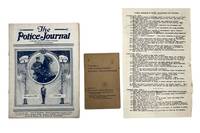
1900ref. 239491900. American police archive from 1900 to 1945 centered on the policing of prostitution and the wartime treatment of venereal disease sexual behavior and adolescent girls as matters of law enforcement. Techniques of Law Enforcement Against Prostitution directs officers in the surveillance arrest and medical handling of women suspected of prostitution extending police work into taverns hotels tourist camps curfew enforcement and cooperation with military and health authorities. Two earlier pieces establish the professional setting in which such work developed: a turn of the century examination tests officers on vagrancy "public nuisance" liquor regulation warrants fires injured persons and entry into houses while the December 1931 Police Journal addresses criminology heredity and environment traffic control and foreign police systems. Group of three printed police training and professional materials 1900 to 1945: 1 General Knowledge of Duties Examinations for Policemen. San Francisco reproducing examinations dated October 3 1900 July 17 1902 and January 30 1904. The examination defines competent police work broadly as candidates are asked "What efforts should a policeman make to prevent crime on his beat" how to handle injured or sick persons in the street the regulations governing policemen at fires the legal definitions of misdemeanor felony vagrancy assault battery murder and manslaughter and others subjects. 2 Burns R. Vernon ed. The Police Journal: A Monthly Review of Police Progress Problems and Activities. New York: The Police Journal Publishing Company December 1931. Vol. XVIII No. 10. The magazine identifies itself as "The Professional Magazine of the Police of the Nation" and the "Official Organ of the National Commission on Police Welfare." Its contributors and associate editors include criminologists physicians and identification specialists 3 National Advisory Police Committee to the Federal Security Administrator. Techniques of Law Enforcement Against Prostitution: A Manual for the Guidance of Enforcement Officers in Proceeding Against Prostitutes and Procurers. Washington: U.S. Government Printing Office 1945 revised issue retaining 1943 on the title page. Compiled under the Federal Security Agency Office of Community War Services Division of Social Protection and approved by the National Sheriffs' Association the International Association of Chiefs of Police and the Interdepartmental Committee on Venereal Disease Control of the Army Navy and Federal Security Agency. The preliminary matter states "This manual is addressed to law enforcement officers. It is not for general distribution." Its contents proceed from "Crime or Disease" and "Why Repress and Suppress Prostitution" through "The Streetwalker" "The 'Call Flat'" "The Call Girl" "Spot Maps" "Patrolling" taverns and bars hotels tourist and trailer camps taxicabs vice squads "The 'Teen Age' Girl" curfew the Social Protection Division the United States Public Health Service and the Military Police. The earliest material defines police duty through crime prevention nuisance and vagrancy enforcement emergency response alcohol regulation warrants and political conduct. By 1931 professional police literature incorporated criminology traffic engineering hereditary theories of criminality departmental comparison and foreign police systems; Dosi's article brought contemporary Fascist policing directly into an American police journal while Mussolini's regime promoted centralized authority as a model of order. The federal prostitution manual shows these broader claims to police expertise applied to wartime sexual regulation. One passage records 264 women arrested in four months: 91 were found infected with venereal disease and 43 had been apprehended with men in uniform; the women were classified as 213 white 33 "colored" and 18 "Indians" while all but two servicemen were released to military police rather than taken to court. "The 'Teen Age' Girl" identifies broken homes employed mothers early employment servicemen husbands inadequate recreation and "delinquent" parents as police concerns while the curfew section addresses legal authority over adolescent nighttime activity. Later scholarship has used the term carceral feminism for some alliances among women's activism welfare work policing and punitive state power; these materials use the contemporary vocabularies of police welfare criminology social hygiene social protection and prostitution suppression. Examination sheet folded with pronounced horizontal creases light toning and scattered stains; Police Journal with moderate cover wear and toning; federal manual with wrapper soiling edge wear creasing and corner losses contents sound and legible. Overall good condition. A record of prostitution enforcement within a police system increasingly concerned with disease control sexual behavior juvenile supervision and professional authority. unknown
1900ref. 239491900. American police archive from 1900 to 1945 centered on the policing of prostitution and the wartime treatment of venereal disease sexual behavior and adolescent girls as matters of law enforcement. Techniques of Law Enforcement Against Prostitution directs officers in the surveillance arrest and medical handling of women suspected of prostitution extending police work into taverns hotels tourist camps curfew enforcement and cooperation with military and health authorities. Two earlier pieces establish the professional setting in which such work developed: a turn of the century examination tests officers on vagrancy "public nuisance" liquor regulation warrants fires injured persons and entry into houses while the December 1931 Police Journal addresses criminology heredity and environment traffic control and foreign police systems. Group of three printed police training and professional materials 1900 to 1945: 1 General Knowledge of Duties Examinations for Policemen. San Francisco reproducing examinations dated October 3 1900 July 17 1902 and January 30 1904. The examination defines competent police work broadly as candidates are asked "What efforts should a policeman make to prevent crime on his beat" how to handle injured or sick persons in the street the regulations governing policemen at fires the legal definitions of misdemeanor felony vagrancy assault battery murder and manslaughter and others subjects. 2 Burns R. Vernon ed. The Police Journal: A Monthly Review of Police Progress Problems and Activities. New York: The Police Journal Publishing Company December 1931. Vol. XVIII No. 10. The magazine identifies itself as "The Professional Magazine of the Police of the Nation" and the "Official Organ of the National Commission on Police Welfare." Its contributors and associate editors include criminologists physicians and identification specialists 3 National Advisory Police Committee to the Federal Security Administrator. Techniques of Law Enforcement Against Prostitution: A Manual for the Guidance of Enforcement Officers in Proceeding Against Prostitutes and Procurers. Washington: U.S. Government Printing Office 1945 revised issue retaining 1943 on the title page. Compiled under the Federal Security Agency Office of Community War Services Division of Social Protection and approved by the National Sheriffs' Association the International Association of Chiefs of Police and the Interdepartmental Committee on Venereal Disease Control of the Army Navy and Federal Security Agency. The preliminary matter states "This manual is addressed to law enforcement officers. It is not for general distribution." Its contents proceed from "Crime or Disease" and "Why Repress and Suppress Prostitution" through "The Streetwalker" "The 'Call Flat'" "The Call Girl" "Spot Maps" "Patrolling" taverns and bars hotels tourist and trailer camps taxicabs vice squads "The 'Teen Age' Girl" curfew the Social Protection Division the United States Public Health Service and the Military Police. The earliest material defines police duty through crime prevention nuisance and vagrancy enforcement emergency response alcohol regulation warrants and political conduct. By 1931 professional police literature incorporated criminology traffic engineering hereditary theories of criminality departmental comparison and foreign police systems; Dosi's article brought contemporary Fascist policing directly into an American police journal while Mussolini's regime promoted centralized authority as a model of order. The federal prostitution manual shows these broader claims to police expertise applied to wartime sexual regulation. One passage records 264 women arrested in four months: 91 were found infected with venereal disease and 43 had been apprehended with men in uniform; the women were classified as 213 white 33 "colored" and 18 "Indians" while all but two servicemen were released to military police rather than taken to court. "The 'Teen Age' Girl" identifies broken homes employed mothers early employment servicemen husbands inadequate recreation and "delinquent" parents as police concerns while the curfew section addresses legal authority over adolescent nighttime activity. Later scholarship has used the term carceral feminism for some alliances among women's activism welfare work policing and punitive state power; these materials use the contemporary vocabularies of police welfare criminology social hygiene social protection and prostitution suppression. Examination sheet folded with pronounced horizontal creases light toning and scattered stains; Police Journal with moderate cover wear and toning; federal manual with wrapper soiling edge wear creasing and corner losses contents sound and legible. Overall good condition. A record of prostitution enforcement within a police system increasingly concerned with disease control sexual behavior juvenile supervision and professional authority. unknown books
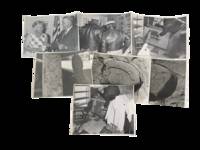
1950ref. 233981950. 1950s crime investigation archive documenting police evidence work during a period when departments increasingly relied on crime-scene photography forensic comparison procedure footwear evidence analysis fingerprint comparison and organized mid-century police evidence methodology to connect suspects to burglaries thefts and other property crimes. The material records officers inside a commercial or storage-room setting examining a desk or cabinet area inspecting the floor and documenting a shoeprint impression with a clearly visible sole pattern. One scene includes a Black officer standing among uniformed white officers a significant detail for mid-century police history since African American officers in many American cities were still restricted in assignment promotion or patrol authority during the 1940s and 1950s. The archive originated from Wisconsin house. Photo archive of 7 Very large format silver gelatin photographs each 11" x 13.75" United States circa 1950s-1960s. This archive showcases the order of investigative procedure with officers entering an interior crime scene locating possible points of entry or concealment documenting footwear evidence conducting footwear comparison analysis and marking distinctive characteristics for forensic comparison. Uniformed officers in leather jackets and peaked caps gather in a cramped small commercial setting lined with cardboard boxes while a Black officer is visible between them near the center of the room. Investigators examine the lower section of a desk or built-in counter with one man crouched partly underneath the work surface and another officer reaching toward the floor. Close-up evidence views record a shoeprint or boot impression pressed into dirt or soft material with original red circles marking specific cuts gouges or comparison points in the sole pattern. Additional views compare a dirty shoe sole against the recovered impression while another scene places a woman wearing a veterans' cap in conversation with a suited man in an office with an American flag possibly connected to witness victim or community context. The presence of a Black officer inside the active investigative setting adds a further historical layer placing African American law enforcement labor within the daily practice of police work at a time when many departments were only slowly expanding Black officers' authority beyond segregated or limited assignments. Light curling handling wear minor edge creasing and surface wear visible; images remain clear and detailed. Overall in very good condition. unknown
1950ref. 233981950. 1950s crime investigation archive documenting police evidence work during a period when departments increasingly relied on crime-scene photography forensic comparison procedure footwear evidence analysis fingerprint comparison and organized mid-century police evidence methodology to connect suspects to burglaries thefts and other property crimes. The material records officers inside a commercial or storage-room setting examining a desk or cabinet area inspecting the floor and documenting a shoeprint impression with a clearly visible sole pattern. One scene includes a Black officer standing among uniformed white officers a significant detail for mid-century police history since African American officers in many American cities were still restricted in assignment promotion or patrol authority during the 1940s and 1950s. The archive originated from Wisconsin house. Photo archive of 7 Very large format silver gelatin photographs each 11" x 13.75" United States circa 1950s-1960s. This archive showcases the order of investigative procedure with officers entering an interior crime scene locating possible points of entry or concealment documenting footwear evidence conducting footwear comparison analysis and marking distinctive characteristics for forensic comparison. Uniformed officers in leather jackets and peaked caps gather in a cramped small commercial setting lined with cardboard boxes while a Black officer is visible between them near the center of the room. Investigators examine the lower section of a desk or built-in counter with one man crouched partly underneath the work surface and another officer reaching toward the floor. Close-up evidence views record a shoeprint or boot impression pressed into dirt or soft material with original red circles marking specific cuts gouges or comparison points in the sole pattern. Additional views compare a dirty shoe sole against the recovered impression while another scene places a woman wearing a veterans' cap in conversation with a suited man in an office with an American flag possibly connected to witness victim or community context. The presence of a Black officer inside the active investigative setting adds a further historical layer placing African American law enforcement labor within the daily practice of police work at a time when many departments were only slowly expanding Black officers' authority beyond segregated or limited assignments. Light curling handling wear minor edge creasing and surface wear visible; images remain clear and detailed. Overall in very good condition. unknown books
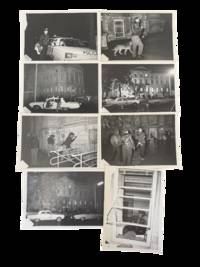
1960ref. 234741960. Police investigation photo archive depicting mid century law enforcement activity riot control operations and custodial procedures during the period when American police departments expanded specialized enforcement units in response to rising urban unrest and public disorder in the 1960s. After the riots in Watts in 1965 Newark and Detroit in 1967 and hundreds of smaller confrontations between police and civilians across American cities departments throughout the Midwest and East Coast increasingly organized motorcycle patrol divisions tactical crowd control units and coordinated search operations using dogs radios and mobile patrol systems. Police departments also adopted more militarized uniforms transportation fleets and surveillance procedures during the decade reflecting the growing emphasis on rapid response policing and visible authority in public spaces. The unidentified location and unnamed investigation place the archive within the broader operational culture of mid century American policing rather than a single sensational crime preserving the routine procedural atmosphere of municipal law enforcement during a period of national tension. Photo archive of 8 silver gelatin photographs likely Midwest or East Coast United States circa 1960s. A uniformed officer wearing a shoulder patch reading "Motorcycle patrol riot control" leads a police dog during a nighttime search outside a large civic building illuminated by streetlights and patrol vehicles. Several scenes show officers standing beside a man seated in the rear compartment of a police cruiser while smoking a cigarette. Additional photographs depict officers entering or exiting the building a sheriff standing inside a county jail entrance and investigators searching stairwells and sidewalks around the stone municipal building. Each print bears the "A.G. Oehler Photographer" stamp in the lower margin indicating professional or departmental photographic documentation for internal use. By the late 1960s many municipal departments reorganized patrol systems around riot squads motorcycle enforcement divisions and rapid mobilization units as demonstrations labor actions antiwar protests and urban unrest became recurring features of American public life. Light surface wear and occasional handling marks; overall in very good condition. Rather than focusing on dramatic violence these scenes preserve the quieter operational routines of custody perimeter searches interrogation transport and nighttime investigation that structured everyday police work during the era. unknown
1960ref. 234741960. Police investigation photo archive depicting mid century law enforcement activity riot control operations and custodial procedures during the period when American police departments expanded specialized enforcement units in response to rising urban unrest and public disorder in the 1960s. After the riots in Watts in 1965 Newark and Detroit in 1967 and hundreds of smaller confrontations between police and civilians across American cities departments throughout the Midwest and East Coast increasingly organized motorcycle patrol divisions tactical crowd control units and coordinated search operations using dogs radios and mobile patrol systems. Police departments also adopted more militarized uniforms transportation fleets and surveillance procedures during the decade reflecting the growing emphasis on rapid response policing and visible authority in public spaces. The unidentified location and unnamed investigation place the archive within the broader operational culture of mid century American policing rather than a single sensational crime preserving the routine procedural atmosphere of municipal law enforcement during a period of national tension. Photo archive of 8 silver gelatin photographs likely Midwest or East Coast United States circa 1960s. A uniformed officer wearing a shoulder patch reading "Motorcycle patrol riot control" leads a police dog during a nighttime search outside a large civic building illuminated by streetlights and patrol vehicles. Several scenes show officers standing beside a man seated in the rear compartment of a police cruiser while smoking a cigarette. Additional photographs depict officers entering or exiting the building a sheriff standing inside a county jail entrance and investigators searching stairwells and sidewalks around the stone municipal building. Each print bears the "A.G. Oehler Photographer" stamp in the lower margin indicating professional or departmental photographic documentation for internal use. By the late 1960s many municipal departments reorganized patrol systems around riot squads motorcycle enforcement divisions and rapid mobilization units as demonstrations labor actions antiwar protests and urban unrest became recurring features of American public life. Light surface wear and occasional handling marks; overall in very good condition. Rather than focusing on dramatic violence these scenes preserve the quieter operational routines of custody perimeter searches interrogation transport and nighttime investigation that structured everyday police work during the era. unknown books
1923Abundant black and white illustrations and reproductions of photos. Features: 'Twixt Sunset and Sunrise - Mining Engineer William Bartle relates a story from Mexico where, outside the large cities "no foreigner's life is worth a farthing"; The Cannibal Islands - Part II - photo-illustrated article by Clifford Collinson who has lived in the Solomon Islands for several years and, in this instalment, visits the little-known atolls of Ong-Tong-Java, with nice photos; The Disappearance of Annie Mooney - A thirty-year-old mystery is solved in a strange and unlooked-for manner - was she kidnapped by the Chinese all those years ago?; The Most Wonderful School in the World - A remarkable "sun-cure" establishment at Aigle in the Swiss mountains where children - recently hopeless cripples - learn their lessons and romp in deep snow clad only in loin-cloths and boots! - with photos; Obyada, Bad Indian - story related by a member of the Royal North-West Mounted police about a troublesome individual near Red Deer, Alberta; The Rum-Runner - the story of a sea captain's first smuggling voyage, as told in St. Pierre, headquarters of a fleet of ships engaged in the liquor-running business; Soliman the Seer - the mysterious fortune-teller of the Pyraid of Cheops; The Children of the Wilderness (Conclusion) - Juliet Bredon's photo-illustrated travels in little known Mongolia; A Wildfowling Adventure - a nasty little adventure on the Solway Firth; Fishing for Crocodiles - using a special hook and line; On Patrol - a quaint little experience related by a flying officer of the Royal Air Force; The MIssing Links - An Indian magician discovers a thief when the police had failed; Round the World With a Lasso - former Texas Ranger Captain George Ash tours the world giving exhibitions and training troops in the use of the lasso - article with photos; The Strangest Mutiny on Record - The Schooner Pedro Varela; Six Hundred Thousand Francs - One of the most audacious jewel robberies ever perpetrated (in Paris); and more. 88 pages plus 16 pages of nostalgic ads. Clean and unmarked with light wear. A quality copy of this excellent vintage issue. Book
ref. 199770Paris, Moutardier, 1829 4 tomes en 2 vol. in-8, demi-veau bleu, dos lisse orné (reliure moderne). Bon exemplaire.
ref. 199758Paris, Bourdin, 1836 3 tomes en 1 vol. in-8, demi-veau blond, dos lisse orné, couv. en couleurs cons. (rel. moderne). Qqs mouillures marginales.
ref. 25068Editions Fleuve Noir / Spécial Police n° 87 de 1956. In-12 broché de 187 pages au format 11,5 x 18 cm. Couverture de Michel Gourdon. Dos carré. Plats et intérieur parfaits. Texte de présentation et photo de Frédéric Dard au verso du 1er plat. Achevé d'imprimer du 1er trimestre 1956 sur les presses de l'imprimerie Foucault. Dernier numéro paru le 86 ( Peter Vanett - Trois jours à vivre ). Etat superbe, proche du neuf. . Edition originale avec au 4ème plat la publicité pour la collection " L'Aventurier ". Précieux exemplaire enrichi d'une cordiale dédicace autographe, signée, de Frédéric Dard. Provient de ma bibliothèque personnelle. Le roman fut adapté au cinéma par Robert Hossein, en 1955. Il est l'auteur du scénario, co-écrit avec René Wheeler, d’après la pièce de théâtre de Frédéric Dard, écrite en 1954. Les principaux rôles étaient tenus par Marina Vlady, Henri Vidal, Serge Reggiani, Jacques Duby, Robert Dalban, Robert Hossein.
ref. 208476À Paris, de l'Imprimerie de C. F. Patris, an XII -1804 in-8, [4]-340 pp., 14 portraits (dont un en frontispice), demi-basane marbrée, dos lisse orné, fleurons dorés, pièce de titre (Petibled). Mouillure claire en début d'ouvrage.
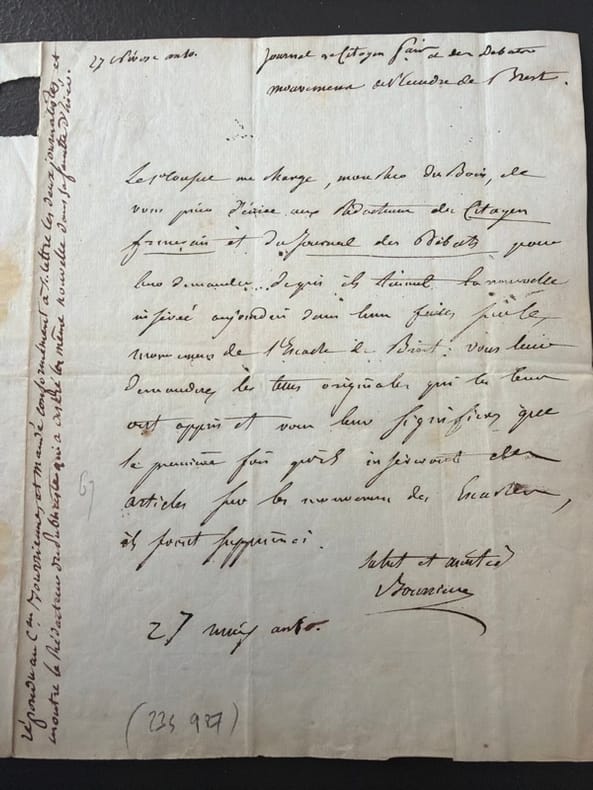
ref. 234987Paris, 27 Nivôse an X (17 janvier 1802) bifeuillet in-8, écrit au recto du premier feuillet, en feuille.
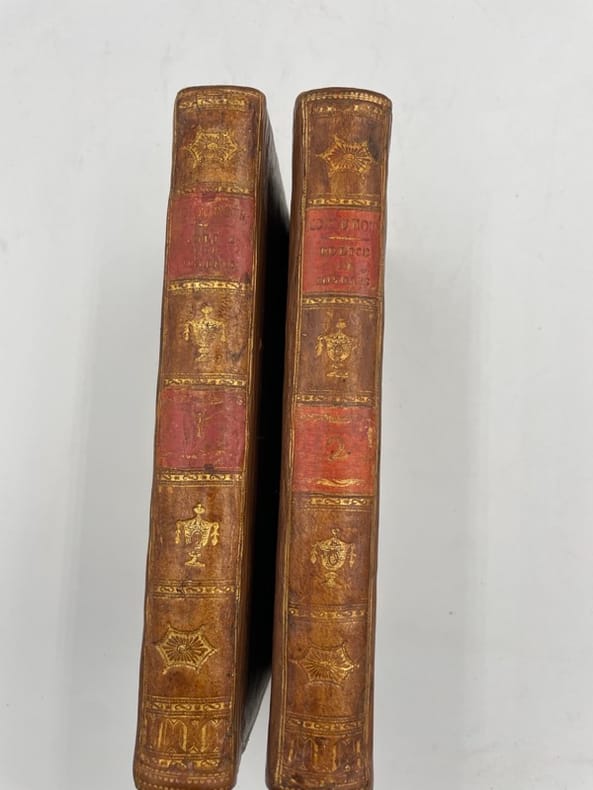
ref. 662532A Paris, chez Léopold Collin, 1807 2 vol. in-8, XX-424 pp. et 466 pp., tableaux dépliants, basane fauve, dos lisse orné, tranches citron mouchetées de rouge (reliure de l'époque). Mors restaurés.
ref. 13979614Paris: Léopold Collin, 1807 2 volumes in-8, xx-424 pages, 1 tableau se dépliant et 466 pages, 1 tableau se dépliant. Demi reliure d'ép. dos lisse ormé de fleurons, coiffes manquantes, dos frotté, très bon état intérieur. Première édition française, Quérard 698. De la bibliothèque de Frederic de Sevillia.