1 132 résultats
réf. RO30333289. Non daté. In-4. Relié demi-cuir. Etat d'usage, Couv. défraîchie, Dos frotté, Papier jauni. 560 pages. Nombreuses rousseurs. Texte sur deux colonnes. Nombreuses gravures en noir et blanc, in et hors texte. Mouillures. Salissures. Page de titre manquante. Filets, titre, auteur, fleurons en doré au dos. Epidermures. Coins frottés.. . . . Classification Dewey : 365-Prisons
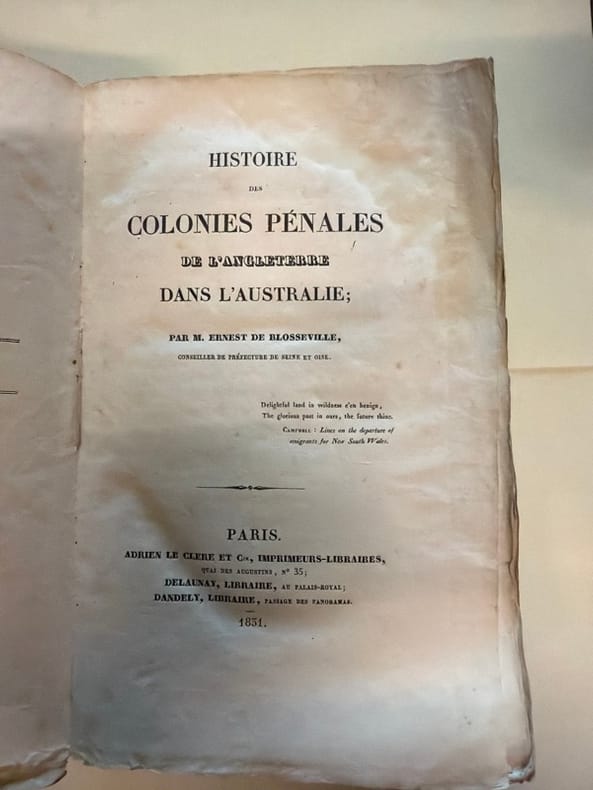
réf. 229559Paris, Le Clère et Cie, Delaunay et Dandely, 1831 in-8, 596 pp., biblio., broché. Qqs rousseurs. Mouillure angulaire.
2002réf. R320125672Le grand livre du mois. 2002. In-8. Broché. Bon état, Couv. convenable, Dos satisfaisant, Intérieur frais. 221 pages.. . . . Classification Dewey : 365-Prisons
réf. 7316Paris, Courcier, An 5, 1797. 4 volumes in-12, basane usagée de l'époque. Première édition, illustrée de 7 figures d'après Blanchard. Monglond (IV, 38) décrit l'exemplaire de la Bibliothèque nationale de France, doté également de sept figures sur les huit annoncées dans le titre.
réf. 73660Editions Privat 2002 livre étude 21*13,5 254 pages collection hommes et communautés
1859réf. GITj500Paris Typographie de Morris et Cie 1859. In-8 broché 475pp. Couverture légèrement poussiéreuse, pâles rousseurs par endroits. L'Auteur dénonce les traitements inhumains et dégradants auxquels sont soumis les détenus et réclame l'application de mesures telles que la fin de l'isolement et le travail en commun, qui devraient faciliter la réinsertion des condamnés.
réf. 223830Paris, Alexis Eymery, 1814 in-8, X-175 pp., bradel demi-basane fauve mouchetée, couverture muette grise conservée (reliure moderne). Petit frottement en queue de dos. Mouillure au titre, quelques rousseurs.
réf. 242166Paris, Alexis Eymery, 1814 in-8, X-176 pp., broché, couverture papier bleu de l'époque. Couverture un peu défraîchie.
réf. 13976065Paris: Alexis Eymery, 1814 in-8, 176 pages. Reliure moderne basane brune, dos à nerfs, fleuron. Qqs rousseurs, cachets.
1814réf. 103Paris, Alexis Eymery, 1814, in-8°, X-176 pages, broché.
1840réf. 44557Paris, Guillaumin, 1840. In-8 de (4)446-(1) pp., demi-chagrin noir, dos à nerfs, tête dorée, non rogné, couverture conservée (Canape).
réf. 35601105, Paris, Guillaumin, 1840; in-8, demi-veau fauve, tranches jasp.(Rel. de l’ép.). 2 ff., 446 pp., 1f.- EDITION ORIGINALE. Livre rare. L’auteur, natif de Paris en 1801, un normalien qui se vit fermer la carrière universitaire parce que trop indépendant, émigra à Guernesey où il enseigna au collège Elisabeth. Il revint en France après la Révolution de 1830 et se lança dans le journalisme au Courrier français, à la Tribune, au Temps, au Constitutionnel, etc. Les gendarmes et les voleurs semblaient l’inspirer, car on lui doit des ouvrages sur Vidocq, Cartouche. Ici il étudie les anciennes prisons de la Seine et leur administration, le dépôt de la Préfecture, Clichy prison pour dettes, Sainte-Pélagie, maison d’arrêt et de correction, prison d’Etat sous l’Empire, la Conciergerie, Bicêtre, La Force, les prisons d’Etat modernes, le Temple et Vincennes. Nombreux documents inédits. Bel exemplaire, provenant de la bibliothèque de N. FAULQUIER qui fut président du tribunal de Clamecy (Nièvre) vers 1850.(Initiales manuscrites sur la garde).
réf. 226940Paris, Desenne, avril 1790 in-8, 124 pp., dérelié.
1885réf. GITj568Paris Aux Bureaux du Progrès Médical, Delahaye et Lecrosnier 1885. 2 volumes fort in-8 brochés LVIII 1 feuillet non chiffré errata et VI 605pp. Sans le 2e plat de la couverture du Tome I; pâles rousseurs sur les couverture, intérieur frais, complet, non coupé. Réimpression soignée de l'édition de 1579, tirée à 500 exemplaires, celui-ci 1 des 350 sur papier parchemin, non justifié.
réf. 1333929358.Gpaperback. Good. Access codes and supplements are not guaranteed with used items. May be an ex-library book. paperback
1901pp. vii, 306, xxiii [87th Regiment Roster] + Numerous photographs. Profusely illustrated with drawings. Inked ownership of M. O. Smith, 1901, on title page. Mildly XLib. Some signatures loose. 8vo. Original full cloth binding. Gilt lettered. Hardbound. A very good copy of the First Edition of this classic Civil War regimental history. Dornbusch P-238; Nevins I. PA 36
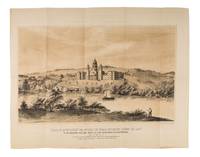
1856réf. 823091856. A New Hampshire Prison "For Juvenile and Female Offenders" Prisons. New Hampshire. "House of Reformation for Juvenile and Female Offenders Against the Laws" To be Erected for the State of New Hampshire at Manchester. Under the Direction of Hon. Frederick Smith Hon. Matthew Harvey and Hon. Hosea Eaton Commissioners. William R. Lincoln and Gridley J.F. Bryant Designers and Architect. Disbound from First Annual Report of the Commissioner for Locating and Building House of Reformation for Juvenile and Female Offenders Against the Laws. Concord: Amos Hadley State Printer 1856. Lithograph signed Kramer & Co. Removed 16-3/4" x 21-3/4" 42.5 x 55.25 cm sepia lithograph image size 11-1/2" x 19" 29.2 x 48.25 cm. Moderate toning faint offsetting horizontal and vertical fold lines a few tiny clean tears along fold lines with minor loss to image. $450. An impressive mid-19th-century architectural rendering showing the proposed reformatory situated along the banks of the Merrimack River in Manchester New Hampshire. Authorized by the state legislature in 1855 construction began on the site the following year. The structure was designed by the prominent Boston architect Gridley J.F. Bryant 1816-1899 a pioneer in Victorian institutional architecture who designed numerous municipal buildings custom houses and prisons throughout New England and who would later renovate the New Hampshire State House in 1866. Bryant worked here alongside co-designer William R. Lincoln. Intended as a progressive state-of-the-art facility for the rehabilitation of juvenile and female offenders the House of Reformation officially opened in 1858. The grand building depicted here was short-lived however; it was severely damaged and largely destroyed by a catastrophic fire in 1865. The site was subsequently rebuilt and went on to become the long-running State Industrial School later the Youth Development Center. OCLC locates 3 individually catalogued copies of this lithograph Library Company of Philadelphia Boston Athenaeum American Antiquarian Society. We located additional copies at Dartmouth and the New Hampshire Historical Society. Reed Building Victorian Boston: The Architecture of Gridley J.F. Bryant 186. unknown
1856réf. 823091856. A New Hampshire Prison "For Juvenile and Female Offenders" Prisons. New Hampshire. "House of Reformation for Juvenile and Female Offenders Against the Laws" To be Erected for the State of New Hampshire at Manchester. Under the Direction of Hon. Frederick Smith Hon. Matthew Harvey and Hon. Hosea Eaton Commissioners. William R. Lincoln and Gridley J.F. Bryant Designers and Architect. Disbound from First Annual Report of the Commissioner for Locating and Building House of Reformation for Juvenile and Female Offenders Against the Laws. Concord: Amos Hadley State Printer 1856. Lithograph signed Kramer & Co. Removed 16-3/4" x 21-3/4" 42.5 x 55.25 cm sepia lithograph image size 11-1/2" x 19" 29.2 x 48.25 cm. Moderate toning faint offsetting horizontal and vertical fold lines a few tiny clean tears along fold lines with minor loss to image. $450. An impressive mid-19th-century architectural rendering showing the proposed reformatory situated along the banks of the Merrimack River in Manchester New Hampshire. Authorized by the state legislature in 1855 construction began on the site the following year. The structure was designed by the prominent Boston architect Gridley J.F. Bryant 1816-1899 a pioneer in Victorian institutional architecture who designed numerous municipal buildings custom houses and prisons throughout New England and who would later renovate the New Hampshire State House in 1866. Bryant worked here alongside co-designer William R. Lincoln. Intended as a progressive state-of-the-art facility for the rehabilitation of juvenile and female offenders the House of Reformation officially opened in 1858. The grand building depicted here was short-lived however; it was severely damaged and largely destroyed by a catastrophic fire in 1865. The site was subsequently rebuilt and went on to become the long-running State Industrial School later the Youth Development Center. OCLC locates 3 individually catalogued copies of this lithograph Library Company of Philadelphia Boston Athenaeum American Antiquarian Society. We located additional copies at Dartmouth and the New Hampshire Historical Society. Reed Building Victorian Boston: The Architecture of Gridley J.F. Bryant 186. unknown books
réf. 55786Paris, L'Harmattan, 2005. 13 x 21, 267 pp., broché, très bon état.
réf. 0656213485.Ghardcover. Good. Access codes and supplements are not guaranteed with used items. May be an ex-library book. hardcover
réf. 1333741480.Gpaperback. Good. Access codes and supplements are not guaranteed with used items. May be an ex-library book. paperback
réf. 13692Albany, Superintendent of State Prisons (impr/pr: J. B. Lyon), sd / nd. In-4 oblong, 203-(9) pp., cartonnage éditeur pleine toile imprimé (coiffes et coins de la reliure frottés, garde volante supérieure détachée). Sans la liste des prix. // Oblong 4to, 203-(9) p., publisher's printed clothbound hardcover (wear to binding spine-ends and corners, front flyleaf detached). Without the price list.
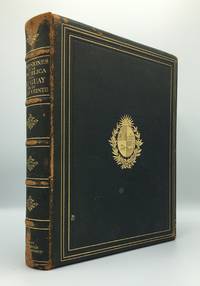
1912réf. 1080Londres etc.: Lloyds Greater Britain Publishing Company Limited. 1912. First edition. Large quarto. Publisher's original full dark-green morocco; the upper board triple-ruled in gilt and with the Uruguayan crest in gilt; the spine with five raised bands compartments ruled and decorated in gilt and with titles in gilt. All edges gilt. Marbled endpapers. Title page contents page introduction and first text page with gilt borders and embellishments. Illustrated profusely throughout with black and white photographs and one map. Ownership inscription of the Australian writer Mary Gilmore to the head of the title page: "Mary Gilmore / Her book / 16. 3. 26". A very good copy the binding square and firm with a few small marks and scuffs to the boards rubbing to the spine and joints and wear to the corners. The contents with scattered foxing to the endpapers are otherwise in very good order and clean throughout. An interesting association copy of this comprehensive extensively illustrated and luxuriously produced survey of the people culture history politics economy industry agriculture geography and natural history of Uruguay at the beginning of the twentieth-century belonging to the influential Australian author journalist and poet Dame Mary Gilmore 1865-1962. A prolific contributor to Australian literature and the broader national discourse during the first half of the twentieth-century Gilmore wrote for a number of leading newspapers and journals of the period serving as the editor of the women's section of The Australian Worker 1908-1931 as well as The Bulletin The Sydney Morning Herald and the Communist Party's Tribune becoming known as a campaigner for the welfare of the disadvantaged. Her first volume of poetry was issued in 1910 thereafter publishing prodigiously for the ensuing half-century coming to be regarded as one of Australia's most popular and widely read poets. Her poetry essays and memoirs covered a wide variety of themes although public imagination was particularly captured by her evocative views of country life with her best known work - 'No Foe Shall Gather Our Harvest' - serving as a morale booster during the Second World War. A political progressive Gilmore gained a reputation as a 'fiery radical' - a champion of the workers and the oppressed. Involving herself with the burgeoning labour movement early in her life she had become a devotee of the utopian socialism of William Lane 1861-1917. In 1896 Gilmore and two hundred others followed Lane to Paraguay where they established a communal settlement called New Australia. She started a family there with William Gilmore whom she married in 1897 but the colony was ultimately short-lived with Gilmore leaving in 1900 living in Buenos Aires for six months followed by a period in Patagonia returning to Australia in 1902 after having saved enough money for a return passage. Gilmore maintained a strong interest in Latin American politics culture and literature for the rest of her life. Indeed she also engaged in translation projects bringing Latin American literature to a wider audience notably endeavouring to produce a 'Uruguayan anthology' for which she corresponded with friends and associates in the country. This was perhaps also the origin of the present volume which itself forms a pleasing representation of Gilmore's wide-ranging ambitions. By her later years Gilmore was a doyenne of the Sydney literary world and became something of a national icon making frequent appearances in the new media of radio and television and maintaining a significant literary output into old age publishing her last book of verse in 1954 aged 89. She died at the age of 97 and was accorded a state funeral a rare honour for a writer and has featured on the reverse of the Australian ten-dollar note since 1993. Londres [etc.]: Lloyds Greater Britain Publishing Company, Limited. hardcover
réf. 30815P., Flammarion, sans date (vers 1898), in 12 broché, VII-411pp. ; couverture fanée avec fortes rousseurs.
1991233 pages. Footnotes. Bibliography. Index. Reproduction of black and white photo in text. "This compelling first-person account deepens our appreciation of the conflicts, failures, and triumphs of those who find themselves in the hands of their nation's enemies." - from dust jacket. Unmarked but for one high-lighted word in bibliography. Binding tight. Moderate overall wear. Dust jacket now preserved in glossy new archival-grade Brodart. A sound copy. EDWARDS 1582. Book