3.319 Ergebnisse
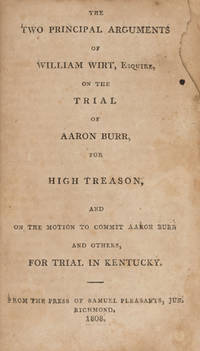
1808Best.-Nr. 849821808. Richmond: From the Press of Samuel Pleasants 1808. Richmond: From the Press of Samuel Pleasants 1808. Streeter 1693: The Prosecution's Arguments at the Burr Treason Trial Trial. Burr Aaron 1756-1836 Defendant. Wirt William 1772-1834. The Two Principal Arguments of William Wirt Esquire On the Trial of Aaron Burr For High Treason And on the Motion to Commit Aaron Burr and Others For Trial in Kentucky. Richmond: From the Press of Samuel Pleasants Jun. 1808. iv 221 pp. Advertisement leaf follows title page. Not issued with the portrait frontispiece of Aaron Burr which is true of only a few copies. 12mo. 5-3/4" x 3-1/2"; 14.6 x 8.9 cm. Contemporary tree calf gilt title and ornaments to spine endpapers renewed with marbled paper. Light rubbing nicks and scratches to boards moderate rubbing to extremities front hinge cracked chips to spine ends and front board at foot of joint and lower outside corner corners bumped and somewhat worn. Moderate toning to interior light browning light foxing and faint dampstaining in places chips to fore-edges of front endleaf and title page. A very good copy overall. $2500. Only edition. Burr was implicated in a plot to steal land from Mexico and the Louisiana Purchase in order to establish an independent country. Arrested and tried in 1807 on charges of treason he was acquitted due to a lack of specific evidence. Wirt his prosecutor was United States Attorney for the District of Virginia. His famous principal speech in the trial of Aaron Burr lasting nearly four hours. Characterized by considerable eloquence wit and logic it enhanced his national stature. Wirt went on to serve as United States Attorney General under Presidents Monroe and John Quincy Adams where he did much to define the office and enhance its stature. The last copy at auction was sold at Sotheby's in 2021 for $2142. Like ours it does not have a frontispiece. Streeter The Celebrated Collection of Americana Formed by the Late Thomas Winthrop Streeter 1693 with frontispiece. Identical to our copy: Cohen Bibliography of Early American Law 14120. Howes USIana W-587. Sabin A Dictionary of Books Relating to America 104883. unknown books
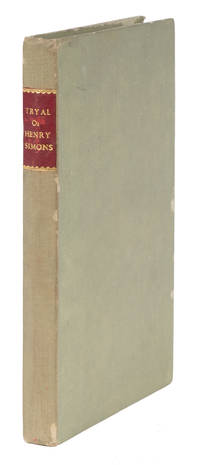
1753Best.-Nr. 723961753. The First Instance of a New Trial Being Granted in a Criminal Case in England Trial. Simons Henry Defendant. The Case of Henry Simons A Polish Jew Merchant; And His Appeal to the Public Thereon. Now Publish'd With the Tryal at Chelmsford For the Benefit of Him and His Unhappy Family. London: Printed And Sold by All the Booksellers and Pamphlet Shops in Town and Country 1753. 115 pp. Bound with Ashley James Defendant. Simons Henry Plaintiff. The Case and Appeal of James Ashley of Bread-Street London: Addressed to the Publick in General. . To Which is Prefixed A Curious Print of the Person and Dress of the Said Henry Simons. London: Printed for And Published by The Appellant 1753. viii 47 pp. Text printed in double columns. Etched portrait frontispiece of Simons. Octavo 7-3/4" x 4-1/2". Stab-stitched pamphlets bound into recent cloth calf lettering piece to spine. Light stains to boards moderate rubbing to extremities small scuff to lettering piece later owner bookplate of English lawyer and judge Geoffrey G. Briggs 1914-1993 to front free endpaper. Moderate toning to both pamphlets left-hand edge of plate but not image affected by trimming light foxing and owner inscription "Wm. Greenwood's 1811" to title page of The Case tiny worm hole to lower-right corner of its text block through p. 91. $2500. Only editions Case and Appeal one of three issues. This was the first instance of a new trial being granted in a criminal case in England. The affair concerned the robbery of gold coins entrusted to Simons by a group of nobles from his hometown. The case resulted in six trials three pamphlets and a great deal of debate in the daily newspapers much of it antisemitic. The thief appeared to have been Simons's innkeeper but it later turned out to be James Ashley who was first convicted then acquitted then convicted again. English Short-Title Catalogue T95662 T76809. unknown
1753Best.-Nr. 723961753. The First Instance of a New Trial Being Granted in a Criminal Case in England Trial. Simons Henry Defendant. The Case of Henry Simons A Polish Jew Merchant; And His Appeal to the Public Thereon. Now Publish'd With the Tryal at Chelmsford For the Benefit of Him and His Unhappy Family. London: Printed And Sold by All the Booksellers and Pamphlet Shops in Town and Country 1753. 115 pp. Bound with Ashley James Defendant. Simons Henry Plaintiff. The Case and Appeal of James Ashley of Bread-Street London: Addressed to the Publick in General. . To Which is Prefixed A Curious Print of the Person and Dress of the Said Henry Simons. London: Printed for And Published by The Appellant 1753. viii 47 pp. Text printed in double columns. Etched portrait frontispiece of Simons. Octavo 7-3/4" x 4-1/2". Stab-stitched pamphlets bound into recent cloth calf lettering piece to spine. Light stains to boards moderate rubbing to extremities small scuff to lettering piece later owner bookplate of English lawyer and judge Geoffrey G. Briggs 1914-1993 to front free endpaper. Moderate toning to both pamphlets left-hand edge of plate but not image affected by trimming light foxing and owner inscription "Wm. Greenwood's 1811" to title page of The Case tiny worm hole to lower-right corner of its text block through p. 91. $2500. Only editions Case and Appeal one of three issues. This was the first instance of a new trial being granted in a criminal case in England. The affair concerned the robbery of gold coins entrusted to Simons by a group of nobles from his hometown. The case resulted in six trials three pamphlets and a great deal of debate in the daily newspapers much of it antisemitic. The thief appeared to have been Simons's innkeeper but it later turned out to be James Ashley who was first convicted then acquitted then convicted again. English Short-Title Catalogue T95662 T76809. unknown books
1803Best.-Nr. 16593Paris, C. F. Patris, 1803. In-8 de (4)-281 pp., veau blond, dos lisse orné, pièce de titre en maroquin vert, roulette dorée d'encadrement sur les plats, ex-dono au centre du premier plat, tranches marbrées (reliure de l'époque).
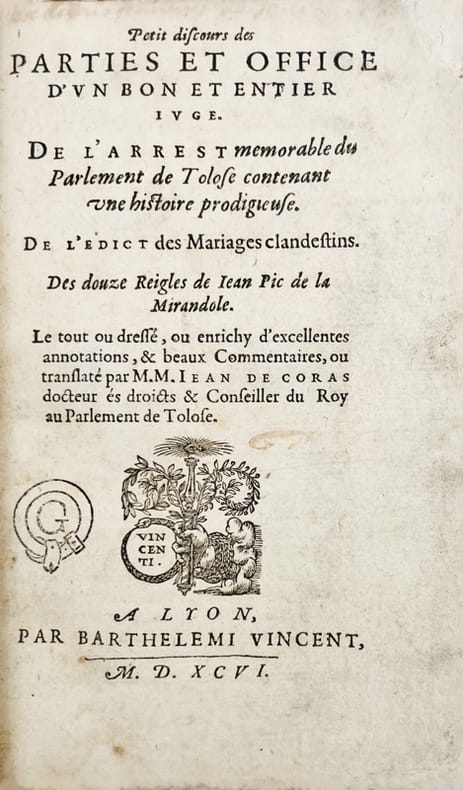
1596Best.-Nr. 44490Lyon, Barthelemi Vincent, 1596. 3 parties en 1 vol. petit in-8 de 80-(16)-160 pp., 16 ff., maroquin havane, dos titré à nerfs, armes dorées au centre des plats et super-libris en pied, roulette dorée sur les chasses et double filet doré sur les coupes, signet de soie verte, tranches dorées (Niédrée).
1764Best.-Nr. 20377[Paris] Le Breton 1764 in-8 demi-veau fauve moucheté, coins en vélin, dos à nerfs orné de fleurons et caissons dorés, pièce de titre rouge [Rel. mod. à l'imitation]
1818Best.-Nr. 820231818. The End of Trial by Battle in the United Kingdom Broadside. Trial. Thornton Abraham c.1793-1860 Respondent. Appeal of Murder: The Decision of the Judges in the Case of Ashford ver. Thornton Court of King's Bench April 20th 1818. Nottingham: Shorrock and Son Successors to E. Hodson Printers 1818. 12-1/2" x 7-1/2" broadside mounted to later backing sheet text in two columns separated by rule below headline and woodcut vignette of a landscape. Moderate toning light soiling to edges a few faint creases printer's flaw and clean tear to right column no loss to legibility. Rare. $3000. Ashford v. Thornton dealt with the aftermath of the murder of Mary Ashford in 1817. Abraham Thornton who had seen and been intimate with Ashford the previous night was tried for rape and murder but acquitted of both charges due to a lack of evidence and inconsistencies in the prosecutor's case. Public outcry around his acquittal led to Mary's brother William invoking an "appeal of murder." This uncommon legal practice allowed a retrial of a defendant acquitted for murder but crucially gave the defendant the right to trial by battle. Thornton invoked that right. After extensive proceedings in the Court of King's Bench the court found that he was eligible to do so. Our broadside documents the final hearing in which Ashford declined to battle with Thornton and withdrew his appeal. Thornton was given a pro forma arraignment and released. The case resulted in the abolition of appeals by murder and thus the end of trial by battle. This broadside is rare and appears to be unrecorded. No copies located on OCLC or Library Hub. Not at Harvard or the British Library. unknown
1818Best.-Nr. 820231818. The End of Trial by Battle in the United Kingdom Broadside. Trial. Thornton Abraham c.1793-1860 Respondent. Appeal of Murder: The Decision of the Judges in the Case of Ashford ver. Thornton Court of King's Bench April 20th 1818. Nottingham: Shorrock and Son Successors to E. Hodson Printers 1818. 12-1/2" x 7-1/2" broadside mounted to later backing sheet text in two columns separated by rule below headline and woodcut vignette of a landscape. Moderate toning light soiling to edges a few faint creases printer's flaw and clean tear to right column no loss to legibility. Rare. $3000. Ashford v. Thornton dealt with the aftermath of the murder of Mary Ashford in 1817. Abraham Thornton who had seen and been intimate with Ashford the previous night was tried for rape and murder but acquitted of both charges due to a lack of evidence and inconsistencies in the prosecutor's case. Public outcry around his acquittal led to Mary's brother William invoking an "appeal of murder." This uncommon legal practice allowed a retrial of a defendant acquitted for murder but crucially gave the defendant the right to trial by battle. Thornton invoked that right. After extensive proceedings in the Court of King's Bench the court found that he was eligible to do so. Our broadside documents the final hearing in which Ashford declined to battle with Thornton and withdrew his appeal. Thornton was given a pro forma arraignment and released. The case resulted in the abolition of appeals by murder and thus the end of trial by battle. This broadside is rare and appears to be unrecorded. No copies located on OCLC or Library Hub. Not at Harvard or the British Library. unknown books
1914Best.-Nr. 659851914. New York 1912-1914. Image in 30-1/2" x 24" frame. New York 1912-1914. Image in 30-1/2" x 24" frame. "His Famous Wig Composed Entirely of Split Hairs and Adorned with the Ceremonial Crimson Tape" Robinson Boardman 1876-1952. Becker-Rosenthal Murder Trial. Mr. Justice Precedent. New York 1914. 21" x 15-1/2" 53.3 x 39.4 cm gouache image on 26" x 19-1/2" 66 x 49.5 cm sheet image signed twice and inscribed by Robinson caption in pencil below image most likely in another hand laid down on illustration board. Image in 30-1/2" x 24" 77.5 x 60.9 cm wooden frame glazed. Light soiling a few minor stains and four crop-marks to margins outside of image which could be covered with a matte image fine. Several minor scuffs and nicks to frame. An exceptional unique piece of original artwork capturing a defining moment in American legal and criminal history. $3500. This striking original gouache was created to illustrate "Leaden Footed Justice in New York State" a feature article published in the Special Feature section of the New York Tribune on Sunday March 1 1914. The penciled caption reads:"Mr. Justice Precedent wearing his famous wig composed entirely of split hairs and adorned with the ceremonial crimson tape." The caricature was a scathing commentary on the notoriously protracted bureaucratically tangled legal proceedings of the Becker-Rosenthal Murder case which centered on NYPD Police Lieutenant Charles Becker who ran a massive protection racket targeting illegal Manhattan casinos. When gambling house owner Herman Rosenthal threatened to expose Becker's corruption to District Attorney Charles S. Whitman Becker hired a gang of underworld executioners including "Gyp the Blood" and "Lefty Louie" to gun Rosenthal down outside the Hotel Metropole. The investigation and subsequent trials completely dominated New York front pages. Becker's first trial began on October 7 1912 resulting in a conviction that was subsequently overturned on appeal by the New York Court of Appeals due to judicial bias. His highly anticipated second trial began on May 6 1914 just over two months after this cartoon appeared. Becker was convicted a second time and after his appeals were exhausted in 1915 went to the electric chair at Sing Sing-marking the first time in U.S. history a police officer was executed for murder. The case profoundly shook the public psyche and entered the cultural lexicon most. unknown
1914Best.-Nr. 659851914. New York 1912-1914. Image in 30-1/2" x 24" frame. New York 1912-1914. Image in 30-1/2" x 24" frame. "His Famous Wig Composed Entirely of Split Hairs and Adorned with the Ceremonial Crimson Tape" Robinson Boardman 1876-1952. Becker-Rosenthal Murder Trial. Mr. Justice Precedent. New York 1914. 21" x 15-1/2" 53.3 x 39.4 cm gouache image on 26" x 19-1/2" 66 x 49.5 cm sheet image signed twice and inscribed by Robinson caption in pencil below image most likely in another hand laid down on illustration board. Image in 30-1/2" x 24" 77.5 x 60.9 cm wooden frame glazed. Light soiling a few minor stains and four crop-marks to margins outside of image which could be covered with a matte image fine. Several minor scuffs and nicks to frame. An exceptional unique piece of original artwork capturing a defining moment in American legal and criminal history. $3500. This striking original gouache was created to illustrate "Leaden Footed Justice in New York State" a feature article published in the Special Feature section of the New York Tribune on Sunday March 1 1914. The penciled caption reads:"Mr. Justice Precedent wearing his famous wig composed entirely of split hairs and adorned with the ceremonial crimson tape." The caricature was a scathing commentary on the notoriously protracted bureaucratically tangled legal proceedings of the Becker-Rosenthal Murder case which centered on NYPD Police Lieutenant Charles Becker who ran a massive protection racket targeting illegal Manhattan casinos. When gambling house owner Herman Rosenthal threatened to expose Becker's corruption to District Attorney Charles S. Whitman Becker hired a gang of underworld executioners including "Gyp the Blood" and "Lefty Louie" to gun Rosenthal down outside the Hotel Metropole. The investigation and subsequent trials completely dominated New York front pages. Becker's first trial began on October 7 1912 resulting in a conviction that was subsequently overturned on appeal by the New York Court of Appeals due to judicial bias. His highly anticipated second trial began on May 6 1914 just over two months after this cartoon appeared. Becker was convicted a second time and after his appeals were exhausted in 1915 went to the electric chair at Sing Sing-marking the first time in U.S. history a police officer was executed for murder. The case profoundly shook the public psyche and entered the cultural lexicon most. unknown books
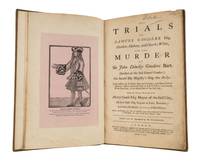
1741Best.-Nr. 859421741. Contemporary Account of an 18th-Century Fratricide Case Overlooked by the ESTC Extra-Illustrated by a Notable 19th-Century Collector Includes Two Unrecorded Broadsides. Trial. Goodere Sir Samuel 1687-1741 Principal Defendant. The Trials of Samuel Goodere Esq; Matthew Mahony And Charles White For the Murder of Sir John Dineley Goodere Bart. Brother to the Said Samuel Goodere On Board His Majesty's Ship the Ruby: At the Sessions of the Peace Oyer and Terminer And General Goal-Delivery Held in and for the City of Bristol And County of the Same City In the Guild-Hall of the Said City; Before the Right Worshipful Henry Combe Esq; Mayor of the Said City Michael Foster Esq; Serjeant at Law Recorder; And Others His Majesty's Justices of Goal-Delivery. Begun on Tuesday the 17th of March 1740. And Continued by Adjournment to Thursday The 26th of the Same Month 1741. Publish'd with the Approbation of Mr. Recorder. London: Printed by A. Millar et al. 1741. ii 53 1 blank pp. With an initial leaf headed "Goal Delivery Grand Jurors March 17. 1740." Printed without bookseller advertisement to verso of final leaf. Folio 12-3/4" x 8"; 32.6 x 20.4 cm. Stab-stitched pamphlet bound in late nineteenth-century cloth gilt title to spine. Light shelfwear to exterior spine ends and corners bumped and worn. Moderate toning to interior occasional light foxing and soiling blind-embossed library stamps of the Corporation of Bristol City Library to right margin of first several leaves title page reinforced at fore-edge on verso. Three later annotations detailing this item's provenance to front endleaf early owner signature "W. Mallard" to head of title page. Later sheet with tipped-on woodcut illustration of Goodere bound before title page double-page copperplate engraving dated 1741 bound after title page 6 items related to the Goodere murder bound after text block some mounted to blank leaves 2 of these have extensive annotations to their versos by Mallard. A very good copy with interesting enhancements included two unrecorded contemporary items. $3500. Only edition one of two 1741 issues. The most complete account of this trial. The trial of Sir Samuel Goodere is a classic of English criminal history. The details are particularly grisly because of the breach of both familial and naval du. unknown
1741Best.-Nr. 859421741. Contemporary Account of an 18th-Century Fratricide Case Overlooked by the ESTC Extra-Illustrated by a Notable 19th-Century Collector Includes Two Unrecorded Broadsides. Trial. Goodere Sir Samuel 1687-1741 Principal Defendant. The Trials of Samuel Goodere Esq; Matthew Mahony And Charles White For the Murder of Sir John Dineley Goodere Bart. Brother to the Said Samuel Goodere On Board His Majesty's Ship the Ruby: At the Sessions of the Peace Oyer and Terminer And General Goal-Delivery Held in and for the City of Bristol And County of the Same City In the Guild-Hall of the Said City; Before the Right Worshipful Henry Combe Esq; Mayor of the Said City Michael Foster Esq; Serjeant at Law Recorder; And Others His Majesty's Justices of Goal-Delivery. Begun on Tuesday the 17th of March 1740. And Continued by Adjournment to Thursday The 26th of the Same Month 1741. Publish'd with the Approbation of Mr. Recorder. London: Printed by A. Millar et al. 1741. ii 53 1 blank pp. With an initial leaf headed "Goal Delivery Grand Jurors March 17. 1740." Printed without bookseller advertisement to verso of final leaf. Folio 12-3/4" x 8"; 32.6 x 20.4 cm. Stab-stitched pamphlet bound in late nineteenth-century cloth gilt title to spine. Light shelfwear to exterior spine ends and corners bumped and worn. Moderate toning to interior occasional light foxing and soiling blind-embossed library stamps of the Corporation of Bristol City Library to right margin of first several leaves title page reinforced at fore-edge on verso. Three later annotations detailing this item's provenance to front endleaf early owner signature "W. Mallard" to head of title page. Later sheet with tipped-on woodcut illustration of Goodere bound before title page double-page copperplate engraving dated 1741 bound after title page 6 items related to the Goodere murder bound after text block some mounted to blank leaves 2 of these have extensive annotations to their versos by Mallard. A very good copy with interesting enhancements included two unrecorded contemporary items. $3500. Only edition one of two 1741 issues. The most complete account of this trial. The trial of Sir Samuel Goodere is a classic of English criminal history. The details are particularly grisly because of the breach of both familial and naval du. unknown books
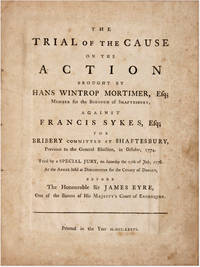
1776Best.-Nr. 712211776. London: S.n. 1776. London: S.n. 1776. An Account of a Notorious Case of Election Bribery Bound with a Related Unrecorded Broadside Trial. Sykes Francis 1730-1804 Defendant. Mortimer Hans Wintrop Plaintiff. The Trial of the Cause on the Action Brought by Hans Wintrop Mortimer Esq; Member for the Borough of Shaftesbury Against Francis Sykes Esq; For Bribery Committed at Shaftesbury Previous to the General Election In October 1774. Tried by a Special Jury On Saturday the 27th of July 1776. At the Assize Held at Dorchester for the County of Dorset Before The Honourable Sir James Eyre One of the Barons of His Majesty's Court of Exchequer. London: S.n. 1776. 19 1 pp. Main text in parallel columns. Quarto 9-3/4" x 7-1/2"; 24.8 x 19 cm. Bound with Text Two later tipped-in leaves of notes. Affixed to one of these leaves are a contemporary account of the trial and a section of a letter in Mortimer's hand. And Tipped-in contemporary 14" x 21" 35.5 x 53.3 cm mezzotint by an unknown artist The Shaftsbury Election or the Humours of Punch 1775. Additional annotations about the mezzotint to front endleaves one followed by two ownership inscriptions one of Henry White. Affixed to one of these is a small clipping about the Mortimer family. And Broadside. Mortimer Hans Winthrop. To the Worthy Electors of the Borough of Shaftsbury. Shafton: s.l. 11 June 1790. Trimmed to 9" x 6" 22.8 x 15.2 cm and affixed to verso of title page. Nineteenth-century calf rebacked in period style gilt rules to boards gilt fillets and retained nineteenth-century lettering piece to spine hinges mended marbled endleaves. Moderate rubbing to boards and toning to text occasional early underlining and brief notes in pencil. $3500. THIS DESCRIPTION IS TRUNCATED DUE TO CHARACTER LIMITS. PLEASE CONTACT US FOR A COMPLETE VERSION. The Shaftesbury Election of 1774 stands as one of the most infamous instances of parliamentary corruption in 18th-century England. Ministerial candidates Sir Francis Sykes and Sir Thomas Rumbold bribed electors with thousands of pounds routing money through a masked figure known as "Punch" to avoid direct liability. Voters were given cash in exchange for signing promissory notes payable to an imaginary figure named "Glenbucket". The defeated candidate Hans Winthrop Mortimer. unknown
1776Best.-Nr. 712211776. London: S.n. 1776. London: S.n. 1776. An Account of a Notorious Case of Election Bribery Bound with a Related Unrecorded Broadside Trial. Sykes Francis 1730-1804 Defendant. Mortimer Hans Wintrop Plaintiff. The Trial of the Cause on the Action Brought by Hans Wintrop Mortimer Esq; Member for the Borough of Shaftesbury Against Francis Sykes Esq; For Bribery Committed at Shaftesbury Previous to the General Election In October 1774. Tried by a Special Jury On Saturday the 27th of July 1776. At the Assize Held at Dorchester for the County of Dorset Before The Honourable Sir James Eyre One of the Barons of His Majesty's Court of Exchequer. London: S.n. 1776. 19 1 pp. Main text in parallel columns. Quarto 9-3/4" x 7-1/2"; 24.8 x 19 cm. Bound with Text Two later tipped-in leaves of notes. Affixed to one of these leaves are a contemporary account of the trial and a section of a letter in Mortimer's hand. And Tipped-in contemporary 14" x 21" 35.5 x 53.3 cm mezzotint by an unknown artist The Shaftsbury Election or the Humours of Punch 1775. Additional annotations about the mezzotint to front endleaves one followed by two ownership inscriptions one of Henry White. Affixed to one of these is a small clipping about the Mortimer family. And Broadside. Mortimer Hans Winthrop. To the Worthy Electors of the Borough of Shaftsbury. Shafton: s.l. 11 June 1790. Trimmed to 9" x 6" 22.8 x 15.2 cm and affixed to verso of title page. Nineteenth-century calf rebacked in period style gilt rules to boards gilt fillets and retained nineteenth-century lettering piece to spine hinges mended marbled endleaves. Moderate rubbing to boards and toning to text occasional early underlining and brief notes in pencil. $3500. THIS DESCRIPTION IS TRUNCATED DUE TO CHARACTER LIMITS. PLEASE CONTACT US FOR A COMPLETE VERSION. The Shaftesbury Election of 1774 stands as one of the most infamous instances of parliamentary corruption in 18th-century England. Ministerial candidates Sir Francis Sykes and Sir Thomas Rumbold bribed electors with thousands of pounds routing money through a masked figure known as "Punch" to avoid direct liability. Voters were given cash in exchange for signing promissory notes payable to an imaginary figure named "Glenbucket". The defeated candidate Hans Winthrop Mortimer. unknown books
1731Best.-Nr. 42632S.l.n.d., , (1731 circa). Manuscrit in-8 calligraphié de (24) ff., texte encadré, maroquin rouge, dos lisse orné, titre doré en long sur le dos : Chansons manuscrites du Père Girard, filets d’encadrement dorés sur les plats, frise intérieure (Purgold).
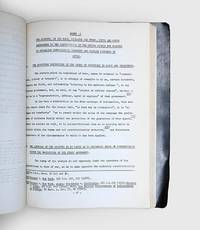
1951Best.-Nr. 1903891951. The failed appeal against the "trial of the century" One of very few copies of Emanuel Bloch's appeal seeking to overturn the prosecution of the Rosenbergs at their infamous trial signed by Bloch for submission to the Court of Appeals on the final page. Bloch 1901-1954 an attorney who focused on civil rights was known for defending clients associated with left-wing and communist causes. The Rosenbergs communists accused of sending atomic secrets to the Soviets chose Bloch to lead their defence. The court found the Rosenbergs guilty of espionage in March 1951 and sentenced them to death in April following a trial widely criticized as prejudiced and motivated by Cold War hysteria. J. Edgar Hoover dubbed the case which attracted worldwide attention "the trial of the century". The Rosenbergs were granted time to prepare the appeal which Bloch submitted to the Circuit Court on 5 November 1951. Comprising 143 pages of argument extensively referenced against other legal cases and with an index Bloch sets forth his legal case. It rests on three grounds: the government had not established definite guilt the Rosenbergs had not been granted a fair trial and the "cruel and unusual punishment" violated the eighth amendment. Besides the constitutional grounding Bloch emphasizes the "frantic atmosphere" in which the Rosenbergs were arrested placing the trial within the context of the panic caused by the Soviet Union's acquisition of the atomic bomb. The appeal was denied by the three judges on the court on 25 February 1952. They reported they had carefully examined the trial record against Bloch's appeal and had found the death sentence was constitutional and would stand. Following the defeat Bloch filed a further appeal with the Supreme Court which declined to review the case. A stay on execution was granted to appeal to President Eisenhower who denied the petition. Various other legal challenges the last of which reached the Supreme Court also failed. Despite an international campaign for clemency backed by the Pope and Albert Einstein the Rosenbergs were executed on 19 June 1953. Despite the failure of Bloch's appeal his brief greatly impressed the Rosenbergs. Julius wrote to Ethel on 4 November 1951 "I read the brief and I wrote Manny Bloch telling him what a stupendous job he did and how everlastingly grateful we are for his tireless efforts for us. Darling the brief is a legal masterpiece and in addition is a literary gem. Although I don't have the background to really pass on the legal fine points I can attest to its excellent organization its meticulousness in presenting in a fair light our case the devastating logic of his points and the tremendous assiduous effort Manny exerted in preparing this document. Believe me it's a priceless piece of work from a great man. How proud we are to be considered his friends. I intend to reread it a number of times so I'll be able to better understand some of the legal points raised" The Rosenberg Letters 2013 pp. 253-4. Bloch is often seen as a lawyer unsuited to the case more suited to civil rights work than a major criminal trial. His failure to interrogate properly the government's key witness Harry Gold has been much criticized. This appeal shifted more to Bloch's speciality of constitutional and civil rights probably constitutes a stronger legal case than that which he presented in the original trial. Nonetheless the Rosenbergs were very confident in him and he became a close friend. Bloch delivered the eulogy at their funeral and took guardianship of their sons though he died soon afterwards of a heart attack. This copy of the brief is evidently one of a small number produced for official use alongside the copies which each Rosenberg received. This copy was deposited in the Civil Rights Division of the American Jewish Committee - it is marked as their file copy and subsequently "withdrawn". It is unknown how they acquired the brief - the American Jewish Committee pointedly distanced themselves from the case likely to avoid the association of Jews with communism and treachery which the case did much to encourage among the public. An inscription on the first page reads "Return to Ted Leskes" - Theodore Leskes 1908-1964 was director of the legal division of the American Jewish Committee focusing on civil rights and discrimination. We trace only one other example of the brief at the University of Kansas and no other copy in commerce. Quarto 285 x 217 mm. Containing 154 mimeographed leaves printed recto only paginated comprising i-xi index 143 pages of contents firmly staple-bound in "Accopress binder" an early likely original binding printed title page mounted to front of binder. Housed in a black cloth flat-back box by the Chelsea Bindery. Stamps of American Jewish Committee to front cover and p. i verso. Chipping around title on front cover reinforced with tape at extremities slight wear to binder extremities contents a little toned else clean. A good copy. hardcover
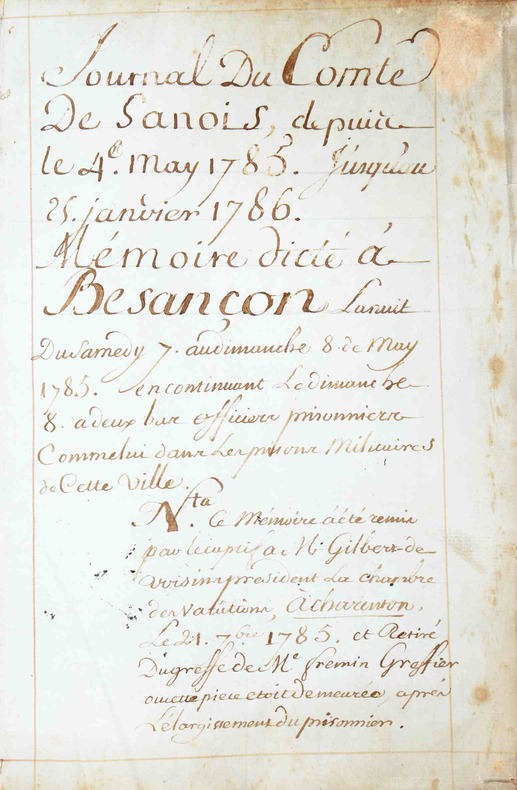
1786Best.-Nr. 11680, , 1786. Manuscrit in-folio réglé (22 x 32,5 cm) de (2)-162 pp., quelques feuillets vierges, vélin sur ais de bois (reliure de l'époque). Titre manuscrit sur le plat supérieur : Journal du Comte de Sanois sortant de la Maison de force de Charenton où il a été détenu au secret depuis le 4. may 1785 jusqu'au 25 janvier 1786. Premier cahier. Mémoire dicté à Besançon. Titre sur le dos : Journal manuscrit du comte de Sanois May 1786 7bre 1787.
Best.-Nr. 2081502111902635Shanghai Jiao Tong University Publishing House N.A. Soft Cover. Fine. The book is in fine condition. Shanghai Jiao Tong University Publishing House paperback