465 résultats
1871réf. 821101871. San Francisco 1871. Only edition. San Francisco 1871. Only edition. A Landmark Gilded Age Murder Trial-Offered with Its Definitive Modern History Trial. Fair Laura D. Defendant. Official Report of the Trial of Laura D. Fair For the Murder of Alex. P. Crittenden. San Francisco: Printed by the San Francisco Co-Operative Printing Co. 1871. 4 325 xvii pp. With two full-page woodcut portraits of Fair and Crittenden as a double frontispiece. Octavo 9-3/4" x 6-1/2"; 24.8 x 16.5 cm. Stab-stitched book bound in later twentieth-century three-quarter sheep over marbled boards gilt title to spine. Rubbing light wear to extremities front joint starting chipping to spine ends corners bumped and worn hinges cracked front hinge reinforced with archival tissue library bookplate with deaccession stamp to front pastedown. Moderate toning to interior; light edgewear and a few chips to portrait leaves; light foxing to last few leaves; tear to head of gutter of title page; internally clean. Housed in attractive custom crimson clamshell box quarter morocco over cloth with raised bands and gilt title to spine. $1500. First and only edition of the official report documenting the "Ferryboat Murder" a landmark case of femininity insanity and Victorian scandal. When Laura Fair discovered her lover Alexander Crittenden had no intention of leaving his wife she fatally shot him aboard a San Francisco ferry in front of his family. The ensuing trial became a national lightning rod for Victorian anxieties regarding the "sanctity of the family" and the legal rights of women. In a pioneering and controversial defense Fair's counsel argued she was a victim of "Moral Mania" a temporary insanity triggered by her menstrual cycle and "nervous prostration." While the suffragist movement championed her as a victim of a patriarchal legal system the public was captivated by the scandalous correspondence printed here in full. This historical drama is explored in depth in Gary Krist's Trespassers at the Golden Gate 2025 which contextualizes the trial within Gilded Age San Francisco. This remains a cornerstone text for the study of 19th-century gender politics and the 'insanity' defense. McDade The Annals of Murder 291. Krist Trespassers at the Golden Gate 2025 a copy of this work is included. unknown
1904réf. 694071904. London: HMSO 1904. London: HMSO 1904. A Notorious Case of Wrongful Conviction that Led to the Creation of the English Court of Criminal Appeal Trial. Adolf Beck Case. Committee of Inquiry into the Case of Mr. Adolf Beck. Report from the Committee; Together with Minutes of Evidence Appendix And Facsimiles of Various Documents. Presented to Both Houses of Parliament by Command of His Majesty. London: Printed for His Majesty's Stationary Office 1904. xix 5 7-334 pp. 4 folding tables of facsimile documents. Complete. Contemporary library buckram red and black calf lettering pieces and gilt library name to spine faint embossed library stamp to front board endleaves added and later removed. Light rubbing to extremities light scuffing to lettering pieces faint binder stamp to front pastedown hinges partially cracked light toning to text a few minor creases and tears to folding tables. $1500. Adolf Beck was twice the victim of wrongful conviction on two related cases due to mistaken identity. The efforts of the judge who presided over his second trial led to the establishment of a committee of inquiry chaired by the noted jurist and Master of the Rolls Sir Richard Henn Collins 1842-1911. The committee determined that Beck was convicted twice through unreliable methods of identification erroneous eyewitness testimony and a rush to convict the accused. Along with its influence on police procedure the committee's report led to the creation of the English Court of Criminal Appeal in 1907. OCLC locates 4 copies in North America 2 in law libraries University of Michigan Yale. Other copies located at Harvard Law School and the Library of Congress. Catalogue of the Library of the Harvard Law School 1909 II:1014. unknown
1736réf. 684421736. Newcastle upon Tyne 1736. Newcastle upon Tyne 1736. Early Account of a Famous Scottish Murder Trial This Copy Includes Two Pages of Contemporary Manuscript Notes Trial. Porteous John 1695-1736 Defendant. The Trial of Capt. John Porteous Before the High Criminal Court Or Lords of Justiciary In Scotland; For Wounding and Killing Several Persons at a Late Execution of a Criminal In the Grass-Market at Edinburgh By Firing and Ordering his Men to Fire on the Spectators. Newcastle upon Tyne: Printed by John White 1736. 32 pp. Octavo 8-1/8" x 5-7/8". Stab-stitched pamphlet and two manuscript leaves in contemporary hand bound into later library cloth calf lettering piece and paper shelf label to spine. Light soiling some fading to spine chipping to edges of lettering piece. Light browning to text some soiling library inkstamps and early owner signature David Hilton to title page library marks to verso. $1500. This appears to be a reissue of an account published the same year in Edinburgh. Porteous was convicted of murder and sentenced to be hanged after soldiers under his command accidentally killed six people while trying to control a mob during an execution. Under pressure from Prime Minister Walpole his execution was deferred pending further investigation. Angered at what was perceived as English interference a mob dragged Porteous from prison and lynched him. More than a murder case this was a highly charged referendum on Scottish autonomy. The events surrounding this case are treated in the early chapters of Sir Walter Scott's novel The Heart of Mid-Lothian 1818. The carefully written manuscript notes appear to have been laid into this pamphlet. It discusses a 1737 Act of Parliament calling for the punishment of the people who lynched Porteous. No print copies located on OCLC. English Short-Title Catalogue T174154. unknown
1809réf. 783081809. A Shilling for His Reputation": An Ironic Libel Suit Brought by a Convicted Libeler - Exceptionally Rare Trial. Tipper Samuel Defendant. Finnerty Peter c.1766-1822 Plaintiff. Finnerty v. Tipper. A Full and Accurate Report of the Trial of the Action Brought by Peter Finnerty Against Samuel Tipper Publisher of "The Satirist" For a Libel. Tried in the Court of Common Pleas Before Sir James Mansfield And a Special Jury On Saturday The 18th of February Last. Taken in Shorthand by an Eminent Reporter; With Some Prefatory Observations and Notes by the Editor. London: Printed for J.M. Richardson 1809. vii 80 pp. Octavo 8-3/4" x 5-1/2"; 22.2 x 14 cm. Disbound stab-stitched pamphlet retaining its original untrimmed edges. Moderate toning light intermittent foxing and minor soiling in a few places. Leaves starting at the head but remaining firmly secure. A well-preserved survival of a fragile production. $1500. THIS DESCRIPTION IS TRUNCATED DUE TO CHARACTER LIMITS. PLEASE CONTACT US FOR A COMPLETE VERSION. First and only edition. This exceptionally rare verbatim report captures a deeply ironic moment in British legal history: a notorious libeler bringing a civil suit for libel to protect a reputation he barely possessed. The plaintiff Peter Finnerty was a fiery Irish radical publisher and journalist whose career was defined by legal battles against the British establishment. In 1797 he was convicted of seditious libel for publishing works sympathetic to the United Irishmen rebellion. Finnerty's relentless anti-establishment crusade made him a celebrated figure among Romantic radicals; the poet Percy Bysshe Shelley famously wrote and published A Poetical Essay on the Existing State of Things 1811 specifically to raise funds for Finnerty's mounting legal fees and support him during his imprisonment. By 1809 Finnerty was once again in the government's crosshairs facing new libel charges after publishing a pamphlet exposing the Duke of York's scandalous sale of military promotions the infamous Mary Anne Clarke affair. While Finnerty awaited trial for this offense Samuel Tipper publisher of the fiercely Tory and pro-establishment magazine The Satirist launched a vicious print attack on him. Refusing to take the insult lying down Finnerty swiftly brought a civil libel suit against Tipper i. unknown
1989réf. 2080302106803074National Detainee Compensation Council 1989. Soft Cover. Fine. The book is in fine condition. National Detainee Compensation Council paperback
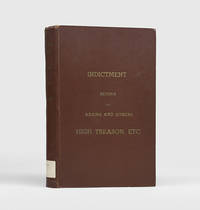
1956réf. 184698Pretoria: The Government Printer 1956. A major moment in South African history First edition of the indictment for the "Treason Trial" in which Nelson Mandela and almost the entire anti-apartheid leadership were prosecuted. One defendant Ahmed Kathrada has signed beside his name; the signature was acquired by a collector in recent years. "The core of the treason charge related to a momentous - and for the government disconcerting - event at Kliptown on the outskirts of Johannesburg on 25-26 June 1955. The delegates were drawn from the ranks of the Congress Alliance a coalition of race-based anti-apartheid groups - the ANC still Africans only the Indian Congresses the Coloured People's Congress and the white mix of communists and non-communists. They had come together to draw up the country's first democratic constitution. Out of the deliberations came the endorsement of a Freedom Charter which to western eyes was an unexceptionable statement of democratic principles and equal rights owing something to the UN Charter but virtually nothing to the Communist Manifesto" Herbstein pp. 28-9. In response 156 individuals who attended or were associated with the meeting were arrested under the 1950 Suppression of Communism Act. The trial helped unite the anti-apartheid movement and attracted worldwide support for the struggle and international condemnation of the South African government. The trial lasted over four years after which all the accused were acquitted. However soon after Mandela and other defendants were imprisoned following the Rivonia Trial. 3 vols bound in 1 as issued folio. Ex library of the South African embassy in Bonn with their stamp to the front free endpaper and their shelf label and number to spine; binding rubbed and slightly worn and shaken contents toned. A good copy. Denis Herbstein White Lies: Canon Collins and the Secret War Against Apartheid 2004. unknown
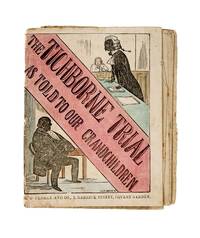
1872réf. 857421872. London 1872. Oblong sheet folded into 16 panels. London 1872. Oblong sheet folded into 16 panels. A Rare and Vibrant Victorian Pictorial Satire of the Century's Most Infamous Legal Charade Trial. Tichborne Case. The Tichborne Trial As Told to Our Grandchildren. London: H. G. Clarke and Co. c.1872. Oblong 34-1/4" x 11-1/2" 87 x 29 cm sheet 5-3/4" x 4-3/4" 14.5 x 12 cm when folded completely in sixteen panels glued into pictorial wrappers title to front wrapper and advertisements to its verso and rear wrapper. Front illustration and panels each with a woodcut vignette and accompanying satirical verse hand-colored. Unobtrusive light foxing and soiling a few small tears along fold lines not affecting images colors vivid. A well-preserved survival of a fragile and seldom-encountered form of Victorian popular ephemera. $1750. This folding satirical panorama was issued during the height of public fascination with the Tichborne case which captivated Victorian England in the 1860s and 1870s. In 1854 Roger Tichborne the 25 year-old heir to the Tichborne baronetcy disappeared while traveling in South America presumed to have died in a shipwreck. His mother refused to abandon hope. When she heard rumors that he was in Australia she placed several advertisements concerning his whereabouts in Australian newspapers. In 1865 an Australian butcher named Thomas Castro sometimes referred to as Arthur Orton claimed to be the missing heir. He failed to convince the courts was convicted of perjury and served a long prison sentence. The dispute over his identity continued until his death in 1898. The case generated a vast body of popular literature and has continued to captivate the public as recently as Zadie Smith's 2023 novel The Fraud. Our example is one of several known silhouette illustration satires of the case by Clarke & Co all of which are rare. The vivid hand-coloring highlights the illustration style which had the advantage for the publisher of emphasizing Orton's size. OCLC locates 7 copies of Clarke & Co. satires under this title 2 in law libraries Yale Harvard. unknown
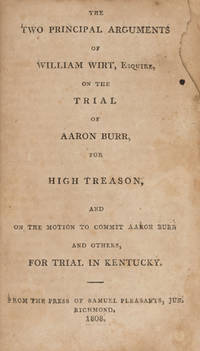
1808réf. 849821808. Richmond: From the Press of Samuel Pleasants 1808. Richmond: From the Press of Samuel Pleasants 1808. Streeter 1693: The Prosecution's Arguments at the Burr Treason Trial Trial. Burr Aaron 1756-1836 Defendant. Wirt William 1772-1834. The Two Principal Arguments of William Wirt Esquire On the Trial of Aaron Burr For High Treason And on the Motion to Commit Aaron Burr and Others For Trial in Kentucky. Richmond: From the Press of Samuel Pleasants Jun. 1808. iv 221 pp. Advertisement leaf follows title page. Not issued with the portrait frontispiece of Aaron Burr which is true of only a few copies. 12mo. 5-3/4" x 3-1/2"; 14.6 x 8.9 cm. Contemporary tree calf gilt title and ornaments to spine endpapers renewed with marbled paper. Light rubbing nicks and scratches to boards moderate rubbing to extremities front hinge cracked chips to spine ends and front board at foot of joint and lower outside corner corners bumped and somewhat worn. Moderate toning to interior light browning light foxing and faint dampstaining in places chips to fore-edges of front endleaf and title page. A very good copy overall. $2500. Only edition. Burr was implicated in a plot to steal land from Mexico and the Louisiana Purchase in order to establish an independent country. Arrested and tried in 1807 on charges of treason he was acquitted due to a lack of specific evidence. Wirt his prosecutor was United States Attorney for the District of Virginia. His famous principal speech in the trial of Aaron Burr lasting nearly four hours. Characterized by considerable eloquence wit and logic it enhanced his national stature. Wirt went on to serve as United States Attorney General under Presidents Monroe and John Quincy Adams where he did much to define the office and enhance its stature. The last copy at auction was sold at Sotheby's in 2021 for $2142. Like ours it does not have a frontispiece. Streeter The Celebrated Collection of Americana Formed by the Late Thomas Winthrop Streeter 1693 with frontispiece. Identical to our copy: Cohen Bibliography of Early American Law 14120. Howes USIana W-587. Sabin A Dictionary of Books Relating to America 104883. unknown
1753réf. 723961753. The First Instance of a New Trial Being Granted in a Criminal Case in England Trial. Simons Henry Defendant. The Case of Henry Simons A Polish Jew Merchant; And His Appeal to the Public Thereon. Now Publish'd With the Tryal at Chelmsford For the Benefit of Him and His Unhappy Family. London: Printed And Sold by All the Booksellers and Pamphlet Shops in Town and Country 1753. 115 pp. Bound with Ashley James Defendant. Simons Henry Plaintiff. The Case and Appeal of James Ashley of Bread-Street London: Addressed to the Publick in General. . To Which is Prefixed A Curious Print of the Person and Dress of the Said Henry Simons. London: Printed for And Published by The Appellant 1753. viii 47 pp. Text printed in double columns. Etched portrait frontispiece of Simons. Octavo 7-3/4" x 4-1/2". Stab-stitched pamphlets bound into recent cloth calf lettering piece to spine. Light stains to boards moderate rubbing to extremities small scuff to lettering piece later owner bookplate of English lawyer and judge Geoffrey G. Briggs 1914-1993 to front free endpaper. Moderate toning to both pamphlets left-hand edge of plate but not image affected by trimming light foxing and owner inscription "Wm. Greenwood's 1811" to title page of The Case tiny worm hole to lower-right corner of its text block through p. 91. $2500. Only editions Case and Appeal one of three issues. This was the first instance of a new trial being granted in a criminal case in England. The affair concerned the robbery of gold coins entrusted to Simons by a group of nobles from his hometown. The case resulted in six trials three pamphlets and a great deal of debate in the daily newspapers much of it antisemitic. The thief appeared to have been Simons's innkeeper but it later turned out to be James Ashley who was first convicted then acquitted then convicted again. English Short-Title Catalogue T95662 T76809. unknown
1818réf. 820231818. The End of Trial by Battle in the United Kingdom Broadside. Trial. Thornton Abraham c.1793-1860 Respondent. Appeal of Murder: The Decision of the Judges in the Case of Ashford ver. Thornton Court of King's Bench April 20th 1818. Nottingham: Shorrock and Son Successors to E. Hodson Printers 1818. 12-1/2" x 7-1/2" broadside mounted to later backing sheet text in two columns separated by rule below headline and woodcut vignette of a landscape. Moderate toning light soiling to edges a few faint creases printer's flaw and clean tear to right column no loss to legibility. Rare. $3000. Ashford v. Thornton dealt with the aftermath of the murder of Mary Ashford in 1817. Abraham Thornton who had seen and been intimate with Ashford the previous night was tried for rape and murder but acquitted of both charges due to a lack of evidence and inconsistencies in the prosecutor's case. Public outcry around his acquittal led to Mary's brother William invoking an "appeal of murder." This uncommon legal practice allowed a retrial of a defendant acquitted for murder but crucially gave the defendant the right to trial by battle. Thornton invoked that right. After extensive proceedings in the Court of King's Bench the court found that he was eligible to do so. Our broadside documents the final hearing in which Ashford declined to battle with Thornton and withdrew his appeal. Thornton was given a pro forma arraignment and released. The case resulted in the abolition of appeals by murder and thus the end of trial by battle. This broadside is rare and appears to be unrecorded. No copies located on OCLC or Library Hub. Not at Harvard or the British Library. unknown
1914réf. 659851914. New York 1912-1914. Image in 30-1/2" x 24" frame. New York 1912-1914. Image in 30-1/2" x 24" frame. "His Famous Wig Composed Entirely of Split Hairs and Adorned with the Ceremonial Crimson Tape" Robinson Boardman 1876-1952. Becker-Rosenthal Murder Trial. Mr. Justice Precedent. New York 1914. 21" x 15-1/2" 53.3 x 39.4 cm gouache image on 26" x 19-1/2" 66 x 49.5 cm sheet image signed twice and inscribed by Robinson caption in pencil below image most likely in another hand laid down on illustration board. Image in 30-1/2" x 24" 77.5 x 60.9 cm wooden frame glazed. Light soiling a few minor stains and four crop-marks to margins outside of image which could be covered with a matte image fine. Several minor scuffs and nicks to frame. An exceptional unique piece of original artwork capturing a defining moment in American legal and criminal history. $3500. This striking original gouache was created to illustrate "Leaden Footed Justice in New York State" a feature article published in the Special Feature section of the New York Tribune on Sunday March 1 1914. The penciled caption reads:"Mr. Justice Precedent wearing his famous wig composed entirely of split hairs and adorned with the ceremonial crimson tape." The caricature was a scathing commentary on the notoriously protracted bureaucratically tangled legal proceedings of the Becker-Rosenthal Murder case which centered on NYPD Police Lieutenant Charles Becker who ran a massive protection racket targeting illegal Manhattan casinos. When gambling house owner Herman Rosenthal threatened to expose Becker's corruption to District Attorney Charles S. Whitman Becker hired a gang of underworld executioners including "Gyp the Blood" and "Lefty Louie" to gun Rosenthal down outside the Hotel Metropole. The investigation and subsequent trials completely dominated New York front pages. Becker's first trial began on October 7 1912 resulting in a conviction that was subsequently overturned on appeal by the New York Court of Appeals due to judicial bias. His highly anticipated second trial began on May 6 1914 just over two months after this cartoon appeared. Becker was convicted a second time and after his appeals were exhausted in 1915 went to the electric chair at Sing Sing-marking the first time in U.S. history a police officer was executed for murder. The case profoundly shook the public psyche and entered the cultural lexicon most. unknown
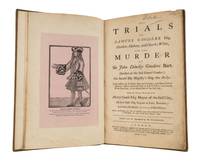
1741réf. 859421741. Contemporary Account of an 18th-Century Fratricide Case Overlooked by the ESTC Extra-Illustrated by a Notable 19th-Century Collector Includes Two Unrecorded Broadsides. Trial. Goodere Sir Samuel 1687-1741 Principal Defendant. The Trials of Samuel Goodere Esq; Matthew Mahony And Charles White For the Murder of Sir John Dineley Goodere Bart. Brother to the Said Samuel Goodere On Board His Majesty's Ship the Ruby: At the Sessions of the Peace Oyer and Terminer And General Goal-Delivery Held in and for the City of Bristol And County of the Same City In the Guild-Hall of the Said City; Before the Right Worshipful Henry Combe Esq; Mayor of the Said City Michael Foster Esq; Serjeant at Law Recorder; And Others His Majesty's Justices of Goal-Delivery. Begun on Tuesday the 17th of March 1740. And Continued by Adjournment to Thursday The 26th of the Same Month 1741. Publish'd with the Approbation of Mr. Recorder. London: Printed by A. Millar et al. 1741. ii 53 1 blank pp. With an initial leaf headed "Goal Delivery Grand Jurors March 17. 1740." Printed without bookseller advertisement to verso of final leaf. Folio 12-3/4" x 8"; 32.6 x 20.4 cm. Stab-stitched pamphlet bound in late nineteenth-century cloth gilt title to spine. Light shelfwear to exterior spine ends and corners bumped and worn. Moderate toning to interior occasional light foxing and soiling blind-embossed library stamps of the Corporation of Bristol City Library to right margin of first several leaves title page reinforced at fore-edge on verso. Three later annotations detailing this item's provenance to front endleaf early owner signature "W. Mallard" to head of title page. Later sheet with tipped-on woodcut illustration of Goodere bound before title page double-page copperplate engraving dated 1741 bound after title page 6 items related to the Goodere murder bound after text block some mounted to blank leaves 2 of these have extensive annotations to their versos by Mallard. A very good copy with interesting enhancements included two unrecorded contemporary items. $3500. Only edition one of two 1741 issues. The most complete account of this trial. The trial of Sir Samuel Goodere is a classic of English criminal history. The details are particularly grisly because of the breach of both familial and naval du. unknown
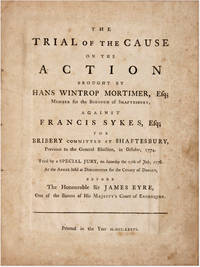
1776réf. 712211776. London: S.n. 1776. London: S.n. 1776. An Account of a Notorious Case of Election Bribery Bound with a Related Unrecorded Broadside Trial. Sykes Francis 1730-1804 Defendant. Mortimer Hans Wintrop Plaintiff. The Trial of the Cause on the Action Brought by Hans Wintrop Mortimer Esq; Member for the Borough of Shaftesbury Against Francis Sykes Esq; For Bribery Committed at Shaftesbury Previous to the General Election In October 1774. Tried by a Special Jury On Saturday the 27th of July 1776. At the Assize Held at Dorchester for the County of Dorset Before The Honourable Sir James Eyre One of the Barons of His Majesty's Court of Exchequer. London: S.n. 1776. 19 1 pp. Main text in parallel columns. Quarto 9-3/4" x 7-1/2"; 24.8 x 19 cm. Bound with Text Two later tipped-in leaves of notes. Affixed to one of these leaves are a contemporary account of the trial and a section of a letter in Mortimer's hand. And Tipped-in contemporary 14" x 21" 35.5 x 53.3 cm mezzotint by an unknown artist The Shaftsbury Election or the Humours of Punch 1775. Additional annotations about the mezzotint to front endleaves one followed by two ownership inscriptions one of Henry White. Affixed to one of these is a small clipping about the Mortimer family. And Broadside. Mortimer Hans Winthrop. To the Worthy Electors of the Borough of Shaftsbury. Shafton: s.l. 11 June 1790. Trimmed to 9" x 6" 22.8 x 15.2 cm and affixed to verso of title page. Nineteenth-century calf rebacked in period style gilt rules to boards gilt fillets and retained nineteenth-century lettering piece to spine hinges mended marbled endleaves. Moderate rubbing to boards and toning to text occasional early underlining and brief notes in pencil. $3500. THIS DESCRIPTION IS TRUNCATED DUE TO CHARACTER LIMITS. PLEASE CONTACT US FOR A COMPLETE VERSION. The Shaftesbury Election of 1774 stands as one of the most infamous instances of parliamentary corruption in 18th-century England. Ministerial candidates Sir Francis Sykes and Sir Thomas Rumbold bribed electors with thousands of pounds routing money through a masked figure known as "Punch" to avoid direct liability. Voters were given cash in exchange for signing promissory notes payable to an imaginary figure named "Glenbucket". The defeated candidate Hans Winthrop Mortimer. unknown
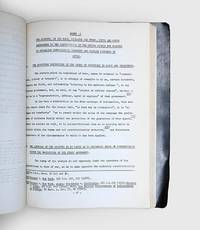
1951réf. 1903891951. The failed appeal against the "trial of the century" One of very few copies of Emanuel Bloch's appeal seeking to overturn the prosecution of the Rosenbergs at their infamous trial signed by Bloch for submission to the Court of Appeals on the final page. Bloch 1901-1954 an attorney who focused on civil rights was known for defending clients associated with left-wing and communist causes. The Rosenbergs communists accused of sending atomic secrets to the Soviets chose Bloch to lead their defence. The court found the Rosenbergs guilty of espionage in March 1951 and sentenced them to death in April following a trial widely criticized as prejudiced and motivated by Cold War hysteria. J. Edgar Hoover dubbed the case which attracted worldwide attention "the trial of the century". The Rosenbergs were granted time to prepare the appeal which Bloch submitted to the Circuit Court on 5 November 1951. Comprising 143 pages of argument extensively referenced against other legal cases and with an index Bloch sets forth his legal case. It rests on three grounds: the government had not established definite guilt the Rosenbergs had not been granted a fair trial and the "cruel and unusual punishment" violated the eighth amendment. Besides the constitutional grounding Bloch emphasizes the "frantic atmosphere" in which the Rosenbergs were arrested placing the trial within the context of the panic caused by the Soviet Union's acquisition of the atomic bomb. The appeal was denied by the three judges on the court on 25 February 1952. They reported they had carefully examined the trial record against Bloch's appeal and had found the death sentence was constitutional and would stand. Following the defeat Bloch filed a further appeal with the Supreme Court which declined to review the case. A stay on execution was granted to appeal to President Eisenhower who denied the petition. Various other legal challenges the last of which reached the Supreme Court also failed. Despite an international campaign for clemency backed by the Pope and Albert Einstein the Rosenbergs were executed on 19 June 1953. Despite the failure of Bloch's appeal his brief greatly impressed the Rosenbergs. Julius wrote to Ethel on 4 November 1951 "I read the brief and I wrote Manny Bloch telling him what a stupendous job he did and how everlastingly grateful we are for his tireless efforts for us. Darling the brief is a legal masterpiece and in addition is a literary gem. Although I don't have the background to really pass on the legal fine points I can attest to its excellent organization its meticulousness in presenting in a fair light our case the devastating logic of his points and the tremendous assiduous effort Manny exerted in preparing this document. Believe me it's a priceless piece of work from a great man. How proud we are to be considered his friends. I intend to reread it a number of times so I'll be able to better understand some of the legal points raised" The Rosenberg Letters 2013 pp. 253-4. Bloch is often seen as a lawyer unsuited to the case more suited to civil rights work than a major criminal trial. His failure to interrogate properly the government's key witness Harry Gold has been much criticized. This appeal shifted more to Bloch's speciality of constitutional and civil rights probably constitutes a stronger legal case than that which he presented in the original trial. Nonetheless the Rosenbergs were very confident in him and he became a close friend. Bloch delivered the eulogy at their funeral and took guardianship of their sons though he died soon afterwards of a heart attack. This copy of the brief is evidently one of a small number produced for official use alongside the copies which each Rosenberg received. This copy was deposited in the Civil Rights Division of the American Jewish Committee - it is marked as their file copy and subsequently "withdrawn". It is unknown how they acquired the brief - the American Jewish Committee pointedly distanced themselves from the case likely to avoid the association of Jews with communism and treachery which the case did much to encourage among the public. An inscription on the first page reads "Return to Ted Leskes" - Theodore Leskes 1908-1964 was director of the legal division of the American Jewish Committee focusing on civil rights and discrimination. We trace only one other example of the brief at the University of Kansas and no other copy in commerce. Quarto 285 x 217 mm. Containing 154 mimeographed leaves printed recto only paginated comprising i-xi index 143 pages of contents firmly staple-bound in "Accopress binder" an early likely original binding printed title page mounted to front of binder. Housed in a black cloth flat-back box by the Chelsea Bindery. Stamps of American Jewish Committee to front cover and p. i verso. Chipping around title on front cover reinforced with tape at extremities slight wear to binder extremities contents a little toned else clean. A good copy. hardcover
réf. 2081502111902635Shanghai Jiao Tong University Publishing House N.A. Soft Cover. Fine. The book is in fine condition. Shanghai Jiao Tong University Publishing House paperback