3 294 résultats
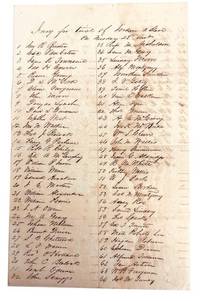
réf. 95800Very Good. Single leaf folded to form four pages with list of 83 names on first two pages. Three later horizontal folds probably for filing. Has some pencil markings beside most names -- either a red "x" or an black line. Ink note at top of one of the narrow folded section on last page:Jury of 80 Men for trial of Jorden on Tuesday 28th Inst. Waterstain -- name still quite readable -- a bit wavy but covers about the right third of both leaves as folded. No information as to date or location. Looks like it probably dates sometime in first two-thirds of 19th century. Someone might be able to narrow it down -- most juror names seem common but Plesant W. Ponder probably is not. Later pencil note in unknown hand on last page: possibly Lawrence County Alabama. unknown
réf. 95800Very Good. Single leaf folded to form four pages with list of 83 names on first two pages. Three later horizontal folds probably for filing. Has some pencil markings beside most names -- either a red "x" or an black line. Ink note at top of one of the narrow folded section on last page:Jury of 80 Men for trial of Jorden on Tuesday 28th Inst. Waterstain -- name still quite readable -- a bit wavy but covers about the right third of both leaves as folded. No information as to date or location. Looks like it probably dates sometime in first two-thirds of 19th century. Someone might be able to narrow it down -- most juror names seem common but Plesant W. Ponder probably is not. Later pencil note in unknown hand on last page: possibly Lawrence County Alabama. unknown books
First edition, 8vo, xxiv, 92pp., previous owner's name and address on soiled half-title, engraved portrait of Sir Robert Thomas Wilson, wrappers browned, some light soiling, stitched as issued, uncut. General Lavalette, who having been condemned to death, escaped from prison by changing into in his wife's dress. Wilson, Bruce and Hutchinson, were tried for being instrumental in the escape from Paris, of Lavalette. Wilson passed the barriers in a cabriolet with Lavalette disguised as a British officer, and escorted him safely to Mons. He sent an account of the adventure to Earl Grey which was intercepted and he was arrested in Paris. The three men were tried in Paris and sentenced to three months imprisonment. JISC locates a single copy at University of Cambridge.
12mo (150 x 90 mm), [2], 79, [1]pp., new boards, printed paper label on upper cover. JISC locating a single copy at Nottingham University Libraries.
réf. 7545All five prints 'Publish'd by Robt. Sayer No. 53 Fleet Street London as the Act directs 1st. Septr. 1772.'. Each of the five on a piece of good laid paper roughly 15 cm square. Wide margins with indentation of plate 9.5 x 8 cm. All five good with occasional light creasing to margins. The second and third items more aged that the others but all good and suitable for framing. Delicately engraved and skillfully coloured. Item One: 'Mr. Bellecour. 3 Comed. Franc. Le Joueur. dans la Comédie du même nom.' Item Two: '19 Comed. Franc. Michau et Henri. dans la Partie de Chasse d'Henri IV. Qu'êtes-vous allons qu'êtes-vous' Item Three: 'Made. Favart. 22 Coméd. Ital. La Vieille. dans la Fée Urgele Acte III.' Item Four: 'Mrs. Trial & Clerval. 29 Coméd. Ital. Bertrand et Monteauciel dans le Déferteur. Voulez-vous bien chanter quand on vous en prie' Item Five: 'Mr. Laurette 30 Coméd. Ital. Jean Louis. dans le Déserteur.' Presumably from Whirsker's "The Metamorphoses of Melpomene and Thalia or Dramatic Characters of the French and Italian Comedies." London: Robert Sayer n.d. but circa 1770. 30 plates. Cohen 1066. Lewine 356 copy on with 19 of the 30 plates at $3000: Micahel Hollander. See Image. All five prints 'Publish'd by Robt. Sayer, No. 53 Fleet Street London, as the Act directs, 1st. Septr. 1772.' unknown
1757réf. 23113Paris Pierre-guillaume Simon 1757 3 Volumes In-12 LXXXIV- 283 + 528 pp + 451 , mors fendus ou faibles, il manque une étiquette de titre et un quatrième volume de tables
1748réf. 28578Nantes 1748 1 document original de 80 pages brochées, manuscrites à l'encre brune sur papier vergé crème, ligné et filigrané, cachet fiscal gravé et historié en noir en haut des pages : "BRETAGNE - 1 SOL - 3 DENIERS", format : 25,5 x 18,5 cm, PROCÈS EN EXPERTISE DES AYANTS DROIT D'HÉRITAGE DE LA SUCESSION REDHOR [REDOR] EN L'ESTOC REDHOR ET CAMUS A NANTES, DEVANT LES SAGES DE LA COUR ET JURIDICTION DES RÉGAIRES DE NANTES, AU VU DES DIFFÉRENTS EXTRAITS DE BAPTÊMES ET D'ÉPOUSAILLES DES PAROISSES DE SAINT-NICOLAS ET DE SAUTRON : SENTENCES DES HÉRITIERS DÉBOUTÉS FAUTE DE JUSTIFIER QU'ILS SOIENT DESCENDANTS DE JEAN REDHOR, FRÈRE DE DE PIERRE REDHOR ET DE JACQUETTE REDHOR, FAIT A NANTES, LE 28 JUIN 1748, signature manuscrite in-fine : LEPETIT greffier,
1906réf. 1987Paris, G. Steinheil, 1906 ; in-8, broché ; 231 pages, couverture bleue imprimée, deux planches hors-texte, quelques gravures in-texte.
réf. 052550Paris Chez H. Nicolle, Libraire 1820 in 8 (20,5x13) 1 volume reliure demi basane havane de l'époque, dos lisse orné de faux nerfs dorés, pièces de titre de cuir beige et vert, 317 pages [1]. Charles Cottu, 1778-1849, Conseiller à la Cour royale de Paris, Secrétaire général de la Société royal des prisons, et du Conseil spécial des prisons de Paris. Relié à la suite: REFLEXIONS SUR L'ETAT ACTUEL DU JURY DE LA LIBERTE INDIVIDUELLE ET DES PRISONS, par M. C. Charles Cottu (Paris, H. Nicolle 1818) II et 186 pages. Bel exemplaire ( Photographies sur demande / We can send pictures of this book on simple request )
1682réf. 144001682. De Vries Simon. Persian royal court scene 1682 depicts kingship judgment and punishment in a European publication describing Persia and other regions of Asia Africa and the Americas. Issued during the Safavid period the scene places a Persian ruler above assembled courtiers and judges while a kneeling governor is restrained before him presenting Dutch readers with a visual account of royal authority and judicial punishment in seventeenth-century Persia. De Vries compiled his extensive geographical work from earlier travel and eyewitness accounts rather than presenting it as the record of his own travels. De Vries Simon. Curieuse aenmerckingen der bysonderste Oost en West-Indische verwonderens-waerdige dingen; nevens die van China Africa en andere gewesten des werelds. Utrecht: Johannes Ribbius 1682. Original etching on laid watermarked paper. Image 6" x 7.5"; overall sheet 8.25" x 6.5". A Persian king occupies an elevated carpeted throne above an assembly of courtiers and judges. Below him a governor kneels while another figure restrains him establishing punishment as the central action of the composition. Most of the assembled figures wear turbans and long garments; several others have markedly different European-style headwear. Through an architectural opening additional guards appear within the palace setting. Small numbers incorporated into the composition correspond to explanatory text printed in early Dutch above the image linking individual figures and actions to De Vries's written account. Published at Utrecht by Johannes Ribbius De Vries's Curieuse aenmerckingen appeared in four parts in 1682 and compiled European accounts of geography customs religion government and court practices across numerous regions. Bibliographic records confirm both the four-part publication and its substantial series of engraved plates. The present scene documents how Persian royal government and judicial authority were explained pictorially to a late seventeenth-century Dutch readership with the numbered key allowing the image to be interpreted alongside the accompanying text. Uncut as published; overall excellent condition. The watermark surviving margins numbered explanatory system and detailed court scene preserve material and textual evidence of the engraving's original use as an illustration within De Vries's 1682 geographical compilation. unknown
1682réf. 144001682. De Vries Simon. Persian royal court scene 1682 depicts kingship judgment and punishment in a European publication describing Persia and other regions of Asia Africa and the Americas. Issued during the Safavid period the scene places a Persian ruler above assembled courtiers and judges while a kneeling governor is restrained before him presenting Dutch readers with a visual account of royal authority and judicial punishment in seventeenth-century Persia. De Vries compiled his extensive geographical work from earlier travel and eyewitness accounts rather than presenting it as the record of his own travels. De Vries Simon. Curieuse aenmerckingen der bysonderste Oost en West-Indische verwonderens-waerdige dingen; nevens die van China Africa en andere gewesten des werelds. Utrecht: Johannes Ribbius 1682. Original etching on laid watermarked paper. Image 6" x 7.5"; overall sheet 8.25" x 6.5". A Persian king occupies an elevated carpeted throne above an assembly of courtiers and judges. Below him a governor kneels while another figure restrains him establishing punishment as the central action of the composition. Most of the assembled figures wear turbans and long garments; several others have markedly different European-style headwear. Through an architectural opening additional guards appear within the palace setting. Small numbers incorporated into the composition correspond to explanatory text printed in early Dutch above the image linking individual figures and actions to De Vries's written account. Published at Utrecht by Johannes Ribbius De Vries's Curieuse aenmerckingen appeared in four parts in 1682 and compiled European accounts of geography customs religion government and court practices across numerous regions. Bibliographic records confirm both the four-part publication and its substantial series of engraved plates. The present scene documents how Persian royal government and judicial authority were explained pictorially to a late seventeenth-century Dutch readership with the numbered key allowing the image to be interpreted alongside the accompanying text. Uncut as published; overall excellent condition. The watermark surviving margins numbered explanatory system and detailed court scene preserve material and textual evidence of the engraving's original use as an illustration within De Vries's 1682 geographical compilation. unknown books
1796réf. 821781796. A Vermont Estate Case Involving Two Former Mayors of New York City Manuscript. Trial. Vermont. Colden vs. Custis and Morgan. Movnt & Judgment. Woodstock VT September 21 1796. 12-3/4" x 8" 32.4 x 20.3 cm bifolium and 12-3/4" x 8" 32.4 x 20.3 cm leaf which was pinned to bifolium forming 6 pp. document. Text in neat hand to rectos and versos docketed on verso of final leaf. Content in neat hand. Moderate toning light soiling horizontal fold lines rubbing to edges short clean tears along folds pin holes to upper-inside corners. $250. In this post-Revolutionary land dispute the estate of Whitehead Hicks 1728-1780-a prominent Queens landowner judge and pre-Revolutionary Mayor of New York City 1766-1776-was represented by Cadwallader David Colden 1769-1834 a Long Island lawyer future abolitionist and later Mayor of New York City 1818-1821. Acting on behalf of the estate Colden sued two Vermont residents Elias Curtis written as Custis in court records and Isaac Morgan for back rent dating to 1775. The disputed property was located in the colonial-era Gloucester County New York-a territory including Woodstock that was absorbed into the newly declared state of Vermont in 1777. Prepared and intended for official filing this manuscript is divided into two distinct parts: a legal motion and a formal judgment which effectively placed the case on appeal. unknown
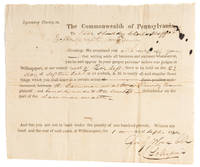
1830réf. 734651830. A Pennsylvania Court Summons from 1830 Manuscript. Trial. Pennsylvania. Summons to Appear as a Witness. Lycoming County PA September 1 1830. 4 pp. 6-3/4" x 8" docketed on verso embossed seal near upper-left corner. Light browning and edgewear a few ink spots vertical and horizontal fold lines a few minor tears along folds. $250. This summons directs Peter Shaddy Charles Huff Sophia Graft and James Danley to appear in the court of quarter sessions in Williamsport to testify in the case of Pennsylvania v. James Kinman and Mrs. Dunlap. unknown
1796réf. 821781796. A Vermont Estate Case Involving Two Former Mayors of New York City Manuscript. Trial. Vermont. Colden vs. Custis and Morgan. Movnt & Judgment. Woodstock VT September 21 1796. 12-3/4" x 8" 32.4 x 20.3 cm bifolium and 12-3/4" x 8" 32.4 x 20.3 cm leaf which was pinned to bifolium forming 6 pp. document. Text in neat hand to rectos and versos docketed on verso of final leaf. Content in neat hand. Moderate toning light soiling horizontal fold lines rubbing to edges short clean tears along folds pin holes to upper-inside corners. $250. In this post-Revolutionary land dispute the estate of Whitehead Hicks 1728-1780-a prominent Queens landowner judge and pre-Revolutionary Mayor of New York City 1766-1776-was represented by Cadwallader David Colden 1769-1834 a Long Island lawyer future abolitionist and later Mayor of New York City 1818-1821. Acting on behalf of the estate Colden sued two Vermont residents Elias Curtis written as Custis in court records and Isaac Morgan for back rent dating to 1775. The disputed property was located in the colonial-era Gloucester County New York-a territory including Woodstock that was absorbed into the newly declared state of Vermont in 1777. Prepared and intended for official filing this manuscript is divided into two distinct parts: a legal motion and a formal judgment which effectively placed the case on appeal. unknown books
1830réf. 734651830. A Pennsylvania Court Summons from 1830 Manuscript. Trial. Pennsylvania. Summons to Appear as a Witness. Lycoming County PA September 1 1830. 4 pp. 6-3/4" x 8" docketed on verso embossed seal near upper-left corner. Light browning and edgewear a few ink spots vertical and horizontal fold lines a few minor tears along folds. $250. This summons directs Peter Shaddy Charles Huff Sophia Graft and James Danley to appear in the court of quarter sessions in Williamsport to testify in the case of Pennsylvania v. James Kinman and Mrs. Dunlap. unknown books
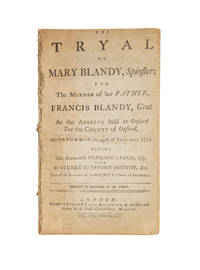
1752réf. 803961752. The "Love Philter" was Arsenic Trial. Blandy Mary 1720-1752 Defendant. The Tryal of Mary Blandy Spinster; For the Murder of Her Father Francis Blandy Gent. At the Assizes Held at Oxford for the County of Oxford On Saturday the 29th of February 1752 Before the Honourable Heneague Legge Esq; and Sir Sydney Stafford Smythe Knt. Two of the Barons of His Majesty's Court of Exchequer. Published by Permission of the Judges. London: Printed for John and James Rivington At the Bible and Crown In St. Paul's Church Yard 1752. ii 46 pp. Folio 11-3/4" x 7". Disbound stab-stitched pamphlet. Moderate toning margins trimmed closely with no loss to text. Light soiling to exterior clean tear from a fold near center of lower half of text block early repairs to inner margins of several leaves a few minor tears and chips to edges of title page chips a few tears with minor loss to text to final leaf. $250. Only edition one of three issues the others an octavo issued by Rivington and an octavo issued in Dublin by Faulkner. Blandy was the daughter of a prosperous lawyer. Her father Francis advertised a large dowry of 10000 which attracted many suitors including one who captivated her Captain William Henry Cranstoun the son of a Scottish nobleman. Francis learned later that he was married and a father. Confronted with these facts by Francis Cranstoun claimed his marriage was invalid and made several attempts he claimed to have it annulled. Over time Francis became suspicious about Cranstoun's motives. Sensing danger Cranstoun gave Mary a "love philtre" and told her to mix it into one of her father's meals. He said it would change his behavior towards him. It was actually arsenic. When Mary realized what she had done she foolishly burned Cranstoun's letters and discarded the rest of the arsenic. Cranstoun fled to France. Mary was tried and sentenced to death by hanging. This was a sensational trial and it was covered extensively by the press. It also generated a secondary literature that included several contributions written by Mary such as "Miss Mary Blandy's Own Account of the Affair between Her and Mr. Cranstoun." As indicated by her last request to the execution officials she remained a proper middle-class lady to the end. "For the sake of decency gentlemen" she pleaded "don't hang. unknown
1752réf. 803961752. The "Love Philter" was Arsenic Trial. Blandy Mary 1720-1752 Defendant. The Tryal of Mary Blandy Spinster; For the Murder of Her Father Francis Blandy Gent. At the Assizes Held at Oxford for the County of Oxford On Saturday the 29th of February 1752 Before the Honourable Heneague Legge Esq; and Sir Sydney Stafford Smythe Knt. Two of the Barons of His Majesty's Court of Exchequer. Published by Permission of the Judges. London: Printed for John and James Rivington At the Bible and Crown In St. Paul's Church Yard 1752. ii 46 pp. Folio 11-3/4" x 7". Disbound stab-stitched pamphlet. Moderate toning margins trimmed closely with no loss to text. Light soiling to exterior clean tear from a fold near center of lower half of text block early repairs to inner margins of several leaves a few minor tears and chips to edges of title page chips a few tears with minor loss to text to final leaf. $250. Only edition one of three issues the others an octavo issued by Rivington and an octavo issued in Dublin by Faulkner. Blandy was the daughter of a prosperous lawyer. Her father Francis advertised a large dowry of 10000 which attracted many suitors including one who captivated her Captain William Henry Cranstoun the son of a Scottish nobleman. Francis learned later that he was married and a father. Confronted with these facts by Francis Cranstoun claimed his marriage was invalid and made several attempts he claimed to have it annulled. Over time Francis became suspicious about Cranstoun's motives. Sensing danger Cranstoun gave Mary a "love philtre" and told her to mix it into one of her father's meals. He said it would change his behavior towards him. It was actually arsenic. When Mary realized what she had done she foolishly burned Cranstoun's letters and discarded the rest of the arsenic. Cranstoun fled to France. Mary was tried and sentenced to death by hanging. This was a sensational trial and it was covered extensively by the press. It also generated a secondary literature that included several contributions written by Mary such as "Miss Mary Blandy's Own Account of the Affair between Her and Mr. Cranstoun." As indicated by her last request to the execution officials she remained a proper middle-class lady to the end. "For the sake of decency gentlemen" she pleaded "don't hang. unknown books
1816réf. 755661816. The Repudiation of Queen Caroline Trial. Caroline of Brunswick Queen of England 1768-1821 Defendant. The Attempt to Divorce the Princess of Wales Impartially Considered; More Particularly with Reference to the Probability of its Success. London: Printed for J. Ridgway and Sons 1816. 25 1 pp. Lacking final advertisement leaf. Octavo 9" x 5-1/2". Stab-stitched pamphlet bound in early textured cloth printed label to front board edges untrimmed. Light toning and foxing to interior. $250. Third edition one of four from the same year. The repudiation of Queen Caroline by King George IV was one of the most sensational events in English history. Estranged soon after their marriage Caroline was eventually banished to Europe after the birth of their daughter Princess Charlotte Augusta. In 1820 her husband's accession to the throne brought her back to Britain. The King asked his ministers to get rid of her. After she refused a monetary offer to ask for a divorce the Earl of Liverpool introduced The Pains and Penalties Bill to the House of Lords in July 1820 in order to strip Caroline of her title and dissolve her marriage. The bill alleged that Caroline had an affair with a servant Bartolomeo Bergami while in Italy. The bill was approved by the House of Lords but it was not submitted to the House of Commons where it would have been defeated. Despite the King's best attempts Caroline remained a popular favorite. Published in 1816 our anonymous work presciently concludes that "there is every reason to believe that the design of dissolving the existing marriage of the Prince Regent will fail" and that "the expectations of the Princess Charlotte will not be defeated." All editions are scarce; OCLC and Library Hub locate 1 copy of the third edition University of St. Andrews. unknown
1816réf. 755661816. The Repudiation of Queen Caroline Trial. Caroline of Brunswick Queen of England 1768-1821 Defendant. The Attempt to Divorce the Princess of Wales Impartially Considered; More Particularly with Reference to the Probability of its Success. London: Printed for J. Ridgway and Sons 1816. 25 1 pp. Lacking final advertisement leaf. Octavo 9" x 5-1/2". Stab-stitched pamphlet bound in early textured cloth printed label to front board edges untrimmed. Light toning and foxing to interior. $250. Third edition one of four from the same year. The repudiation of Queen Caroline by King George IV was one of the most sensational events in English history. Estranged soon after their marriage Caroline was eventually banished to Europe after the birth of their daughter Princess Charlotte Augusta. In 1820 her husband's accession to the throne brought her back to Britain. The King asked his ministers to get rid of her. After she refused a monetary offer to ask for a divorce the Earl of Liverpool introduced The Pains and Penalties Bill to the House of Lords in July 1820 in order to strip Caroline of her title and dissolve her marriage. The bill alleged that Caroline had an affair with a servant Bartolomeo Bergami while in Italy. The bill was approved by the House of Lords but it was not submitted to the House of Commons where it would have been defeated. Despite the King's best attempts Caroline remained a popular favorite. Published in 1816 our anonymous work presciently concludes that "there is every reason to believe that the design of dissolving the existing marriage of the Prince Regent will fail" and that "the expectations of the Princess Charlotte will not be defeated." All editions are scarce; OCLC and Library Hub locate 1 copy of the third edition University of St. Andrews. unknown books
1848réf. 714031848. OCLS 2 copies. No copies found in U.S. law schools. OCLS 2 copies. No copies found in U.S. law schools. McDade 211: An Inept Poisoner Trial. Coolidge Valorous P. 1820-1849 Defendant. Trial of Dr. Valorous P. Coolidge For the Murder of Edward Mathews At Waterville Maine. As Reported For and Published in the Boston Daily Times. N.p.: S.n. 1848. 40 pp. Text in parallel columns. Octavo 9-1/2" x 6"; 24 x 15.2 cm. Stab-stitched pamphlet in self-wrappers untrimmed edges. Some wear to corners moderate browning heavier browning to leaves at beginning and end of text faint dampstaining in a few places tiny inkspots to a few leaves. $250. Only edition. Coolidge murdered Mathews with a shot of poison-laced brandy because Mathews refused to loan him money. When the body was found Coolidge was summoned by the coroner's jury to perform an autopsy on his own victim. After an inept series of attempts to hide his crime Coolidge was convicted and sentenced to hang. He cheated the gallows however by committing suicide. OCLC locates 7 copies in law libraries Yale Los Angeles County U.S. Supreme Court Library University of Maine Duke Seton Hall York University University of Pennsylvania. McDade The Annals of Murder 211. unknown
1848réf. 714031848. OCLS 2 copies. No copies found in U.S. law schools. OCLS 2 copies. No copies found in U.S. law schools. McDade 211: An Inept Poisoner Trial. Coolidge Valorous P. 1820-1849 Defendant. Trial of Dr. Valorous P. Coolidge For the Murder of Edward Mathews At Waterville Maine. As Reported For and Published in the Boston Daily Times. N.p.: S.n. 1848. 40 pp. Text in parallel columns. Octavo 9-1/2" x 6"; 24 x 15.2 cm. Stab-stitched pamphlet in self-wrappers untrimmed edges. Some wear to corners moderate browning heavier browning to leaves at beginning and end of text faint dampstaining in a few places tiny inkspots to a few leaves. $250. Only edition. Coolidge murdered Mathews with a shot of poison-laced brandy because Mathews refused to loan him money. When the body was found Coolidge was summoned by the coroner's jury to perform an autopsy on his own victim. After an inept series of attempts to hide his crime Coolidge was convicted and sentenced to hang. He cheated the gallows however by committing suicide. OCLC locates 7 copies in law libraries Yale Los Angeles County U.S. Supreme Court Library University of Maine Duke Seton Hall York University University of Pennsylvania. McDade The Annals of Murder 211. unknown books
1679réf. 731571679. A Drunken Night Gone Wrong Trial. Cornwallis Charles 3rd Baron 1655-1698 Defendant. An Impartial Account of the Trial of the Lord Conwallis sic. London: s.n. 1679. ii 12 pp. Folio 11-1/4" x 7-1/4". Stab-stitched pamphlet in recent printed wrappers. Light edgewear and chipping to fore-edge and spine. Light toning to interior occasional light foxing and soiling small tear to bottom-edge of final leaf not affecting text. $250. Only edition. While drunk and disorderly Cornwallis and a friend harassed and threatened a sentry. After failing to ruffle the sentry despite threats ranging from the physical to the sexual their attention turned to some boys passing by. The friend attacked one of them and broke the boy's neck. Cornwallis was tried as an accomplice and acquitted although several jury members voted to convict him of manslaughter. OCLC locates 2 copies of this title in law libraries Harvard Library of Congress. English Short-Title Catalogue R7670. unknown
1679réf. 731571679. A Drunken Night Gone Wrong Trial. Cornwallis Charles 3rd Baron 1655-1698 Defendant. An Impartial Account of the Trial of the Lord Conwallis sic. London: s.n. 1679. ii 12 pp. Folio 11-1/4" x 7-1/4". Stab-stitched pamphlet in recent printed wrappers. Light edgewear and chipping to fore-edge and spine. Light toning to interior occasional light foxing and soiling small tear to bottom-edge of final leaf not affecting text. $250. Only edition. While drunk and disorderly Cornwallis and a friend harassed and threatened a sentry. After failing to ruffle the sentry despite threats ranging from the physical to the sexual their attention turned to some boys passing by. The friend attacked one of them and broke the boy's neck. Cornwallis was tried as an accomplice and acquitted although several jury members voted to convict him of manslaughter. OCLC locates 2 copies of this title in law libraries Harvard Library of Congress. English Short-Title Catalogue R7670. unknown books
1803réf. 784691803. Lord Admiral Nelson Testified as a Character Witness Trial. Despard Edward Marcus 1751-1803 Primary Defendant. Gurney Joseph Reporter. Gurney William Brodie Reporter. The Trial of Edward Marcus Despard Esquire. For High Treason At the Session House Newington Surry sic On Monday the Seventh of February 1803. London: Sold by M. Gurney 1803. 271 1 pp. Final page is a publisher advertisement. Octavo 8-1/2" x 5". Contemporary three-quarter calf over marbled boards lettering piece gilt fillets and tiny early shelf label to spine speckled edges. Light rubbing and two small paper fragments from a label to boards moderate rubbing to extremities with wear to spine ends front board beginning to separate but secure rear joint starting at ends corners bumped and somewhat worn early owner bookplate John Smith Esq. to front pastedown rear hinge starting. Moderate toning to interior light foxing to a few leaves. $250. Only edition. After a brilliant military career in the West Indies Colonel Despard was recalled from his command and dismissed on frivolous charges. He tried to clear his name and seek compensation but his complaints led to imprisonment without a trial for two years. Financially ruined and bitter he came to resent the establishment. He joined the radical London Corresponding Society and revolutionary United Irishman and took part in a plot to organize uprisings in London and Ireland. After the plot was foiled Despard and six others were convicted of treason. A highlight during the trial was Lord Admiral Nelson's testimony as a character witness on Despard's behalf. Despard and his co-conspirators share the dubious distinction of being the last men in Great Britain sentenced to be hanged drawn and quartered the form of execution given to convicted traitors since 1283. However the king commuted their sentences to death by hanging followed by decapitation. Catalogue of the Library of the Harvard Law School 1909 II:1061. unknown
1803réf. 784691803. Lord Admiral Nelson Testified as a Character Witness Trial. Despard Edward Marcus 1751-1803 Primary Defendant. Gurney Joseph Reporter. Gurney William Brodie Reporter. The Trial of Edward Marcus Despard Esquire. For High Treason At the Session House Newington Surry sic On Monday the Seventh of February 1803. London: Sold by M. Gurney 1803. 271 1 pp. Final page is a publisher advertisement. Octavo 8-1/2" x 5". Contemporary three-quarter calf over marbled boards lettering piece gilt fillets and tiny early shelf label to spine speckled edges. Light rubbing and two small paper fragments from a label to boards moderate rubbing to extremities with wear to spine ends front board beginning to separate but secure rear joint starting at ends corners bumped and somewhat worn early owner bookplate John Smith Esq. to front pastedown rear hinge starting. Moderate toning to interior light foxing to a few leaves. $250. Only edition. After a brilliant military career in the West Indies Colonel Despard was recalled from his command and dismissed on frivolous charges. He tried to clear his name and seek compensation but his complaints led to imprisonment without a trial for two years. Financially ruined and bitter he came to resent the establishment. He joined the radical London Corresponding Society and revolutionary United Irishman and took part in a plot to organize uprisings in London and Ireland. After the plot was foiled Despard and six others were convicted of treason. A highlight during the trial was Lord Admiral Nelson's testimony as a character witness on Despard's behalf. Despard and his co-conspirators share the dubious distinction of being the last men in Great Britain sentenced to be hanged drawn and quartered the form of execution given to convicted traitors since 1283. However the king commuted their sentences to death by hanging followed by decapitation. Catalogue of the Library of the Harvard Law School 1909 II:1061. unknown books