3 315 résultats
1686réf. 806181686. London: Printed for Dorman Newman 1686. London: Printed for Dorman Newman 1686. A Member of a Plot to Depose James II Trial. Warrington Henry Booth Earl of 1652-1694 Defendant. The Tryal of Henry Baron Delamere for High-Treason In Westminster-Hall The 14th Day of January 1685. Before the Right Honourable George Lord Jeffreys Baron of Wemm Lord High Chancellour of England Constituted Lord High Steward on that Occasion. On Which Day After Full Hearing The Lord Delamere was Acquitted from All Matters Laid to His Charge. London: Printed for Dorman Newman 1686. iv 87 1 pp. With imprimatur leaf. Folio 12" x 7-1/2". Disbound stab-stitched pamphlet spine discreetly reinforced with archival tissue. Moderate toning faint dampstaining to top-edge not affecting text occasional light foxing light soiling and a few faint stains to exterior. $150. Only edition. Warrington was indicted as a participant in Monmouth's rebellion an attempt by the Duke of Monmouth an illegitimate son of Charles II to claim the throne and depose James II. The special charge against Delamere "was that at the time of Monmouth's rebellion he had gone secretly to Cheshire with the view of inciting a rising in the north of England." While it is nearly certain that Delamere sympathized with Monmouth's designs he was able to explain his journey as a wish to visit a favorite child who was dangerously ill. "Moreover Thomas Saxon the only witness who would positively swear to the correspondence of Delamere and Monmouth so hopelessly contradicted himself that he was afterwards convicted of perjury" DNB. Dictionary of National Biography DNB II:842-844. English Short-Title Catalogue R23568. unknown
1686réf. 728161686. London 1686. Sole edition. London 1686. Sole edition. A Member of a Plot to Depose James II Trial. Warrington Henry Booth Earl of 1652-1694 Defendant. The Tryal of Henry Baron Delamere for High-Treason In Westminster-Hall The 14th Day of January 1685. Before the Right Honourable George Lord Jeffreys Baron of Wemm Lord High Chancellour of England Constituted Lord High Steward on that Occasion. On Which Day After Full Hearing The Lord Delamere was Acquitted from All Matters Laid to His Charge. London: Printed for Dorman Newman 1686. iv 87 1 pp. With imprimatur leaf. Folio 13" x 7-3/4". Stab-stitched pamphlet bound into recent quarter cloth lettering piece to spine edges untrimmed. A few small faint stains to front board. Light toning to text somewhat heavier in places occasional faint dampspotting and staining light soiling to first and final leaves. $200. Only edition. Warrington was indicted as a participant in Monmouth's rebellion an attempt by the Duke of Monmouth an illegitimate son of Charles II to claim the throne and depose James II. The special charge against Delamere "was that at the time of Monmouth's rebellion he had gone secretly to Cheshire with the view of inciting a rising in the north of England." While it is nearly certain that Delamere sympathized with Monmouth's designs he was able to explain his journey as a wish to visit a favorite child who was dangerously ill. "Moreover Thomas Saxon the only witness who would positively swear to the correspondence of Delamere and Monmouth so hopelessly contradicted himself that he was afterwards convicted of perjury.": Dictionary of National Biography II:842-844. English Short-Title Catalogue R23568. unknown
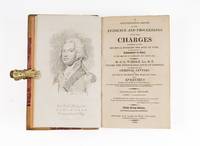
1809réf. 822571809. One of the Great Scandals of Georgian England Trial. Wardle Gwyllym Lloyd 1762-1833 Reporter. Frederick Augustus Prince Duke of York and Albany 1763-1827 Defendant. A Circumstantial Report of the Evidence and Proceedings Upon the Charges Preferred Against His Royal Highness the Duke of York in the Capacity of Commander in Chief In the Months of February and March 1809. Before the House of Commons. Including the Whole of the Original Letters of His Royal Highness the Duke of York; The Speeches Correctly Taken in Full Of the Various Members; With All the Other Documents Produced in the Course of the Investigation And the Decision of the House of Commons Upon This Very Important Subject. Illustrated by Portraits. Albion Press Edition. London: Printed for James Cundee Ivy-Lane 1809. viii 3-700 pp. Stipple-engraved frontispiece 12 stipple-engraved plates. Complete. Octavo 8-1/4" x 5". Nineteenth-century three-quarter calf over marbled boards raised bands gilt fillets and red and black lettering pieces to spine edges colored yellow. Negligible light rubbing and a few minor scuffs to boards moderate rubbing to extremities corners bumped and lightly worn small bookseller stamp Lawrance & Hill London to verso of front free endpaper. Moderate toning to interior light foxing in places finger smudges to a few leaves small hale to leaf 3E2 pp. 403-404 with minor loss to text. $350. Only edition. This trial was one of the great scandals of Georgian England. In 1806 it was discovered that Mary Anne Clarke the mistress of Prince Frederick Duke of York and Albany 1763-1827 commander-in-chief and the second son of King George III was selling commissions for personal profit presumably with Frederick's cooperation. Investigated by Parliament Frederick was exonerated but he resigned his post however because a large minority voted against him. He was reinstated two years later. Clarke was forced to leave London. She was convicted for libel in 1813 and served a nine-month prison sentence. She then moved to France and spent the rest of her life there. Lloyd a former military officer and the reporter of this account initiated the case as a Member of Parliament. British Museum Catalogue Compact Edition 26:691. unknown books
1796réf. 730951796. London: T. Hepinstall J. Parsons & C. Wood 1796. London: T. Hepinstall J. Parsons & C. Wood 1796. "Assault Rout and Riot" Trial. Warren John 1730-1800 Defendant. The Trial of the Bishop of Bangor and Others Before Mr. Justice Heath At the Assises at Shrewsbury On Tuesday July 16 1796. For an Assault Rout And Riot: With the Pleadings at Large of Counsellors Adam and Erskine; Also the Charge to the Jury by Mr. Justice Heath. London: Sold by T. Hepinstall J. Parsons And C. Wood 1796. 47 1 pp. Octavo 8-1/4" x 4-1/4". Stab-stitched pamphlet bound in later quarter cloth over plain boards gilt fillets and title to spine. Light toning to boards small scuff to front board light fading to edges of rear board small later ink annotations to front free endpaper and rear pastedown. Light toning to interior light foxing and soiling in a few places contemporary notes in ink to half-title and title page with underlining and marks to a few other pages ownership signature of Peter Bailey Williams dated 1794 to verso of final leaf. $1250. First edition. Warren the bishop of Bangor in northwest Wales had appointed his nephew as registrar of the diocese. Since the nephew was underage Samuel Grindley was appointed deputy registrar but when the nephew attempted to replace him he refused to leave his office. A fight broke out between Grindley and Warren with others joining the bishop's side. At one point Grindley threatened Warren with a pistol and the fight did not conclude until the bishop's wife intervened and dragged him away. Erskine was engaged for the defense and secured an acquittal despite the judge's summing-up in favor of conviction. The notes to the half-title and title page remark somewhat disparagingly on the case describing Grindley as "a man of no principle." Williams 1763-1836 was a Welsh Anglican rector in Caernarfonshire. OCLC locates 11 copies of this title 4 in North America Library of Congress Newberry Library Huntington Library Redwood Library and Athenaeum. English Short-Title Catalogue T191335. unknown books
1686réf. 806181686. London: Printed for Dorman Newman 1686. London: Printed for Dorman Newman 1686. A Member of a Plot to Depose James II Trial. Warrington Henry Booth Earl of 1652-1694 Defendant. The Tryal of Henry Baron Delamere for High-Treason In Westminster-Hall The 14th Day of January 1685. Before the Right Honourable George Lord Jeffreys Baron of Wemm Lord High Chancellour of England Constituted Lord High Steward on that Occasion. On Which Day After Full Hearing The Lord Delamere was Acquitted from All Matters Laid to His Charge. London: Printed for Dorman Newman 1686. iv 87 1 pp. With imprimatur leaf. Folio 12" x 7-1/2". Disbound stab-stitched pamphlet spine discreetly reinforced with archival tissue. Moderate toning faint dampstaining to top-edge not affecting text occasional light foxing light soiling and a few faint stains to exterior. $150. Only edition. Warrington was indicted as a participant in Monmouth's rebellion an attempt by the Duke of Monmouth an illegitimate son of Charles II to claim the throne and depose James II. The special charge against Delamere "was that at the time of Monmouth's rebellion he had gone secretly to Cheshire with the view of inciting a rising in the north of England." While it is nearly certain that Delamere sympathized with Monmouth's designs he was able to explain his journey as a wish to visit a favorite child who was dangerously ill. "Moreover Thomas Saxon the only witness who would positively swear to the correspondence of Delamere and Monmouth so hopelessly contradicted himself that he was afterwards convicted of perjury" DNB. Dictionary of National Biography DNB II:842-844. English Short-Title Catalogue R23568. unknown books
1686réf. 728161686. London 1686. Sole edition. London 1686. Sole edition. A Member of a Plot to Depose James II Trial. Warrington Henry Booth Earl of 1652-1694 Defendant. The Tryal of Henry Baron Delamere for High-Treason In Westminster-Hall The 14th Day of January 1685. Before the Right Honourable George Lord Jeffreys Baron of Wemm Lord High Chancellour of England Constituted Lord High Steward on that Occasion. On Which Day After Full Hearing The Lord Delamere was Acquitted from All Matters Laid to His Charge. London: Printed for Dorman Newman 1686. iv 87 1 pp. With imprimatur leaf. Folio 13" x 7-3/4". Stab-stitched pamphlet bound into recent quarter cloth lettering piece to spine edges untrimmed. A few small faint stains to front board. Light toning to text somewhat heavier in places occasional faint dampspotting and staining light soiling to first and final leaves. $200. Only edition. Warrington was indicted as a participant in Monmouth's rebellion an attempt by the Duke of Monmouth an illegitimate son of Charles II to claim the throne and depose James II. The special charge against Delamere "was that at the time of Monmouth's rebellion he had gone secretly to Cheshire with the view of inciting a rising in the north of England." While it is nearly certain that Delamere sympathized with Monmouth's designs he was able to explain his journey as a wish to visit a favorite child who was dangerously ill. "Moreover Thomas Saxon the only witness who would positively swear to the correspondence of Delamere and Monmouth so hopelessly contradicted himself that he was afterwards convicted of perjury.": Dictionary of National Biography II:842-844. English Short-Title Catalogue R23568. unknown books
1817réf. 740901817. Edinburgh 1817. Edinburgh 1817. Trial of a Leader of an 1816 Plot to Overthrow the British Government Trial. Watson James 1766-1838 Defendant. The Trial of James Watson The Elder Before the Court of King's Bench In Westminster Hall On the 9th 10th 11th 12th 13th 14th And 16th June 1817. For High Treason. Taken in Short Hand. Edinburgh: Printed for Alex. Jameson et al. 1817. vi 250 pp. Octavo 8-3/4" x 5-1/2". Printed wrappers edges untrimmed bound in later patterned cloth gilt-stamped title and date to spine. Light rubbing to boards and extremities spine ends and corners bumped and lightly worn front hinge starting rear hinge cracked. Light toning to interior very light foxing to a few leaves light soiling to wrappers ownership signature of William Macmath dated April 29 1868 to inside of front wrapper. $150. Only edition. Watson was tried for his role in the Spa Fields riot. This riot followed a pair of meetings held by revolutionaries at Spa Fields Islington England on November 15 and December 2 1816. Opponents of the government they resolved to encourage rioting and then seize control of the government by capturing the Tower of London and the Bank of England. Watson Arthur Thistlewood and three other leaders were arrested and charged with high treason as a result. Watson was acquitted and the other three were released without trial. Thistlewood would go on to lead the failed Cato Street Conspiracy in 1820. OCLC locates 7 copies of this title in North American law libraries Yale Columbia University of Minnesota University of Missouri LA County Library of Congress Social Law. unknown
1817réf. 684541817. London 1817. London 1817. Detailed Trial of a Leader of an 1816 Plot to Overthrow of British Government Trial. Watson James 1766-1838 Defendant. Gurney William Brodie 1777-1855 Reporter. The Trial of James Watson For High Treason At the Bar of the Court of King's Bench On Monday the 9th Tuesday the 10th Wednesday the 11th Thursday the 12th Friday the 13th Saturday the 14th and Monday the 16th of June 1817. With the Antecedent Proceedings. London: Sold by Butterworth and Son 1817. Two volumes. 586; 578 pp. Octavo 8-1/2" x 5-3/4". Later library cloth red and black calf lettering pieces to spines. Light soiling and a few minor stains light fading to spines and edges of boards some chipping to lettering pieces. Moderate toning light foxing in places front hinge of Volume II cracked several signatures in that volume loose faint library stamps to title pages brief library annotations to versos. $450. Only edition. Watson was tried for his role in the Spa Fields riot. This riot followed a pair of meetings held by revolutionaries at Spa Fields Islington England on November 15 and December 2 1816. Opponents of the government they resolved to encourage rioting and then seize control of the government by capturing the Tower of London and the Bank of England. Watson Arthur Thistlewood and three other leaders were arrested and charged with high treason as a result. Watson was acquitted and the other three were released without trial. Catalogue of the Library of the Harvard Law School II:1220. unknown
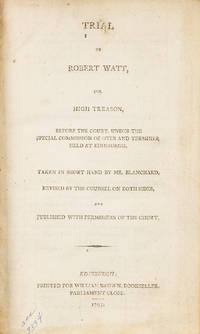
1795réf. 822471795. Edinburgh: Printed for William Brown 1795. Edinburgh: Printed for William Brown 1795. An Ill-Founded Plot to Establish an Independent Scotland Trial. Watt Robert c.1761-1794 Defendant. Trial of Robert Watt For High Treason Before the Court Under the Special Commission of Oyer and Terminer Held at Edinburgh. Taken in Short Hand by Mr. Blanchard Revised by the Counsel on Both Sides And Published with the Permission of the Court. Edinburgh: Printed for William Brown 1795. ii 364 pp. Folding plate illustrating pikes found in Watt's possession. Octavo 8" x 4-3/4". Contemporary three-quarter calf over paper-covered boards gilt rules to boards along calf blind ornaments and gilt fillets and title to spine speckled edges. Light rubbing and a few minor spots and smudges to boards moderate rubbing to extremities corners bumped and moderately worn. Moderate toning to interior negligible light foxing and tiny smudges and stains to preliminaries plate final leaf of text and rear endleaves. A handsome copy. $450. Only edition. Watt a wine merchant and political radical was the architect of a somewhat confused plot to establish Scotland as an independent country. After a search of his house turned up a number of pikes and the type for a seditious handbill he was arrested and tried for treason. A co-conspirator was pardoned but Watt was not so lucky. He was convicted and sentenced to be hanged and beheaded despite the jury's recommendation of mercy. The sentence reflected the court's opinion of the severity of Watt's crime. It was also intended to be a warning to other radicals. English Short-Title Catalogue N013806. unknown
1795réf. 789051795. Edinburgh: Printed for William Brown 1795. Edinburgh: Printed for William Brown 1795. The Trial of a Would-Be Revolutionary Trial. Watt Robert c.1761-1794 Defendant. Trial of Robert Watt For High Treason Before the Court Under the Special Commission of Oyer and Terminer Held at Edinburgh. Taken in Short Hand by Mr. Blanchard Revised by the Counsel on Both Sides And Published with the Permission of the Court. Edinburgh: Printed for William Brown 1795. ii 364 pp. Folding plate illustrating pikes found in Watt's possession. Octavo 8-1/4" x 4-3/4". Contemporary calf gilt fillets to spine lettering piece lacking blind tooling to board edges. Light rubbing and a few small nicks and scratches to boards which are slightly bowed and separated but secured by cords faint dampstain to front board moderate rubbing to extremities shelf location in ink to foot of spine corners bumped and worn faint offsetting to preliminaries front free endpaper loosening but secure. Light toning to interior light soiling in a few places edgewear and light creasing to folding plate brief recent ink annotation to title page. $250. Only edition. Watt a wine merchant and political radical was the architect of a somewhat confused plot to establish Scotland as an independent country. After a search of his house turned up a number of pikes and the type for a seditious handbill he was arrested and tried for treason. A co-conspirator was pardoned but Watt was not so lucky. He was convicted and sentenced to be hanged and beheaded despite the jury's recommendation of mercy. The sentence reflected the court's opinion of the severity of Watt's crime. It was also intended to be a warning to other radicals. English Short-Title Catalogue N013806. unknown
1794réf. 728651794. The Trial and Confession of a Scottish Traitor Trials. Scotland. Watt Robert Defendant c.1761-1794. Trials of Robert Watt and David Downie for High Treason Before the Courts of Oyer and Terminer Held at Edinburgh Aug. 14. 15. 22. 27.-Sept. 3. 5. 6. 1794. With an Engraving of the Pikes Found in the Possession of Robert Watt and Others. To Which is Subjoined the Celebrated Speech of Sir Hercules Langrishe On Parliamentary Reform Delivered in the House of Commons Ireland March 4. 1794. Edinburgh: Printed for Manners and Miller 1794. 4 92 pp. With a woodcut illustration after title page. Bound with Watt Robert. By Authority. The Declaration and Confession of Robert Watt Written Subscribed & Delivered by Himself The Evening Before His Execution For High Treason At Edinburgh October 15. 1794. Attested by the Reverend Dr Baird Principal of the University of Edinburgh; And the Reverend T.S. Jones One of the Ministers of Lady Glenorchie's Chapel. Edinburgh: Printed for Bell & Bradfute 1794. iv 35 1 pp. With a lithograph portrait frontispiece moved to beginning of Trials by binder. Publisher advertisement to final page. Octavo 8" x 4-3/4". Disbound stab-stitched pamphlets. Light toning to interior more moderate in some places light soiling in a few places red monogram stamp "AB" to upper gutter of title pages and p. 1 of Trials ms. notes in an early hand to versos of first two leaves of Trials and to foot of title page of Confession. $650. Only editions. Watt a wine merchant and political radical was the architect of a somewhat confused plot to establish Scotland as an independent country. After a search of his house turned up a number of pikes and the type for a seditious handbill he was arrested and tried for treason. Downie a co-conspirator was pardoned but Watt was not so lucky. He was convicted and sentenced to be hanged and beheaded despite the jury's recommendation of mercy. The sentence reflected the courts' opinion of the severity of Watt's crime. It was also intended to be a warning to other radicals. English Short-Title Catalogue T174262 T94672. unknown
1817réf. 684541817. London 1817. London 1817. Detailed Trial of a Leader of an 1816 Plot to Overthrow of British Government Trial. Watson James 1766-1838 Defendant. Gurney William Brodie 1777-1855 Reporter. The Trial of James Watson For High Treason At the Bar of the Court of King's Bench On Monday the 9th Tuesday the 10th Wednesday the 11th Thursday the 12th Friday the 13th Saturday the 14th and Monday the 16th of June 1817. With the Antecedent Proceedings. London: Sold by Butterworth and Son 1817. Two volumes. 586; 578 pp. Octavo 8-1/2" x 5-3/4". Later library cloth red and black calf lettering pieces to spines. Light soiling and a few minor stains light fading to spines and edges of boards some chipping to lettering pieces. Moderate toning light foxing in places front hinge of Volume II cracked several signatures in that volume loose faint library stamps to title pages brief library annotations to versos. $450. Only edition. Watson was tried for his role in the Spa Fields riot. This riot followed a pair of meetings held by revolutionaries at Spa Fields Islington England on November 15 and December 2 1816. Opponents of the government they resolved to encourage rioting and then seize control of the government by capturing the Tower of London and the Bank of England. Watson Arthur Thistlewood and three other leaders were arrested and charged with high treason as a result. Watson was acquitted and the other three were released without trial. Catalogue of the Library of the Harvard Law School II:1220. unknown books
1817réf. 740901817. Edinburgh 1817. Edinburgh 1817. Trial of a Leader of an 1816 Plot to Overthrow the British Government Trial. Watson James 1766-1838 Defendant. The Trial of James Watson The Elder Before the Court of King's Bench In Westminster Hall On the 9th 10th 11th 12th 13th 14th And 16th June 1817. For High Treason. Taken in Short Hand. Edinburgh: Printed for Alex. Jameson et al. 1817. vi 250 pp. Octavo 8-3/4" x 5-1/2". Printed wrappers edges untrimmed bound in later patterned cloth gilt-stamped title and date to spine. Light rubbing to boards and extremities spine ends and corners bumped and lightly worn front hinge starting rear hinge cracked. Light toning to interior very light foxing to a few leaves light soiling to wrappers ownership signature of William Macmath dated April 29 1868 to inside of front wrapper. $150. Only edition. Watson was tried for his role in the Spa Fields riot. This riot followed a pair of meetings held by revolutionaries at Spa Fields Islington England on November 15 and December 2 1816. Opponents of the government they resolved to encourage rioting and then seize control of the government by capturing the Tower of London and the Bank of England. Watson Arthur Thistlewood and three other leaders were arrested and charged with high treason as a result. Watson was acquitted and the other three were released without trial. Thistlewood would go on to lead the failed Cato Street Conspiracy in 1820. OCLC locates 7 copies of this title in North American law libraries Yale Columbia University of Minnesota University of Missouri LA County Library of Congress Social Law. unknown books
1795réf. 822471795. Edinburgh: Printed for William Brown 1795. Edinburgh: Printed for William Brown 1795. An Ill-Founded Plot to Establish an Independent Scotland Trial. Watt Robert c.1761-1794 Defendant. Trial of Robert Watt For High Treason Before the Court Under the Special Commission of Oyer and Terminer Held at Edinburgh. Taken in Short Hand by Mr. Blanchard Revised by the Counsel on Both Sides And Published with the Permission of the Court. Edinburgh: Printed for William Brown 1795. ii 364 pp. Folding plate illustrating pikes found in Watt's possession. Octavo 8" x 4-3/4". Contemporary three-quarter calf over paper-covered boards gilt rules to boards along calf blind ornaments and gilt fillets and title to spine speckled edges. Light rubbing and a few minor spots and smudges to boards moderate rubbing to extremities corners bumped and moderately worn. Moderate toning to interior negligible light foxing and tiny smudges and stains to preliminaries plate final leaf of text and rear endleaves. A handsome copy. $450. Only edition. Watt a wine merchant and political radical was the architect of a somewhat confused plot to establish Scotland as an independent country. After a search of his house turned up a number of pikes and the type for a seditious handbill he was arrested and tried for treason. A co-conspirator was pardoned but Watt was not so lucky. He was convicted and sentenced to be hanged and beheaded despite the jury's recommendation of mercy. The sentence reflected the court's opinion of the severity of Watt's crime. It was also intended to be a warning to other radicals. English Short-Title Catalogue N013806. unknown books
1795réf. 789051795. Edinburgh: Printed for William Brown 1795. Edinburgh: Printed for William Brown 1795. The Trial of a Would-Be Revolutionary Trial. Watt Robert c.1761-1794 Defendant. Trial of Robert Watt For High Treason Before the Court Under the Special Commission of Oyer and Terminer Held at Edinburgh. Taken in Short Hand by Mr. Blanchard Revised by the Counsel on Both Sides And Published with the Permission of the Court. Edinburgh: Printed for William Brown 1795. ii 364 pp. Folding plate illustrating pikes found in Watt's possession. Octavo 8-1/4" x 4-3/4". Contemporary calf gilt fillets to spine lettering piece lacking blind tooling to board edges. Light rubbing and a few small nicks and scratches to boards which are slightly bowed and separated but secured by cords faint dampstain to front board moderate rubbing to extremities shelf location in ink to foot of spine corners bumped and worn faint offsetting to preliminaries front free endpaper loosening but secure. Light toning to interior light soiling in a few places edgewear and light creasing to folding plate brief recent ink annotation to title page. $250. Only edition. Watt a wine merchant and political radical was the architect of a somewhat confused plot to establish Scotland as an independent country. After a search of his house turned up a number of pikes and the type for a seditious handbill he was arrested and tried for treason. A co-conspirator was pardoned but Watt was not so lucky. He was convicted and sentenced to be hanged and beheaded despite the jury's recommendation of mercy. The sentence reflected the court's opinion of the severity of Watt's crime. It was also intended to be a warning to other radicals. English Short-Title Catalogue N013806. unknown books
1794réf. 728651794. The Trial and Confession of a Scottish Traitor Trials. Scotland. Watt Robert Defendant c.1761-1794. Trials of Robert Watt and David Downie for High Treason Before the Courts of Oyer and Terminer Held at Edinburgh Aug. 14. 15. 22. 27.-Sept. 3. 5. 6. 1794. With an Engraving of the Pikes Found in the Possession of Robert Watt and Others. To Which is Subjoined the Celebrated Speech of Sir Hercules Langrishe On Parliamentary Reform Delivered in the House of Commons Ireland March 4. 1794. Edinburgh: Printed for Manners and Miller 1794. 4 92 pp. With a woodcut illustration after title page. Bound with Watt Robert. By Authority. The Declaration and Confession of Robert Watt Written Subscribed & Delivered by Himself The Evening Before His Execution For High Treason At Edinburgh October 15. 1794. Attested by the Reverend Dr Baird Principal of the University of Edinburgh; And the Reverend T.S. Jones One of the Ministers of Lady Glenorchie's Chapel. Edinburgh: Printed for Bell & Bradfute 1794. iv 35 1 pp. With a lithograph portrait frontispiece moved to beginning of Trials by binder. Publisher advertisement to final page. Octavo 8" x 4-3/4". Disbound stab-stitched pamphlets. Light toning to interior more moderate in some places light soiling in a few places red monogram stamp "AB" to upper gutter of title pages and p. 1 of Trials ms. notes in an early hand to versos of first two leaves of Trials and to foot of title page of Confession. $650. Only editions. Watt a wine merchant and political radical was the architect of a somewhat confused plot to establish Scotland as an independent country. After a search of his house turned up a number of pikes and the type for a seditious handbill he was arrested and tried for treason. Downie a co-conspirator was pardoned but Watt was not so lucky. He was convicted and sentenced to be hanged and beheaded despite the jury's recommendation of mercy. The sentence reflected the courts' opinion of the severity of Watt's crime. It was also intended to be a warning to other radicals. English Short-Title Catalogue T174262 T94672. unknown books
1732réf. 734361732. By Reason of Some Natural Imperfection" Trial. Weld v. Weld. The Proceedings in the Arches-Court of Canterbury in a Cause Between the Hon. Mrs. Catherine Weld Daughter to the Lord Aston; And Edward Weld Esq; Her Husband. Containing I. Her Libel Exhibited Against Him for Impotency. II. Her Answer and Replication. III. Certificates of Ambrose Dickens Esq; His Majesty's Serjeant Surgeon Mr. Williams and Several Other Eminent Surgeons Who Examined Mr. Weld; And also of three Midwives who Examined Mrs. Weld. IV. Copies of the Depositions of Several Noble Persons Relating to This Cause. V. The Sentence Pronounced. To Which is Prefixed a Preface. London: Printed for H. Owen 1757. 48 pp. Octavo 7-1/2' x 4-3/4". Stab-stitched pamphlet in recent stiff marbled-paper wrappers calf lettering piece to spine. Moderate toning to interior faint vertical crease to text block some wear to outer corners of text block light foxing to a few leaves light soiling to title page and p. 48. $750. Third stated edition. The Welds married in 1727 but when there was no issue after three years Catherine sued Edward for divorce in ecclesiastical court on the grounds that he was "unable to perform the Conjugal Rites by Reason of some natural Imperfection which he well knew in himself." Edward fought to clear his name claiming that after a simple surgical procedure he had in fact consummated the marriage twice. The case gained a great deal of public attention largely because the detail of Catherine's claim and the amount of medical evidence presented were unusual even for an impotency trial. Ultimately the divorce was denied and the couple reached a private resolution to live apart. Edward remarried after Catherine's death and fathered a daughter and four sons. It is unclear why our copy is designated the third edition. It appears to be based on an account issued by E. Raynor which went through five editions and two Dublin reprints all in 1732. OCLC and the ESTC locate 3 copies in North America Cornell Rice Harvard Law School. English Short-Title Catalogue ESTC N11985. unknown
1732réf. 727691732. London: Printed for E. Rayner 1732. London: Printed for E. Rayner 1732. "Unable to Perform the Conjugal Rites" Trial. Weld v. Weld. The Whole of the Proceedings in the Arches-Court of Canterbury In a Cause Between the Hon. Mrs. Catherine Weld Daughter to the Lord Aston And Edward Weld Esquire Her Husband. Containing I. Her Libel Exhibited Against Him for Impotency. II. Her Answer and Replication. III. Certificates of Ambrose Dickens Esq; His Majesty's Serjeant-Surgeon Mr. Williams And Several Other Surgeons Who Examin'd Mr. Weld; And Also of Three Midwives who Examined Mrs. Weld. IV. Copies of the Depositions of Several Noble Persons Relating to this Cause. V. The Sentence Pronounced by the Worshipful Dr. Bettesworth Feb. 15. 1731. To Which is Prefixed a Preface By the Author of the Tryal of F. Girard and Miss Cadiere. London: Printed for E. Rayner 1732. 48 pp. leaves B3 and B4 pp. 13-16 misnumbered 9-12. Octavo 7-1/2" x 4-1/2". Stab-stitched pamphlet bound into later quarter calf over marbled boards gilt title and date to spine a number of blank leaves added by binder after p. 48. Light rubbing to extremities front joint just starting at ends. Light toning to interior occasional light foxing light soiling in a few places slight offsetting to preliminaries and first two leaves. $750. Fifth and final edition. The Welds married in 1727 but when there was no issue after three years Catherine sued Edward for divorce in ecclesiastical court on the grounds that he was "unable to perform the Conjugal Rites by Reason of some natural Imperfection which he well knew in himself." Edward fought to clear his name claiming that after a simple surgical procedure he had in fact consummated the marriage twice. The case gained a great deal of public attention largely because the detail of Catherine's claim and the amount of medical evidence presented were unusual even for an impotency trial. Ultimately the divorce was denied and the couple reached a private resolution to live apart. Edward remarried after Catherine's death and successfully produced a daughter and four sons. English Short-Title Catalogue T52462. unknown
1732réf. 734361732. By Reason of Some Natural Imperfection" Trial. Weld v. Weld. The Proceedings in the Arches-Court of Canterbury in a Cause Between the Hon. Mrs. Catherine Weld Daughter to the Lord Aston; And Edward Weld Esq; Her Husband. Containing I. Her Libel Exhibited Against Him for Impotency. II. Her Answer and Replication. III. Certificates of Ambrose Dickens Esq; His Majesty's Serjeant Surgeon Mr. Williams and Several Other Eminent Surgeons Who Examined Mr. Weld; And also of three Midwives who Examined Mrs. Weld. IV. Copies of the Depositions of Several Noble Persons Relating to This Cause. V. The Sentence Pronounced. To Which is Prefixed a Preface. London: Printed for H. Owen 1757. 48 pp. Octavo 7-1/2' x 4-3/4". Stab-stitched pamphlet in recent stiff marbled-paper wrappers calf lettering piece to spine. Moderate toning to interior faint vertical crease to text block some wear to outer corners of text block light foxing to a few leaves light soiling to title page and p. 48. $750. Third stated edition. The Welds married in 1727 but when there was no issue after three years Catherine sued Edward for divorce in ecclesiastical court on the grounds that he was "unable to perform the Conjugal Rites by Reason of some natural Imperfection which he well knew in himself." Edward fought to clear his name claiming that after a simple surgical procedure he had in fact consummated the marriage twice. The case gained a great deal of public attention largely because the detail of Catherine's claim and the amount of medical evidence presented were unusual even for an impotency trial. Ultimately the divorce was denied and the couple reached a private resolution to live apart. Edward remarried after Catherine's death and fathered a daughter and four sons. It is unclear why our copy is designated the third edition. It appears to be based on an account issued by E. Raynor which went through five editions and two Dublin reprints all in 1732. OCLC and the ESTC locate 3 copies in North America Cornell Rice Harvard Law School. English Short-Title Catalogue ESTC N11985. unknown books
1732réf. 727691732. London: Printed for E. Rayner 1732. London: Printed for E. Rayner 1732. "Unable to Perform the Conjugal Rites" Trial. Weld v. Weld. The Whole of the Proceedings in the Arches-Court of Canterbury In a Cause Between the Hon. Mrs. Catherine Weld Daughter to the Lord Aston And Edward Weld Esquire Her Husband. Containing I. Her Libel Exhibited Against Him for Impotency. II. Her Answer and Replication. III. Certificates of Ambrose Dickens Esq; His Majesty's Serjeant-Surgeon Mr. Williams And Several Other Surgeons Who Examin'd Mr. Weld; And Also of Three Midwives who Examined Mrs. Weld. IV. Copies of the Depositions of Several Noble Persons Relating to this Cause. V. The Sentence Pronounced by the Worshipful Dr. Bettesworth Feb. 15. 1731. To Which is Prefixed a Preface By the Author of the Tryal of F. Girard and Miss Cadiere. London: Printed for E. Rayner 1732. 48 pp. leaves B3 and B4 pp. 13-16 misnumbered 9-12. Octavo 7-1/2" x 4-1/2". Stab-stitched pamphlet bound into later quarter calf over marbled boards gilt title and date to spine a number of blank leaves added by binder after p. 48. Light rubbing to extremities front joint just starting at ends. Light toning to interior occasional light foxing light soiling in a few places slight offsetting to preliminaries and first two leaves. $750. Fifth and final edition. The Welds married in 1727 but when there was no issue after three years Catherine sued Edward for divorce in ecclesiastical court on the grounds that he was "unable to perform the Conjugal Rites by Reason of some natural Imperfection which he well knew in himself." Edward fought to clear his name claiming that after a simple surgical procedure he had in fact consummated the marriage twice. The case gained a great deal of public attention largely because the detail of Catherine's claim and the amount of medical evidence presented were unusual even for an impotency trial. Ultimately the divorce was denied and the couple reached a private resolution to live apart. Edward remarried after Catherine's death and successfully produced a daughter and four sons. English Short-Title Catalogue T52462. unknown books
1807réf. 738661807. Boston: Belcher and Armstrong 1807. Boston: Belcher and Armstrong 1807. The Trial that Followed the Boston Massacre Trial. Wemms William Primary Defendant. The Trial of the British Soldiers Of the 29th Regiment of Foot For the Murder of Crispus Attucks Samuel Gray Samuel Maverick James Caldwell And Patrick Carr On Monday Evening March 5 1770. Boston: Printed and Published by Belcher and Armstrong 1807. 120 pp. Octavo 7-1/2" x 5". Contemporary marbled boards with later rebacking quarter-paper spine with printed title and ornaments. Moderate rubbing to boards heavier rubbing to board edges with wear to corners joints starting hinges cracked boards secure. Light browning to interior faint dampstaining to margins in a few places light soiling to title page. $950. Reissue of the first edition published in 1770 with a title beginning The Trial of William Wemms. The violent confrontation between soldiers and citizens known as the Boston Massacre resulted in the trial of eight soldiers for murder. Defended by John Adams and Josiah Quincy six were acquitted and two who fired fatal shots were convicted of manslaughter burned on the hand and released. McDade The Annals of Murder 122 note. Cohen Bibliography of Early American Law 13203. unknown
1807réf. 738661807. Boston: Belcher and Armstrong 1807. Boston: Belcher and Armstrong 1807. The Trial that Followed the Boston Massacre Trial. Wemms William Primary Defendant. The Trial of the British Soldiers Of the 29th Regiment of Foot For the Murder of Crispus Attucks Samuel Gray Samuel Maverick James Caldwell And Patrick Carr On Monday Evening March 5 1770. Boston: Printed and Published by Belcher and Armstrong 1807. 120 pp. Octavo 7-1/2" x 5". Contemporary marbled boards with later rebacking quarter-paper spine with printed title and ornaments. Moderate rubbing to boards heavier rubbing to board edges with wear to corners joints starting hinges cracked boards secure. Light browning to interior faint dampstaining to margins in a few places light soiling to title page. $950. Reissue of the first edition published in 1770 with a title beginning The Trial of William Wemms. The violent confrontation between soldiers and citizens known as the Boston Massacre resulted in the trial of eight soldiers for murder. Defended by John Adams and Josiah Quincy six were acquitted and two who fired fatal shots were convicted of manslaughter burned on the hand and released. McDade The Annals of Murder 122 note. Cohen Bibliography of Early American Law 13203. unknown books
1852réf. 641061852. Vannoud Louis; Cavallari Luigi. Vannoud Louis; Cavallari Luigi. A Sensational Case of Kidnapping Trial. Wikoff Henry 1813-1884 Principal Defendant. Vannoud Louis Defendant. Cavallari Luigi Defendant. Trial of Wikoff Vannoud And Cavallari For a Forced Marriage Between Miss Gamble and One of the Accused. Before the High Court of Genoa February 9-10 1852. London: William Shoberl 1852. 64 pp. Lithograph portrait frontispiece of Wikoff. Octavo 8-1/2" x 5-1/2". Stab-stitched pamphlet in printed wrappers. Moderate soiling rubbing to extremities with some wear to spine ends and corners. Light toning to text foxing to a few leaves internally clean. $750. Only edition. An account of one of the sensational trials of the early 1850s. Wikoff or as he called himself Chevalier Wikoff was an American impresario occasional European correspondent for the New York Herald and possibly a spy for Lord Palmerston. He was engaged to Jane Catherine Gamble an English woman. Gamble changed her mind shortly before the wedding and fled to Genoa. Wikoff tracked her down and apparently tricked her into coming along with him to his apartment. Shortly afterwards Gamble filed a complaint of kidnapping that landed Wikoff in an Italian jail for 15 months. He was found guilty in an Italian court and forced to return her letters and "extorted promise of marriage." Ever enterprising Wikoff responded to the negative publicity with a memoir entitled My Courtship and Its Consequences 1855 which became a best-seller. Copies of The Trial of Wikoff are scarce. OCLC locates 7 worldwide: 2 in the British Library and 5 in North American law libraries Harvard Library of Congress University of Georgia University of Minnesota University of Pennsylvania. unknown
1852réf. 641061852. Vannoud Louis; Cavallari Luigi. Vannoud Louis; Cavallari Luigi. A Sensational Case of Kidnapping Trial. Wikoff Henry 1813-1884 Principal Defendant. Vannoud Louis Defendant. Cavallari Luigi Defendant. Trial of Wikoff Vannoud And Cavallari For a Forced Marriage Between Miss Gamble and One of the Accused. Before the High Court of Genoa February 9-10 1852. London: William Shoberl 1852. 64 pp. Lithograph portrait frontispiece of Wikoff. Octavo 8-1/2" x 5-1/2". Stab-stitched pamphlet in printed wrappers. Moderate soiling rubbing to extremities with some wear to spine ends and corners. Light toning to text foxing to a few leaves internally clean. $750. Only edition. An account of one of the sensational trials of the early 1850s. Wikoff or as he called himself Chevalier Wikoff was an American impresario occasional European correspondent for the New York Herald and possibly a spy for Lord Palmerston. He was engaged to Jane Catherine Gamble an English woman. Gamble changed her mind shortly before the wedding and fled to Genoa. Wikoff tracked her down and apparently tricked her into coming along with him to his apartment. Shortly afterwards Gamble filed a complaint of kidnapping that landed Wikoff in an Italian jail for 15 months. He was found guilty in an Italian court and forced to return her letters and "extorted promise of marriage." Ever enterprising Wikoff responded to the negative publicity with a memoir entitled My Courtship and Its Consequences 1855 which became a best-seller. Copies of The Trial of Wikoff are scarce. OCLC locates 7 worldwide: 2 in the British Library and 5 in North American law libraries Harvard Library of Congress University of Georgia University of Minnesota University of Pennsylvania. unknown books
1846réf. 709871846. Taunton Mass. 1846. Verdict Not Guilty. Taunton Mass. 1846. Verdict Not Guilty. "A House of Human Slaughter" Trial. Williams Benjamin W. Principal Defendant. Report of the Trial of B.W. Williams and Others Editors and Printers of the Dew Drop A Temperance Paper Published at Taunton Mass. For an Alleged Libel Upon William Wilbar A Rumseller of Taunton Before the Supreme Judicial Court at New Bedford At the November Term 1845 His Honor Judge Hubbard on the Bench. Taunton Mass.: Hack & King Printers Dew Drop Office 1846. 60 pp. Octavo 8-1/2" x 5-1/4". Disbound stab stitched pamphlet. Moderate toning light soiling to exterior some rubbing to extremities. Light browning to text faint tick marks in light pencil to margins in a few places light foxing to a few leaves. $450. First edition. In January 1845 the defendant published an article in his temperance paper The Dew Drop that referred to Mr. Wilbar as "the incarnate Devil" with a mouth that emitted "flames of fire" that "withered and scorched all the deluded wretches" who entered his shop "a house of human slaughter." The defendants were acquitted after 45 minutes of deliberation. Although there are many reprint editions available the original 1846 printing is scarce in the marketplace. OCLC locates 7 copies in North American law libraries Harvard Library of Congress Social Law University of Minnesota University of Missouri University of Pennsylvania York University. Not in McCoy Freedom of the Press. Cohen Bibliography of Early American Law 12078. unknown