3.319 Ergebnisse
Best.-Nr. 53857, Paris, J. Hetzel et Cie 1872, in-8, demi-basane havane, (dos arraché, rel. usée), int. frais, 577p.
2021br. Il codice di procedura civile contempla uno speciale procedimento a cognizione piena per la disciplina delle controversie in materia di lavoro, riservato alla "competenza" di giudici a ciò funzionalmente destinati e, per questo, muniti di un sapere tecnico-giuridico necessariamente specializzato. La previsione di un trattamento differenziato per questa tipologia di contenzioso risponde a due fondamentali ragioni: per un verso, la disuguaglianza economica tra una parte e l'altra del rapporto contrattuale; per un altro, la natura e il contenuto delle situazioni sostanziali oggetto della lite, coincidenti quasi sempre con diritti indisponibili o semi-indisponibili o disponibili e, però, protetti da norme inderogabili o comunque di rango costituzionale.Le disposizioni relative - introdotte dalla l. n. 533 del 1973 in risposta all'emersione dei nuovi diritti dovuta alle fondamentali riforme di carattere sostanziale della fine degli anni '60 e dell'inizio degli anni '70 dello scorso secolo - non hanno subito significative modifiche e, anzi, hanno conosciuto una sempre più ampia espansione ed esportazione in altri e differenti contesti.
Cosenza, Tip. N. Caputi & Figli, 1901. In 8°, PP 21n. Brossura originale.
1875Best.-Nr. 80971875 Caen, Le Blanc-Hardel, 1875. Un fascicule in-4 de72 pages, couverture jaune imprimée. Dos cassé, manques à la couverture, intérieur frais.
1875Best.-Nr. 77031875 Caen, Le Blanc-Hardel, 1875. Une plaquette in-4 de 48 pages, couverture jaune. Manques à la couverture. Exemplaire de Beaurepaire.
First edition, folio (295 x 190 mm), 4pp., drop-head title, a well margined copy with just slight signs of a water stain, sewn in recent marbled wrappers, preserved in a custom-made folding cloth case, leather spine label lettered in gilt. Sexual abuse of a nine year old girl by an Irish priest. The second part of the pamphlet contains "a very foul case" of sexual abuse of a nine year girl by an Irish Catholic priest of the name of Dowdel. The girl, named Bishop, swore in court that the previous August she used to visit Dowdel, then a prisoner in the Gate-house where she had first made his acquaintance when her mother was also a prisoner there. According to her testimony: "he used to kiss her, to take her upon his knee, and to give her sugared beer, some time put his tongue into her mouth, and his hands up her coats; that he hurt her once with his finger, which made her cry; and then to please her, gave her two groats: and that a week after he took her in like manner upon his knee, and after he had kissed her a while, he threw her upon his bed (having made his Door fast with a stick) fell upon her, pull'd up her Coats, and hurt her with something..." When the matter came out the girl's father, being drunk, told Dowdel that for forty pounds he could see to it that everything would be hushed up. Dowdel thought forty pounds too much and offered ten. At his trial Dowdel shamelessly confessed his misdemeanour with a frankness which later earned some leniency from the court. He speaks in what appears to be the writer's attempt to imitate his Irish accent. "Being asked if he would challenge any of the jury, he answered like an Irish St. Omer, Me like dem well, they be all honest men. Being asked, if he used to kiss the Girl and set her upon his knee ; he answered Yes my Lor the chile be so pretty and do twenty pretty tings make me laugh a hundred times. Being asked if he ever gave her money, he said, My Lord that be my Charitee, when her Mother bee in Prison, I tooke her to eat half my dinner, and I say this bee pretty Shile, I had love for the Shile and gave her any ting I had : she used to come often for my Charitee. But amongst the rest of his discourse he owned the matter in effect in these words, which happened about entering her body, he said, Me enter her dis far, pointing his finger to the Court." Wing, F 2337.
1862Best.-Nr. 786631862. A Lethal Dose of Strychnine Intended to Induce Abortion Trial. Hersey George C Defendant. Yerrinton James M.W. Reporter. Report of the Case of Geo. C. Hersey Indicted for the Murder of Betsy Frances Tirrell Before the Supreme Judicial Court of Massachusetts; Including the Hearing on the Motion in Arrest of Judgment The Prisoner's Petition For a Commutation of Sentence The Death Warrant Officer's Return Upon It And the Confession. Boston: A. Williams & Co. 1862. 267 pp. Octavo 9-1/2" x 6". Original cloth blind stamped frames to boards gilt title to spine. Light rubbing and a few faint stains to boards moderate rubbing to extremities spine gilt oxidized chipping to spine ends joints starting at ends corners bumped and worn. Light browning to interior faint marginal dampstaining light foxing to a few leaves. $100. First edition. According to McDade "Hersey had been living in Weymouth Massachusetts with the Tirrell family since the sudden death four months before of their daughter and his fiancee Mary Tirrell. A second daughter Betsy became pregnant by him and he gave her a drug which he represented would cause an abortion. Actually it was strychnine which he had obtained in Boston allegedly to poison a dog. He was convicted and hanged. The preface claims this to be the only in 1862 published trial in which strychnine was detected by analysis in the deceased." McDade The Annals of Murder 472. unknown books
1862Best.-Nr. 786631862. A Lethal Dose of Strychnine Intended to Induce Abortion Trial. Hersey George C Defendant. Yerrinton James M.W. Reporter. Report of the Case of Geo. C. Hersey Indicted for the Murder of Betsy Frances Tirrell Before the Supreme Judicial Court of Massachusetts; Including the Hearing on the Motion in Arrest of Judgment The Prisoner's Petition For a Commutation of Sentence The Death Warrant Officer's Return Upon It And the Confession. Boston: A. Williams & Co. 1862. 267 pp. Octavo 9-1/2" x 6". Original cloth blind stamped frames to boards gilt title to spine. Light rubbing and a few faint stains to boards moderate rubbing to extremities spine gilt oxidized chipping to spine ends joints starting at ends corners bumped and worn. Light browning to interior faint marginal dampstaining light foxing to a few leaves. $100. First edition. According to McDade "Hersey had been living in Weymouth Massachusetts with the Tirrell family since the sudden death four months before of their daughter and his fiancee Mary Tirrell. A second daughter Betsy became pregnant by him and he gave her a drug which he represented would cause an abortion. Actually it was strychnine which he had obtained in Boston allegedly to poison a dog. He was convicted and hanged. The preface claims this to be the only in 1862 published trial in which strychnine was detected by analysis in the deceased." McDade The Annals of Murder 472. unknown
1846Best.-Nr. 829311846. Hartford: Published by Elihu Geer 1846. Hartford: Published by Elihu Geer 1846. Marital Homicide and Insanity: McDade 1115 Trial. Woodford Orrin Defendant. Morgan Nathaniel Harris 1805-1881 Reporter. A Full Report of the Trial of Orrin Woodford for the Murder of His Wife Diana Woodford; At Avon Conn. July 22d 1845; At the January Term Of the Superior Court Holden at Hartford 1846. Including the Arguments of Counsel And Accompanied by Plans of the House and Premises Where the Homicide was Committed. Together with an Accurate Portrait of the Prisoner. Hartford: Published by Elihu Geer 1846. 69 pp. Two woodcut illustrations. Main text in parallel columns. Octavo 8-1/2" x 5-3/4"; 21.5 x 14.5 cm. Stab-stitched pamphlet bound into later cloth gilt title to spine. Light rubbing to extremities light fading to edges of boards. Light toning to interior moderate soiling and light edgewear to endleaves light foxing to a few leaves. A very good copy of a scarce title. $500. Only edition. Judged to be insane Woodford was convicted of manslaughter and sentenced to a term of ten years for stabbing and beating his wife to death. Morgan was the keeper of the Hartford County Jail. This is a scarce title. OCLC locates 11 copies in law libraries. McDade The Annals of Murder 1115. unknown books
1813Best.-Nr. 695001813. London: J. Fairburn 1813. 24 pp. London: J. Fairburn 1813. 24 pp. "A Figure with the Body Feet And Tail of a Rat With the Head and Face of a Man Resembling the Plaintiff" Trial. Wood William Defendant. St. Luke's Parish Malt!!! Fairburn's Edition of the Trial Between Doctor Smith and Mr. Wm. Wood: For a Malicious and Scandalous Libel Against the Said Doctor Smith Contained in a Print Or Picture Commonly Called a Caricature!! Intitled "The Inside of a Newly-Reformed Workhouse with All Abuses Removed": In Which Caricature was Depicted 4 Sacks of Parish Malt and a Figure with the Body Feet And Tail of a Rat With the Head and Face of a Man Resembling the Plaintiff Nibbling at Them: Also a Figure of a Women in Breeches Pulling the Rat by the Tail Intended to Represent the Plaintiff's Wife: With the Defendant Charging the Vestry-Clerk with Receiving 45 for Bastardy of an Adjoining Parish who with Satan at his Elbow Prompting Him to Tell a Good Fat Lie Denies the Charge &c.: Including the Evidence at Full Length Taken in Short Hand. Which was Tried in the Court of King's Bench Guildhall On Wednesday January 20 1813 Before Lord Ellenborough And a Special Jury. London: Published by John Fairburn 1813. 24 pp. Octavo 8" x 5-1/4". Disbound stab-stitched pamphlet. Light browning and foxing moderate edgewear final few leaves partially detached negligible light soiling to exterior "5" in early hand to head of front wrapper. A rare title. $750. Only edition. "This was an action brought by John Smith a surgeon and apothecary . against William Wood a boot and shoe maker . in the same parish; to recover a compensation in damages for publishing a gross scandalous and malicious libel in the form of a caricature picture or print . tending to injure and defame the character of the plaintiff.-The damages were laid at one thousand pounds" pp. 3-4. The court found for the defendant. OCLC locates 2 print copies Cornell University University of Minnesota Law School. Catalogue of the Library of the Harvard Law School 1909 II:1191. unknown books
1846Best.-Nr. 829311846. Hartford: Published by Elihu Geer 1846. Hartford: Published by Elihu Geer 1846. Marital Homicide and Insanity: McDade 1115 Trial. Woodford Orrin Defendant. Morgan Nathaniel Harris 1805-1881 Reporter. A Full Report of the Trial of Orrin Woodford for the Murder of His Wife Diana Woodford; At Avon Conn. July 22d 1845; At the January Term Of the Superior Court Holden at Hartford 1846. Including the Arguments of Counsel And Accompanied by Plans of the House and Premises Where the Homicide was Committed. Together with an Accurate Portrait of the Prisoner. Hartford: Published by Elihu Geer 1846. 69 pp. Two woodcut illustrations. Main text in parallel columns. Octavo 8-1/2" x 5-3/4"; 21.5 x 14.5 cm. Stab-stitched pamphlet bound into later cloth gilt title to spine. Light rubbing to extremities light fading to edges of boards. Light toning to interior moderate soiling and light edgewear to endleaves light foxing to a few leaves. A very good copy of a scarce title. $500. Only edition. Judged to be insane Woodford was convicted of manslaughter and sentenced to a term of ten years for stabbing and beating his wife to death. Morgan was the keeper of the Hartford County Jail. This is a scarce title. OCLC locates 11 copies in law libraries. McDade The Annals of Murder 1115. unknown
1813Best.-Nr. 695001813. London: J. Fairburn 1813. 24 pp. London: J. Fairburn 1813. 24 pp. "A Figure with the Body Feet And Tail of a Rat With the Head and Face of a Man Resembling the Plaintiff" Trial. Wood William Defendant. St. Luke's Parish Malt!!! Fairburn's Edition of the Trial Between Doctor Smith and Mr. Wm. Wood: For a Malicious and Scandalous Libel Against the Said Doctor Smith Contained in a Print Or Picture Commonly Called a Caricature!! Intitled "The Inside of a Newly-Reformed Workhouse with All Abuses Removed": In Which Caricature was Depicted 4 Sacks of Parish Malt and a Figure with the Body Feet And Tail of a Rat With the Head and Face of a Man Resembling the Plaintiff Nibbling at Them: Also a Figure of a Women in Breeches Pulling the Rat by the Tail Intended to Represent the Plaintiff's Wife: With the Defendant Charging the Vestry-Clerk with Receiving 45 for Bastardy of an Adjoining Parish who with Satan at his Elbow Prompting Him to Tell a Good Fat Lie Denies the Charge &c.: Including the Evidence at Full Length Taken in Short Hand. Which was Tried in the Court of King's Bench Guildhall On Wednesday January 20 1813 Before Lord Ellenborough And a Special Jury. London: Published by John Fairburn 1813. 24 pp. Octavo 8" x 5-1/4". Disbound stab-stitched pamphlet. Light browning and foxing moderate edgewear final few leaves partially detached negligible light soiling to exterior "5" in early hand to head of front wrapper. A rare title. $750. Only edition. "This was an action brought by John Smith a surgeon and apothecary . against William Wood a boot and shoe maker . in the same parish; to recover a compensation in damages for publishing a gross scandalous and malicious libel in the form of a caricature picture or print . tending to injure and defame the character of the plaintiff.-The damages were laid at one thousand pounds" pp. 3-4. The court found for the defendant. OCLC locates 2 print copies Cornell University University of Minnesota Law School. Catalogue of the Library of the Harvard Law School 1909 II:1191. unknown
1846Best.-Nr. 709871846. Taunton Mass. 1846. Verdict Not Guilty. Taunton Mass. 1846. Verdict Not Guilty. "A House of Human Slaughter" Trial. Williams Benjamin W. Principal Defendant. Report of the Trial of B.W. Williams and Others Editors and Printers of the Dew Drop A Temperance Paper Published at Taunton Mass. For an Alleged Libel Upon William Wilbar A Rumseller of Taunton Before the Supreme Judicial Court at New Bedford At the November Term 1845 His Honor Judge Hubbard on the Bench. Taunton Mass.: Hack & King Printers Dew Drop Office 1846. 60 pp. Octavo 8-1/2" x 5-1/4". Disbound stab stitched pamphlet. Moderate toning light soiling to exterior some rubbing to extremities. Light browning to text faint tick marks in light pencil to margins in a few places light foxing to a few leaves. $450. First edition. In January 1845 the defendant published an article in his temperance paper The Dew Drop that referred to Mr. Wilbar as "the incarnate Devil" with a mouth that emitted "flames of fire" that "withered and scorched all the deluded wretches" who entered his shop "a house of human slaughter." The defendants were acquitted after 45 minutes of deliberation. Although there are many reprint editions available the original 1846 printing is scarce in the marketplace. OCLC locates 7 copies in North American law libraries Harvard Library of Congress Social Law University of Minnesota University of Missouri University of Pennsylvania York University. Not in McCoy Freedom of the Press. Cohen Bibliography of Early American Law 12078. unknown books
1846Best.-Nr. 709871846. Taunton Mass. 1846. Verdict Not Guilty. Taunton Mass. 1846. Verdict Not Guilty. "A House of Human Slaughter" Trial. Williams Benjamin W. Principal Defendant. Report of the Trial of B.W. Williams and Others Editors and Printers of the Dew Drop A Temperance Paper Published at Taunton Mass. For an Alleged Libel Upon William Wilbar A Rumseller of Taunton Before the Supreme Judicial Court at New Bedford At the November Term 1845 His Honor Judge Hubbard on the Bench. Taunton Mass.: Hack & King Printers Dew Drop Office 1846. 60 pp. Octavo 8-1/2" x 5-1/4". Disbound stab stitched pamphlet. Moderate toning light soiling to exterior some rubbing to extremities. Light browning to text faint tick marks in light pencil to margins in a few places light foxing to a few leaves. $450. First edition. In January 1845 the defendant published an article in his temperance paper The Dew Drop that referred to Mr. Wilbar as "the incarnate Devil" with a mouth that emitted "flames of fire" that "withered and scorched all the deluded wretches" who entered his shop "a house of human slaughter." The defendants were acquitted after 45 minutes of deliberation. Although there are many reprint editions available the original 1846 printing is scarce in the marketplace. OCLC locates 7 copies in North American law libraries Harvard Library of Congress Social Law University of Minnesota University of Missouri University of Pennsylvania York University. Not in McCoy Freedom of the Press. Cohen Bibliography of Early American Law 12078. unknown
1852Best.-Nr. 641061852. Vannoud Louis; Cavallari Luigi. Vannoud Louis; Cavallari Luigi. A Sensational Case of Kidnapping Trial. Wikoff Henry 1813-1884 Principal Defendant. Vannoud Louis Defendant. Cavallari Luigi Defendant. Trial of Wikoff Vannoud And Cavallari For a Forced Marriage Between Miss Gamble and One of the Accused. Before the High Court of Genoa February 9-10 1852. London: William Shoberl 1852. 64 pp. Lithograph portrait frontispiece of Wikoff. Octavo 8-1/2" x 5-1/2". Stab-stitched pamphlet in printed wrappers. Moderate soiling rubbing to extremities with some wear to spine ends and corners. Light toning to text foxing to a few leaves internally clean. $750. Only edition. An account of one of the sensational trials of the early 1850s. Wikoff or as he called himself Chevalier Wikoff was an American impresario occasional European correspondent for the New York Herald and possibly a spy for Lord Palmerston. He was engaged to Jane Catherine Gamble an English woman. Gamble changed her mind shortly before the wedding and fled to Genoa. Wikoff tracked her down and apparently tricked her into coming along with him to his apartment. Shortly afterwards Gamble filed a complaint of kidnapping that landed Wikoff in an Italian jail for 15 months. He was found guilty in an Italian court and forced to return her letters and "extorted promise of marriage." Ever enterprising Wikoff responded to the negative publicity with a memoir entitled My Courtship and Its Consequences 1855 which became a best-seller. Copies of The Trial of Wikoff are scarce. OCLC locates 7 worldwide: 2 in the British Library and 5 in North American law libraries Harvard Library of Congress University of Georgia University of Minnesota University of Pennsylvania. unknown books
1852Best.-Nr. 641061852. Vannoud Louis; Cavallari Luigi. Vannoud Louis; Cavallari Luigi. A Sensational Case of Kidnapping Trial. Wikoff Henry 1813-1884 Principal Defendant. Vannoud Louis Defendant. Cavallari Luigi Defendant. Trial of Wikoff Vannoud And Cavallari For a Forced Marriage Between Miss Gamble and One of the Accused. Before the High Court of Genoa February 9-10 1852. London: William Shoberl 1852. 64 pp. Lithograph portrait frontispiece of Wikoff. Octavo 8-1/2" x 5-1/2". Stab-stitched pamphlet in printed wrappers. Moderate soiling rubbing to extremities with some wear to spine ends and corners. Light toning to text foxing to a few leaves internally clean. $750. Only edition. An account of one of the sensational trials of the early 1850s. Wikoff or as he called himself Chevalier Wikoff was an American impresario occasional European correspondent for the New York Herald and possibly a spy for Lord Palmerston. He was engaged to Jane Catherine Gamble an English woman. Gamble changed her mind shortly before the wedding and fled to Genoa. Wikoff tracked her down and apparently tricked her into coming along with him to his apartment. Shortly afterwards Gamble filed a complaint of kidnapping that landed Wikoff in an Italian jail for 15 months. He was found guilty in an Italian court and forced to return her letters and "extorted promise of marriage." Ever enterprising Wikoff responded to the negative publicity with a memoir entitled My Courtship and Its Consequences 1855 which became a best-seller. Copies of The Trial of Wikoff are scarce. OCLC locates 7 worldwide: 2 in the British Library and 5 in North American law libraries Harvard Library of Congress University of Georgia University of Minnesota University of Pennsylvania. unknown
1807Best.-Nr. 738661807. Boston: Belcher and Armstrong 1807. Boston: Belcher and Armstrong 1807. The Trial that Followed the Boston Massacre Trial. Wemms William Primary Defendant. The Trial of the British Soldiers Of the 29th Regiment of Foot For the Murder of Crispus Attucks Samuel Gray Samuel Maverick James Caldwell And Patrick Carr On Monday Evening March 5 1770. Boston: Printed and Published by Belcher and Armstrong 1807. 120 pp. Octavo 7-1/2" x 5". Contemporary marbled boards with later rebacking quarter-paper spine with printed title and ornaments. Moderate rubbing to boards heavier rubbing to board edges with wear to corners joints starting hinges cracked boards secure. Light browning to interior faint dampstaining to margins in a few places light soiling to title page. $950. Reissue of the first edition published in 1770 with a title beginning The Trial of William Wemms. The violent confrontation between soldiers and citizens known as the Boston Massacre resulted in the trial of eight soldiers for murder. Defended by John Adams and Josiah Quincy six were acquitted and two who fired fatal shots were convicted of manslaughter burned on the hand and released. McDade The Annals of Murder 122 note. Cohen Bibliography of Early American Law 13203. unknown books
1807Best.-Nr. 738661807. Boston: Belcher and Armstrong 1807. Boston: Belcher and Armstrong 1807. The Trial that Followed the Boston Massacre Trial. Wemms William Primary Defendant. The Trial of the British Soldiers Of the 29th Regiment of Foot For the Murder of Crispus Attucks Samuel Gray Samuel Maverick James Caldwell And Patrick Carr On Monday Evening March 5 1770. Boston: Printed and Published by Belcher and Armstrong 1807. 120 pp. Octavo 7-1/2" x 5". Contemporary marbled boards with later rebacking quarter-paper spine with printed title and ornaments. Moderate rubbing to boards heavier rubbing to board edges with wear to corners joints starting hinges cracked boards secure. Light browning to interior faint dampstaining to margins in a few places light soiling to title page. $950. Reissue of the first edition published in 1770 with a title beginning The Trial of William Wemms. The violent confrontation between soldiers and citizens known as the Boston Massacre resulted in the trial of eight soldiers for murder. Defended by John Adams and Josiah Quincy six were acquitted and two who fired fatal shots were convicted of manslaughter burned on the hand and released. McDade The Annals of Murder 122 note. Cohen Bibliography of Early American Law 13203. unknown
1732Best.-Nr. 734361732. By Reason of Some Natural Imperfection" Trial. Weld v. Weld. The Proceedings in the Arches-Court of Canterbury in a Cause Between the Hon. Mrs. Catherine Weld Daughter to the Lord Aston; And Edward Weld Esq; Her Husband. Containing I. Her Libel Exhibited Against Him for Impotency. II. Her Answer and Replication. III. Certificates of Ambrose Dickens Esq; His Majesty's Serjeant Surgeon Mr. Williams and Several Other Eminent Surgeons Who Examined Mr. Weld; And also of three Midwives who Examined Mrs. Weld. IV. Copies of the Depositions of Several Noble Persons Relating to This Cause. V. The Sentence Pronounced. To Which is Prefixed a Preface. London: Printed for H. Owen 1757. 48 pp. Octavo 7-1/2' x 4-3/4". Stab-stitched pamphlet in recent stiff marbled-paper wrappers calf lettering piece to spine. Moderate toning to interior faint vertical crease to text block some wear to outer corners of text block light foxing to a few leaves light soiling to title page and p. 48. $750. Third stated edition. The Welds married in 1727 but when there was no issue after three years Catherine sued Edward for divorce in ecclesiastical court on the grounds that he was "unable to perform the Conjugal Rites by Reason of some natural Imperfection which he well knew in himself." Edward fought to clear his name claiming that after a simple surgical procedure he had in fact consummated the marriage twice. The case gained a great deal of public attention largely because the detail of Catherine's claim and the amount of medical evidence presented were unusual even for an impotency trial. Ultimately the divorce was denied and the couple reached a private resolution to live apart. Edward remarried after Catherine's death and fathered a daughter and four sons. It is unclear why our copy is designated the third edition. It appears to be based on an account issued by E. Raynor which went through five editions and two Dublin reprints all in 1732. OCLC and the ESTC locate 3 copies in North America Cornell Rice Harvard Law School. English Short-Title Catalogue ESTC N11985. unknown books
1732Best.-Nr. 727691732. London: Printed for E. Rayner 1732. London: Printed for E. Rayner 1732. "Unable to Perform the Conjugal Rites" Trial. Weld v. Weld. The Whole of the Proceedings in the Arches-Court of Canterbury In a Cause Between the Hon. Mrs. Catherine Weld Daughter to the Lord Aston And Edward Weld Esquire Her Husband. Containing I. Her Libel Exhibited Against Him for Impotency. II. Her Answer and Replication. III. Certificates of Ambrose Dickens Esq; His Majesty's Serjeant-Surgeon Mr. Williams And Several Other Surgeons Who Examin'd Mr. Weld; And Also of Three Midwives who Examined Mrs. Weld. IV. Copies of the Depositions of Several Noble Persons Relating to this Cause. V. The Sentence Pronounced by the Worshipful Dr. Bettesworth Feb. 15. 1731. To Which is Prefixed a Preface By the Author of the Tryal of F. Girard and Miss Cadiere. London: Printed for E. Rayner 1732. 48 pp. leaves B3 and B4 pp. 13-16 misnumbered 9-12. Octavo 7-1/2" x 4-1/2". Stab-stitched pamphlet bound into later quarter calf over marbled boards gilt title and date to spine a number of blank leaves added by binder after p. 48. Light rubbing to extremities front joint just starting at ends. Light toning to interior occasional light foxing light soiling in a few places slight offsetting to preliminaries and first two leaves. $750. Fifth and final edition. The Welds married in 1727 but when there was no issue after three years Catherine sued Edward for divorce in ecclesiastical court on the grounds that he was "unable to perform the Conjugal Rites by Reason of some natural Imperfection which he well knew in himself." Edward fought to clear his name claiming that after a simple surgical procedure he had in fact consummated the marriage twice. The case gained a great deal of public attention largely because the detail of Catherine's claim and the amount of medical evidence presented were unusual even for an impotency trial. Ultimately the divorce was denied and the couple reached a private resolution to live apart. Edward remarried after Catherine's death and successfully produced a daughter and four sons. English Short-Title Catalogue T52462. unknown books
1732Best.-Nr. 734361732. By Reason of Some Natural Imperfection" Trial. Weld v. Weld. The Proceedings in the Arches-Court of Canterbury in a Cause Between the Hon. Mrs. Catherine Weld Daughter to the Lord Aston; And Edward Weld Esq; Her Husband. Containing I. Her Libel Exhibited Against Him for Impotency. II. Her Answer and Replication. III. Certificates of Ambrose Dickens Esq; His Majesty's Serjeant Surgeon Mr. Williams and Several Other Eminent Surgeons Who Examined Mr. Weld; And also of three Midwives who Examined Mrs. Weld. IV. Copies of the Depositions of Several Noble Persons Relating to This Cause. V. The Sentence Pronounced. To Which is Prefixed a Preface. London: Printed for H. Owen 1757. 48 pp. Octavo 7-1/2' x 4-3/4". Stab-stitched pamphlet in recent stiff marbled-paper wrappers calf lettering piece to spine. Moderate toning to interior faint vertical crease to text block some wear to outer corners of text block light foxing to a few leaves light soiling to title page and p. 48. $750. Third stated edition. The Welds married in 1727 but when there was no issue after three years Catherine sued Edward for divorce in ecclesiastical court on the grounds that he was "unable to perform the Conjugal Rites by Reason of some natural Imperfection which he well knew in himself." Edward fought to clear his name claiming that after a simple surgical procedure he had in fact consummated the marriage twice. The case gained a great deal of public attention largely because the detail of Catherine's claim and the amount of medical evidence presented were unusual even for an impotency trial. Ultimately the divorce was denied and the couple reached a private resolution to live apart. Edward remarried after Catherine's death and fathered a daughter and four sons. It is unclear why our copy is designated the third edition. It appears to be based on an account issued by E. Raynor which went through five editions and two Dublin reprints all in 1732. OCLC and the ESTC locate 3 copies in North America Cornell Rice Harvard Law School. English Short-Title Catalogue ESTC N11985. unknown
1732Best.-Nr. 727691732. London: Printed for E. Rayner 1732. London: Printed for E. Rayner 1732. "Unable to Perform the Conjugal Rites" Trial. Weld v. Weld. The Whole of the Proceedings in the Arches-Court of Canterbury In a Cause Between the Hon. Mrs. Catherine Weld Daughter to the Lord Aston And Edward Weld Esquire Her Husband. Containing I. Her Libel Exhibited Against Him for Impotency. II. Her Answer and Replication. III. Certificates of Ambrose Dickens Esq; His Majesty's Serjeant-Surgeon Mr. Williams And Several Other Surgeons Who Examin'd Mr. Weld; And Also of Three Midwives who Examined Mrs. Weld. IV. Copies of the Depositions of Several Noble Persons Relating to this Cause. V. The Sentence Pronounced by the Worshipful Dr. Bettesworth Feb. 15. 1731. To Which is Prefixed a Preface By the Author of the Tryal of F. Girard and Miss Cadiere. London: Printed for E. Rayner 1732. 48 pp. leaves B3 and B4 pp. 13-16 misnumbered 9-12. Octavo 7-1/2" x 4-1/2". Stab-stitched pamphlet bound into later quarter calf over marbled boards gilt title and date to spine a number of blank leaves added by binder after p. 48. Light rubbing to extremities front joint just starting at ends. Light toning to interior occasional light foxing light soiling in a few places slight offsetting to preliminaries and first two leaves. $750. Fifth and final edition. The Welds married in 1727 but when there was no issue after three years Catherine sued Edward for divorce in ecclesiastical court on the grounds that he was "unable to perform the Conjugal Rites by Reason of some natural Imperfection which he well knew in himself." Edward fought to clear his name claiming that after a simple surgical procedure he had in fact consummated the marriage twice. The case gained a great deal of public attention largely because the detail of Catherine's claim and the amount of medical evidence presented were unusual even for an impotency trial. Ultimately the divorce was denied and the couple reached a private resolution to live apart. Edward remarried after Catherine's death and successfully produced a daughter and four sons. English Short-Title Catalogue T52462. unknown
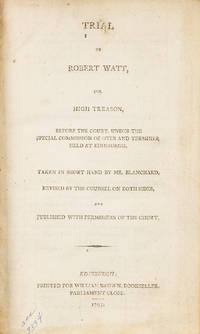
1795Best.-Nr. 822471795. Edinburgh: Printed for William Brown 1795. Edinburgh: Printed for William Brown 1795. An Ill-Founded Plot to Establish an Independent Scotland Trial. Watt Robert c.1761-1794 Defendant. Trial of Robert Watt For High Treason Before the Court Under the Special Commission of Oyer and Terminer Held at Edinburgh. Taken in Short Hand by Mr. Blanchard Revised by the Counsel on Both Sides And Published with the Permission of the Court. Edinburgh: Printed for William Brown 1795. ii 364 pp. Folding plate illustrating pikes found in Watt's possession. Octavo 8" x 4-3/4". Contemporary three-quarter calf over paper-covered boards gilt rules to boards along calf blind ornaments and gilt fillets and title to spine speckled edges. Light rubbing and a few minor spots and smudges to boards moderate rubbing to extremities corners bumped and moderately worn. Moderate toning to interior negligible light foxing and tiny smudges and stains to preliminaries plate final leaf of text and rear endleaves. A handsome copy. $450. Only edition. Watt a wine merchant and political radical was the architect of a somewhat confused plot to establish Scotland as an independent country. After a search of his house turned up a number of pikes and the type for a seditious handbill he was arrested and tried for treason. A co-conspirator was pardoned but Watt was not so lucky. He was convicted and sentenced to be hanged and beheaded despite the jury's recommendation of mercy. The sentence reflected the court's opinion of the severity of Watt's crime. It was also intended to be a warning to other radicals. English Short-Title Catalogue N013806. unknown books
1795Best.-Nr. 789051795. Edinburgh: Printed for William Brown 1795. Edinburgh: Printed for William Brown 1795. The Trial of a Would-Be Revolutionary Trial. Watt Robert c.1761-1794 Defendant. Trial of Robert Watt For High Treason Before the Court Under the Special Commission of Oyer and Terminer Held at Edinburgh. Taken in Short Hand by Mr. Blanchard Revised by the Counsel on Both Sides And Published with the Permission of the Court. Edinburgh: Printed for William Brown 1795. ii 364 pp. Folding plate illustrating pikes found in Watt's possession. Octavo 8-1/4" x 4-3/4". Contemporary calf gilt fillets to spine lettering piece lacking blind tooling to board edges. Light rubbing and a few small nicks and scratches to boards which are slightly bowed and separated but secured by cords faint dampstain to front board moderate rubbing to extremities shelf location in ink to foot of spine corners bumped and worn faint offsetting to preliminaries front free endpaper loosening but secure. Light toning to interior light soiling in a few places edgewear and light creasing to folding plate brief recent ink annotation to title page. $250. Only edition. Watt a wine merchant and political radical was the architect of a somewhat confused plot to establish Scotland as an independent country. After a search of his house turned up a number of pikes and the type for a seditious handbill he was arrested and tried for treason. A co-conspirator was pardoned but Watt was not so lucky. He was convicted and sentenced to be hanged and beheaded despite the jury's recommendation of mercy. The sentence reflected the court's opinion of the severity of Watt's crime. It was also intended to be a warning to other radicals. English Short-Title Catalogue N013806. unknown books
1794Best.-Nr. 728651794. The Trial and Confession of a Scottish Traitor Trials. Scotland. Watt Robert Defendant c.1761-1794. Trials of Robert Watt and David Downie for High Treason Before the Courts of Oyer and Terminer Held at Edinburgh Aug. 14. 15. 22. 27.-Sept. 3. 5. 6. 1794. With an Engraving of the Pikes Found in the Possession of Robert Watt and Others. To Which is Subjoined the Celebrated Speech of Sir Hercules Langrishe On Parliamentary Reform Delivered in the House of Commons Ireland March 4. 1794. Edinburgh: Printed for Manners and Miller 1794. 4 92 pp. With a woodcut illustration after title page. Bound with Watt Robert. By Authority. The Declaration and Confession of Robert Watt Written Subscribed & Delivered by Himself The Evening Before His Execution For High Treason At Edinburgh October 15. 1794. Attested by the Reverend Dr Baird Principal of the University of Edinburgh; And the Reverend T.S. Jones One of the Ministers of Lady Glenorchie's Chapel. Edinburgh: Printed for Bell & Bradfute 1794. iv 35 1 pp. With a lithograph portrait frontispiece moved to beginning of Trials by binder. Publisher advertisement to final page. Octavo 8" x 4-3/4". Disbound stab-stitched pamphlets. Light toning to interior more moderate in some places light soiling in a few places red monogram stamp "AB" to upper gutter of title pages and p. 1 of Trials ms. notes in an early hand to versos of first two leaves of Trials and to foot of title page of Confession. $650. Only editions. Watt a wine merchant and political radical was the architect of a somewhat confused plot to establish Scotland as an independent country. After a search of his house turned up a number of pikes and the type for a seditious handbill he was arrested and tried for treason. Downie a co-conspirator was pardoned but Watt was not so lucky. He was convicted and sentenced to be hanged and beheaded despite the jury's recommendation of mercy. The sentence reflected the courts' opinion of the severity of Watt's crime. It was also intended to be a warning to other radicals. English Short-Title Catalogue T174262 T94672. unknown books