3 221 résultats
1852réf. 808911852 Lyon, Savy, 1852, in 8° broché, II-53 pages ; couverture verte imprimée.
in-8 broche de 246 pages.— Edition originale. Tres bel exemplaire. [BU-1]
in-8 broche de 316 pages.— Edition originale. Bel exemplaire (manque les gardes et la couv.). [BU-11]
1869réf. 846831869 Paris, Le Chevalier, 1869, in 12 relié demi-percaline verte amateur, IV-216 pages ; rares rousseurs.
In-8, broché, couverture de papier moderne, 16 p. Edition originale de cette défense de Louis XVI, demeurée anonyme, donnée au lendemain de sa comparution, avant que le verdict ne soit rendu. L'auteur rend compte de la conduite du roi en captivité, de ses préoccupations et de ses ultimes réflexions. (Martin & Walter, 5485. Un unique exemplaire à la BnF, seul exemplaire dans les bibliothèques françaises). Quelques corrections de l'époque à la plume. Bon exemplaire.
réf. 32439In-8, broché, couverture de papier moderne, 16 p. S.l.n.d. [1792].
In-12 carré, broché, couverture grise imprimée rempliée, 48 p., exemplaire numéroté sur vélin d'Arches, non rogné. Rare plaquette publiée anonymement autour du procès de Frédéric Adler, jugé pour l'assassinat du Président du Conseil d'Autriche, le Comte Stürghk, en 1916. Publié anonymement l'ouvrage est attribué à Roger Lévy. Physicien proche d'Einstein, Friedrich Adler devint secrétaire du parti social-démocratique autrichien. Leader de l'aile gauche du parti, il s'opposa à la politique de guerre nationaliste du parti, donna sa démission en 1914. En octobre 1916, il assassina le Ministre-Président Comte Stürgkh responsable, selon lui, de la poursuite de la guerre. Friedrich Adler fut jugé par un tribunal d'exception et condamné à mort. L'Empereur Charles Ier, successeur de François-Joseph (1916) commua la peine en 18 ans de prison. Il fut finalement amnistié en 1918. Contient en annexe, le "Manifeste de Frédéric Adler" (1916) ainsi que le compte rendu du procès. Exemplaire hors commerce imprimé sur vélin d'Arches, n° 93 /102. Bel exemplaire, frais, tel que paru.
1917réf. 355081917 In-12 carré, broché, couverture grise imprimée rempliée, 48 p., exemplaire numéroté sur vélin d'Arches, non rogné. Paris, imprimerie de Louis Kaldor, s.d. (1917).
réf. 200708431Paris, Editions de Crémille, 1995 ; in-12, 234 pp., cartonnage de l'éditeur.
réf. 200708411Paris, Editions de Crémille, 1995 ; in-12, 230 pp., cartonnage de l'éditeur.
réf. 200708423Paris, Editions de Crémille, 1996 ; in-12, 232 pp., cartonnage de l'éditeur.
réf. 200708427Paris, Editions de Crémille, 1996 ; in-12, 222 pp., cartonnage de l'éditeur.
réf. 200708412Paris, Editions de Crémille, 1996 ; in-12, 230 pp., cartonnage de l'éditeur.
réf. 200708424Paris, Editions de Crémille, 1996 ; in-12, 232-224 pp., cartonnage de l'éditeur. Les 2 volumes.
réf. 200708426Paris, Editions de Crémille, 1996 ; in-12, 226 pp., cartonnage de l'éditeur.
réf. 200708413Paris, Editions de Crémille, 1996 ; in-12, 230 pp., cartonnage de l'éditeur.
réf. 200708417Paris, Editions de Crémille, 1995 ; in-12, 232-242 pp., cartonnage de l'éditeur. Les 2 volumes.
réf. 200708430Paris, Editions de Crémille, 1996 ; in-12, 222 pp., cartonnage de l'éditeur.
réf. 201103647Paris, Editions de Crémille, 1996 ; in-12, 230-238 pp., cartonnage de l'éditeur. Les 2 volumes. Très bon état.
réf. 200708425Paris, Editions de Crémille, 1995 ; in-12, 234 pp., cartonnage de l'éditeur.
1757pl. veau fauve, tit. et tom. sur pc. de maroquin bordeaux sur dos à 5 nerfs ornés de très fins motifs floraux, dentelles et filets encadrants dorés, tr. rouges, roulette dorée sur les coupes, ex-libris manuscrit en garde, (fortes épidermures, 2 coiffes de tête et 2 de queue accidentées, 4 pc. de tom. manquantes, coupes et coins émoussés avec mq. aux coins, tranche latérale du t. II tachée, mors fendillés aux t. II et III, en marge inf. tache de cire à la p. 45 du t. IV), intérieur assez frais excepté pour le t. II avec piqûres et mouillures claires marginales Ouvrage de premier ordre constitué des minutes du procès de Damiens, qui marque, par la précision des descriptions et l’horreur de la situation, un tournant décisif pour le droit pénal et l’application des peines. Il s’agit du dernier écartelé de France. Ouvrage de référence bien complet de la table publiée séparément et placée en tête du premier volume pour cette édition strictement conforme à l’édition au format in-4° de la même année.
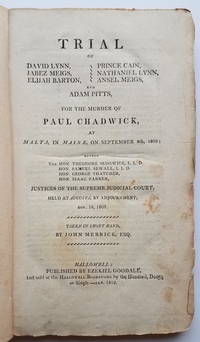
1810réf. 3720Early Maine Murder Trial Gone Awry An account of a murder trial in Malta now Windsor in the District of Maine. Paul Chadwick was a surveyor on what was then the northern frontier of Maine and in an area where disputed land titles were common. Chadwick was shot while conducting a survey by a group of landowners disguised as Indians. Despite fairly overwhelming evidence of the guilt of the accused the jury found all not guilty. Previous owner's Rice Dudley book label on front pastedown. Another early owner's name Moody Kent in ink in several places. References: Shaw & Shoemaker: 21516 3 locations. Sabin: 47985. Williamson: 5651. Noyes: 505. Skillin: 10-32. McDade: 641. Condition: 186 2 pp. Original blue/gray paper-covered boards with chipping. Paper spine cracked and eroded. Original paper spine label with vertical separation. Occasional foxing and staining mostly very light. A solid example of a scarce early Maine imprint. Ezekiel Goodale
1693réf. D12884Printed by Edward Jones. and Published by him and Randal Taylor 1693. First Edition. Hardcover. Near Fine. Modern half calf and marbled paper gilt-stamped lettering on spine; 300x187mm; pp. 4 64. Binding is fine. Text block browned as expected; tiny chips at corners of first two leaves. In December 1692 the young but already dissolute Cornish peer Charles 4th Lord Mohun was involved in a fracas arising from a botched attempt to kidnap the popular actress Anne Bracegirdle. Mohun was acting as accomplice to a young army officer Captain Hill who had taken a fancy to Bracegirdle and decided not to take no for an answer. Their plan to bundle her into a coach was thwarted by the intervention of several of Bracegirdles neighbours but principally by her fellow actor William Mountford. In the ensuing scuffle Mountford was stabbed; he died shortly after. His trial was one of the society events of the year as Mohun had already been part of numerous duels and brawls and tho he was not yet a member of the House his father had been a good Whig and the young Lords future vote was not something that either party were keen to squander. His acquittal proved as sensational as the trial itself had been. One newsletter commented bitterly that a commoner would not have been so fortunate; others debated the intricacies of an attempted appeal that it was thought Mountfords widow intended to lodge but which was expected to be stifled by the Lords. Perhaps most intriguing of all was the conclusion drawn by Queen Mary herself that the verdict was symptomatic of a rot at the very heart of society. Mohun did not learn his lesson. He continued to brawl and only a few years later he was again arrested for another murder of an apparently unrelated Captain Hill. On this occasion he was spared a trial though and took advantage of a royal pardon. Over the next few years he repaid his Whig colleagues trust in him by proving a dependable lieutenant in the House. He may well have been fulfilling precisely the same role when he took the field against the Tory Duke of Hamilton with fatal consequences for both. Printed by Edward Jones... and Published by him and Randal Taylor hardcover books
1693réf. D12884Printed by Edward Jones. and Published by him and Randal Taylor 1693. First Edition. Hardcover. Near Fine. Modern half calf and marbled paper gilt-stamped lettering on spine; 300x187mm; pp. 4 64. Binding is fine. Text block browned as expected; tiny chips at corners of first two leaves. In December 1692 the young but already dissolute Cornish peer Charles 4th Lord Mohun was involved in a fracas arising from a botched attempt to kidnap the popular actress Anne Bracegirdle. Mohun was acting as accomplice to a young army officer Captain Hill who had taken a fancy to Bracegirdle and decided not to take no for an answer. Their plan to bundle her into a coach was thwarted by the intervention of several of Bracegirdles neighbours but principally by her fellow actor William Mountford. In the ensuing scuffle Mountford was stabbed; he died shortly after. His trial was one of the society events of the year as Mohun had already been part of numerous duels and brawls and tho he was not yet a member of the House his father had been a good Whig and the young Lords future vote was not something that either party were keen to squander. His acquittal proved as sensational as the trial itself had been. One newsletter commented bitterly that a commoner would not have been so fortunate; others debated the intricacies of an attempted appeal that it was thought Mountfords widow intended to lodge but which was expected to be stifled by the Lords. Perhaps most intriguing of all was the conclusion drawn by Queen Mary herself that the verdict was symptomatic of a rot at the very heart of society. Mohun did not learn his lesson. He continued to brawl and only a few years later he was again arrested for another murder of an apparently unrelated Captain Hill. On this occasion he was spared a trial though and took advantage of a royal pardon. Over the next few years he repaid his Whig colleagues trust in him by proving a dependable lieutenant in the House. He may well have been fulfilling precisely the same role when he took the field against the Tory Duke of Hamilton with fatal consequences for both. Printed by Edward Jones... and Published by him and Randal Taylor hardcover
1946réf. 44591946 Lyon, Bonnefon, 1946, in 8 broché, 337 pages.