3 294 résultats
1806réf. 739791806. Not a Soul We Believe Can Lament his Fate" Trial. Patch Richard Defendant c.1770-1806. Trial of R. Patch For the Murder of Isaac Blight Ship-Breaker of Rotherhithe In the County of Surry. Tried at Horsemonger-Lane In the Borough of Southwark Before the Lord Chief Baron Sir Archibald Mac Donald And a Respectable Jury of the County of Surry. Guilty-Death. London: Printed by Dewick and Clarke for T. Hughes and Crosby & Co. 1806. 34 2 pp. With a final advertisement leaf. Octavo 7-1/4" x 4-1/2". Disbound stab-stitched pamphlet fore and bottom edges untrimmed. Light toning occasional light soiling to edges. Housed in lightly rubbed 8" x 5" three-quarter morocco folder and plain slipcase. $350. First edition. Patch the eldest son of a smuggler had been forced to mortgage his Exeter farm and subsequently fled to London in order to dodge his creditors. While there he met Blight a ship-breaker who proposed that he become a partner in the business. Patch agreed but lacked the money to pay for his share and killed Blight instead. Despite many attempts to conceal the crime he was convicted on strong circumstantial evidence in 1806. A second edition of our account appeared later in 1806 with additional material and a frontispiece. It is unclear whether our first edition was issued with a frontispiece though the copy at the Library of Congress has one. No records note the final advertisement leaf present in our copy. OCLC and Library Hub locate 3 copies of the first edition worldwide Library of Congress University of Leeds Bishopsgate Institute. unknown books
1806réf. 829611806. London: M. Gurney Bookseller Holborn-Hill 1806. London: M. Gurney Bookseller Holborn-Hill 1806. With an Interesting Manuscript Note Trial. Patch Richard Defendant c.1770-1806. Gurney Joseph 1744-1815 Reporter. Gurney William Brodie 1777-1855 Reporter. The Trial of Richard Patch for the Wilful Murder of Isaac Blight At Rotherhithe On the 23d of September 1805. At the Session House Newington Surrey On Saturday the Fifth of April 1806. Taken in Short-Hand. London: Sold by M. Gurney Bookseller Holborn-Hill 1806. 197 3 pp. Folding frontispiece "Plan of the Premises of the Late Mr. Blight". Publisher advertisement to verso of final leaf. Octavo 8" x 5"; 20.25 x 12.5 cm. Recent cloth gilt title and publication date to spine marbled edges endpapers renewed. A few faint finger smudges spine ends lightly bumped. Moderate toning and light foxing to interior a few creases and short tears and a corner fold to frontispiece later manuscript leaf in a neat hand affixed to its verso. A very good copy. $250. Second and final edition of two issues. Patch the eldest son of a smuggler had been forced to mortgage his Exeter farm and subsequently fled to London in order to dodge his creditors. While there he met Blight a ship-breaker who proposed that he become a partner in the business. Patch agreed but lacked the money to pay for his share and killed Blight instead. In passing sentence the judge told Patch: "you began this practice in fraud continued it in ingratitude and completed it by shedding the blood of your friend and benefactor." The long manuscript note on the affixed leaf discusses whether "the proposed change allowing the Defence of Prisoners by Counsel is not needed" with reference to this case. Its author rejects this proposal. The note concludes with a reference to the Second Report of the Royal Commission on the Criminal Law 1836. The first Gurney edition was published in 1805 and reissued in 1806. British Museum Catalogue Compact Edition 11:313. unknown
1806réf. 739791806. Not a Soul We Believe Can Lament his Fate" Trial. Patch Richard Defendant c.1770-1806. Trial of R. Patch For the Murder of Isaac Blight Ship-Breaker of Rotherhithe In the County of Surry. Tried at Horsemonger-Lane In the Borough of Southwark Before the Lord Chief Baron Sir Archibald Mac Donald And a Respectable Jury of the County of Surry. Guilty-Death. London: Printed by Dewick and Clarke for T. Hughes and Crosby & Co. 1806. 34 2 pp. With a final advertisement leaf. Octavo 7-1/4" x 4-1/2". Disbound stab-stitched pamphlet fore and bottom edges untrimmed. Light toning occasional light soiling to edges. Housed in lightly rubbed 8" x 5" three-quarter morocco folder and plain slipcase. $350. First edition. Patch the eldest son of a smuggler had been forced to mortgage his Exeter farm and subsequently fled to London in order to dodge his creditors. While there he met Blight a ship-breaker who proposed that he become a partner in the business. Patch agreed but lacked the money to pay for his share and killed Blight instead. Despite many attempts to conceal the crime he was convicted on strong circumstantial evidence in 1806. A second edition of our account appeared later in 1806 with additional material and a frontispiece. It is unclear whether our first edition was issued with a frontispiece though the copy at the Library of Congress has one. No records note the final advertisement leaf present in our copy. OCLC and Library Hub locate 3 copies of the first edition worldwide Library of Congress University of Leeds Bishopsgate Institute. unknown
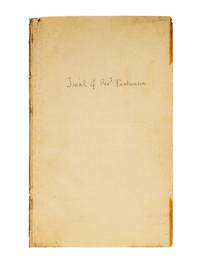
1811réf. 859051811. New YorK: Largin & Thompson 1811. New YorK: Largin & Thompson 1811. A High-Profile 19th-Century "Me Too" Moment: OCLC Locates 1 Copy in a Law Library Trial. Parkinson William 1774-1848 Defendant. Sampson William 1764-1836 Reporter. Trial of Mr. William Parkinson Pastor of the First Baptist Church in the City of New-York On an Indictment for Assault and Battery upon Mrs. Eliza Wintringham. New York: Printed by Largin & Thompson No. 5 Burling Slip 1811. 84 pp. Octavo 8" x 5"; 20.3 x 12.7 cm. Disbound stab-stitched pamphlet title page preceded by later blank leaves the first inscribed "Trial of Revd. Parkinson" two later leaves at rear of text. Moderate toning light foxing to a few leaves light soiling and early owner signature of Thomas H. Wright to title page a minor tear to its fore-edge. A very good copy of a rare title. $500. Only edition. A fascinating account of a 19th-century ecclesiastical scandal involving William Parkinson a former Chaplain of the U.S. House of Representatives. Parkinson was accused of "assault and battery" against Eliza Wintringham a member of his congregation-a charge that served as a contemporary euphemism for sexual misconduct. The trial was a sensation fueled by allegations that Wintringham was one of several women with whom the pastor was "romantically involved" Cohen. Despite the testimony the jury returned a verdict of not guilty allowing Parkinson to remain in his pulpit for another three decades. Recorded by William Sampson the noted Irish legal reformer and pioneer of American court reporting. This is a rare title. OCLC locates 9 copies 1 in a law library Harvard. Cohen Bibliography of Early American Law 13849. unknown books
1857réf. 694831857. A Notable Nineteenth-Century Will Case Involving Codicils and Questions of Sanity Trial. Parish Will Case. Parish Henry 1787-1856. Porter John K. 1819-1892. Parish Will Case. Argument of John K. Porter In Behalf of the Respondents in the Court of Appeals of the State of New York January 10 1862. Albany: Comstock & Cassidy 1862. 98 pp. Octavo 8-3/4" x 5-1/2"; 22.2 x 14 cm. Stab-stitched pamphlet in printed wrappers front wrapper detached. Light soiling and moderately edgewear to wrappers moderate wear to spine ends moderate toning to text corners of some leaves dog-eared. $450. Only edition. Henry Parish a New York merchant died in 1856 at age 69. He had made his will in 1842 but subsequently amended it with three codicils signed after he had suffered a paralyzing stroke in 1849. These codicils were contested by James and Daniel Parish residuary devisees in the will on the grounds of mental impairment. The New York Surrogate's Court and subsequently the state Court of Appeals ultimately rejected their argument and upheld the codicils. This trial attracted a good deal of attention and both legal teams were comprised of talented prominent lawyers. Porter a lawyer for the contestants was a highly ranked member of the New York Bar and was involved in state politics. He went on to hold a seat on the New York Court of Appeals before returning to private practice; he was also one of the prosecutors of Charles Guiteau for the assassination of President James Garfield in 1881. Catalogue of the Library of the Harvard Law School 1909 II:1159. unknown books
1857réf. 694901857. A Notable Nineteenth-Century Will Case Involving Codicils and Questions of Sanity Trial. Parish Will Case. Parish Henry 1787-1856. Earle Pliny 1809-1892. Medical Opinion in the Parish Will Case. New York: John F. Trow 1857. 69 pp. Octavo 9-1/4" x 6"; 23.5 x 15.2 cm. Stab-stitched pamphlet in printed wrappers. Light soiling to exterior spine abraded wrappers partially detached at ends light wear to corners moderate toning to interior lower corners lacking from final leaf and rear wrapper with no loss to text "Hon: Charles Allen Worcester Mass." in contemporary hand to head of title page small check-mark next to author name which is underlined. $450. Only edition. Henry Parish a New York merchant died in 1856 at age 69. He had made his will in 1842 but subsequently amended it with three codicils signed after he had suffered a paralyzing stroke in 1849. These codicils were contested by James and Daniel Parish residuary devisees in the will on the grounds of mental impairment. The New York Surrogate's Court and subsequently the state Court of Appeals ultimately rejected their argument and upheld the codicils. This trial attracted a good deal of attention and it involved testimony by several leading medical and legal experts. At the time of this pamphlet's publication Earle was visiting physician to the New York City Lunatic Asylum. He went on to a prestigious career in psychiatry including as one of the founders of the American Medical Association and is best known for his many visits to institutions which included giving instructional and entertaining lectures to patients on a variety of subjects. Charles Allen 1797-1869 a former owner of this pamphlet was a lawyer Congressional representative from Massachusetts from 1849-1853 and chief justice of the Suffolk County Superior Court from 1858-1867. His ownership of this title reflects the level of attention the case received. OCLC locates 1 copy at SUNY-Albany. Not in Cohen which lists a composite volume by Trow that includes this title. See Bibliography of Early American Law 11386. unknown books
1857réf. 694811857. A Notable Nineteenth-Century Will Case Involving Codicils and Questions of Sanity Trial. Parish Will Case. Bell Luther V. 1806-1862. Medical Opinion in the Parish Will Case. New York: John F. Trow 1857. 69 pp. Octavo 9-1/4" x 6". Stab-stitched pamphlet in printed wrappers. Light soiling to exterior wear to spine ends and corners some chipping and edgewear to wrappers which are partially detached at ends dampstaining to wrappers and text block moderate toning lower corners lacking from first three leaves with no loss to text corners of some other leaves chipped or dog-eared early owner signature "Wm Bouvier" of "Bonner" to front wrapper and half-title. $750. Only edition. Henry Parish a New York merchant died in 1856 at age 69. He left a will made in 1842 that had been amended with three codicils signed by him some time after suffering a paralyzing stroke in 1849. These codicils were contested on the grounds of mental impairment. This trial attracted a good deal of attention and it involved testimony by several leading medical and legal experts. At time of this pamphlet's publication Bell was president of the Massachusetts Medical Society and a former superintendent of the McLean Asylum for the Insane near Boston. Not in Cohen which lists a composite volume by Trow containing this title. See Bibliography of Early American Law 11386. unknown books
1857réf. 694891857. A Notable Nineteenth-Century Will Case Involving Codicils and Questions of Sanity Trial. Parish Will Case. Bell Luther V. 1806-1862. Medical Opinion in the Parish Will Case. New York: John F. Trow 1857. 69 pp. Octavo 9-1/4" x 6". Stab-stitched pamphlet in printed wrappers spine reinforced with archival tape. Light soiling and a few minor marks to exterior wear to spine ends and corners a few small chips to wrappers and edges of a few leaves moderate toning to interior. $450. Only edition. Henry Parish a New York merchant died in 1856 at age 69. He left a will made in 1842 that had been amended with three codicils signed by him some time after suffering a paralyzing stroke in 1849. These codicils were contested on the grounds of mental impairment. This trial attracted a good deal of attention and it involved testimony by several leading medical and legal experts. At time of this pamphlet's publication Bell was president of the Massachusetts Medical Society and a former superintendent of the McLean Asylum for the Insane near Boston. Not in Cohen which lists a composite volume by Trow containing this title. See Bibliography of Early American Law 11386. unknown books
1857réf. 694951857. New York: John F. Trow 1857. New York: John F. Trow 1857. Testimony of Seven Medical Experts in a Notable Nineteenth-Century Will Case Involving Questions of Sanity Trial. Parish Will Case. Parish Henry 1787-1856. The Parish Will Case Before the Surrogate of the City of New York. Medical Opinions upon the Medical Competency of Mr. Parish by John Watson M.D. D.T. Brown M.D. M.H. Ranney M.D. Pliny Earle M.D. Luther V. Bell M.D. LL.D. M.H. Ranney M.D. I. Ray M.D. Sir Henry Holland Bart. M.D. F.R.S. New York: John F. Trow 1857. iii 573 pp. Each section preceded by divisional title page. Octavo 9-1/2" x 6-1/4"; 24 x 15.8 cm. Contemporary three-quarter morocco over marbled boards gilt-edged raised bands and gilt title to spine speckled edges. Some rubbing to boards and extremities moderate toning to text light foxing to a few leaves. A well-preserved copy. $450. First edition. Henry Parish a New York merchant died in 1856 at age 69. He had made his will in 1842 but subsequently amended it with three codicils signed after he had suffered a paralyzing stroke in 1849. These codicils were contested by James and Daniel Parish residuary devisees in the will on the grounds of mental impairment. The New York Surrogate's Court and subsequently the state Court of Appeals ultimately rejected their argument and upheld the codicils. This trial attracted a good deal of attention and involved testimony by several leading medical and legal experts. Our volume collects this testimony. Later editions were issued in 1858 and 1860. Cohen Bibliography of Early American Law 11386. unknown books
1857réf. 694811857. A Notable Nineteenth-Century Will Case Involving Codicils and Questions of Sanity Trial. Parish Will Case. Bell Luther V. 1806-1862. Medical Opinion in the Parish Will Case. New York: John F. Trow 1857. 69 pp. Octavo 9-1/4" x 6". Stab-stitched pamphlet in printed wrappers. Light soiling to exterior wear to spine ends and corners some chipping and edgewear to wrappers which are partially detached at ends dampstaining to wrappers and text block moderate toning lower corners lacking from first three leaves with no loss to text corners of some other leaves chipped or dog-eared early owner signature "Wm Bouvier" of "Bonner" to front wrapper and half-title. $750. Only edition. Henry Parish a New York merchant died in 1856 at age 69. He left a will made in 1842 that had been amended with three codicils signed by him some time after suffering a paralyzing stroke in 1849. These codicils were contested on the grounds of mental impairment. This trial attracted a good deal of attention and it involved testimony by several leading medical and legal experts. At time of this pamphlet's publication Bell was president of the Massachusetts Medical Society and a former superintendent of the McLean Asylum for the Insane near Boston. Not in Cohen which lists a composite volume by Trow containing this title. See Bibliography of Early American Law 11386. unknown
1857réf. 694891857. A Notable Nineteenth-Century Will Case Involving Codicils and Questions of Sanity Trial. Parish Will Case. Bell Luther V. 1806-1862. Medical Opinion in the Parish Will Case. New York: John F. Trow 1857. 69 pp. Octavo 9-1/4" x 6". Stab-stitched pamphlet in printed wrappers spine reinforced with archival tape. Light soiling and a few minor marks to exterior wear to spine ends and corners a few small chips to wrappers and edges of a few leaves moderate toning to interior. $450. Only edition. Henry Parish a New York merchant died in 1856 at age 69. He left a will made in 1842 that had been amended with three codicils signed by him some time after suffering a paralyzing stroke in 1849. These codicils were contested on the grounds of mental impairment. This trial attracted a good deal of attention and it involved testimony by several leading medical and legal experts. At time of this pamphlet's publication Bell was president of the Massachusetts Medical Society and a former superintendent of the McLean Asylum for the Insane near Boston. Not in Cohen which lists a composite volume by Trow containing this title. See Bibliography of Early American Law 11386. unknown
1857réf. 694901857. A Notable Nineteenth-Century Will Case Involving Codicils and Questions of Sanity Trial. Parish Will Case. Parish Henry 1787-1856. Earle Pliny 1809-1892. Medical Opinion in the Parish Will Case. New York: John F. Trow 1857. 69 pp. Octavo 9-1/4" x 6"; 23.5 x 15.2 cm. Stab-stitched pamphlet in printed wrappers. Light soiling to exterior spine abraded wrappers partially detached at ends light wear to corners moderate toning to interior lower corners lacking from final leaf and rear wrapper with no loss to text "Hon: Charles Allen Worcester Mass." in contemporary hand to head of title page small check-mark next to author name which is underlined. $450. Only edition. Henry Parish a New York merchant died in 1856 at age 69. He had made his will in 1842 but subsequently amended it with three codicils signed after he had suffered a paralyzing stroke in 1849. These codicils were contested by James and Daniel Parish residuary devisees in the will on the grounds of mental impairment. The New York Surrogate's Court and subsequently the state Court of Appeals ultimately rejected their argument and upheld the codicils. This trial attracted a good deal of attention and it involved testimony by several leading medical and legal experts. At the time of this pamphlet's publication Earle was visiting physician to the New York City Lunatic Asylum. He went on to a prestigious career in psychiatry including as one of the founders of the American Medical Association and is best known for his many visits to institutions which included giving instructional and entertaining lectures to patients on a variety of subjects. Charles Allen 1797-1869 a former owner of this pamphlet was a lawyer Congressional representative from Massachusetts from 1849-1853 and chief justice of the Suffolk County Superior Court from 1858-1867. His ownership of this title reflects the level of attention the case received. OCLC locates 1 copy at SUNY-Albany. Not in Cohen which lists a composite volume by Trow that includes this title. See Bibliography of Early American Law 11386. unknown
1857réf. 694951857. New York: John F. Trow 1857. New York: John F. Trow 1857. Testimony of Seven Medical Experts in a Notable Nineteenth-Century Will Case Involving Questions of Sanity Trial. Parish Will Case. Parish Henry 1787-1856. The Parish Will Case Before the Surrogate of the City of New York. Medical Opinions upon the Medical Competency of Mr. Parish by John Watson M.D. D.T. Brown M.D. M.H. Ranney M.D. Pliny Earle M.D. Luther V. Bell M.D. LL.D. M.H. Ranney M.D. I. Ray M.D. Sir Henry Holland Bart. M.D. F.R.S. New York: John F. Trow 1857. iii 573 pp. Each section preceded by divisional title page. Octavo 9-1/2" x 6-1/4"; 24 x 15.8 cm. Contemporary three-quarter morocco over marbled boards gilt-edged raised bands and gilt title to spine speckled edges. Some rubbing to boards and extremities moderate toning to text light foxing to a few leaves. A well-preserved copy. $450. First edition. Henry Parish a New York merchant died in 1856 at age 69. He had made his will in 1842 but subsequently amended it with three codicils signed after he had suffered a paralyzing stroke in 1849. These codicils were contested by James and Daniel Parish residuary devisees in the will on the grounds of mental impairment. The New York Surrogate's Court and subsequently the state Court of Appeals ultimately rejected their argument and upheld the codicils. This trial attracted a good deal of attention and involved testimony by several leading medical and legal experts. Our volume collects this testimony. Later editions were issued in 1858 and 1860. Cohen Bibliography of Early American Law 11386. unknown
1857réf. 694831857. A Notable Nineteenth-Century Will Case Involving Codicils and Questions of Sanity Trial. Parish Will Case. Parish Henry 1787-1856. Porter John K. 1819-1892. Parish Will Case. Argument of John K. Porter In Behalf of the Respondents in the Court of Appeals of the State of New York January 10 1862. Albany: Comstock & Cassidy 1862. 98 pp. Octavo 8-3/4" x 5-1/2"; 22.2 x 14 cm. Stab-stitched pamphlet in printed wrappers front wrapper detached. Light soiling and moderately edgewear to wrappers moderate wear to spine ends moderate toning to text corners of some leaves dog-eared. $450. Only edition. Henry Parish a New York merchant died in 1856 at age 69. He had made his will in 1842 but subsequently amended it with three codicils signed after he had suffered a paralyzing stroke in 1849. These codicils were contested by James and Daniel Parish residuary devisees in the will on the grounds of mental impairment. The New York Surrogate's Court and subsequently the state Court of Appeals ultimately rejected their argument and upheld the codicils. This trial attracted a good deal of attention and both legal teams were comprised of talented prominent lawyers. Porter a lawyer for the contestants was a highly ranked member of the New York Bar and was involved in state politics. He went on to hold a seat on the New York Court of Appeals before returning to private practice; he was also one of the prosecutors of Charles Guiteau for the assassination of President James Garfield in 1881. Catalogue of the Library of the Harvard Law School 1909 II:1159. unknown
1811réf. 859051811. New YorK: Largin & Thompson 1811. New YorK: Largin & Thompson 1811. A High-Profile 19th-Century "Me Too" Moment: OCLC Locates 1 Copy in a Law Library Trial. Parkinson William 1774-1848 Defendant. Sampson William 1764-1836 Reporter. Trial of Mr. William Parkinson Pastor of the First Baptist Church in the City of New-York On an Indictment for Assault and Battery upon Mrs. Eliza Wintringham. New York: Printed by Largin & Thompson No. 5 Burling Slip 1811. 84 pp. Octavo 8" x 5"; 20.3 x 12.7 cm. Disbound stab-stitched pamphlet title page preceded by later blank leaves the first inscribed "Trial of Revd. Parkinson" two later leaves at rear of text. Moderate toning light foxing to a few leaves light soiling and early owner signature of Thomas H. Wright to title page a minor tear to its fore-edge. A very good copy of a rare title. $500. Only edition. A fascinating account of a 19th-century ecclesiastical scandal involving William Parkinson a former Chaplain of the U.S. House of Representatives. Parkinson was accused of "assault and battery" against Eliza Wintringham a member of his congregation-a charge that served as a contemporary euphemism for sexual misconduct. The trial was a sensation fueled by allegations that Wintringham was one of several women with whom the pastor was "romantically involved" Cohen. Despite the testimony the jury returned a verdict of not guilty allowing Parkinson to remain in his pulpit for another three decades. Recorded by William Sampson the noted Irish legal reformer and pioneer of American court reporting. This is a rare title. OCLC locates 9 copies 1 in a law library Harvard. Cohen Bibliography of Early American Law 13849. unknown
1856réf. 784901856. Five titles in 1 book. Five titles in 1 book. Poisoning and Lunacy Trial. Palmer William 1824-1856 Defendant. Illustrated and Unabridged Edition of The Times Report of the Trial of William Palmer for Poisoning John Parsons Cook At Rugeley. From the Short-Hand Notes Taken in the Central Court from Day to Day. London: Ward and Lock 1856. 184 pp. With numerous woodcut illustrations and a folding frontispiece. Bound with Trial. Windham William Frederick b.1840 Defendant. The Great Lunacy Case of Mr. W.F. Windham. Reported by a Solicitor. London: H. Vickers 1862. 60 pp. 2 pp. publisher advertisements. And Richardson James. Studies from the Antique. Edinburgh: John Baxter 1862. 62 pp. And Runciman David 1803-1872. Marriage and Married Life; A Week Day Homily. Glasgow: Printed by Robert Anderson 1862. 32 pp. And Cooper James Fenimore 1789-1851. The Water Witch; Or The Skimmer of the Seas. A Tale. London: Published by J. Cunningham 1839. 136 pp. Together 5 titles in 1 volume. Octavo 8" x 5-1/2"; 20.3 x 14 cm trim size of Windham trial 7-1/2" x 5"/19 x 12.5 cm. Stab-stitched pamphlets bound in contemporary cloth gilt title to spine early manuscript table of contents to front endleaf. Light rubbing to extremities light fading to spine spine ends and corners bumped and lightly worn faint offsetting to endleaves hinges cracked. Light toning to interior a few mostly partial cracks to text block second item loosening very slightly but secure small spots and tiny faint stains to a few leaves folding frontispiece of first item reinforced at right edge not affecting image. $500. This volume contains accounts of two famous nineteenth-century trials. Palmer a first-rate sociopath was tried and convicted for the 1855 murder of his friend John Cook and executed in 1856. Also known as the Rugeley Poisoner or the Prince of Poisoners he was suspected of several other murders including four of his children killed before their first birthdays. The Windham trial was one of the most famous insanity trials of the time and an early example of the use of forensic psychiatry. Windham's uncle a distinguished soldier and M.P. alleged that his nephew was unfit to take possession of the estate. After weeks of testimony the court disagreed and Windham was found sane. The other titl. unknown books
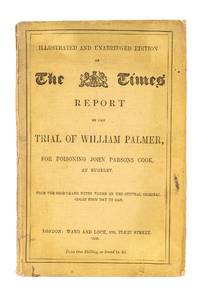
1856réf. 847541856. Well-Illustrated Contemporary Account of a Famous London Poisoning Trial Trial. Palmer William 1824-1856 Defendant. Illustrated and Unabridged Edition of The Times Report of the Trial of William Palmer for Poisoning John Parsons Cook At Rugeley. From the Short-Hand Notes Taken in the Central Court from Day to Day. London: Ward and Lock 158 Fleet Street 1856. 184 pp. Folding frontispiece woodcut illustrations throughout text several full-page advertisements to wrappers. Report of the final day of the trial and its verdict clipped from the London Times January 14 1856 laid in. Octavo 8-1/4" x 5-1/2"; 20.95 x 13.97 cm. Stab-stitched pamphlet in printed wrappers. Binding slightly cocked light soiling edgewear and a few tiny stains to wrappers creasing to spine moderate wear to spine ends. Moderate toning to interior light browning to sections light soiling to title page lower corner lacking from frontispiece with minor loss to image. A very good copy overall. $250. Only edition. Also known as the Rugeley Poisoner or the Prince of Poisoners Palmer was a physician who abandoned his practice to own and breed racehorses which often put him in financial difficulty. As a full-blown sociopath he saw murder as a convenient way to restore his finances. In order to collect on their life insurance policies he poisoned his brother wife his mother-in-law and four of his children who were killed before their first birthdays. He also defrauded a friend John Cook when he was poisoning him and cheated his wealthy mother out of thousands of pounds. He was finally convicted in 1855 for murdering Cook and was executed the following year. Davenport-Hines "Palmer William Called the Rugeley Poisoner" Oxford Dictionary of National Biography accessed online. British Museum Catalogue Compact Edition 19:281. unknown books
1793réf. 759751793. The Trial of a "Scottish Martyr" Trial. Palmer Thomas Fyshe 1747-1802 Defendant. The Trial of the Rev. Thomas Fyshe Palmer Before the Circuit Court of Justiciary Held at Perth On the 12th and 13th September 1793 On an Indictment for Seditious Practices. Taken in Court by Mr. Ramsey An Eminent Short-Hand Writer from London. With an Appendix. Edinburgh: Printed for W. Skirving 1793. 195 1 pp. Lacking portrait frontispiece. Octavo 8-1/4" x 5". Disbound stab-stitched pamphlet. Moderate toning light soiling and a few faint stains to exterior light foxing to a few leaves clean tear to leaf O3 pp. 109-110 affecting text without loss to legibility. $125. Only edition. Palmer an English minister and political reformer active in Scotland was convicted of sedition in 1793 for circulating a radical address to the public. Along with six other men referred to as the "Scottish Martyrs to Liberty" he was sentenced to seven years' transportation to Botany Bay. English Short-Title Catalogue T93757. unknown books
1856réf. 847541856. Well-Illustrated Contemporary Account of a Famous London Poisoning Trial Trial. Palmer William 1824-1856 Defendant. Illustrated and Unabridged Edition of The Times Report of the Trial of William Palmer for Poisoning John Parsons Cook At Rugeley. From the Short-Hand Notes Taken in the Central Court from Day to Day. London: Ward and Lock 158 Fleet Street 1856. 184 pp. Folding frontispiece woodcut illustrations throughout text several full-page advertisements to wrappers. Report of the final day of the trial and its verdict clipped from the London Times January 14 1856 laid in. Octavo 8-1/4" x 5-1/2"; 20.95 x 13.97 cm. Stab-stitched pamphlet in printed wrappers. Binding slightly cocked light soiling edgewear and a few tiny stains to wrappers creasing to spine moderate wear to spine ends. Moderate toning to interior light browning to sections light soiling to title page lower corner lacking from frontispiece with minor loss to image. A very good copy overall. $250. Only edition. Also known as the Rugeley Poisoner or the Prince of Poisoners Palmer was a physician who abandoned his practice to own and breed racehorses which often put him in financial difficulty. As a full-blown sociopath he saw murder as a convenient way to restore his finances. In order to collect on their life insurance policies he poisoned his brother wife his mother-in-law and four of his children who were killed before their first birthdays. He also defrauded a friend John Cook when he was poisoning him and cheated his wealthy mother out of thousands of pounds. He was finally convicted in 1855 for murdering Cook and was executed the following year. Davenport-Hines "Palmer William Called the Rugeley Poisoner" Oxford Dictionary of National Biography accessed online. British Museum Catalogue Compact Edition 19:281. unknown
1856réf. 784901856. Five titles in 1 book. Five titles in 1 book. Poisoning and Lunacy Trial. Palmer William 1824-1856 Defendant. Illustrated and Unabridged Edition of The Times Report of the Trial of William Palmer for Poisoning John Parsons Cook At Rugeley. From the Short-Hand Notes Taken in the Central Court from Day to Day. London: Ward and Lock 1856. 184 pp. With numerous woodcut illustrations and a folding frontispiece. Bound with Trial. Windham William Frederick b.1840 Defendant. The Great Lunacy Case of Mr. W.F. Windham. Reported by a Solicitor. London: H. Vickers 1862. 60 pp. 2 pp. publisher advertisements. And Richardson James. Studies from the Antique. Edinburgh: John Baxter 1862. 62 pp. And Runciman David 1803-1872. Marriage and Married Life; A Week Day Homily. Glasgow: Printed by Robert Anderson 1862. 32 pp. And Cooper James Fenimore 1789-1851. The Water Witch; Or The Skimmer of the Seas. A Tale. London: Published by J. Cunningham 1839. 136 pp. Together 5 titles in 1 volume. Octavo 8" x 5-1/2"; 20.3 x 14 cm trim size of Windham trial 7-1/2" x 5"/19 x 12.5 cm. Stab-stitched pamphlets bound in contemporary cloth gilt title to spine early manuscript table of contents to front endleaf. Light rubbing to extremities light fading to spine spine ends and corners bumped and lightly worn faint offsetting to endleaves hinges cracked. Light toning to interior a few mostly partial cracks to text block second item loosening very slightly but secure small spots and tiny faint stains to a few leaves folding frontispiece of first item reinforced at right edge not affecting image. $500. This volume contains accounts of two famous nineteenth-century trials. Palmer a first-rate sociopath was tried and convicted for the 1855 murder of his friend John Cook and executed in 1856. Also known as the Rugeley Poisoner or the Prince of Poisoners he was suspected of several other murders including four of his children killed before their first birthdays. The Windham trial was one of the most famous insanity trials of the time and an early example of the use of forensic psychiatry. Windham's uncle a distinguished soldier and M.P. alleged that his nephew was unfit to take possession of the estate. After weeks of testimony the court disagreed and Windham was found sane. The other titl. unknown
1793réf. 759751793. The Trial of a "Scottish Martyr" Trial. Palmer Thomas Fyshe 1747-1802 Defendant. The Trial of the Rev. Thomas Fyshe Palmer Before the Circuit Court of Justiciary Held at Perth On the 12th and 13th September 1793 On an Indictment for Seditious Practices. Taken in Court by Mr. Ramsey An Eminent Short-Hand Writer from London. With an Appendix. Edinburgh: Printed for W. Skirving 1793. 195 1 pp. Lacking portrait frontispiece. Octavo 8-1/4" x 5". Disbound stab-stitched pamphlet. Moderate toning light soiling and a few faint stains to exterior light foxing to a few leaves clean tear to leaf O3 pp. 109-110 affecting text without loss to legibility. $125. Only edition. Palmer an English minister and political reformer active in Scotland was convicted of sedition in 1793 for circulating a radical address to the public. Along with six other men referred to as the "Scottish Martyrs to Liberty" he was sentenced to seven years' transportation to Botany Bay. English Short-Title Catalogue T93757. unknown
1808réf. 719711808. Rare Trial Account With a Frontispiece by George and Isaac Cruikshank Trial. Paget Sir Arthur 1771-1840 Defendant. Cruikshank Isaac 1789-1856 Frontispiece. Cruikshank George 1792-1878 Frontispiece. Crim. Con. 10000 Damages. Smeeton's Edition of the Trial Between the Right Hon. Lord Borringdon and Sir A. Paget K.B. For Criminal Conversation with the Plaintiff's Wife. Which was Tried in the Sheriffs' Court Before W. Burchall Esq. And a Special Jury July 19 1808. Taken in Short Hand. London: Published by G. Smeeton 18 James Street Long Acre 1808. Octavo 8-1/2" x 5-1/4". 16 pp. Etched copperplate frontispiece by Isaac Cruikshank assisted by George Cruikshank. Stab-stitched pamphlet bound into contemporary or near-contemporary flexible cloth gilt title to front cover frontispiece and several leaves re-hinged. Light rubbing to extremities bookplate of Fernand Gabriel and Anne Renier to front pastedown early owner inscription "Walter Scott His Book/ July 29 1808" to verso of frontispiece. Crack in text block between frontispiece and title page which is lightly soiled moderate toning to interior light foxing to first half of text block. $650. A rare account of one of the great scandals of the day which involved two well-known aristocrats who were active politicians. The criminal conversation occurred in 1808 when Paget eloped with Lady Augusta Fane then the wife of John Parker 1772-1840 2nd Baron Boringdon or Borringdon. Paget married her the following year two days after her divorce was granted. The Walter Scott who owned this copy was not the Scottish author. Fernand Gabriel and Anne Renier were important collectors of popular printed material. OCLC locates 1 copy Harvard. No copies listed on Library Hub. Cohn George Cruikshank: A Catalogue Raisonne 85. unknown books
1808réf. 719711808. Rare Trial Account With a Frontispiece by George and Isaac Cruikshank Trial. Paget Sir Arthur 1771-1840 Defendant. Cruikshank Isaac 1789-1856 Frontispiece. Cruikshank George 1792-1878 Frontispiece. Crim. Con. 10000 Damages. Smeeton's Edition of the Trial Between the Right Hon. Lord Borringdon and Sir A. Paget K.B. For Criminal Conversation with the Plaintiff's Wife. Which was Tried in the Sheriffs' Court Before W. Burchall Esq. And a Special Jury July 19 1808. Taken in Short Hand. London: Published by G. Smeeton 18 James Street Long Acre 1808. Octavo 8-1/2" x 5-1/4". 16 pp. Etched copperplate frontispiece by Isaac Cruikshank assisted by George Cruikshank. Stab-stitched pamphlet bound into contemporary or near-contemporary flexible cloth gilt title to front cover frontispiece and several leaves re-hinged. Light rubbing to extremities bookplate of Fernand Gabriel and Anne Renier to front pastedown early owner inscription "Walter Scott His Book/ July 29 1808" to verso of frontispiece. Crack in text block between frontispiece and title page which is lightly soiled moderate toning to interior light foxing to first half of text block. $650. A rare account of one of the great scandals of the day which involved two well-known aristocrats who were active politicians. The criminal conversation occurred in 1808 when Paget eloped with Lady Augusta Fane then the wife of John Parker 1772-1840 2nd Baron Boringdon or Borringdon. Paget married her the following year two days after her divorce was granted. The Walter Scott who owned this copy was not the Scottish author. Fernand Gabriel and Anne Renier were important collectors of popular printed material. OCLC locates 1 copy Harvard. No copies listed on Library Hub. Cohn George Cruikshank: A Catalogue Raisonne 85. unknown
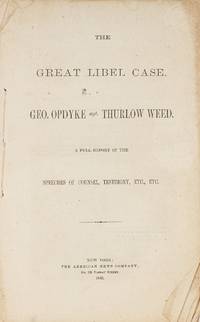
1865réf. 860061865. A Rare Record of Civil War Scandal and Political Warfare Trial. Opdyke George 1805-1880 Defendant. The Great Libel Case. Geo. Opdyke Agt. Thurlow Weed. A Full Report of the Speeches of Counsel Testimony Etc. Etc. New York: The American News Company No. 121 Nassau Street 1865. 156 pp. Octavo 5-3/4" x 9-1/4". Stab-stitched pamphlet in printed wrappers lower section of spine reinforced with cellotape. Light soiling spine abraded wrappers which are partially detached but secure creased and edgeworn. Moderate toning to interior corner folds to margins of title page and following few leaves. A good copy. $150. Only edition of the comprehensive trial report documenting the explosive legal battle between New York City Mayor George Opdyke and Thurlow Weed the powerful editor of the Albany Evening Journal. At the height of the Civil War Weed accused Opdyke of using his office to reap illicit profits from government military contracts-essentially charging the Mayor with war profiteering. The trial which lasted several weeks and featured a "who's who" of New York political and legal elite ultimately ended in a hung jury leaving both reputations permanently scarred. Beyond the legal arguments the testimony offers a raw look at the intersection of private industry and military supply during the Union's most desperate hours. Catalogue of the Library of the Harvard Law School 1909 II:1157. unknown books
1865réf. 860061865. A Rare Record of Civil War Scandal and Political Warfare Trial. Opdyke George 1805-1880 Defendant. The Great Libel Case. Geo. Opdyke Agt. Thurlow Weed. A Full Report of the Speeches of Counsel Testimony Etc. Etc. New York: The American News Company No. 121 Nassau Street 1865. 156 pp. Octavo 5-3/4" x 9-1/4". Stab-stitched pamphlet in printed wrappers lower section of spine reinforced with cellotape. Light soiling spine abraded wrappers which are partially detached but secure creased and edgeworn. Moderate toning to interior corner folds to margins of title page and following few leaves. A good copy. $150. Only edition of the comprehensive trial report documenting the explosive legal battle between New York City Mayor George Opdyke and Thurlow Weed the powerful editor of the Albany Evening Journal. At the height of the Civil War Weed accused Opdyke of using his office to reap illicit profits from government military contracts-essentially charging the Mayor with war profiteering. The trial which lasted several weeks and featured a "who's who" of New York political and legal elite ultimately ended in a hung jury leaving both reputations permanently scarred. Beyond the legal arguments the testimony offers a raw look at the intersection of private industry and military supply during the Union's most desperate hours. Catalogue of the Library of the Harvard Law School 1909 II:1157. unknown