Trial; Murray, William, DefendantBiblio.com
465 resultados
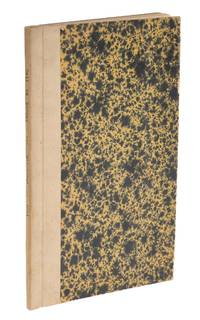
1834ref. 734791834. Scottish Criminal Conversation Trial Interesting for Issues Concerning Intercepted Letters Trial. Murray William Defendant. Report of Trial in the Action of Damages for Crim. Con.: Poor Alexander Bell Teacher Dundee Versus William Murray Now or Lately Rector of the Dundee Academy Taken in Short-Hand; Containing a Discussion Upon the Law of Intercepted Correspondence. Edinburgh: s.n. 1834. 63 pp. Octavo 8-1/2" x 5". Stab-stitched pamphlet bound into recent quarter cloth over marbled boards printed title to spine. Light soiling to cloth and negligible wear to corners front hinge cracked rear hinge starting at ends printed shelfmark and residue from removed bookplate to inner front board. Light toning to interior light foxing in a few places. A nice copy of a scarce title. $250. Only edition. This trial involved a teacher who was allegedly cuckolded by the rector of his school. The plaintiff's case rested on the admissibility of a letter said to have been sent by the wife to Murray but not received by him. OCLC locates 14 copies 7 in North American law libraries. Catalogue of the Library of the Harvard Law School 1909 II:1015. unknown
1833ref. 573241833. A Scarce Scottish Defamation Case Trial. Nairne James 1782-1847 Defendant. The Trial Before the Lord President of the Court of Session Lord Mackenzie And a Special Jury Taken in Shorthand Of the Issues in the Action of Damages at the Instance of Lady Ramsay Widow of the Late Colonel Sir Thomas Ramsay of Balmain Baronet Against James Nairne W.S. For Falsehood and Defamation; Containing the Speeches of Counsel and Charge of the Lord President With the Whole Evidence And an Appendix of Letters and Documents. Edinburgh: Published for the pursuer by W. and R. Chambers; London: Orr and Smith 1833. iv 234 80 pp. Quarto 11-1/4" x 9". Original three-quarter cloth over paper-covered boards rebacked retaining original spine and printed paper title label hinges mended untrimmed edges. Some rubbing a few stains to boards early owner signature of John Osbourne Browne Esq. to front. Annotations in contemporary hand to foot of table of contents interior otherwise clean. Ex-library. Shelf number to foot of spine bookplate to front pastedown date-due sheet and label to front free endpaper. A nice copy of a scarce title. $250. Only edition. A highly detailed record of a case involving accusations of marital infidelity by a colleague of Lady Ramsay's late husband. Lady Ramsay prevailed; the jury determined that her "character" was "perfectly pure and unsullied" and awarded her damages of 200 pounds sterling. 234. OCLC locates 10 copies in North American law libraries. Catalogue of the Library of Harvard Law School 1909 II:1171. unknown
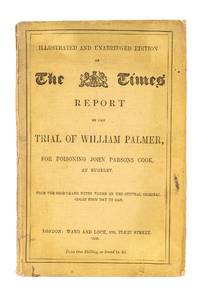
1856ref. 847541856. Well-Illustrated Contemporary Account of a Famous London Poisoning Trial Trial. Palmer William 1824-1856 Defendant. Illustrated and Unabridged Edition of The Times Report of the Trial of William Palmer for Poisoning John Parsons Cook At Rugeley. From the Short-Hand Notes Taken in the Central Court from Day to Day. London: Ward and Lock 158 Fleet Street 1856. 184 pp. Folding frontispiece woodcut illustrations throughout text several full-page advertisements to wrappers. Report of the final day of the trial and its verdict clipped from the London Times January 14 1856 laid in. Octavo 8-1/4" x 5-1/2"; 20.95 x 13.97 cm. Stab-stitched pamphlet in printed wrappers. Binding slightly cocked light soiling edgewear and a few tiny stains to wrappers creasing to spine moderate wear to spine ends. Moderate toning to interior light browning to sections light soiling to title page lower corner lacking from frontispiece with minor loss to image. A very good copy overall. $250. Only edition. Also known as the Rugeley Poisoner or the Prince of Poisoners Palmer was a physician who abandoned his practice to own and breed racehorses which often put him in financial difficulty. As a full-blown sociopath he saw murder as a convenient way to restore his finances. In order to collect on their life insurance policies he poisoned his brother wife his mother-in-law and four of his children who were killed before their first birthdays. He also defrauded a friend John Cook when he was poisoning him and cheated his wealthy mother out of thousands of pounds. He was finally convicted in 1855 for murdering Cook and was executed the following year. Davenport-Hines "Palmer William Called the Rugeley Poisoner" Oxford Dictionary of National Biography accessed online. British Museum Catalogue Compact Edition 19:281. unknown
1806ref. 829611806. London: M. Gurney Bookseller Holborn-Hill 1806. London: M. Gurney Bookseller Holborn-Hill 1806. With an Interesting Manuscript Note Trial. Patch Richard Defendant c.1770-1806. Gurney Joseph 1744-1815 Reporter. Gurney William Brodie 1777-1855 Reporter. The Trial of Richard Patch for the Wilful Murder of Isaac Blight At Rotherhithe On the 23d of September 1805. At the Session House Newington Surrey On Saturday the Fifth of April 1806. Taken in Short-Hand. London: Sold by M. Gurney Bookseller Holborn-Hill 1806. 197 3 pp. Folding frontispiece "Plan of the Premises of the Late Mr. Blight". Publisher advertisement to verso of final leaf. Octavo 8" x 5"; 20.25 x 12.5 cm. Recent cloth gilt title and publication date to spine marbled edges endpapers renewed. A few faint finger smudges spine ends lightly bumped. Moderate toning and light foxing to interior a few creases and short tears and a corner fold to frontispiece later manuscript leaf in a neat hand affixed to its verso. A very good copy. $250. Second and final edition of two issues. Patch the eldest son of a smuggler had been forced to mortgage his Exeter farm and subsequently fled to London in order to dodge his creditors. While there he met Blight a ship-breaker who proposed that he become a partner in the business. Patch agreed but lacked the money to pay for his share and killed Blight instead. In passing sentence the judge told Patch: "you began this practice in fraud continued it in ingratitude and completed it by shedding the blood of your friend and benefactor." The long manuscript note on the affixed leaf discusses whether "the proposed change allowing the Defence of Prisoners by Counsel is not needed" with reference to this case. Its author rejects this proposal. The note concludes with a reference to the Second Report of the Royal Commission on the Criminal Law 1836. The first Gurney edition was published in 1805 and reissued in 1806. British Museum Catalogue Compact Edition 11:313. unknown
1679ref. 727661679. A Victim of the Popish Plot Trial. Popish Plot. Richard Langhorne Defendant c.1624-1679. The Tryall of Richard Langhorn Esq; Counsellor at Law: For Conspiring the Death of the King Subversion of the Government And Protestant Religion. Who Upon Full Evidence was Found Guilty of High Treason And Received Sentence Accordingly At the Sessions in the Old-Bayley Holden for London and Middlesex On Saturday Being the 14th. of June 1679. Published by Authority. London: Printed for H. Hills et al. 1679. ii 41 44-68 2 pp. Collates complete quire M paginated 41 44 45 44. Folio 12-1/2" x 7". Stab-stitched pamphlet bound into recent quarter morocco over marbled boards. Light fading to morocco light rubbing to bottom edge. Moderate toning to interior light foxing and soiling in a few places illegible early marks to front endleaf and head of title page later small stamped "5" to front endleaf. A handsome copy. $250. Only edition. One of the cruelest hoaxes in British history and one that led to a wave of anti-Catholic violence the Popish Plot was the invention of Titus Oates an Anglican clergyman and his friend Dr. Israel Tonge a cleric and passionate anti-Catholic. They pretended to have discovered a Jesuit plot to assassinate the King massacre Protestants and set James Duke of York the King's Catholic brother on the throne. Langhorne was a Roman Catholic and had provided legal and financial advice to Jesuits in London. He was convicted of treason and executed and beatified as a Catholic martyr in 1929 by Pius XI. English Short-Title Catalogue R1705. unknown
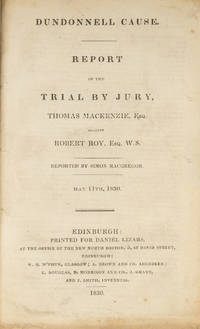
1830ref. 729131830. Edinburgh: Printed for Daniel Lizars 1830. Edinburgh: Printed for Daniel Lizars 1830. A Notable Scottish Estate Case Trial. Roy Robert Defendant. MacGregor Simon Reporter. Dundonnell Cause. Report of the Trial by Jury Thomas Mackenzie Esq. Against Robert Roy Esq. W.S. Reported by Simon MacGregor. May 11 1830. Edinburgh: Printed for Daniel Lizars by Ballantyne and Co. 1830. 84 pp. Octavo 8-1/2" x 5-1/4". Stab-stitched pamphlet bound into recent period-style three-quarter calf over marbled boards raised bands and lettering piece to spine. Light rubbing to board edges. Light toning to interior light foxing and soiling in a few places. $250. Only edition. Roy a Scottish lawyer was accused of swindling an estate from his client Kenneth Mackenzie of Dundonnell by Mackenzie's son Thomas. The trial attracted several notable legal names among them Henry Cockburn who had secured an acquittal for Helen McDougal in the famous Burke and Hare murder trial the year before. His jury address and the exchanges between counsel are well-documented in our account. The jury was split and a second trial was held in January 1831 which resulted in Roy's conviction. OCLC locates 10 copies of this title 4 in North America Library of Congress University of Minnesota Law Harvard Law Los Angeles County Law. unknown
1689ref. 536261689. The Legality of Lord Russell's Trial Trial. Rye House Plot. Atkyns Sir Robert 1621-1709. A Defence of the Late Lord Russel's Innocency By Way of An Answer or Confutation of a Libellous Pamphlet Intituled An Antidote Against Poyson; With Two Letters of the Author of This Book Upon the Subject of His Lordship's Tryal. Together with an Argument in the Great Case Concerning Elections of Members to Parliament Between Sr Samuel Barnardiston Bar. Plaintiff And Sr Will. Soames Sheriff of Suffolk Defend' in the Court of King's-Bench In an Action Upon the Case And Afterwards by Error Sued in the Exchequer-Chamber. London: Printed for Timothy Goodwin 1689. iii 51 pp. Title page preceded by advertisement leaf. Argument in the Great Case preceded by divisional title page. Folio 12" x 7". Disbound text secure. Some edgewear and soiling to first and final leaves worming through upper margins of most leaves with no loss to text. Toning small faint stains to a few leaves internally clean. $250. First edition. This is a reply to a pamphlet by Sir Bartholomew Shower that defended the legal position of the Russell trial. Atkyns was Russell's legal advisor. Russell 1639-1683 was implicated in and ultimately executed due to his supposed involvement in the Rye House Plot a plan to assassinate King Charles II and his brother and heir to the throne James Duke of York devised by a group of Whigs. Some historians believe this plot was largely fabricated by Charles II as a way to destroy the Whigs most notably Russell and Algernon Sydney 1623-1683 who were convicted and executed on the basis of flimsy evidence. English Short-Title Catalogue R4958. unknown
1710ref. 651451710. A Triumph for Tories and High-Churchmen Trial. Sacheverell Henry 1674-1724 Defendant. The Tryal of Dr. Henry Sacheverell Before the House of Peers For High Crimes and Misdemeanors; Upon an Impeachment by the Knights Citizens and Burgesses in Parliament Assembled In the Name of Themselves And of All the Commons of Great Britain: Begun in Westminster-Hall the 27th Day of February 1709/10 And from Thence Continued by Several Adjournments Until the 23d Day of March Following. Published by Order of the House of Peers. London: Printed for Jacob Tonson 1710. 456 pp. Bound with The Bishop of Salisbury's And the Bishop of Oxford's Speeches in the House of Lords On the First Article of the Impeachment of Dr. Henry Sacheverell; Also the Bishop of Lincoln's and Bishop of Norwich's Speeches At the Opening of the Second Article of the Said Impeachment. London: Printed And Sold by John Morphew Near Stationers-Hall 1710. 16; 16; 2 35-52; 53-63 1 pp. Four parts each with title page first three parts have individual pagination. And An Impartial Account of What Pass'd Most Remarkable in the Last Session of Parliament Relating to the Case of Dr. Henry Sacheverell. Done on Such Another Paper and Letter And May Therefore be Bound up with the Tryal of the Said Doctor sic London: Printed for Jacob Tonson at Grays-Inn Gate in Grays-Inn-Lane 1710. 47 1 pp. And A List of the Lords Who Protested Against Some Proceedings In Relation to the Case of Dr. Henry Sacheverell In the House of Peers; with Their Lordships Reasons for Entring Their Protestations. London: S.n. Printed in the Year 1710. 15 1 pp. Octavo 7-1/2" x 4-1/2". Recent period-style marbled boards printed paper title label to spine speckled edges. Light toning to text internally clean. An appealing copy. $250. First octavo editions each one among several issues from 1710. The volume collects a group of four fundamental documents relating to the ideological controversy between Whigs and Tories. Dr. Henry Sacheverell was impeached for preaching two sermons that advocated the Tory doctrines of non-resistance and passive obedience. His punishment was unique. He was not allowed to preach for three years but he was allowed to perform other clerical functions and a. unknown
1681ref. 806151681. Treason Trial of a Founding Member of the Whig Party Trial. Shaftesbury Anthony Ashley Cooper Earl of 1621-1683. The Proceedings at the Sessions House in the Old-Baily London on Thursday the 24th Day of November 1681. Before His Majesties Commissioners of Oyer and Terminer Upon the Bill of Indictment for High-Treason Against Anthony Earl of Shaftsbury. Published by His Majestie Special Command. London: Printed for Samuel Mearne and John Baker 1681. iv 48 pp. With initial blank leaf. Folio 11" x 6-3/4". Disbound stab-stitched pamphlet spine discreetly reinforced with archival tissue. Moderate toning negligible light foxing in a few places light browning to edges of margins light soiling and a few minor stains to exterior folds and light wear to corners of several leaves faint smudge to head of leaf B1 p.1. $250. Only edition. A founder of the Whig party and an important patron of John Locke Shaftesbury was a prominent English politician during the Interregnum and reign of King Charles II. He was an outspoken supporter of the Exclusion Bill which was intended to exclude the Catholic James II from ascending the thrones of England Scotland and Ireland. Shaftesbury was arrested for high treason by the Tory leadership after the failure of the bill in 1681. The prosecution was dropped several months later. However in 1682 after the Tories had gained the ability to pack London juries Shaftesbury fled the country to avoid a second trial. He died in Amsterdam in 1683. English Short-Title Catalogue R21380. unknown
1792ref. 812901792. An Important 1792 Trial Related to an Election From the Library of Anne Renier Trial. Tooke John Horne 1736-1812 Defendant. Fox Charles James 1749-1806 Plaintiff. Johnson Joseph 1738-1809 Publisher. Proceedings in an Action for Debt Between the Right Honorable Charles James Fox Plaintiff And John Horne Tooke Esq. Defendant. Published by the Defendant. London: Printed for and Sold by the Booksellers 1792. 39 1 pp. Octavo 8-1/4" x 5-1/4". Disbound stab-stitched pamphlet. Moderate toning light foxing light rubbing to extremities final two leaves partially detached owner name "Renier" to verso of title page owner initials "AR" to verso of final leaf. $250. First edition one of two issues from 1792. This was a legally and politically important trial. Tooke one of the great English radicals of the period opposed Fox in the Westminster elections of 1790. Defeated by a large majority he petitioned the House of Commons for redress based on allegations of riotous conduct by the electors. The action was declared frivolous and Tooke was sued by Fox for 198 damage. To make matters worse under the 1789 law against vexatious suits Tooke was held liable as well for costs. The trial heard before Lord Kenyon gave Tooke a platform from which he condemned Parliamentary corruption and spoke eloquently against the severe limitations imposed upon juries in this and other trials of a similar nature--from a legal point of view perhaps the most interesting feature of the trial. Counsel for Fox was Thomas Erskine. Despite its topicality this pamphlet had an unusually long history; it was re-issued in 1793 1812 1815 and 1819. This copy belonged to Anne Renier 1911-1988. She and her husband Fernand Gabriel Renier 1905-1988 were important collectors of popular books pamphlets and ephemera. English Short-Title Catalogue N11983. unknown
1831ref. 833811831. Trial Relating to an Important Event of the July Monarchy With a Presentation Inscription from the Primary Defendant Trial. Valerius Philippe Primary Defendant. Proces du Service Funebre Celebre le 14 Fevrier 1831 a Saint-Germain-l'Auxerrois. Accusation Contre MM. Valerius Durouchoux Fils Boblet Quinel et de Balthasar. Paris: Chez G.A. Dentu Imprimeur-Libraire No 21; Et Palais-Royal Galerie d'Orleans No 13 1831. xxi 128 pp. Octavo 8-1/2" x 5-1/4"; 21.5 x 13 cm. Pamphlet in stiff wrappers bound into later quarter cloth over marbled boards calf lettering piece and gilt ornaments and publication date to spine fragment of ribbon marker publisher advertisement to rear wrapper. A few minor nicks to boards moderate rubbing to extremities some wear to corners and edges of lettering piece pictorial bookplate of Paul Lacombe to front pastedown. Moderate toning and light foxing to interior creases and corner folds to a few leaves offsetting from bookplate to front free endpaper presentation inscription from Valerius to title page. A very good copy with interesting associations. $250. Only edition. A report of a turning point in the Reign of King Louis-Philippe I also known as the July Monarchy 1830-1848: the trial that followed the failed 1831 uprising against the king a member of the House of Orleans provoked by Legitimists people who denied the legitimacy of a non-Bourbon monarch. This event was sparked by a politically charged memorial service for the Bourbon Duke of Berry who was assassinated in 1820. It ended with the repression of the Legitimists. The wry inscription reads "offered by the accused Valerius." A fervent Legitimist he was a primary organizer and financier of the memorial ceremony which was seen by government as an incitement to riot. Valerius and his co-defendants were ultimately acquitted. This copy was later acquired by Lacombe 1834-1919 an important Parisian archivist and historian who was also a notable bibliophile. This is a scarce title. OCLC locates 2 copies in North America Harvard University of Michigan. unknown
1794ref. 688001794. taken in short-hand by Joseph Gurney. taken in short-hand by Joseph Gurney. Treason Trial of a Notable Manchester Cotton Merchant and Political Radical Trial. Walker Thomas 1749-1817 Principal Defendant. Gurney Joseph 1744-1815 Reporter. The Whole Proceedings on the Trial of an Indictment Against Thomas Walker of Manchester Merchant William Paul Samuel Jackson James Cheetham Oliver Pearsall Benjamin Booth And Joseph Collier; For a Conspiracy to Overthrow the Constitution and Government And to Aid and Assist the French Being the King's Enemies in Case they Should Invade this Kingdom. Tried at the Assizes at Lancaster April 2 1794 Before the Hon. Mr. Justice Heath One of the Judges of His Majesty's Court of Common Pleas. Taken in Short-Hand by Joseph Gurney. Manchester: Printed for T. Boden 1794. xvi 134 2 pp. With a half-title and errata leaf. Octavo 7-3/4" x 4-3/4". Later library cloth calf lettering piece to spine. Light soiling and shelfwear light chipping to edges of lettering piece. Moderate toning to text somewhat heavier in places light foxing to a few leaves library stamp to title page library mark in pencil to verso. $250. Only edition. A cotton merchant by trade Walker was a well-connected radical and social reformer. His circle of friends and acquaintances included Thomas Paine Charles James Fox Josiah Wedgwood Joseph Priestley and John Horne Tooke. He and his friends aroused suspicion during the anti-radical hysteria in Great Britain that followed the outbreak of the French Revolution. That was the basis of the treason trial of Walker and several of his associates. The defence was conducted by Thomas Erskine. The trial showed that the evidence was perjured so the charge was abandoned. English Short-Title Catalogue T81558. unknown
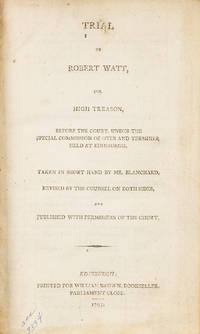
1795ref. 789051795. Edinburgh: Printed for William Brown 1795. Edinburgh: Printed for William Brown 1795. The Trial of a Would-Be Revolutionary Trial. Watt Robert c.1761-1794 Defendant. Trial of Robert Watt For High Treason Before the Court Under the Special Commission of Oyer and Terminer Held at Edinburgh. Taken in Short Hand by Mr. Blanchard Revised by the Counsel on Both Sides And Published with the Permission of the Court. Edinburgh: Printed for William Brown 1795. ii 364 pp. Folding plate illustrating pikes found in Watt's possession. Octavo 8-1/4" x 4-3/4". Contemporary calf gilt fillets to spine lettering piece lacking blind tooling to board edges. Light rubbing and a few small nicks and scratches to boards which are slightly bowed and separated but secured by cords faint dampstain to front board moderate rubbing to extremities shelf location in ink to foot of spine corners bumped and worn faint offsetting to preliminaries front free endpaper loosening but secure. Light toning to interior light soiling in a few places edgewear and light creasing to folding plate brief recent ink annotation to title page. $250. Only edition. Watt a wine merchant and political radical was the architect of a somewhat confused plot to establish Scotland as an independent country. After a search of his house turned up a number of pikes and the type for a seditious handbill he was arrested and tried for treason. A co-conspirator was pardoned but Watt was not so lucky. He was convicted and sentenced to be hanged and beheaded despite the jury's recommendation of mercy. The sentence reflected the court's opinion of the severity of Watt's crime. It was also intended to be a warning to other radicals. English Short-Title Catalogue N013806. unknown
1682ref. 144001682. De Vries Simon. Persian royal court scene 1682 depicts kingship judgment and punishment in a European publication describing Persia and other regions of Asia Africa and the Americas. Issued during the Safavid period the scene places a Persian ruler above assembled courtiers and judges while a kneeling governor is restrained before him presenting Dutch readers with a visual account of royal authority and judicial punishment in seventeenth-century Persia. De Vries compiled his extensive geographical work from earlier travel and eyewitness accounts rather than presenting it as the record of his own travels. De Vries Simon. Curieuse aenmerckingen der bysonderste Oost en West-Indische verwonderens-waerdige dingen; nevens die van China Africa en andere gewesten des werelds. Utrecht: Johannes Ribbius 1682. Original etching on laid watermarked paper. Image 6" x 7.5"; overall sheet 8.25" x 6.5". A Persian king occupies an elevated carpeted throne above an assembly of courtiers and judges. Below him a governor kneels while another figure restrains him establishing punishment as the central action of the composition. Most of the assembled figures wear turbans and long garments; several others have markedly different European-style headwear. Through an architectural opening additional guards appear within the palace setting. Small numbers incorporated into the composition correspond to explanatory text printed in early Dutch above the image linking individual figures and actions to De Vries's written account. Published at Utrecht by Johannes Ribbius De Vries's Curieuse aenmerckingen appeared in four parts in 1682 and compiled European accounts of geography customs religion government and court practices across numerous regions. Bibliographic records confirm both the four-part publication and its substantial series of engraved plates. The present scene documents how Persian royal government and judicial authority were explained pictorially to a late seventeenth-century Dutch readership with the numbered key allowing the image to be interpreted alongside the accompanying text. Uncut as published; overall excellent condition. The watermark surviving margins numbered explanatory system and detailed court scene preserve material and textual evidence of the engraving's original use as an illustration within De Vries's 1682 geographical compilation. unknown
ref. 7545All five prints 'Publish'd by Robt. Sayer No. 53 Fleet Street London as the Act directs 1st. Septr. 1772.'. Each of the five on a piece of good laid paper roughly 15 cm square. Wide margins with indentation of plate 9.5 x 8 cm. All five good with occasional light creasing to margins. The second and third items more aged that the others but all good and suitable for framing. Delicately engraved and skillfully coloured. Item One: 'Mr. Bellecour. 3 Comed. Franc. Le Joueur. dans la Comédie du même nom.' Item Two: '19 Comed. Franc. Michau et Henri. dans la Partie de Chasse d'Henri IV. Qu'êtes-vous allons qu'êtes-vous' Item Three: 'Made. Favart. 22 Coméd. Ital. La Vieille. dans la Fée Urgele Acte III.' Item Four: 'Mrs. Trial & Clerval. 29 Coméd. Ital. Bertrand et Monteauciel dans le Déferteur. Voulez-vous bien chanter quand on vous en prie' Item Five: 'Mr. Laurette 30 Coméd. Ital. Jean Louis. dans le Déserteur.' Presumably from Whirsker's "The Metamorphoses of Melpomene and Thalia or Dramatic Characters of the French and Italian Comedies." London: Robert Sayer n.d. but circa 1770. 30 plates. Cohen 1066. Lewine 356 copy on with 19 of the 30 plates at $3000: Micahel Hollander. See Image. All five prints 'Publish'd by Robt. Sayer, No. 53 Fleet Street London, as the Act directs, 1st. Septr. 1772.' unknown
1983ref. 2092902143902098Not Available 1983. Soft Cover. Fine. Volume: 1 Not Available paperback
1983ref. 2092902143802134Not Available 1983. Soft Cover. Fine. Volume: 1 Not Available paperback
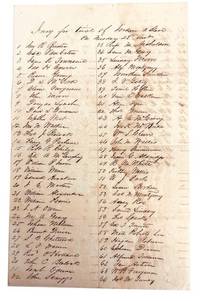
ref. 95800Very Good. Single leaf folded to form four pages with list of 83 names on first two pages. Three later horizontal folds probably for filing. Has some pencil markings beside most names -- either a red "x" or an black line. Ink note at top of one of the narrow folded section on last page:Jury of 80 Men for trial of Jorden on Tuesday 28th Inst. Waterstain -- name still quite readable -- a bit wavy but covers about the right third of both leaves as folded. No information as to date or location. Looks like it probably dates sometime in first two-thirds of 19th century. Someone might be able to narrow it down -- most juror names seem common but Plesant W. Ponder probably is not. Later pencil note in unknown hand on last page: possibly Lawrence County Alabama. unknown
ref. 3978The Burning of The Reichstag Reed Douglas Special Correspondent of The Times at the Leipzig Trial. Published by Victor Gollancz London 1934. First Edition Publishers Note Laid-In. 8vo up to 9½" tall. 352pp. with four black and white plates. Black cloth boards gilt spine titles. Text block is clean without markings tears or folds; a very light toning to edges. Boards are clean and binding is strong. Un clipped dust jacket has darkened along spine and edges. Minor chipping to head and foot. Protected in mylar. An exceedingly rare copy in original wrapper. The Reichstag fire February 27 1933 was a critical event in the expansion of Nazi power. Hitler seized upon the building's fire as evidence of communist scheming and the following day a state of emergency was declared and orders were given for all KPD The Communist Party of Germany members of the Reichstag to be arrested. The Reichstag Fire Decree imposed restrictions on the press banned political meetings and marches and intercepted communications. The legal concept of habeas corpus was suspended allowing the regime to detain suspected terrorists or revolutionaries without charge. This emergency decree was followed in March by the Enabling Act giving the Nazis dictatorial control for a five-year period. While the Reichstag fire was undoubtedly arson who was responsible remains one of history's great mysteries. Arrested at the rear of the building was Marinus van der Lubbe a 23-year-old Dutch communist who claimed sole and full responsibility denying the existence of co-conspirators. Also arrested were Ernst Torgler the chairman of the KPD three Bulgarians Georgi Dimitrov Blagoi Popov and Vassili Tanev. At their trial December 23 1933 Judge Wilhelm Bürger found Marinus van der Lubbe was guilty of "arson and with attempting to overthrow the government". The Judge further concluded that the German Communist Party had indeed planned the fire in order to start a revolution but the evidence against the other defendants was insufficient to justify a conviction. Marinus van der Lubbe was executed January 10 1934. Nearly 75 years after the event the German government granted him a posthumous pardon. hardcover
ref. BN372137Judaism on trial: An unconventional discussion about Jews Judaism and the State of Israel Hardcover Jan 01 2000 Lopes Cardozo Nathan T Hardcover Judaism on trial: An unconventional discussion about Jews Judaism and the State of Israel Hardcover Jan 01 2000 Lopes Cardozo Nathan T Hardcover Judaism on trial: An unconventional discussion about Jews Judaism and the State of Israel Hardcover Jan 01 2000 Lopes Cardozo Nathan T Hardcover hardcover
ref. 2368London: H. Owen 1757. . 8vo in half-sheets lacking the final blank; now bound in modern blue paper wrappers with typed label. Text somewhat soiled particularly at edges; first 4 leaves with small horizontal closed tear not affecting text; title with small loss in the bottom gutter. ESTC N25456. A record of the notorious trial of Captain James Gambier later Vice Admiral for adultery with Sir Charles Knowles's wife Maria Magdalena Therese de Bouget 1733-1796. Interestingly the wife's maiden name is given as Plusbee on p. 13 whereas it actually Bouget London: H. Owen, 1757. unknown
1863ref. 830711863. Trial. Bailey John Crawshay Primary Defendant. Somerset Henry Charles FitzRoy 8th Duke of Beaufort 1824-1899 Plaintiff. In the Common Pleas. His Grace the Duke of Beaufort Against John Crawshay Bailey and Others. For Trespass on Cwmdu Hill In the Parish of St. Michael Cwmdu Breconshire. Report of the Trial Before Mr. Justice Mellor and a Special Jury At Brecon On the 21st 23d And 24th of March 1863. Watkins Hooper Baylis And Baker 11 Sackville Street London Solicitors for His Grace. London: Printed by Strangeways & Walden 1863. iv 284 2 pp. Octavo 9-1/2" x 6-1/4"; 24.5 x 15.5 cm. Later green pebbled cloth printed paper label to spine endpapers renewed. Light rubbing and minor shelfwear moderate toning to interior negligible light foxing and soiling to a few leaves presentation inscription "C. Lloyd Esq./ With Mr. Baker's Compliments/ 30 March 1868" to front endleaf. $300. Somerset the 8th Duke of Beaufort was a British peer military officer and Conservative politician. This case centered on trespassing by members of the public on some of his vast property holdings totalling some 51000 acres in all in Wales. The defendants nearby farmers alleged that the portions of the land in question were part of their estates but the court found for the Duke. This copy was presented by Charles Baker one of the Duke's attorneys in the case. This is a scarce title. OCLC locates 3 copies in North American law libraries Columbia Harvard Jenkins Law Library. unknown
1863ref. 831271863. Don't Trespass on My Land! Trial. Bailey John Crawshay Primary Defendant. Somerset Henry Charles FitzRoy 8th Duke of Beaufort 1824-1899 Plaintiff. In the Common Pleas. His Grace the Duke of Beaufort Against John Crawshay Bailey and Others. For Trespass on Cwmdu Hill In the Parish of St. Michael Cwmdu Breconshire. Report of the Trial Before Mr. Justice Mellor and a Special Jury At Brecon On the 21st 23d And 24th of March 1863. Watkins Hooper Baylis And Baker 11 Sackville Street London Solicitors for His Grace. London: Printed by Strangeways & Walden 1863. iv 284 2 pp. Octavo 9-1/2" x 6-1/4"; 24.5 x 15.5 cm. Textured cloth with later cloth rebacking printed paper label to spine endpapers renewed. Light rubbing and minor shelfwear faint dampstaining to boards minor bubbling of cloth in places moderate toning to interior mostly negligible light foxing and soiling to a few leaves inscription "To be kept with His Grace's Breconshire Muniments/ C. Baker/ 29 Apl. 1863" to head of title page. $300. Somerset the 8th Duke of Beaufort was a British peer military officer and Conservative politician. This case centered on trespassing by members of the public on some of his vast property holdings about 51000 acres in Wales. The defendants nearby farmers alleged that the portions of the land in question were part of their estates but the court found for the Duke. This copy was apparently retained and filed by Charles Baker one of the Duke's attorneys in the case who was also an antiquarian and the duke's "steward of seignories of Gower and Kilvey." This is a scarce title. OCLC locates 3 copies in North American law libraries Columbia Harvard Jenkins Law Library. Powys-Land Club Collections Historical and Archaeological Relating to Montgomeryshire 5:407. unknown
1829ref. 694181829. Boston: Dutton and Wentworth Printers 1829. Boston: Dutton and Wentworth Printers 1829. A Trial Concerning Libel and Press Freedom Owned by a Notable American Bookseller Trial. Child David Lee 1794-1874 Defendant. Whitman John W. 1798-1833 Reporter. Trial of the Case of the Commonwealth Versus David Lee Child For Publishing in the Massachusetts Journal a Libel on the Honorable John Keyes Before the Supreme Judicial Court Holden at Cambridge In the County of Middlesex October Term 1828. Boston: Dutton and Wentworth Printers 1829. 119 pp. Octavo 8-3/4" x 5-1/2". Disbound stab-stitched pamphlet. Negligible light edgewear and soiling to exterior embossed library stamp of the New Hampshire Historical Society and early owner signature of Samuel G. Drake dated 1838 to title page. Moderate toning occasional early marks and notes in pencil to margins faint dampstaining to margins of title page and a few other leaves. $300. Only edition. This trial addressed the contested boundary between freedom of the press and the law of libel. In his Massachusetts Journal and various handbills Child accused Keyes of irregularities as chairman of the county Committee of Accounts bid rigging and animosity toward the administration in power in Washington. Child was found guilty. Our copy was owned by Samuel Gardner Drake 1798-1875 an important antiquarian bookseller publisher and prolific historian. The bookstore he operated in Boston specialized in early American history as Drake himself did; a copy of this title is listed in a catalogue he issued in 1869. Cohen Bibliography of Early American Law 13312. McCoy Freedom of the Press C318. Drake Catalogue of Rare Useful and Curious Books Tracts &c. in American Literature 1869 V:63. unknown
1760ref. 826621760. Copy of an Account of the Last Peer Hanged as a Common Criminal with an Interesting Provenance Trial. Ferrers Lawrence Laurence Shirley Earl 1720-1760 Defendant. The Trial of Lawrence Earl Ferrers For the Murder of John Johnson Before the Right Honourable the House of Peers In Westminster-Hall In Full Parliament On Wednesday the 16th Thursday the 17th And Friday the 18th of April 1760: On the Last of Which Days Judgment for Murder was Given Against Him. Published by Order of the House of Peers. London: Printed for Samuel Billingsley 1760. iv 55 pp. With initial imprimatur leaf. Folio 11-1/2" x 7-1/4". Stab-stitched pamphlet bound in nineteenth-century quarter speckled calf over marbled boards gilt fillets to calf edges gilt title to spine gilt morocco armorial bookplate of Edward Hailstone to front pastedown. Moderate rubbing to extremities boards partially detached but secure. Moderate toning to interior text block trimmed closely with loss to page numbers and catch-words in places no loss to main text early annotation "Right Honoble/ Welbore Ellis/ Council Office" to recto of imprimatur leaf. $300. Only edition one of two issues from the same year the other published in Dublin by Faulkner. Lord Ferrers was apparently a pleasant man if arrogant when sober but prone to violent rages and brutality while drunk. After six years of abuse his wife left him and returned to her family. She applied to Parliament for and received an order for maintenance. This came from a separate trust administered by Ferrers's steward John Johnson. The Earl eventually convinced himself that Johnson was plotting against him stealing his money and having an affair with his estranged wife. During a meeting he ordered Johnson to kneel and to beg pardon. Ferrers shot Johnson when he complied with this order. As established at trial Ferrers had been sober when he shot Johnson but quickly took to the bottle and assaulted the wounded man again. Johnson eventually died. Ferrers employed an insanity defense but was unsuccessful. He was sentenced to be hanged and anatomized the last peer to be executed in this manner. Welbore Ellis 1713-1802 was an English politician and civil servant who served as Secretary of State for the Colonies during the American Revolution. At the time of the trial he was M. unknown