3.510 resultados
ref. 17078A Grenoble, imp. Cuchet, 1769, 1 en cahiers, sans couverture. in-4 de 23 pages ;
ref. 5472Aix-en-Provence, veuve Adibert, 1762, 1 2 pages in-4, incomplet ;
1764ref. 20377[Paris] Le Breton 1764 in-8 demi-veau fauve moucheté, coins en vélin, dos à nerfs orné de fleurons et caissons dorés, pièce de titre rouge [Rel. mod. à l'imitation]
ref. 11788s.l., s.n., s.d., Paris, Didot, 1767, Paris, Gueffier, 1769, Grenoble, Giroud, 1769, 1 plein veau marbré, dos à nerfs, tranches rouge, ex-libris armorié collé sur le contreplat, dos et plats frottés, coins émoussés, 1 coiffe manquante. in-4, 1 ff. blanc avec notes manuscrites d'époque, 227 pp., IV-326 pp. + 1 feuillet d'errata, (2)-179-11 pp., 35 pp., 2 ff.n.c., et 2 feuillets manuscrits, 3 grands tableaux généalogiques dépliants (familles De Clermont, Clermont-Tonnerre ;
RENNES, Imp. Catel - sans date (vers 1868) - In-8 - Débroché - 98 pages + de A à R + XXX pages
1875ref. 80971875 Caen, Le Blanc-Hardel, 1875. Un fascicule in-4 de72 pages, couverture jaune imprimée. Dos cassé, manques à la couverture, intérieur frais.
1788ref. 15874[], [], 1788. In-4 de 36 pp. BEAUMARCHAIS (Pierre-Augustin Caron de). Troisième mémoire, ou dernier exposé des faits qui ont rapport à Pierre-Augustin Caron de Beaumarchais ; dans le procès du sieur Kornmann contre sa femme. Pièce justificatives. Lettre de Guillaume Kormann au Sieur Daudet, déposées au greffe le premier juin 1787. Paris, De l’Imprimerie de Seguy-Thiboust, 1789. In-4 de 81-18 pp. Relié en tête : FOURNEL (Jean-François Fournel). Eclaircissements pour Me Fournel, avocat en la cour, sur la plaidoirie prononcée par le sieur Bergasse à l'audience de la Tournelle criminelle du jeudi 19 mars 1789. Sans lieu ni date (1789). In-4 de 24 pp.Ensemble 1 vol. in-4, demi-basane havane marbrée à coins, dos lisse ornée de filets dorés, pièce de titre en maroquin blond, tranches rouges (reliure de l'époque).
ref. xc39Relié In-4 (20 x 26 cm), plaquette en reliure demi-toile, 17 pages, sans date [18e siècle], sans mention d'éditeur ; frottements aux coupes, manque de toile au centre du dos, par ailleurs assez bon état général. Livraison a domicile (La Poste) ou en Mondial Relay sur simple demande.
1804br. d’attente, non rogné, (couv. fanée, dos lég. abîmé avec qq. mq., qq. rousseurs) « Je n’ai jamais été, je ne serai jamais le partisan ou le stipendiaire des ennemis de ma patrie ; je suis Français, et je m’honore de l’être : tous mes vœux ont été pour la gloire, pour la prospérité de la France ; toute ma haine a été vouée à ce cabinet qui trafique depuis huit ans des malheurs de l’Europe, à ce cabinet instigateur de tant de troubles et machinateur de tant de crimes ; et si j’ai approché les princes français dans l’intention et l’espérance de servir ma patrie, je me suis éloigné d’eux, plein de ce mépris qu’inspireront toujours des hommes qui comptent sur les droits de leur naissance, et non pas sur leur courage ou sur leurs qualités personnelles, pour rentrer dans un empire dont leurs courtisans et leurs flatteurs dévoreraient bientôt la substance et perpétueraient les désastres. La vérité m’obligera à dire ce que la modération de mon esprit me porterait à taire ; je ne puis ni ne veux rien celer. Qu’on blâme cet écrit, ou qu’on l’approuve, j’aurai rempli mon devoir ; j’aurai laissé à ma patrie un gage de mon amour pour elle ; et ces lignes, j’ose du moins l’espérer, défendront ma mémoire contre les atteintes de la calomnie ou de la haine. »
ref. 41588, Paris, Imprimerie de la République / Marchands de nouveautés Germinal an XII [1804], in-8, br. d’attente, non rogné, (couv. fanée, dos lég. abîmé avec qq. mq., qq. rousseurs), 160/ 100p.
ref. 056907Paris Chez P. Alex. Le Prieur 1761 in 12 (17x10) 1 volume reliure plein veau fauve écaille de l'époque, dos à nerfs orné de caissons dorés, pièce de titre de maroquin rouge, tranches teintées rouge, 531 pages. Edition originale. Très bel exemplaire ( Photographies sur demande / We can send pictures of this book on simple request )
ref. 19175Paris, Chamuel, 1898, 1 broché. in-8 de 418 pages non coupées, 2 photos dont 1 en frontispice.
1829FIRST AND ONLY EDITION of this rare and extremely detailed case study of a false accusation of poisoning. 4, vii, 5-302, 1, cxix. Complete. Printed on very good wove paper. 8vo. Contemporary quarter calf and decorated boards. Light wear to binding. Occasional light foxing. Overall very good condition. Rare: only a handful of copies in WorldCat.
ref. 10285et d’autres sociétés secrètes d’Espagne.Avec des notes historiques de M. Manuel de CUENDAS.In 8 demi-toile marron, titre, filets dorés. Faux-titre, frontispice, titre illustré, 398 pages, 1 page de table des matières, 111 gravures dans le texte et culs de lampe, 18 hors-texte par les meilleurs artistes. Paris Paul BOIZARD 1859. Bon exemplaire
2017Mm140x205 Brossura editoriale con alette, pp. 596 con centinaia di foto di condannati a morte, vittime del grande terrore. Nuovo. Spedizione in 24 ore dalla conferma dell'ordine.
1949Volume in stato mediocre (vedi foto). Volume autografato dell'autore.
1949Volume in brossura, in ottimo stato. Rilegatura robusta.
19201 18,5x12 cm., in brossura, copertina illustrata con disegno (I carabineri e il brigante) a colori, pp.128, prima edizione, in italiano, libro popolare, buone condizioni, solo piccoli segni d'uso e tempo.
1978295 pages including index and some black and white illustrations. "Some of the proceedings described in the following pages seem unjust to us, but we have to remember that these trials took place about 160 years ago. Many important reforms have been introduced both in England and France which have gone far to establish and safeguard the rights of the accused. One aspect has not changed; a criminal trial in France is more dramatic, more akin to the theatre, than in England, both in its setting and in the display of emotion." - from Foreward. Several cup rings upon back board. Small rubber stamp upon front endpaper else contents clean and unmarked. Light to moderate wear. Solid copy. Book
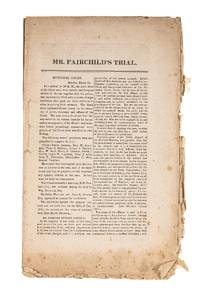
1845ref. 847281845. He "Argued Much from the Bible to Induce Me to Submit to His Base Designs" Trial. Fairchild Joy Hamlet 1790-1859 Defendant. A Full and Accurate Report of the Trial of Rev. Joy H. Fairchild Before the Municipal Court of Boston For Adultery with Miss Rhoda Davidson. Caption title: Mr. Fairchild's Trial. Boston: H.B. Skinner 1845. Octavo 10" x 6"; 25 x 15 cm. 24 pp. Text in parallel columns. Stab-stitched pamphlet with untrimmed edges. Moderate toning occasional light foxing. Lower outside corners of last two leaves lacking with minor loss to text on last leaf. $250. A scarce antebellum legal document of the highly publicized Boston municipal trial of the Reverend Joy Hamlet Fairchild a married Orthodox Congregational minister accused of committing adultery with Rhoda Davidson a young domestic servant of Edgecomb Maine living in his household. After Davidson gave birth to a child and named Fairchild as the father the ensuing scandal captivated the New England public exposing deep anxieties surrounding ministerial morality and the sexual exploitation of working-class women. One of several publications about this celebrated notorious case. Fairchild vigorously defended himself against the adultery charge claiming he was the victim of a malicious conspiracy engineered by rival clergymen intent on framing him as a habitual libertine. This Skinner printing captures the full dramatic tension of the courtroom including Davidson's detailed testimony regarding how Fairchild used perverted biblical arguments to overcome her moral objections: "I asked him if God had not declared that every man should have his own wife and none other. He said that was Paul's language and then argued much from the Bible to induce me to submit to his base designs which he succeeded in accomplishing." It closes with the equally vexing verdicts. Despite his conviction in ecclesiastical court the Boston municipal jury found that he was not guilty of adultery. The trial highlights a fascinating divergence in nineteenth-century American jurisprudence. A compelling artifact documenting the intersection of religion law and public obsession with sexual scandal in New England. As in most other copies we located ours is lacking its wrappers which contained the title and publication information. Accounts of this case are sca. unknown books
1845ref. 847281845. He "Argued Much from the Bible to Induce Me to Submit to His Base Designs" Trial. Fairchild Joy Hamlet 1790-1859 Defendant. A Full and Accurate Report of the Trial of Rev. Joy H. Fairchild Before the Municipal Court of Boston For Adultery with Miss Rhoda Davidson. Caption title: Mr. Fairchild's Trial. Boston: H.B. Skinner 1845. Octavo 10" x 6"; 25 x 15 cm. 24 pp. Text in parallel columns. Stab-stitched pamphlet with untrimmed edges. Moderate toning occasional light foxing. Lower outside corners of last two leaves lacking with minor loss to text on last leaf. $250. A scarce antebellum legal document of the highly publicized Boston municipal trial of the Reverend Joy Hamlet Fairchild a married Orthodox Congregational minister accused of committing adultery with Rhoda Davidson a young domestic servant of Edgecomb Maine living in his household. After Davidson gave birth to a child and named Fairchild as the father the ensuing scandal captivated the New England public exposing deep anxieties surrounding ministerial morality and the sexual exploitation of working-class women. One of several publications about this celebrated notorious case. Fairchild vigorously defended himself against the adultery charge claiming he was the victim of a malicious conspiracy engineered by rival clergymen intent on framing him as a habitual libertine. This Skinner printing captures the full dramatic tension of the courtroom including Davidson's detailed testimony regarding how Fairchild used perverted biblical arguments to overcome her moral objections: "I asked him if God had not declared that every man should have his own wife and none other. He said that was Paul's language and then argued much from the Bible to induce me to submit to his base designs which he succeeded in accomplishing." It closes with the equally vexing verdicts. Despite his conviction in ecclesiastical court the Boston municipal jury found that he was not guilty of adultery. The trial highlights a fascinating divergence in nineteenth-century American jurisprudence. A compelling artifact documenting the intersection of religion law and public obsession with sexual scandal in New England. As in most other copies we located ours is lacking its wrappers which contained the title and publication information. Accounts of this case are sca. unknown
1914ref. 659851914. New York 1912-1914. Image in 30-1/2" x 24" frame. New York 1912-1914. Image in 30-1/2" x 24" frame. "His Famous Wig Composed Entirely of Split Hairs and Adorned with the Ceremonial Crimson Tape" Robinson Boardman 1876-1952. Becker-Rosenthal Murder Trial. Mr. Justice Precedent. New York 1914. 21" x 15-1/2" 53.3 x 39.4 cm gouache image on 26" x 19-1/2" 66 x 49.5 cm sheet image signed twice and inscribed by Robinson caption in pencil below image most likely in another hand laid down on illustration board. Image in 30-1/2" x 24" 77.5 x 60.9 cm wooden frame glazed. Light soiling a few minor stains and four crop-marks to margins outside of image which could be covered with a matte image fine. Several minor scuffs and nicks to frame. An exceptional unique piece of original artwork capturing a defining moment in American legal and criminal history. $3500. This striking original gouache was created to illustrate "Leaden Footed Justice in New York State" a feature article published in the Special Feature section of the New York Tribune on Sunday March 1 1914. The penciled caption reads:"Mr. Justice Precedent wearing his famous wig composed entirely of split hairs and adorned with the ceremonial crimson tape." The caricature was a scathing commentary on the notoriously protracted bureaucratically tangled legal proceedings of the Becker-Rosenthal Murder case which centered on NYPD Police Lieutenant Charles Becker who ran a massive protection racket targeting illegal Manhattan casinos. When gambling house owner Herman Rosenthal threatened to expose Becker's corruption to District Attorney Charles S. Whitman Becker hired a gang of underworld executioners including "Gyp the Blood" and "Lefty Louie" to gun Rosenthal down outside the Hotel Metropole. The investigation and subsequent trials completely dominated New York front pages. Becker's first trial began on October 7 1912 resulting in a conviction that was subsequently overturned on appeal by the New York Court of Appeals due to judicial bias. His highly anticipated second trial began on May 6 1914 just over two months after this cartoon appeared. Becker was convicted a second time and after his appeals were exhausted in 1915 went to the electric chair at Sing Sing-marking the first time in U.S. history a police officer was executed for murder. The case profoundly shook the public psyche and entered the cultural lexicon most. unknown books
1914ref. 659851914. New York 1912-1914. Image in 30-1/2" x 24" frame. New York 1912-1914. Image in 30-1/2" x 24" frame. "His Famous Wig Composed Entirely of Split Hairs and Adorned with the Ceremonial Crimson Tape" Robinson Boardman 1876-1952. Becker-Rosenthal Murder Trial. Mr. Justice Precedent. New York 1914. 21" x 15-1/2" 53.3 x 39.4 cm gouache image on 26" x 19-1/2" 66 x 49.5 cm sheet image signed twice and inscribed by Robinson caption in pencil below image most likely in another hand laid down on illustration board. Image in 30-1/2" x 24" 77.5 x 60.9 cm wooden frame glazed. Light soiling a few minor stains and four crop-marks to margins outside of image which could be covered with a matte image fine. Several minor scuffs and nicks to frame. An exceptional unique piece of original artwork capturing a defining moment in American legal and criminal history. $3500. This striking original gouache was created to illustrate "Leaden Footed Justice in New York State" a feature article published in the Special Feature section of the New York Tribune on Sunday March 1 1914. The penciled caption reads:"Mr. Justice Precedent wearing his famous wig composed entirely of split hairs and adorned with the ceremonial crimson tape." The caricature was a scathing commentary on the notoriously protracted bureaucratically tangled legal proceedings of the Becker-Rosenthal Murder case which centered on NYPD Police Lieutenant Charles Becker who ran a massive protection racket targeting illegal Manhattan casinos. When gambling house owner Herman Rosenthal threatened to expose Becker's corruption to District Attorney Charles S. Whitman Becker hired a gang of underworld executioners including "Gyp the Blood" and "Lefty Louie" to gun Rosenthal down outside the Hotel Metropole. The investigation and subsequent trials completely dominated New York front pages. Becker's first trial began on October 7 1912 resulting in a conviction that was subsequently overturned on appeal by the New York Court of Appeals due to judicial bias. His highly anticipated second trial began on May 6 1914 just over two months after this cartoon appeared. Becker was convicted a second time and after his appeals were exhausted in 1915 went to the electric chair at Sing Sing-marking the first time in U.S. history a police officer was executed for murder. The case profoundly shook the public psyche and entered the cultural lexicon most. unknown
1988ref. 2091202132800374Ongaku no Tomosha 1988. Soft Cover. Fine. Number of books: 1 Ongaku no Tomosha paperback
ref. 139839Paris, Imprimerie Nationale, s.d. (1792) in-8, 6 pp., broché. Mouillure.