3,507 results
ref. DADAX0735532400New unknown
ref. DADAX0801441684New unknown
ref. SONG1599941287Used: Good unknown
ref. SONG0415426731Used: Good unknown
ref. SONG8497774698Used: Good unknown
ref. SONG0813511089Used: Good unknown
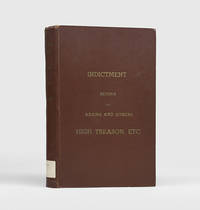
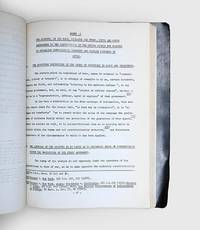
1951ref. 1903891951. The failed appeal against the "trial of the century" One of very few copies of Emanuel Bloch's appeal seeking to overturn the prosecution of the Rosenbergs at their infamous trial signed by Bloch for submission to the Court of Appeals on the final page. Bloch 1901-1954 an attorney who focused on civil rights was known for defending clients associated with left-wing and communist causes. The Rosenbergs communists accused of sending atomic secrets to the Soviets chose Bloch to lead their defence. The court found the Rosenbergs guilty of espionage in March 1951 and sentenced them to death in April following a trial widely criticized as prejudiced and motivated by Cold War hysteria. J. Edgar Hoover dubbed the case which attracted worldwide attention "the trial of the century". The Rosenbergs were granted time to prepare the appeal which Bloch submitted to the Circuit Court on 5 November 1951. Comprising 143 pages of argument extensively referenced against other legal cases and with an index Bloch sets forth his legal case. It rests on three grounds: the government had not established definite guilt the Rosenbergs had not been granted a fair trial and the "cruel and unusual punishment" violated the eighth amendment. Besides the constitutional grounding Bloch emphasizes the "frantic atmosphere" in which the Rosenbergs were arrested placing the trial within the context of the panic caused by the Soviet Union's acquisition of the atomic bomb. The appeal was denied by the three judges on the court on 25 February 1952. They reported they had carefully examined the trial record against Bloch's appeal and had found the death sentence was constitutional and would stand. Following the defeat Bloch filed a further appeal with the Supreme Court which declined to review the case. A stay on execution was granted to appeal to President Eisenhower who denied the petition. Various other legal challenges the last of which reached the Supreme Court also failed. Despite an international campaign for clemency backed by the Pope and Albert Einstein the Rosenbergs were executed on 19 June 1953. Despite the failure of Bloch's appeal his brief greatly impressed the Rosenbergs. Julius wrote to Ethel on 4 November 1951 "I read the brief and I wrote Manny Bloch telling him what a stupendous job he did and how everlastingly grateful we are for his tireless efforts for us. Darling the brief is a legal masterpiece and in addition is a literary gem. Although I don't have the background to really pass on the legal fine points I can attest to its excellent organization its meticulousness in presenting in a fair light our case the devastating logic of his points and the tremendous assiduous effort Manny exerted in preparing this document. Believe me it's a priceless piece of work from a great man. How proud we are to be considered his friends. I intend to reread it a number of times so I'll be able to better understand some of the legal points raised" The Rosenberg Letters 2013 pp. 253-4. Bloch is often seen as a lawyer unsuited to the case more suited to civil rights work than a major criminal trial. His failure to interrogate properly the government's key witness Harry Gold has been much criticized. This appeal shifted more to Bloch's speciality of constitutional and civil rights probably constitutes a stronger legal case than that which he presented in the original trial. Nonetheless the Rosenbergs were very confident in him and he became a close friend. Bloch delivered the eulogy at their funeral and took guardianship of their sons though he died soon afterwards of a heart attack. This copy of the brief is evidently one of a small number produced for official use alongside the copies which each Rosenberg received. This copy was deposited in the Civil Rights Division of the American Jewish Committee - it is marked as their file copy and subsequently "withdrawn". It is unknown how they acquired the brief - the American Jewish Committee pointedly distanced themselves from the case likely to avoid the association of Jews with communism and treachery which the case did much to encourage among the public. An inscription on the first page reads "Return to Ted Leskes" - Theodore Leskes 1908-1964 was director of the legal division of the American Jewish Committee focusing on civil rights and discrimination. We trace only one other example of the brief at the University of Kansas and no other copy in commerce. Quarto 285 x 217 mm. Containing 154 mimeographed leaves printed recto only paginated comprising i-xi index 143 pages of contents firmly staple-bound in "Accopress binder" an early likely original binding printed title page mounted to front of binder. Housed in a black cloth flat-back box by the Chelsea Bindery. Stamps of American Jewish Committee to front cover and p. i verso. Chipping around title on front cover reinforced with tape at extremities slight wear to binder extremities contents a little toned else clean. A good copy. hardcover
ref. DADAX0719082641New unknown
ref. DADAX1799500756New unknown
1825ref. 829431825. Nottingham: Sutton and Son 1825. Nottingham: Sutton and Son 1825. An Early And Unsuccessful Insanity Defense for the Impulsive Murder of a Woman Trial. Dewey Thomas d.1825 Defendant. A Copious Report of the Trial of Thomas Dewey For the Wilful Murder of Maria Austin Before the Hon. James Allan Park Knt. On Monday July 25 1825 At the Town Hall Nottingham. To Which is Added Some Particulars of His Life Character Behaviour And Execution. Copied from the Nottingham Review With Some Additions. Nottingham: Printed and Sold by Sutton and Son Review Office 1825. 22 pp. 12mo. 6-1/2" x 3-3/4"; 16.5 x 9.5 cm. Stab-stitched pamphlet in printed wrappers. Moderate toning light soiling to exterior a few creases to rear wrapper faint dampstaining along spine and head of text block around gutter. A very good copy overall. $500. Only edition. Thomas Dewey stabbed Maria Austin a neighbor and acquaintance after a quarrel in which she told him not to order her children about. Dewey claimed insanity and several witnesses testified to this effect but the judge and jury disagreed. He was convicted of capital murder and sentenced to death. Though it was unclear at trial whether a romantic connection between the two existed at the time of the murder the account appended to the trial in our work suggests that Dewey was a womanizer jealous of Austin's husband from whom she was estranged. It concludes with a poem titled "The Morning of Execution." OCLC locates 7 copies of this scarce title 3 in North America Harvard Law School Library of Congress University of Kansas. Library Hub locates no additional copies. unknown
1956ref. 184698Pretoria: The Government Printer 1956. A major moment in South African history First edition of the indictment for the "Treason Trial" in which Nelson Mandela and almost the entire anti-apartheid leadership were prosecuted. One defendant Ahmed Kathrada has signed beside his name; the signature was acquired by a collector in recent years. "The core of the treason charge related to a momentous - and for the government disconcerting - event at Kliptown on the outskirts of Johannesburg on 25-26 June 1955. The delegates were drawn from the ranks of the Congress Alliance a coalition of race-based anti-apartheid groups - the ANC still Africans only the Indian Congresses the Coloured People's Congress and the white mix of communists and non-communists. They had come together to draw up the country's first democratic constitution. Out of the deliberations came the endorsement of a Freedom Charter which to western eyes was an unexceptionable statement of democratic principles and equal rights owing something to the UN Charter but virtually nothing to the Communist Manifesto" Herbstein pp. 28-9. In response 156 individuals who attended or were associated with the meeting were arrested under the 1950 Suppression of Communism Act. The trial helped unite the anti-apartheid movement and attracted worldwide support for the struggle and international condemnation of the South African government. The trial lasted over four years after which all the accused were acquitted. However soon after Mandela and other defendants were imprisoned following the Rivonia Trial. 3 vols bound in 1 as issued folio. Ex library of the South African embassy in Bonn with their stamp to the front free endpaper and their shelf label and number to spine; binding rubbed and slightly worn and shaken contents toned. A good copy. Denis Herbstein White Lies: Canon Collins and the Secret War Against Apartheid 2004. unknown
ref. DADAX0231175221New unknown
ref. DADAX143666845XNew unknown
1830ref. 777401830. Dover: Published by Geo. W. Ela 1830. Dover: Published by Geo. W. Ela 1830. Libel and Press Freedom in 1830 New Hampshire Trial. Hill Horatio b.1807 Defendant. Barton Cyrus 1795-1855 Defendant. Report of the Case of Timothy Upham against Hill & Barton Publishers of the New-Hampshire Patriot For Alleged Libels At the Court of Common Pleas Rockingham County March and October Terms.1830. Dover: Published by Geo. W. Ela 1830. 159 pp. Octavo 8-3/4" x 5-1/2". Stab-stitched pamphlet front and rear wrappers lacking later hand-lettered title to spine edges untrimmed. Light browning light edgewear to several leaves light foxing and soiling in a few places light creasing to last few leaves pencil marks and brief annotations to a few pages small tear to title page affecting text without loss to legibility final leaf separated with small tears but secured by thread. $500. Only edition. Hill and Barton publishers of the New Hampshire Patriot and Star Gazette accused Upham of impropriety during his time as Collector of Customs at Portsmouth and "impaired his candidacy for Governor by calling him a smuggler and a federalist" Cohen. Upham sued for damages of $10000; the trial resulted in a hung jury and the case was slated for retrial at the court's next session. OCLC locates 5 copies of this title in law libraries Yale Library of Congress Harvard University of Missouri The Ohio State University. Cohen Bibliography of American Law 12070. McCoy Freedom of the Press U236. unknown
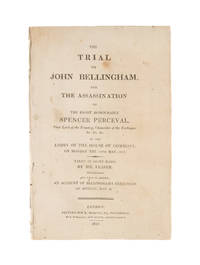
1812ref. 759851812. The Only Successful Attempt on the Life of a British Prime Minister Trial. Bellingham John 1769-1812 Defendant. The Trial of John Bellingham For the Assassination of the Right Honourable Spencer Perceval First Lord of the Treasury Chancellor of the Exchequer &c. &c. &c. In the Lobby of the House of Commons On Monday the 11th May 1812. Taken in Short Hand By Mr. Fraser. To Which is Added An Account of Bellingham's Execution On Monday May 18. London: Printed for R. Mercer 1812. ii 108 pp. Octavo 8" x 5-1/2". Disbound stab-stitched pamphlet. Moderate toning light soiling to exterior light foxing to title page and a few other leaves small chip to bottom-edge of final leaf. $500. Only edition. Bellingham was motivated by a baseless claim that the Crown owed him money as compensation for time he served in a Russian prison. He believed he was owed compensation because the government did not try to assist him. His murder of Perceval was the only successful attempt on the life of a British Prime Minister. OCLC locates 5 copies in North American law libraries Harvard LA County Social Law University of Pennsylvania York. Not in the British Museum Catalogue. unknown
ref. DADAX0060851430New unknown
ref. DADAX0128093358New unknown
ref. DADAX0857380788New unknown
ref. DADAX1482212188New unknown
ref. DADAX0520273648New unknown
ref. DADAX1781593523New unknown
ref. DADAX0190653167New unknown
ref. DADAX1558499954New unknown
ref. DADAX0198833857New unknown
ref. DADAX0367261251New unknown