Jesse, F Tennyson (Trial of Thomas John Ley; Lawrence John Smith; Murder of John Mcmain Mudie)Biblio.com

916 resultados
ref. 159040London: William Hodge and Company 1947 1st printing. Hardcover 313pp. Fine no dust jacket. Illustrations photographs chronology appendix. Trial of Thomas John Ley & Lawrence John Smith. Murder of John Mcmain Mudie. Publisher series: Notable British Trials. Law Chalk Pit Murders. William Hodge and Company Hardcover
ref. 159037London: William Hodge and Company 1953 1st printing. Hardcover 271pp. Fine no dust jacket. Illustrations photographs chronology appendices bibliography. Trial of John George Haigh. Murder of Olive Durand-Deacon. Publisher series: Notable British Trials. Law Murder Trials. William Hodge and Company Hardcover
ref. rja818518UKthick 8vo HBdw/djillustrated1st edn. Complete number line 1. FINE/FINE. No owner inscrptn and no price-clip to dw/dj.Brightcrispcleanmattb/w Whitechapel map with small circular cut-outs of victims' murder sites to front and spine illustrated dw/dj with black lettering on front and white lettering on spine; with negligible shelf-wear or creasing to edges and corners - no nicks or tears present.Topfore-edges bright and clean; contents brighttightcleansolid and sound - pristine - no dog-ear reading creases to any pages' corners appears unread apart from my collation.Publisher's brightcrisp cleansharp-corneredoriginal plain red cloth boards with partial wrap-around monochrome portrait of Michael Maybrick 1844-1913 illustrated upper board and continuing around the foot of spine and lowerrear edgeno lettering to spine/ backstripa blackred striped headtailband and immaculate plain black endpapers.UKthick 8vo HBdw/djillustrated1st ednxi-xiiipp1-850pp paginated includes author's Note19 chaptersprofusely illustrated with contemporary facsimile b/w illustration reproductionsand b/w photographs etc. throughout the text and the bookAppendices III AcknowledgementsSourcesPicture Creditsan Index; plus unpaginated half-titletitle pagesa dedicationa Contents list/tableand an epigram. A book like no other - the tale of a gripping quest to discover the identity of history's most notorious murderer and a literary high-wire act from the legendary writer and director of Withnail and I. For over a hundred years'the mystery of Jack the Ripper' has been a source of unparalleled fascination and horrorspawning an army of obsessive theoristsand endless volumes purporting finally to reveal the identity of the brutal murderer who terrorised Victorian England. But what if there was never really any 'mystery' at all What if the Ripper was always hiding in plain sightdeliberately leaving a trail of clues to his identity for anyone who cared to lookwhile cynically mocking those who were supposedly attempting to bring him to justice In 'They All Love Jack'the award-winning film director and screenwriter Bruce Robinson exposes the cover-up that enabled one of history's most notorious serial killers to remain at large.More than twelve years in the writingthis is much more than a radical reinterpretation of the Jack the Ripper legendand an enthralling hunt for the killer.A literary high-wire act reminiscent of Tom Wolfe or Hunter S. Thompsonit is an expressionistic journey through the cesspools of late-Victorian societya phantasmagoria of highly placed villainshypocrites and institutionalised corruption. Polemicforensic investigationpanoramic portrait of an age underpinned by deep scholarship and delivered in Robinson's inimitably vivid and scabrous prose'They All Love Jack' is an absolutely riveting and unique bookdemolishing the theories of generations of self-appointed experts - the so-called 'Ripperologists' - to make clearat lastwho really did it; and more importantlyhow he managed to get away with it for so long. Please contact seller @ rpaxtonden@blueyonder.co.ukbecause of the weight/value of this item for correctinsured shipping/Pp quotes - particularly ALL overseas buyers - BEFORE ordering through the order page! N.B. ALL buyers please notestocks' actual shipping/Pp costs are adjusted and any difference is refundedafter order's receipt and before the order's despatchespecially if the items are offered either Pp included/FREE. N.B. US/Canada customers please be aware: Standard US AIRMAIL to these destinations can nowin some casescost more than the price of the book! If speed is not of the essence then Economy rate is recommended - at approx. anything from a 1/3rd to 1/2 of the standard US AIR quote/rate - sometimes arriving sooner than the 42 days - but not always. LONDON.FOURTH ESTATE,2015. hardcover
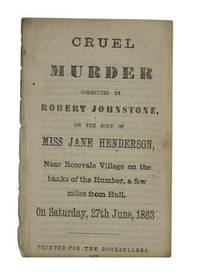
1863ref. AQ33168Glasgow: Printed for the booksellers 1863. 8pp. Disbound. Title page shaved at foot with slight loss to imprint. A prose and verse chapbook recounting the brutal murder of Jane Henderson by her lover Robert Johnstone in 1863 on the outskirts of Hull. On 27th June Johnstone stabbed Henderson multiple times before disposing of her body in a nearby river. The pair had been conducting an illicit affair for a considerable time. Henderson had become pregnant and Johnstone desirous to be rid of her in favour of another woman conspired to murder. Henderson's corpse was soon discovered and upon a person a letter written by Johnstone to lure her to the place of her murder. Johnstone was swiftly arrested and imprisoned. His fate is unrecorded. 'Her throat then I cut while the blood flowed profusely Then she fell like a corpse most dreadful to view; My crime to conceal I drew her near the water And into the Humber her body I threw'. . 16mo. Printed for the booksellers unknown
1938ref. 17449New York: Modern Library 1938. First edition thus. Hardcover. Very Good/Good. ML 113.2. Stated First Modern Library Edition 1938. True crime stories including the Hauptmann Lindbergh baby case. Blue flexible/balloon cloth boards with gold logo on front. Star stamp on rear endpaper. Some fading of cloth at top and bottom of spine and bottom front. Blue pictorial dust jacket has 95 cents price on flap and rear panel. 257 ML titles listed inside. Half-inch chips at top and bottom of dust jacket spine tiny corner chips and edgewear small stain and a few small scrapes on jacket spine. Modern Library hardcover
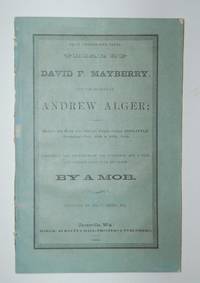
ref. 38036Janesville Wis.: Barker Burnett & Hall Printers & Publishers 1855. First edition 8vo 205 x 135 mm 48pp. some light spotting orig. green upper printed wrapper lower wrapper missing disbound. "Mayberry knowing Alger was returning with a sum of money met him on the road in Harmony Wisconsin and killed him with a hatchet while riding with him. Wisconsin had abolished the death penalty and a mob seized Mayberry after his conviction and hanged him in the streets."McDale. McDale The Annals of Murder. Janesville, Wis.: Barker, Burnett & Hall, Printers & Publishers, 1855 unknown
ref. 34284Edinburgh: Edinburgh: Printed for G. Hamilton and J. Balfour 1753. First edition 4 288 149 1pp. folding engraved map Birmingham Law Society stamp on title recent half calf marbled boards spine gilt red morocco title label. The Appin Murder occurred on 14 May 1752 near Appin in the west of Scotland and it resulted in what is often held to be a notorious miscarriage of justice. It occurred in the tumultuous aftermath of the Jacobite Rising of 1745. The murder inspired events in Robert Louis Stevenson's novel Kidnapped. Edinburgh: Edinburgh: Printed for G. Hamilton and J. Balfour, 1753 hardcover
ref. 26500Rochford Essex Police Constabulary. Entries dated from the Chief Constable's Office Chelmsford. 6 December 1881 to 30 October 1885. 179pp. foolscap 8vo and contains 332 general orders by 'W. H. Poyntz Major and Chief Constable'. The volume is entirely in manuscript but is not in Poyntz's handwriting. It comprises 168 paginated pages followed by an eleven-page index giving a one-line summary of the 'Purport' of each order. The volume is a ruled notebook in original quarter binding of black cloth spine and marbled boards with the words 'GENERAL ORDERS' printed on a label on the cover with 'Rochford' written in manuscript beneath. Complete and entirely legible on aged and worn paper with a few loose leaves and shaken in heavily worn binding. A detailed and informative volume casting a fascinating light on Victorian provincial policing he entries reflecting the exacting standards of the chief constable. Subjects include procedure punishments pay registrations and promotions leave uniform 'Belts to be worn with Tunics and Great Coats' 'Winter and Summer Gloves' 'Parade in Uniform Boots' 'the length of the Constables hair' drinking on duty 'Gambling and raffling in Public and Beer Houses' transcriptions of letters from the Home Office the giving of testimony 'disused Mine Shafts' 'Boiler explosions'. The most significant entry relates to the murder of Inspector Thomas Simmonds: 'General Order 284 28th. January 1885 The Chief Constable has much gratification in promoting P.C. 107 Alfred Marden to a 1st. Class and at the same time a “Merit” Class Constable for gallant and meritorious Conduct in having on the 20th. instant at Hornchurch within the Liberty of Havering atte Bower after his Superior Officer Inspector Simmons had been struck down by a shot from a revolver fired by one of three armed Burglars whom they were about to search Continued the pursuit of two of these men by himself notwithstanding that while so doing two shots were discharged at him The Conduct of this young Office reflects high credit on himself and through him on the Essex Constabulary'. General Order 314 18 July 1885 reads: 'The Chief Constable directs that Superintendents and Officers in charge of Petty Sessions are to be very particular watching the manner that Constables give evidence when in the Witness Box. Nothing looks worse than its being given in an indistinct and hesitating manner and where such is apparent instruction and practice should be afforded the officer. A Constable must stand straight up at “attention” and not “fiddle about” with his hands in a nervous sort of manner. As putting on the right hand glove after taking the oath seems rather to unsettle some officers and as difficulty seems frequently to arise in replacing it that part of General Order No. 166 dated 15th October 1883 relating thereto is hereby Cancelled'. An example of 'Punishments' is issued 'for the information of Divisions' as General Order 291 23 February 1885: 'P.C. 92. G. Hurrell 1st. Class is – for having been found partially undressed and asleep in a hut while on duty at 2 A.M. on the 10th. instant and for making a false preort against his Inspector – dismissed from the Force P.C. 175 N. Paye 1st. Class 128 A. Whalley 2nd. Class and 138 A. Sweeting 3rd. Class are – for not using proper diligence to return to their Station at Greys when sent to London on duty thereby missing the train and remaining away all night – each fined half a days pay viz: Paye 1s11d Whalley 1s/8d and Sweeting 1s/7d This not being the first Case of the kind that has occurred the Chief Constable wishes it to be clearly understood that any similar neglect of duty will be severely dealt with.' Born in Dublin Poyntz joined the Royal Marine Light Infantry in 1853 and reached the rank of Major serving in Hong Kong China Japan and Woolwich. Chief Constable of Nottingham 1872-1881; and Chief Constable of Essex 1881-1887. For information on his career at Essex see Chapter 5 'Major Poyntz makes Changes 1881-87' of Maureen Scollan's 'Sworn to Serve: Police in Essex 1840-1990' 1993 according to which he put 'new ideas in action' and faced ' public order problems involving Salvation Army and Guy Fawkes festivities'. Under Poyntz 'officers of all ranks were reminded to call on important members of the community when they changed station' while Poyntz himself 'would often appear unannounced when cases were being heard by local justices and sometimes commented unfavourably on the way his officers gave their evidence' see G.O. 314 above. 'Major Poyntz was constantly reminding the superintendents of their responsibilities and their need to check everything from the renewal of pedlars' certificates to the health of their men. They were even ordered to inspect the drains'. [ Rochford, Essex Police Constabulary. ] Entries dated from the Chief Constable's Office, Chelmsford. 6 December 1881 to 30 Octo hardcover
ref. 159031London: William Hodge & Company 1950 new edition. Hardcover 298pp. Very good no dust jacket. Photographs chronology appendices. Trial of Alma Victoria Rattenbury Alma Victoria Rattenbury George Percy Stoner George Percy Stoner. Murder of Francis Mawson Rattenbury & Francis Mawson Rattenbury. Publisher series: Notable British Trials. Locale:. Law Murder Trials--England Murder Trials--England Trials. William Hodge & Company Hardcover
ref. 19107Receipt of His Majesty's Exchequer London. 6 May 1715. 1p. on 15 x 17.5cm. Aged and worn with loss to edges and laid down on part of a leaf removed from an album. The usual printed text completed in manuscript recording a payment of £25. Note: An account of the 1699 Sarah Stout murder trial at which Cowper 'called expert medical testimony including the famous physicians Samuel Garth and Hans Sloane together with the anatomist William Cowper not related' is given in his entry in the Oxford DNB. [ Receipt of His Majesty's Exchequer, London. ] 6 May 1715. unknown
ref. 17852The Central Criminal Court Old Bailey London. Stamped first day of trial 12 December 1907. On one side of a 10 x 12.5 cm piece of card. In fair condition lightly aged and worn. Signed 'C C Wakefield' and granting admission to 'the representative of the Pall Mall ' the trial beginning on 12 December 1907. Annotated around Wakefield's signature: 'For the trial of Robert Wood for the murder of Emily Dimmock of St Paul's Road Camden Town Judge - W Justice Grantham Leading Conuncil - Sir Charles Mathews for the prosecution; Mr Marshall Halll for the defence. Verdict - Not guilty.' The Central Criminal Court (Old Bailey), London. Stamped first day of trial, 12 December 1907. unknown
1969ref. 36318Richmond VA: March 11 1969. 1969. Very good. - Typed letter filling two-thirds of an 11-inch high by 8-1/2 inch wide sheet of cream notepaper. Signed "William C. Perdue". Together with a Virginia Pentitentiary mailing envelope and a carbon copy of the letter from Foxe to which Perdue is replying. Perdue's letter is lightly creased around the edges and has been folded three times for mailing. There are 2 staples in the top left corner where the envelope & carbon copy have been attached to Perdue's letter. Very good. Perdue is replying to a letter of encouragement and support from Freudian psychiatrist and criminologist Dr. Arthur N. Foxe who writes: "I have been mindful of your use of the concept of Criminosis psychoneurotic behavior taking the form of criminal or antisocial actsand I have read your article with attention and interest." Foxe knows the concept to be valid from his own experiences and struggles at Great Meadow maximum security prison in the thirties. Perdue replies:"I am deeply honored to have gotten your letter.I have been in the Field of Criminology for only 15 years at this one Penitentiary and it is certainly an honor to have one of the "Criminology Greats" extend a verbal pat-on-the-back as well as encouragment.in a Field of Work still filled with 'amused skepticism' mentioned by you in your recent article." Perdue's thesis was titled "A comparison of the Rorschach responses ot two groups of murderers confined in prison". Among his published articles co-authored with David Lester are "Those who murder kin: a Rorschach study" and "Movement responses of Murderers to Roschach stimuli". Richmond, VA: March 11, 1969. unknown
1693ref. D12884Printed by Edward Jones. and Published by him and Randal Taylor 1693. First Edition. Hardcover. Near Fine. Modern half calf and marbled paper gilt-stamped lettering on spine; 300x187mm; pp. 4 64. Binding is fine. Text block browned as expected; tiny chips at corners of first two leaves. In December 1692 the young but already dissolute Cornish peer Charles 4th Lord Mohun was involved in a fracas arising from a botched attempt to kidnap the popular actress Anne Bracegirdle. Mohun was acting as accomplice to a young army officer Captain Hill who had taken a fancy to Bracegirdle and decided not to take no for an answer. Their plan to bundle her into a coach was thwarted by the intervention of several of Bracegirdles neighbours but principally by her fellow actor William Mountford. In the ensuing scuffle Mountford was stabbed; he died shortly after. His trial was one of the society events of the year as Mohun had already been part of numerous duels and brawls and tho he was not yet a member of the House his father had been a good Whig and the young Lords future vote was not something that either party were keen to squander. His acquittal proved as sensational as the trial itself had been. One newsletter commented bitterly that a commoner would not have been so fortunate; others debated the intricacies of an attempted appeal that it was thought Mountfords widow intended to lodge but which was expected to be stifled by the Lords. Perhaps most intriguing of all was the conclusion drawn by Queen Mary herself that the verdict was symptomatic of a rot at the very heart of society. Mohun did not learn his lesson. He continued to brawl and only a few years later he was again arrested for another murder of an apparently unrelated Captain Hill. On this occasion he was spared a trial though and took advantage of a royal pardon. Over the next few years he repaid his Whig colleagues trust in him by proving a dependable lieutenant in the House. He may well have been fulfilling precisely the same role when he took the field against the Tory Duke of Hamilton with fatal consequences for both. Printed by Edward Jones... and Published by him and Randal Taylor hardcover
1824ref. BB056Murder Trial Account of the Murder of the late Mr William Weare . the coroner's inquest the trials of the prisoners and the execution. By George Henry Jones. London 1824. With 3 landscapes 2 folding plates finely lithographed by C J Hullmandel. 8vo iv344pp; half-leather marbled boards spine label "Thurtell's Trial" lightly scuffed very solid and clean throughout. First edition. William Weare was a solicitor of Lyon's Inn and a gambler. His killer was John Thurtell 1794–1824 a sports promoter amateur boxer a former Royal Marine officer and a son of the Mayor of Norwich. Thurtell owed Weare a gambling debt of £300 an immense sum at the time equivalent to £24500 in 20151. Thurtell believed Weare had cheated him of the money. Whatever the truth when Weare demanded payment Thurtell murdered him rather than pay up. He invited Weare to join him and his friends – Joseph Hunt a tavern landlord and William Probert a former convict and alcohol merchant – for a weekend of gambling at Probert's cottage at the site of Oaks Close off Gills Hill Lane subsequently popularly known as Murder Lane23 Radlett. On 24 October 1823 they journeyed from London in Thurtell's horse-drawn gig but Weare was killed in a dark lane just short of their destination. The gruesome and callous events created such public sensation that it attracted numerous ballads and theatre shows at the time along with comment by the essayist Babington Macaulay and the crime used variously in the work of Sir Walter Scott William Hazllitt and Robert Louis Stevenson. After the trial one of the accused was hanged and another Joseph Hunt was transported to Botany Bay Australia. Charles Joseph Hullmandel 1789–1850 studied art and printmaking and is considered amongst the most important figures in the development of British lithography. He developed a method for reproducing gradations in tones and for creating the effect of soft color washes which enabled the reproduction of Romantic landscape paintings of the type made popular by J. M. W. Turner. Hullmandel's essay The Art of Drawing on Stone 1824 was an important handbook of lithography issued the same year as this account of the trial.
1967ref. 2111902153302711Asahishinbunsha 1967. Soft Cover. Fine. Number of books: 1 Asahishinbunsha paperback
1968ref. 2110502150410891Naniwashobo 1968. Soft Cover. Fine. Volume: 1 Naniwashobo paperback
1952ref. 2110502150414133Bunkyo shuppan 1952. Soft Cover. Fine. Volume: 1 Bunkyo shuppan paperback
1947ref. 2110502150400718All Romance Company 1947. Soft Cover. Fine. Volume: 1 All Romance Company paperback
1960ref. 2110502150412343modern movie company 1960. Soft Cover. Fine. Volume: 1 modern movie company paperback
ref. 2091502133540254Do bunsho-in N.A. Soft Cover. Fine. Number of books: 1 Do bunsho-in paperback
1967ref. 2091502133526841Asahishinbunsha 1967. Soft Cover. Fine. Number of books: 1 Asahishinbunsha paperback
1982ref. 2091202133001843Kawade Shobo Shinsha 1982. Soft Cover. Fine. Number of books: 1 Kawade Shobo Shinsha paperback
1956ref. 2090202118205086Kawaideshobo 1956. Soft Cover. Fine. The book is in fine condition. Kawaideshobo paperback
1956ref. 2090202118205183Kawaideshobo 1956. Soft Cover. Fine. The book is in fine condition. Kawaideshobo paperback
1978ref. 2090202118203981Kinema Junposha 1978. Soft Cover. Fine. The book is in fine condition. Kinema Junposha paperback