5 711 résultats
réf. DADAX0415373247New unknown
réf. DADAX0415242304New unknown
réf. DADAX0415243432New unknown
réf. DADAX0415396476New unknown
réf. DADAX0415856353New unknown
réf. DADAX0195130537New unknown
2001réf. 17080082Black Inc Australia 2001. Trade Paperback. Very Good. Trade Paperback. 649 pages. PUBLISHING DETAILS: Black Inc. Australia 2001. CONDITION: This book is in very good condition. More specifically: Covers have light creasing. Corners of covers are lightly bumped. Spine has minimal reading creases. . Edges of pages are lightly browned. ABOUT THIS BOOK: Tells how so many war criminals have entered into Australia. He discusses the modern war criminals who have recently found sanctuary here. He also analyses the work of the Special Investigations Unit into war crimes and its betrayal by the Keating Government. Forward by Bob Hawke. Quantity Available: 1. Category: True Crime; Military & Warfare. ISBN: 1863953701. ISBN/EAN: 9781863953702. Inventory No: 17080082. 9781863953702 Black Inc paperback

1966Silver print cm 24 x 16. Al verso annotazione dattiloscritta e segni di stampa. Al di la' della nota apposta da un ignoto cronista, l'immagine scattata in Sardegna negli anni che vedono Graziano Mesina latitante in Barbagia, sembra raccontare una comunanza di disgraziati davanti a un fuoco piu' che una guerra di uno stato storicamente invasore dell'isola.
1968Silver print cm 22 x18. Graziano Mesina nello studio del questore di Nuoro, ammanettato e al centro di due ali di poliziotti in posa. E' il 23 marzo 1968: i giornali e la televisione in bianco e nero celebrano la vittoria sul bandito simbolo di indomita ribellione che ora lancia proclami ai suoi compagni affinche liberino gli ostaggi ancora nelle loro mani. Otto anni dopo fuggira' dal carcere di massima sicurezza di Lecce ridando nuova forza a un mito.
1939réf. 014524Lyon Albums du Crocodile, septième année, numéro I, janvier-février 1939 In-8 agrafé, couverture illustrée
1990Undated reprint with white illustrated covers. Possibly circa 1990. 76 pages. "Of this we can be certain; if any ppolitical figure today did try to implement the policies propounded by my father he would spend the rest of his life in prison as a political martyr sentenced on innumerable counts of violating Federal Law as laid down by our present United States Supreme Court. This book will come I am sure as a surprise to some, an inspiration to others and I hope be of interest to all." - Archibald B. Roosevelt. Unmarked with moderate wear and faint sticker shadow adopt front cover. A quality copy. Book
192632 pages. Features: Fascinating news bits inside front cover; Merry Richmond, Virginia - Rich in Romance/The Rare Old Traditions are still Undimmed; Letting in the Alien (Immigration) Flood - Why? - Relatives have relatives and the Perlman Bill would admit them all; Two Dozen Ways to Keep Sane - ways of thinking and living cause mental breakdowns; Woodrow Wilson - Taker of Chances (part 4); The Drama of Our Youth - village theatricals when father and mother were characters in the play; Mr. (Henry) Ford's Page - he talks about the mirage of the 'saturation point' of a service; Editorials - foreigners involved in crime, prohibition, controversial reporting about Russia, the Mexican/US border, Mr. Trotsky (Braunstein) takes another fling at the U.S., Winston Churchill and the cancellation of war debt; Literary Fakers and Their Fakes - Wherein the delightful 'Spectra' Hoax is told and the Eulogists of Modern and Ultra-Modern Verse are engulfed in sorrow; A Dinosaur Breaks into History - if man drew a pictograph from life, it upsets many theories; What to do to make life worthwhile - many people consider that a college education and 'success' are synonymous, but here are some people who are of the opposite opinion; Paul Revere tells his own story - family archives furnish new light on Patriot's Famous Ride into Lexington; Chats with Office Callers;There is nothing new under the sea - how Robert Fulton Demonstrated Submarines Over a Hundred Years Ago; When Cliff House Went Really Dry - the once famous San Francisco Resort Sees Changed Days; How to Steal Apples - loopholes of law which enable fruit marauders to defy mantraps, spring guns and the farmer's bulldog; Co-operation Saves Workers From Death - employees of the Pacific Telephone and Telegraph Company at Los Angeles fight Tuberculosis, the Great White Plague, at the Lone Wolf Colony; How the Indians Made Sugar; Beating the Grain of Mustard Seed - nurseryman George Klehm can grow a 35' elm tree in six years; A Dance a Week - The Lancers ("Oriental) with first violin sheet music (continued); Back cover quote from Benjamin Harrison about national expansion. Average wear. Unmarked. Middle page loose but present. A worthy vintage copy. Magazine
1953réf. 012518Princeton New Jersey: Princeton University Press 1953. 226pp with fold-out chart. Previous owner name stamped at bottom of title page. Light edgewear to dj. Text clean. 1st Printing. Cloth. Very Good/Very Good. 8vo - over 7¾" - 9¾" tall. Princeton University Press Hardcover
1955réf. 1402095Oklahoma City: Britten 1955. First Edition. Hardcover. Very Good. 1st printing. Pictorial cloth with image of the devil looming over Okla City and looking very pleased. 264pp. Illus. Index. Endpaper maps. "A revised and well-illustrated narrative of the capital city its politics and people portions of which were first published in the North Star as: Inside Oklahoma City." McRill was City Manager of OKC. A hard book to find with the devil's help or without. Minor wear to extremities; Vg. No dj as issued. 6-guns 1433. Britten hardcover
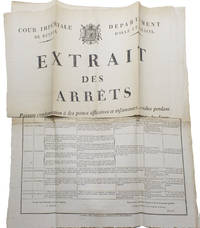
1813réf. 30782Rennes: Chez Cousin-Danelle Imprimeur de la Cour Impériale 1813. l sheet consisting of three leaves. 1 vols. FOLIO 20 x 46 inches. Broadside. Some marginal discoloration and creasing else very good. l sheet consisting of three leaves. 1 vols. FOLIO 20 x 46 inches. Lists the date of arrest the court identifies the criminal with age profession address a physical description crime and punishment citing the applicable laws next to them. Chez Cousin-Danelle, Imprimeur de la Cour Impériale unknown
1813réf. 30782Rennes: Chez Cousin-Danelle Imprimeur de la Cour Impériale 1813. l sheet consisting of three leaves. 1 vols. FOLIO 20 x 46 inches. Broadside. Some marginal discoloration and creasing else very good. l sheet consisting of three leaves. 1 vols. FOLIO 20 x 46 inches. Lists the date of arrest the court identifies the criminal with age profession address a physical description crime and punishment citing the applicable laws next to them. Chez Cousin-Danelle, Imprimeur de la Cour Impériale unknown books
1910réf. 86220New York: Funk & Wagnalls 1910. First edition. Octavo. Gray pictorial cloth stamped in black and silver inks on cover and spine; 379pp. 8 inserted leaves of plates halftones by Glenn O. Coleman. Trace of rubbing at spine ends and corners; scattered pencil marginalia with old erasure to front endpaper; still a tight square and attractive copy Very Good or better. Hapgood's uncommon chronicle of immigrant and underworld life on the Lower East Side of Manhattan a sequel of sorts to his classic The Spirit of the Ghetto. Hapgood a sometime anarchist and full-time free-lover was in the first wave of Greenwich Village bohemians; his celebratory accounts of Manhattan's seedier sections have long stood as scarce classics of New York writing. This a really brilliant copy; the book is very rarely seen thus. We have noted binding variants in gray cloth as here and green. Funk & Wagnalls unknown
1910réf. 86220New York: Funk & Wagnalls 1910. First edition. Octavo. Gray pictorial cloth stamped in black and silver inks on cover and spine; 379pp. 8 inserted leaves of plates halftones by Glenn O. Coleman. Trace of rubbing at spine ends and corners; scattered pencil marginalia with old erasure to front endpaper; still a tight square and attractive copy Very Good or better. Hapgood's uncommon chronicle of immigrant and underworld life on the Lower East Side of Manhattan a sequel of sorts to his classic The Spirit of the Ghetto. Hapgood a sometime anarchist and full-time free-lover was in the first wave of Greenwich Village bohemians; his celebratory accounts of Manhattan's seedier sections have long stood as scarce classics of New York writing. This a really brilliant copy; the book is very rarely seen thus. We have noted binding variants in gray cloth as here and green. Funk & Wagnalls unknown books
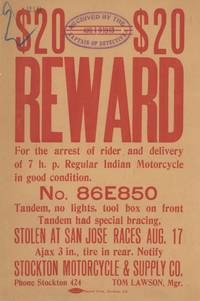
1913réf. List2840Stockton California 1913. Single 6 x 9 inch sheet. Marked with blue crayon at upper left corner otherwise near fine. A wanted poster offering $20 for the return of a stolen Indian motorcycle. Indian motorcycles were an early American motorcycle built by the Hendee Manufacturing Company in Springfield Massachusetts. This particular one was a tandem model stolen from a race ground in San Jose in August of 1913. Motorcycling was then a very new sport with the first motorcycling club the Federation of American Motorcyclists having been formed in New York City not ten years prior. unknown
1913réf. List2840Stockton California 1913. Single 6 x 9 inch sheet. Marked with blue crayon at upper left corner otherwise near fine. A wanted poster offering $20 for the return of a stolen Indian motorcycle. Indian motorcycles were an early American motorcycle built by the Hendee Manufacturing Company in Springfield Massachusetts. This particular one was a tandem model stolen from a race ground in San Jose in August of 1913. Motorcycling was then a very new sport with the first motorcycling club the Federation of American Motorcyclists having been formed in New York City not ten years prior. unknown books
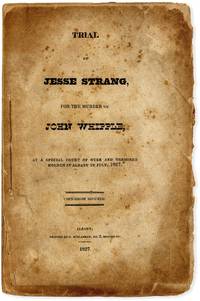
1827réf. 87802Albany: D. M'Glashan 1827. First and Only Edition. Octavo in 4's. 24cm. Stab bound pages with the title page serving as the front cover and no trace that the pamphlet was ever bound. 35pp. Some mild chipping to edges and extremities most notably the upper right corner toning and soiling to wraps; internally clean but uniformly toned with offsetting from the type throughout edges untrimmed luxuriously wide margins some traces of careless opening in places. Very good by dint of survival and solidity rather than beauty the paper is cheap and the pamphlet was printed to leverage opportunity rather than posterity. A notable and at the time highly controversial trial dealing with what was later referred to as "The Murder at Cherry Hill." The prominent New York Van Rensselaer family owned and lived at Cherry Hill Farm in Albany the daughter Elsie was married somewhat unhappily to John Whipple and fell for a younger man she met in a bar by the name of Jesse Strang. The couple fell in love Elsie expressed her deep unhappiness with Whipple; Strang masquerading under the name of Jesse Orton took on a job at the farm and began an affair with Elsie which was maintained by the house staff many of whom were enslaved people of color whose testimonies were heard at the trial passing notes between the two. Elsie chafing somewhat at having to endure her legal husband resolved that he must die to make way for Strang and they would run away together to Canada. The first plan was arsenic poisoning which failed. What Elsie lacked in poisoning ability she made up for with murderous intent and she purchased a rifle removed the ammunition from her now somewhat suspicious husband's gun and induced Strang who does not come across as the sharpest tool in the shed to shoot Whipple dead. Strang then attempted to fabricate an alibi which did not hold up and he was arrested. What followed was a widely publicised trial in which both defendants turned on each other Elsie's status as the daughter of prominent landowners was leveraged as protection from any serious punishment and Strang bore the brunt of the law. He had of course further doomed himself by attempting to plant evidence lying under several oaths and generally being one of the less gifted murderers of the early 19th century; he was hanged Elsie went home to Cherry Hill the Van Rensselaer's invested heavily in local collective amnesia and the rest of the US stared somewhat incredulously and gossiped over their breakfast grits. It was a carnival of awfulness that posed many questions about the societal rights and freedoms of women the privileges of wealth and the integrity of the judicial system. Fairly represented in institutions with 20 examples in US libraries but scarce in commerce and usually in later binding. D. M'Glashan unknown
1827réf. 87802Albany: D. M'Glashan 1827. First and Only Edition. Octavo in 4's. 24cm. Stab bound pages with the title page serving as the front cover and no trace that the pamphlet was ever bound. 35pp. Some mild chipping to edges and extremities most notably the upper right corner toning and soiling to wraps; internally clean but uniformly toned with offsetting from the type throughout edges untrimmed luxuriously wide margins some traces of careless opening in places. Very good by dint of survival and solidity rather than beauty the paper is cheap and the pamphlet was printed to leverage opportunity rather than posterity. A notable and at the time highly controversial trial dealing with what was later referred to as "The Murder at Cherry Hill." The prominent New York Van Rensselaer family owned and lived at Cherry Hill Farm in Albany the daughter Elsie was married somewhat unhappily to John Whipple and fell for a younger man she met in a bar by the name of Jesse Strang. The couple fell in love Elsie expressed her deep unhappiness with Whipple; Strang masquerading under the name of Jesse Orton took on a job at the farm and began an affair with Elsie which was maintained by the house staff many of whom were enslaved people of color whose testimonies were heard at the trial passing notes between the two. Elsie chafing somewhat at having to endure her legal husband resolved that he must die to make way for Strang and they would run away together to Canada. The first plan was arsenic poisoning which failed. What Elsie lacked in poisoning ability she made up for with murderous intent and she purchased a rifle removed the ammunition from her now somewhat suspicious husband's gun and induced Strang who does not come across as the sharpest tool in the shed to shoot Whipple dead. Strang then attempted to fabricate an alibi which did not hold up and he was arrested. What followed was a widely publicised trial in which both defendants turned on each other Elsie's status as the daughter of prominent landowners was leveraged as protection from any serious punishment and Strang bore the brunt of the law. He had of course further doomed himself by attempting to plant evidence lying under several oaths and generally being one of the less gifted murderers of the early 19th century; he was hanged Elsie went home to Cherry Hill the Van Rensselaer's invested heavily in local collective amnesia and the rest of the US stared somewhat incredulously and gossiped over their breakfast grits. It was a carnival of awfulness that posed many questions about the societal rights and freedoms of women the privileges of wealth and the integrity of the judicial system. Fairly represented in institutions with 20 examples in US libraries but scarce in commerce and usually in later binding. D. M'Glashan unknown books
réf. DADAX080397244XNew unknown
réf. 32697La Roulotte Paris 1950 In-8 ( 235 X 160 mm ), cartonnage ivoire, dos lisse janséniste. 56 pages de textes illustrés en marges des 80 dessins de tatouages par Jacques DELARUE et 64 planches illustrées de 80 photographies reproduites sur papier couché, dont 11 sont de Robert DOISNEAU, d'autres proviennent du Musée de l'Homme ou des collections Alexandre LACASSAGNE ( un des fondateurs de l'anthropologie criminelle ) et GRANGEVERSANNE. EDITION ORIGINALE sur papier d'édition. Jaquette absente, le dos a été habilement restauré, l'ouvrage est pur et les photographies très fraîches.
First edition, 8to (228 x 150mm), [2], iv, [2], 228pp., perforated stamp of the 'Hartford Medical Society Library' on title, errata slip pasted on the verso of the 'Contents' leaf, folding plate of an improved hand-crank mill for prison labour, modern boards, uncut, printed paper label on spine, a good copy. In his final years Hippisley turned to the question of prison discipline, and the study of the prevention and punishment of crime, publicly advocating the hand-crank instead of the treadmill. Goldsmith, 23921.