Bevan, EdwynAntiquariat.de
1 259 résultats
1985réf. 950704Chicago: Ares Publishers, 1985. XXI; 409 S., zahlr. Abb. Broschiert.
2016New Persian Paperback. Roy. 8vo. (24 x 17 cm). Text in Persian with bilingual title in English and Persian on cover. 512 p., maps. The history of Iran in Qajar dynasty: The era of Aqa Mohammad Khan.= Târîkh-i Irân dar dawrah-'i Qâjârâyah: 'Asr-i Âqâ Muhammad Khân.
2016New Persian Paperback. Roy. 8vo. (24 x 17 cm). Text in Persian with bilingual title in English and Persian on cover. [8], 312 p. The history of Dialamites in Iran (Local governments, Ziarids, Buyids).= Daylamiyân dar gustarah-'i târîkh-i Irân: Hukûmat'hâ-yi mah?allî, Âl-i Ziyâr, A?l-i Bûyah.
2003réf. 2083002115706015Chinese book office 2003. Soft Cover. Fine. Size: 21cm Number of books: 6 Chinese book office paperback
1995réf. 1186611London ; New York : Viking., 1995. XXIX, 384 S. : 50 Abb., Kt. ; 24 cm Originalhardcover mit Schutzumschlag / with dust jacket.
réf. 50283E.J. Brill, Leiden, Holland, 1967
2007réf. ART5753MPaperback, 240 pages, published by British Museum Press in 2007, very good conditions.
réf. 8987Lexington, KY, Forgotten Books, 2011 (Reprinted Edition). 1 volume, in-4, 367 pp., softcover, with frontispiece of President Li Yuan-Hung, enriched with 28 black and white illustrations, stamp on front page, in excellent condition.
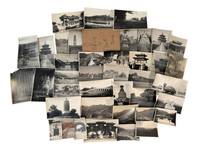
1910réf. 235921910. Peking and North China travel photo archive circa 1912 to 1918 documenting the former imperial capital during the turbulent opening years of the Republic of China when centuries of Qing imperial rule had only recently ended and Beijing remained the political and cultural heart of northern China. The photographs record a landscape where imperial monuments Buddhist temples ancient roads and rural villages continued to define daily life despite the collapse of the dynasty in 1912. Produced during the era that followed the Xinhai Revolution and preceded the consolidation of the warlord period the archive preserves a city and surrounding countryside poised between imperial tradition and an uncertain republican future. Photo archive of 40 original silver gelatin photographs ranging from approximately 2 × 3 inches to 4 × 6 inches Peking Beijing and North China circa 1912 to 1918. The photographs depict the Temple of Heaven the Summer Palace Pei Hai Beihai Park the Forbidden City and its surrounding walls the White Dagoba at Miaoying Temple monumental ceremonial gateways pagodas temple courtyards the Great Wall north of Peking the Western Hills stone bridges lakes canals and mountain landscapes. Other photographs show Buddhist monks walking through temple precincts camel caravans crossing rocky valleys mule carts on country roads grazing livestock village architecture and rural agricultural scenes beyond the capital. Contemporary manuscript captions identify numerous locations including "The Great Wall of China" "Temple of Heaven Peking" "Pei Hai Grounds Peking" "Bridge over stream between Jade Fountain & Summer Palace" "The 3rd Green Golf at Paomachang Peking" "Western Hills near Peking" "Camel Drive at the Great Wall Nankow Pass north of Peking" and "Temple in the Western Hills near Peking Golden Roof." One inscription notes that several views "were taken by the younger Miss Dunne last summer" preserving a small but meaningful record of the archive's contemporary provenance. This photo archive belong to one of the most consequential transitions in modern Chinese history. The Qing dynasty collapsed in 1912 after more than two and a half centuries of rule ending the imperial system that had governed China since 221 BCE. Although the Republic of China replaced the monarchy Beijing remained filled with imperial architecture ceremonial spaces and religious institutions whose daily rhythms changed only gradually. The Forbidden City was still occupied by the abdicated emperor Puyi until 1924 Buddhist monasteries continued to function throughout the Western Hills and camel caravans remained an essential means of transporting goods across northern China's mountain passes. Foreign travelers could still move through monuments that only a generation earlier had been closely associated with imperial authority while political power increasingly shifted among competing republican governments and regional military leaders during the emerging Warlord Era. Rather than emphasizing political upheaval directly the archive records the remarkable continuity of Beijing's monumental landscape and traditional patterns of travel religion and commerce immediately after the fall of the last Chinese dynasty. Light surface wear occasional corner creasing and scattered silvering consistent with age; manuscript identifications on many versos. Overall in very good condition. A concentrated visual record of Peking and North China at the moment imperial China gave way to the Republic preserving both the enduring ceremonial landscape of the Qing capital and the traditional life that continued beneath profound political change. unknown books
1910réf. 235921910. Peking and North China travel photo archive circa 1912 to 1918 documenting the former imperial capital during the turbulent opening years of the Republic of China when centuries of Qing imperial rule had only recently ended and Beijing remained the political and cultural heart of northern China. The photographs record a landscape where imperial monuments Buddhist temples ancient roads and rural villages continued to define daily life despite the collapse of the dynasty in 1912. Produced during the era that followed the Xinhai Revolution and preceded the consolidation of the warlord period the archive preserves a city and surrounding countryside poised between imperial tradition and an uncertain republican future. Photo archive of 40 original silver gelatin photographs ranging from approximately 2 × 3 inches to 4 × 6 inches Peking Beijing and North China circa 1912 to 1918. The photographs depict the Temple of Heaven the Summer Palace Pei Hai Beihai Park the Forbidden City and its surrounding walls the White Dagoba at Miaoying Temple monumental ceremonial gateways pagodas temple courtyards the Great Wall north of Peking the Western Hills stone bridges lakes canals and mountain landscapes. Other photographs show Buddhist monks walking through temple precincts camel caravans crossing rocky valleys mule carts on country roads grazing livestock village architecture and rural agricultural scenes beyond the capital. Contemporary manuscript captions identify numerous locations including "The Great Wall of China" "Temple of Heaven Peking" "Pei Hai Grounds Peking" "Bridge over stream between Jade Fountain & Summer Palace" "The 3rd Green Golf at Paomachang Peking" "Western Hills near Peking" "Camel Drive at the Great Wall Nankow Pass north of Peking" and "Temple in the Western Hills near Peking Golden Roof." One inscription notes that several views "were taken by the younger Miss Dunne last summer" preserving a small but meaningful record of the archive's contemporary provenance. This photo archive belong to one of the most consequential transitions in modern Chinese history. The Qing dynasty collapsed in 1912 after more than two and a half centuries of rule ending the imperial system that had governed China since 221 BCE. Although the Republic of China replaced the monarchy Beijing remained filled with imperial architecture ceremonial spaces and religious institutions whose daily rhythms changed only gradually. The Forbidden City was still occupied by the abdicated emperor Puyi until 1924 Buddhist monasteries continued to function throughout the Western Hills and camel caravans remained an essential means of transporting goods across northern China's mountain passes. Foreign travelers could still move through monuments that only a generation earlier had been closely associated with imperial authority while political power increasingly shifted among competing republican governments and regional military leaders during the emerging Warlord Era. Rather than emphasizing political upheaval directly the archive records the remarkable continuity of Beijing's monumental landscape and traditional patterns of travel religion and commerce immediately after the fall of the last Chinese dynasty. Light surface wear occasional corner creasing and scattered silvering consistent with age; manuscript identifications on many versos. Overall in very good condition. A concentrated visual record of Peking and North China at the moment imperial China gave way to the Republic preserving both the enduring ceremonial landscape of the Qing capital and the traditional life that continued beneath profound political change. unknown
1887réf. 62521ABLondon. Smith, Elder and Co. 1887. 469 S., englischsprachig. Or.-Leinen. guter, altersgemäßer Zustand., Besitzereintr. a. Titel., Ecken etw. bestoßen., Riss im ob. drittel d. Buchrückens., Buchdeckel u. Kanten leicht berieben.
1979190 p., illus. Examination of the Mongol invasion which began in 1241. Hardcover Very good condition good
1991réf. 2082702114905878Mingde Publishing Company 1991. Soft Cover. Fine. Number of pages: 338p Size: 22cm Mingde Publishing Company paperback
1990Dustjacket is protected in mylar. ; 1.02 x 8.5 x 5.67 Inches; 264 pages; This book is the first detailed study of the foundation, history, government, growth and decline of the cities founded in Syria by Seleukos I in 301BC shortly after the time of Alexander the Great. It throws new light on an important period in ancient history. In particular, Dr Grainger concentrates on the relationship between the kings and the cities in their kingdoms and reveals that former theories concerning such a relationship require drastic revision. Most importantly the relationship is shown to have been much more to the kings' advantage than previous discussions on Hellenistic states have supposed. He argues in fact that neither the kings nor the cities intended the cities to be autonomous or independent since they were far too reliant on royal support against the enmity of the surrounding population. Evidence for this can be seen in the actions of the cities on the collapse of the Seleukid dynasty in the first century BC; then they were forced to cast about for a new protector and eventually accepted Rome albeit reluctantly. Dr Grainger discusses the differing fate of the cities during this process when some failed altogether, most declined, and only one, Antioch, prospered.
1980"The third of a trilogy of novels about the rise of the House of Stewart" Book
1986Pages Very slightly tanned. Else fine. ; The third volume, published in two parts, is an account of every aspect of Iranian civilisation from the death of Alexander in 323 BC to the advent of Islam in the seventh century AD. This complex period, of major importance in Iranian history and extending for almost a thousand years, encompasses the reigns of the Seleucid, the Parthian, the Kushan and Sasanian dynasties. As additions to the general objectives of these volumes, Professor Yarshater has included in this volume chapters on the institutional, administrative, legal, numismatic, linguistic and literary aspects of the period; and he further develops the scope of the volume by including studies of Iran's interaction with neighbouring societies, of Iran's mythical and legendary history, and of Iranian settlements outside the geographical boundaries of Iran and Afghanistan. This volume is the most comprehensive study published of this very important period of Iran's history. ; The Cambridge History of Iran; Vol. 3.2; 883 pages
2009New Persian Original bdg. HC. Roy. 8vo. (24 x 17 cm). In Persian with bilingual title English and Persian on cover. 141 p. The book of Syrous: King of Achaemenid.= Kûrush'nâmah.
1999Fine English Paperback. Pbo. 4to. (30 x 24 cm). In English and Turkish. 67, [2] p., color and b/w ills. The Artist, The Sultan and his portrait: Mehmed the Conqueror according to Gentile Bellini.= Ressam, Sultan ve portresi: Gentile Bellini'ye göre Fatih Sultan Mehmet. [Exhition catalogue]. Edited by Münevver Eminoglu. Consultant: Günsel Renda. This exhibition consists of a single painting: the famous portrait that the Ottoman Sultan Mehmed the Conqueror had painted by the Italian artist Gentile Bellini about five hundred years ago and is now in the collection of the National Gallery of London. The painting is a magnificent souvenir of a brief 'golden age' in a reminder that, as early as the Renaissance and under the leadership of a strong and foresighted ruler, Ottoman society, which always looked wetward, hd the chance to grasp universal civilization.
1999New English Paperback. Pbo. 4to. (30 x 24 cm). In English and Turkish. 67, [2] p., color and b/w ills. The Artist, The Sultan and his portrait: Mehmed the Conqueror according to Gentile Bellini.= Ressam, Sultan ve portresi: Gentile Bellini'ye göre Fatih Sultan Mehmet. [Exhition catalogue]. Edited by Münevver Eminoglu. Consultant: Günsel Renda. This exhibition consists of a single painting: the famous portrait that the Ottoman Sultan Mehmed the Conqueror had painted by the Italian artist Gentile Bellini about five hundred years ago and is now in the collection of the National Gallery of London. The painting is a magnificent souvenir of a brief 'golden age' in a reminder that, as early as the Renaissance and under the leadership of a strong and foresighted ruler, Ottoman society, which always looked wetward, hd the chance to grasp universal civilization.
1960réf. CHIN0324Penguin Books (1960). 4°, XXVIII, 336 S., mit 31 Textfig., 190 s/w. Bildtaf., OLn. m. (läd.) OU. / (Beigabe:) SPARKE, Penny. Modern Japanese Design. New York, Dutton (1987). 144 S., mit zahlr. Abb., ill. OKart., Gebrauchsspuren.
1989175 pages. Index. Colour illustrations. The Hundred Years' War. The Rise of the Ottomans. The Fury of the Steppes. China's Brilliant Dynasty. The African Empires. Clean, bright and unmarked with virtually zero wear. Beautiful copy. Book
1976Very Light foxing to top of textblock. Tiny red pen mark to rear endpaper (arrow). Minor shelfwear. ; Looks at the history and administration of the provinces of the Ptolemaic Empire outside Egypt including: Cyrenaica, Cyprus, Phoenicia, Palestine, Coele-Syria, and various parts of Asia Minor and the Greek Islands also looks at Coinage. ; Columbia Studies in the Classical Tradition IV; 301 pages
1990réf. 2090502113706365Not Available 1990. Soft Cover. Fine. The book is in fine condition. Not Available paperback
1997In-4 (cm. 29), tela editoriale, titolo al dorso, sovracoperta, pp. 228, con illustrazioni in bianco e nero e a colori, ISBN 88-8030-081-4. In buono stato di conservazione (good copy).
2000réf. 0700975New World Press 2000-01-01. paperback. Used - Good. Ship out in 2 business day And Fast shipping Free Tracking number will be provided after the shipment.Number of Pages: 360 Pages. Language: Chinese-English bilingual in two volumes. The present book is a one of aphorisms written in essay form. mainly dealing with the topic of how to conduct ones life properly. Employing a wealth of quotations and elegant phrasing. its observations explain profound truths in simple terms and provide much food for thought. Aimed at helping the reader to mold his values and temper his will. it is a book for ordinary people who are prepared to make efforts t. Satisfaction guaranteedor money back. New World Press paperback