Salomon, GottholdMareMagnum

2692 risultati
18421st edition. Original paper wrappers. 8vo. 17 pages, 21 cm. Title translates roughly to "God's Voice From The Fire: A Speech Given in The New Israelite Temple Honoring the Best of the School Teachers and Teachers Lost in the Fire. " Gotthold (1784-1862) was a German Jewish rabbi, politician, and bible translator. He was the first Jew to translate the complete Old Testament into High German, following in the footsteps of Moses Mendelssohn. He also preached at the Hamburg Temple. This speech addresses The Great fire of Hamburg, which began early on May 5, 1842, in Deichstrasse and burned until the morning of May 8, destroying about one third of the buildings in the Altstadt. It killed 51 people and destroyed 1, 700 residences and several important public buildings, necessitating major civic rebuilding and prompting infrastructure improvements. The heavy demand on insurance companies led to the establishment of reinsurance. The Neuen Israelitischen Tempel (aka, the Hamburg Temple) was the first permanent Reform synagogue and the first ever to have a Reform prayer rite. It operated in Hamburg (Germany) from 1818 to 1938 (Wikipedia). SUBJECTS: Jewish sermons -- Germany. OCLC lists 5 copies worldwide (Harvard, HUC, NLI, State Archives of Freien and Hansestadt, UBremen, and Leo Baeck) . Very good condition. (GER-55-2)
1745rif. 17051745 plaquette in-douze (booklet duodecimo), dos et couverture muets recouverts d'un papier chiné sur fond marron (spine and the cover without text), toutes tranches lisses (all smooth edges), texte à manchette (marginal note), illustrations : sur la page de titre et orné de bandeaux - d'une lettrine et d'un cul-de-lampe (engraved title page and illuminated of headpieces and of a dropped initial and of a tailpiece), naissances de rousseurs (beginning of the redness marks), 120 pages, 1745 à Berne Imprimerie de Leurs Excellences,
1926rif. 0050011926 Paris, Kieffer, 1926. In-quarto (190 X 243 mm) broché, couverture rempliée illustrée couleurs ; (2) ff. de faux-titre et titre, (1) f. de dessin original, IV pages, (1) f., 201 pages, (1) f. d'achevé d'imprimer, (1) f. blanc, (78) planches de suite, (1) f. blanc.
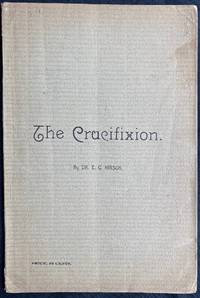
1892rif. 43449Chicago: Bloch 1892. paperback. 1st edition original printed green paper wrappers 8vo. 49 pages. Singerman 4345. Rabbi Emil G. Hirsch 1851-1923 "who headed Chicago's Sinai Congregation for forty-two years and led Reform Judaism into the Progressive movement and down social justice pathways was born in Luxemburg. One of several Jews involved in founding the NAACP Hirsch was married to the daughter of abolitionist rabbi David Einhorn and served in his father-in-law's former pulpit in Baltimore before moving to Louisville Kentucky and then Chicago. He was professor of rabbinical literature and philosophy at the University of Chicago in 1892 active in the Republican Party and editor of several influential Jewish publications" Lawrence Bush in Jewish Currents "Hirsch and his congregants struggled to come to terms with the large number of Jewish immigrants who moved to Chicago after 1880 boosting the Jewish community from about 10000 in 1880 to over 300000 in 1920.For the established Jews represented by Sinai the Jewish 'Ghetto' - the immigrant neighborhood on the city's West Side - appeared to represent a world apart and a sharp contrast to Sinai's radical and inclusive reform agenda: a highly visible expression of Jewish ethnicity and traditional Judaism which Reform Jews associated with isolation discrimination and exclusion." Nevertheless during the 1890s "Hirsch spoke up against the deplorable condition of Jews in the Russian Empire and reached out to West Side residents. His support for workers' rights also won him much support among Jewish immigrants who overwhelmingly belonged to the working class. "Hirsch worked closely with Jane Addams and other members of the Hull House circle. In 1908 Hirsch and Addams were among the co-founders of the NAACP. Hirsch inspired several members of Sinai congregation: Sears and Roebuck president and philanthropist Julius Rosenwald was one of Hirsch's closest associates so was legal scholar Julian Mack who presided over a widely noted juvenile court in Chicago in the first decade of the 20th century. Hannah Solomon was one of the founders of the organized Jewish women's movement in the United States. Joseph Schaffner and Harry Hart were the leading partner of the clothing manufacturer Hart Schaffner & Marx one of Chicago's largest employers. Influenced by Hirsch's social theology Schaffner and Hart settled with their workers during the 1910-1911 clothing strike recognizing their right to form a union" Tobias Brinkmann. SUBJECT S : Jesus Christ -- Jewish interpretation. Jewish Christ -- Crucifixion.OCLC: 13532781. Light wear excellent condition a beautiful copy Very Good Condition B AMR-2-2-XLF#. Chicago: Bloch unknown
1845rif. 547003New York: American Female Moral Reform Society 1845. Unbound. Very Good. Single leaf folded to make eight pages. One quarter of first page toned old folds very good or better. A cursory examination of the contents indicates that the American Female Moral Reform Society weren't very enthusiastic about prostitution. American Female Moral Reform Society unknown books
2001rif. 61959Washington DC: U. S. Government Printing Office 2001. Presumed first edition/first printing. Wraps. Very good. No dust jacket as issued. Cover has minor wear and soiling. iv 1104 p. Some portions redacted. Serial No. 106-179. The hearings explored the failure of the White House to provide documents requested by the committee. U. S. Government Printing Office paperback
2007rif. 64002Washington DC: U.S. Government Printing Office 2007. Presumed first edition/first printing. Wraps. Good. No dust jacket as issued. Cover has some wear and soiling. iii 632 p. Includes illustrations. Serial No. 109-202. This hearing addressed what were considered serious problems with RU-486 associated with the deaths of at least 8 women 9 life-threatening incidents 232 hospitalizations 116 blod transfusions and 88 cases of infections. U.S. Government Printing Office paperback
2001rif. 43087Washington DC: GPO 2001. First Edition. First Printing. very good. 1109 wraps illus. GPO paperback
1939Near Fine English In modern full leather bdg. Large roy. 8vo. (25 x 17 cm). In Turkish. 5 volumes set: ([6], 1832 p.). Maarif tarihi: Istanbul mektepleri ve ilim, terbiye ve san'at müesseseleri dolayisiyle. 5 volumes set. Vol. 1: Saray mektepleri. Vol. 2: Garplilasma ve yenilik devri, 1187 /1773-1923. Vol. 3: Mutlakiyet devri mektepleri. Vol. 4: Mesrutiyet devri mektepleri. Vol. 5: Cumhuriyet devri mektepleri. First and Only Edition. Extremely rare as set. Osman Nuri Ergin was the initiator of the studies regarding modern municipalities' studies and gave so many qualified books related to Ottoman-Turkish urbanism and municipalities' studies scientifically. He was also the first scholar who was one of the architectures of municipalities' studies and history of urbanism and education. His best known book in this field called "Mecelle-i Umûr-i Belediyye". The book is one of the main sources for the history of urbanism, especially for the history of Istanbul. Istanbul Metropolitan Municipality and other metropolitan cities of Turkey function on the bases of what he declared. Since he worked as an officer for the government during the World War I, the time of Abdulhamid II and at the time of the young Republic, he was one of the figures who know the cultural and social changes in Turkish society. During this cultural transformation, he played a role of bridge in between Ottoman culture and modern day Turkey with the help of some enlightened scholars. He had so many attempts to transform Ottoman Sufi culture to the next generations. To reach this goal, he wrote so many valuable books. Although he wrote books in the fields such as Sufi order, grammar, history of arts, literature, he was not able to publish all of his works in his life. This 'Maarif tarihi' [= History of education] is still the most comprehensive corpus on Ottoman / Turkish education and cultural history.
rif. 19427Newcastle upon Tyne: Printed and published by E. Mackenzie Jun. 129 Pilgrim Street. 1831. 59 1pp. 8vo. Stitched and disbound. In fair condition lightly aged and worn. The author is not named on the title-page but the text ends p.59 with the signature in type of 'CHARLES LARKIN.' The final page carries a list of 'Errata'. Drop-head title p.3: 'To The Auditory who heard the Speech of Captain Gordon delivered in Brunswick Place Chapel on Wednesday evening March 2 1831 This Letter is respectfully inscribed.' The Reformation Society 'of which Captain Gordon styles himself the honorary secretary' is attacked as a 'society for the support of a tottering system of fraud falsehood fanaticism hypocrisy intolerance and oppression'. The only copy on COPAC at Durham there is a second impression held at Durham and two other locations. Newcastle upon Tyne: Printed and published by E. Mackenzie, Jun. 129, Pilgrim Street. 1831. unknown
rif. 2642443 Berkeley Square "Friday Night". A note presumably in the recipient's hand states "London 14 July 1832. answered". Four pages 8vo bifolium some staining see image but all legible. "Tomorrow morning you will receive in George Street from the Librarian of the House of Lords copies of my two Protests and of Lord Wynford's Protest on the 3rd Reading of the English Reform Bill. I wiosh my Protests to be sent to the Editor of the Standard & Lord Wynford has commissioned me to send his also. Five of the Protests have already appeared in that Paper - which had expressed as I was informed a wish to have them & a readiness to publish them & any others that might be sent to the Editor. It is on this footing that these Protests must be sent. It must on no account appear - nor must a word be said to entitle the Editor to conclude - whatever he may suppose - that either Lord Wynford or I have anything to do with sending them. They must be conveyed to the Editor to publish - if he shall think fit phrase underlined - and must be sent in consequence of his expressing a wish to have & a readiness to publish the Protests. If he does not think fit to publish them he may let it alone & retyurn them. They are not to be paid for as advertisements or otherwise. If you are kind enough to undertake to forward them to the Paper - the Person who takes them may speak or it may bewritten but I should think not with a name in the following sense - that the Protests of Lords H & W are sent to the Standard by one who has reason to know that they are correct in consequence of the readiness expressed by the Editor to make known to the Public the Protests aginst the BILL- - and in consequence of several having already appeared. It might be as well to send them in time for tomorrows sic Evening Paper - or Mondays at furthest. I called in George Street today hoping to catch you before you left your office - but I was too late. I beg if you have any objection to undertaking this office - that you will make no scruple of delivering it. You will find that I could hardly send my Protests in my own name Believe me to be .". POSTSCRIPT They told me at the House of Lords that they were not sent from thence to the Papers. Their not having been sent long ago was very stupid. I hope you will make Dr Coventry understand how absolutely inappropriate it was for me or any one else to make any amendments in so difficult a matter at such a stage - without warning or preparation & in si=uch a House! phrase underlined It was quite out of the question. The thing must now work its own way - if possible to correct them - as they shew themselves in the working of this elaborate & complicated & machine; Should thge Librarian not have sent them to your office in due time - perhaps you will send to him for them. I wrote my name in my two Protests - it would be better to scratch that out." Note: "Lord Haddington went on to vote against the Reform Bill in 1831 but later changed his mind and voted for it in 1832 possibly due to the political crises surrounding its passage." Wikipedia 43 Berkeley Square, "Friday Night". A note presumably in the recipient's hand states "London 14 July 1832. ans[wered]". unknown
rif. 93948Amsterdam, Chez Thomas Lombrail 1707, 165x95mm, relié plein veau de l’époque, dos à 5 nerfs, pièce de titre en cuir rouge, fleurons dorés, tranches jaspées, coiffe supérieure endomagée, usures aux coins, autrement bon état.
rif. REL905MChez Pierre Brunel, Amsterdam, 1699. In-8, reliure de l'époque plein veau fauve, dos à 5 nerfs, caissons ornés, titrage doré, environ 30 et 567 pages. Coiffes arasées. Dos et plats convenables. Tranches bonnes. Intérieur bon. Quelques pages sur 2 colonnes. Coins émoussés. Belle pièce de témoignage
1683rif. 112590Mabre cramoisy 1683 Suivant la copie imprimée à Paris, chez Sebastien Mabre-Cramoisy, 1683, mention de quatrième édition, 3 volumes in-16 de 80x135 mm environ, tome I : (6) ff. titre, avertissement, table, sommaire), 396 pages, (1) f., - tome II : (1) f., (4) ff. (titre, table et sommaire), 447 pages, (1) f., - tome III : (1) f., (4) ff. (titre, table et sommaire), 381 pages, (37) ff. de table, (2) ff., pleine basane fauve granitée, dos à 4 nerfs portant titres dorés, ornés de caissons à motifs dorés, coupes dorées, tranches finement mouchetées de rouge. Ex-libris de la Bibliotheca Blomania (Bibliothèque W. Von Blome (1683-1761), conseiller privé du Roi du Danemark, vendue à Hambourg en 1929). Manque le frontispice et la première garde blanche + trous de vers dans la marge du tome I, petite restauration ancienne p. 45 du tome II, petit défaut d'impression p. 102 du tome III, frottements d'usage sur le cuir, gardes blanches cernées, sinon bon état.
1684rif. 174621684 LONDINI, Ed. Willielmo Wats, imp. A. Mearne, T. Dring, B. Tooke, T. Sawbridge, & G. Wells - 1684 - 1 fort volume in-folio - Reliure plein veau de l'époque avec restauration postérieure maladroite - Beau portrait en Frontispice de l'auteur - Page de titre, (32), 1175 pages & Glossaire & index 36 pages - Bon exemplaire 2 grands Ex-libris armoriés: Sigill Henrici Baker tristram e coll line o ronn (Henry Baker), devise "Fortiger Gerig Cracem" & Thomas Phillips, Middle Hill, Worcestershire ** , devise "Deus Patria Rex"- Envoi rapide et soigné - Réf. 17462
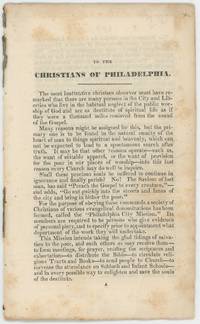
1831rif. BK0169Philadelphia: William F. Geddes 1831. 2 12 2 pp. Stitched pamphlet measuring 4 ¼ x 7 inches. Good plus with scattered foxing and soiling some wear to edges. An early appeal for organized missionary work among Philadelphia's urban poor issued upon the establishment of the Philadelphia City Mission in March 1831. The organization brought together Christians from several evangelical denominations to reach residents who rarely or never attended church. Its organizers acknowledged that poverty itself could prevent participation in religious life citing "the want of suitable apparel or the want of provision for the poor in our places of worship-into this last reason every Church may do well to inquire." The pamphlet begins by describing the large numbers of people living in Philadelphia and its surrounding districts who remained outside the ordinary reach of the churches: "The most inattentive christian observer must have remarked that there are many persons in the City and Liberties who live in the habitual neglect of the public worship of God and are as destitute of spiritual life as if they were a thousand miles removed from the sound of the Gospel." The Mission proposed to carry religious instruction directly into poorer neighborhoods through home visits prayer meetings the distribution of Bibles and tracts and efforts to increase attendance at Sabbath and infant schools. Its members were to be drawn from different evangelical denominations and required to demonstrate personal piety before undertaking missionary work. An interesting document of Philadelphia's early urban missionary movement particularly for its recognition of the economic and social barriers separating the city's poorer inhabitants from established religious institutions. . William F. Geddes unknown
1831rif. BK0169Philadelphia: William F. Geddes 1831. 2 12 2 pp. Stitched pamphlet measuring 4 ¼ x 7 inches. Good plus with scattered foxing and soiling some wear to edges. An early appeal for organized missionary work among Philadelphia's urban poor issued upon the establishment of the Philadelphia City Mission in March 1831. The organization brought together Christians from several evangelical denominations to reach residents who rarely or never attended church. Its organizers acknowledged that poverty itself could prevent participation in religious life citing "the want of suitable apparel or the want of provision for the poor in our places of worship-into this last reason every Church may do well to inquire." The pamphlet begins by describing the large numbers of people living in Philadelphia and its surrounding districts who remained outside the ordinary reach of the churches: "The most inattentive christian observer must have remarked that there are many persons in the City and Liberties who live in the habitual neglect of the public worship of God and are as destitute of spiritual life as if they were a thousand miles removed from the sound of the Gospel." The Mission proposed to carry religious instruction directly into poorer neighborhoods through home visits prayer meetings the distribution of Bibles and tracts and efforts to increase attendance at Sabbath and infant schools. Its members were to be drawn from different evangelical denominations and required to demonstrate personal piety before undertaking missionary work. An interesting document of Philadelphia's early urban missionary movement particularly for its recognition of the economic and social barriers separating the city's poorer inhabitants from established religious institutions. . William F. Geddes unknown books
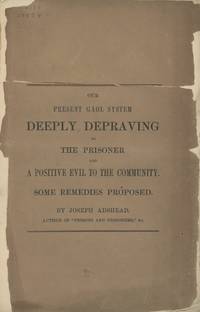
1847rif. BK0175Manchester: G. & A. Falkner Printers 1847. 107 pp. 8vo. Original printed brown wrappers with front wrapper detached and substantially torn and chipped but preserved. Some additional wear and soiling. Presentation inscription at the head of the title page reading "G. T. Bigelow Esq. / From the Author. Fair overall. An examination of British prison conditions by Joseph Adshead 1800-1861 a Manchester merchant social reformer and advocate of the separate system of imprisonment. Adshead had previously published Prisons and Prisoners 1845 in which he defended the Pennsylvania system against critics including Charles Dickens who had condemned solitary confinement following his visit to the United States. Adshead argues that the prevailing practice of confining prisoners together often without adequate separation by age offense or criminal history served to encourage further crime. He describes conditions at several prisons. The presentation inscription is of particular interest. The recipient appears to be George Tyler Bigelow 1810-1878 the Massachusetts attorney and later Chief Justice of the Massachusetts Supreme Judicial Court. In 1844 Bigelow and George Bemis defended Abner Rogers Jr. a prisoner charged with murdering Charles Lincoln Jr. the warden of the Massachusetts State Prison. Rogers was acquitted on the grounds of insanity in a widely discussed case that raised questions about criminal responsibility and the mental condition of prisoners. The presentation of Adshead's work to Bigelow suggests a connection between two men involved in contemporary debates over prisons and their administration. . G. & A. Falkner, Printers unknown
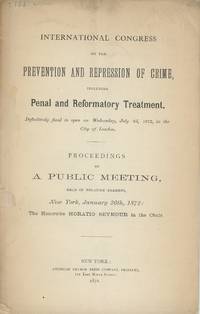
1872rif. BK0173New York: American Church Press Company 1872. Two pamphlets in original printed wrappers 6 x9 inches. Good to very good with toning light soiling and minor wear and chipping to wrappers. Two contemporary publications documenting American preparations for the International Prison Congress held in London in July 1872. Organized principally through the efforts of American prison reformer Enoch C. Wines the congress brought together representatives from Europe and the United States to discuss prison administration criminal punishment and methods of rehabilitation. The meeting followed the American National Prison Congress of 1870 whose declaration of principles had called for greater emphasis on the reformation of offenders. The first pamphlet International Congress on the Prevention and Repression of Crime Including Penal and Reformatory Treatment: Circular Letter Addressed to the National Committees in the Several Countries Proposing to Take Part in the Congress outlines arrangements for the approaching meeting. It calls upon participating countries to establish national committees prepare reports on their existing prison systems appoint delegates and suggest subjects and specialists for discussion. The second International Congress on the Prevention and Repression of Crime Including Penal and Reformatory Treatment: Proceedings of a Public Meeting Held in Relation Thereto New York January 26th 1872 records a meeting chaired by former New York governor Horatio Seymour. It includes addresses and correspondence concerning the proposed congress among them expressions of support from foreign representatives. The meeting formed part of Wines's efforts to secure international participation in the London gathering. OCLC locates six and three copies of each title respectively over multiple entries. . American Church Press Company unknown
1872rif. BK0173New York: American Church Press Company 1872. Two pamphlets in original printed wrappers 6 x9 inches. Good to very good with toning light soiling and minor wear and chipping to wrappers. Two contemporary publications documenting American preparations for the International Prison Congress held in London in July 1872. Organized principally through the efforts of American prison reformer Enoch C. Wines the congress brought together representatives from Europe and the United States to discuss prison administration criminal punishment and methods of rehabilitation. The meeting followed the American National Prison Congress of 1870 whose declaration of principles had called for greater emphasis on the reformation of offenders. The first pamphlet International Congress on the Prevention and Repression of Crime Including Penal and Reformatory Treatment: Circular Letter Addressed to the National Committees in the Several Countries Proposing to Take Part in the Congress outlines arrangements for the approaching meeting. It calls upon participating countries to establish national committees prepare reports on their existing prison systems appoint delegates and suggest subjects and specialists for discussion. The second International Congress on the Prevention and Repression of Crime Including Penal and Reformatory Treatment: Proceedings of a Public Meeting Held in Relation Thereto New York January 26th 1872 records a meeting chaired by former New York governor Horatio Seymour. It includes addresses and correspondence concerning the proposed congress among them expressions of support from foreign representatives. The meeting formed part of Wines's efforts to secure international participation in the London gathering. OCLC locates six and three copies of each title respectively over multiple entries. . American Church Press Company unknown books
1847rif. BK0175Manchester: G. & A. Falkner Printers 1847. 107 pp. 8vo. Original printed brown wrappers with front wrapper detached and substantially torn and chipped but preserved. Some additional wear and soiling. Presentation inscription at the head of the title page reading "G. T. Bigelow Esq. / From the Author. Fair overall. An examination of British prison conditions by Joseph Adshead 1800-1861 a Manchester merchant social reformer and advocate of the separate system of imprisonment. Adshead had previously published Prisons and Prisoners 1845 in which he defended the Pennsylvania system against critics including Charles Dickens who had condemned solitary confinement following his visit to the United States. Adshead argues that the prevailing practice of confining prisoners together often without adequate separation by age offense or criminal history served to encourage further crime. He describes conditions at several prisons. The presentation inscription is of particular interest. The recipient appears to be George Tyler Bigelow 1810-1878 the Massachusetts attorney and later Chief Justice of the Massachusetts Supreme Judicial Court. In 1844 Bigelow and George Bemis defended Abner Rogers Jr. a prisoner charged with murdering Charles Lincoln Jr. the warden of the Massachusetts State Prison. Rogers was acquitted on the grounds of insanity in a widely discussed case that raised questions about criminal responsibility and the mental condition of prisoners. The presentation of Adshead's work to Bigelow suggests a connection between two men involved in contemporary debates over prisons and their administration. . G. & A. Falkner, Printers unknown books
1972rif. 46484Washington: National Welfare Rights Organization n.d. but 1972. Strike placard comprised of original photographic poster 43x28cm. printed offset in purple and black on white stock stapled to pastepaper board hole-punched and threaded with thick string for hanging around neck. Extremities rather chipped and bottom edge slightly curled poster rather dust-soiled else Good or better with clear evidence of use. Placard featuring a poster protesting H.R.1 and the "D.C. Four Against the Poor" President Richard Nixon Senator from Connecticut Abraham Ribicoff Congressman from Arkansas Wilbur Mills and Senator from Louisiana Russell Long. Adorned with their photographic portraits below which is printed "These men are dangerous!!! They have conspired to starve children destroy families force women into slavery and exploit poor people -- all in the name of 'Welfare Reform.' STOP THESE MEN!" The placard was presumably worn at the NWRO-sponsored "Children's March for Survival" on March 25 in Washington D.C. The parade which consisted of over 50000 participants more than half of them children was led by Jesse Jackson and NRWO's leader George Wiley and included speakers Bella Abzug and Corettaa Scott King with her two daughters. The poster used here not separately catalogued in OCLC as of October 2019. National Welfare Rights Organization unknown
1972rif. 46484Washington: National Welfare Rights Organization n.d. but 1972. Strike placard comprised of original photographic poster 43x28cm. printed offset in purple and black on white stock stapled to pastepaper board hole-punched and threaded with thick string for hanging around neck. Extremities rather chipped and bottom edge slightly curled poster rather dust-soiled else Good or better with clear evidence of use. Placard featuring a poster protesting H.R.1 and the "D.C. Four Against the Poor" President Richard Nixon Senator from Connecticut Abraham Ribicoff Congressman from Arkansas Wilbur Mills and Senator from Louisiana Russell Long. Adorned with their photographic portraits below which is printed "These men are dangerous!!! They have conspired to starve children destroy families force women into slavery and exploit poor people -- all in the name of 'Welfare Reform.' STOP THESE MEN!" The placard was presumably worn at the NWRO-sponsored "Children's March for Survival" on March 25 in Washington D.C. The parade which consisted of over 50000 participants more than half of them children was led by Jesse Jackson and NRWO's leader George Wiley and included speakers Bella Abzug and Corettaa Scott King with her two daughters. The poster used here not separately catalogued in OCLC as of October 2019. National Welfare Rights Organization unknown books
1872rif. 30317Philadelphia: Published for the Industrial League by Henry Carey Baird 1872. First Edition. Octavo 23.5cm.; disbound from larger volume with remnants of cloth spine still present; 96pp.; frontispiece full-page illus. throughout. Very faint previous vertical fold else Very Good and fresh. The title story is a satirical utopia intended to discredit supporters of laissez-faire economics and the Free-Trade League in particular. LEWIS p. 57; SARGENT p. 29; not in NEGLEY. Published for the Industrial League by Henry Carey Baird unknown
1872rif. 30317Philadelphia: Published for the Industrial League by Henry Carey Baird 1872. First Edition. Octavo 23.5cm.; disbound from larger volume with remnants of cloth spine still present; 96pp.; frontispiece full-page illus. throughout. Very faint previous vertical fold else Very Good and fresh. The title story is a satirical utopia intended to discredit supporters of laissez-faire economics and the Free-Trade League in particular. LEWIS p. 57; SARGENT p. 29; not in NEGLEY. Published for the Industrial League by Henry Carey Baird unknown books