2788 risultati
In-8 (188 x 118 mm), pleine peau de truie estampée sur ais de bois, dos gothique à 5 nerfs ornés d'un décor de rinceaux, grandes armes d'Auguste Ier de Saxe (August von Sachsen) dans un large cartouche au centre des plats légendées "Von Gottes gnaden Augustus Herzog zu Sachsen des heiligen Römischen Reichs", encadré d'une roulette comportant également ses armories, des portraits en médaillon dans un décor de rinceaux, initiales "A W E / G G O V" en tête et date de "1574" en pied estampés au noir, quatre fermoirs en laiton ciselé conservés, coupes biseautées, tranches rouges (reliure allemande de l'époque), (22), 888 p., (1) f. bl., portrait de l'auteur gravé sur bois au titre. Édition imprimée à Leipzig par Hans Rambau, du compendium de ses oeuvres donné par Philip Melanchthon lui-même l'année de sa mort, afin de fournir la première dogmatique protestante. Conçu dans un but pédagogique, il était destiné à diffuser les principes de la Réforme en matière de dogme et de liturgie. Contient: "La Confession de foi luthérienne": la confession d'Augsbourg ("Confessio Augustana") et son "Apologia confessionis"; Les "Lieux communs théologiques" ("Loci communes"); "Examen eorum, qui audiuntur ante ritum publicæ ordinationis" sur l'ordination sacerdotale; la réfutation des doctrines de Michel Servet et des anabaptistes ("Responsiones erroris Serveti et Anabaptistarum") ainsi que la réponse à Francesco Stancaro ("Responsio de Controuersijs Stancari"). Portrait de Melanchthon gravé sur bois au titre. Le nom de l'éditeur est donné au colophon. L'ouvrage est dédicacé à l'empereur Charles V. (Bindseil, 'Bibliotheca Melanchoniana', n°63. VD16 M 2890). Exemplaire aux grandes armes d'Auguste Ier de Saxe (August von Sachsen) estampées à froid sur les deux plats, légendées "Von Gottes gnaden Augustus Herzog zu Sachsen des heiligen Römischen Reichs" ("Par la grâce de Dieu, Auguste, duc de Saxe du Saint Empire romain germanique"). On trouve également ses armories incorporées à la roulette d'encadrement des plats au sein d'un décor de portraits en médaillon et de rinceaux. Electeur de Saxe de 1553 à sa mort, Auguste Ier (Freiberg, 1526 – Dresde, 1586), comte palatin de Saxe et margrave de Misnie de 1556 à sa mort, a été l'un des principaux protecteurs du parti luthérien dans le Saint Empire entre 1570 et 1586. Il est le responsable du privilège accordé à l'éditeur de ce volume ("Cum priuilegio Pr. Aug. Elect. D. Sax."). Ex-libris autographe du théologien Johannes Georgius Gottsmann de Hartroda en Thuringe sur le premier contre-plat à la date du 23 juillet 1674. Ainsi qu'un ex-dono autographe de Heinr[ich] Andr[ea] Friederici, à la date de 1719. Papier légèrement bruni. Petits accrocs de papier sans gravité ni perte à la marge extérieure du titre. Le décor du plat supérieur et du dos est estompé. Très bon exemplaire, bien conservé, dans sa première reliure allemande de truie estampée.
1908Very Good Turkish, Ottoman (1500-1928) Handsome fine contemporary brown half-leather bindings. Six raised bands to spine, title, and issue numbers gilt lettered, floral decorations in compartments. 4to. (30 x 24 cm). In Ottoman script (Old Turkish with Arabic letters) and French. All pages with illustrations in text or full-page illustrations, all numbers with an Islamic numbering system, reversed collation, with two title pages: Ottoman recto and in French verso, numbers 35, 41, 44, 45 with title pages in color. Rare poster is coming with the set inside the volumes as a supplement to the magazine. Extremely rare togetherness of the complete set of 130 issues of the Ottoman Turkish-French satirical magazine "Kalem", richly illustrated with thousands of attractive illustrations and cartoons, started its publication life with the end of Sultan Abdulhamid II's repression regime in 1908. The collection provides an invaluable resource, reflecting the changes in society after the Second Constitutional Revolution in New Ottoman State. The magazine was published weekly in 130 numbers between 21 August 1324 (3 September 1908) and 16 June 1327 (29 June 1911), starting immediately after the Second Ottoman Constitutional Revolution. The magazine was a mixture of satire and a saloon magazine, focusing on politics, social life, and revolution. The only continuously running part of the magazine was Haftalik Dedikodu (Weekly Gossip). The founders of the magazine were Salah (Selah) Cimcoz (1875-1947), a Turkish politician, lawyer, and owner of Kalem Newspaper, and Celal Esat Arseven (1876-1971) a Turkish painter, writer, and parliamentarian. He was the first to introduce the history of art and urbanistic architecture to Turkey. Duman 1080.; Only one complete copy survive in institutions worldwide in OCLC 472569754 (Bibliothèque nationale de France, BnF). (Source: References: Tobias Heinzelmann, Die Balkankrise in der osmanischen Karikatur).
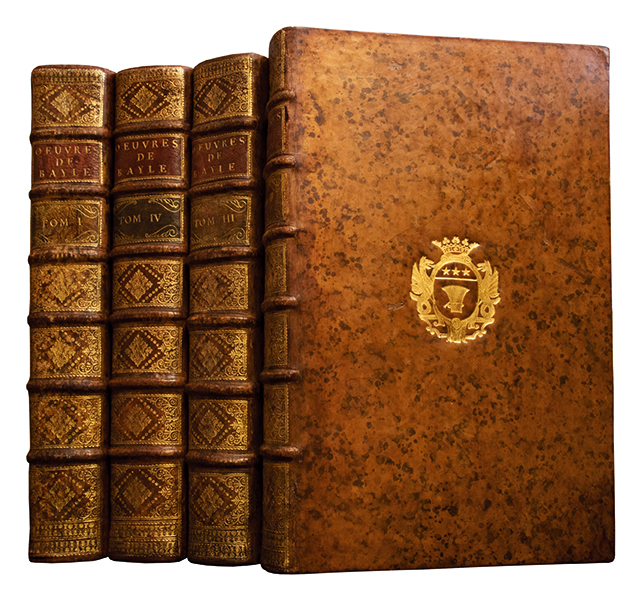
5 tomes en 4 volumes in-folio (391 x 250 mm), plein veau blond marbré de l’époque, dos à 6 nerfs guillochés or, ornés de caissons richement fleuronnés et cloisonnés, armes dorées au centre des plats, pièces de titre et de tomaison de veau havane et blond, coiffes et coupes filetées or, tranches rouges. Edition la plus complète des oeuvres collectives de Pierre Bayle, donnée par Pierre Desmaizeaux, proche protégé de l'auteur. "Edition qui doit être préférée à celle de 1727-31, parce qu'elle contient, de plus que la première, cent cinquante lettres à sa famille, formant un cahier de 211 pages qui est placé à la fin du premier volume" (Brunet). "Ce recueil contient tous les ouvrages publiés de Bayle, hors le dictionnaire. Il comprend aussi tout ce qui avait été imprimé de la correspondance" (Delvolve, 'Pierre Bayle…', Bibliographie, p. 436). Selon le catalogue de la BnF, qui se fonde sur le matériel typographique, cette édition aurait été imprimée en France, probablement à Trévoux. Vignette de titre allégorique gravée par Frederik Ottens, d'après Bernard Picard. Table des matières en tête de chaque volume et table des matières de l'ensemble en fin du volume IV. Le premier volume renferme plusieurs gravures sur bois dans le texte et 3 planches hors texte sur cuivre (pages 518, 578 [placé face 584] et 600). Le volume III est divisé en deux parties sous page de faux-titre, titre particulier et pagination continue. Le volume IV renferme plusieurs illustrations sur bois dans le texte dont trois grandes représentations des systèmes planétaires de Ptolémée (p. 394), de Ticho-Brahé (p. 398) et Copernic (p. 401). Quelques rousseurs et petites auréoles éparses. Quelques traces de restauration à la reliure. Très bel exemplaire en veau blond de l'époque aux armes de Jean-Claude Fauconnet de Vildé (1694–1765) dorées sur les plats (aux volumes II, II et IV). Ecuyer, conseiller du roi et de la Ville de Paris, il devint avocat à la cour et au Parlement (Catalogue des livres de feu M. Fauconnet de Vilde, Paris, de Bure le jeune, 1765, p. 24). (Guigard, II, 210. OHR, pl. 1654).
1737rif. 380701737 5 tomes en 4 volumes in-folio (391 x 250 mm), plein veau blond marbré de lépoque, dos à 6 nerfs guillochés or, ornés de caissons richement fleuronnés et cloisonnés, armes dorées au centre des plats, pièces de titre et de tomaison de veau havane et blond, coiffes et coupes filetées or, tranches rouges. A La Haye, par la Compagnie des Libraires [i.e. en France], 1737.
1760rif. 0041101760 Sans lieu d'édition [Paris], ni nom d'éditeur [Chaubert et Hérissant], 1760. In-quarto (206 X 265 mm) demi-basane fauve à coins, dos cinq nerfs, pièce de titre chagrin grenat, tranches rouges (reliure de l'époque) ; (1) f. blanc, VIII (dont titre)-336 pages, (1) f. blanc. Pièce de titre renouvelée. Ex-libris ancien collé sur le premier contreplat.
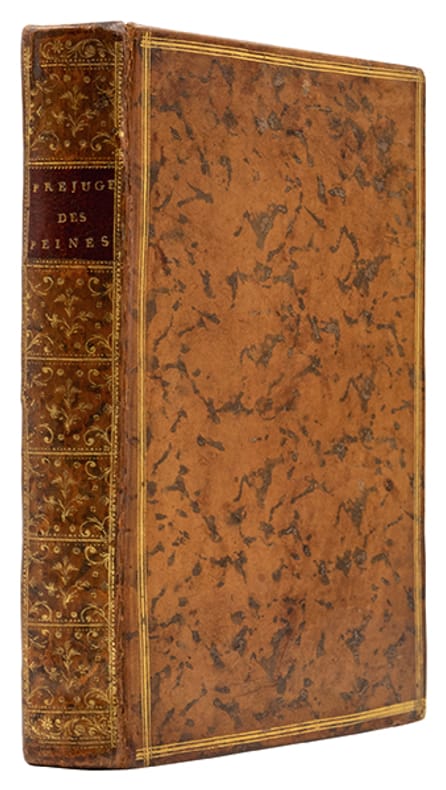
2 ouvrages reliés en un volume in-8 (195 x 124 mm), plein veau marbré de l'époque, dos lisse orné de compartiments fleuronnés et cloisonnés, pièces de titre de maroquin bordeaux, triples filets d'encadrement sur les plats, roulette sur les coupes, tranches jaspées. 1- Édition originale, rare. Le premier essai politique de Robespierre, alors jeune avocat âgé de 26 ans, qu’il composa en réponse à un concours ouvert par la Société royale littéraire de Metz en 1784, et pour lequel il obtint une médaille d’or ainsi qu’un prix de 400 livres. En homme des Lumières disciple de Montesquieu et de Beccaria, sur un mode modéré mais en un style lyrique et enflammé qui sera sa marque, Robespierre critique l’arbitraire de la justice de son temps et soumet un plan de réforme de la justice pénale. Il propose de bannir le déshonneur imposé aux familles des condamnés, plaide pour la suppression de la confiscation de leurs biens, pour l’égalité devant le châtiment et pour que les bâtards puissent accéder à la condition de citoyen à part entière. (Martin & Walter, 29526/1). 2- Edition originale. L'essai, en tête du volume, composé par le juriste et académicien Pierre-Louis Lacretelle (1751-1824) fut couronné en même temps que celui de Robespierre. Devançant celui-ci, Lacretelle obtint le premier prix, Robespierre le second, mais on décida que la récompense serait la même. Si les deux mémoires comportaient "nombre d'idées semblables", de celui de Lacretelle, on vanta "la hauteur de ses considérations philosophiques et morales, la sagacité de son esprit, la justesse de ses idées et l’humanité de ses sentiments". En 1823, en publiant ses Œuvres complètes, Lacretelle revint sur cette rencontre avec Robespierre : "Rien, dans ce début, ne promettait le personnage qu’on a vu sept ans après. On pourrait croire qu’il s’ignorait encore lui-même. Il faut avoir vu toute une révolution pour savoir à quel point elle peut transformer un homme, ou plutôt développer en lui des poisons cachés et encore sans fermentation". Infimes accrocs à un mors. Très bel exemplaire, très frais, grand de marges, très bien relié à l'époque.
1785rif. 384201785 2 ouvrages reliés en un volume in-8 (195 x 124 mm), plein veau marbré de l'époque, dos lisse orné de compartiments fleuronnés et cloisonnés, pièces de titre de maroquin bordeaux, triples filets d'encadrement sur les plats, roulette sur les coupes, tranches jaspées.
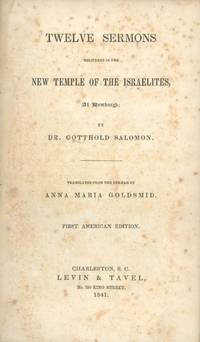
1841rif. 43466Charleston S. C.: Levin & Tavel 1841. with no dust jacket. 1st American Edition Original Publisher's Cloth Small 8vo 2 236 pages followed by several unnumbered pages of publisher's advertisements. Singerman 0761 Rosenbach 483. Jacob Rader Marcus the dean of historians of American Jewish history suggests in his work UNITED STATES JEWRY 1776-1985 Detroit 1989 that "The motive that prompted Nathaniel Levin and a Charleston associate to reprint an English translation of the sermons of Gotthold Salomon was apologetic.The book was Twelve Sermons Delivered in the New Temple of the Israelites at Hamburgh. The Hamburg temple in Germany was a liberal Jewish synagog one of the first in Europe. An English translation had been made of the sermons at London in 1839 by Anna Maria Goldsmid the daughter of Sir Isaac Lyon Goldsmid the Anglo-Jewish emancipator and religious liberal. The American reprint appeared two years later. Both editions were intended not only to edify Jews but also to interest and attract non-Jews. It was Levin's hope that these sermons would remove unjust prejudices against the Jew and would present 'the lofty character of the Israelite in its true colors.' A book of this sort would help the Jews put their best foot forward." Interestingly this 1st American edition of Twelve Sermons contains a new preface extolling the religious liberty of America and highlighting the refuge it afforded to the Jews. The new preface is merely signed "L" certainly referring authorship by Isaac Leeser and further supported by the fact that volume is preceded by two pages of advertisements for works by Leeser even though his works had no connection to the Charleston Publisher of this work. That Leeser who would become American Orthodoxy's greatest warrior against the Reform would offer a preface to and advertise his works in a collection of sermons from the breakaway Liberal Hamburg Temple in Germany suggests that he did not yet see the coming threat from the Reform movement. At the time of printing in Charleston Gustavus Poznanski 5 years into his term as rabbi and still somewhat traditional was just starting to make what felt like radical reforms as he "excised the Resurrection of the Dead and abolished the Second day of festivals five years before the same was done at the Breslau conference." America's first Reform import from Germany and it's first synagogue established as Reformed Har Sinai Congregation in Baltimore was still a year away from birth. Indeed the official term "Reform" did even come into use to describe Liberal Judaism except as a general adjective until 1845 even in Germany. Leeser's involvement in this publication merits further study as it is not mentioned in the bibliographies nor in Sussman's comprehensive "Isaac Leeser and the Making of American Judaism." Indeed in the 1840s at the time of this printing "there was a major split in Congregation Beth Elohim which many historians of American Jewish history see as the beginning of the American Reform movement. The conflict began after the introduction of an organ into the synagogue when it was rebuilt following a fire in 1840. The series of conflicts between Reform and Traditionalist elements in Beth Elohim resulted in a complicated dispute between the President who favored Reform and the Board of Trustees which was controlled by the Traditionalists. The President refused to call the Board of Trustees to meet as was required by the synagogue's constitution because he knew they would admit new traditionalist members and obtain control of the congregation. The Board ignored him and met on their own a move which the Reformers challenged in court. The resulting case State v. Ancker has become known as an early example of U. S. Courts refusing to intervene in complex religious questions" Wikipedia. Salomon 1784-1862 was the preacher of the new Reform Hamburg Temple. His "sermons modeled like those of other preachers on Protestant examples were praised by his contemporaries notably H. Heine." Goldsmid 1805-1889 a daughter of Sir Isaac Lyon Goldsmid was a London author poetess translator educator and communal worker JE. Includes bibliographical references. SUBJECTS: Jewish sermons. OCLC: 5001081. OCLC lists 11 copies worldwide. The National Library of Israel keeps their copy in their Rare Collection. Binding split front board detached lacks backstrip foxing to first several leaves Good Condition thus. A scarce and important publication associated with the early beginnings of the Reform movement in Charleston and with Leeser's first years of scholarly output. B KH-9-29A-BDZS--'elx. Charleston, S. C.: Levin & Tavel unknown
1522In-4°, 48cc, frontespizio in cornice figurata, gotico corsivo, illustrazioni xilografiche, capilettera, legatura in piena pergamena, buone condizioni. Prima edizione. Si tratta del diffuso Catalogus scritto dal Domenicano Bernardo di Lussemburgo come continuazione di quello di Nicola Eymerich, e che tratta delle più diffuse eresie del tempo, includendo ovviamente quella luterana. In-4 °, 48cc, frontispiece in ornated frame, gothic text, woodcut illustrations, inital letters, full vellum binding, good condition. First edition. This is the widespread Catalogus written by the Dominican Bernard of Luxembourg as a continuation of that of Nicola Eymerich, and which deals with the most common heresies of the time, obviously including the Lutheran one.
1533In-8°, 59pp, (1cb), prima edizione. Legatura in marocchino rosso alle armi di don Felipe Ramirez Nuñez de Guzmán Duca di Medina sui piatti in oro, entro cornice in oro. Titolo in oro al dorso (PRO. PONT; VAR.), nervature, tagli in oro. L’opera del teologo bresciano Lodovico Oriano è una risposta alle questioni e dubbi sollevati da Martin Lutero sulla liceità della potestà del romano pontefice, sul libero arbitrio, sulla giustificazione per fede e opere, cioè sui cardini su cui poggiava l’intero impianto teologico della Chiesa cattolica. Rilegato con Discussio decreti magni Concilii Lateranensis, et quarundam rationum annexarum, de potestate ecclesiæ in temporalibus; & incommoda diuersæ sententiæ, authore Guilhelmo Singletono, 135pp, stemma dei Gesuiti sul frontespizio, fregi, iniziali e finalino xilografici. L’opera di Leonardo Lessio (alias William Singleton) è stata spesso oggetto di contestazione per apparire come non ortodossa alla lezione biblica. In-8°, 59pp, (1cb), first edition. Binding in red morocco, gilt coat of arms of Don Felipe Ramirez Nuñez de Guzmán Duke of Medina on plates, within a gilt frame. Gilt title on spine (PRO. PONT; VAR.), bands, gilt edges. The work of the Brescian theologian Lodovico Oriano is a response to the questions and doubts raised by Martin Luther on the legitimacy of the power of the Roman pontiff, on free will, on justification by faith and works, that is the cornerstones on which was placed the entire theological structure of Catholic church. Bound with Discussio decreti magni Concilii Lateranensis, et quarundam rationum annexarum, de potestate ecclesiæ in temporalibus; & incommoda diuersæ sententiæ, authore Guilhelmo Singletono, 135pp, Jesuit coat of arms on the title page, wood engraved friezes, initials and tail. The work of Leonardo Lessio (alias William Singleton) has often been the subject of dispute for appearing as unorthodox to the biblical lesson.
1901rif. 726361901. in 16 volumes. in 16 volumes. A Remarkable Collection of Nineteenth-Century Works on Legal Reform and International Law Compiled by a Notable Scottish Lawyer Great Britain. Law Reform. Murray David 1842-1928. The David Murray Collection of Law Reform and International Law. 16 volumes. 155 titles. Various paginations. Octavo Vols. 1-15: 8-1/2" x 5" 21.6 x 12.7 cm; Vol. 16: 9-1/4" x 6" 23.5 x 15.25 cm. Contemporary three-quarter calf over marbled boards gilt-stamped insignia of the Royal Faculty of Procurators Glasgow to front boards blind rules to joint edges and corners raised bands and lettering piece to spines marbled edges and endpapers presentation bookplate from David Murray to the Faculty dated April 29 1902 to front pastedown of first volume. Light rubbing to boards light residue from leather treatment occasional scuffs nicks scratches and spots to boards and extremities which are more moderately rubbed with darkening in a few places some lettering pieces loose but secure cracking to spines of Volumes 14-16 boards of Volume 1 detached front joint of Volume 2 starting at foot joints of Volume 16 starting at ends. Volumes 1 5 6 7 9 10 and 13 have descriptions of their contents in Murray's hand to their half-titles. A remarkable handsomely bound collection. A COMPLETE LIST OF TITLES IS INCLUDED AMONG THE PHOTOS ASSOCIATED WITH THIS LISTING. $7000. This collection pertains chiefly to the subjects of law reform and international law. It was formed during the nineteenth century by the notable Scottish lawyer bibliophile and antiquary David Murray who presented it to the Library of the Royal Faculty of Procurators in Glasgow in 1902. As indicated by the contents which span almost the entire nineteenth century Murray had long possessed a sustaining interest in law reform. Many titles touch upon the numerous areas of law that were dramatically reformed during the 1800s including bankruptcy law conveyancing and real property law judicial administration chancery and equity and to a lesser extent codification criminal law and jurisprudence. Many of the works are presentation copies inscribed to other well-known international lawyers and reformers of the nineteenth century among them Sir Travers Twiss Sir John Connell and Edwin Wilkins Field. Among the authors themselves are John Austin Basil Mont. unknown
1901rif. 726361901. in 16 volumes. in 16 volumes. A Remarkable Collection of Nineteenth-Century Works on Legal Reform and International Law Compiled by a Notable Scottish Lawyer Great Britain. Law Reform. Murray David 1842-1928. The David Murray Collection of Law Reform and International Law. 16 volumes. 155 titles. Various paginations. Octavo Vols. 1-15: 8-1/2" x 5" 21.6 x 12.7 cm; Vol. 16: 9-1/4" x 6" 23.5 x 15.25 cm. Contemporary three-quarter calf over marbled boards gilt-stamped insignia of the Royal Faculty of Procurators Glasgow to front boards blind rules to joint edges and corners raised bands and lettering piece to spines marbled edges and endpapers presentation bookplate from David Murray to the Faculty dated April 29 1902 to front pastedown of first volume. Light rubbing to boards light residue from leather treatment occasional scuffs nicks scratches and spots to boards and extremities which are more moderately rubbed with darkening in a few places some lettering pieces loose but secure cracking to spines of Volumes 14-16 boards of Volume 1 detached front joint of Volume 2 starting at foot joints of Volume 16 starting at ends. Volumes 1 5 6 7 9 10 and 13 have descriptions of their contents in Murray's hand to their half-titles. A remarkable handsomely bound collection. A COMPLETE LIST OF TITLES IS INCLUDED AMONG THE PHOTOS ASSOCIATED WITH THIS LISTING. $7000. This collection pertains chiefly to the subjects of law reform and international law. It was formed during the nineteenth century by the notable Scottish lawyer bibliophile and antiquary David Murray who presented it to the Library of the Royal Faculty of Procurators in Glasgow in 1902. As indicated by the contents which span almost the entire nineteenth century Murray had long possessed a sustaining interest in law reform. Many titles touch upon the numerous areas of law that were dramatically reformed during the 1800s including bankruptcy law conveyancing and real property law judicial administration chancery and equity and to a lesser extent codification criminal law and jurisprudence. Many of the works are presentation copies inscribed to other well-known international lawyers and reformers of the nineteenth century among them Sir Travers Twiss Sir John Connell and Edwin Wilkins Field. Among the authors themselves are John Austin Basil Mont. unknown books
rif. 5761In folio, relié d'ép. pl. peau, rel à 5 nerfs, deux pièces de titre, un filet d'encadrement sur les plats, fleuron central repoussé sur chaque plat, coiffes bonnes, mors solides. Ouvrage peu manié, bien conservé, intérieur trés frais. 32 pp ; Impression du dictionnaire sur 2 col. (1 à 1624) ; Notes de David Hoeschel : 2 col. : 1 à 104 ; Index Rerum... 23 pp ; 2 p