3883 risultati
1838First edition. Contemporary boards. 8vo. 279 pages. 17cm. In Hebrew. Title translates to Kore Ha-Dorot: Remarks. Solomon Judah Löb HaKohen Rapoport (17861867) was a Galician rabbi and Jewish scholar. He was born in Lemberg, Kingdom of Galicia and Lodomeria. He married in 1810 Franziska Freide Heller, the daughter of the well-known Aryeh Leib Heller, and was instrumental in publishing the work Avnei Miluim of his father in law. He wrote both the index, sources and numerous comments. (Wikipedia, 2016) He wrote "Torah Or" against the radical views Geiger had expressed in his Urschrift, rebuked Jost for taking the same attitude in his Okaat Megullah (an open letter to the rabbis assembled at Frankfort-on-the-Main in 1845 ) and assumed a negative attitude toward the convention of German rabbis at Frankfort-on-the-Main in 1845 (JE, 1906) . SUBJECTS: Jews -- History -- 586 B. C. -70 A. D. OCLC lists 9 copies worldwide. Ex-library with usual markings. Very Good Condition. (HEB-50-39)
rif. DADAX0198286635New unknown
rif. DADAX022613802XNew unknown
rif. DADAX0137017464New unknown
rif. DADAX0198705832New unknown
rif. DADAX019958463XNew unknown
rif. DADAX0198807007New unknown
rif. DADAX0190861495New unknown
rif. DADAX022670243XNew unknown
rif. SONG0198795173Used: Good unknown
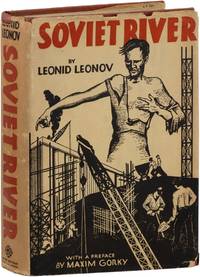
1932rif. 84363New York: Dial Press; Lincoln Mac Veagh 1932. First American Edition. Octavo. 19.5cm. Original deep red cloth titled in black to spine with embossed publisher's imprint to front board. Dustjacket. 383pp. Bumped to spine ends with some minor wear to corners some minor darkening to the cloth in places; internally clean fore-edge untrimmed top edge a trifle dusty; in the John Gram dustjacket with some toning to the spine panel shallow chipping and loss to the spine ends intruding upon the author's first name and a short closed tear to the front upper front spine hinge. A good strong copy with some wear. Leonov's novel of Soviet labor centred around the building of an enormous factory; Sotstroy. Gorky provides the preface; the novel was notable at the time as an antidote to the image of the USSR as an enormous generator of plans progress noble artistic and industrial endeavor and a shining beacon of energy. Leonov tends towards a more on the ground depiction of enthusiastic ineptitude paranoia and fanaticism. Bookplate of Alvin Kapusta to front pastedown a Special Assistant for Soviet Nationalities at the US State Department and a notable scholar of the Soviet Bloc whose collections are housed at the Hoover Institution. Dial Press; Lincoln Mac Veagh unknown
1932rif. 84363New York: Dial Press; Lincoln Mac Veagh 1932. First American Edition. Octavo. 19.5cm. Original deep red cloth titled in black to spine with embossed publisher's imprint to front board. Dustjacket. 383pp. Bumped to spine ends with some minor wear to corners some minor darkening to the cloth in places; internally clean fore-edge untrimmed top edge a trifle dusty; in the John Gram dustjacket with some toning to the spine panel shallow chipping and loss to the spine ends intruding upon the author's first name and a short closed tear to the front upper front spine hinge. A good strong copy with some wear. Leonov's novel of Soviet labor centred around the building of an enormous factory; Sotstroy. Gorky provides the preface; the novel was notable at the time as an antidote to the image of the USSR as an enormous generator of plans progress noble artistic and industrial endeavor and a shining beacon of energy. Leonov tends towards a more on the ground depiction of enthusiastic ineptitude paranoia and fanaticism. Bookplate of Alvin Kapusta to front pastedown a Special Assistant for Soviet Nationalities at the US State Department and a notable scholar of the Soviet Bloc whose collections are housed at the Hoover Institution. Dial Press; Lincoln Mac Veagh unknown books
rif. DADAX0231157924New unknown
rif. 25479Between 27 July 1885 and 22 March 1886. All from Edgbaston Birmingham the second a letterhead. See his entry in the Oxford DNB. From the Piffard papers. A total of 9pp 12mo. The recipient is 'B. Piffard Esq.' and the letters are all signed 'Jesse Collings'. ONE: 27 July 1885. 2pp 12mo. He apologises for the delay in replying: 'I have been so over-pressed with Parliamentary and other work.' He will go into the matter of Piffard's letter at the 'Committee meeting of our Allotments & Small Holdings Association' that very day. 'We are waking up the Charity Commissioners to a great extent but it will be utterly impossible to do full justice to the rights of the people until the management of these charities and other mattes connected with the poor are placed in the hands of the new rural municipalities which I hope will be created as soon as a Liberal Government returns to power'. TWO: 10 December 1885. 3pp 12mo. The subject of the letter is 'the enclosures contemplated by Earl Brownlow' about which Piffard has sent him a newspaper cutting. 'If I could get a "brief" shortly stating the case I would see if there was any possibility of bringing the matter before Parliament': 'I do not know how I should raise the question but I would watch for some opening if I knew all the particulars of the case'. He informs him that 'The county elections are turning out exceedingly well and this means the beginning of the end of the power of the territorial Party. The action of our Allotments and Small Holdings Association is getting more and more powerful in the rural districts and we shall push it forward to the utmost extent.' THREE: 8 January 1886. 1p 12mo. Further thoughts on the subject of Letter Two. FOUR: 24 January 1886. 2pp 12mo. 'The matter seems a very unsatisfactory one and I should like to do anything within my power towards securing the popular rights if you could suggest anything. I have such an enormous amount of work on hand that it would be impossible for me to go through the matter and prepare a brief but if any short statement can be formulated bringing out the points I will ask some questions in Parliament on the subject. It seems monstrous that Lrods of the Manor should retain such powers while they have shuffled off all the obligations in which their supposed rights over land are founded.' FIVE: 22 March 1886. 1p 12mo. He is pleased to hear of the success which has attended Piffard's efforts both with regard to the Charity Commissioners and the enclosures.' He is returning Piffard's 'plan' and regrets that he is 'so fully occupied just now that I am sorry I am not able to take any special action in the matter'. Between 27 July 1885 and 22 March 1886. All from Edgbaston, Birmingham (the second a letterhead). unknown
1989204 pages including selected bibliography and index. "Considers two major aspects of China's economic reform: the new 'open policy' towards the west, aimed at attracting technology and skills into the country, and the new emphasis on 'regionalization', which has established market-orientated rather than bureaucratically-controlled patterns of economic development. Provides a detailed and comprehensive survey of the prospects for China's regional development in the future." - from dust jacket. Minimal wear. Tight and square. Red cloth-covered boards. Ink underlining and marginalia. Light wear to dust jacket with one inch opening at top of front fore-edge. Solid attractive copy. Book
rif. BN514907MAKING THE IMPOSSIBLE POSSIBLE One Man's Mission to Reform the Japanese Railways Gebundene Ausgabe MAKING THE IMPOSSIBLE POSSIBLE One Man's Mission to Reform the Japanese Railways Gebundene Ausgabe MAKING THE IMPOSSIBLE POSSIBLE One Man's Mission to Reform the Japanese Railways Gebundene Ausgabe unknown
In-8, broché, couverture papier marbré moderne, x, 136 p., faux-titre et titre imprimés en rouge et noir. Edition à la date de l'originale. A l'occasion de la publication de l'ouvrage de Linguet qu'il réfute, Dusaulx intervient sur la question de l'emprisonnement, l'organisation des prisons (particulièrement la Bastille) et la justice pénale dans ses rapports avec les institutions politiques. Il appuie sa réflexion sur des expériences à l'étranger. Très bon exemplaire, très frais.
rif. 27151In-8, broché, couverture papier marbré moderne, x, 136 p., faux-titre et titre imprimés en rouge et noir. Londres, Aux dépens de l'auteur, 1783.
In-8, cartonnage bleu à la Bradel, dos orné de doubles filets dorés (reliure Laurenchet), 107 p. Edition originale. Ces "Considérations sur le Tiers-Etat" parurent avant l'œuvre célèbre de Sieyès qui s'y réfère (janvier 1789). Plus social, Rabaut traite des questions politiques et économiques. "Il réclame la liberté du commerce, la diminution et la simplification des impôts, la suppression de la réglementation industrielle et des barrières provinciales" (INED, 3694). Mais aussi, il est le premier à y développer la notion de "régénération" qui rencontra, dans la Révolution, le succès que l'on sait. (Goldsmiths'-Kress library, n°13742). Quelques pet. auréoles claires et petites réparation. Exemplaire bien relié.
rif. 20416In-8, cartonnage bleu à la Bradel, dos orné de doubles filets dorés (reliure Laurenchet), 107 p. S.l., 1788.
In-8, broché, couverture papier moderne, 51 p. Edition originale. "L'auteur a été identifié par D. Robert comme étant Liquois de Beaufort, protestant et ex-constitutionnel de Montreuil-sur-Mer. Personnage toutefois assez énigmatique pour que certains aient prétendu que la main de Napoléon se cachait derrière de celle Beaufort. Si le personnage importe peu, il n'en est pas de même de [ce] Projet appelé à un grand retentissement, dès sa parution en 1806" (cf. B. Plongeron, 'Les projets de réunion des communions chrétiennes, du Directoire à l'Empire'. In: "Revue d'histoire de l'Église de France", T.66, n°176, 1980. p. 17-49). L'auteur préconise une "fusion des Églises (…) rempart nécessaire pour maintenir la force et la perpétuité d'un gouvernement et assurer la prospérité de l'Empire; du sein de la réunion naîtra naturellement une religion nationale, qui seule peut produire des vertus et des moeurs nationales" (p. 239). Mais il ne saurait être question de prendre pour centre de ralliement l'Église catholique, hérissée qu'elle est de "vérités dogmatiques". Rare et important.
rif. 29068In-8, broché, couverture papier moderne, 51 p. Paris, de l'imprimerie de Brasseur Ainé, chez l''auteur, 1806.
rif. 91719Duaci, Ex. Officina Typogr. Baltazaris Belleri, Anno 1925, 1 volume in-18 de 105x55 mm environ, (1) f., 460 pages, (8) ff. (index), (3) ff., pleine basane fauve granitée, dos lisse portant titres dorés sur pièce de titre cognac, orné de caissons à motifs dorés, gardes marbrées avec un ex-libris sur le premier contreplat, tranches finement mouchetées. Petits notes manuscrites sur la page de titre, une signature sur la première garde, frottements sur les coins mors et coiffes, sinon bon état;
rif. 058038Lugduni ( Lyon ) Sumpt. Antonii Pillehotte 1621 in 12 (17x11) 1 fort volume reliure plein velin souple ivoire de l'époque, page de titre imprimée en rouge et en noir790 pages, et faux-feuillets non chiffrés d'index, petite trace brun clair sur l'angle externe de la marge supérieure de quelques cahiers. Martinus Becanus, Hilvarenbeek 1563 - Vienne 1624, jésuite des Pays-Bas espagnols, théologien catholique, controversiste de la Contre-Réforme. Seconde et dernière partie seule. Bon exemplaire ( Photographies sur demande / We can send pictures of this book on simple request )
In-8, broché, couverture imprimée (accrocs au dos), (4), 135 p., tableaux statistiques, 2 grands plans pliés hors texte. Edition originale. Député de la Drôme en 1815 et de 1828 à 1839, membre de l'Académie des sciences morales et politiques, Bérenger de la Drôme devint l'un des principaux spécialistes des questions pénales et carcérales et l'un des pionniers de la réforme pénitentiaire en France. Dans cet ouvrage, l’auteur soumet son projet de réforme du système carcéral, fondé sur la réinsertion sociale et la diminution du nombre de récidives. Tableaux statistiques et 2 grands plans pliés de "maison pénitentiaire départementale". (Coquelin & Guillaumin, I, 697). Couverture passée, rousseurs. Exemplaire non rogné.