3 729 résultats
réf. DADAX0199591571New unknown
réf. DADAX0198868855New unknown
réf. DADAX0521265630New unknown
réf. 19427Newcastle upon Tyne: Printed and published by E. Mackenzie Jun. 129 Pilgrim Street. 1831. 59 1pp. 8vo. Stitched and disbound. In fair condition lightly aged and worn. The author is not named on the title-page but the text ends p.59 with the signature in type of 'CHARLES LARKIN.' The final page carries a list of 'Errata'. Drop-head title p.3: 'To The Auditory who heard the Speech of Captain Gordon delivered in Brunswick Place Chapel on Wednesday evening March 2 1831 This Letter is respectfully inscribed.' The Reformation Society 'of which Captain Gordon styles himself the honorary secretary' is attacked as a 'society for the support of a tottering system of fraud falsehood fanaticism hypocrisy intolerance and oppression'. The only copy on COPAC at Durham there is a second impression held at Durham and two other locations. Newcastle upon Tyne: Printed and published by E. Mackenzie, Jun. 129, Pilgrim Street. 1831. unknown
réf. 2642443 Berkeley Square "Friday Night". A note presumably in the recipient's hand states "London 14 July 1832. answered". Four pages 8vo bifolium some staining see image but all legible. "Tomorrow morning you will receive in George Street from the Librarian of the House of Lords copies of my two Protests and of Lord Wynford's Protest on the 3rd Reading of the English Reform Bill. I wiosh my Protests to be sent to the Editor of the Standard & Lord Wynford has commissioned me to send his also. Five of the Protests have already appeared in that Paper - which had expressed as I was informed a wish to have them & a readiness to publish them & any others that might be sent to the Editor. It is on this footing that these Protests must be sent. It must on no account appear - nor must a word be said to entitle the Editor to conclude - whatever he may suppose - that either Lord Wynford or I have anything to do with sending them. They must be conveyed to the Editor to publish - if he shall think fit phrase underlined - and must be sent in consequence of his expressing a wish to have & a readiness to publish the Protests. If he does not think fit to publish them he may let it alone & retyurn them. They are not to be paid for as advertisements or otherwise. If you are kind enough to undertake to forward them to the Paper - the Person who takes them may speak or it may bewritten but I should think not with a name in the following sense - that the Protests of Lords H & W are sent to the Standard by one who has reason to know that they are correct in consequence of the readiness expressed by the Editor to make known to the Public the Protests aginst the BILL- - and in consequence of several having already appeared. It might be as well to send them in time for tomorrows sic Evening Paper - or Mondays at furthest. I called in George Street today hoping to catch you before you left your office - but I was too late. I beg if you have any objection to undertaking this office - that you will make no scruple of delivering it. You will find that I could hardly send my Protests in my own name Believe me to be .". POSTSCRIPT They told me at the House of Lords that they were not sent from thence to the Papers. Their not having been sent long ago was very stupid. I hope you will make Dr Coventry understand how absolutely inappropriate it was for me or any one else to make any amendments in so difficult a matter at such a stage - without warning or preparation & in si=uch a House! phrase underlined It was quite out of the question. The thing must now work its own way - if possible to correct them - as they shew themselves in the working of this elaborate & complicated & machine; Should thge Librarian not have sent them to your office in due time - perhaps you will send to him for them. I wrote my name in my two Protests - it would be better to scratch that out." Note: "Lord Haddington went on to vote against the Reform Bill in 1831 but later changed his mind and voted for it in 1832 possibly due to the political crises surrounding its passage." Wikipedia 43 Berkeley Square, "Friday Night". A note presumably in the recipient's hand states "London 14 July 1832. ans[wered]". unknown
réf. DADAX0195057376New unknown
réf. DADAX1847421067New unknown
réf. 93948Amsterdam, Chez Thomas Lombrail 1707, 165x95mm, relié plein veau de l’époque, dos à 5 nerfs, pièce de titre en cuir rouge, fleurons dorés, tranches jaspées, coiffe supérieure endomagée, usures aux coins, autrement bon état.
réf. DADAX0195078721New unknown
réf. DADAX0231126506New unknown
réf. DADAX0195101669New unknown
réf. DADAX0231157924New unknown
réf. REL905MChez Pierre Brunel, Amsterdam, 1699. In-8, reliure de l'époque plein veau fauve, dos à 5 nerfs, caissons ornés, titrage doré, environ 30 et 567 pages. Coiffes arasées. Dos et plats convenables. Tranches bonnes. Intérieur bon. Quelques pages sur 2 colonnes. Coins émoussés. Belle pièce de témoignage
1683réf. 112590Mabre cramoisy 1683 Suivant la copie imprimée à Paris, chez Sebastien Mabre-Cramoisy, 1683, mention de quatrième édition, 3 volumes in-16 de 80x135 mm environ, tome I : (6) ff. titre, avertissement, table, sommaire), 396 pages, (1) f., - tome II : (1) f., (4) ff. (titre, table et sommaire), 447 pages, (1) f., - tome III : (1) f., (4) ff. (titre, table et sommaire), 381 pages, (37) ff. de table, (2) ff., pleine basane fauve granitée, dos à 4 nerfs portant titres dorés, ornés de caissons à motifs dorés, coupes dorées, tranches finement mouchetées de rouge. Ex-libris de la Bibliotheca Blomania (Bibliothèque W. Von Blome (1683-1761), conseiller privé du Roi du Danemark, vendue à Hambourg en 1929). Manque le frontispice et la première garde blanche + trous de vers dans la marge du tome I, petite restauration ancienne p. 45 du tome II, petit défaut d'impression p. 102 du tome III, frottements d'usage sur le cuir, gardes blanches cernées, sinon bon état.
1684réf. 174621684 LONDINI, Ed. Willielmo Wats, imp. A. Mearne, T. Dring, B. Tooke, T. Sawbridge, & G. Wells - 1684 - 1 fort volume in-folio - Reliure plein veau de l'époque avec restauration postérieure maladroite - Beau portrait en Frontispice de l'auteur - Page de titre, (32), 1175 pages & Glossaire & index 36 pages - Bon exemplaire 2 grands Ex-libris armoriés: Sigill Henrici Baker tristram e coll line o ronn (Henry Baker), devise "Fortiger Gerig Cracem" & Thomas Phillips, Middle Hill, Worcestershire ** , devise "Deus Patria Rex"- Envoi rapide et soigné - Réf. 17462
réf. DADAX0333553365New unknown
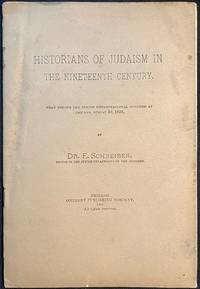
1894réf. 42366Chicago: Occident Pub. Co 1894. 1st edition. Original Printed Wrappers. 8vo. 28 pages. 23 cm. Singerman 4766. "We have no work like it in the English language. It is a valuable contribution to the literature of the Reform Movement. Dr. Schreiber has acquitted himself remarkably well in performing the difficult task of portraying in biographies the origin and growth of reform in Judaism. The book should be read by every Israelite be he conservative or radical. - Jewish Spectator Memphis" Back cover. The Author Rabbi Emanuel Schreiber was head of the Religious Department at the Occident Publishing Company which published this work and also produced the "Occident Newspaper" no apparent connection to Leeser's Occident published in Chicago 1873-1896. It was a "weekly radical reform Jewish journal. It was devoted to general news politics literature science art and the interest of the Hebrews of the Northwest.this paper was printed in both English and German" Scott "Newspapers And Periodicals of Illinois 1814-1879." Urbana 1911. The paper described itself as "The foremost radical reform Jewish newspaper in the world. It is edited by the most eminent writers of today" from the rear cover of this work. Subjects: Jews -- Historiography. Jewish historians. OCLC: 7426681. Some staining to wrappers and occasional text pages paper bright and binding very good very well preserved Very Good Condition Overall. B AMR-43-30-XX-LDBLVRF-'ex. Chicago: Occident Pub. Co unknown
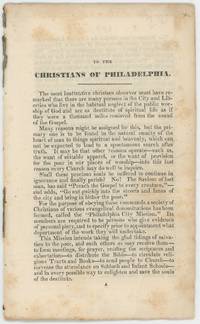
1831réf. BK0169Philadelphia: William F. Geddes 1831. 2 12 2 pp. Stitched pamphlet measuring 4 ¼ x 7 inches. Good plus with scattered foxing and soiling some wear to edges. An early appeal for organized missionary work among Philadelphia's urban poor issued upon the establishment of the Philadelphia City Mission in March 1831. The organization brought together Christians from several evangelical denominations to reach residents who rarely or never attended church. Its organizers acknowledged that poverty itself could prevent participation in religious life citing "the want of suitable apparel or the want of provision for the poor in our places of worship-into this last reason every Church may do well to inquire." The pamphlet begins by describing the large numbers of people living in Philadelphia and its surrounding districts who remained outside the ordinary reach of the churches: "The most inattentive christian observer must have remarked that there are many persons in the City and Liberties who live in the habitual neglect of the public worship of God and are as destitute of spiritual life as if they were a thousand miles removed from the sound of the Gospel." The Mission proposed to carry religious instruction directly into poorer neighborhoods through home visits prayer meetings the distribution of Bibles and tracts and efforts to increase attendance at Sabbath and infant schools. Its members were to be drawn from different evangelical denominations and required to demonstrate personal piety before undertaking missionary work. An interesting document of Philadelphia's early urban missionary movement particularly for its recognition of the economic and social barriers separating the city's poorer inhabitants from established religious institutions. . William F. Geddes unknown
1831réf. BK0169Philadelphia: William F. Geddes 1831. 2 12 2 pp. Stitched pamphlet measuring 4 ¼ x 7 inches. Good plus with scattered foxing and soiling some wear to edges. An early appeal for organized missionary work among Philadelphia's urban poor issued upon the establishment of the Philadelphia City Mission in March 1831. The organization brought together Christians from several evangelical denominations to reach residents who rarely or never attended church. Its organizers acknowledged that poverty itself could prevent participation in religious life citing "the want of suitable apparel or the want of provision for the poor in our places of worship-into this last reason every Church may do well to inquire." The pamphlet begins by describing the large numbers of people living in Philadelphia and its surrounding districts who remained outside the ordinary reach of the churches: "The most inattentive christian observer must have remarked that there are many persons in the City and Liberties who live in the habitual neglect of the public worship of God and are as destitute of spiritual life as if they were a thousand miles removed from the sound of the Gospel." The Mission proposed to carry religious instruction directly into poorer neighborhoods through home visits prayer meetings the distribution of Bibles and tracts and efforts to increase attendance at Sabbath and infant schools. Its members were to be drawn from different evangelical denominations and required to demonstrate personal piety before undertaking missionary work. An interesting document of Philadelphia's early urban missionary movement particularly for its recognition of the economic and social barriers separating the city's poorer inhabitants from established religious institutions. . William F. Geddes unknown books
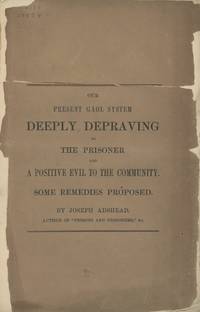
1847réf. BK0175Manchester: G. & A. Falkner Printers 1847. 107 pp. 8vo. Original printed brown wrappers with front wrapper detached and substantially torn and chipped but preserved. Some additional wear and soiling. Presentation inscription at the head of the title page reading "G. T. Bigelow Esq. / From the Author. Fair overall. An examination of British prison conditions by Joseph Adshead 1800-1861 a Manchester merchant social reformer and advocate of the separate system of imprisonment. Adshead had previously published Prisons and Prisoners 1845 in which he defended the Pennsylvania system against critics including Charles Dickens who had condemned solitary confinement following his visit to the United States. Adshead argues that the prevailing practice of confining prisoners together often without adequate separation by age offense or criminal history served to encourage further crime. He describes conditions at several prisons. The presentation inscription is of particular interest. The recipient appears to be George Tyler Bigelow 1810-1878 the Massachusetts attorney and later Chief Justice of the Massachusetts Supreme Judicial Court. In 1844 Bigelow and George Bemis defended Abner Rogers Jr. a prisoner charged with murdering Charles Lincoln Jr. the warden of the Massachusetts State Prison. Rogers was acquitted on the grounds of insanity in a widely discussed case that raised questions about criminal responsibility and the mental condition of prisoners. The presentation of Adshead's work to Bigelow suggests a connection between two men involved in contemporary debates over prisons and their administration. . G. & A. Falkner, Printers unknown
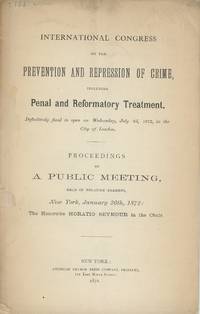
1872réf. BK0173New York: American Church Press Company 1872. Two pamphlets in original printed wrappers 6 x9 inches. Good to very good with toning light soiling and minor wear and chipping to wrappers. Two contemporary publications documenting American preparations for the International Prison Congress held in London in July 1872. Organized principally through the efforts of American prison reformer Enoch C. Wines the congress brought together representatives from Europe and the United States to discuss prison administration criminal punishment and methods of rehabilitation. The meeting followed the American National Prison Congress of 1870 whose declaration of principles had called for greater emphasis on the reformation of offenders. The first pamphlet International Congress on the Prevention and Repression of Crime Including Penal and Reformatory Treatment: Circular Letter Addressed to the National Committees in the Several Countries Proposing to Take Part in the Congress outlines arrangements for the approaching meeting. It calls upon participating countries to establish national committees prepare reports on their existing prison systems appoint delegates and suggest subjects and specialists for discussion. The second International Congress on the Prevention and Repression of Crime Including Penal and Reformatory Treatment: Proceedings of a Public Meeting Held in Relation Thereto New York January 26th 1872 records a meeting chaired by former New York governor Horatio Seymour. It includes addresses and correspondence concerning the proposed congress among them expressions of support from foreign representatives. The meeting formed part of Wines's efforts to secure international participation in the London gathering. OCLC locates six and three copies of each title respectively over multiple entries. . American Church Press Company unknown
1872réf. BK0173New York: American Church Press Company 1872. Two pamphlets in original printed wrappers 6 x9 inches. Good to very good with toning light soiling and minor wear and chipping to wrappers. Two contemporary publications documenting American preparations for the International Prison Congress held in London in July 1872. Organized principally through the efforts of American prison reformer Enoch C. Wines the congress brought together representatives from Europe and the United States to discuss prison administration criminal punishment and methods of rehabilitation. The meeting followed the American National Prison Congress of 1870 whose declaration of principles had called for greater emphasis on the reformation of offenders. The first pamphlet International Congress on the Prevention and Repression of Crime Including Penal and Reformatory Treatment: Circular Letter Addressed to the National Committees in the Several Countries Proposing to Take Part in the Congress outlines arrangements for the approaching meeting. It calls upon participating countries to establish national committees prepare reports on their existing prison systems appoint delegates and suggest subjects and specialists for discussion. The second International Congress on the Prevention and Repression of Crime Including Penal and Reformatory Treatment: Proceedings of a Public Meeting Held in Relation Thereto New York January 26th 1872 records a meeting chaired by former New York governor Horatio Seymour. It includes addresses and correspondence concerning the proposed congress among them expressions of support from foreign representatives. The meeting formed part of Wines's efforts to secure international participation in the London gathering. OCLC locates six and three copies of each title respectively over multiple entries. . American Church Press Company unknown books
1847réf. BK0175Manchester: G. & A. Falkner Printers 1847. 107 pp. 8vo. Original printed brown wrappers with front wrapper detached and substantially torn and chipped but preserved. Some additional wear and soiling. Presentation inscription at the head of the title page reading "G. T. Bigelow Esq. / From the Author. Fair overall. An examination of British prison conditions by Joseph Adshead 1800-1861 a Manchester merchant social reformer and advocate of the separate system of imprisonment. Adshead had previously published Prisons and Prisoners 1845 in which he defended the Pennsylvania system against critics including Charles Dickens who had condemned solitary confinement following his visit to the United States. Adshead argues that the prevailing practice of confining prisoners together often without adequate separation by age offense or criminal history served to encourage further crime. He describes conditions at several prisons. The presentation inscription is of particular interest. The recipient appears to be George Tyler Bigelow 1810-1878 the Massachusetts attorney and later Chief Justice of the Massachusetts Supreme Judicial Court. In 1844 Bigelow and George Bemis defended Abner Rogers Jr. a prisoner charged with murdering Charles Lincoln Jr. the warden of the Massachusetts State Prison. Rogers was acquitted on the grounds of insanity in a widely discussed case that raised questions about criminal responsibility and the mental condition of prisoners. The presentation of Adshead's work to Bigelow suggests a connection between two men involved in contemporary debates over prisons and their administration. . G. & A. Falkner, Printers unknown books
1972réf. 46484Washington: National Welfare Rights Organization n.d. but 1972. Strike placard comprised of original photographic poster 43x28cm. printed offset in purple and black on white stock stapled to pastepaper board hole-punched and threaded with thick string for hanging around neck. Extremities rather chipped and bottom edge slightly curled poster rather dust-soiled else Good or better with clear evidence of use. Placard featuring a poster protesting H.R.1 and the "D.C. Four Against the Poor" President Richard Nixon Senator from Connecticut Abraham Ribicoff Congressman from Arkansas Wilbur Mills and Senator from Louisiana Russell Long. Adorned with their photographic portraits below which is printed "These men are dangerous!!! They have conspired to starve children destroy families force women into slavery and exploit poor people -- all in the name of 'Welfare Reform.' STOP THESE MEN!" The placard was presumably worn at the NWRO-sponsored "Children's March for Survival" on March 25 in Washington D.C. The parade which consisted of over 50000 participants more than half of them children was led by Jesse Jackson and NRWO's leader George Wiley and included speakers Bella Abzug and Corettaa Scott King with her two daughters. The poster used here not separately catalogued in OCLC as of October 2019. National Welfare Rights Organization unknown
1972réf. 46484Washington: National Welfare Rights Organization n.d. but 1972. Strike placard comprised of original photographic poster 43x28cm. printed offset in purple and black on white stock stapled to pastepaper board hole-punched and threaded with thick string for hanging around neck. Extremities rather chipped and bottom edge slightly curled poster rather dust-soiled else Good or better with clear evidence of use. Placard featuring a poster protesting H.R.1 and the "D.C. Four Against the Poor" President Richard Nixon Senator from Connecticut Abraham Ribicoff Congressman from Arkansas Wilbur Mills and Senator from Louisiana Russell Long. Adorned with their photographic portraits below which is printed "These men are dangerous!!! They have conspired to starve children destroy families force women into slavery and exploit poor people -- all in the name of 'Welfare Reform.' STOP THESE MEN!" The placard was presumably worn at the NWRO-sponsored "Children's March for Survival" on March 25 in Washington D.C. The parade which consisted of over 50000 participants more than half of them children was led by Jesse Jackson and NRWO's leader George Wiley and included speakers Bella Abzug and Corettaa Scott King with her two daughters. The poster used here not separately catalogued in OCLC as of October 2019. National Welfare Rights Organization unknown books