3 725 résultats
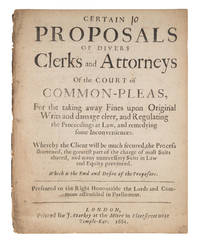
1661réf. 724361661. A Scarce Restoration-Era Pamphlet Proposing Reforms to Court Procedure Law Reform. Great Britain. Certain Proposals of Divers Clerks and Attorneys of the Court of Common-Pleas For the Taking Away Fines upon Original Writs and Damage Cleer And Regulating the Proceedings at Law And Remedying Some Inconveniences. Whereby the Client Will be Much Secured The Process Shortened The Greatest Part of the Charge of Most Suits Abated And Many Unnecessary Suits in Law and Equity Prevented. Which is the End and Desire of the Proposers. Presented to the Right Honourable the Lords and Commons Assembled in Parliament. London: Printed for J. Starkey at the Mitre in Fleetstreet near Temple-Bar 1661. vi 8 pp. Quarto 7" x 5-1/2". Disbound stab-stitched pamphlet. Moderate toning soiling to exterior light browning to margins "10" in early hand to head of title page. $450. Only edition. Produced by a "divers" group of "clerks and attorneys of the Court of Common-Pleas" this pamphlet suggests ways to reform pleading and procedure and reduce the number of lawsuits in the civil and equity courts. This is a scarce title. OCLC locates 6 copies 4 in law libraries Harvard Library of Congress San Francisco Law Library Yale. English Short-Title Catalogue R35481. unknown books
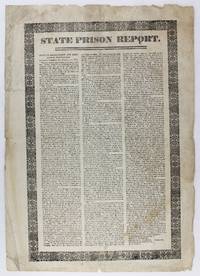
1834réf. 3806Providence 1834. Good plus. Broadside 15 x 10.5 inches printed in three columns within an ornamental border. Old folds short splits along some folds a few small chips moderate dust-soiling and foxing. Untrimmed. A rare broadside disseminating a report from a five-man committee of the General Assembly of Rhode Island recommending penal code reform and the establishment of a state prison in the Ocean State in 1834. The beginning of the report expounds upon the inconsistency of the various legal punishments meted out in county jails. The committee then evaluates different methods of imprisonment in New York Pennsylvania Connecticut and other states concluding as follows: "On the whole the committee are in favor and recommend to the General Assembly the erection of a State penitentiary on the principle of solitary confinement at labor with instruction in labor in morals and religion." The committee hoped this prison reform would "relieve the State from the future support of convicts and may produce a moral reformation in those who may be subjected to its operation." We could locate just one copy of this broadside in OCLC at Brown. unknown
1972réf. 232591972. Prison and IncarcerationSocial activism Prison reform organizing conference broadside. Attica and San Quentin prison organizing stand at the center of this January 1972 Berkeley conference broadside which opens with a Brecht quote "Slave who is it that shall free you.all of us or none" and declares that "no one in America today is more a slave than the inmates in American prisons." The text ties prison struggle to "class and racial oppression" names the murders at Attica and San Quentin and frames the prison system as a site of beatings drugs "behavior modification" and brain surgery schemes. The conference was held just a few months after the 1971 Attica uprising during which prisoners revolted against inhumane treatment and racial discrimination in a violent struggle that left 39 dead. The conference roster grounds the prison rights moment Bay Area Black liberation featuring figures including Afeni Shakur Fay Stender and former Soledad Prison chief psychiatrist Frank Rundle. "Slave Who Is It Shall Free You . . . All of Us or None." The Struggle Inside. Prison Action Conference. Berkeley 1972. Single-sheet broadside 8.5 x 11 inches for a prison action conference scheduled for January 28-30 in Pauley Ballroom UC Berkeley printed on both sides. Recto features two halftone prison photographs and a dense typed manifesto arguing that prisoner demands had moved "from traditional demands for food and shelter to demands for civil and religious rights and finally to a general challenge to the prison system and the society which fosters it." It announces the conference as "a forum for self education and exploration of potential action to assist the prison movement" with key speakers Afeni Shakur a defendant in the Panther 21 trial Fay Stender a Berkeley attorney with years of prison movement experience and Frank Rundle former chief psychiatrist at Soledad Prison. Verso gives the full three-day program: Friday evening remarks by Stender and Shakur; Saturday sessions on "Medical Repression in Prisons" "Adult Authority and Indeterminate Sentencing" "Economics of Prisons" "Juvenile Reformatories and Detention" and "Prisoners Demands"; and Sunday sessions on "Women in Prison" "Defense of Political Prisoners" "Military Prisons" "Prison-Community Communications" "Prisoners Organizations" "County Jails and Pre-trial Detention" plus a closing "Panel Discussion on Racism." The broadside illustrates the actions and intentions of the Berkeley prison movement at a time when prison rebellion legal defense anti-racist analysis and ex-prisoner testimony were being brought before public audiences in the aftermath of the Attica Uprising. Afeni Shakur's appearance links the handbill to the political world of the Black Panther movement while the inclusion of sessions on women in prison political prisoners juvenile detention county jails and medical repression demonstrate the intersectional goals of the movement and the broadening of post-Attica activism from outrage over one massacre to a larger indictment of prison administration and criminal punishment. Some light staining; otherwise very good condition. A Bay Area prison movement piece that preserves both the rhetoric and the working program of organizing against U.S. imprisonment in the immediate aftermath of the 1971 Attica Uprising. unknown
1661réf. 724361661. A Scarce Restoration-Era Pamphlet Proposing Reforms to Court Procedure Law Reform. Great Britain. Certain Proposals of Divers Clerks and Attorneys of the Court of Common-Pleas For the Taking Away Fines upon Original Writs and Damage Cleer And Regulating the Proceedings at Law And Remedying Some Inconveniences. Whereby the Client Will be Much Secured The Process Shortened The Greatest Part of the Charge of Most Suits Abated And Many Unnecessary Suits in Law and Equity Prevented. Which is the End and Desire of the Proposers. Presented to the Right Honourable the Lords and Commons Assembled in Parliament. London: Printed for J. Starkey at the Mitre in Fleetstreet near Temple-Bar 1661. vi 8 pp. Quarto 7" x 5-1/2". Disbound stab-stitched pamphlet. Moderate toning soiling to exterior light browning to margins "10" in early hand to head of title page. $450. Only edition. Produced by a "divers" group of "clerks and attorneys of the Court of Common-Pleas" this pamphlet suggests ways to reform pleading and procedure and reduce the number of lawsuits in the civil and equity courts. This is a scarce title. OCLC locates 6 copies 4 in law libraries Harvard Library of Congress San Francisco Law Library Yale. English Short-Title Catalogue R35481. unknown
réf. DADAX1847209572New unknown
1919réf. 21647Genève, Editions Atar, 1915 -1919. Grands in-4 de 77-[3]; 83-[1]; 77-[3] pages, cartonnages décorés et ornés d'une vignette couleurs, titre doré aux dos et aux premiers plats.
réf. DADAX0133489035New unknown
[Köln: Coloniae, apud Maternum Cholinum, 1568]. 16vo.; 246 hojas sin numerar. Ejemplar carente de portada. Edición príncipe. Encuadernación de la época, en pergamino, con pérdida de un tercio de la esquina inferior externa del plano superior. Benoist, que había sido confesor de María Estuardo, alcanzó una notable fama como párroco de la iglesia de Saint-Eustache, hasta el punto de ser apodado "el Papa de Les Halles". Regente de Teología en la Sorbona, publicó en 1564 una biblia bilingue en latín y francés y en1588 editó una versión únicamente en francés de la biblia que fue acusada de calvinismo. Expulsado de la Sorbona, fue elegido por Enrique IV como su confesor. Se le deben también dos rarísimos tratados sobre brujería.
1687réf. 10564A Paris, chez Antoine Lambin, 1687. In-16 de [36]-274-[2] pages, plein veau moucheté aux armes (aux 2 plats), dos à 5 nerfs orné de fleurons, encadrement et titre dorés, tranches rouges.
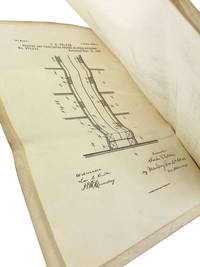
1887réf. 21386Washington: H. Peters 1887. Very Good. Washington: H. Peters 1887. Folio 30.5cm.; ribbon-bound engraved self-wrappers wax-sealed and accomplished in manuscript; 8ll. of photo-engraved plans printed on versos only followed by 3pp. text printed in double columns on rectos only. Previous mail folds extremities a bit chipped and toned ribbons slightly frayed else Very Good internally clean and sound. Signed by Acting Secretary of State D.L. Hawkins and Commissioner of Patents Burton J. Hall. Detailed patent application submitted by the Superintendent of the Chicago Bridewell Prison on September 13 1887. Charles E. Felton ca. 1832-1909 was the prison's longest serving overseer having held the position from its opening in 1872 until his retirement in 1890. Formerly a printer in Buffalo New York Felton entered the field of prison administration through the usual political platforms though he assumed his position in Chicago not through the usual channels but based on his previous experience serving as director of the Erie PA correctional facility. A Democrat and avid duck hunter with a rather unfocussed eye on the mayoralty of Chicago Felton was especially interested in enforcing labor in his prisons as a means of reducing costs and galvanizing individual reformation a position he clung to even past his retirement. The present patent submitted with steel manufacturer Herbert B. Streeter 1833-1919 offered substantial air circulation improvements for prisons "or other structures where the tiers of cells or dormitories have an open hall or corridor without separation by floors or otherwise." Previously the Chicago House of Corrections had just one small ventilating flue leaving the air "absolutely foul and poisonous." The plans depicted here show two foul air flues and one steam-coil heating device per cell as well as additional open air gratings for increased circulation. Though it is unclear whether the patent was ever approved Felton in an address delivered before the Prison Congress four years later complained that the increase in crime rates could be blamed in part on "the comfortable quarters" offered prospective convicted criminals. Also to blame "the present views of the public and acts of legislatures as to systems of prison labor and its ease to the prisoner.the quality of food; their the prisoners' easy access to visitation and the readiness with which a sympathetic public accepts as true the complaints of the prisoners" "Inter Ocean" newspaper October 14 1891. This patent submitted to improve the comfortable prison cells Felton so bemoaned an important document for students and historians of prison reform architecture and engineering. H. Peters unknown books
réf. BK0166Boston: Charles C. Little and James Brown 1847. 203 pp. 8vo. Original printed wrappers. Near Fine. An important contemporary attack on the Pennsylvania system of prison discipline and its use of prolonged cellular separation published during a heated national and international debate over the treatment of prisoners. Gray had served as vice-president of the Boston Prison Discipline Society and for several years chaired the board of directors of the Massachusetts State Prison. The book appeared amid the bitter 1846-47 controversy within the Boston Prison Discipline Society after Charles Sumner challenged the organization's longstanding hostility toward the Pennsylvania system. Sumner's intervention drew attention in Europe and correspondence from Alexis de Tocqueville; Gray answered from the opposing side with the present work. A later account specifically identified Prison Discipline in America as the principal American response taking a stand against the Pennsylvania system.1 Gray's argument rests heavily on comparative evidence from American prisons including statistics from the Massachusetts State Prison at Charlestown and Eastern State Penitentiary at Philadelphia. He regarded the higher rates of insanity and mortality under constant separation as evidence against the system concluding that it tended to "enfeeble the body and the mind." His observations became an enduring part of the literature on solitary confinement and continue to be cited in modern medical and legal discussions of its psychological effects. A particularly nice copy in near fine condition in the original wraps. 1 "RIVAL SYSTEMS OF PRISON DISCIPLINE. Speech before the Boston Prison Discipline Society at the Tremont Temple June 18 1847" in Charles Sumner. His Complete Works Lee and Shepard 1900 digitized by Project Gutenberg accessed October 8 2026 https://www.gutenberg.org/cache/epub/45473/pg45473-images.html. . Charles C. Little and James Brown unknown books
1887réf. 21386Washington: H. Peters 1887. Very Good. Washington: H. Peters 1887. Folio 30.5cm.; ribbon-bound engraved self-wrappers wax-sealed and accomplished in manuscript; 8ll. of photo-engraved plans printed on versos only followed by 3pp. text printed in double columns on rectos only. Previous mail folds extremities a bit chipped and toned ribbons slightly frayed else Very Good internally clean and sound. Signed by Acting Secretary of State D.L. Hawkins and Commissioner of Patents Burton J. Hall. Detailed patent application submitted by the Superintendent of the Chicago Bridewell Prison on September 13 1887. Charles E. Felton ca. 1832-1909 was the prison's longest serving overseer having held the position from its opening in 1872 until his retirement in 1890. Formerly a printer in Buffalo New York Felton entered the field of prison administration through the usual political platforms though he assumed his position in Chicago not through the usual channels but based on his previous experience serving as director of the Erie PA correctional facility. A Democrat and avid duck hunter with a rather unfocussed eye on the mayoralty of Chicago Felton was especially interested in enforcing labor in his prisons as a means of reducing costs and galvanizing individual reformation a position he clung to even past his retirement. The present patent submitted with steel manufacturer Herbert B. Streeter 1833-1919 offered substantial air circulation improvements for prisons "or other structures where the tiers of cells or dormitories have an open hall or corridor without separation by floors or otherwise." Previously the Chicago House of Corrections had just one small ventilating flue leaving the air "absolutely foul and poisonous." The plans depicted here show two foul air flues and one steam-coil heating device per cell as well as additional open air gratings for increased circulation. Though it is unclear whether the patent was ever approved Felton in an address delivered before the Prison Congress four years later complained that the increase in crime rates could be blamed in part on "the comfortable quarters" offered prospective convicted criminals. Also to blame "the present views of the public and acts of legislatures as to systems of prison labor and its ease to the prisoner.the quality of food; their the prisoners' easy access to visitation and the readiness with which a sympathetic public accepts as true the complaints of the prisoners" "Inter Ocean" newspaper October 14 1891. This patent submitted to improve the comfortable prison cells Felton so bemoaned an important document for students and historians of prison reform architecture and engineering. H. Peters unknown
réf. BK0166Boston: Charles C. Little and James Brown 1847. 203 pp. 8vo. Original printed wrappers. Near Fine. An important contemporary attack on the Pennsylvania system of prison discipline and its use of prolonged cellular separation published during a heated national and international debate over the treatment of prisoners. Gray had served as vice-president of the Boston Prison Discipline Society and for several years chaired the board of directors of the Massachusetts State Prison. The book appeared amid the bitter 1846-47 controversy within the Boston Prison Discipline Society after Charles Sumner challenged the organization's longstanding hostility toward the Pennsylvania system. Sumner's intervention drew attention in Europe and correspondence from Alexis de Tocqueville; Gray answered from the opposing side with the present work. A later account specifically identified Prison Discipline in America as the principal American response taking a stand against the Pennsylvania system.1 Gray's argument rests heavily on comparative evidence from American prisons including statistics from the Massachusetts State Prison at Charlestown and Eastern State Penitentiary at Philadelphia. He regarded the higher rates of insanity and mortality under constant separation as evidence against the system concluding that it tended to "enfeeble the body and the mind." His observations became an enduring part of the literature on solitary confinement and continue to be cited in modern medical and legal discussions of its psychological effects. A particularly nice copy in near fine condition in the original wraps. 1 "RIVAL SYSTEMS OF PRISON DISCIPLINE. Speech before the Boston Prison Discipline Society at the Tremont Temple June 18 1847" in Charles Sumner. His Complete Works Lee and Shepard 1900 digitized by Project Gutenberg accessed October 8 2026 https://www.gutenberg.org/cache/epub/45473/pg45473-images.html. . Charles C. Little and James Brown unknown
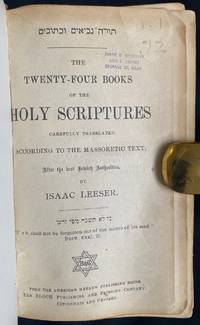
1880réf. 43529Cincinnati & Chicago: From the American Hebrew Publishing House the Bloch Publishing and Printing Company 1880. 1880s Preface is dated 1856. Original Full Leather binding with black & gilt spine label 12mo 2 leaves iii-xii 1243 pages. 17 cm. Title in Hebrew at head of title. Copyright page lists 1853 the copyright date for the first edition of Leeser's original translation of the Twenty Four Books of the Holy Scriptures published in 1854. The present Preface is dated Philadelphia 1856. The 1880s date is based on Singerman 3204 which notes the presence of the "undated 'Advertisement to the London Edition.' Repeated.in undated Bloch editions 1243 p. with acopyright date of 1853." Preceding the 1856 Preface is the undated 4-page "Advertisement to the London Edition" which notes that "This corrected version supplies an admitted want to our times. The so-called Authorized or Anglican version of the Scriptures.betrays great need for revision.Jews who of their own accord introduce the Anglican version into their households and who provide none other for the schools commit a flagrant breach of sacred trust in the abandonment of those for whose safe guidance they are immediately responsible to a helpless ignorance of truth-an ignorance all the more fatal because false interpreataions are obtruded in season and out of season with an unscrupulous object-to procure apostasy i.e. conversion from Judaism.Hence this version accomplished by a learned and conscientious Hebraist i.e. Leeser has found acceptance from all denominations. In the 10-page 1856 Preface Leeser explains in detail the need for his new translation giving many examples from earlier Christian translations of what we would today call "Christian bias." Leeser here acknowledges recent partial Jewish translations noting "Hitherto-at least before the completion of the first edition of this work two years ago-no other translation in the English had been completed by Jews although several had been commenced; for instance Dr. Raphall's and Mr. A. De Sola's and Mr Lindenthal's book of Genesis with Hebrew text and ample notes and Dr. Benische's version with Hebrew text to the end of the Second Book of Kings." OCLC 233529725 locates 4 copies worldwide U Illinois Andrews U Community of Christ MO UPenn of an "1853" edition published in "Cincinnati ; Chicago : from the American Hebrew Pub. House the Bloch Pub. and Print. Co." with 1243 pages and 17 cm high ours is 16 cm. However the OCLC listing notes neither the "Advertisement to the London Edition" nor Leeser's Preface of 1856 both of whose pagination does not affect that of the main text. Such was the enmity between Leeser and leaders of the Reform movement that it would seem surprising that Leeser would authorize a Bloch publication of his bible during his lifetime given that Bloch was owned by Isaac M. Wise' brother-in-law Edward Bloch. Only a year after the date of the preface in our copy Leeser famously printed an "anonymous attack on Wise signed 'Lawyers' in the pages of his Occident shortly after the appearance of Minhag Amerika in 1857. Leesers' anti-Reform rejoinder singled out Bloch & Co. for allegedly keeping its store open on the Jewish Sabbath and closing it on Sunday the Christian Sabbath." Singerman. In our Bloch copy the copyright is still held by Isaac Leeser; It was not until 1888 20 years after Leeser's death in 1868 that "his Bloch's firm obtained the copyright of this popular and frequently reprinted landmark text." Neither Singerman nor Goldman list any edition published by Bloch before 1884. Singerman Nr 1418 and Goldman Nr 13 both list a similar edition 1856 published in Philadelphia by C. Sherman & Son also with the 1856 Preface and identical pagination and physically smaller than the 1853 ed.with a new preface by Leeser." Goldman specifically writes that the "Advertisement to the London Edition" does not appear until an 1865 edition is "published in London in 5625 1865 by Trubner & Co. printed by John Childs and Son. Explaining the need for a new translation in the prefatory 'advertisement' the publisher criticized the standard King James Version authorized by the English Church for being flawed with 'abundant cases of false rendering' and 'propagandist tendencies.' They thus chose to issue Leeser's translation despite the existence of English translations by Christians because "this version accomplished by a learned and conscientious Hebraist has found acceptance from all denominations." This may be a previously unrecorded stereotype reissue of Trubner's London edition by Bloch issued with the 1853 Copyright date the 1856 Preface and the undated Advertisement though its mid-19th Century binding with black leather spine label would not be much later than 1880. Some pencil underlining to Advertisement and Preface with small owner's stamps and pulling as well. Gutter margin at title page is thin and crowds the title page text see photo. Spine reinforced with leather at edges boards show wear especially at corners but a solid Good Condition copy. A rare Leeser variant. B AMR-38-23. Cincinnati & Chicago: From the American Hebrew Publishing House, the Bloch Publishing and Printing Company unknown
1786réf. LFA-126725195Un ouvrage de 459 pages, format 105 x 165 mm, relié parchemin, publié en 1786, A Amsterdam Chez Henry Desbordes, bon état, rare
réf. 39374In-16 (156 x 100 mm), demi-chagrin noir (rel. "Belz, suc. Niedrée "), 15 pages. [Paris], De l’Imprimerie de Jean Petit (…), Jouxte la copie imprimée à Paris par Claude Monstr’œil, 1604.
1791réf. 20133Lyon, chez Rosset et Dombey, 1791 ; in-8 (215 mm), broché ; 60 pp., couverture d’attente bleu collée à une feuille de passe. (sign A-C8, D6).
2 volumes in-12, demi-maroquin rouge cerise de l’époque, dos lisses ornés de compartiments garnis d’un jeu de doubles filets et petits fers spéciaux répétés au centre, titre et tomaison dorés, tranches citron, viii, (2), 462 p. et (4), 422 p., portrait gravé en frontispice. Edition originale. Issu d'une famille de huguenots français réfugiés en Prusse, pasteur, professeur, journaliste, détenteur de la chaire de philosophie puis devenu doyen de l'Académie de Berlin, Johann Heinrich Samuel Formey (1711-1797) occupa une position clef dans l'Europe culturelle de son temps. Spécialiste et introducteur de Christian Wolff en France, défenseur modéré des Lumières, il fournit plusieurs articles à l'Encyclopédie (dont "Dieu") tout en entretenant des rapports parfois difficiles avec Voltaire et les Encyclopédistes. Cet ouvrage contient le recueil de vingt-deux essais philosophiques dont certains avaient paru séparément: la liberté, le sommeil, les songes ("l’un de ses écrits les plus remarquables"), le suicide, l'usure, la matière, le bonheur, les preuves de l'existence de Dieu, "la réformation de la justice", la "physique appliquée à la morale", etc. (Haag, V, p. 144, n° 54. Cf. E. Marcu, 'Un encyclopédiste oublié: J.-H.S. Formey'). Quelques brunissures et petites auréoles éparses. Bon exemplaire, bien relié à l’époque.
In-12, cartonnage marbré à la Bradel, titre doré (reliure signée Laurenchet), [16] feuillets, grande marque de titre sur bois à l’aigle couronné à deux têtes et lettrines historiées. Edition originale et unique. Humaniste et médecin italien mort à Florence, Paolo Giovio (1483-1552), en français Paul Jove, a été l'un des chroniqueurs et historiens les plus réputés de son temps. Il fut ainsi l’un des principaux chroniqueurs des guerres d'Italie et d’Allemagne à propos desquelles il livre ici ses réflexions sous forme de dialogues fictifs entre Arioviste, chef des Suèves et Jules César. Ces "Dialogues" sont suivis d’une lettre à Johann Friedrich I, le Magnanime, Prince Electeur de Saxe (en allemand Johann Friedrich I von Sachsen, der Großmütige) et à Philippe Ier de Hesse (Philipp I, Landgraf von Hessen). La brochure a été imprimée à Cologne (Köln) chez Jaspar von Gennep. (VD16 ZV 6636). Très bon exemplaire, très frais, grand de marges, très bien relié.
1547réf. 33100In-12, cartonnage marbré à la Bradel, titre doré (reliure signée Laurenchet), [16] feuillets, grande marque de titre sur bois à l’aigle couronné à deux têtes et lettrines historiées. S.l. [Köln, Jaspar von Gennep], 1547.
Paris: Parisiis, vaenundantur à Ponceto le Preux bibliopola Universitatis addicto, 1549. 4to. menor; 142 ff., 2 hs. Encuadernación de época, en piel, con gofrados en seco en los planos, con ligera pérdida en el extremo inferior exterior del plano superior.
Köln: Coloniae, excudebat Iaspar Gennepaeus, 1556. 8vo.; 8 hs., 655 pp. Encuadernación de época, en piel con gofrados en seco.
1850réf. 20201Paris, Julien, Lanier et Cie (Le Mans, imprimerie de Julien, Lanier), 1850 ; in-8, demi-chagrin bordeaux, dos lisse à faux nerfs dorés, titre doré (reliure de l’époque) ; X-511 pp.
2 parties en un volume in-8, plein veau, dos à 4 nerfs, plats ornés d'un jeu d'encadrement de filets à froid garnis d'un fleuron en écoinçons (rel. américaine de l'époque - full paneled contemporary american calf), (10), 220 p., (1) f., vi, 76 p., (1) f. errata. Edition originale (First edition) de cet ouvrage, selon A. Burckhardt: "Genève présentée aux Bostoniens". Né à Caen en 1692, Andrew Le Mercier, poursuivit ses études de théologie à Genève et embarqua pour l'Amérique où il devint pasteur à Boston à partir de 1715. The "Political and Geographical account…" has special title page and separate paging. "In 1729, French Protestant minister André Le Mercier worked, along with 13 other ministers, to create the Presbytery of Londonderry in New England. This was the first presbytery in New England and the only colonial presbytery that ever attracted a Huguenot minister (...). For some ministers Le Mercier offered an important bridge between Old and New World religious traditions. In 1732 le Mercier published [this] two-volume work (…). He was the only minister in all of New England with any direct knowledge of ecclesiastical and church practice in Calvin's home city, and he took special care to explain Geneva's parish system to his New England colleagues for whom formal parishes were becoming increasingly important in the eighteenth century" (Jon Butler, 'The Huguenots in America: A Refugee People in New World Society', Cambridge, Mass.: Harvard University Press, 1983, 88). (Cf. A. Burckhardt, in ‘Bull. de la Soc. de l'Hist. du Protestantisme Français’, 1991, p. 613-637. Brinley Sales, 7593. Early American Imprints, I, n°3557. Evans, 3596). Petit manque de papier en marge de la p. 27 de la deuxième partie avec perte de qqs caractères. Quelques rousseurs. Provenance: "Jos. Green, 1732" owner's signatures to title page and "The gift of Mr. Edward Jackson" handwritten from the same hand. Bel exemplaire conservé dans une reliure américaine de l'époque (A very nice early American binding in excellent condition).
réf. 363792 parties en un volume in-8, plein veau, dos à 4 nerfs, plats ornés d'un jeu d'encadrement de filets à froid garnis d'un fleuron en écoinçons (rel. américaine de l'époque - full paneled contemporary american calf), (10), 220 p., (1) f., vi, 76 p., (1) f. errata. Boston, New-England; Sold by S. Gerrish, and other Booksellers, 1732.