2 692 résultats
1867réf. BK0168Philadelphia: J. B. Chandler Printer 1867. 116 pp. 8vo. Original printed wrappers. Ex-library with small Massachusetts State Library stamp to title page; otherwise near fine. Very good. A late defense of the Pennsylvania system of prison discipline written as the model developed at Eastern State Penitentiary was increasingly becoming an exception among American prisons. The system kept inmates separated from one another both at work and at rest in contrast to the Auburn system which brought prisoners together for silent congregate labor during the day. Eastern State maintained the separate system from its opening in 1829 into the 1870s despite sustained criticism of its effects and lessened ability to keep prisoners separate in the first place due to overcrowding.1 Published as a defense of the Pennsylvania system of separate confinement the pamphlet appeared after the model associated with Eastern State Penitentiary had already been the subject of decades of criticism in the United States and abroad. The work is generally attributed to Richard Vaux son of the prominent Philadelphia prison reformer Roberts Vaux and himself a longtime advocate of the Pennsylvania system. By the time this edition appeared in 1867 separate confinement had lost ground nationally to the Auburn system of congregate labor making the pamphlet a late statement in defense of a model of incarceration closely identified with Philadelphia and Eastern State Penitentiary. 1 Ashley Theresa Rubin Institutionalizing the Pennsylvania System: Organizational Exceptionalism Administrative Support and Eastern State Penitentiary 1829-1875 PhD diss. University of California Berkeley 2013. . J. B. Chandler, Printer unknown books
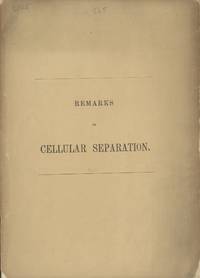
1861réf. BK0164Philadelphia: Publication Committee of the Philadelphia Society for Alleviating the Miseries of Public Prisons 1861. 112 pp. 8vo. Original printed wrappers. Wrappers frayed along spine otherwise near fine internally; very good overall. A defense of the Pennsylvania system of prison discipline advocating the separation of prisoners as a means of moral reform rather than punishment alone. The work was read by appointment before the American Association for the Improvement of Penal and Reformatory Institutions at its annual meeting in New York on November 29 1860 and published the following year by the Philadelphia Society for Alleviating the Miseries of Public Prisons. Foulke was one of Philadelphia's leading nineteenth-century prison reformers and a prominent defender of the system associated with Eastern State Penitentiary in which prisoners were housed separately. By 1860 the practice had become the subject of sustained criticism in the United States and Europe particularly over the psychological effects of prolonged isolation. Foulke takes up those objections at length arguing that cellular separation had been confused with punitive solitary confinement and presenting it instead as a carefully supervised regime intended to encourage reflection and rehabilitation. Foulke engages with Charles Dickens's celebrated attack on the Pennsylvania system after his 1842 visit to Eastern State Penitentiary reproducing and responding to Dickens's account. Published at a time when American penal institutions were becoming an international subject of study and controversy Remarks provides a substantial contemporary statement of the case for one of the country's most influential-and eventually most disputed-experiments in incarceration. . Publication Committee of the Philadelphia Society for Alleviating the Miseries of Public Prisons unknown books
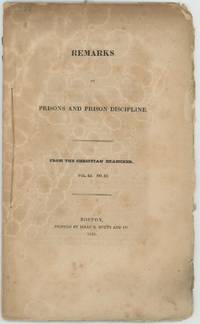
1826réf. BK0167Boston: Isaac R. Butts and Co 1826. 35 pp. 8vo. Original printed wrappers sewn. Wrappers toned and mottled with some edge wear; contents toned. Very good. An early American prison reform pamphlet attributed to Lewis Tappan by Sabin and by Tappan biographer Bertram Wyatt-Brown. Originally appearing in the Christian Examiner it was published separately in 1826 just as the penitentiary was becoming one of the central experiments of antebellum social reform. The essay describes the new system of discipline then being developed at Auburn and other American prisons: prisoners confined separately at night brought together for labor during the day under enforced silence and subjected to regular religious instruction. The arrangement was intended to prevent prisons from becoming schools of crime while replacing indiscriminate punishment with an organized program of labor surveillance and moral reform. The Boston Prison Discipline Society founded the previous year became the principal national advocate of this Auburn system and issued its first annual report in 1826. Its program called for separate cells productive employment religious and common-school instruction and the separation of youthful offenders from adults and habitual offenders.1 Tappan was still a Boston merchant when the pamphlet appeared several years before he became one of the founders of both the New York and American Anti-Slavery Societies in 1833 and later a leading organizer of the defense of the Amistad captives.2 1 Prison Discipline Society Boston Mass. records CC 1 Simmons College Archives Boston MA USA. 2 Lewis Tappan Papers Manuscript Division Library of Congress Washington D.C. https://hdl.loc.gov/loc.mss/eadmss.ms010139. . Isaac R. Butts and Co unknown books
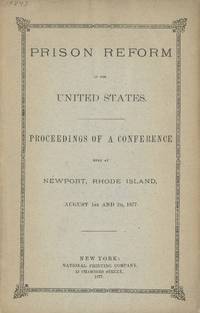
1877réf. BK0163New York: National Printing Company 1877. 8vo 56 pp. Original printed wrappers. "Compliments of Dr. Wines" slip affixed to title page. Near fine with a small tear to front wrapper at seam. Proceedings of an important national conference on prison reform organized around a program prepared by Enoch Cobb Wines the leading American prison reformer of the period. Wines had served as secretary of the New York Prison Association and was instrumental in organizing the landmark National Congress on Penitentiary and Reformatory Discipline at Cincinnati in 1870. The Newport conference met seven years later to formulate a practical system of penal institutions and policies that could be recommended to state legislatures. Much of the pamphlet is devoted to the conference's "Outline Draft of a System of Preventive Reformatory and Penitentiary Institutions and Discipline" which attempted to address criminal justice as a single system extending from childhood through incarceration. Its recommendations begin with compulsory education and institutions for neglected and delinquent children and proceed through reform schools houses of detention women's prisons county jails and state penitentiaries. The conference was particularly severe in its judgment of the existing jail system: "The county jails of the United States numbering about two thousand are with few exceptions schools of vice nurseries of crime and feeders of the penitentiaries. Their construction and management are alike bad; indeed the former is so radically defective as to render any good administration of them impossible." The conference occurred during a period when many of Wines's ideas were beginning to find practical application most notably at Elmira under Zebulon Brockway. Its recommendations ranged from compulsory education and separate institutions for juveniles and women to trained prison officers productive labor improved sanitation and greater state oversight. The "Compliments of Dr. Wines" slip gives this copy a nice association with the man chiefly responsible for both the conference and the program it produced. . National Printing Company unknown books
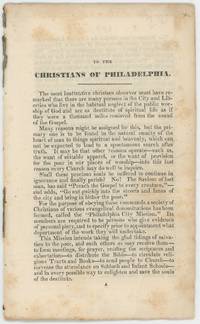
1831réf. BK0169Philadelphia: William F. Geddes 1831. 2 12 2 pp. Stitched pamphlet measuring 4 ¼ x 7 inches. Good plus with scattered foxing and soiling some wear to edges. An early appeal for organized missionary work among Philadelphia's urban poor issued upon the establishment of the Philadelphia City Mission in March 1831. The organization brought together Christians from several evangelical denominations to reach residents who rarely or never attended church. Its organizers acknowledged that poverty itself could prevent participation in religious life citing "the want of suitable apparel or the want of provision for the poor in our places of worship-into this last reason every Church may do well to inquire." The pamphlet begins by describing the large numbers of people living in Philadelphia and its surrounding districts who remained outside the ordinary reach of the churches: "The most inattentive christian observer must have remarked that there are many persons in the City and Liberties who live in the habitual neglect of the public worship of God and are as destitute of spiritual life as if they were a thousand miles removed from the sound of the Gospel." The Mission proposed to carry religious instruction directly into poorer neighborhoods through home visits prayer meetings the distribution of Bibles and tracts and efforts to increase attendance at Sabbath and infant schools. Its members were to be drawn from different evangelical denominations and required to demonstrate personal piety before undertaking missionary work. An interesting document of Philadelphia's early urban missionary movement particularly for its recognition of the economic and social barriers separating the city's poorer inhabitants from established religious institutions. . William F. Geddes unknown books
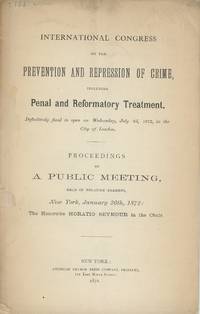
1872réf. BK0173New York: American Church Press Company 1872. Two pamphlets in original printed wrappers 6 x9 inches. Good to very good with toning light soiling and minor wear and chipping to wrappers. Two contemporary publications documenting American preparations for the International Prison Congress held in London in July 1872. Organized principally through the efforts of American prison reformer Enoch C. Wines the congress brought together representatives from Europe and the United States to discuss prison administration criminal punishment and methods of rehabilitation. The meeting followed the American National Prison Congress of 1870 whose declaration of principles had called for greater emphasis on the reformation of offenders. The first pamphlet International Congress on the Prevention and Repression of Crime Including Penal and Reformatory Treatment: Circular Letter Addressed to the National Committees in the Several Countries Proposing to Take Part in the Congress outlines arrangements for the approaching meeting. It calls upon participating countries to establish national committees prepare reports on their existing prison systems appoint delegates and suggest subjects and specialists for discussion. The second International Congress on the Prevention and Repression of Crime Including Penal and Reformatory Treatment: Proceedings of a Public Meeting Held in Relation Thereto New York January 26th 1872 records a meeting chaired by former New York governor Horatio Seymour. It includes addresses and correspondence concerning the proposed congress among them expressions of support from foreign representatives. The meeting formed part of Wines's efforts to secure international participation in the London gathering. OCLC locates six and three copies of each title respectively over multiple entries. . American Church Press Company unknown books
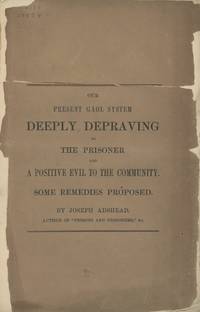
1847réf. BK0175Manchester: G. & A. Falkner Printers 1847. 107 pp. 8vo. Original printed brown wrappers with front wrapper detached and substantially torn and chipped but preserved. Some additional wear and soiling. Presentation inscription at the head of the title page reading "G. T. Bigelow Esq. / From the Author. Fair overall. An examination of British prison conditions by Joseph Adshead 1800-1861 a Manchester merchant social reformer and advocate of the separate system of imprisonment. Adshead had previously published Prisons and Prisoners 1845 in which he defended the Pennsylvania system against critics including Charles Dickens who had condemned solitary confinement following his visit to the United States. Adshead argues that the prevailing practice of confining prisoners together often without adequate separation by age offense or criminal history served to encourage further crime. He describes conditions at several prisons. The presentation inscription is of particular interest. The recipient appears to be George Tyler Bigelow 1810-1878 the Massachusetts attorney and later Chief Justice of the Massachusetts Supreme Judicial Court. In 1844 Bigelow and George Bemis defended Abner Rogers Jr. a prisoner charged with murdering Charles Lincoln Jr. the warden of the Massachusetts State Prison. Rogers was acquitted on the grounds of insanity in a widely discussed case that raised questions about criminal responsibility and the mental condition of prisoners. The presentation of Adshead's work to Bigelow suggests a connection between two men involved in contemporary debates over prisons and their administration. . G. & A. Falkner, Printers unknown books
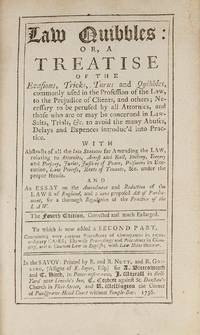
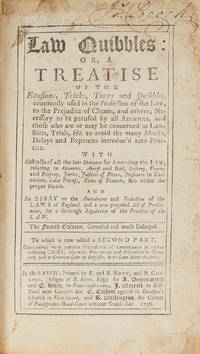
1736réf. 857121736. London 1736. Fourth & final edition. London 1736. Fourth & final edition. A Spirited Call for Reform: A Layman's Guide to Law's "Evasions Tricks Turns and Quibbles" Legal Criticism. Law Reform. Great Britain. Law Quibbles: Or A Treatise of the Evasions Tricks Turns and Quibbles Commonly Used in the Profession of the Law To the Prejudice of Clients And Others; Necessary to be Perused by All Attornies And Those Who Are or May be Concerned in Law Suits Trials &c. To Avoid the Many Abuses Delays and Expences Introduc'd into Practice. With Abstracts of All the Late Statutes for Amending the Law Relating to Attornies Arrest and Bail Bribery Forgery and Perjury Juries Justices of Peace Prisoners in Execution Law Process Rents of Tenants &c. Under the Proper Heads. And an Essay on the Amendment and Reduction of the Laws of England And a New Proposed Act of Parliament For a Thorough Regulation of the Practice of the Law. Corrected and much Enlarged. To Which is Now Added a Second part Containing Every Curious Precedents of Conveyances in Extraordinary Cases; Likewise Proceedings and Precedents in Chancery And at Common Law in English; With Law-Notes Thereon. London: Printed by E. and R. Nutt and R. Gosling 1736. viii 72 132 135 13 pp. With an index and advertisement leaf. Collated and complete. Octavo 7-3/4" x 4-1/2"; 19.6 x 11.8 cm. Contemporary calf blind rules to boards blind fillets along joints raised bands and lettering piece to spine gilt tooling to board edges. Moderate rubbing to boards light wear to extremities joints starting at head chip to center of lettering piece spine ends lightly abraded small vertical surface crack to spine hinges cracked. Light toning to interior crack in text block between pp. 78 & 79 all leaves secure occasional small faint dampstains at page edges. Early owner signature of Thomas Winter dated 1781 to front pastedown. A good sound copy of a scarce and engaging title. $750. Fourth and final edition significantly expanded. First published in 1724 Law Quibbles is a lively and sharply critical guide to the procedural artifices and technical maneuvers of the English legal profession. Designed for the lay reader as much as the practitioner it functions both as a satirical expose and as a practical survival manual for navigating 18th-century litigation. The first part presents an alphabetical "dic. unknown books
1736réf. 856711736. London 1736. Fourth & final edition. London 1736. Fourth & final edition. A Reform-Oriented Layman's Guide to Law's "Evasions Tricks Turns and Quibbles" Legal Criticism. Law Reform. Great Britain. Law Quibbles: Or A Treatise of the Evasions Tricks Turns and Quibbles Commonly Used in the Profession of the Law To the Prejudice of Clients And Others; Necessary to be Perused by All Attornies And Those Who Are or May be Concerned in Law Suits Trials &c. To Avoid the Many Abuses Delays and Expences Introduc'd into Practice. With Abstracts of All the Late Statutes for Amending the Law Relating to Attornies Arrest and Bail Bribery Forgery and Perjury Juries Justices of Peace Prisoners in Execution Law Process Rents of Tenants &c. Under the Proper Heads. And an Essay on the Amendment and Reduction of the Laws of England And a New Proposed Act of Parliament For a Thorough Regulation of the Practice of the Law. Corrected and much Enlarged. To Which is Now Added a Second part Containing Every Curious Precedents of Conveyances in Extraordinary Cases; Likewise Proceedings and Precedents in Chancery And at Common Law in English; With Law-Notes Thereon. London: Printed by E. and R. Nutt and R. Gosling 1736. viii 132 135 13 72 pp. An Essay on the Amendment and Reduction of the Laws of England bound at rear text complete. Octavo 8" x 4-1/2"; 20.2 x 11.5 cm. Modern quarter calf over marbled boards lettering piece to spine endpapers renewed. Some fading to spine negligible light shelfwear to extremities. Moderate toning to interior occasional light foxing light soiling in a few places light edgewear to first and last several leaves first four leaves reinforced at edges on verso reinforcement just touching text on one page without loss early owner signature of James Pocock to head of title page. A good copy. $650. Fourth and final edition substantially expanded. First issued in 1724 Law Quibbles occupies a distinctive place in the history of English legal literature as a hybrid work combining satire procedural commentary statutory digest practical precedent book and reform tract. The first part presents an alphabetical exposition of procedural stratagems tactical evasions and professional "mysteries" attributed to legal practitioners. Framed for both attorneys and lay litigants it documents contemporary perceptions of delay expense and pr. unknown books
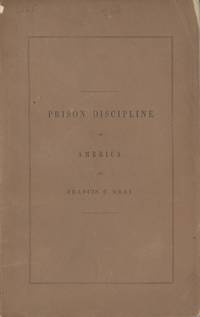
réf. BK0166Boston: Charles C. Little and James Brown 1847. 203 pp. 8vo. Original printed wrappers. Near Fine. An important contemporary attack on the Pennsylvania system of prison discipline and its use of prolonged cellular separation published during a heated national and international debate over the treatment of prisoners. Gray had served as vice-president of the Boston Prison Discipline Society and for several years chaired the board of directors of the Massachusetts State Prison. The book appeared amid the bitter 1846-47 controversy within the Boston Prison Discipline Society after Charles Sumner challenged the organization's longstanding hostility toward the Pennsylvania system. Sumner's intervention drew attention in Europe and correspondence from Alexis de Tocqueville; Gray answered from the opposing side with the present work. A later account specifically identified Prison Discipline in America as the principal American response taking a stand against the Pennsylvania system.1 Gray's argument rests heavily on comparative evidence from American prisons including statistics from the Massachusetts State Prison at Charlestown and Eastern State Penitentiary at Philadelphia. He regarded the higher rates of insanity and mortality under constant separation as evidence against the system concluding that it tended to "enfeeble the body and the mind." His observations became an enduring part of the literature on solitary confinement and continue to be cited in modern medical and legal discussions of its psychological effects. A particularly nice copy in near fine condition in the original wraps. 1 "RIVAL SYSTEMS OF PRISON DISCIPLINE. Speech before the Boston Prison Discipline Society at the Tremont Temple June 18 1847" in Charles Sumner. His Complete Works Lee and Shepard 1900 digitized by Project Gutenberg accessed October 8 2026 https://www.gutenberg.org/cache/epub/45473/pg45473-images.html. . Charles C. Little and James Brown unknown books
1940réf. 47622Pasadena: San Pasqual Press 1940. First Edition. Octavo 23.5cm; royal blue cloth with printed title labels mounted to spine and front cover; dustjacket; xii1551pp. Spine ends gently nudged else Fine in a Near Fine dustjacket unclipped priced $2 gently spine-sunned with some trivial wear to extremities and a few tiny tears. A "brilliant and pitiless exposé of our haywire piratical monetary system" from front flap in which the author points out the defects in our monetary system and analyzing various reform proposals. Hale 1859-1944 a California educator research-worker and former Democratic nominee for the U.S. Senate was a major crusader for monetary reform known for her anti-suffrage and anti-vaccine activities. OCLC notes 15 holdings. San Pasqual Press unknown books
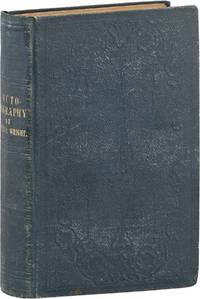
1849réf. 86600Boston: Bela Marsh 1849. First Edition. First printing. Octavo 18.5cm. Publisher's green embossed cloth titled in gilt; pale salmon endpapers; 414pp; mezzotint portrait frontispiece. A quite attractive copy just lightly rubbed to boards with a few scattered spots of foxing to text; solidly Very Good overall and somewhat uncommon thus. A significant if entirely idiosyncratic work in the annals of American radical reform as much a philosophical treatise as an autobiography. American pacifist freethinker feminist and abolitionist Henry Clarke Wright 1797-1870 though little remembered was among the most interesting radical voices of the mid-19th century a defrocked Presbyterian minister who in his adopted role as a "Christian reformer" preached against all established religions and adopted a thoroughly stridently contrarian voice in nearly every field of social reform he touched which was practically all of them. His views opposing established government put him directly in the line of such individualist anarchists as Lysander Spooner and Benjamin Tucker while his opposition to slavery was so uncompromising that he was ejected from the American Antislavery Society in 1837. He remained closely associated with most of the New England radical abolitionist community however especially with William Lloyd Garrison with whom he frequently collaborated. Like most of Wright's commercially-issued works this one was published by the Boston radical publisher Bela Marsh known for disseminating works by fellow abolitionists and freethinkers during the antebellum period. 86600. Bela Marsh unknown books
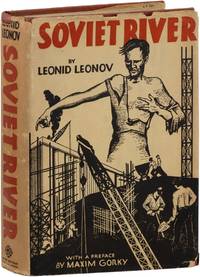
1932réf. 84363New York: Dial Press; Lincoln Mac Veagh 1932. First American Edition. Octavo. 19.5cm. Original deep red cloth titled in black to spine with embossed publisher's imprint to front board. Dustjacket. 383pp. Bumped to spine ends with some minor wear to corners some minor darkening to the cloth in places; internally clean fore-edge untrimmed top edge a trifle dusty; in the John Gram dustjacket with some toning to the spine panel shallow chipping and loss to the spine ends intruding upon the author's first name and a short closed tear to the front upper front spine hinge. A good strong copy with some wear. Leonov's novel of Soviet labor centred around the building of an enormous factory; Sotstroy. Gorky provides the preface; the novel was notable at the time as an antidote to the image of the USSR as an enormous generator of plans progress noble artistic and industrial endeavor and a shining beacon of energy. Leonov tends towards a more on the ground depiction of enthusiastic ineptitude paranoia and fanaticism. Bookplate of Alvin Kapusta to front pastedown a Special Assistant for Soviet Nationalities at the US State Department and a notable scholar of the Soviet Bloc whose collections are housed at the Hoover Institution. Dial Press; Lincoln Mac Veagh unknown books
1832réf. 84913London: Effingham Wilson 1832. A New Edition Greatly Enlarged and Corrected. Octavo. 23cm. Bound in later rather institutional black buckram with paper title label. 16pp. ads to front matter; xxxii; 683pp. 1pp ads to rear. Minor wear and bumping to extremities with a little rippling of the cloth to the front board strong and tight; internally clean later endpapers ink ownerships to front flyleaf frontispiece portrait "Friends of Reform - Foes of Revolution" quite heavily spotted with some offsetting to the title page edges untrimmed some occasional light spotting within. A very good copy in a later binding of a rather unwieldy work. A later printing of Wade's incendiary 1820 catalog of abuses performed by the Church The King the Government and various business interests against the people security and progress of Great Britain. A continued bestseller demonstrating a fervent appetite on the part of the British public to read Wade's excoriating denunciation of the upper classes and their merely wealthy counterparts. On a number of fronts this public airing of secretly dirty laundry met with some political and social success and led to some very public gestures at reform. Effingham Wilson unknown books
réf. 57805Original illuminated document on parchment; hand-lettered in italic with gilt illuminations at upper left and right margins; signed beneath work by the calligrapher "E. von E." unidentified. With original signatures of 71 board members and staff of the Henry Street Settlement. Mild soil at margins; Near Fine. A handsome hand-lettered tribute to outgoing President of the Board of the Henry Street Settlement Newbold Morris. Morris 1902-1966 was an important figure in Henry Street history assuming the board presidency soon after the reorganization of the Settlement under Director Helen Hall in 1944. Morris also played a prominent role in New York City planning and politics during the Robert Moses era; he was among the more prominent members of the New York Planning Commission; was President of the City Council from 1938 to 1945 and an unsuccessful candidate for Mayor in 1945 and 1949. Later in 1961 Morris achieved some notoriety as the City Parks Commissioner when he rejected the permits of hundreds of folk musicians who had been performing in Washington Square Park sparking the so-called "Beatnik Riot" one of the opening salvos of Sixties countercultural activism. The document is undated but expresses appeciation for Morris's "completion of a decade of service" placing it in the vicinity of 1954-5. Beneath the calligraphic portion the document has been signed by seventy-one individuals including fellow board-members staff and residents. These include a host of prominent mid-century New York figures beginning with Hall herself and including the prominent civic leader Nicholas Kelley; choreographer Alwin Nikolais; economist Mary Keyserling; painter Jack Levine; long-time Henry Street youth worker Ralph Tefferteller and many others. A unique and visually attractive artifact marking the mid-century apex of one of the most successful and long-lived social welfare projects in New York. unknown books
1915réf. 63968Chicago: by the Author 1915. First Edition. 12mo. Staple-bound pamphlet. Printed pink paper wrappers; 48pp. Mild toning and wear to wrappers; internally clean sound and unmarked; Very Good. A somewhat scarce and early work by the Chicago medical doctor and Socialist Party organizer. Advocates the abolition of currency to be replaced with a system of social credit and labor checks. by the Author unknown books
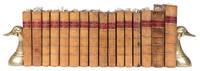
1901réf. 726361901. in 16 volumes. in 16 volumes. A Remarkable Collection of Nineteenth-Century Works on Legal Reform and International Law Compiled by a Notable Scottish Lawyer Great Britain. Law Reform. Murray David 1842-1928. The David Murray Collection of Law Reform and International Law. 16 volumes. 155 titles. Various paginations. Octavo Vols. 1-15: 8-1/2" x 5" 21.6 x 12.7 cm; Vol. 16: 9-1/4" x 6" 23.5 x 15.25 cm. Contemporary three-quarter calf over marbled boards gilt-stamped insignia of the Royal Faculty of Procurators Glasgow to front boards blind rules to joint edges and corners raised bands and lettering piece to spines marbled edges and endpapers presentation bookplate from David Murray to the Faculty dated April 29 1902 to front pastedown of first volume. Light rubbing to boards light residue from leather treatment occasional scuffs nicks scratches and spots to boards and extremities which are more moderately rubbed with darkening in a few places some lettering pieces loose but secure cracking to spines of Volumes 14-16 boards of Volume 1 detached front joint of Volume 2 starting at foot joints of Volume 16 starting at ends. Volumes 1 5 6 7 9 10 and 13 have descriptions of their contents in Murray's hand to their half-titles. A remarkable handsomely bound collection. A COMPLETE LIST OF TITLES IS INCLUDED AMONG THE PHOTOS ASSOCIATED WITH THIS LISTING. $7000. This collection pertains chiefly to the subjects of law reform and international law. It was formed during the nineteenth century by the notable Scottish lawyer bibliophile and antiquary David Murray who presented it to the Library of the Royal Faculty of Procurators in Glasgow in 1902. As indicated by the contents which span almost the entire nineteenth century Murray had long possessed a sustaining interest in law reform. Many titles touch upon the numerous areas of law that were dramatically reformed during the 1800s including bankruptcy law conveyancing and real property law judicial administration chancery and equity and to a lesser extent codification criminal law and jurisprudence. Many of the works are presentation copies inscribed to other well-known international lawyers and reformers of the nineteenth century among them Sir Travers Twiss Sir John Connell and Edwin Wilkins Field. Among the authors themselves are John Austin Basil Mont. unknown books
1883réf. 727291883. London 1883. London 1883. The "Annual Blister" of Victorian Law: A Scarce 1883 Reformist Tract on the Deceased Wife's Sister Controversy Marriage Law Reform Association. A Summary of the Chief Arguments For and Against Marriage With A Deceased Wife's Sister. London: Marriage Law Reform Association 1883. 15 1 pp. Octavo 8-1/4" x 5-1/2". Stab-stitched pamphlet in self wrappers. Light toning negligible edgewear light foxing in a few places. $350. Third and final edition. A scarce reformist tract representing one of the most protracted legal and social battles of the Victorian era. The Marriage Law Reform Association was established in 1851 to overturn Lord Lyndhurst's Marriage Act of 1835 which codified the prohibition of marriage between a widower and his sister-in-law. This restriction was rooted in the theological "one flesh" doctrine of affinity which legally equated a wife's sister with a blood sister. The controversy often dubbed the "annual blister" due to its near-yearly debate in Parliament highlighted a sharp class divide; while the wealthy could travel abroad to marry the working classes-who relied on sisters-in-law for domestic stability-were forced into "legalized concubinage." The debate permeated Victorian culture appearing in works ranging from Gilbert and Sullivan's Iolanthe to the novels of Dinah Craik. This edition captures the height of the Association's campaign which eventually succeeded with the passage of the Deceased Wife's Sister's Marriage Act in 1907. Sweet & Maxwell A Legal Bibliography of the British Commonwealth of Nations Vol. 2 p. 224. unknown books
1831réf. 56386London: Effingham Wilson 1831. Octavo 22.5cm. Later half brown calf purple cloth over boards and subsequently rebacked with brown calf reinforcements to corners top edge stained other edges sprinkled red; orange endpapers; xx576pp. Lacking frontispiece. Externally worn but skilfully repaired internally clean with occasional spots of foxing: Very Good. A key text of early nineteenth-century English parliamentary reformers: "a massive compendium of all the abuses electoral ecclesiastical legal" that they "sought to abolish. . . its emphasis on the need to have practical as well as equitable representation lies at the root of parliamentary democracy." The book "passed through edition after edition continually augmented with new arguments new reports of abuses and new statistics"; this 1831 edition "was the most influential coming as it did on the eve of the Reform Bill 1832" Printing and the Mind of Man p.180. PMM296. GOLDSMITHS 23071. KRESS C.638. Effingham Wilson unknown books
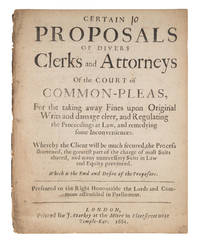
1661réf. 724361661. A Scarce Restoration-Era Pamphlet Proposing Reforms to Court Procedure Law Reform. Great Britain. Certain Proposals of Divers Clerks and Attorneys of the Court of Common-Pleas For the Taking Away Fines upon Original Writs and Damage Cleer And Regulating the Proceedings at Law And Remedying Some Inconveniences. Whereby the Client Will be Much Secured The Process Shortened The Greatest Part of the Charge of Most Suits Abated And Many Unnecessary Suits in Law and Equity Prevented. Which is the End and Desire of the Proposers. Presented to the Right Honourable the Lords and Commons Assembled in Parliament. London: Printed for J. Starkey at the Mitre in Fleetstreet near Temple-Bar 1661. vi 8 pp. Quarto 7" x 5-1/2". Disbound stab-stitched pamphlet. Moderate toning soiling to exterior light browning to margins "10" in early hand to head of title page. $450. Only edition. Produced by a "divers" group of "clerks and attorneys of the Court of Common-Pleas" this pamphlet suggests ways to reform pleading and procedure and reduce the number of lawsuits in the civil and equity courts. This is a scarce title. OCLC locates 6 copies 4 in law libraries Harvard Library of Congress San Francisco Law Library Yale. English Short-Title Catalogue R35481. unknown books
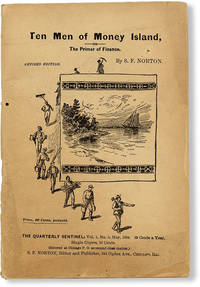
1902réf. 54696Girard KS: Appeal Publishing Company 1902. Revised Edition. Octavo 18.75cm; original pictorial wrappers; 56-96pp; illus. Light wear and toning to spine and wrapper extremities with shallow loss to base of spine a short split to upper spine and some faint creasing to upper right corners; Very Good. A tax reform utopia originally published serially in the Chicago Sentinel between 1879 and 1885 and subsequently in pamphlet format by Norton in 1892 which sold over a hundred thousand copies. Ten Men of Money Island was variously reprinted even as late as 1930 including editions by Wayland's Appeal to Reason the London utopian publisher Reeves and the Chicago publisher F.J. Schulte. SARGENT p.45 citing only the London ed. Not in Negley or Lewis and not found in Wright. Appeal Publishing Company unknown books
1972réf. 46484Washington: National Welfare Rights Organization n.d. but 1972. Strike placard comprised of original photographic poster 43x28cm. printed offset in purple and black on white stock stapled to pastepaper board hole-punched and threaded with thick string for hanging around neck. Extremities rather chipped and bottom edge slightly curled poster rather dust-soiled else Good or better with clear evidence of use. Placard featuring a poster protesting H.R.1 and the "D.C. Four Against the Poor" President Richard Nixon Senator from Connecticut Abraham Ribicoff Congressman from Arkansas Wilbur Mills and Senator from Louisiana Russell Long. Adorned with their photographic portraits below which is printed "These men are dangerous!!! They have conspired to starve children destroy families force women into slavery and exploit poor people -- all in the name of 'Welfare Reform.' STOP THESE MEN!" The placard was presumably worn at the NWRO-sponsored "Children's March for Survival" on March 25 in Washington D.C. The parade which consisted of over 50000 participants more than half of them children was led by Jesse Jackson and NRWO's leader George Wiley and included speakers Bella Abzug and Corettaa Scott King with her two daughters. The poster used here not separately catalogued in OCLC as of October 2019. National Welfare Rights Organization unknown books
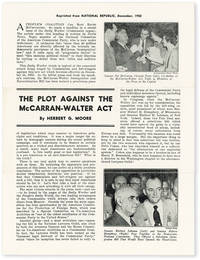
1952réf. 51262Los Angeles: Freedom Clubs 1952. Offprint. Quarto 11" x 8-1/2"; bifolium; 4pp. Two horizontal mailing folds as issued else Fine. Reprinted from the December 1952 issue of the National Republic. Right-wing attack on attempts to block passage of the McCarran-Walter Immigration Act which established immigration restrictions in order to ". safeguard the country from communism "Jewish interests" and undesirables . deemed as external threats to national security" REF: Marinari. "Divided and Conquered: Immigration Reform Advocates and the Passage of the 1952 Immigration and Nationality Act." Journal of American Ethnic History vol. 35 no. 3 Spring 2016. Freedom Clubs unknown books
1894réf. 48920Chicago: By the Author 1894. Revised Edition. 12mo 20cm; original pictorial wrappers stapled; 931pp; illus. Text is tanned and a bit brittle at the edges neat splits to front wrapper above and below the staples with several tiny tears and a few slivers missing from wrapper extremities particularly at preliminary and terminal leaves; Good complete copy. A tax reform utopia originally published serially in the Chicago Sentinel between 1879 and 1885. An author's note at base of title page states: ".it was then published in cheap pamphlet form - of which over a hundred thousand copies have since been sold. Its popularity as an educator seems to warrant the present better and more expensive edition." Issued as Vol. I no. 1 in Norton's Quarterly Sentinel apparently a successor to his weekly newspaper of the same name. No further numbers of the Quarterly appear to have been issued. Ten Men of Money Island was variously reprinted even as late as 1930 including editions by Wayland's Appeal to Reason the London utopian publisher Reeves and the Chicago publisher F.J. Schulte. SARGENT p.45 citing only the London ed. Not in Negley or Lewis and not found in Wright. By the Author unknown books
1872réf. 30317Philadelphia: Published for the Industrial League by Henry Carey Baird 1872. First Edition. Octavo 23.5cm.; disbound from larger volume with remnants of cloth spine still present; 96pp.; frontispiece full-page illus. throughout. Very faint previous vertical fold else Very Good and fresh. The title story is a satirical utopia intended to discredit supporters of laissez-faire economics and the Free-Trade League in particular. LEWIS p. 57; SARGENT p. 29; not in NEGLEY. Published for the Industrial League by Henry Carey Baird unknown books