2 782 résultats
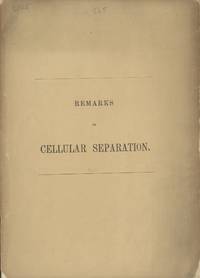
1861réf. BK0164Philadelphia: Publication Committee of the Philadelphia Society for Alleviating the Miseries of Public Prisons 1861. 112 pp. 8vo. Original printed wrappers. Wrappers frayed along spine otherwise near fine internally; very good overall. A defense of the Pennsylvania system of prison discipline advocating the separation of prisoners as a means of moral reform rather than punishment alone. The work was read by appointment before the American Association for the Improvement of Penal and Reformatory Institutions at its annual meeting in New York on November 29 1860 and published the following year by the Philadelphia Society for Alleviating the Miseries of Public Prisons. Foulke was one of Philadelphia's leading nineteenth-century prison reformers and a prominent defender of the system associated with Eastern State Penitentiary in which prisoners were housed separately. By 1860 the practice had become the subject of sustained criticism in the United States and Europe particularly over the psychological effects of prolonged isolation. Foulke takes up those objections at length arguing that cellular separation had been confused with punitive solitary confinement and presenting it instead as a carefully supervised regime intended to encourage reflection and rehabilitation. Foulke engages with Charles Dickens's celebrated attack on the Pennsylvania system after his 1842 visit to Eastern State Penitentiary reproducing and responding to Dickens's account. Published at a time when American penal institutions were becoming an international subject of study and controversy Remarks provides a substantial contemporary statement of the case for one of the country's most influential-and eventually most disputed-experiments in incarceration. . Publication Committee of the Philadelphia Society for Alleviating the Miseries of Public Prisons unknown
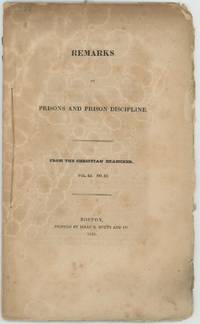
1826réf. BK0167Boston: Isaac R. Butts and Co 1826. 35 pp. 8vo. Original printed wrappers sewn. Wrappers toned and mottled with some edge wear; contents toned. Very good. An early American prison reform pamphlet attributed to Lewis Tappan by Sabin and by Tappan biographer Bertram Wyatt-Brown. Originally appearing in the Christian Examiner it was published separately in 1826 just as the penitentiary was becoming one of the central experiments of antebellum social reform. The essay describes the new system of discipline then being developed at Auburn and other American prisons: prisoners confined separately at night brought together for labor during the day under enforced silence and subjected to regular religious instruction. The arrangement was intended to prevent prisons from becoming schools of crime while replacing indiscriminate punishment with an organized program of labor surveillance and moral reform. The Boston Prison Discipline Society founded the previous year became the principal national advocate of this Auburn system and issued its first annual report in 1826. Its program called for separate cells productive employment religious and common-school instruction and the separation of youthful offenders from adults and habitual offenders.1 Tappan was still a Boston merchant when the pamphlet appeared several years before he became one of the founders of both the New York and American Anti-Slavery Societies in 1833 and later a leading organizer of the defense of the Amistad captives.2 1 Prison Discipline Society Boston Mass. records CC 1 Simmons College Archives Boston MA USA. 2 Lewis Tappan Papers Manuscript Division Library of Congress Washington D.C. https://hdl.loc.gov/loc.mss/eadmss.ms010139. . Isaac R. Butts and Co unknown
1903réf. 52594Rockford IL: Calvert-Wilson Co. Press 1903. 12mo. 95 1 pp. Two photo plates 1 floor plan. Olive-green pictorial publisher’s cloth w/ iron jail cell gate in white on front cover white lettering NF copy signed by Lewis on ffep. First edition signed of this fascinating anthology of writings and poetry advocating penal reform including excerpts from Clarence Darrow’s Resist Not Evil. Lewis 1857-1949 was a cigar store owner in Rockford IL and local gadfly who supported “socialist” causes like prison reform and free parks. This work was published by the author to encourage the Rockford city fathers to construct a new jail which was subsequently built at First and Walnut. Calvert-Wilson Co. Press, hardcover
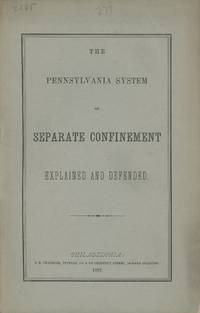
1867réf. BK0168Philadelphia: J. B. Chandler Printer 1867. 116 pp. 8vo. Original printed wrappers. Ex-library with small Massachusetts State Library stamp to title page; otherwise near fine. Very good. A late defense of the Pennsylvania system of prison discipline written as the model developed at Eastern State Penitentiary was increasingly becoming an exception among American prisons. The system kept inmates separated from one another both at work and at rest in contrast to the Auburn system which brought prisoners together for silent congregate labor during the day. Eastern State maintained the separate system from its opening in 1829 into the 1870s despite sustained criticism of its effects and lessened ability to keep prisoners separate in the first place due to overcrowding.1 Published as a defense of the Pennsylvania system of separate confinement the pamphlet appeared after the model associated with Eastern State Penitentiary had already been the subject of decades of criticism in the United States and abroad. The work is generally attributed to Richard Vaux son of the prominent Philadelphia prison reformer Roberts Vaux and himself a longtime advocate of the Pennsylvania system. By the time this edition appeared in 1867 separate confinement had lost ground nationally to the Auburn system of congregate labor making the pamphlet a late statement in defense of a model of incarceration closely identified with Philadelphia and Eastern State Penitentiary. 1 Ashley Theresa Rubin Institutionalizing the Pennsylvania System: Organizational Exceptionalism Administrative Support and Eastern State Penitentiary 1829-1875 PhD diss. University of California Berkeley 2013. . J. B. Chandler, Printer unknown
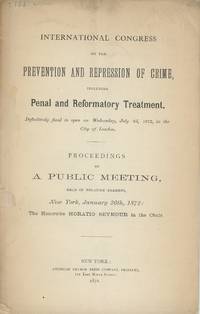
1872réf. BK0173New York: American Church Press Company 1872. Two pamphlets in original printed wrappers 6 x9 inches. Good to very good with toning light soiling and minor wear and chipping to wrappers. Two contemporary publications documenting American preparations for the International Prison Congress held in London in July 1872. Organized principally through the efforts of American prison reformer Enoch C. Wines the congress brought together representatives from Europe and the United States to discuss prison administration criminal punishment and methods of rehabilitation. The meeting followed the American National Prison Congress of 1870 whose declaration of principles had called for greater emphasis on the reformation of offenders. The first pamphlet International Congress on the Prevention and Repression of Crime Including Penal and Reformatory Treatment: Circular Letter Addressed to the National Committees in the Several Countries Proposing to Take Part in the Congress outlines arrangements for the approaching meeting. It calls upon participating countries to establish national committees prepare reports on their existing prison systems appoint delegates and suggest subjects and specialists for discussion. The second International Congress on the Prevention and Repression of Crime Including Penal and Reformatory Treatment: Proceedings of a Public Meeting Held in Relation Thereto New York January 26th 1872 records a meeting chaired by former New York governor Horatio Seymour. It includes addresses and correspondence concerning the proposed congress among them expressions of support from foreign representatives. The meeting formed part of Wines's efforts to secure international participation in the London gathering. OCLC locates six and three copies of each title respectively over multiple entries. . American Church Press Company unknown
réf. 5761In folio, relié d'ép. pl. peau, rel à 5 nerfs, deux pièces de titre, un filet d'encadrement sur les plats, fleuron central repoussé sur chaque plat, coiffes bonnes, mors solides. Ouvrage peu manié, bien conservé, intérieur trés frais. 32 pp ; Impression du dictionnaire sur 2 col. (1 à 1624) ; Notes de David Hoeschel : 2 col. : 1 à 104 ; Index Rerum... 23 pp ; 2 p
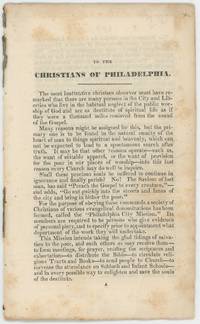
1831réf. BK0169Philadelphia: William F. Geddes 1831. 2 12 2 pp. Stitched pamphlet measuring 4 ¼ x 7 inches. Good plus with scattered foxing and soiling some wear to edges. An early appeal for organized missionary work among Philadelphia's urban poor issued upon the establishment of the Philadelphia City Mission in March 1831. The organization brought together Christians from several evangelical denominations to reach residents who rarely or never attended church. Its organizers acknowledged that poverty itself could prevent participation in religious life citing "the want of suitable apparel or the want of provision for the poor in our places of worship-into this last reason every Church may do well to inquire." The pamphlet begins by describing the large numbers of people living in Philadelphia and its surrounding districts who remained outside the ordinary reach of the churches: "The most inattentive christian observer must have remarked that there are many persons in the City and Liberties who live in the habitual neglect of the public worship of God and are as destitute of spiritual life as if they were a thousand miles removed from the sound of the Gospel." The Mission proposed to carry religious instruction directly into poorer neighborhoods through home visits prayer meetings the distribution of Bibles and tracts and efforts to increase attendance at Sabbath and infant schools. Its members were to be drawn from different evangelical denominations and required to demonstrate personal piety before undertaking missionary work. An interesting document of Philadelphia's early urban missionary movement particularly for its recognition of the economic and social barriers separating the city's poorer inhabitants from established religious institutions. . William F. Geddes unknown books
1831réf. BK0169Philadelphia: William F. Geddes 1831. 2 12 2 pp. Stitched pamphlet measuring 4 ¼ x 7 inches. Good plus with scattered foxing and soiling some wear to edges. An early appeal for organized missionary work among Philadelphia's urban poor issued upon the establishment of the Philadelphia City Mission in March 1831. The organization brought together Christians from several evangelical denominations to reach residents who rarely or never attended church. Its organizers acknowledged that poverty itself could prevent participation in religious life citing "the want of suitable apparel or the want of provision for the poor in our places of worship-into this last reason every Church may do well to inquire." The pamphlet begins by describing the large numbers of people living in Philadelphia and its surrounding districts who remained outside the ordinary reach of the churches: "The most inattentive christian observer must have remarked that there are many persons in the City and Liberties who live in the habitual neglect of the public worship of God and are as destitute of spiritual life as if they were a thousand miles removed from the sound of the Gospel." The Mission proposed to carry religious instruction directly into poorer neighborhoods through home visits prayer meetings the distribution of Bibles and tracts and efforts to increase attendance at Sabbath and infant schools. Its members were to be drawn from different evangelical denominations and required to demonstrate personal piety before undertaking missionary work. An interesting document of Philadelphia's early urban missionary movement particularly for its recognition of the economic and social barriers separating the city's poorer inhabitants from established religious institutions. . William F. Geddes unknown
réf. 19886Cologne, Pierre de la Vallée, [Amsterdam, Louis et Daniel Elzévier] 1657. In-12, [24]-398-111 pp., maroquin brou de noix de David, triple filet doré en encadrement sur les plats, dos à nerfs orné de caissons dorés, bordure intérieure ornée d'une dentelle dorée, tranches dorées sur marbrure (rares taches et rousseurs).
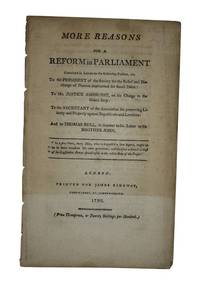
1793réf. AQ34964London: Printed for James Ridgway 1793. 15pp 1. Disbound with title detached. Leaves browned light spotting and staining. The first edition thus which includes four anonymous letters which had previously been published in periodicals printed by political publisher and radical sympathiser James Ridgway 1755 – 1838. . First edition. 8vo. Printed for James Ridgway unknown
1915réf. 62581Boston: Wright & Potter Printing Co. State Printers 1915. 8vo. v 1 234 pp. Photo frontisp. numerous photo plates 1 large folding floor plan charts. Blue embossed & ribbed publisher’s cloth gilt lettering stamped front cover & spine minor shelfwear slight rubbing edgewear still a NF copy w/ presentation slip bound-in from the Board of PPIE Managers for Massachusetts. First edition of this report which highlighted the tremendous achievements by the State of Massachusetts during the Progressive era as well as their very popular tea room which was one of the best-attended attractions during the run of the World’s Fair. The Massachusetts Booth emphasized their reforms in education for vocational training and reducing poverty new educational methods improvements in Mental Health “Insanity Hospitals” Public Health reforms to improve the blind as well as dental agricultural and medical reforms. In addition there was a fine exhibit on Massachusetts road building for the early “Good Roads” campaign reforms prior to World War I. Wright & Potter Printing Co., State Printers, hardcover
réf. ORD-7893Ses démêlés avec l'Inquisition, sa condamnation à mort et sa délivrance miraculeuse. Genève. Imprimerie de Jules-Guillaume Fick. 1868. In-8 (120 x 182mm) broché, couverture muette d'origine, 41 pages. Bon exemplaire, sans rousseurs, non rogné, ex libris L-H Darnet.
réf. 5925A Douay, chez Baltazar Bellere, 1662. Quatre volumes en un in-8 plein veau d'époque, dos à nerfs sobre, titre doré, plats décorés, ouvrage regroupant: La Perle des prêtres: [titre], [table], 102 pages; S. Philippe Neri, fondateur de l'Oratoire: [titre], [table], 76 pages; Le Directeur charitable: [titre], [table], 84 pages; Recueil de plusieurs personnes éminentes: [titre][table], pp. 1-86 et 109-186 (manquent 11 ff.). Epidermures, coiffes arasées, mouillure en marge sans atteinte au texte, exemplaire méritant restauration.
réf. 25258P., Ducloux, 1850, in 8° broché, 240 pages ; qq. rousseurs ; couverture fanée avec infimes manques.
1824réf. 816Lyon, Bohaire, 1824, in-8, broché, (2) ff., 126 pp., couv. impr.
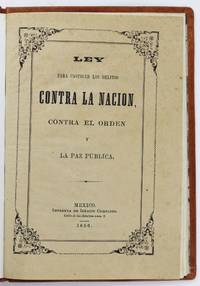
1856réf. 4036Mexico City: Imprenta de Ignacio Cumplido 1856. Still very good. 17pp. Original printed wrappers bound into full calf front board gilt lettered. Some toning and scattered light foxing. This law was promulgated at the end of 1856 by the new liberal government of Mexico following its ascendancy in the mid-1850s and preceded the reform Constitution of 1857 by two months. Its statutes defined "crimes against the independence and security of the nation" including various forms of treason rebellion and foreign military service or assistance and made them punishable by death. The law anticipated conservative resistance and revolt against the new policies of the liberal faction that aimed to strip power and influence from the church and traditional aristocracy of the country. Their efforts indeed led to full-scale civil war in 1858 and the second French intervention in the early 1860s. OCLC locates a small handful of institutional copies and we locate just one in available sales records. Scarce and in attractive original wrappers. Imprenta de Ignacio Cumplido unknown books
1856réf. 4036Mexico City: Imprenta de Ignacio Cumplido 1856. Still very good. 17pp. Original printed wrappers bound into full calf front board gilt lettered. Some toning and scattered light foxing. This law was promulgated at the end of 1856 by the new liberal government of Mexico following its ascendancy in the mid-1850s and preceded the reform Constitution of 1857 by two months. Its statutes defined "crimes against the independence and security of the nation" including various forms of treason rebellion and foreign military service or assistance and made them punishable by death. The law anticipated conservative resistance and revolt against the new policies of the liberal faction that aimed to strip power and influence from the church and traditional aristocracy of the country. Their efforts indeed led to full-scale civil war in 1858 and the second French intervention in the early 1860s. OCLC locates a small handful of institutional copies and we locate just one in available sales records. Scarce and in attractive original wrappers. Imprenta de Ignacio Cumplido unknown
1946Very Good Turkish, Ottoman (1500-1928) Original autograph letter signed by Lawyer Usmanbas sent to his daughter Fetânet Hanim who was sister of Turkish musician Ilhan Usmanbas, (1921-). 22x14 cm. In Ottoman script. 1 p. Full. Dated 26-7-[1]946. He mentions a lawsuit in detail.
1791réf. 20133Lyon, chez Rosset et Dombey, 1791 ; in-8 (215 mm), broché ; 60 pp., couverture d’attente bleu collée à une feuille de passe. (sign A-C8, D6).
1970réf. 42163Washington DC: NORML 1970. First Edition. Very good. Collection of souvenir ephemera from NORML the marijuana advocacy organization founded in 1970. Three buttons two 1.25" diameter and one.5" diameter. Match book 2" x 2.25" approx. Touches of toning and edgewear very good overall. NORML unknown books
1970réf. 42163Washington DC: NORML 1970. First Edition. Very good. Collection of souvenir ephemera from NORML the marijuana advocacy organization founded in 1970. Three buttons two 1.25" diameter and one.5" diameter. Match book 2" x 2.25" approx. Touches of toning and edgewear very good overall. NORML unknown
Grand in-8, broché, couverture abîmée, x, 318 p., non coupé. "Par Pierre Marcha, seigneur du Prat, maître des requêtes de Marie de Médicis et en 1626 intendant de l'armée royale. Histoire complète des guerres dans le Vivarais de 1619 à 1629. Mais protestant d'abord, catholique ensuite, il émet des jugements partiaux, aussi l'éditeur prend soin de publier la 'Relation du duc de Rohan' à la suite". (Sources de l'histoire de France, 3588). Couverture abîmée, parfait état intérieur. Exemplaire non coupé.
réf. 19544Grand in-8, broché, couverture abîmée, x, 318 p., non coupé. Paris, Privas, 1908.
réf. 21061P., Le Centurion, 1983, grand in 8° carré, cartonnage de l'éditeur, jaquette illustrée en couleurs, 144pp. ; importante iconographie. Bel exemplaire.
réf. 56940P., Isidore LIseux, 1875, petit in 12 broché, VIII-93 pages ; à toutes marges ; couverture rempliée ; quelques rousseurs, essentiellement à la couverture.