1787 risultati
2001rif. 42894Washington DC: GPO 2001. very good. 154 wraps. This was one of the last major legislative reviews before the attacks of September 11 2001. This is a snapshot of a view of the security situation that no longer exists. GPO paperback
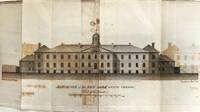
1801rif. 5570New York: I Collins 1801. First Edition. Somewhat later full sheep. Very good; some flaking to the spine of the binding; some offsetting to the plates; otherwise a bright fresh copy. 8vo 4 5 - 94 95 - 109 are erroneously numbered 83 - 97pp. 2 large folding plates a floor plan and elevation and 2 folding tables included in the pagination. Eddy was a Quaker merchant and reformer who had spent time in prison during the Revolution because of his Tory sympathies. He had befriended Philip Schuyler the father-in-law of Alexander Hamilton and hosted a visit of his to Philadelphia to inspect the Walnut Street Jail in 1796. This visit was the impetus for the first penal reform in New York State. Eddy was thus launched upon a career. In 1801 he published the book offered here that is a description of a new prison. The actual design was the work of the Mangin brothers see DAB who are best known for the design of New York City Hall. Eddy's report however contains all of his stipulations for the building and its appointments as well as a detailed summary of how the inmates were to be treated menu lists clothing etc. A most important book: the first native American work on prisons written by the country's first prison director. S & S #431; King Am. Philanthropy # 817; Sabin #21816; see Lewis for citations to Eddy. I Collins unknown books
1794148 p. + Frontis portrait of Muir engraved by John Scoles. 8vo. 210 mm. Early Henry family autograph ownership. ExLib stamp of the Lancaster Mechanic's Society. Age stain, but still good. Thomas Muir [the Younger of Huntershill](1765-1799) was a Scottish political reformer. As a student he embraced controversy, and he soon developed a reputation as a lawyer who was willing to appear in court on behalf of poor clients who could not afford to pay a fee and was a fierce critic of a legal system that he believed was biased in favor of the rich. As a young Whig he helped form Friends of the People branches were formed throughout Scotland. Muir was arrested January, 1793, and charged with sedition. After being interrogated for several hours he was released on bail. Muir now traveled to London where he had talks with other leaders of the Friends of the People. The leaders of the movement were concerned about the violence taking place in France. Muir agreed to go to France and join Tom Paine in his attempts to persuade the leaders of the revolution to abandon the plan to execute Louis XVI. Muir was unsuccessful and after having talks with the Girondist leaders, he returned to Scotland, and was promptly arrested. Edinburgh he was tried for sedition before Lord Braxfield and a hand-picked jury of anti-reformers. Muir was found guilty and sentenced to fourteen years' transportation. Afraid that Scottish reformers would attempt to rescue Muir, he was quickly removed to London. Radicals in the House of Commons immediately began a campaign to save the men now being described as the Scottish Martyrs. Attempts to stop the men being transported failed and in May 1794, the ship Surprise left Portsmouth and began its 13,000 mile journey to Botany Bay. The men arrived on 25th October to join the Colony of 1,908 convicts. As a political prisoner, Muir was given more freedom than most convicts and he was allowed to buy a small farm close to Sydney Cove. After two years at Port Jackson, New South Wales, Thomas Muir escaped with the help of Francis Peron, the chief mate of the American ship, the Otter of Boston. Muir reached Vancouver Island but after being offered help by a Spanish captain, he was arrested and taken on board the Ninfa. While on the way to Cadiz the Ninfa was attacked by the British warship Irresistible. During the battle Thomas Muir was hit by a glancing blow from a cannonball which smashed his left cheekbone and seriously injured both his eyes. For several days Muir's condition was so bad he was expected to die. When the French government heard about what had happened to Muir they tried to persuade the Spanish authorities to release him. The Spanish eventually agreed and Muir arrived in Bordeaux in November 1797. Muir joined up with Tom Paine in Paris where they continued the fight for parliamentary reform in Britain. However, Muir had never fully recovered from the wound he received on the Ninfa and his health began to deteriorate at the end of 1798. He was taken to Chantilly where he died on 26th January, 1799. First American Edition. Evans 27633. EVANS2
rif. 65933. pp. 337-392 AND 617-670. Both disbound from annual volumes the overall stitching retained in excellent condition. For the TWO titles. unknown
rif. 1391591313.Gpaperback. Good. Access codes and supplements are not guaranteed with used items. May be an ex-library book. paperback
rif. 1396311270.Ghardcover. Good. Access codes and supplements are not guaranteed with used items. May be an ex-library book. hardcover
1724rif. 753321724. Rare Eighteenth-Century English Tract on Law Reform Law Reform. Great Britain. An Essay on the Amendment And Reduction Of the Laws of England. For the Ease of the Subject The Advancement of Justice And Regulating the Profession of the Law. London: Printed by E. and R. Nutt And R. Gosling Assigns of Edward Sayer Esq; for Tho. Corbett 1724. iv 63 1 pp. Octavo 7-1/2" x 4-3/4". Stab-stitched pamphlet bound into recent quarter calf over marbled boards blind fillets running parallel to joints gilt fillets and contrasting calf lettering piece to spine. Moderate toning to interior faint dampstaining and some wear to fore-edges of final three leaves. $850. Only edition as a separate work. Also issued as the second part of Law Quibbles 1st ed. 1724 this work is a substantial proposal to reform English law and the English legal profession. Clearly the work of an informed and responsible author it influenced the work of the Society of Gentlemen Practisers a professional society for attorneys and solicitors in England and Wales established in 1739. All editions of Law Quibbles are scarce; An Essay is rare. OCLC locates 2 copies Franklin and Marshall College Staatsbibliothek zu Berlin; the ESTC locates 1 California State Library Sutro Library. English Short-Title Catalogue ESTC N30349. unknown books
19431st Edition. Original Paper Wrappers. 8vo. 13 pages ; 20 cm. In English. Contents include: An Invocation from Samuel Schulman, Introductory Remarks from Samuel H. Goldenson, an a sermon from Julian Morgenstern entitled, Could Kaufmann Speak? The service, was held at Congregation Emanu-El in New York City. The full text of Goldenson, Morgenstern, and Schulmans remarks is included. OCLC lists just 7 copies worldwide. Slight Browning but overall in very good condition. (AMR-49-19)
rif. 1019781572.Ghardcover. Good. Access codes and supplements are not guaranteed with used items. May be an ex-library book. hardcover
rif. 1332100899.Gpaperback. Good. Access codes and supplements are not guaranteed with used items. May be an ex-library book. paperback
rif. 0332973085.Ghardcover. Good. Access codes and supplements are not guaranteed with used items. May be an ex-library book. hardcover
rif. 0260273589.Ghardcover. Good. Access codes and supplements are not guaranteed with used items. May be an ex-library book. hardcover
rif. 0260271608.Ghardcover. Good. Access codes and supplements are not guaranteed with used items. May be an ex-library book. hardcover
Paris: Parisiis, vaenundantur à Ponceto le Preux bibliopola Universitatis addicto, 1549. 4to. menor; 142 ff., 2 hs. Encuadernación de época, en piel, con gofrados en seco en los planos, con ligera pérdida en el extremo inferior exterior del plano superior.
Madrid, Imprenta de A. Vicente, 1852 [e] Imprenta de la Bibloteca Económica de Educación y Enseñanza, 1853 [e] Imprenta y Estereotipia deManuel Rivadeneyra,1852-1853. Cuatro tomos en un volúmen en 4to.; 96 pp + 4 hs., VII-278 pp., 1 h. + VIII pp., 2 hs., 272 pp. + 3 hs., 216 pp. Encuadernación en piel marbreada, de la época.
2000Fine English Paperback., Fine., 21 x 15 cm., [xi], 248, [2] p., "Araç tarih amaç tanzimat; Tarih-i Cevdet'in siyasi anlami.", Christoph K. Nuemann, Tarih Vakfi Yurt Yayinlari, Ist., 2000. Ahmed Cevdet Pasa Tanzimat döneminin en ünlü sahsiyetlerinden biridir. Yazdigi Tarih-i Cevdet de, son dönem In Ottoman. metinlerin en önemlilerinden biri olarak kabul edilir. Daha sade, daha ari bir edebiyat dilinin ilk ustalik örneklerinden olmasi kadar, 1774-1826 arasi Osmanli Imparatorlugu tarihinin standart anlatisi olmasi da bu degerlendirmede büyük rol oynar. Tarihçi Christoph K. Neumann'in hedefi, eserin, içinde yazildigi zamana getirdigi elestirel yaklasim göz önünde bulundurularak okunmasidir. Çalisma, üç ana konuyu ele aliyor: Ahmed Cevdet, genel olarak Osmanli tarihyaziciligi ve 19. yüzyil Ottoman history. Eserin kendi zamaninin siyasi düsüncesindeki önemi ise ön plandadir. Cevdet'in Ottoman history anlatisinin temelinde hangi önermeler, beklentiler ve bakis açilari vardi? Yazar hangi amaçlarla yaziyor ve nelere karsi tavir aliyordu? Getirdigi gerekçelerle 19. yüzyilin ikinci yarisindaki Ottoman history arasinda hangi baglantilar kurulabilir? Yazar gibi biz de bu kitabin Tarih-i Cevdet'i, tasvir ettigi çag için daha iyi kullanilabilir bir kaynak haline getirecegini umuyoruz.
1907rif. 3067367M. Gladbach, Zentralstelle der Volksvereins für das katholische Deutschland, 1907. XIII (2) 160 S. OBroschur (Feuchtigkeitsspuren, teils angestaubt).
New York, Contemporary Jewish Record, 1940. Paper Wrappers, 8vo, 19 pages. Holocaust era. Offprint from the Jan-Feb 1940 issue. Very Good condition. (P-2)
2018New Turkish Paperback. Roy. 8vo. (24 x 17 cm). In Turkish with Ottoman documents. 166 p., b/w ills. and Ottoman archival documents. Political and economical developments that took place beginning from the late 16th century, by changing the Ottoman administrative order in a great scale, gave way to a decentralization process. In this period, the class of notable superseded the governors assigned from the centre. Notables, who acquired the management of vast acres and farms through the system of tax farming and manor, in time had captured province bureaucracy and strengthened their autonomies. However, while the consequences of heavy defeat against Russia in 1774 had necessitated reformation in military field, the cost of these reforms played off central government and local powers. In he beginning of 19th century, as reforms which proposed re-centralization tired to push notables out of the system, notables opposed with a rigorous resistance. In this period in which arduous struggles occurred had taken place between Notables and the government, one of the strongest notables who joined authority struggle with the state was Osman Agha of Tavas. (Source: A Notable Against Ottoman Centralization in the Period of Tanzimat: Tavaslizâde Osman Agha, MEHMET YASAR ERTAS).
Córdoba, 2010. 4to.; LXXIV-249 pp. Ilustraciones. Encuadernación en cartoné.
2005rif. 49546Washington DC: GPO 2005. First Edition. First Printing. Wraps. good. 242 wraps illus. Serial No. 109-57. GPO paperback
rif. 0260016829.Ghardcover. Good. Access codes and supplements are not guaranteed with used items. May be an ex-library book. hardcover
rif. 0259134597.Gpaperback. Good. Access codes and supplements are not guaranteed with used items. May be an ex-library book. paperback
rif. 066616147X.Ghardcover. Good. Access codes and supplements are not guaranteed with used items. May be an ex-library book. hardcover
rif. 0666106312.Ghardcover. Good. Access codes and supplements are not guaranteed with used items. May be an ex-library book. hardcover