2 782 résultats
Datée du 31 décembre 1848, la lettre, dernière de l'année qui s'achève, mentionne la réforme fiscale qui prend effet le 1er janvier de 1849 et met en circulation le premier timbre. Dans son post-scriptum, Léopold Delaire rappelle à son oncle « la taxe des lettres se trouvant réduite uniformément à 20 centimes, à compter du premier janvier, Je vous engage à nous donner plus souvent de vos nouvelles, afin de compenser, dans l'intérêt du Trésor public, la diminution de plus des deux tiers qui va s'opérer dans nos frais de correspondance. J'appose sur cette lettre un des nouveaux timbres qui serviront désormais à l'affranchissement : elle vous parviendra donc franche de port ». La dernière phrase a été rayée d'un trait. Le début de la lettre dresse un bilan sévère d'une année révolutionnaire que Léopold Delaire juge « féconde en tristes et lamentables événements ». Le jeune homme se montre cependant soulagé par l'élection en décembre 1848 de Louis Napoléon Bonaparte. «Grâce à Dieu, elle finit mieux qu'on ne pouvait l'espérer. L'immense majorité obtenue par Napoléon, le petit nombre de voix réparti sur les candidats avoués des hommes du désordre, le triomphe complet du parti modéré qui veut l'ordre, la famille et la propriété assurent au moins le présent et rétablissent la confiance ». Si des troubles peuvent encore survenir, « ils ne sont pas de nature à menacer l'ordre ». Léopold Delaire brosse ensuite le tableau d'une capitale rendue à la vie avec la reprise du commerce,les étrangers peuplant de nouveau les hôtels garnis et les maisons meublées, les voitures de maître se croisant en tout sens dans les rues. Il note que, depuis l'élection du président de la République, les Parisiens qui avaient quitté la capitale début décembre semblent vouloir rentrer. Il commente, pourcentages à l'appui, les résultats des élections dans le département de l'Allier, dont sa famille est originaire, qui recèle « une minorité considérable de gens dangereux », ce qui « est bien surprenant dans un département qui est presque tout agricole ». Léopold Delaire est le fils de Jean Marie Delaire, président de la Cour des Comptes et le petit-fils du général Jean-Pierre-Hugues de Cambacérès. Le destinataire de la lettre est Antoine Delaire, maire de Montaigu-le-Blin, dans l'Allier.
1997228 pages. "If ever there was a definitive examination of Preston Manning and the birth of his movement of Western Canadian Populists, this is it." - Peter C. Newman. Gift greetings upon title page else book clean and unmarked with very light wear. Light wear to dust jacket. Attractive copy. Book
réf. 1334805504.Gpaperback. Good. Access codes and supplements are not guaranteed with used items. May be an ex-library book. paperback
réf. 0484676377.Ghardcover. Good. Access codes and supplements are not guaranteed with used items. May be an ex-library book. hardcover
1964réf. 308645Wien, Akademie der Wissenschaften, 1964. 8vo. 231 Seiten. Originalbroschur. 23cm
réf. 188682S.l., s.d. (1771) in-8, 44 pp. demi-basane fauve, dos lisse, pièce de titre cerise, tranches rouges (reliure de l'époque). Coiffes rognées, coins et coupes abîmés.
réf. 19427Newcastle upon Tyne: Printed and published by E. Mackenzie Jun. 129 Pilgrim Street. 1831. 59 1pp. 8vo. Stitched and disbound. In fair condition lightly aged and worn. The author is not named on the title-page but the text ends p.59 with the signature in type of 'CHARLES LARKIN.' The final page carries a list of 'Errata'. Drop-head title p.3: 'To The Auditory who heard the Speech of Captain Gordon delivered in Brunswick Place Chapel on Wednesday evening March 2 1831 This Letter is respectfully inscribed.' The Reformation Society 'of which Captain Gordon styles himself the honorary secretary' is attacked as a 'society for the support of a tottering system of fraud falsehood fanaticism hypocrisy intolerance and oppression'. The only copy on COPAC at Durham there is a second impression held at Durham and two other locations. Newcastle upon Tyne: Printed and published by E. Mackenzie, Jun. 129, Pilgrim Street. 1831. unknown
réf. BK0166Boston: Charles C. Little and James Brown 1847. 203 pp. 8vo. Original printed wrappers. Near Fine. An important contemporary attack on the Pennsylvania system of prison discipline and its use of prolonged cellular separation published during a heated national and international debate over the treatment of prisoners. Gray had served as vice-president of the Boston Prison Discipline Society and for several years chaired the board of directors of the Massachusetts State Prison. The book appeared amid the bitter 1846-47 controversy within the Boston Prison Discipline Society after Charles Sumner challenged the organization's longstanding hostility toward the Pennsylvania system. Sumner's intervention drew attention in Europe and correspondence from Alexis de Tocqueville; Gray answered from the opposing side with the present work. A later account specifically identified Prison Discipline in America as the principal American response taking a stand against the Pennsylvania system.1 Gray's argument rests heavily on comparative evidence from American prisons including statistics from the Massachusetts State Prison at Charlestown and Eastern State Penitentiary at Philadelphia. He regarded the higher rates of insanity and mortality under constant separation as evidence against the system concluding that it tended to "enfeeble the body and the mind." His observations became an enduring part of the literature on solitary confinement and continue to be cited in modern medical and legal discussions of its psychological effects. A particularly nice copy in near fine condition in the original wraps. 1 "RIVAL SYSTEMS OF PRISON DISCIPLINE. Speech before the Boston Prison Discipline Society at the Tremont Temple June 18 1847" in Charles Sumner. His Complete Works Lee and Shepard 1900 digitized by Project Gutenberg accessed October 8 2026 https://www.gutenberg.org/cache/epub/45473/pg45473-images.html. . Charles C. Little and James Brown unknown
réf. BK0166Boston: Charles C. Little and James Brown 1847. 203 pp. 8vo. Original printed wrappers. Near Fine. An important contemporary attack on the Pennsylvania system of prison discipline and its use of prolonged cellular separation published during a heated national and international debate over the treatment of prisoners. Gray had served as vice-president of the Boston Prison Discipline Society and for several years chaired the board of directors of the Massachusetts State Prison. The book appeared amid the bitter 1846-47 controversy within the Boston Prison Discipline Society after Charles Sumner challenged the organization's longstanding hostility toward the Pennsylvania system. Sumner's intervention drew attention in Europe and correspondence from Alexis de Tocqueville; Gray answered from the opposing side with the present work. A later account specifically identified Prison Discipline in America as the principal American response taking a stand against the Pennsylvania system.1 Gray's argument rests heavily on comparative evidence from American prisons including statistics from the Massachusetts State Prison at Charlestown and Eastern State Penitentiary at Philadelphia. He regarded the higher rates of insanity and mortality under constant separation as evidence against the system concluding that it tended to "enfeeble the body and the mind." His observations became an enduring part of the literature on solitary confinement and continue to be cited in modern medical and legal discussions of its psychological effects. A particularly nice copy in near fine condition in the original wraps. 1 "RIVAL SYSTEMS OF PRISON DISCIPLINE. Speech before the Boston Prison Discipline Society at the Tremont Temple June 18 1847" in Charles Sumner. His Complete Works Lee and Shepard 1900 digitized by Project Gutenberg accessed October 8 2026 https://www.gutenberg.org/cache/epub/45473/pg45473-images.html. . Charles C. Little and James Brown unknown books
1977186 pages. A dramatic insight into our penal system and the critical need to seek reform. "It's refreshing to encounter a quiet voice of reason amid the rising clamor for a return to capital punishment and harsher treatment of prisoners." - William French, Globe and Mail. A dramatic insight into our penal system and the critical need to seek reform. Rubber stamp atop front cover and title page else unmarked. Average wear. Solid copy. Book
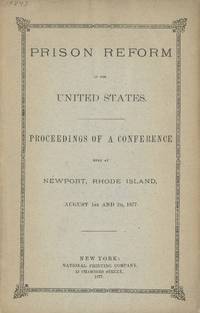
1877réf. BK0163New York: National Printing Company 1877. 8vo 56 pp. Original printed wrappers. "Compliments of Dr. Wines" slip affixed to title page. Near fine with a small tear to front wrapper at seam. Proceedings of an important national conference on prison reform organized around a program prepared by Enoch Cobb Wines the leading American prison reformer of the period. Wines had served as secretary of the New York Prison Association and was instrumental in organizing the landmark National Congress on Penitentiary and Reformatory Discipline at Cincinnati in 1870. The Newport conference met seven years later to formulate a practical system of penal institutions and policies that could be recommended to state legislatures. Much of the pamphlet is devoted to the conference's "Outline Draft of a System of Preventive Reformatory and Penitentiary Institutions and Discipline" which attempted to address criminal justice as a single system extending from childhood through incarceration. Its recommendations begin with compulsory education and institutions for neglected and delinquent children and proceed through reform schools houses of detention women's prisons county jails and state penitentiaries. The conference was particularly severe in its judgment of the existing jail system: "The county jails of the United States numbering about two thousand are with few exceptions schools of vice nurseries of crime and feeders of the penitentiaries. Their construction and management are alike bad; indeed the former is so radically defective as to render any good administration of them impossible." The conference occurred during a period when many of Wines's ideas were beginning to find practical application most notably at Elmira under Zebulon Brockway. Its recommendations ranged from compulsory education and separate institutions for juveniles and women to trained prison officers productive labor improved sanitation and greater state oversight. The "Compliments of Dr. Wines" slip gives this copy a nice association with the man chiefly responsible for both the conference and the program it produced. . National Printing Company unknown
1877réf. BK0163New York: National Printing Company 1877. 8vo 56 pp. Original printed wrappers. "Compliments of Dr. Wines" slip affixed to title page. Near fine with a small tear to front wrapper at seam. Proceedings of an important national conference on prison reform organized around a program prepared by Enoch Cobb Wines the leading American prison reformer of the period. Wines had served as secretary of the New York Prison Association and was instrumental in organizing the landmark National Congress on Penitentiary and Reformatory Discipline at Cincinnati in 1870. The Newport conference met seven years later to formulate a practical system of penal institutions and policies that could be recommended to state legislatures. Much of the pamphlet is devoted to the conference's "Outline Draft of a System of Preventive Reformatory and Penitentiary Institutions and Discipline" which attempted to address criminal justice as a single system extending from childhood through incarceration. Its recommendations begin with compulsory education and institutions for neglected and delinquent children and proceed through reform schools houses of detention women's prisons county jails and state penitentiaries. The conference was particularly severe in its judgment of the existing jail system: "The county jails of the United States numbering about two thousand are with few exceptions schools of vice nurseries of crime and feeders of the penitentiaries. Their construction and management are alike bad; indeed the former is so radically defective as to render any good administration of them impossible." The conference occurred during a period when many of Wines's ideas were beginning to find practical application most notably at Elmira under Zebulon Brockway. Its recommendations ranged from compulsory education and separate institutions for juveniles and women to trained prison officers productive labor improved sanitation and greater state oversight. The "Compliments of Dr. Wines" slip gives this copy a nice association with the man chiefly responsible for both the conference and the program it produced. . National Printing Company unknown books
1943réf. 212581Chislehurst : Prison Medical Reform Council 1943. First Edition. Paperback. Near fine copy in the original stiff-card wrappers; edges very slightly dust-dulled and toned. Remains particularly and surprisingly well-preserved; tight bright clean and especially sharp-cornered.; 8vo 8"" - 9"" tall; 32 pages; Description: 32 p. ; 21 cm. Subjects: Prisoners -- Great Britain - Personal narratives -- Political aspects -- Prisons -- Health and hygiene -- Prison reformers. Chislehurst : Prison Medical Reform Council paperback
2013réf. 1261602013 Lieux Dits Editions - 2013 - In-4 relié, cartonnage illustré, sous jaquette illustrée - 223 pages - Avec 300 illustrations en N&B et en couleurs, in et hors texte, dans l'ouvrage
réf. 9057Essais sur les réformes pénitentiaires. In 8 broché, faux-titre, titre, XXXII, 278 pages, 1 page d’errata. Paris A. Durand et Pedone Lauriel éditeurs 1875. Edition originale. (dos renforcé, petites rousseurs sur la couverture, ainsi qu’en début et fin de volume, sinon ensemble très correct. Peu courant. L’auteur était procureur de la République à Provins et docteur en droit.
réf. 103496Bonn, Bouvier Verlag 1971, 235x160mm, broschiert. Schönes Exemplar.
2002réf. 43079Washington DC: GPO 2002. First Edition. First Printing. very good. 317 wraps illus. Report 107-768. Union Calendar No. 483. Contains minority and additional views. GPO paperback
réf. Juanpebooks123284WE ship worldwide. Brand new 100%guarentee unknown
réf. 1528230906.Gpaperback. Good. Access codes and supplements are not guaranteed with used items. May be an ex-library book. paperback
réf. 1527939731.Gpaperback. Good. Access codes and supplements are not guaranteed with used items. May be an ex-library book. paperback
réf. 1528241673.Gpaperback. Good. Access codes and supplements are not guaranteed with used items. May be an ex-library book. paperback
réf. 0260212083.Ghardcover. Good. Access codes and supplements are not guaranteed with used items. May be an ex-library book. hardcover
réf. 0260022624.Ghardcover. Good. Access codes and supplements are not guaranteed with used items. May be an ex-library book. hardcover
réf. 1334617988.Gpaperback. Good. Access codes and supplements are not guaranteed with used items. May be an ex-library book. paperback
réf. 0656023716.Ghardcover. Good. Access codes and supplements are not guaranteed with used items. May be an ex-library book. hardcover