2 692 résultats
Paper wrappers; 4to. 136 pages. "A United Synagogue jubilee publication (1 913-1963) . " Cover sunned; edges bumped. Very good condition. (PC-1)
réf. 0656218509.Ghardcover. Good. Access codes and supplements are not guaranteed with used items. May be an ex-library book. hardcover
2005réf. 47968Washington DC: GPO 2005. First Edition. First Printing. very good. 193 wraps. Serial No. 109-43. GPO paperback
réf. 1396126147.Gpaperback. Good. Access codes and supplements are not guaranteed with used items. May be an ex-library book. paperback
réf. 1396706259.Ghardcover. Good. Access codes and supplements are not guaranteed with used items. May be an ex-library book. hardcover
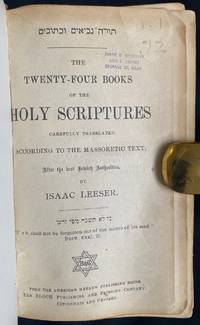
1880réf. 43529Cincinnati & Chicago: From the American Hebrew Publishing House the Bloch Publishing and Printing Company 1880. 1880s Preface is dated 1856. Original Full Leather binding with black & gilt spine label 12mo 2 leaves iii-xii 1243 pages. 17 cm. Title in Hebrew at head of title. Copyright page lists 1853 the copyright date for the first edition of Leeser's original translation of the Twenty Four Books of the Holy Scriptures published in 1854. The present Preface is dated Philadelphia 1856. The 1880s date is based on Singerman 3204 which notes the presence of the "undated 'Advertisement to the London Edition.' Repeated.in undated Bloch editions 1243 p. with acopyright date of 1853." Preceding the 1856 Preface is the undated 4-page "Advertisement to the London Edition" which notes that "This corrected version supplies an admitted want to our times. The so-called Authorized or Anglican version of the Scriptures.betrays great need for revision.Jews who of their own accord introduce the Anglican version into their households and who provide none other for the schools commit a flagrant breach of sacred trust in the abandonment of those for whose safe guidance they are immediately responsible to a helpless ignorance of truth-an ignorance all the more fatal because false interpreataions are obtruded in season and out of season with an unscrupulous object-to procure apostasy i.e. conversion from Judaism.Hence this version accomplished by a learned and conscientious Hebraist i.e. Leeser has found acceptance from all denominations. In the 10-page 1856 Preface Leeser explains in detail the need for his new translation giving many examples from earlier Christian translations of what we would today call "Christian bias." Leeser here acknowledges recent partial Jewish translations noting "Hitherto-at least before the completion of the first edition of this work two years ago-no other translation in the English had been completed by Jews although several had been commenced; for instance Dr. Raphall's and Mr. A. De Sola's and Mr Lindenthal's book of Genesis with Hebrew text and ample notes and Dr. Benische's version with Hebrew text to the end of the Second Book of Kings." OCLC 233529725 locates 4 copies worldwide U Illinois Andrews U Community of Christ MO UPenn of an "1853" edition published in "Cincinnati ; Chicago : from the American Hebrew Pub. House the Bloch Pub. and Print. Co." with 1243 pages and 17 cm high ours is 16 cm. However the OCLC listing notes neither the "Advertisement to the London Edition" nor Leeser's Preface of 1856 both of whose pagination does not affect that of the main text. Such was the enmity between Leeser and leaders of the Reform movement that it would seem surprising that Leeser would authorize a Bloch publication of his bible during his lifetime given that Bloch was owned by Isaac M. Wise' brother-in-law Edward Bloch. Only a year after the date of the preface in our copy Leeser famously printed an "anonymous attack on Wise signed 'Lawyers' in the pages of his Occident shortly after the appearance of Minhag Amerika in 1857. Leesers' anti-Reform rejoinder singled out Bloch & Co. for allegedly keeping its store open on the Jewish Sabbath and closing it on Sunday the Christian Sabbath." Singerman. In our Bloch copy the copyright is still held by Isaac Leeser; It was not until 1888 20 years after Leeser's death in 1868 that "his Bloch's firm obtained the copyright of this popular and frequently reprinted landmark text." Neither Singerman nor Goldman list any edition published by Bloch before 1884. Singerman Nr 1418 and Goldman Nr 13 both list a similar edition 1856 published in Philadelphia by C. Sherman & Son also with the 1856 Preface and identical pagination and physically smaller than the 1853 ed.with a new preface by Leeser." Goldman specifically writes that the "Advertisement to the London Edition" does not appear until an 1865 edition is "published in London in 5625 1865 by Trubner & Co. printed by John Childs and Son. Explaining the need for a new translation in the prefatory 'advertisement' the publisher criticized the standard King James Version authorized by the English Church for being flawed with 'abundant cases of false rendering' and 'propagandist tendencies.' They thus chose to issue Leeser's translation despite the existence of English translations by Christians because "this version accomplished by a learned and conscientious Hebraist has found acceptance from all denominations." This may be a previously unrecorded stereotype reissue of Trubner's London edition by Bloch issued with the 1853 Copyright date the 1856 Preface and the undated Advertisement though its mid-19th Century binding with black leather spine label would not be much later than 1880. Some pencil underlining to Advertisement and Preface with small owner's stamps and pulling as well. Gutter margin at title page is thin and crowds the title page text see photo. Spine reinforced with leather at edges boards show wear especially at corners but a solid Good Condition copy. A rare Leeser variant. B AMR-38-23. Cincinnati & Chicago: From the American Hebrew Publishing House, the Bloch Publishing and Printing Company unknown
195419p. Pagination includes wraps. Tall 8vo. Original printed wraps. Nice copy. PA PAMPH 20_6 BX7
réf. 0259475807.Gpaperback. Good. Access codes and supplements are not guaranteed with used items. May be an ex-library book. paperback
réf. 0331703777.Ghardcover. Good. Access codes and supplements are not guaranteed with used items. May be an ex-library book. hardcover
1932réf. 54896Huntington WV & Washington D.C.: Prisoners Relief Society 1932. 8vo. x 342 pp. With numerous photo plates text illustrations. Textured blue publisher’s cloth gilt lettering stamped on front cover & spine very minor shelfwear w/ d.j. cover art image of the West Virginia penitentiary gate minor chipping head & foot of spine wear to corners VG/VG copy. First edition of this gripping memoir by former prisoner convicted of manslaughter describing the deplorable conditions of West Virginia Penitentiary which Dudding describes as a vermin-infested “damnation.” Of particular interest are his extended essays on metabolic imbalances poor brain chemistry and drug abuse as contributing factors to crime along with unwanted pregnancies and marrying too young often resulting in delinquent progeny. Prisoners Relief Society, hardcover
2000réf. 39579Washington DC: U. S. Government Printing Office 2000. Presumed First Edition First printing. Wraps. good. 24 cm 1723 wraps illus. footnotes tables. House Report 106-1037. From July 26 through August 1 1995 this committee's Subcommittee on National Security International Affairs and Criminal Justice and the Committee on the Judiciary's Subcommittee on Crime held joint hearings on all aspects of the Federal Government's role in the 1993 tragedy at the Mt. Carmel Center a religious community about 10 miles northeast of Waco TX. This is one of several reports produced. The committee has reached the following conclusions as a result of its investigation: THE EVENTS OF APRIL 19 1993: Aerial Forward-Looking Infrared videos filmed on April 19 1993 include flashes around the Mt. Carmel Center that at first blush resemble muzzle blasts. Careful scientific analysis of the flashes does not however appear to support allegations that these flashes are the result of gunfire. Analysts who submitted reports to both this committee and the Office of Special Counsel reached similar conclusions: that the flashes they were asked to examine appeared to be solar or other thermal reflections emanating from debris. However the analyst retained by this committee reported that an overhead FLIR camera of the type used by the FBI on April 19 1993 would not record every muzzle flash occurring within its field of view. Therefore while the flashes that have generated such controversy do not appear to represent gunshots it is within the range of possibility that gunshots may have occurred that were not captured by the FLIR camera. This conclusion is bolstered by the March 21 2000 FLIR reenactment performed at Ft. Hood TX. Every FBI agent interviewed by the committee has denied discharging any weapons other than for the delivery of CS gas on April 19 1993 or knowing of any gunfire from government sources. This committee has uncovered no evidence to contradict these claims. There is no evidence that HRT snipers stationed at a house designated the Sierra One sniper position across the Double EE Ranch Road from the compound fired shots on April 19 1993. Shell casings recovered at the house by the Texas Rangers have been tested by the Office of Special Counsel and matched weapons used by the Bureau of Alcohol Tobacco and Firearms on February 28 1993. The operations plan approved by Attorney General Janet Reno called for a gradual section-by-section insertion of CS gas over the course of 2 days followed by ``deconstruction'' of the building if the Branch Davidians had not surrendered after 48 hours. Nonetheless on the morning of April 19 1993 the HRT punched large holes in the walls of the building drove M-728 Combat Engineering Vehicles deep into the building and destroyed one-half of the gymnasium on the side of the building. At approximately 8 a.m. on April 19 1993 HRT member David Corderman after obtaining authorization from HRT commander Richard Rogers fired either two or three pyrotechnic M-651 rounds in an attempt to insert gas in an underground tornado shelter on the Green side of the Center. Corderman had fired non-pyrotechnic ferret rounds at the shelter's tarpaper and plywood roof but they had failed to penetrate it. Although HRT leadership was aware of the possibility that HRT personnel might need to use M-651 rounds they failed to include the contingent use of M-651 rounds in the operations plan they sent for approval to the Attorney General. They also failed on April 19 1993 to obtain authorization for this deviation from higher up the chain of command. U. S. Government Printing Office paperback
réf. 0260695963.Ghardcover. Good. Access codes and supplements are not guaranteed with used items. May be an ex-library book. hardcover
Philadelphia, No Publisher (the Author) , 1923. Paper Wrappers, 8vo, 25 pages. Musings of a tourist on a trip to the "Near East. " Apparently a follow-up to the author's previous work, "The Tourist, Outward And Homeward Bound" (Philadelphia: Gilliam's Sons, 1901) , which was written for American's on their Grand Tour, with special attention to the voyage on the ocean liner to and from Europe. No copies listed on OCLC. Corner crease, Very good condition (P-2-8)
New York, Jewish Forum, 1939. Paper Wrappers, 8vo, 15 pages (new pagination) . "Reprinted FROM THE Jewish Forum October, 1939." Very good condition. (P-2-47)
réf. ria9798844036255_inpPaperback. New. New Book; Fast Shipping from UK; Not signed; Not First Edition; I made a solemn promise to Grand Master Brian "Buzz" Smith: if anything happened to him and he couldn't finish his book I would finish it. Buzz wanted his students to work together to complete it and that is exactly what I did. No one paperback
réf. ria9798393199814_inpPaperback. New. New Book; Fast Shipping from UK; Not signed; Not First Edition; The Revolutionized Art System RAS as taught by SGuro John Davies and Grand Master Jimmy Reforma represents a profound legacy of Filipino Martial Arts FMA. This centuries-old family fighting system which only became public knowled paperback
réf. B9798393199814Paperback / softback. New. paperback
1972428 pages. Index. Bibliography. Fold-out map at back. "Traces the development of Straits society, viewed not from London or Calcutta but from the settlements themselves and especially the capital in Singapore... Examines the social, administrative and economic character of the settlements, the problems of external defence and piracy, relations with the Malay states, and the long history of pressure for constitutional reform and transfer to direct colonial rule." - from dust jacket. Prior owner's details upon front free endpaper. Average wear to book. Binding tight. Above-average wear to dust jacket which is now preserved in glossy new archival-grade Brodart. A sound copy. Book
No Place (Cincinnati? ) , Union of American Hebrew Congregations, 1940. Paper Wrappers, 8vo, 15 pages. History of the UAHC. Address delivered at a banquet of the Friends of the Union, New York City, Apr. 2, 1940. OCLC lists only 2 copies worldwide (HUC, Wisconsin-Milwaukee) , none outside the Midwest. Very good condition. (P-2-55)
2002réf. 45362Washington DC: GPO 2002. First Edition. First Printing. good. 672 wraps stiff paper covers illus. GPO paperback
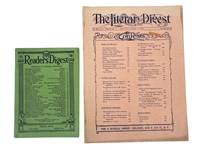
1904réf. 237201904. Two American digest periodicals documenting changes in national public discourse from the Progressive Era through the Great Depression. The earlier issue contains prominent contemporary coverage of the Statesboro Georgia lynching of 1904 reproducing reactions from newspapers across the country and condemning the burning and killing of two Black men by a white mob after the courts had already imposed sentences. The Literary Digest. New York: Funk & Wagnalls Company August 27 1904. Vol. XXIX No. 9 Whole No. 749. Together with The Reader's Digest. Pleasantville New York: The Reader's Digest Association May 1932. Eleventh Year Vol. 21 No. 121. Two illustrated periodicals. The Literary Digest complete in original printed wrappers; the Reader's Digest in original green printed wrappers. The Literary Digest treats the Statesboro lynching as a national disgrace assembling condemnations of the white mob that seized two Black prisoners from lawful custody and burned them alive after their convictions. Its opposition to mob violence is forceful for a mainstream national periodical but the journalism is not racially radical: it condemns lynching chiefly as a collapse of law civilization and public order while reproducing racialized language paternalistic assumptions and comparisons with "Darkest Africa" that reveal the limits of white Progressive reform discourse. The article documents how anti-lynching sentiment could coexist with the racial hierarchies embedded in early twentieth-century American journalism. Other contents also address the Russo-Japanese War Theodore Roosevelt's "Big Stick" politics immigration early automobile culture religion scientific racism and political caricature preserving the mixture of reform journalism racial ideology international reporting and editorial debate that shaped mass-circulation American periodicals at the beginning of the twentieth century. The May 1932 issue captures an American reading public attempting to understand economic collapse mass unemployment and the instability of modern life during the darkest years of the Great Depression. Its condensed articles move from Arthur Pound's courtroom account of bankrupt workers shopkeepers and failed speculators to proposals for canceling international war debts arguments over housing and advertising and criticism of the press's exploitation of the Lindbergh kidnapping. Reports on Japan's campaign in Manchuria cancer research industrial materials telecommunications and labor-saving inventions place domestic economic crisis beside the geopolitical and technological transformations reshaping the interwar world. The two issues document national and international crises into accessible commentary for a broad readership moving from the racial violence imperial politics and reform debates of 1904 to the economic collapse mass media consumer culture and geopolitical instability of 1932. Both remain stapled without annotations or other markings. Completely legible and in overall very good condition with only minor discoloration and scattered creasing or handling use. unknown books
1904réf. 237201904. Two American digest periodicals documenting changes in national public discourse from the Progressive Era through the Great Depression. The earlier issue contains prominent contemporary coverage of the Statesboro Georgia lynching of 1904 reproducing reactions from newspapers across the country and condemning the burning and killing of two Black men by a white mob after the courts had already imposed sentences. The Literary Digest. New York: Funk & Wagnalls Company August 27 1904. Vol. XXIX No. 9 Whole No. 749. Together with The Reader's Digest. Pleasantville New York: The Reader's Digest Association May 1932. Eleventh Year Vol. 21 No. 121. Two illustrated periodicals. The Literary Digest complete in original printed wrappers; the Reader's Digest in original green printed wrappers. The Literary Digest treats the Statesboro lynching as a national disgrace assembling condemnations of the white mob that seized two Black prisoners from lawful custody and burned them alive after their convictions. Its opposition to mob violence is forceful for a mainstream national periodical but the journalism is not racially radical: it condemns lynching chiefly as a collapse of law civilization and public order while reproducing racialized language paternalistic assumptions and comparisons with "Darkest Africa" that reveal the limits of white Progressive reform discourse. The article documents how anti-lynching sentiment could coexist with the racial hierarchies embedded in early twentieth-century American journalism. Other contents also address the Russo-Japanese War Theodore Roosevelt's "Big Stick" politics immigration early automobile culture religion scientific racism and political caricature preserving the mixture of reform journalism racial ideology international reporting and editorial debate that shaped mass-circulation American periodicals at the beginning of the twentieth century. The May 1932 issue captures an American reading public attempting to understand economic collapse mass unemployment and the instability of modern life during the darkest years of the Great Depression. Its condensed articles move from Arthur Pound's courtroom account of bankrupt workers shopkeepers and failed speculators to proposals for canceling international war debts arguments over housing and advertising and criticism of the press's exploitation of the Lindbergh kidnapping. Reports on Japan's campaign in Manchuria cancer research industrial materials telecommunications and labor-saving inventions place domestic economic crisis beside the geopolitical and technological transformations reshaping the interwar world. The two issues document national and international crises into accessible commentary for a broad readership moving from the racial violence imperial politics and reform debates of 1904 to the economic collapse mass media consumer culture and geopolitical instability of 1932. Both remain stapled without annotations or other markings. Completely legible and in overall very good condition with only minor discoloration and scattered creasing or handling use. unknown
réf. 1024507394.Ghardcover. Good. Access codes and supplements are not guaranteed with used items. May be an ex-library book. hardcover
1971385 pages. Index. Black and white illustrations. "This book is a study in the history of ideas, specifically with reference to the conjunction of the movements of religion and social reform in Canada in the years 1914 to 1928... The book catches the social gospel in mid-passage, in a period when its influence was high but its fortunes in crisis." - from Preface. Book clean and unmarked with very light wear. Tight and square. Moderate wear to dust jacket which is preserved in protective Brodart cover. Nice copy. Book
1978428 pages including notes and index. Critically assesses middle-class reform, and addresses the question of ethnic Americans: 'If we did it, why couldn't they?' "...a sober, very well researched, and very valuable contribution to our general knowledge of the relations between immigrants, Blacks, and reformers in the North... a fine and sobering book." - Nathan Glazer, Professor, Harvard University. Book clean and unmarked with light wear. Slight warping to red cloth-covered boards. Dust jacket rough. Solid copy overall. Book