3 993 résultats
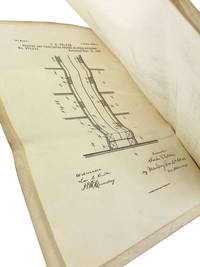
1887réf. 21386Washington: H. Peters 1887. Very Good. Washington: H. Peters 1887. Folio 30.5cm.; ribbon-bound engraved self-wrappers wax-sealed and accomplished in manuscript; 8ll. of photo-engraved plans printed on versos only followed by 3pp. text printed in double columns on rectos only. Previous mail folds extremities a bit chipped and toned ribbons slightly frayed else Very Good internally clean and sound. Signed by Acting Secretary of State D.L. Hawkins and Commissioner of Patents Burton J. Hall. Detailed patent application submitted by the Superintendent of the Chicago Bridewell Prison on September 13 1887. Charles E. Felton ca. 1832-1909 was the prison's longest serving overseer having held the position from its opening in 1872 until his retirement in 1890. Formerly a printer in Buffalo New York Felton entered the field of prison administration through the usual political platforms though he assumed his position in Chicago not through the usual channels but based on his previous experience serving as director of the Erie PA correctional facility. A Democrat and avid duck hunter with a rather unfocussed eye on the mayoralty of Chicago Felton was especially interested in enforcing labor in his prisons as a means of reducing costs and galvanizing individual reformation a position he clung to even past his retirement. The present patent submitted with steel manufacturer Herbert B. Streeter 1833-1919 offered substantial air circulation improvements for prisons "or other structures where the tiers of cells or dormitories have an open hall or corridor without separation by floors or otherwise." Previously the Chicago House of Corrections had just one small ventilating flue leaving the air "absolutely foul and poisonous." The plans depicted here show two foul air flues and one steam-coil heating device per cell as well as additional open air gratings for increased circulation. Though it is unclear whether the patent was ever approved Felton in an address delivered before the Prison Congress four years later complained that the increase in crime rates could be blamed in part on "the comfortable quarters" offered prospective convicted criminals. Also to blame "the present views of the public and acts of legislatures as to systems of prison labor and its ease to the prisoner.the quality of food; their the prisoners' easy access to visitation and the readiness with which a sympathetic public accepts as true the complaints of the prisoners" "Inter Ocean" newspaper October 14 1891. This patent submitted to improve the comfortable prison cells Felton so bemoaned an important document for students and historians of prison reform architecture and engineering. H. Peters unknown books
1887réf. 21386Washington: H. Peters 1887. Very Good. Washington: H. Peters 1887. Folio 30.5cm.; ribbon-bound engraved self-wrappers wax-sealed and accomplished in manuscript; 8ll. of photo-engraved plans printed on versos only followed by 3pp. text printed in double columns on rectos only. Previous mail folds extremities a bit chipped and toned ribbons slightly frayed else Very Good internally clean and sound. Signed by Acting Secretary of State D.L. Hawkins and Commissioner of Patents Burton J. Hall. Detailed patent application submitted by the Superintendent of the Chicago Bridewell Prison on September 13 1887. Charles E. Felton ca. 1832-1909 was the prison's longest serving overseer having held the position from its opening in 1872 until his retirement in 1890. Formerly a printer in Buffalo New York Felton entered the field of prison administration through the usual political platforms though he assumed his position in Chicago not through the usual channels but based on his previous experience serving as director of the Erie PA correctional facility. A Democrat and avid duck hunter with a rather unfocussed eye on the mayoralty of Chicago Felton was especially interested in enforcing labor in his prisons as a means of reducing costs and galvanizing individual reformation a position he clung to even past his retirement. The present patent submitted with steel manufacturer Herbert B. Streeter 1833-1919 offered substantial air circulation improvements for prisons "or other structures where the tiers of cells or dormitories have an open hall or corridor without separation by floors or otherwise." Previously the Chicago House of Corrections had just one small ventilating flue leaving the air "absolutely foul and poisonous." The plans depicted here show two foul air flues and one steam-coil heating device per cell as well as additional open air gratings for increased circulation. Though it is unclear whether the patent was ever approved Felton in an address delivered before the Prison Congress four years later complained that the increase in crime rates could be blamed in part on "the comfortable quarters" offered prospective convicted criminals. Also to blame "the present views of the public and acts of legislatures as to systems of prison labor and its ease to the prisoner.the quality of food; their the prisoners' easy access to visitation and the readiness with which a sympathetic public accepts as true the complaints of the prisoners" "Inter Ocean" newspaper October 14 1891. This patent submitted to improve the comfortable prison cells Felton so bemoaned an important document for students and historians of prison reform architecture and engineering. H. Peters unknown
réf. 57805Original illuminated document on parchment; hand-lettered in italic with gilt illuminations at upper left and right margins; signed beneath work by the calligrapher "E. von E." unidentified. With original signatures of 71 board members and staff of the Henry Street Settlement. Mild soil at margins; Near Fine. A handsome hand-lettered tribute to outgoing President of the Board of the Henry Street Settlement Newbold Morris. Morris 1902-1966 was an important figure in Henry Street history assuming the board presidency soon after the reorganization of the Settlement under Director Helen Hall in 1944. Morris also played a prominent role in New York City planning and politics during the Robert Moses era; he was among the more prominent members of the New York Planning Commission; was President of the City Council from 1938 to 1945 and an unsuccessful candidate for Mayor in 1945 and 1949. Later in 1961 Morris achieved some notoriety as the City Parks Commissioner when he rejected the permits of hundreds of folk musicians who had been performing in Washington Square Park sparking the so-called "Beatnik Riot" one of the opening salvos of Sixties countercultural activism. The document is undated but expresses appeciation for Morris's "completion of a decade of service" placing it in the vicinity of 1954-5. Beneath the calligraphic portion the document has been signed by seventy-one individuals including fellow board-members staff and residents. These include a host of prominent mid-century New York figures beginning with Hall herself and including the prominent civic leader Nicholas Kelley; choreographer Alwin Nikolais; economist Mary Keyserling; painter Jack Levine; long-time Henry Street youth worker Ralph Tefferteller and many others. A unique and visually attractive artifact marking the mid-century apex of one of the most successful and long-lived social welfare projects in New York. unknown books
réf. 57805Original illuminated document on parchment; hand-lettered in italic with gilt illuminations at upper left and right margins; signed beneath work by the calligrapher "E. von E." unidentified. With original signatures of 71 board members and staff of the Henry Street Settlement. Mild soil at margins; Near Fine. A handsome hand-lettered tribute to outgoing President of the Board of the Henry Street Settlement Newbold Morris. Morris 1902-1966 was an important figure in Henry Street history assuming the board presidency soon after the reorganization of the Settlement under Director Helen Hall in 1944. Morris also played a prominent role in New York City planning and politics during the Robert Moses era; he was among the more prominent members of the New York Planning Commission; was President of the City Council from 1938 to 1945 and an unsuccessful candidate for Mayor in 1945 and 1949. Later in 1961 Morris achieved some notoriety as the City Parks Commissioner when he rejected the permits of hundreds of folk musicians who had been performing in Washington Square Park sparking the so-called "Beatnik Riot" one of the opening salvos of Sixties countercultural activism. The document is undated but expresses appeciation for Morris's "completion of a decade of service" placing it in the vicinity of 1954-5. Beneath the calligraphic portion the document has been signed by seventy-one individuals including fellow board-members staff and residents. These include a host of prominent mid-century New York figures beginning with Hall herself and including the prominent civic leader Nicholas Kelley; choreographer Alwin Nikolais; economist Mary Keyserling; painter Jack Levine; long-time Henry Street youth worker Ralph Tefferteller and many others. A unique and visually attractive artifact marking the mid-century apex of one of the most successful and long-lived social welfare projects in New York. unknown
1939réf. DEZ-7258Paris, Librairie Fischbacher, 1939. In-8 en demi chagrin marron au dos à faux nerfs. 216 pp. Nombreuses soulignures et une tâche d'encre en marge de la dernière page sinon bon état.
1969359 pages. Index. Bibliography. Black and white photographic plates. First published in Danish in 1956. Originally intended as a course in tonal and technical design of the organ and organ history, but was supplemented with content on organ architecture and the location of the organ. - from Foreword. Chapters include: The Proportions of Sound; The Acoustics of Buildings, The Organ Pipes, The Stops of the Organ; The Technical and Tonal Design of an Organ Werk; The Organ in the Middle Ages; The West European Organ Types; The Organ Facade; The Location of the Organ; The Organ Reform Movement; Maintenance - Rebuilding - New Instruments. Rebound in sturdy yellow library buckram. Usual library markings. A sound working copy of this esteemed reference. Book
Cincinnati, 1918, no publisher. Paper Wrappers, 8vo, 31 pages. Rabbi Abraham Feldman's copy, with his name stamp on cover No copies listed on OCLC. Bound in stiff pamphlet protector. Very Good condition, an outstanding copy. Scarce (P-2-13)
In-12, cartonnage marbré de l'époque lég. frotté, (2) f., 91 p. Édition originale de ce recueil de sept opuscules rarissimes de théologie et doctrine protestantes du XVIe, donnés par G.T. Strobel, auteur de plusieurs éditions de référence de Luther et de Melanchthon et historien de la Réforme du XVIIIe siècle. Ex-libris manuscrit de Paul Rubow.
réf. 27033In-12, cartonnage marbré de l'époque lég. frotté, (2) f., 91 p. Francofurti et Lipsiae, 1784.
réf. 1334795754.Gpaperback. Good. Access codes and supplements are not guaranteed with used items. May be an ex-library book. paperback
réf. 0656235020.Ghardcover. Good. Access codes and supplements are not guaranteed with used items. May be an ex-library book. hardcover
réf. 39094In-8, broché, couverture papier moderne, tranches rouges, 15 p. Paris, Baudouin, 1789.
réf. 1391437241.Ghardcover. Good. Access codes and supplements are not guaranteed with used items. May be an ex-library book. hardcover
réf. 1390949257.Gpaperback. Good. Access codes and supplements are not guaranteed with used items. May be an ex-library book. paperback
2005réf. 49078Washington DC: GPO 2005. First Edition. First Printing. good. 146 wraps illus. Serial No. 109-59. GPO paperback
1997528 pages including index. Exposes the myths and the realities of the global economy in terms of human struggle. Contends that the global economy is sowing 'creative destruction' everywhere: while making possible great accumulations of wealth, it is also reviving forms of human exploitation that characterized industry 100 years ago. Warms that without reform, social peace and middle-class lifestyles will be threatened. Bright, clean and unmarked but for remainder dot upon bottom edge. Excellent copy. Book
réf. 024329168X.Gpaperback. Good. Access codes and supplements are not guaranteed with used items. May be an ex-library book. paperback
19151st Edition. Original Wrappers. 8vo. 23 pages ; 22 cm. The Presidential Address to the Union of Jewish Literary Societies by the Chief Rabbi in 1915. Rabbi Joseph Herman Hertz, CH (1872 1946) was a Jewish Hungarian-born rabbi and Bible scholar. He is most notable for holding the position of Chief Rabbi of the United Kingdom from 1913 until his death in 1946, in a period encompassing both world wars and the Holocaust. (Wikipedia, 2017) From the fourth year of Hertzs long-held post of Chief Rabbi. OCLC + Worldcat list about 15 copies worldwide. Some toning. A few pages creased from previous fold. Otherwise clean and in very good condition. (BR-11-42) xx
réf. 1334783632.Gpaperback. Good. Access codes and supplements are not guaranteed with used items. May be an ex-library book. paperback
réf. 0656307285.Ghardcover. Good. Access codes and supplements are not guaranteed with used items. May be an ex-library book. hardcover
réf. 51495P., Grassart, 1864, in 12 relié demichagrin marron, dos à nerfs orné, VI-330 pages ; des rousseurs ; infimes frottis.
1992réf. 2080502106405169Fujishuppan 1992. Soft Cover. Fine. The book is in fine condition. Fujishuppan paperback
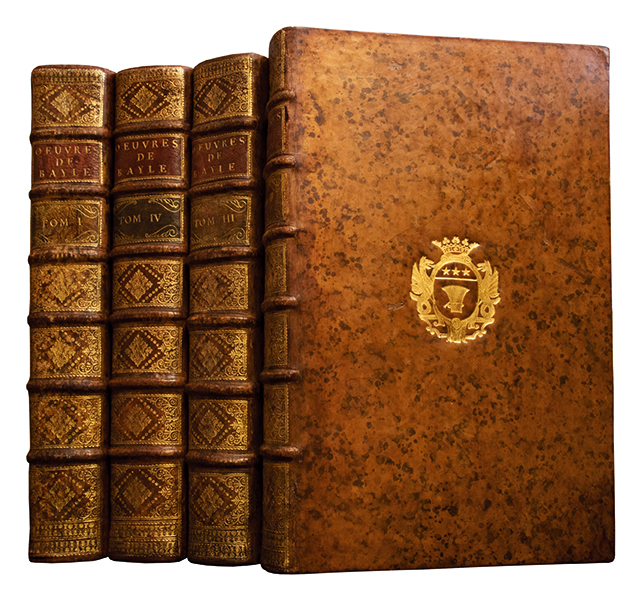
5 tomes en 4 volumes in-folio (391 x 250 mm), plein veau blond marbré de l’époque, dos à 6 nerfs guillochés or, ornés de caissons richement fleuronnés et cloisonnés, armes dorées au centre des plats, pièces de titre et de tomaison de veau havane et blond, coiffes et coupes filetées or, tranches rouges. Edition la plus complète des oeuvres collectives de Pierre Bayle, donnée par Pierre Desmaizeaux, proche protégé de l'auteur. "Edition qui doit être préférée à celle de 1727-31, parce qu'elle contient, de plus que la première, cent cinquante lettres à sa famille, formant un cahier de 211 pages qui est placé à la fin du premier volume" (Brunet). "Ce recueil contient tous les ouvrages publiés de Bayle, hors le dictionnaire. Il comprend aussi tout ce qui avait été imprimé de la correspondance" (Delvolve, 'Pierre Bayle…', Bibliographie, p. 436). Selon le catalogue de la BnF, qui se fonde sur le matériel typographique, cette édition aurait été imprimée en France, probablement à Trévoux. Vignette de titre allégorique gravée par Frederik Ottens, d'après Bernard Picard. Table des matières en tête de chaque volume et table des matières de l'ensemble en fin du volume IV. Le premier volume renferme plusieurs gravures sur bois dans le texte et 3 planches hors texte sur cuivre (pages 518, 578 [placé face 584] et 600). Le volume III est divisé en deux parties sous page de faux-titre, titre particulier et pagination continue. Le volume IV renferme plusieurs illustrations sur bois dans le texte dont trois grandes représentations des systèmes planétaires de Ptolémée (p. 394), de Ticho-Brahé (p. 398) et Copernic (p. 401). Quelques rousseurs et petites auréoles éparses. Quelques traces de restauration à la reliure. Très bel exemplaire en veau blond de l'époque aux armes de Jean-Claude Fauconnet de Vildé (1694–1765) dorées sur les plats (aux volumes II, II et IV). Ecuyer, conseiller du roi et de la Ville de Paris, il devint avocat à la cour et au Parlement (Catalogue des livres de feu M. Fauconnet de Vilde, Paris, de Bure le jeune, 1765, p. 24). (Guigard, II, 210. OHR, pl. 1654).
3 volumes in-8, demi-basane de l'époque, étiquettes de bibliothèque, (4), cviij, 294 p.; (4), 334 p. et (4), iv, 336 p. Première et unique édition posthume des oeuvres du fils de Madame de Staël et petit fils de Necker. Le premier volume est précédé d'une biographie de l'auteur par sa soeur Albertine de Staël-Holstein, duchesse de Broglie. Il contient différentes pièces, dont celles qui accompagnèrent sa candidature à la Chambre, ses notices et préfaces aux éditions des oeuvres de Madame de Staël, plusieurs pièces de "propagande protestante" et ses interventions, pétitions et documents visant à l’abolition de l'esclavage accompagnés de gravures dans le texte (vue de navire négrier en coupe, chaines et garrots). Le deuxième volume contient la "Notice sur Necker"; le troisième les "Lettres sur l'Angleterre". (France littéraire, IX, 254-255. Dictionnaire historique et biographique de la Suisse, VI, p. 312).
1737réf. 380705 tomes en 4 volumes in-folio (391 x 250 mm), plein veau blond marbré de l’époque, dos à 6 nerfs guillochés or, ornés de caissons richement fleuronnés et cloisonnés, armes dorées au centre des plats, pièces de titre et de tomaison de veau havane et blond, coiffes et coupes filetées or, tranches rouges. A La Haye, par la Compagnie des Libraires [i.e. en France], 1737.