1 941 résultats
1791réf. 24509Paris MERCURE DE FRANCE 1791 -in-12 broché un journal (original d'époque), broché bleu-gris in-douze Editeur (paperback duodecimo editor)(19 x 11,5 cm), dos muet, couverture imprimée en noir, brochure d'origine non rognée, texte imprimé sur papier velin, ligné et filigrané, sans illustrations (no illustration), pagination (18ff. chiffrées de la page 49 à la page 84 et 36 ff. chiffrées de la page 73 à la page 144), Journal du samedi 8 Octobre 1791 (n°41) Paris MERCURE DE FRANCE Editeur,
réf. 209602S.l.n.d. (1813) in-8, [2] pp. n. ch., couvertes d'une écriture fine et lisible (environ 30 lignes par page), en feuille.
réf. 209634Mitau, 25 avril 1808 in-4, [4] ff. n. ch., couverts d'une écriture fine et très lisible (environ 35/40 lignes par page), quelques ratures et biffures, en feuilles.
réf. 204663S.l., 28 octobre 1796 in-folio, [6] ff. n. ch., couverts d'une écriture fine et très lisible (environ 40 lignes par page), en feuilles.
réf. 209603S.l.n.d. petit in-4, [4] pp. n. ch., couvertes d'une écriture moyenne et lisible (environ 25 lignes par page), nombreux passages surlignés, en feuille.
réf. 209601S.l., 20 janvier 1813 in-folio, [3] ff. n. ch., couverts d'une écriture fine et lisible (environ 50 lignes par page), en feuilles.
réf. 240754Paris, Ponthieu, 1824 in-8, [4]-XII-172 pp., broché sous couverture rose imprimée.
réf. 235667Commune-affranchie [Lyon], Destefanis, an II (1794) in-12, 128 pp., veau fauve raciné, dos lisse orné de filets, guirlandes et fleurons dorés, pièce de titre noire, tranches marbrées (reliure de la Restauration).
réf. 206984S.l., s.d. (août 1795) placard grand in-folio de 55 x 42 cm, texte sur trois colonnes. Petite déchirure en haut du placard.
réf. 225678Paris, Fournier, 1843 in-8, XV-322 pp., demi-basane bleue, dos lisse orné de filets dorés (reliure de l'époque). Dos passé. et légèrement frotté. Coins usés. Rousseurs. Dans le premier ouvrage, les pages 81 à 96 ont été insérées après la page 64.
réf. 198217Jersey, aux frais des catholiques réfugiés, la 3e année de la persécution, 1791 in-8, 62 pp., en feuilles, cousu.
réf. 236382Paris, au bureau d'agence littéraire, s.d. (1792) in-8, 24 pp., broché sous couverture moderne de papier bleu imprimé. Atteintes de vers.
réf. 204137Paris, De l'Impr. des 83 départements, 1792 in-8, 29 pp., dérelié.
réf. 219540Paris, Imprimerie nationale, An II in-8, 78 pp., un feuillet replié et 47 pp., demi-percaline bleue (reliure postérieure). Quelques taches.
réf. 205044Paris, Impr. de Potier de Lille, rue Favart, 1792 in-12, 3 pp., en feuilles.
réf. 207426Paris, Imprimerie Nationale, 1792 , 24 pp., dérelié. Taches.
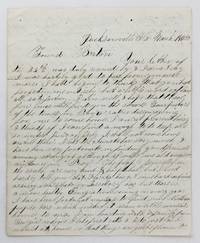
1858réf. 4106Jacksonville Fl: March 15 1858. Very good plus. 4pp. on a single folded sheet. Old mailing folds. An informative dispatch from antebellum Florida from A.C Scranton to "Friend Barton" in 1858. In his letter Scranton reports that despite some problems he is enjoying southern people and general life in Florida: "The people generally in the south are very kind & hospitibal but I need hardly to tell you that Florida has got some hard times as every new state or Territory has but thare is a more healthy Emigration coming in every year I have been fortunate anough to find some Northern people here which makes it seam a little more like home to me. I am boarding with a family from Georgia whome I like first rate & I do just as I would at home so that things are quite pleasant here considering I am amongst strangers." He then provides information on Jacksonville and then two disasters that hit his adopted hometown: "Jacksonville is the largest place in Florida & had at one time about 3000 inhabitants it is not as large as it was once some three years ago it was visited by a very destructive fire & burned nearly half of the town. Last summer there was some kind of Fever here that almost prostrated the place some called it the Yellow Fever & some the African but none could tell for certin.about a hundred & fifteen or twenty that died here in 3 months & a grate many left the town nearly all the stors wer closed not a sound of a hammer was to be heard. When cold weather came it stoped the sickness and it seams quite lively now. It has been for many years a grate resort in the winter season for invaleds but on account of the sickness last summer thare are but few this winter if it continus healthy this summer the place will revive but if not it will kill it entirely." Scranton also discusses the transportation system that served Jacksonville and the recent winding down of the Seminole Wars: "It is situated on the Johns River about 23 miles from the mouth and is connected with Charleston & Savana by a regular line of steamers that runs up the river a hundred miles to a place called Platka whare Emigrants land & then travel by land to the interior to settle the country thare is a railroad building from this place to Tallahasse the capital of the state a distance of a hundred & eighty miles which wen completed will be a little help to this place. There is also another in progress from Fernandina a new town that lays in the North East corner of the state to a place called cedar keys on the gulf side whare they intend to carry the US mail direct from New Orleans to New York insted of going round by Key west & will shorten the time considerable. Florida has cost Uncle Sam a large some of money.the government.will make a treaty with them & send them into the Indian Territory & then close the Indian war in Florida." Almost all of the Seminoles remaining in Florida relocated to Indian Territory in the year this letter was written. A wonderfully-detailed firsthand account of Jacksonville and its development and challenges during the late 1850s. A printed transcription accompanies the letter. March 15 unknown books
1858réf. 4106Jacksonville Fl: March 15 1858. Very good plus. 4pp. on a single folded sheet. Old mailing folds. An informative dispatch from antebellum Florida from A.C Scranton to "Friend Barton" in 1858. In his letter Scranton reports that despite some problems he is enjoying southern people and general life in Florida: "The people generally in the south are very kind & hospitibal but I need hardly to tell you that Florida has got some hard times as every new state or Territory has but thare is a more healthy Emigration coming in every year I have been fortunate anough to find some Northern people here which makes it seam a little more like home to me. I am boarding with a family from Georgia whome I like first rate & I do just as I would at home so that things are quite pleasant here considering I am amongst strangers." He then provides information on Jacksonville and then two disasters that hit his adopted hometown: "Jacksonville is the largest place in Florida & had at one time about 3000 inhabitants it is not as large as it was once some three years ago it was visited by a very destructive fire & burned nearly half of the town. Last summer there was some kind of Fever here that almost prostrated the place some called it the Yellow Fever & some the African but none could tell for certin.about a hundred & fifteen or twenty that died here in 3 months & a grate many left the town nearly all the stors wer closed not a sound of a hammer was to be heard. When cold weather came it stoped the sickness and it seams quite lively now. It has been for many years a grate resort in the winter season for invaleds but on account of the sickness last summer thare are but few this winter if it continus healthy this summer the place will revive but if not it will kill it entirely." Scranton also discusses the transportation system that served Jacksonville and the recent winding down of the Seminole Wars: "It is situated on the Johns River about 23 miles from the mouth and is connected with Charleston & Savana by a regular line of steamers that runs up the river a hundred miles to a place called Platka whare Emigrants land & then travel by land to the interior to settle the country thare is a railroad building from this place to Tallahasse the capital of the state a distance of a hundred & eighty miles which wen completed will be a little help to this place. There is also another in progress from Fernandina a new town that lays in the North East corner of the state to a place called cedar keys on the gulf side whare they intend to carry the US mail direct from New Orleans to New York insted of going round by Key west & will shorten the time considerable. Florida has cost Uncle Sam a large some of money.the government.will make a treaty with them & send them into the Indian Territory & then close the Indian war in Florida." Almost all of the Seminoles remaining in Florida relocated to Indian Territory in the year this letter was written. A wonderfully-detailed firsthand account of Jacksonville and its development and challenges during the late 1850s. A printed transcription accompanies the letter. March 15 unknown
réf. 206403S.l.n.d. (1792) in-8, 131 pp., broché sous couverture d'attente grise. Manque la page de titre. Couverture abîmée.
1863réf. 106360Pamphlet 8vo original blue printed wrappers 75 pp. Wrappers chipped torn and detached disbound some chips and tears to edges normal aging; overall in fair condition but content is complete. This pamphlet gives a very good overview of emigration in New York at the Time of the Civil War. It includes an appendix that shows where the emigrants were coming from. Not surprisingly Ireland topped the list in 1862 with 32217. Emigration from Italy was low at the time but within 20 years they would represent the largest pool of emigrants to New York. John F. Thow, books
réf. 226535Evreux, Imprimerie de J. J. L. Ancelle, 1793 in-4, 32 pp., dérelié.
réf. 201266Paris, Imprimerie nationale, s.d. in-8, 12 pp., dérelié.
réf. 203530S.l.n.d. in-8, 12 pp., en feuilles.
réf. 203531S.l.n.d. in-8, 16 pp., en feuilles.
réf. 207025Paris, Imprimerie de la Répubique, floréal an XI (mai 1803) in-8, [2] pp. n. ch., en feuille.