Bernadac (Christian)Livre Rare Book
Christian BernadacLivre Rare Book
DEPORTATION en 4 tomes + 1 tome d'illustrations et documents.
1992réf. HIS200C1121992 / Broché Editions France-Empire.

Librairie du Levant · Bayonne, France90,00 €
1 169 résultats
1993réf. 95664France Empire 1993 Complet 5 volumes. In-8 broché 24 cm sur 16. Dos marqués par les lectures. bon état d’occasion.
1995réf. 285898BBKöln, Böhlau, 1995. 3 Bde. Gr.-8°. Mit Abb., Ill., Grundr. u. Faks. a. Taf. u. graph. Darst. i. Text, sowie 10 beil., gefalt. Ktn. Zusammen 2467 S. OLwdbde. m. OPapp-Schuber. - Sehr gutes Ex.
1992réf. HIS200C1121992 / Broché Editions France-Empire.
1945réf. 181052Centre de documentation juive contemporaine Paris, Centre de documentation juive contemporaine, 1945. In-8 relié demi-basane à coins sapin. Dos à nerfs à titre doré. Receuil de lois raciales promulguées par le régime de Vichy s'appliquant en France occupée et libre, y compris l'Algérie et les colonies, entre 1940 et 1944. Couvertures conservées. Dos frotté. Rousseurs sur les deux premières pages blanches. Peu courant. Bon état.
1901réf. 11865Ottawa S.E. Dawson 1901
1853réf. GITb985Paris Imprimerie et Librairie Administratives de Paul Dupont 1853. 11 fascicules mensuels sur 12 brochés pagination continue. orné d'une grande carte dépliante. Manque le mois de septembre. Non coupé, bien complet de la carte.
réf. AMA-563Photographie de presse (Cliché A.F.P.). 17 octobre 1945. 180 x 132 mm.
2005réf. 106978P., Editions du Mémorial de la Shoah, 2005, in-folio, non paginé, 10 feuillets illustrés de reproductions photographiques de documents sur la Déportation, sous chemise cartonnée pleine toile rouge, lacets de fermeture, bon état. Rare
réf. QWA-20960Association "Les Fils et les Filles des Déportés Juifs de France" / "The Beate Klarsfeld Foiundation", 1994, pet. in-4 rel. skiv. (20 x 25), 1552 p., très nombreuses photos, fac-similés, bon état.
réf. 2573tome III editions TISERIAS , 1406 pages dans ce tome se trouve la liste des personnes arrétèes par mesure de repression dans la zone occupée(suite), la liste des personnes arrétées par mesure de repression dans les departements du Haut-Rhin , du bas Rhin et de la Moselle annéxés par le Reich , liste s de personnes arrétées par mesure de repression dans les limites du Reich et des terroirs qu'il occupe( hors France occupée et departement annexés )
1945réf. 143915- Une feuille repliée. 55 x 71 cm.
1895réf. 2361Strasbourg, Paris, Le Roux, Rétaux & Fils, 1895 1 vol. in-8 (229 x 152 mm.), XVI, 283 pp., 1 carte dépliante n/b, broché, cachet ex-libris sur le verso du faux-titre et ex-libris manuscrit sur 1ère de couverture, bon état.
1919Very Good English Paperback. Pbo. Small 4to. (26 x 19 cm). In Ottoman script. No bibliographic detail. 70 p., fully b/w ills. Extremely rare. Hegira; 1335 = Gregorian; 1919. Islâm ahalinin dûçar olduklari mezâlim hakkinda vesâika müstenid malûmât.
1919Very Good English Paperback. Demy 8vo. (21 x 14 cm). In English. 157 p. It's not reproduced edition, it's original 1919 edition. Stains on front and back cover, otherwise a good copy. Extremely rare. It's an anti-propaganda compilation about the 1915 deportation and genocide claims in its period from the treatment of the non-muslim in general in the Ottoman Empire in Tanzimat (Reform) period to the reports of proceedings at the Hintchakist and Dashnakist Congresses, printed by the National Congress of Turkey. First Edition.
2011New Greek, Modern (post 1453) Paperback. 4to. (28 x 20 cm). In Greek and Turkish. [200] p., color and b/w ills. Erotokritos: Bir Girit destani. Translation and transcription by Hakki Bilgehan. A poem of a Cretan poet of the 17th century. Vitsentzos Kornaros. Turkish translation and transcription in latin letters of the original Greek poem. 500 copies were printed.
réf. ORD-6670Du 11e jour du 2e mois de l'an second de la République Française une & indivisible. Paris. Imprimerie Exécutive du Louvre. An II. In-4 (180 x 235mm) de 3 pages imprimées, signé Vian, à la main.
réf. ORD-13959La plupart de 1792. 20 fascicules in-4 (ca 180 x 235mm) sans couvertures, comptant de 1 à 8 pages, la plupart en bon état, quelques-uns insolés ou un peu tachés. L'ensemble.
1989réf. ba62sous emboîtage remplié à 3 rabats, cartonnage pleine toile grise (26 cm X 33,8 cm) avec un dessin N&B dans l'auteur contrecollé sur le 1er plat , feuillets libres, 4 + 4 + 11 pp + 111 planches illustrées de dessins de l'auteur 106 en N&B et 5 dessins rehaussés en couleurs, les dessins représentent des scènes de vie au camp ou des portraits de déportés. Avant-propos de Marcel Paul, préface de Julien Cain.
1932réf. 114941932 broché (paperback) grand in-octavo, dos et couverture crèmes imprimés (spine and cover printed), tranches non rognées (edges no smooth), illustrations : 1 portrait en frontispice (frontispiece portrait) et fac-similés hors-texte (facsimiles full page engraving), rares et légères piqûres (rares and lights smalls points of redness marks), XV+579 pages, 1932 à Paris Librairie Bloud et Gay,
réf. 13943Paris Librairie J. Lecoffre. J. Gabalda, Editeur 1916 in 8 (22,5x14) 2 volumes brochés, 408 et 358 pages, dont importante liste nécrologique des prêtres déportés (la justice pendant la révolution). Tome I: Déportation générale à l'étranger par la loi d'exil du 26 août 1792, Tome II: déportation violente et captivité sous la Convention et le Directoire. Bon exemplaire
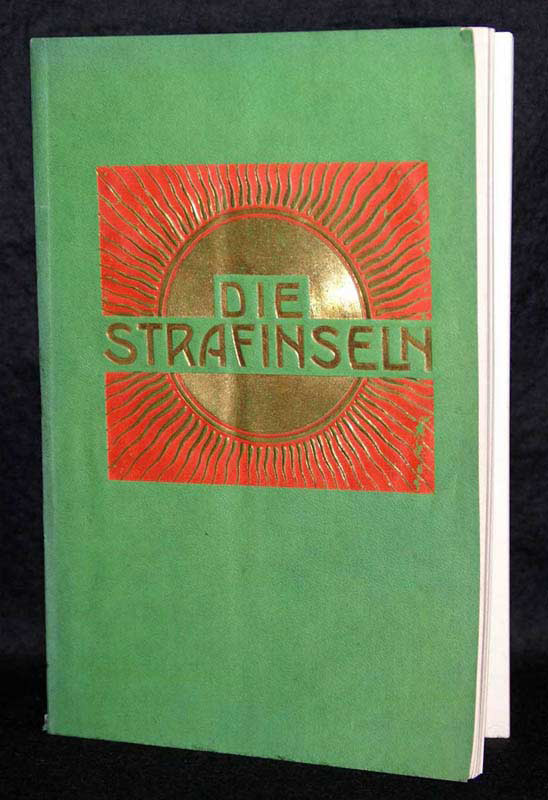
1904réf. STXG0060Stuttgart, F. Lehmann 1904. 8°. IV, 133(3) S. Grüne OBrosch. mit aufwendig eingerahmtem Deckeltitel in Rot- u. Goldpräg. Rücken mit Lichtspuren; alte Signatur auf Hinterdeckel; insgesamt schönes u. sauberes Ex. Meyer zu Hoberge S. 21ff. - Erste Ausgabe. Pamphlet des deutschen Oberlandesgerichtsrates Casimir Wagner, in dem er die Strafverschickung von Kriminellen propagiert. W. zählte zu den überzeugtesten Verfechtern der Deportation und erwog auch die Zwangsverschickung politischer Gegner. "..Haß und Furcht gegenüber verschiedenen sozial und politisch unerwünschten Gruppierungen dominieren das Werk. Sie alle wollte W. am liebsten ad hoc deportieren lassen." (Meyer zu Hoberge). Aus kolonialpolitischen Gründen schienen ihm die deutschen Pazifikinseln als künftige Strafkolonien am geeignetsten.
1933Very Good French Paperback. Demy 8vo. (21 x 14 cm). In French. 2 volumes set: (207, 22 p.; 75 p.). Commission mixte pour l'Echange des Populations Greccques et Turques. Actes, decisions, sentences arbitrales relatifs a l'Echange de Populations Grecques et Turques. 2 volumes set. Tome I. / Tome II: Annexe: Rapport final de la commission mixte. Contents: Actes signes a Lausanne (1923).; Cnvention concernant l'Echange des Populations Grecues et Turques et protocole signes le 30 Janvier 1923, le gouvernement de la Grande Assemblee NAtionale de Turque et le gouvernement Hellenique.; Protocole by Ismet, Dr. Riza Nour, Hassan.; Accord Greco-Turc relatif a la Restitution des Internes Civils et a l'Echange des Prisonniers de Guerre signe le 20 Janvier 1923.; Declaration relative aux proprietes musulmanes en Grece signee le 24 Juillet 1923. Recueil...; Accord d'Athenes.; Liste d'immeubles mentionnee a l'Art. 8 de l'accord sur les Biens signe a Athenes le 1er decembre 1926) appartenant a des ressortissants hellenes etablis a Smyrne, Mersine et Pendik et se trouvant en possession de leurs proprietaires.; et alli.; Recueil des decisions prises par la Commission Mixte depuis le 19 mars 1932 jusqu'au 9 decembre 1933, date de la signature de la derniere Convention d'Ankara.; Rapport final.
1921Very Good Turkish, Ottoman (1500-1928) Contemporary cloth bdg. with Ottoman gilt on the spine made in the Ottoman period. Original pictorial cover saved inside. Roy. 8vo. (23 x 16 cm). In Ottoman script. 256 p., b/w ills. An illustrated rare book on Misak Torlakian case in 1921. Misak Torlakian, (1889-1968), was the assassin of Behbud Khan Javanshir, Internal Affairs Minister of Azerbaijan, in 1921. Torlakian was admitted "guilty but not responsible" due to his mental condition by the British military tribunal in November 1921. Torlakian was born in 1889 in Trebizond, Ottoman Empire. Joining the Armenian Revolutionary Federation (ARF) at the age of 18, Torlakian, tasked to obtain military intelligence during World War, by then a member of a Russian Army scout unit, provided valuable information about Turkish army dispositions. was sent by the ARF to execute Behbud Khan Javanshir Azad Khanoglu, (Azerbaijani politician, diplomat, Minister of Internal Affairs of Azerbaijan Democratic Republic (ADR) and Deputy Minister of Trade and Industry), (1877-1921). Torlakian murdered Javanshir in October 1921, the British tribunal issued a guilty verdict but ruled that he was not responsible for his actions due to his epilepsy. Torlokyan left for Greece, where he was released and left for the United States. Behbud Khan Javanshir was assassinated outside the Pera Palace Hotel in Istanbul on July 18, 1921. This rare book includes several unnumbered b/w plates like a plan of the route of Behbud Khan Jawanshir from Municipality building in Tepebasi to Pera Palas Hotel, shortly before his assassination, his portrait, Torlakian's photo with his friend and others. Bookseller stamp on colophon. Slightly chipped on two pages' margins. Colophon date 1922 [1328 AH] Özege 21155.; TBTK 1149.; First Edition.
1949Very Good Armenian Original half bound leather bdg. Large demy8vo. (22 x 15,5 cm). In Armenian. 675 p. Prior to Soviet rule, the Dashnaksutiun had governed the First Republic of Armenia. The Socialist Soviet Republic of Armenia was founded in 1920. Diaspora Armenians were divided about this: supporters of the nationalist Dashnaksutiun did not support the Soviet state, while supporters of the Armenian General Benevolent Union (AGBU) were more positive about the newly founded Soviet state. From 1828 with the Treaty of Turkmenchay to the October Revolution in 1917, Eastern Armenia had been part of the Russian Empire and partly confined to the borders of the Erivan Governorate. After the October Revolution, Bolshevik leader Vladimir Lenin's government announced that minorities in the empire could pursue a course of self-determination. Following the collapse of the empire, in May 1918 Armenia, and its neighbors Azerbaijan and Georgia, declared their independence from Russian rule and each established their respective republics. After the near-annihilation of the Armenians during the Armenian Genocide and the subsequent Turkish-Armenian War, the historic Armenian area in the Ottoman Empire was overrun with despair and devastation. A number of Armenians joined the advancing 11th Soviet Red Army. Afterward, Turkey and the newly proclaimed Soviet republics in the Caucasus negotiated the Treaty of Kars, in which Turkey resigned from its claims to Batumi to Georgia in exchange for the Kars territory, corresponding to the modern-day Turkish provinces of Kars, Igdir, and Ardahan. The medieval Armenian capital of Ani, as well as the cultural icon of the Armenian people Mount Ararat, were located in the ceded area. Additionally, Joseph Stalin, then acting Commissar for Nationalities, granted the areas of Nakhchivan and Nagorno-Karabakh (both of which were promised to Armenia by the Bolsheviks in 1920) to Azerbaijan. From 12 March 1922 to 5 December 1936, Armenia was a part of the Transcaucasian SFSR (TSFSR) together with the Georgian SSR and the Azerbaijan SSR. The policies of the first Soviet Armenian government, the Revolutionary Committee (Revkom), headed by young, inexperienced, and militant communists such as Sarkis Kasyan and Avis Nurijanyan, were implemented in a highhanded manner and did not take into consideration the poor conditions of the republic and the general weariness of the people after years of conflict and civil strife. Such was the degree and scale of the requisitioning and terror imposed by the local Cheka that in February 1921 the Armenians, led by former leaders of the republic, rose up in revolt and briefly unseated the communists in Yerevan. The Red Army, which was campaigning in Georgia at the time, returned to suppress the revolt and drove its leaders out of Armenia. Convinced that these heavy-handed tactics were the source of the alienation of the native population to Soviet rule, in 1921 Moscow appointed an experienced administrator, Alexander Miasnikian, to carry out a more moderate policy and one better attuned to Armenian sensibilities. With the introduction of the New Economic Policy (NEP), Armenians began to enjoy a period of relative stability. Life under the Soviet rule proved to be a soothing balm in contrast to the turbulent final years of the Ottoman Empire. The Armenians received medicine, food, as well as other provisions from the central government and extensive literacy reforms were carried [.] Only one copy is located in OCLC: 782028953 (National Library of Israel - Jewish National Library).