5 261 résultats
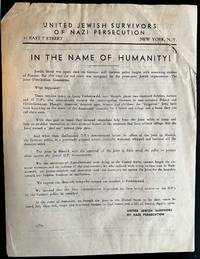
1947réf. 43409New York The Organization No Date 1947. 1st edition. Double-sided English-Yiddish leaflet 2 pages. The Yiddish header translates roughly as "An Announcement To the Jewish Public" Bilingual American Flyer condemning the Joint the American Joint Distribution Committee AJDC for not doing more to help the Jewish DPs and its "hiding" behind the German police when DP's demonstrated for more action on DP resettlement. The issuing organization the United Jewish Survivors of Nazi Persecution/Farband fun Geveyzene Yidishe Katsetler un Partizaner was the first survivor network founded in the US. Their Yiddish name translates as "The Association of Former Jewish Concentration Camp Inmates and Partisans." The word "Katsetler" in their name is a contraction of "kontsentratsyonslager-er" using the letters K and Z "ka" and "tset" and thus short for "kontsetratsyonslager" a concentration camp inmate or survivor sometimes also noted as a "katsetnik." The flyer announces: "Jewish blood was again shed on German soil! German police fought with remaining victims of Nazism. But this time the sad event was instigated by the prominent Jewish organization-The Joint Distribution Committee. What happened There remains today in Camp Foehrenwald near Munich about two thousand helpless forlorn and ill D.P's who miraculously escaped the extermination furnaces in nazi-occupied Poland and Hitler-Germany. Hungry desperate destitute men women and children the 'forgotten' Jews have been knocking at the doors of the democratic countries for a haven and refuge and a home they can call their own. With this goal in mind they demand immediate help from the Joint while in camp and help to establish themselves in their eventual homes in the countries that have offered refuge. But the Joint turned a 'deaf ear' toward their pleas. And when these disillusioned D.P.'s demonstrated before the offices of the Joint in Munich the German police in a previously planned attack critically wounded whipped and battered off the demonstrators. The Joint in Munich with the approval of the Joint in Paris asked the police to protect them against the Jewish D.P. demonstrators. We the survivors of Nazi-Germany now living in the United States cannot forget the extreme torments and the inferno of the nazi-torture; we who suffered with many victims now in Foch- renwald are horror-stricken and dismayed and our hearts cry out against the Joint for the brutality toward our helpless brethern in misfortune. We express our deep-felt sympathy toward our brothers in Foehrenwald. demand that the Joint representatives responsible for these brutal attacks on the D.P.'s by the German police be punished. In the name of humanity we beseech the Jews in the United States to let their voices be heard help these sick tragic and frustrated victims to find homes and a life of human dignity again" From the English side of the flyer. After World War II Munich served as a major center for Jewish Holocaust survivors the "Sh'erit ha-Pletah" who were living in DP camps. The "Joint" was the primary welfare organization providing aid clothing and food to these camps. While the Joint was a vital lifeline its Munich headquarters at Siebertstrasse 3 sometimes became the focal point for frustration regarding the pace of aid distribution or more frequently the slow pace of emigration to Palestine Aliyah and broader often frustrating postwar conditions. Following the 1947 Exodus ship incident where Jewish refugees were returned to Germany by the British Jewish DPs felt trapped and staged intense demonstrations including protests at the offices of international organizations like the Joint to highlight their despair. These demonstrations were part of a broader effort by survivors to assert their agency and demand rights during their time in Munich 1945-1951. For more on tensions between Munich's Jewish DPs and the Joint see www.juedisches-museum-muenchen.de/en/exhibitions/munich-displaced-online/moehlstrasse. Scholar David Slucki notes about the publishers of this leaflet that "Within months of arriving in the United States in 1946 Jewish Holocaust survivors began to organize themselves to help with the process of resettlement. The small band of socialists who established the Farband fun Geveyzene Yidishe Katsetler un Partizaner United Jewish Survivors of Nazi Persecution this group initiated a dual process of identity formation and memorialization of the Holocaust. The first survivor network founded in the United States the Katsetler Farband this group developed a memorial culture that included commemorations and publications replete with its own rituals and calendar. Moreover the organization was part of a broader process of defining what experiences constituted the Holocaust and who was to be considered a survivor. Ultimately they were among a host of survivor networks in the United States to lay the foundation for Holocaust memorialization" Slucki D. 2017. A Community of Suffering: Jewish Holocaust Survivor Networks in Postwar America. Jewish Social Studies 222 116-145. https://muse.jhu.edu/article/649094 We could locate no copies in OCLC-Worldcat Archive Grid nor using a google search. Touch of edgewear one diagonal fold paper generally bright and strong about Very Good- Condition. Holo2-163-28A. New York, The Organization, No Date unknown
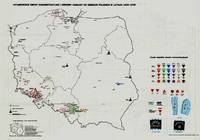
1979réf. 41929Warszawa Warsaw: Pan´stw. Wydawn. Naukowe 1979. 1st Edition. Original black printed portfolio 8vo. Portfolio of seven large folding maps on on 4 sheets of heavy paper 3 are double sided 1 is singled sided. Primarily black and white with some color. Text in Polish. Title translates to “Nazi camps in Poland 1939 - 1945. An Encyclopaedic Reference Book: Maps." Collection of 7 maps each 84 cm x 60 cm 33 x 24 inches produced by Jan Laskowski at the Main Commission for the Investigation of Nazi Crimes in Poland. The maps comprise Volume II of the work; Volume I is a heavily illustrated 676-page book of the same title which we offer separately. The Seven maps all present are: - Map 1 Single Sided: Hitlerowskie obozy na ziemiach polskich w latach 1939 - 1945. “Nazi camps in Poland in the years 1939 - 1945”. Showing: concentration and extermination camps sub-camps of concentration camps extermination centers POW camps more important sub-camps working divisions commandos and temporary POW camps penal labor camps major labor camps prisons transit camps & ghettos. - Map 2A: Getta na ziemiach polskich w okresie okupacji hitlerowskiej w latach 1939 - 1945 “Ghettos in Poland during the Nazi occupation in 1939 - 1945”. - Map 2B: Hitlerowskie obozy przejsciowe na ziemiach polskich w latach 1939 - 1945 “Nazi transit camps in Poland in 1939-1945”. - Map 3A: Hitlerowskie wiezienia i areszty na ziemiach polskich w latach 1939 - 1945 “Nazi prisons and arrests in Poland in 1939 - 1945”. - Map 3B: Hitlerowskie obozy pracy na ziemiach polskich w latach 1939 - 1945 “Nazi labor camps in Poland in the years 1939 - 1945”. - Map 4A: Hitlerowskie obozy jenieckie na ziemiach polskich w latach 1939 - 1945 “Nazi POW camps in Poland in 1939 - 1945”. - Map 4B: Hitlerowskie obozy koncentracyjne i osrodki zaglady na ziemiach polskich w latach 1939 - 1945 “Nazi concentration camps and extermination centers in Poland in 1939 - 1945”. Maps 2A & 2B have been described as a “Terrifying pair of maps showing the locations of German POW and internment camps in Poland during World War II highlighting the widespread locations of these establishments. In some parts of the map the information becomes so dense that three inset maps are shown. This map was designed by Jan Laskowski and printed in 1979 as part of a work on the Nazi extermination machine produced by PWN Warsaw a state-owned research-focused publishing house in Poland. The map on the front is particularly interesting for its depiction of symbols used to classify internees in German camps. The uppermost of these depictions shows the combinations that can be made for different types of prisoners of different levels of importance. The armbands that would have been worn by these prisoners is shown as well as the prison uniforms. Other details are also shown. The map lists hundreds of sites run by Nazi operators throughout the country. These include concentration camps death camps transitional camps and ghettos. The map is divided according to Poland's voivodeships with a key in the lower left. Names of cities too long to spell are also provided in the lower left. This map was produced during a point in Poland's history during which it was actively revisiting the period during the Second World War. Leading social scientists devoted their time to trying to gather all the living as well as the recorded history of the events of the Holocaust and related atrocities before this information vanished. Leading these efforts particularly during the 1960s and 1970s was the Glówna Komisja Scigania Zbrodni przeciwko Narodowi Polskiemu known as the Chief Commission for the Prosecution of Crimes against the Polish Nation. They were active in publishing maps both for domestic educational purposes and for international remembrance and diplomatic efforts regarding the Holocaust. Jan Laskowski was a leading cartographer who produced a number of maps in this field. These maps were produced as part of a series of maps that purported to combine to form an atlas of all of Hitler's crimes in Poland. Many of the large wall maps produced during this period could only show a fraction of the crimes or only the atrocities committed in one region. Thus a series of maps was needed to show all the points necessary which this present work contributes to. Polish Reinterpretations of the Holocaust: Studying the effects of German occupation in Poland is a delicate subject. While it is certain that Poland suffered at least as badly as any other European nation during the Second World War reinterpretations of the Holocaust in the country have also been used to satisfy nationalistic tendencies. It has become evident to Western observers in the last several years that there is a strong nationalist movement in Poland that seeks to place blame for the Holocaust solely on the shoulders of non-Polish actors a movement originally fostered under Soviet rule. This movement has gone so far as to limit freedom of speech criminalizing with a three-year sentence the suggestion that Poland or its citizens in any form participated in the murders committed by Nazis. As such the term ‘Polish concentration camps’ has been deemed unacceptable with the government-approved term being ‘concentration camps on Polish territory.’ All lines of evidence show that this map 2A & 2B was produced using the most accurate and impartial historical sources. The language on the map is simple naming only ‘Hitler's Atrocities’ and there is no evidence of a clear anti-German bias. However it is impossible to separate this map one of the most important productions of the remembrance movement during this period from the social situation in which it was produced. Maps like these can easily be converted into propaganda instruments and today's Polish leaders most of whom grew up during Soviet occupation will have formed their understanding of the Holocaust through maps like these. Soviet Censorship: While the content of the map appears to have been produced free from bias the map still had to go through Soviet censorship. Mentioning prisoner of war camps in which primarily Soviet troops were interned would have been a prerequisite condition upon which the publication of the map rested. Further the lack of mention of any Soviet killings or camps requires no explanation….The map unlike many later maps makes no differentiation between the populations who suffered at the various camps. This represents the Soviet agenda that all nations suffered fought and won equally which sought to limit divisions in this post-identity state” Ruderman 2022. SUBJECTS: World War 1939-1945 -- Prisoners and prisons German. -- Concentration camps -- Poland. Guerre mondiale 1939-1945 -- Prisonniers et prisons des Allemands. -- Camps d'internement -- Pologne. Obozy koncentracyjne -- Polska -- 1900-1945. OCLC: 830885973. Light shelf wear to portfolio as expected. All maps in pristine condition with normal folds as issued. Very Good Condition. Complete and dramatic BR5 holo2-147-19-'cc. Warszawa (Warsaw): Pan´stw. Wydawn. Naukowe unknown
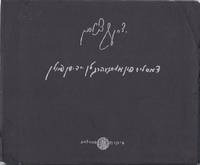
1948réf. 29513New York; YKUF 1948. Paperback. Original Wrappers. 12mo. 79 pages. 17 cm. Undated edition. In Yiddish. Includes introduction by Miriam Novitch as well as "Vi Yitshak Katsnelson hat geshribn zayne klog-lider" also by Miriam Novitsh on pages 15-16. “Song of the Murdered Jewish People" by Itzhak Katzenelson 1885–1944 a Hebrew and Yiddish poet. ”Katzenelson’s world fell apart when in August 1942 his wife Hanna and two younger sons Ben-Tsiyon and Binyamin were deported to Treblinka. From then on his literary creativity was piercingly shaped by lamentations over the loss of his family. Nonetheless with his oldest son Tsevi he found the strength to join the Jewish Fighting Organization and took part in the first uprising of January 1943. After the ghetto was destroyed in April and May 1943 he escaped to the Aryan section of Warsaw and obtained a Honduran identity document. Nevertheless he was sent to a German detention camp for foreign subjects in Vittel France. He was imprisoned there until April 1944 and devoted most of his time to writing. Two important works were produced during that period: Pinkas Vitel The Vittel Diary a Hebrew composition that uses the language of an incensed diarist and reconstructs the days of terror in Warsaw during the mass deportations; and Dos lid fun oysgehargetn yidishn folk The Poem about the Murdered Jewish People a pathos-filled Yiddish poem that laments the destruction of the Jewish people and of the poet himself who has been become bitterly angry with humankind and God. These two works are among the boldest and most lofty literary expressions to emerge from the Holocaust.… All of Katzenelson’s works from his Vittel period were either buried in hiding places or were given to people he trusted; consequently they were saved and published shortly after the end of the war. In the middle of April 1944 Katzenelson and his son Tsevi were sent to the Drancy transit camp and from there one month later to Auschwitz where they were murdered. In 1950 the Ghetto Fighters kibbutz built a museum and an institute for research about the Holocaust that bear Yitshak Katzenelson’s name” YIVO Encyclopedia. Subjects: Holocaust Jewish 1939-1945 -- Poetry. OCLC: 12260367. Half Dollar size chip to cover no text loss institutional stamp on title page taped spine otherwise Good Condition. BK5 B HOLO2-97-33-XX-ELABCC. New York; YKUF paperback
1938réf. liliOctavo paper boards 22 x 15 cm viii 132 pages; backstrip chipped paper toned and a little brittle with torn title page and occasional chipping decent condition overall. Half-tone photos throughout. A very evocative guide book to "Jewish excursions" in Frankfurt and Hessen dedicated to "My wife Bertha Lilienthal née Fuchs. My hiking companion on rocky roads." The preface is dated almost exactly a year before Kristallnacht. The author was the chief cantor at the main synagogue in Wiesbaden. He and his wife fled to Amsterdam in June 1939. He was transported to Theresienstadt in 1943 and murdered in October 1944. His wife's exact fate is unknown. J. Kauffmann, Jüdischer Buchverlag hardcover
1938réf. liliOctavo paper boards 22 x 15 cm viii 132 pages; backstrip chipped paper toned and a little brittle with torn title page and occasional chipping decent condition overall. Half-tone photos throughout. A very evocative guide book to "Jewish excursions" in Frankfurt and Hessen dedicated to "My wife Bertha Lilienthal née Fuchs. My hiking companion on rocky roads." The preface is dated almost exactly a year before Kristallnacht. The author was the chief cantor at the main synagogue in Wiesbaden. He and his wife fled to Amsterdam in June 1939. He was transported to Theresienstadt in 1943 and murdered in October 1944. His wife's exact fate is unknown. J. Kauffmann, Jüdischer Buchverlag hardcover books
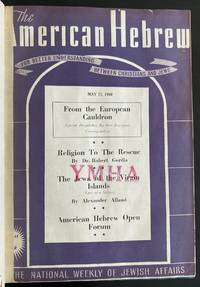
1940réf. 40003New York N. Y. : American Hebrew 1940. Hardcover. 1st edition. 4to. Period Cloth 4to Approximately 20 pages each issue approximately 520 pages total. Issues were published weekly. Holocaust-era American weekly Jewish magazine. “From the time of its founding The American Hebrew covered many topics of intense Jewish interest internationally” wikipedia. This set of magazines contain articles showing reform Jewish perspectives on WWII and the Holocaust including material about Jewish refugees “Behind the War” “Relationship Between Religion and Democracy “War Propaganda in England and Germany” as well as more mundane topics such as an essay we noted titled “Resort Guide: Another List of Ideal Vacation Spots Selected for American Hebrew Readers.” SUBJECTS: Jewish newspapers. -- United States. OCLC: 1479954. Many copies have a YMHA stamp on cover of magazine. Cloth cover has staining and dampstains pages are not affected. Spine says “American Hebrew 147 May-Nov. 1940”. Magazines in Very Good Condition. B HOLO2-140-11-X-'mmecc. New York, N. Y. : American Hebrew hardcover
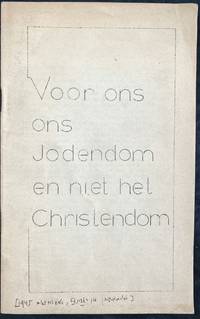
1930réf. 25194Amsterdam: Selecta 1930. Softcover 24 pages 22 cm. In Dutch. “For us Judaism—and not Christianity. ” Jewish response to attempts at conversion just prior to the Holocaust. Chief Rabbi Justus Tal 1881-1954 was "From 1918 until the outbreak of World War II.Chief Rabbi of Utrecht. During the war he was hidden from the Nazis by a Protestant clergyman. Afterwards he assumed the post in Amsterdam and was elected president of the Dutch Conference of Chief Rabbis" JTA 1954. OCLC: 64304774. OCLC lists 14 copies worldwide only 3 in the US HUC Harvard YIVO none south or west of Ohio. Light wear. Handwritten note on bottom of cover notes "edited by Chief Rabbinate of Netherlands Amsterdam 1945.” Good condition. B Holo2-162-37XXXCC-'. Amsterdam: Selecta unknown
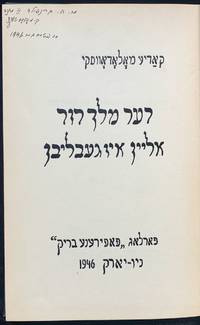
1946réf. 43238New York: Papirene Brik 1946. First edition. Original boards. 8vo 156 pages 24 cm. In Yiddish. Title appears in English as "Only King David Remained." Inscribed by Molodowsky on title page in year of publication Early post-war book of poems by Kadya Mololdowsky that is composed of poems about the Holocaust and that "draw upon traditional Jewish literary responses to catastrophe." Contains some of Molodowsky's most well regarded poems. Kadya Molodowsky was a major figure in the Yiddish literary scene in Warsaw from the 1920s through 1935 and in New York from 1935 until her death in 1975. A teacher in the Yiddish schools in Warsaw as a young woman she was best known for her children's poems. In the United States she wrote for the Yiddish press and founded and edited a journal Sviva Surroundings which she published for three decades. Living in Israel 1948-52 she founded and edited a journal Heym. She published six major books of poems 1927-1965 novels short stories plays and essays. Recurrent themes in her work include the lives of Jewish women and girls Jewish tradition in the face of modernity Israel and the Holocaust. SUBJECTS: Yiddish poetry. David King of Israel -- Poetry. David King of Israel. Poetry. OCLC: 19314664. Clean copy with book stamp from "Emil Gorovets's Library." Very Good Condition. An attractive inscribed work by a leading female Yiddish writer. YID-48-47-LEXCCM!-'gg. New York: Papirene Brik unknown
1963réf. 43253New York: YKUF 1963. Paperback. Original Wrappers. 12mo. 79 pages. 17 cm. In Yiddish. Includes introduction by Miriam Novitch as well as "Vi Yitshak Katsnelson hat geshribn zayne klog-lider" also by Miriam Novitsh on pages 15-16. “Song of the Murdered Jewish People" by Itzhak Katzenelson 1885–1944 a leading Hebrew and Yiddish poet. ”Katzenelson’s world fell apart when in August 1942 his wife Hanna and two younger sons Ben-Tsiyon and Binyamin were deported to Treblinka. From then on his literary creativity was piercingly shaped by lamentations over the loss of his family. Nonetheless with his oldest son Tsevi he found the strength to join the Jewish Fighting Organization and took part in the first uprising of January 1943. After the ghetto was destroyed in April and May 1943 he escaped to the Aryan section of Warsaw and obtained a Honduran identity document. Nevertheless he was sent to a German detention camp for foreign subjects in Vittel France. He was imprisoned there until April 1944 and devoted most of his time to writing. Two important works were produced during that period: Pinkas Vitel The Vittel Diary a Hebrew composition that uses the language of an incensed diarist and reconstructs the days of terror in Warsaw during the mass deportations; and Dos lid fun oysgehargetn yidishn folk The Poem about the Murdered Jewish People a pathos-filled Yiddish poem that laments the destruction of the Jewish people and of the poet himself who has been become bitterly angry with humankind and God. These two works are among the boldest and most lofty literary expressions to emerge from the Holocaust.… All of Katzenelson’s works from his Vittel period were either buried in hiding places or were given to people he trusted; consequently they were saved and published shortly after the end of the war. In the middle of April 1944 Katzenelson and his son Tsevi were sent to the Drancy transit camp and from there one month later to Auschwitz where they were murdered. In 1950 the Ghetto Fighters kibbutz built a museum and an institute for research about the Holocaust that bear Yitshak Katzenelson’s name” YIVO Encyclopedia. Subjects: Holocaust Jewish 1939-1945 -- Poetry. OCLC: 28824340. Some stains on covers Good Condition. B HOLO2-97-33A-XX-ELABCC. New York: YKUF paperback
1st Edition. Original Wrappers. 8vo. Tri-Fold Holocaust-era Pamphlet with 5 pages ; 24 cm. The Undersigned Rabbis Are: Philip S. Bernstein, Barnett R. Brickner, Israel Goldstein, James G. Heller, Mordecai M. Kaplan, B. L. Levinthal, Israel H. Levinthal, Louis M. Levitsky, Joshua Loth Liebman, Joseph H. Lookstein, Jacob R. Marcus, Abraham A. Neuman, Louis I. Newman, David de Sola Pool, Abba Hillel Silver, Milton Steinberg, and Stephen S. Wise. We, the undersigned Rabbis, they write, of all elements of American Jewish religious life, have noted with concern a statement by ninety of our colleagues in which they repudiate Zionism on the ground that it is inconsistent with Jewish religious and moral doctrine. This statement misrepresents Zionism and misinterprets historic Jewish religious teaching OCLC lists no holdings worldwide. Front wrapper is mostly loose. 4th and 5th page are torn with a few words affected. Otherwise in good condition. Very rare. (zion-10-57)
1950Original Wraps. Folio. 3 pages. 36 cm. First edition. Large single sided mimeographed typewritten newsletter entitled ORT Highlights. Number 54, New York, 212 Fifth Avenue, May 11, 1950; no publisher given, author, etc. Contains a list of brief articles under the following headings: A Farewell Message to Mme. Roubach, North African Jews Prepare for Emigration to Israel, ORT Leaders Interview Former French Prime Minister, Rehabilitation Center in Austria, Austrian ORT Students Present Birthday Gift to President Chaim Weizmann, ORT Schools in British Zone Germany Will Operate After July 1st, Berlin ORT School Wins Praise at Exhibition, American ORT Federation Elects New Leaders (George J. Mintzer and Julius Hochman) . Subjects: World ORT Union. Jews - Education - Periodicals. Jews - United States Periodicals. None listed on OCLC. Edges damaged and worn, with minor text loss to bottom sentences of pages 1 and 2. Otherwise clean. Good - condition. (HOLO2-113-25)
1869Original boards. 8vo. VI, 332 pages. 25 cm. First edition. Contains bookstamp of Rabbi Davin Schoenberger of Aachen (who served as chief rabbi of Aachen, Germany, from 1926 to 1938; he performed the marriage of Anne Frank's parents, as reported in his obituary in the New York Times, December 10, 1989) . In German, some Hebrew throughout. Studies in Jewish and Jewish-Arabic Religious Philosophy. ' Extensive study of medieval Jewish religious philosophy; focuses on theological discussions, Aristotelianism, Maimonides, etc. Adolf Abraham Schmiedl (18211914) , Austrian rabbi and scholar. Born at Prossnitz (Prostejov) , Moravia, Schmiedl served as rabbi in Gewitsch, Moravia (184649) ; then as Landesrabbiner at Teschen, Silesia (to 1852) and later at Bielitz (Bielsko) , Prosnitz, and Vienna. - 2008 EJ. Bound in original marbled boards. Subjects: Jewish philosophy. Philosophy, Medieval. Backstrip absent, light foxing throughout, corners of boards lightly bumped, otherwise fresh and clean. Very good condition. (GER-44-35)
19721st edition, original cloth with dust jacket, 4to, 11 pages + 754, 170 columns. Illustrations throughout. In Hebrew, with an English section. This is the story of a vanished world, the shtetel of Antopol. The material for this presentation was gathered painstakingly over a long period of time by a relatively small group of dedicated people who wished to preserve its memory and heritage for the descendants of its martyred. More than a history, this story is very personal because our parents, grandparents and great-great grandparents going back many generations came from this community. This is also a place whose many sons and daughters in years past left to seek a new and free life. Many achieved success and prominence all over the world - the United States, South Africa, Argentina, and other areas of the globe. We are the fortunate descendants of these hardy forebears and pioneers. It is hard to imagine that only a few decades ago there existed a vibrant, living community called Antopol, with its men, women and children; its market place, stores, schools. Beth medroshim (Houses of Prayer) , orphanages, Gmilas Hasodim (free loan society for the needy) , newspaper stands - all so familiar and so dear to memory. This little town was typical of hundreds of similar smaller and larger communities. And, like Atlantis, or some past people recounted in a saga, it suddenly vanished in the most bloody massacre in all of history. But this presentation is for the living - to convey to us, the she'erit or last remnant of descendants, something of the heritage, spirit and, record of the life of this community which many of us know only in an abstract and detached way. The task is too great, and our resources too limited to write the whole story. This little volume, condensed and translated into English, is both a record and a personal memorial to a profoundly meaningful and warmly nostalgic past. (foreword from the English version of this book) SUBJECT(S) : Jews -- Belarus -- Antopal. Holocaust, Jewish (1939-1945) . Ethnic relations. OCLC: 19155706. Dust jacket has some tearing and damp stains, cover corners are dented, some wear on bottom of spine, page edges slightly yellowed, internally very good. Good Condition overall. (YIZ-17-7A) xx
IN HEBREW AND YIDDISH. 1.7 kg. Contains b&w plates. 340x240 mm. 480 pages. Gilt hardcover and spine. Ex-library copy with usual marks. Few pages age stained. Binding visible between pages 120-121. Page 120 stained - no damage to text. Pages yellowing. Else in good condition. PLEASE NOTE: This item is overweight. We may ask for extra shipping costs.
19511st edition, original wrappers, 8vo. 64 pages, portraits throughout. In Yiddish with English title page. Book 3 part 1 of History of the Jews in Bialystok. SUBJECT (S) : Jews -- Poland -- Bialystok. OCLC: 970935047, OCLC lists 17 copies worldwide. Ex library with usual marks, light wear on spine and cover, Good Condition overall. (YIZ-18-12A)
19491st edition. Original Cloth, 8vo, 480 + 380 pages. In Yiddish. The chronicle of Bialystok: basic material for the history of the Jews in Bialystok until the period after the First World War. Very Good Condition(YIZ-10-1)
19491st edition. Original Cloth, 8vo, 480 + 380 pages. In Yiddish. The chronicle of Bialystok: basic material for the history of the Jews in Bialystok until the period after the First World War. OCLC: 10792576. Very Good Condition(YIZ-10-1)
19491st edition. Original Cloth, 8vo, 380 pages. In Yiddish. The chronicle of Bialystok: basic material for the history of the Jews in Bialystok until the period after the First World War. Very Good Condition(YIZ-10-1A)
19611st edition, original cloth, 4to, xix+ 288+ (2) pages. On title page: Brzezin memorial book. Illustrations throughout. Yiddish, with English introduction. There once was a town of Jewish tailors Brzezin. From early dawn until late at night one could hear the music of the Singer sewing machines. It was the music of hard work, of intense anxiety, of a hard life, but also of noisy youth, semi-intellectuals, observant Jews, Hasidim who lived and had aspirations in the small Jewish town Brzezin. The Nazi savages extinguished this life forever, transformed it into ashes. Only a few Jews from the tailoring town Brzezin, by some miracle, remain, scattered over the entire world, individuals who were witnesses to the German cannibalism. May these words, frail in print, but inscribed not with ink but with blood, be a modest contribution to the matseve [gravestone] for my native town, Brzezin. Brzezin was one of the oldest and most popular Jewish communities in Poland. When this community was established, it carried the name Krakowek [Little Krakow]. At that time, the community extended from the Strykower highway to beyond the Jewish besoylem [cemetery] to the surrounding hills. The Polish noblewoman, Anna Lasocka, had brought the first weavers from afar into this community. Then the community developed even further and began to broaden its borders. At that time, the town already carried the name Brzezin. Jewish tailors came to Brzezin from many places, and after several generations, the town developed its own type of tailoring industry, by which it was known all over the world. A cottage industry was the main occupation here. As early as 1772, Brzezin was famous for its mass production in tailoring. Until 1914 the great Czarist Russia was flooded with the inexpensive products of Brzeziner tailors. In the years between the two world wars, the export of Brzezin industry was spread over many lands in Europe and into other parts of the world. In this, the great Jewish magaziners [owners of clothing enterprises] exporters such as Frankensztejn, Tuszynski, Sulkowicz, and others played a great role. The Jews in Brzezin did not only work, they also participated actively in the socio-political and cultural life of the town, had their representatives on the town council in town hall, and had their religious and secular educational, cultural, and social organizations. Materially, it was a life of Jewish poverty, but spiritually, socially, and culturally, it was rich. (translated from book) SUBJECT(S) : Holocaust, Jewish (1939-1945) -- Poland -- Brzeziny (Lo´dz´) ; Jews. OCLC: 19306453. Light wear on cover, some wear on spine. Good Condition Overall. (YIZ-16-6A)
19671st edition. Original cloth with jacket, 4to. , 840 columns. VOLUME ONE OF TWO ONLY. Illustrated with photographs, facsimiles, folded map. In Hebrew and Yiddish. Series: Sifre zikaron li-kehilot ha-golah. SUBJECT(S) : Jews -- Poland -- Czestochowa -- History. Holocaust, Jewish (1939-1945) -- Poland -- Czestochowa. Czestochowa (Poland) -- Ethnic relations. Other Titles: Ts'enstohov; Entsiklopedyah shel galuyot. Light wear to jacket. Very good condition. (YIZ-14-8)
1st edition. No Date [1939]. Small broadsheet. 1 page. 22 cm. Single sided flyer for an Rightwing mass meeting; content of the flyer are as follows: SPEAKERS: BOAKE CARTER Radio's Fearless News Editor, on the timely subject FREE SPEECH AND THE NEWS JOHN E. KELLY Brilliant, well-posted writer and lecturer will speak on JOHN L.LEWISPUBLIC ENEMY No. 2 and others. PresidingGEORGE U. HARVEY Dynamic, Capable Borough President of Queens President of WE AMERICANS. This meetingis under the sponsorship of: American Federation Against Communism, American Patriots, The Christian Front. Tickets may be purchased from: CARNEGIE HALL, 7th St. and 7th Ave., New York, N. Y. IROQUOIS HOTEL, 49 West 44th Street, New York, N. Y. WALTER OGDEN, 413 West 59th Street, New York, N. Y. Admission 25c - 40c Reserved 99c. Arthur Derounian, on page 52 of the book Under Cover, noted the content of Kellys speech as follows: John Eoghan Kelly, Christian Front organizer and promoter of the Franco cause in America, talked on Public Enemy Number Two-John L. Lewis who, according to the inside information obtained exclusively by Kelly, had "100,000 armed Communists rarin' to Sovietize America. Who is Public Enemy Number One? I asked of the man next to me. Roosevelt. Who in hell did you think it wuz?" Also of note, is that the speaker George U. Harvey was the Republican Borough President of Queens for twelve years. The meeting of the Great Pro-American Mass Meeting in Behalf of Free Speech and Americanism, a gathering of several anti-immigrant, anti-Communist, reactionary organizations, on May 24, 1939. The crowd, turned away from their first meeting location at Carnegie Hall, hadre-congregated at the Great Northern Hotel a few doors down 57th street. Police swarmed the lobby, shouts went around to keep the newspapers out, and journalists were violently jostled aside. Among those present at this nationalistic rally were speakers for the American Patriots, Inc; the Christian Front; the American Nationalist Party (NYPL blog article Edith Wynner,Firecracker by Laura Ruttum June 13, 2008.) Subjects: Anti-Semitic Propaganda. OCLC lists 2 copies (NYPL, AJC). Previously folded; otherwise Very Goodcondition. (LB-5-2) Xx
1975Later cloth. 4to. 88 leaves. 30 cm. First edition. Fascimile. In German. On the History of the Jewish Community of Aurich, 1592-1940. Compiled photocopy booklet for a course at the IGS School in Aurich, bound in later cloth; illustrated, with several maps, family registers, and historical and legal documents. Subjects: Jews - Germany - Aurich (Lower Saxony) . OCLC lists two copies (HUC, Univ Florida) . Previous owners name on endpage, otherwise clean and fresh. Very good + condition. (HOLO2-108-34)
19831st English Language edition. 4to. Original wrappers, xxxix + 663 pages. Illustrations throughout. In English. The book by Serge Klarsfeld, contains vital statistics of some 76, 000 Jews deported from France. Together with his wife Beate, the Paris-based Serge Klarsfeld has published lists of Jews deported from France and Belgium over the last decades. He was the leading Nazi hunter in France . France was one of the more liberal nations in opening its doors to Jewish refugees from Poland, Romania, and Germany. Some 350, 000 Jews were living in France when the Germans invaded the country in June 1940. More than half of them were refugees from Germany who had arrived during the 1930s. Many were French citizens whose families had lived in France for centuries and who were fully assimilated. Others had come to France, often from Eastern Europe, to seek a better life and escape from antisemitism. Approximately 76, 000 Jews were deported from France between 1942 and 1944. Most went to Auschwitz-Birkenau, where the vast majority were exterminated on arrival. Klarsfeld's book is a most startling document. Nearly the size of the Manhattan (NYC) telephone directory, it lists nearly 76, 000 names of Jews deported to Eastern Europe or killed in France. Names are listed in alphabetical order, according to each of the 80 convoys. Family name, first name, birth date, place of birth, and nationality are recorded for every person. Klarsfeld also provides a detailed history of each convoy. (Jewishgen 2018) SUBJECT(S) : Jews -- Persecutions -- France. Holocaust, Jewish (1939-1945) -- Registers of dead -- France. World War, -- Deportations from France. Ethnic relations. Genealogy. Translation of: Le mémorial de la déportation des juifs de France. OCLC: 9685134. Small tear to margin of cover, otheriwse Very Good Condition Overall. (YIZ-16-20) xx
19351st Edition. Original Red Paper Wrappers. 8vo. 56 pages ; 24 cm. In German. Title Translates into English as, The German Aliya In Histadruth. Includes the full German text of addresses from Georg Landauer, Moscheh Brachmann, Hans Rubin, Fritz Löwenstein, and Josef Sprinzak. Sprinzak was a leading Zionist activist in the first half of the 20th century, an Israeli politician, and the first Speaker of the Knesset, a role he held from 1949 until his death in 1959. (Wikipdia, 2016) SUBJECT(S) : Jews, German -- Palestine. Histadrut. OCLC lits 5 copies worldwide (Stanford, Harvard, HUC, NLI, Univ of Haifa) , none in New York. Wrappers are worn with a few tears. Small marking on title page. Overall about very good condition. (zion-10-60A)
19601st edition, later paper wrappers, 8vo. 808 + xx columns, illustrations throughout. In Hebrew, with an English title page and introduction. We consider it important and necessary to represent a review of our Memorial-Book to the children and friends of the Goniondz Society who do not read Yiddish or Hebrew. Let all of them get an idea about the Hometown of their parents and relatives and together with them hold dear the memory of the small Jewish community, that went to martyrdom during the black period of the bestial Nazi rule. 6, 000, 000 Jews perished during the 2nd World War in Eastern and Central Europe. Many bigger and smaller towns were immortalized in memorial books. They stand out like living symbols, spiritual monuments for the coming generations. Our beloved Goniondz has surely earned such a monument. The Jewish Goniondz was very lively and interesting. The small Jewish population was very active, established many parties and clubs and gave to the world outstanding intellectuals in many fields, both Jewish and general. Citizens of Goniondz are spread out all over the world. The majority of them live in the United States and in Israel, where they have established many societies and cooperatives in the socio-philanthropic field, giving financial and moral support to needy townspeople. The Memorial-Book portrays to a great extent the manysided life of Goniondz before its destruction. (from book) SUBJECT(S) : Jews -- Poland -- Gonia? Dz. Holocaust, Jewish (1939-1945) . Ethnic relations. OCLC: 18096280, OCLC lists 29 copies worldwide. Cover is missing, outside pages have some wear and discoloration, internally very good, Good Condition overall. (YIZ-20-2)